


Request Quote
| Product | Product Code | SAFETY DATA | Technical data | |
|---|---|---|---|---|
(2N) 99% InAlGaP |
IN-ALGAP-02-C | SDS > | Data Sheet > | |
(3N) 99.9% InAlGaP |
IN-ALGAP-03-C | SDS > | Data Sheet > | |
(4N) 99.99% InAlGaP |
IN-ALGAP-04-C | SDS > | Data Sheet > | |
(5N) 99.999% InAlGaP |
IN-ALGAP-05-C | SDS > | Data Sheet > |
| Compound Formula | InAlGaP |
|---|---|
| Molecular Weight | 242.496 |
| Appearance | Solid |
| Melting Point | N/A |
| Boiling Point | N/A |
| Density | N/A |
| Solubility in H2O | N/A |
| Exact Mass | 241.784752 g/mol |
| Monoisotopic Mass | 241.784752 g/mol |
| Charge | 0 |
| Signal Word | N/A |
|---|---|
| Hazard Statements | N/A |
| Hazard Codes | N/A |
| Risk Codes | N/A |
| Safety Statements | N/A |
| Transport Information | N/A |
| Linear Formula | InAlGaP |
|---|---|
| Pubchem CID | 57507653 |
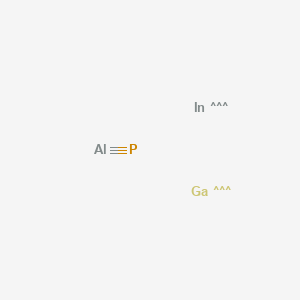
| IUPAC Name | alumanylidynephosphane; gallium; indium |
| Beilstein/Reaxys No. | |
| SMILES | [Al]#P.[Ga].[In] |
| InchI Identifier | InChI=1S/Al.Ga.In.P |
| InchI Key | JFHJAOBBUDGJMJ-UHFFFAOYSA-N |
| Chemical Formula | |
| Molecular Weight | |
| Standard InchI | |
| Appearance | |
| Melting Point | |
| Boiling Point | |
| Density |
Customer Reviews
Customers For Aluminium Gallium Indium Phosphide Have Also Viewed
Related Applications, Forms & Industries for Aluminium Gallium Indium Phosphide

Each business day American Elements' scientists & engineers post their choice for the most exciting materials science news of the day
See more Aluminum products. Aluminum (or Aluminium) (atomic symbol: Al, atomic number: 13) is a Block P, Group 13, Period 3 element with an atomic weight of 26.9815386. It is the third most abundant element in the earth's crust and the most abundant metallic element.  Aluminum's name is derived from alumina, the mineral from which Sir Humphrey Davy attempted to refine it from in 1812. Aluminum was first predicted by Antoine Lavoisier 1787 and first isolated by Hans Christian Øersted in 1825. Aluminum is a silvery gray metal that possesses many desirable characteristics. It is light, nonmagnetic and non-sparking. It stands second among metals in the scale of malleability, and sixth in ductility. It is extensively used in many industrial applications where a strong, light, easily constructed material is needed.
  Although it has only 60% of the electrical conductivity of copper, it is used in electrical transmission lines because of its light weight. Pure aluminum is soft and lacks strength, but alloyed with small amounts of copper, magnesium, silicon, manganese, or other elements, it imparts a variety of useful properties.
See more Gallium products. Gallium (atomic symbol: Ga, atomic number: 31) is a Block P, Group 13, Period 4 element with an atomic weight of 69.723.The number of electrons in each of Gallium's shells is 2, 8, 18, 3 and its electron configuration is [Ar] 3d10 4s2 4p1. The gallium atom has a radius of 122.1 pm and a Van der Waals radius of 187 pm.  Gallium was predicted by Dmitri Mendeleev in 1871. It was first discovered and isolated by Lecoq de Boisbaudran in 1875. In its elemental form, gallium has a silvery appearance.
  Gallium is one of three elements that occur naturally as a liquid at room temperature, the other two being mercury and cesium. Gallium does not exist as a free element in nature and is sourced commercially from bauxite and sphalerite. Currently, gallium is used in semiconductor devices for microelectronics and optics. The element name originates from the Latin word 'Gallia' referring to Gaul, the old name of France.
See more Indium products. Indium (atomic symbol: In, atomic number: 49) is a Block P, Group 13, Period 5 element with an atomic weight of 114.818. The number of electrons in each of indium's shells is [2, 8, 18, 18, 3] and its electron configuration is [Kr] 4d10 5s2 5p1. The indium atom has a radius of 162.6 pm and a Van der Waals radius of 193 pm. Indium was discovered by Ferdinand Reich and Hieronymous Theodor Richter in 1863.  It is a relatively rare, extremely soft metal is a lustrous silvery gray and is both malleable and easily fusible. It has similar chemical properties to
  gallium such as a low melting point and the ability to wet glass. Fields such as optics and microelectronics that utilize semiconductor technology have wide uses for indium, especially in the form of Indiun Tin Oxide (ITO). Thin films of Copper Indium Gallium Selenide (CIGS) are used in high-performing solar cells. Indium's name is derived from the Latin word indicum, meaning violet.
 See more Phosphorus products. Phosphorus (atomic symbol: P, atomic number: 15) is a Block P, Group 15, Period 3 element. The number of electrons in each of Phosphorus's shells is 2, 8, 5 and its electronic configuration is [Ne] 3s2 3p3. The phosphorus atom has a radius of 110.5.pm and its Van der Waals radius is 180.pm. Phosphorus is a highly-reactive non-metallic element (sometimes considered a metalloid) with two primary allotropes, white phosphorus and red phosphorus its black flaky appearance is similar to graphitic carbon. Compound forms of phosphorus include phosphates and phosphides. Phosphorous was first recognized as an element by Hennig Brand in 1669 its name (phosphorus mirabilis, or "bearer of light") was inspired from the brilliant glow emitted by its distillation.