Academia.eduAcademia.edu

Tetrapod Trackways From the Early Middle Devonian Period of Poland

2010, Nature

https://doi.org/10.1038/NATURE08623

Abstract
sparkles

AI

The fossil record of the earliest tetrapods is contributed by both body fossils and trackways, with the earliest trackways predating body fossils by approximately 18 million years. This research presents well-preserved tetrapod tracks from the Early Middle Devonian of Poland, which challenge existing timelines and understanding of the fish-tetrapod transition. The findings imply significant implications for the ecological and environmental contexts of this transition in evolutionary history.

Key takeaways
sparkles

AI

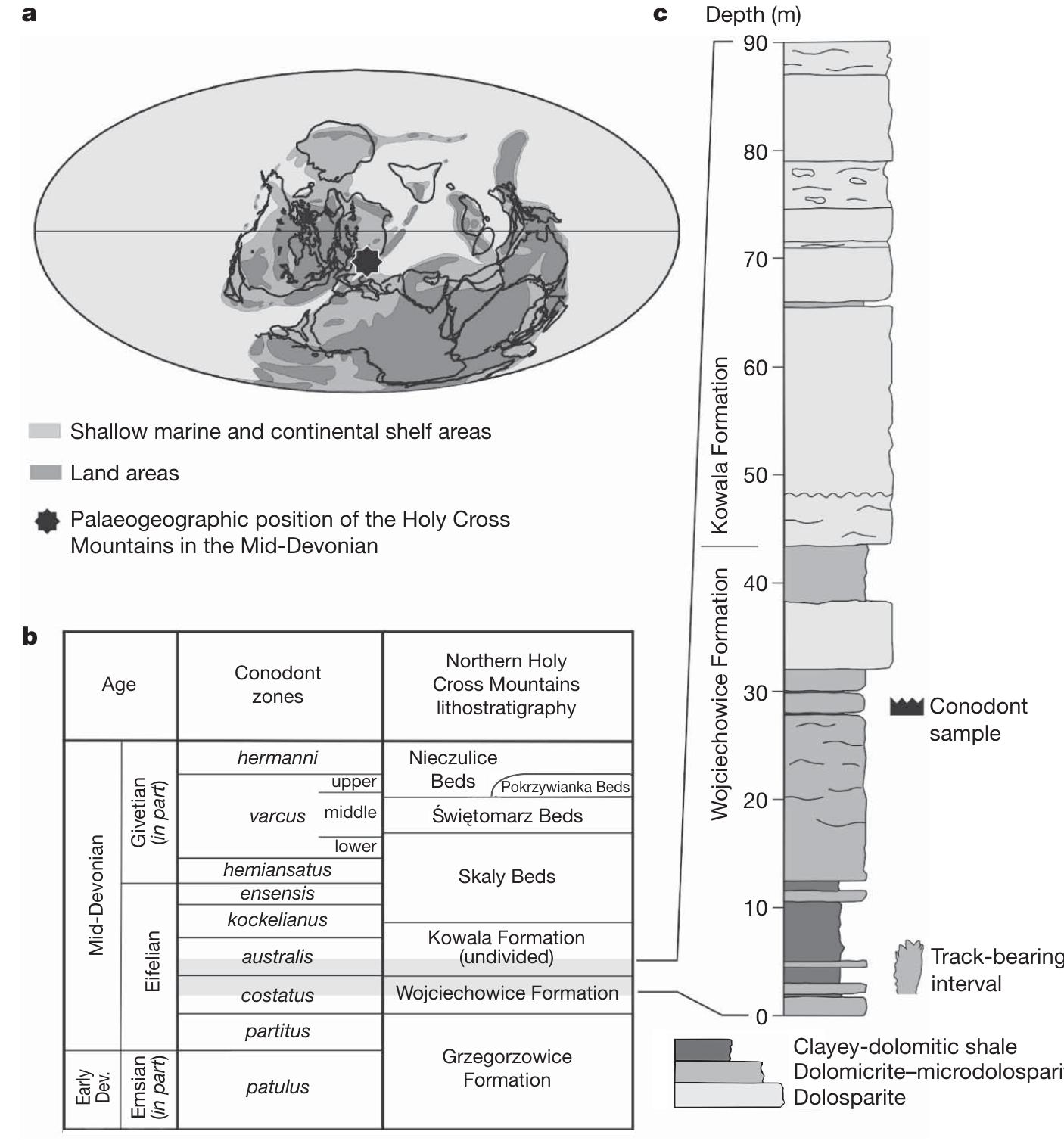
  1. The Polish trackways date to early Middle Devonian, 18 million years older than known tetrapod body fossils.
  2. Trackways challenge previous beliefs about the timing and environmental context of the fish-tetrapod transition.
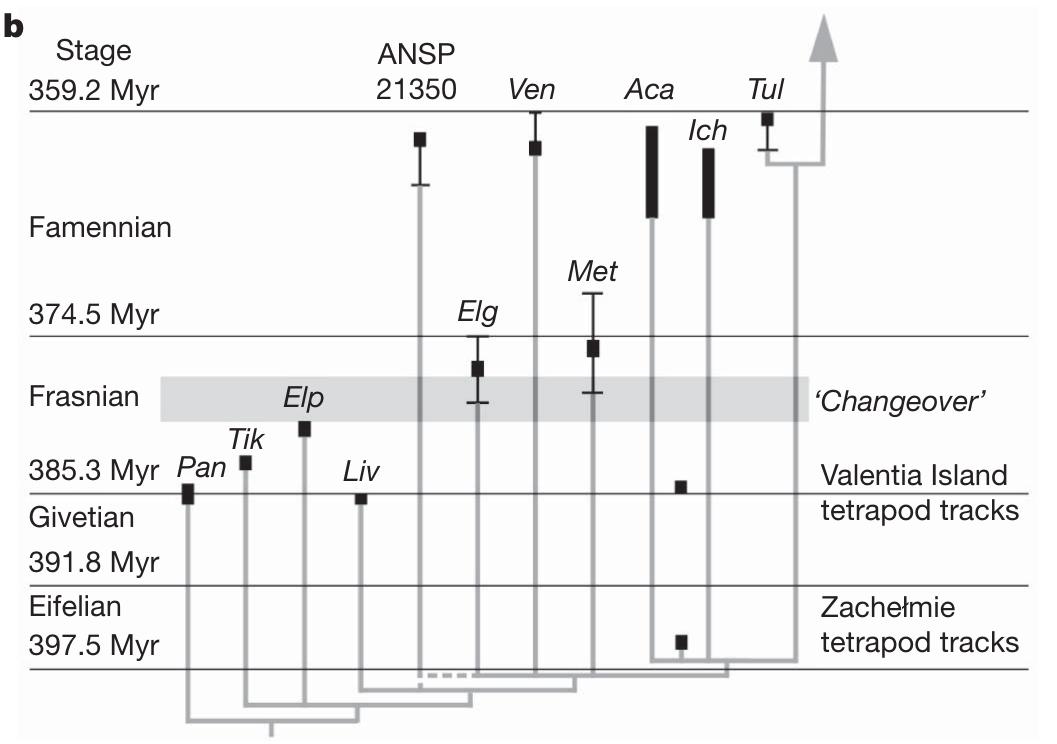
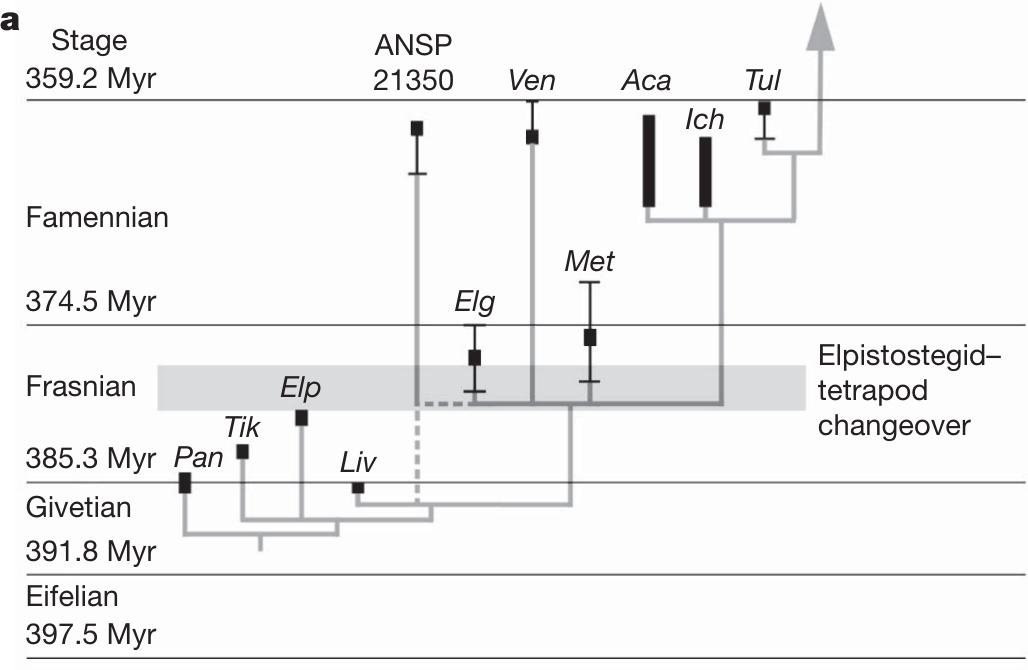
  3. Tetrapods coexisted with elpistostegids for at least 10 million years, suggesting a more complex evolutionary scenario.
  4. Eifelian trackways indicate tetrapods thrived in marine intertidal or lagoonal environments, not just freshwater.
  5. Future research should focus on intertidal deposits for further tetrapod tracks and body fossils.

References (50)

  1. Lebedev, O. A. The first find of a Devonian tetrapod in USSR. Dokl. Akad. Nauk SSSR [in Russian] 278, 1407-1413 (1984).
  2. Coates, M. I. & Clack, J. A. Polydactyly in the earliest known tetrapod limbs. Nature 347, 66-67 (1990).
  3. Ahlberg, P. E. Tetrapod or near-tetrapod fossils from the Upper Devonian of Scotland. Nature 354, 298-301 (1991).
  4. Ahlberg, P. E., Luksevics, E. & Lebedev, O. The first tetrapod finds from the Devonian (Upper Famennian) of Latvia. Phil. Trans. R. Soc. B 343, 303-328 (1994).
  5. Daeschler, E. B., Shubin, N. H., Thomson, K. S. & Amaral, W. W. A Devonian tetrapod from North America. Science 265, 639-642 (1994).
  6. Ahlberg, P. E. Elginerpeton pancheni and the earliest tetrapod clade. Nature 373, 420-425 (1995).
  7. Lebedev, O. A. & Coates, M. I. The postcranial skeleton of the Devonian tetrapod Tulerpeton curtum. Zool. J. Linn. Soc. 113, 307-348 (1995).
  8. Coates, M. I. The Devonian tetrapod Acanthostega gunnari Jarvik: postcranial anatomy, basal tetrapod interrelationships and patterns of skeletal evolution. Trans. R. Soc. Edinb. Earth Sci. 87, 363-421 (1996).
  9. Ahlberg, P. E. Postcranial stem tetrapod remains from the Devonian of Scat Craig, Morayshire, Scotland. Zool. J. Linn. Soc. 122, 99-141 (1998).
  10. Ahlberg, P. E. & Clack, J. A. Lower jaws, lower tetrapods-a review based on the Devonian genus Acanthostega. Trans. R. Soc. Edinb. Earth Sci. 89, 11-46 (1998).
  11. Daeschler, E. B. Early tetrapod jaws from the Late Devonian of Pennsylvania, USA. J. Paleontol. 74, 301-308 (2000).
  12. Ahlberg, P. E., Luksevics, E. & Mark-Kurik, E. A near-tetrapod from the Baltic Middle Devonian. Palaeontology 43, 533-548 (2000).
  13. Zhu, M., Ahlberg, P. E., Zhao, W. & Jia, L. First Devonian tetrapod from Asia. Nature 420, 760-761 (2002).
  14. Clack, J. A. et al. A uniquely specialized ear in a very early tetrapod. Nature 425, 66-69 (2003).
  15. Clement, G. et al. Devonian tetrapod from Western Europe. Nature 427, 412-413 (2004).
  16. Lebedev, O. A. A new tetrapod Jakubsonia livnensis from the Early Famennian (Devonian) of Russia and palaeoecological remarks on the Late Devonian tetrapod habitats. Acta Univ. Latviensis 679, 79-98 (2004).
  17. Shubin, N. H., Daeschler, E. B. & Coates, M. I. The early evolution of the tetrapod humerus. Science 304, 90-93 (2004).
  18. Ahlberg, P. E., Clack, J. A. & Blom, H. The axial skeleton of the Devonian tetrapod Ichthyostega. Nature 437, 137-140 (2005).
  19. Ahlberg, P. E., Clack, J. A., Luksevics, E., Blom, H. & Zupins, I. Ventastega curonica and the origin of tetrapod morphology. Nature 453, 1199-1204 (2008).
  20. Callier, V., Clack, J. A. & Ahlberg, P. E. Contrasting developmental trajectories in the earliest known tetrapod forelimbs. Science 324, 364-367 (2009).
  21. Clack, J. A. Gaining Ground: The Origin and Early Evolution of Tetrapods (Indiana Univ. Press, 2002).
  22. Schultze, H. P. & Arsenault, M. The panderichthyid fish Elpistostege: a close relative of tetrapods? Palaeontology 28, 293-309 (1985).
  23. Vorobyeva, E. I. & Schultze, H. P. in Origins of the Higher Groups of Tetrapods (eds Schultze, H. P. & Trueb, L.) 68-109 (Cornell, 1991).
  24. Vorobyeva, E. & Kuznetsov, A. in Fossil Fishes as Living Animals (ed. Mark-Kurik, E.) 131-140 (Academy of Sciences of Estonia, 1992).
  25. Vorobyeva, E. I. The shoulder girdle of Panderichthys rhombolepis (Gross) (Crossopterygii), Upper Devonian, Latvia. Geobios 19, 285-288 (1995).
  26. Boisvert, C. A. The pelvic fin and girdle of Panderichthys and the origin of tetrapod locomotion. Nature 438, 1145-1147 (2005).
  27. Brazeau, M. D. & Ahlberg, P. E. Tetrapod-like middle ear architecture in a Devonian fish. Nature 439, 318-321 (2006).
  28. Boisvert, C. A., Mark-Kurik, E. & Ahlberg, P. E. The pectoral fin of Panderichthys and the origin of digits. Nature 456, 636-638 (2008).
  29. Daeschler, E. B., Shubin, N. H. & Jenkins, F. A. A Devonian tetrapod-like fish and the evolution of the tetrapod body plan. Nature 440, 757-763 (2006).
  30. Shubin, N. H., Daeschler, E. B. & Jenkins, F. A. The pectoral fin of Tiktaalik rosae and the origin of the tetrapod limb. Nature 440, 764-771 (2006).
  31. Downs, J. P., Daeschler, E. B., Jenkins, F. A. & Shubin, N. H. The cranial endoskeleton of Tiktaalik roseae. Nature 455, 925-929 (2008).
  32. Ahlberg, P. E. & Johanson, Z. Osteolepiforms and the ancestry of tetrapods. Nature 395, 792-794 (1998).
  33. Gradstein, F., Ogg, J. & Smith, A. A Geologic Time Scale 2004. (Cambridge Univ. Press, 2004).
  34. Warren, J. W. & Wakefield, N. A. Trackways of tetrapod vertebrates from the Upper Devonian of Victoria, Australia. Nature 238, 469-470 (1972).
  35. Warren, A. A., Jupp, R. & Bolton, B. Earliest tetrapod trackway. Alcheringa 10, 183-186 (1986).
  36. Sto ¨ssel, I. The discovery of a new Devonian tetrapod trackway in SW Ireland. J. Geol. Soc. 152, 407-413 (1995).
  37. Clack, J. A. Devonian tetrapod trackways and trackmakers; a review of the fossils and footprints. Palaeogeogr. Palaeoclimatol. Palaeoecol. 130, 227-250 (1997).
  38. Gourmanis, C., Webb, J. A. & Warren, A. A. Fluviodeltaic sedimentology and ichnology of part of the Silurian Grampians Group, western Victoria. Aust. J. Earth Sci. 50, 811-825 (2003).
  39. Williams, E. A., Sergeev, S. A., Sto ¨ssel, I. & Ford, M. An Eifelian U-Pb zircon date for the Enagh Tuff Bed from the Old Red Sandstone of the Munster Basin in NW Iveragh, SW Ireland. J. Geol. Soc. 154, 189-193 (1997).
  40. Turnau, E. & Racki, G. Givetian palynostratigraphy and palynofacies: new data from the Bodzentyn Syncline (Holy Cross Mountains, central Poland). Rev. Palaeobot. Palynol. 106, 237-271 (1999).
  41. Szulczewski, M. Depositional evolution of the Holy Cross Mts. (Poland) in the Devonian and Carboniferous-a review. Geol. Q. 39, 471-488 (1995).
  42. Narkiewicz, K. & Narkiewicz, M. Mid Devonian carbonate platform development in the Holy Cross Mts. area (central Poland): new constraints from the conodont Bipennatus fauna. N. J. Geol. Pala ¨ontol. (in the press).
  43. Pajchlowa, M. The Devonian in the Grzegorzowice-Skały Profile. Biuletyn Instytutu Geologicznego [in Polish] 122, 145-254 (1957).
  44. Adamczak, F. Middle Devonian Podocopida (Ostracoda) from Poland; their mor- phology, systematics and occurrence. Senckenbergiana lethaea 57, 265-467 (1976).
  45. Malec, J. & Turnau, E. Middle Devonian conodont, ostracod and miospore stratigraphy of the Grzegorzowice-Skały section, Holy Cross Mountains, Poland. Bull. Pol. Acad. Sci. Earth Sci. 45, 67-86 (1997).
  46. Zhu, M. et al. The oldest articulated osteichthyan reveals mosaic gnathostome characters. Nature 458, 469-474 (2009).
  47. Markey, M. J. & Marshall, C. R. Terrestrial-style feeding in a very early aquatic tetrapod is supported by evidence from experimental analysis of suture morphology. Proc. Natl Acad. Sci. USA 104, 7134-7138 (2007).
  48. Kurss, V. in Fossil Fishes as Living Animals (ed. Mark-Kurik, E.) 251-260 (Academy of Sciences of Estonia, 1992).
  49. Trewin, N. H. Palaeoecology and sedimentology of the Achanarras fish bed of the Middle Old Red Sandstone, Scotland. Trans. R. Soc. Edinb. Earth Sci. 77, 21-46 (1986).
  50. Scotese, C. R. PALEOMAP AEhttp://www.scotese.comae (2002).

FAQs

sparkles

AI

What new evidence supports tetrapod tracks preceding body fossils?add

The study presents well-preserved tetrapod tracks from the early Middle Devonian, around 395 million years ago, predating existing tetrapod body fossils by 18 million years.

How does the age of Polish tetrapod tracks affect previous assumptions?add

The findings necessitate a reassessment of the fish-tetrapod transition timeline, suggesting tetrapods originated significantly earlier than previously indicated.

What ecological settings are relevant to the early tetrapod emergence?add

The data suggests early tetrapods thrived in intertidal and lagoonal environments rather than densely vegetated areas, indicating a marine origin.

How does track morphology inform our understanding of early tetrapod locomotion?add

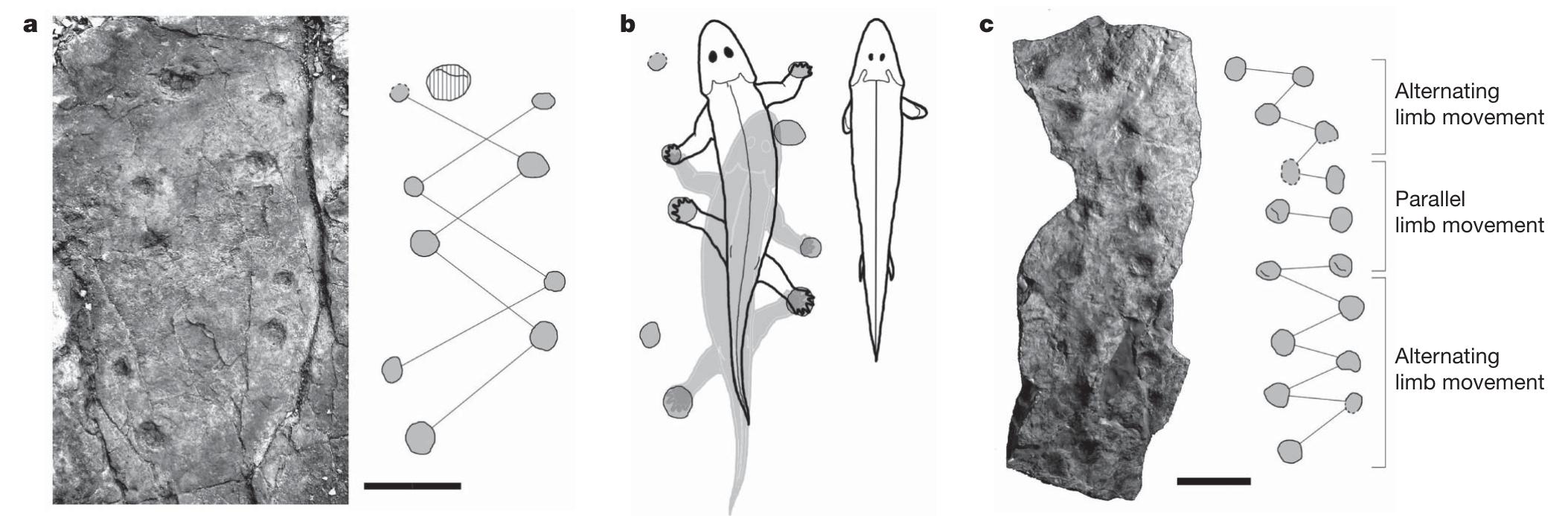
Distinct footprints and stride patterns indicate that early tetrapods, approximately 40-50 cm in length, exhibited lateral limb movement typical of terrestrial locomotion.

What are the implications of the long ghost lineages for elpistostegids and tetrapods?add

The research suggests elpistostegids and tetrapods coexisted for at least 10 million years, indicating that elpistostegidr morphologies were stable rather than transient.

About the author
Uppsala University, Faculty Member
Papers
203
Followers
612
View all papers from Per Ahlbergarrow_forward