Please remember that WiKirby contains spoilers, which you read at your own risk! See our general disclaimer for details.

Kid Kirby
| Kid Kirby | |
|---|---|
 Promotional artwork for Kid Kirby. | |
| Details | |
| Developer(s) | DMA Design |
| Platform(s) | Super Nintendo Entertainment System |
Kid Kirby was a Kirby series game that was once planned to be released on the Super Nintendo Entertainment System. The game would have supported the SNES Mouse, and featured its own colorful unique 3D art style in addition to 2D graphics. Kid Kirby was developed by Scotland-based DMA Design Ltd., which eventually became Rockstar North, a third-party development company known for their work on the Grand Theft Auto series of games.
Overview[edit]
The earliest mention ever of Kid Kirby was dated from 1994 to 1995, where it was said to be in development around the time Lemmings 3 was developed. According to ex-DMA Design developer "Mike Dailly", Nintendo was "fed up with the game" and cancelled it due to prolonged development times.[1] The poor sales of the Super NES Mouse and the inability of the game to be played well with a regular SNES controller were additional reasons that led to the cancellation of the game.[2] The game was covered by Club Nintendo Mexico in the July 1995 issue, which also included promotional artwork for the game including the logo.[3] Ex-DMA "Mike Dailly" has also claimed to have a copy of a playable demo build of Kid Kirby, however it was lost.[1]
The storyline of Kid Kirby, as told from the perspective of an older Kirby, starred a younger version of himself, who was featured in a more-purple hue with one strand of curly hair. The story would have played out in a similar fashion to Kirby's Adventure, where the Star Rod was stolen once again from the Fountain of Dreams and Kirby had to go and retrieve it.[4] Familiar characters such as King Dedede (now named "Prince Dedede", as he was not quite a king just yet) and Bronto Burt were set to appear in the game. In addition, some new enemies designed for the game were a walking fire-like enemy and an unknown octopus-inspired creature. For the game's front-end interface, while developers initially considered a 3D rotating map, a photo album layout was eventually chosen instead to tie in further with the game's subject focusing on Kirby's past memories.[5]
A tweet by 8-4 co-founder John Ricciardi revealed that tie-in promotional merchandise was supposed to be released in October of an unspecified year to promote Kid Kirby. This included a promotional wall poster as well as a pillow mobile depicting artwork of young Kirby.[6]
Gameplay[edit]
Kid Kirby currently has no surviving footage, so not much could be demonstrated regarding its gameplay. However, it was described by programmer James Watson (also known as "DudleySoft") that players would control a hand-shaped cursor using the SNES Mouse, mainly to click, drag, and release Kirby to launch him in a set trajectory. Kirby's launch path would also be determined with guide lines, similar to those used in Kirby's Dream Course. Additional controls would have included slapping Kirby upwards three times and slamming him downwards when he was in midair. Kirby would've been also able to activate "powerups", which morph him into different forms like a paper airplane or a rock.[4]
120 stages were set to be featured in the game, including 60 stages that were part of the game's Story Mode, and the other 60 being secret stages which could be accessed by a hidden door (possibly inside a bell) in the regular stages. In these stages, Kirby could collect stars while reaching the hoop at the end which marked the stage's goal.[4] "Mike Dailly" also revealed that the stages were set to feature assorted themes like a forest, cavern, laboratory, and even a castle.[7]
Kid Kirby would have also featured a 2-player split-screen race mode where two players would compete to see who could reach the exit of the level first.[4]
Trivia[edit]

- A hoax spread online claimed that Hard Hat from Donkey Kong Land was originally designed for and meant to appear in Kid Kirby. This confusion initially stemmed off from a website named Unseen64, which has a page for the game that originally hosted the images for various rendered artwork of Kid Kirby characters and Hard Hat.[8] Since 2021, these images have been removed from the website.
- In particular, the rendered artwork has been originally sourced from a 2012 auction for an official Nintendo-themed binder that dates back to 1995, with the only surviving image featuring Bronto Burt and Hard Hat's artworks on the same cover together.
- This particular piece of Hard Hat artwork appears in higher quality in the preview page for Donkey Kong Land from Volume 69 of Nintendo Power, confirming that the artwork belongs to said game itself and not Kid Kirby.
- According to ex-DMA "Mike Dailly", Kid Kirby's internal name was "Jelly".[7]
- Had it been released as intended, Kid Kirby would become the first Kirby game to be developed by a non-Japanese video game development company.
- A possible method of 100% completion was to get everything on each level to add 1% to the completion counter. There were 120 levels in the game, which would mean 120% completion would be possible.[4]
Gallery[edit]
Official artwork[edit]
-
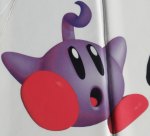 Artwork of young Kirby
 -
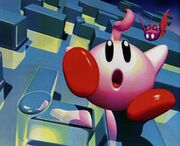 Artwork of young Kirby within a level setting
 -
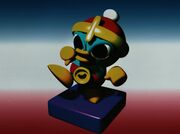 Artwork of Prince Dedede
 -
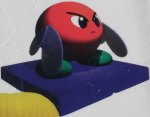 Artwork of Bronto Burt
 -
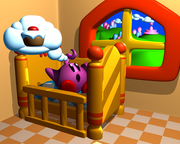 A shocked young Kirby in bed dreaming of cake
 -
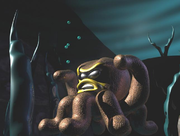 The unknown octopus-like creature
 -
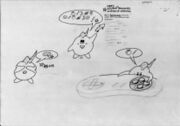 Sketches of early ideas for the game
 -
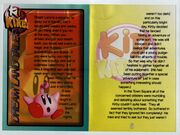 Instruction manual pages 4 and 5
 -
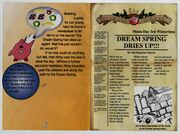 Instruction manual pages 6 and 7
 -
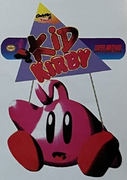 An official mock-up for a Kid Kirby-themed pillow mobile, meant as tie-in merchandise


Sprite sheets[edit]
-
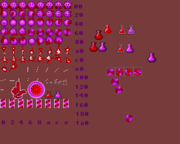 KIRBY2 - Sprite sheet depicting young Kirby's sprites, an unknown fire enemy, potion flasks, and other objects
 -
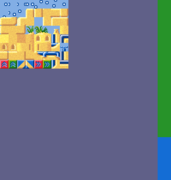 OZDA - Sprite sheet depicting a possible beach tileset
 -
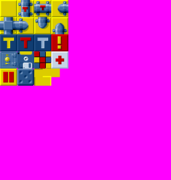 OZ2 - Sprite sheet depicting a possible technological tileset
 -
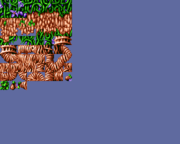 TESTBLOX - Sprite sheet depicting a possible forest/jungle tileset


Stages[edit]
-
 LEWORK4 - A factory-themed level with conveyor belts.
 -
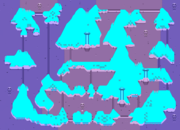 CAVE8 - A cave-themed level with water fountains.
 -
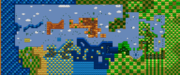 DNEW4 - A level with colorful blocks and tilesets.
 -
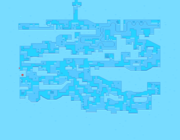 ICE4 - An ice-themed level.
 -
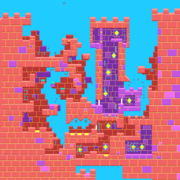 KENOUT - An unknown castle level with bright colors.
 -
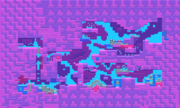 LAB1 - A purple laboratory-themed level, featuring pipes Kirby can travel in and bizarre containers.
 -
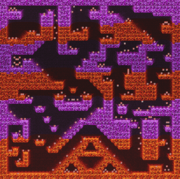 TUBE9 - A purple and orange-colored striped cave level.
 -
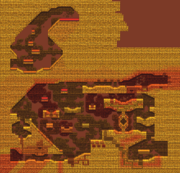 SEWER3 - A level resembling what looks like an ancient sewer system.
 -
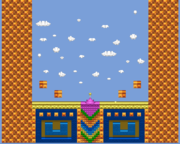 DRMBOSS - A boss battle arena located near the Fountain of Dreams.


External links[edit]
- "Mike Dailly"'s assets reveal on Flickr (archived)
- Kid Kirby on Unseen64
- Kid Kirby on Kirbytraum (German fansite)
- Intro storyline concept for Kid Kirby (PDF), shared by Steve Hammond
References
- ↑ 1.0 1.1 Twitter PM with "Mike Dailly" (@mdf200) by WiKirby editor Meeper12346, on Imgur (1) (2)
- ↑ "Playing Catch Up: GTA/Lemmings' Dave Jones" on Gamasutra (Archived)
- ↑ Archived Club Nintendo Mexico July 1995 scan from Destructoid
- ↑ 4.0 4.1 4.2 4.3 4.4 Article from GiantBomb on Kid Kirby by main programmer James Watson, under the name "DudleySoft"
- ↑ Archived page from James Watson (DudleySoft)'s blog
- ↑ Tweet regarding cancelled Kid Kirby merchandise by 8-4 co-founder John Ricciardi (@johntv) (Archived on March 25, 2023)
- ↑ 7.0 7.1 "Mike Dailly"'s assets reveal on Flickr (archived)
- ↑ Archived page of Kid Kirby on Unseen64 (November 24, 2020)