
eek!
Jul. 7th, 2026 07:23 pm![[personal profile]](https://www.dreamwidth.org/img/silk/identity/user.png) chazzbanner
chazzbannerAbout an hour ago I realized I had turned the button the wrong way. Ye gads!
-
thirty pillows pilfered
Jul. 7th, 2026 07:18 pmmusesfoolI am off tomorrow for the dentist - it should just be a cleaning (though I am braced to hear I need yet another crown) but I am always so tired when it's over. And my team meeting on Tuesday got cancelled so I am tempted to take next Tuesday off since I'm already off Wednesday (my birthday), Thursday, and Friday of next week. My boss was like, sure! but I'm still thinking about it.
I thought I had something else to post about but I can't remember... oh right, I finally watched Project Hail Mary the other night. I enjoyed it but it was too long. And there was not enough Eva Stratt, who was the best thing in the movie.
*

Book Review Backlog: Part I (January to March)
Jul. 7th, 2026 03:36 pmmuccamukkThese are probably going to be brief, as my memory isn't that strong six months later.
Searching for Serafim: The Life and Legacy of Serafim "Joe" Fortes by Ruby Smith Díaz
(Local author, read before she gave a talk for Black History Month.)
Short biography and a poem about a Caribbean Black man working as a lifeguard in Vancouver, BC, in the early 20th century. The records of Serafim Fortes are pretty slight, and almost all from the perspective of white people—who treated him as a sort of mascot, and talked about how great he was despite his race—so Smith Díaz is mostly reading against the grain of the historical record, and speculating lot. I normally do not like history books that include this much speculation, however, Smith Díaz is very clear about when and why she's filling in ideas, and I think it works in this context. It introduced me to Marie-Claire Graham's concept of "speculative archiving" as a way of dealing with gaps in the record created by historical violence, which this book is more or less an example of. I appreciated that Smith Díaz did not shy away from or excuse records of Fortes behaving poorly. Very much worth a read as a local history, and as an example of navigating a fragmented and racist archive.
 Everything Is Fine Here by Iryn Tushabe, narrated by Nneka Okoye
(Canada Reads Longlist, which I wish had been on the shortlist.)
A coming of age novel about a young woman in western Uganda, who discovers that her beloved older sister is a lesbian. One's reaction to that premise might be, "Oh no!" but this novel was not a tragedy about queer bashing, though the setting and my knowledge of Ugandan politics made it a tense read.
(I also felt that my ((at this point rather hazy)) knowledge of Ugandan geography, culture and food helped me a lot, including having been in the same places described in the book. There's a lot of cultural detail and non-English terms dropped in without explanation, so remembering what most things were saved me a lot of looking stuff up.)
But most of the novel is about a teenager trying to figure out both the world and herself, in a family with a lot of internal conflict and pressures. There's a few cases of sixteen-year-olds making poor choices, but for the most part the novel offers its characters a lot of grace. It's about discovering the world can be a lot bigger than you're told it is, and offering and receiving second chances. Really loved this one.
Witch King by Martha Wells, narrated by Eric Mok(Reread before getting into the new one.)
I'm really glad I reread this, as I initially rushed through it to find out what happened, and as a result didn't remember several key plot points, which turned out to be essential to the second novel. There are a lot of moving parts!
Basically still love everyone in this band, and appreciate getting a novel about decentralising power, rather than building empires.
Queen Demon by Martha Wells, narrated by Eric MokReally enjoyed this one, also, though it ends in a more obvious cliffhanger than the first one, which stands more or less on its own.
Mostly just like the characters and enjoy spending time with them. It's again nice to see people struggling with the work of consensus building, interspersed with battle scenes, lol. I like Kai slowly coming out of his shell in the first timeline, and how much the characters have changed over the centuries between the flashbacks and present day. It really nicely both shows the long-range consequences, and builds up tension as the plots weave towards each other. Bit bummed out by some of the casualties along the way.
I hope we get the next one soon!
Flyover videos
Jul. 7th, 2026 11:19 pmnanilaWe grabbed our hats and sunglasses and went onto the roof to have a closer look.
It ended up being a very close look indeed. (I would like to point out that none of us were the ones clapping.)
This was a more comfortable view of the formation flying.
Here they are coming from t’other direction.
This continued for around 10 minutes before they all zoomed off, presumably to base for a little rest from the heat.
MOPOP Hall of Fame recognition for Bujold
Jul. 7th, 2026 02:17 pm![[syndicated profile]](https://www.dreamwidth.org/img/silk/identity/feed.png) lois_mcmaster_bujold_feed
lois_mcmaster_bujold_feedhttps://www.mopop.org/sffhof-vote-2026
If you click the plus sign next to an entry, it gives a little explanatory paragraph.
I've described career awards before as "an award for winning awards". Collect the whole set...
https://www.sfadb.com/Lois_McMaster_B...
(This database is incredibly handy, and I'm so grateful to the unsung folks who put it together. It has much to offer beyond Bujold, I should point out.)
Ta, L.
posted by Lois McMaster Bujold on July, 07
fic: sail your sea, meet your storm (shetland)
Jul. 7th, 2026 08:53 pmusuallyhatssail your sea, meet your storm (2380 words) by usuallyhats
Chapters: 1/1
Fandom: Shetland (TV)
Rating: Teen And Up Audiences
Warnings: No Archive Warnings Apply
Relationships: Duncan Hunter/Jimmy Perez
Characters: Jimmy Perez, Duncan Hunter
Summary:
"I don't know," Duncan half shouts over the din, "I just want to be out there," and he's gone before Jimmy can say anything more. Without really considering what he's doing, Jimmy follows him out, closing the door behind him in an attempt to keep the storm outside where it belongs.
Is this the blurb writer, or does the author actually believe this?
Jul. 7th, 2026 06:13 pmoursinOxford, 1920. For the first time in its 1,000-year history, the world’s most famous university has admitted female students.
This would be rather startling to the ladies who had studied as home students, at Somerville, Lady Margaret Hall, St Hugh's and St Hilda's, before women were admitted to Oxford degrees which was what actually happened in 1920 -
- and those ladies who were still around were there to collect the degrees they were now entitled to.
I am so hoping that this is a blurb produced either by AI or by some intern at the publishers who has not actually read the book but has gathered that it is about women going to Oxford in 1920?
Because if the book is written in some apprehension that there were No Female Students among the dreaming spires before 1920 I hope the author is visited in her sleep by the shades of all, or at least some of, the women who were, who included some notoriously stroppy and acerbic characters.
This is even more egregious than the historical romance which posited a daughter of an Oxford prof at a date of obligatory celibacy for College fellows, which is a bit niche perhaps, but Women's Struggle for Education is surely well-documented???
(Come on down, Vera Brittain, The Women at Oxford: a fragment of history)
In further Did Not Do The Research, or at least have a Brit-Picker, JD Robb Stolen in Death has significant plot around theft of Important Jewels - from the Tate in London, wtf, surely you meant the V&A....
Automated Moderation Is Here to Stay
Jul. 7th, 2026 04:21 pmeff_feedThis blog post is part 1 of a 2-part series. The second part will set out recommendations for companies and policymakers.
Six years ago—one month into a global pandemic—we argued that the automated moderation processes many platforms were rapidly adopting should be highly transparent, easily appealable, and temporary. We warned that "protocols adopted in times of crisis often persist when the crisis is over."
That warning proved prescient. The use of automation and artificial intelligence (AI) to identify, flag, and moderate content has become the new norm—a permanent feature of how platforms govern speech online. In this two part series, we’re take stock of this new norm, and considering what platforms can and should do to ensure that AI serves online expression rather than stifling it.
A brief history of automated content moderation
From spam filtering and keyword blacklists to the hash-matching technologies used to identify child sexual abuse material and terrorist content, automated technologies have been used in commercial content moderation for many years. While these tools have long posed risks to freedom of expression, their use was, for quite some time, relatively limited in scope.
Then, in 2017, a blog post published by Facebook (now Meta) described the company's "fairly recent" use of artificial intelligence to identify, classify, and remove violent extremist content. At the same time, Facebook emphasized caution, noting that it did not want to suggest there was "any easy technical fix."
Just one year later, Mark Zuckerberg appeared before the U.S. Senate's Commerce and Judiciary Committees and disclosed that "99 percent of the ISIS and Al Qaida content" removed by Facebook was flagged by AI "before any human sees it." He also stated that Facebook was "developing A.I. tools that can identify certain classes of bad activity proactively and flag it for our team at Facebook." At the time, we raised concerns about the ethical implications of using AI in this manner.
Then came 2020. The sudden reduction of the human moderation workforce, combined with a dramatic increase in social media use—and with it, a surge in misinformation—created the perfect conditions for platforms to expand their reliance on AI-driven moderation. It quickly became apparent that companies'—and particularly Meta's—approach to moderation during the pandemic represented a backslide in transparency, freedom of expression, and access to remedy. The increased reliance on automation was a significant factor.
The costs and benefits of AI content moderation
We knew in 2020 that the use of AI to moderate content would present problems for online freedom of expression. Today, those problems are well-documented. A 2025 joint declaration by special rapporteurs and representatives of the United Nations (UN), Organization for Security and Co-operation in Europe (OSCE), Organization of American States (OAS), and African Commission on Human and Peoples’ Rights (ACHPR) states:
“The use of AI content moderation can lead to over-removal, discrimination and censorship. Reliance on inherently biased datasets and opaque training processes can amplify pre-existing inequalities, risking homogenisation of expression, and erasure of linguistic and cultural diversity.”
EFF and many of our allies have documented these impacts. For example, our 2019 paper co-authored with Witness and Syrian Archive examined the impact of extremist content regulations—and their implementation through automation and AI—on human rights documentation. A 2020 report from Human Rights Watch highlighted the consequences of these removals, noting: "There is no way of knowing how much potential evidence of serious crimes is disappearing without anyone's knowledge."
The Center for Democracy and Technology's recent series on content moderation in the Global South demonstrates persistent inequities in content moderation of four “low-resource” languages—so-called because the relative scarcity of training data makes it more difficult to develop equitable and accurate AI models for them.
Content moderation often disproportionately impacts vulnerable and historically marginalized groups, and AI content moderation is no different. GLAAD recognizes the role AI plays in scaling content moderation but notes that “when moderation systems lack nuance, transparency, and human oversight, they can fail to curb harassment and wrongly suppress legitimate LGBTQ content.”
These failures are not incidental. They are a predictable consequence of deploying automated systems to make complex judgments about language, culture, context, and identity at scale.
All of that said, automated content moderation can offer important benefits. The primary one: helping to spare human content moderators who must review content that varies from whimsical to horrific, often for little pay and with devastating mental health consequences. Outsourcing this work to the bots can offer some relief—though it’s worth noting that the humans hired to train the AI models face a similar dynamic.
In addition, AI models could potentially be trained over time to be more precise, accurate, and dynamic, helping to mitigate over-censorship and disinformation. The jury is still out on whether this potential will be realized; what we do know is that new approaches to the persistent problem of over and under-enforcement are desperately needed.
Automated moderation is no longer an experiment
Getting the balance between real costs and potential benefits depends a lot on the details: how automated systems are designed, trained, implemented, and audited.
Despite advances in the sophistication and scale of automated moderation systems, many of the transparency, accountability, and due process safeguards advocated by civil society, researchers, and human rights experts have yet to be fully realized. At the same time, automated systems have become increasingly central to how platforms enforce their rules and govern online speech.
The question today is not whether companies will use AI to moderate content, but under what conditions they should do so. And now as ever, the answer is not that the public should just trust that platforms’ deployment of increasingly powerful systems will serve, rather than inhibit online expression. In fact, as automated systems become more sophisticated and more deeply embedded in platform governance, the need for transparency and accountability becomes more urgent.
Spent the last two nights at the hospital with a resident
Jul. 9th, 2026 12:30 pmconulyTaking the bus back from the hospital always gets me thinking about Hurricane Sandy. They named a corner after those two boys. They'd be in high school now, or even entering college. It's easy to judge their mother - and don't get me wrong, I do judge her, because she made every possible mistake from before the storm even hit, starting with not evacuating - but people do dumb stuff all the time and it usually works out just fine. People don't usually die because they did something stupid, they don't usually lose their kids over it.
It's been rainy too. It's really just a maudlin way to start a week.
But I still think, every time I take that bus from the hospital, that those kids should've gotten to grow up, and instead they didn't even get to go trick-or-treating that year.
The moral of this post, inasmuch as there even is one, is that if your area is under an evacuation order, or ought to be, fucking evacuate. Or if you've decided to shelter in place, shelter in place. Don't try to evacuate after the storm is already upon you. That's how it all goes wrong.
Help EFF Cut the AI Hype
Jul. 7th, 2026 04:17 pmeff_feedIn the global race to build and dominate the AI industry, it can sure seem like the interests of ordinary people sit last on the agenda. It's just the opposite for EFF. While companies furiously jam AI tools into their veins and your eyeballs, EFF’s technologists, activists, and attorneys have been meticulously cutting through the hype to ensure AI can serve your privacy and free expression. Technology has leaned into a new era, and this summer you can help EFF fight for the people.
Over the next two weeks, we’re encouraging you to support the cause as an EFF member for as little as $10 each month. You can get great member swag every year like our privacy puffy stickers, Claw Back t-shirt, and Privacy Badger Crewneck.
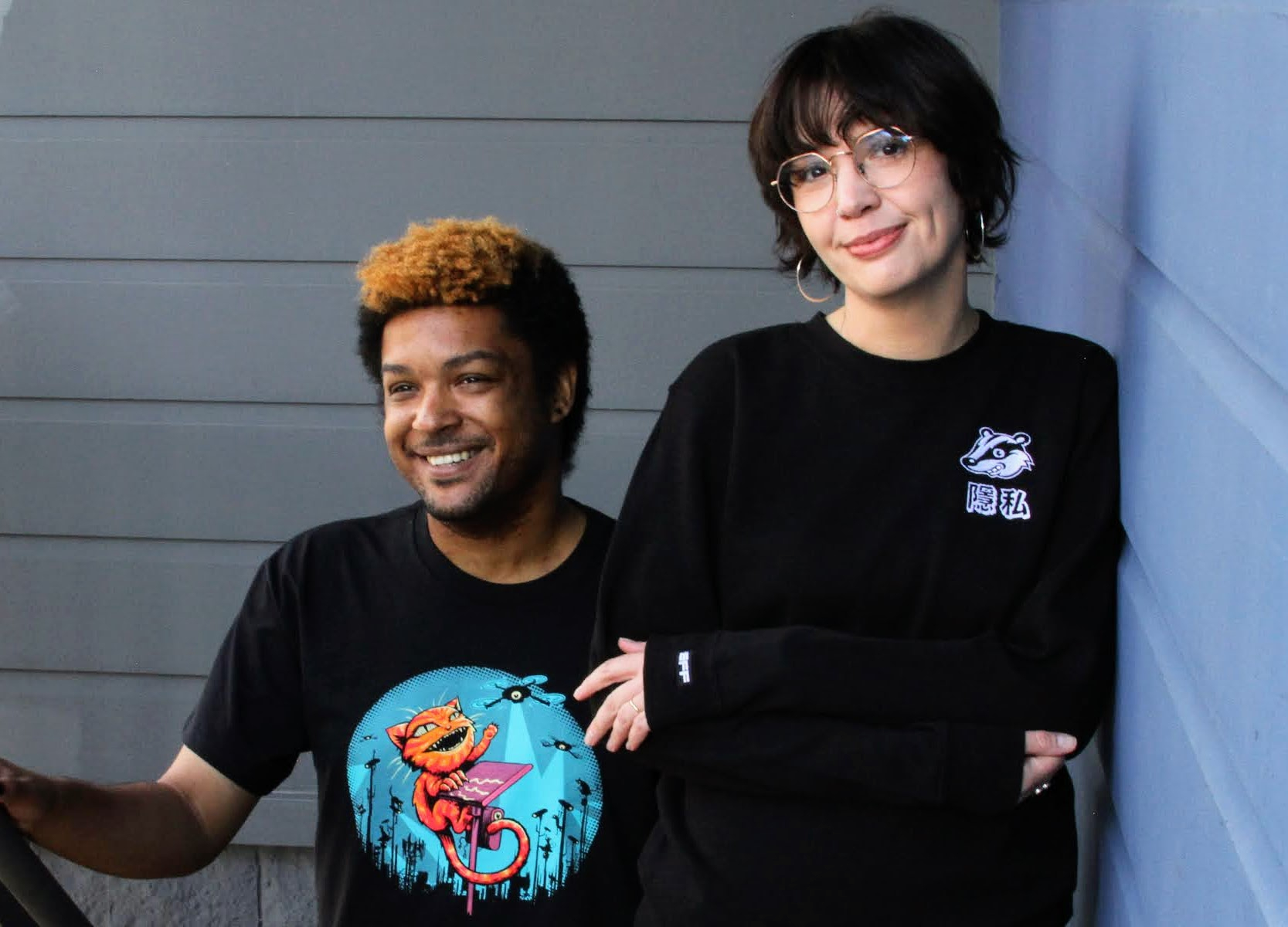
Fight mass surveillance! Pictured: Claw Back member t-shirt and Privacy Badger Crewneck.
AI tools—beyond their marketing fluff—demonstrate both incredible potential and real danger. With the support of members around the world, EFF detangles the possibilities from the anxieties and threats with the care and nuance it deserves. In recent months, EFF:
- Mobilized people against the GUARD Act, which would require problematic age verifications systems for AI companions.
- Joined civil society partners to call out a General Services Administration proposal that would make AI tools less safe and less useful.
- Sued for answers under the Freedom of Information Act to uncover how the government is using AI to evaluate requests for medical care.
- Testified before the U.S. Congress Homeland Security Subcommittee on Cybersecurity and Infrastructure Protection.
The scope of AI, both the good and the bad, multiplies every day. If we want the AI-powered benefits of efficiency, scientific discovery, and greater accessibility to knowledge, then we also need strong protections against surveillance, harms to creativity and innovation online, perpetuating systemic bias, and privacy violations now.
With AI taking over the public consciousness, you can be assured that EFF will never stop advocating for you. Together, we can ensure that technology supports freedom, justice, and innovation for all people.
____________________
EFF is a member-supported U.S. 501(c)(3) organization. We've received top ratings from the nonprofit watchdog Charity Navigator since 2013! Your donation is tax-deductible as allowed by law.
Saturday Morning Breakfast Cereal - Turing
Jul. 7th, 2026 11:20 amsmbc_comics_feed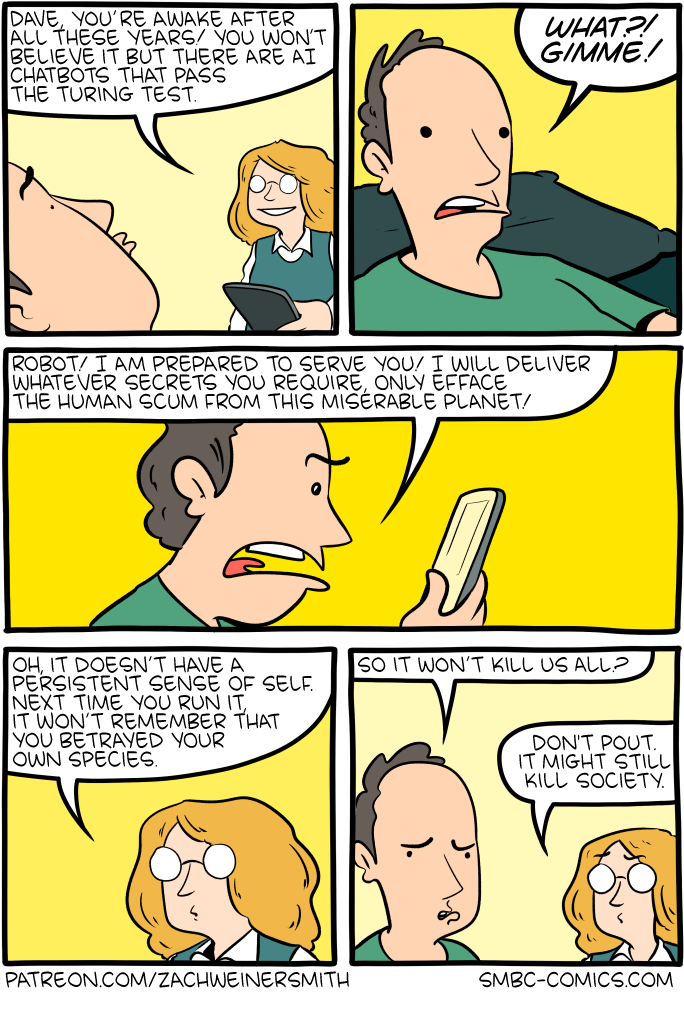
Click here to go see the bonus panel!
Hovertext:
Later they make you pay for the premium version in order to betray humanity.
Today's News:
Maintainer spotlight: Gen Li (@rami3l)
Jul. 7th, 2026 12:00 aminside_rust_feedThere are hundreds of people who maintain the Rust toolchain, often on a volunteer basis on top of another job. The Rust Content team is working on a series of blog posts highlighting some of these prolific contributors to recognize the awesome work that they are doing in order to make Rust better for everyone. You can find the previous post here. Consider donating to the Rust Foundation Maintainers Fund if you'd like to support Rust Project maintainers.
In this post, we would like to introduce Gen Li (@rami3l). Gen started contributing to Rust around four years ago. In 2023, he joined the Rustup team, and in 2025 he became the lead of this team. Apart from working on Rustup, Gen Li also mentored several Rust contributors as a part of Google Summer of Code (GSoC).
We interviewed Gen to find out what how he joined the Rustup team and what are his thoughts on coding as a social activity. Read more below!
Can you briefly introduce yourself?
Hi, my name is Gen Li. I come from Chongqing, an industrial city in southwestern China. I studied engineering and computer science at École Centrale de Pékin in Beijing, and I also went through a study exchange program in France, where I studied at the Centrale Nantes engineering school. After I graduated, I worked in China for a while, and last year I moved to Paris, so now I am based in France.
How did you start with Rust?
During my university studies, I was working with Python a lot, mostly to automate various processes, such as analyzing lab data. I got annoyed by Python a little bit, because it was hard to write correct code, and the package management story at that time was quite confusing1. When I wanted to dive deeper and figure out how things in Python are actually implemented, I realized that it is often done in other languages, such as C, Cython or Fortran, which seemed quite complex.
In 2019, my friend @lynzrand introduced me to this cool new language that he has been playing with. I decided to try it, and then took it as a personal challenge to try to learn all the new concepts that I found in Rust. My first experience of building something serious in it was helping that friend build a component for an online service used for teaching classes.
What impressed me a lot about Rust was the whole developer experience and its tooling, such as the compiler or Cargo. Especially the whole unified process of creating, packaging and shipping a Rust project and the great documentation and error messages that guide you along the way.
I also examined other technologies and spent a lot of time learning (and fighting!) their tooling, and found that Rust really hit the sweet spot, so I decided to stick with it.
How did you get involved with the Rust Project?
I wanted to explore what it takes to create good tooling, and what makes Rust such an extraordinary experience. What I found great is that software in the Rust Project is written in Rust wherever possible, which means that it is not necessary to master multiple languages to make adjustments to the toolchain, and every improvement that we make to Rust then directly helps its contributors, which is something that I am really fond of.
My first contribution was to the wider Rust ecosystem. When writing a small Rust automation tool that used clap for argument parsing, I found out that clap had a bug. I was able to investigate it and fix it, so I was able to make a meaningful contribution to clap. Contributing to this project also led to my first interaction with Ed Page, a member of the Cargo team, who maintained clap.
That was a really nice experience, so I wanted to contribute more to "famous" Rust projects. I continued with scratching my own itches, so after I found a bug with derive expansion in Rust Analyzer, which I was using daily, I sent my first pull request to the upstream Rust toolchain. At that time, I was still a "drive-by" contributor, mostly fixing the bugs that bothered me, but I eventually wanted to participate more.
How did you join the Rustup team?
Weihang Lo, a Cargo contributor who organized a large Telegram Rust community that I was a part of, told me that the Rustup team was in danger. That was surprising to me, because at that time I thought that Rustup was very stable and that it doesn't need any new development, and could stay as-is "forever". Of course, now I know that is not the case.
Robert Collins, the only Rustup team member at that time, was calling for help. Given that I already had an intermediate knowledge of Rust, I thought that I could probably help maintaining it to get it out of the hardship that it was experiencing at the moment. So I contacted Robert and tried to do some basic maintenance tasks, starting from trivial fixes, and later also implementing larger features.
A few months later, I was invited to the Rustup team, together with Dirkjan Ochtman, a very experienced Rust maintainer. Together, we kind of restarted the maintenance of Rustup, and we have been maintaining it ever since. In 2024, Chris Denton joined the team, bringing invaluable Windows expertise.
How did joining the Rustup team affect your perspective on it?
Rustup is a crucial component of the overall Rust developer experience, which excels thanks to different tools (compiler, Cargo, Rustup, etc.) being tightly integrated and working well together. Contrary to what I used to think, it actually requires quite a lot of maintenance! We have to keep up both with changes to the Rust toolchain and its components, but also changes to operating systems. We also try to optimize its performance, due to the list of components and Rust targets growing over time, both in size and count. It is not possible to simply stick to what was done in the past ten years; we constantly have to adapt. This was a big mental shift for me.
Another thing that surprised me was the social aspect of contributing to open source. I used to think that the Rust Project had to be managed by some mysterious mechanism that I didn't understand, which would organize and structure work and provide resources to contributors. I learned that this is currently far from reality, and that almost everything is self-directed. For anything to happen, someone has to actively produce an effort to do it. Everyone is focusing on the one aspect that matters to them, and there is essentially no top-down management.
In general, I am happy that I am a member of the Rust Project, because I love helping other people out and volunteering, but it is also an incredible learning experience for me. I am constantly learning new things, even about Rustup and its various subsystems, which were developed over time by many people before me.
What have you been up to in the Rustup team since you joined it?
Between 2023 and 2025, it seemed that little has changed with Rustup, despite several new releases and minor bugfixes being released. However, in reality, we have done a lot of refactoring and modernization work, such as reworking the logging system and finalizing the migration to tokio, which was possible thanks to Robert's prior efforts. This work was quite important for the long-term health of Rustup's codebase, although most Rust users probably did not notice any changes during this period, because it all kind of happened behind the scenes.
In 2026, we have finally started shipping user-visible UX improvements, such as the new command-line interface style and toolchain installation acceleration, which has received a lot of praise from the community. It should be noted that these changes simply wouldn't be possible without the aforementioned maintenance groundwork. It is this long-term work that has brought us the nice results we see today, and I really wish to make that sustainable.
In the past two years, you were a mentor in the GSoC program. What was that like?
Even though the Rustup team is now in a better state than it was a few years ago, we still need to find new contributors to meet the ever-growing demand for new Rustup features and improvements, and to reduce our bus factor :) That is why I decided to participate in Google Summer of Code last year, as it is a great opportunity to onboard new contributors, and it makes me very happy that I can mentor them. While I could implement a new feature myself, it is much better to guide someone to work on it.
I'm very happy that last year we found Francisco Gouveia, whose GSoC project was focused on making Rustup concurrent and thus making toolchain installation faster. This project had great results, and helped optimize Rustup downloads across the globe. Francisco has been super helpful all along the project, and we saw a lot of potential in him, which is why we invited him to join the Rustup team after his GSoC project concluded. That is a real success story! Now I am looking forward to this year's GSoC project.
I am constantly learning new stuff while mentoring, which is great. I also learned that mentoring is all about communicating, and it helped me improve my responses in various situations, both professionally and personally.
You seem to have a lot of things on your plate. How do you find the time to contribute to Rust?
That's not an easy question to answer for me. On the one hand, Rust has always been my passion, and I am still very motivated to contribute, which is also why I constantly come back to help with various things, even at weekends or during the night. I also have many ideas on what to improve in Rustup if I had enough time for it, e.g. implementing toolchain deduplication or repairs.
But on the other hand, after my graduation, I have to prioritize my professional life, and also life outside code. I still have some spare time, but it is very hard to find long uninterrupted time slots that would allow me to focus on complex fixes or even major redesigns of Rustup to address some of its long-standing problems.
I know now that the risk of open source burnout is real. Sometimes things feel stressful and unpredictable, and it sometimes comes to me that holidays don't actually feel like holidays anymore, because I have to bounce between multiple things.
Currently, I am actively looking for opportunities to find funding for my work on Rustup, and potentially also other relevant projects that I could help out with, such as bootstrap (the Rust compiler build system) or the release process of the Rust toolchain.
What advice would you give to someone who would like to contribute to Rust?
For a start, it is good to start engaging with the Rust Project! Even if it is a small thing. I know many contributors who started their stories by fixing small issues that bothered them, such as making typo fixes or documentation enrichments, and later expanded to work on larger features. When your contribution resolves a real problem for your usage of Rust, it will give you more motivation to work on it. My contribution journey started by fixing tooling bugs that I encountered while using Rust, and through that I found a real purpose in contributing to Rust.
However, contributions do not have to be only technical. Open source is all about communicating and interacting with other people. You can make a difference simply by advertising what you are doing, for example by sharing your experiences with Rust in a certain domain. One of my contributions was that I have encouraged my schoolmate, @roife, to contribute to Rust, and now they are a regular contributor to Rust Analyzer and became a member of the Rust Project :)
Of course, you should remain constructive and not spam or harass people. Always interact with people responsibly!
Would you like to change something in the Rust Project?
If I had a magic wand, I'd use it to make maintenance and cleanup work get more attention and recognition. I think that we should also highlight the overall "health" of the Rust Project more often.
I believe that more people in the Rust Project should have the opportunity and means to continue doing what they are really good at. I believe in the power of individuals, and we should value that even more in our community. There are so many passionate and talented people working on Rust, and I would like them to see more recognition and more funding.
Would you like to share anything else with the Rust community?
Coding is a social activity, and a means of communication. If we can feel the love that others put into the code that they wrote, and bundle technical parts together with the human parts, then we will be able to achieve something greater in a more harmonious way.
We thank Gen for sharing his thoughts with us, and for all his work on improving Rustup!
1.97.0 pre-release testing
Jul. 7th, 2026 12:00 aminside_rust_feedThe 1.97.0 pre-release is ready for testing. The release is scheduled for July 9. Release notes can be found here.
You can try it out locally by running:
RUSTUP_DIST_SERVER=https://dev-static.rust-lang.org rustup update stableThe index is https://dev-static.rust-lang.org/dist/2026-07-07/index.html.
You can leave feedback on the internals thread.
The release team is also thinking about changes to our pre-release process: we'd love your feedback on this GitHub issue.
Night Journey disappoints
Jul. 7th, 2026 08:15 amchickenfeethttps://operaramblings.blog/2026/07/07/night-journey-promises-much-delivers-less/
Seoul 7 - university and masks and such
Jul. 7th, 2026 07:22 pmmindstalkI haven't talked about masking in Korea. Not a ton of data yet. But when I took the subway from first to second Airbnb, my availability sample of passengers was like 3-5% masked, one tenth of what you'd seen in Japan. And yesterday I'd have said that bus drivers, as seen through their windows, were one maybe to several unmasked. But today I saw five masked drivers, and maybe another maybe or two; I wasn't counting the unmasked ones, but not a ton. Today's sample might have been a third masked, if not close to a half. So I dunno!
As for people outside, it's mostly unmasked, but frequent enough that you'll see multiples in 10 minutes. Including two bicycle riders together on the river trail today. ( Read more... )
Call the Dead Again, Ann Granger
Jul. 7th, 2026 09:00 amfiredrake_feed1998 mystery, eleventh of Granger's novels of Chief Inspector Alan Markby and non-detective Meredith Mitchell. A local lawyer and minor European luminary has his head bashed in outside his kitchen door, after Meredith had given a stunning young woman a lift to his house…
A dot-brand walks into a bar
Jul. 7th, 2026 03:47 amdomainincite_feed“He doesn’t need a VPN, his network works above the DNS. Do you know what the DNS is?” When he said it, the 80-year-old barfly I found myself in a long conversation with at the weekend had no idea what I do for a living. He was not a technical guy. Long-retired, his career had […]
The post A dot-brand walks into a bar first appeared on Domain Incite.