Books by Krzysztof J. Baranowski
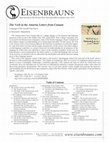
The Amarna letters from Canaan offer us a unique glimpse of the historical and linguistic panoram... more The Amarna letters from Canaan offer us a unique glimpse of the historical and linguistic panorama of the Levant in the middle of the 14th century BCE. Their evidence regarding verbs is crucial for the historical and comparative study of the Semitic languages. Proper evaluation of this evidence requires an understanding of its scribal origin and nature. For this reason, The Verb in the Amarna Letters from Canaan addresses the historical circumstances in which the linguistic code of the letters was born and the unique characteristics of this system. The author adduces second-language acquisition as a proper framework for understanding the development of this language by scribes who were educated in centers on the cuneiform periphery. In this way, the book advances a novel interpretation: the letters testify to a scribal interlanguage that was born of the local use of cuneiform and was affected by the fossilization and transfer processes taking place in these language learners. This vision of the linguistic system of the letters as the learners' interlanguage informs the main part of the book, which is devoted to verbal morphology and semantics. The chapter on morphology offers an overview of conjugation patterns and morphemes in terms of paradigms. Employing a variationist approach, it also analyzes the bases on which the verbal forms were constructed. Next, the individual uses of each form are illustrated by numerous examples that provide readers with a basis for discovering alternative interpretations. The systemic view of each form and the various insights that permeate this book provide invaluable data for the historical and comparative study of the West Semitic verbal system, particularly of ancient Hebrew, Ugaritic, and Arabic.
Papers by Krzysztof J. Baranowski
Folia Orientalia, 2018
The Karatepe inscriptions contain an intriguing image of a woman walking fearlessly with spindles... more The Karatepe inscriptions contain an intriguing image of a woman walking fearlessly with spindles. This image builds on the symbolism of the spindle in the ancient Near East as an emblem of femininity and highlights the gendered language of the passage in which it occurs. In the context, the figure of the woman with spindles is contraposed with the image of the fearful man. The contrast between them portrays the magnitude of the positive changes accomplished by Azitawada, the ruler who commissioned the inscriptions.
Przegląd Orientalistyczny, 2016
The Ancient Hebrew Siloam tunnel inscription has unique characteristics among Northwest Semitic e... more The Ancient Hebrew Siloam tunnel inscription has unique characteristics among Northwest Semitic epigraphic texts. It does not mention the king or deity nor does it follow any known literary genre. Its insistence on technical details indicates that it was commissioned by the builders of the tunnel with the purpose of commemorating their engineering achievement. Given this background and nature, the Siloam inscription is a unique testimony of historical consciousness among middle and lower class members of the society in the 8th-7th century Judah who felt the need to record their story in writing.
![Research paper thumbnail of Aramejskie słowa i wyrażenia w grece Nowego Testamentu [=Aramaic Words and Phrases in the Greek Version of the New Testament]](https://attachments.academia-assets.com/53265402/thumbnails/1.jpg)
The presence of Aramaic words and phrases testifies to the milieu of the New Testament. The occur... more The presence of Aramaic words and phrases testifies to the milieu of the New Testament. The occurrence of personal and geographical names reveals that Aramaic was one of the languages used in Palestine at that time. Aramaic personal names are often composed of the initial Βαρ- (בַּר) “son” or are common nouns which refer to their bearers’ qualities. The identification of geographical names as specifically Aramaic rather than Semitic in general relies on their final vowel α, which corresponds to the Aramaic emphatic state. The relatively low number of Aramaic names in the New Testament stems from the preference for Hebrew onomastics among the local Jewish population and the permanence of earlier Hebrew toponymy. The Aramaic words attributed to Jesus can be considered as examples of what comes closest to his ipsissima verba. What is also very precious is the word μαραναθα, which preserves a liturgical formula of the first Christians. All these words and phrases are better characterized as transcriptions into Greek or loanwords than borrowings into Greek. Their non-Greek character is expressed in their numerous variant spellings in the manuscript tradition.
The Amarna letters from Canaan (ca. the middle of the fourteenth century B.C.E.) contain several ... more The Amarna letters from Canaan (ca. the middle of the fourteenth century B.C.E.) contain several passages which employ the yaqtul forms in the narrative. These passages attest to the existence of the short prefix conjugation in contemporaneous Canaanite dialects. This conclusion is based on the close similarity of their syntax to the Biblical Hebrew wayyiqtol.
![Research paper thumbnail of Historia pisma klinowego w południowym Kanaanie [=Cuneiform in Canaan]](https://attachments.academia-assets.com/39927282/thumbnails/1.jpg)
An overview of the artifacts with cuneiform inscriptions from the Land of Israel shows that the u... more An overview of the artifacts with cuneiform inscriptions from the Land of Israel shows that the use of cuneiform script in this regions falls into two neatly distinguishable periods, each having its own characteristics. The cuneiform tradition of southern Canaan originated from contacts between Hazor and Mari. Writing was adopted in the Old Babylonian period and used in administration and for epistolary exchange. From the beginning, cuneiform script was taught locally and transmitted in families, from one generation to another, as was the case with other professions. In the Late Bronze Age, the local practice of writing expanded and participated in a larger western peripheral stream of the cuneiform tradition. Its demise was the result of political and cultural changes which occurred at the end of the Late Bronze Age. Cuneiform writing appeared again in the Land of Israel with the Assyrian occupation at the end of the eight cent. B.C.E. In contrast to the Late Bronze Age, in the Neo-Assyrian period cuneiform writing was not adopted by the indigenous population nor taught locally, as the lack of scholarly texts indicates. From this period, only two categories of documents survive: royal steles and administrative tablets. Several cuneiform artifacts from the Neo-Babylonian and Persian periods are difficult to interpret. Some of them had to be brought from abroad; others may testify to occasional use of cuneiform writing locally.

A Blessing in the Phoenician Karatepe Inscription?
The inscription from Karatepe (KAI 26) is a bilingual artefact in Luwian and Phoenician. Since bo... more The inscription from Karatepe (KAI 26) is a bilingual artefact in Luwian and Phoenician. Since both texts are written in a fluent and idiomatic manner, they must be interpreted independently. A comparison between them can be undertaken only after an independent reading. This way of approaching the texts calls into question the volitive interpretation of the so-called blessing in III:2–III:11 in the Phoenician version on the basis of the volitive meaning of the parallel Luwian section. Indeed, the presence of a blessing is unlikely in a royal Phoenician inscription because of its literary genre. Moreover, it is improbable that wbrk in II:2 begins a blessing since all other Phoenician inscriptions use the yiqtol ybrk to introduce one. Lines III :2–11, rather than being a request for blessing, are a description of blessing and prosperity accorded to the city by Baal and the gods.
The article, its origin and semantic import, are topics of a vigorous debate. The present paper a... more The article, its origin and semantic import, are topics of a vigorous debate. The present paper analyzes the use of the article in epigraphic Hebrew, a corpus that has remained on the margins of the current discussion. It concludes that the use of the article in Hebrew inscriptions closely resembles its use in the Hebrew Bible. The article is the marker of definiteness and is used with nouns that have a specific, identifiable reference.
The article proposes a new translation of lines 8-14 of Amarna letter no. 255. The letter is a di... more The article proposes a new translation of lines 8-14 of Amarna letter no. 255. The letter is a diplomatic protest by Mut-Baḫlu, the local ruler of Pella, against the pharaoh’s command that he relinquish his control over the local traffic of caravans. Mut-Baḫlu argues that to control the caravans is his hereditary right. Such an argument is well attested in the Amarna correspondence between the great powers. Its use in a vassal’s letter is a crafty attempt to exploit the diplomatic conventions of the Late Bronze Age.
Word Pairs
Word pairs (also called ‘fixed pairs’ or ‘parallel pairs’) are couples of corresponding, synonymo... more Word pairs (also called ‘fixed pairs’ or ‘parallel pairs’) are couples of corresponding, synonymous words in the parallel lines of biblical poetry. They are a poetic phenomenon found commonly in Semitic poetry and result from the use of parallelism.
![Research paper thumbnail of Dwie nowe inskrypcje fenickie z Ibizy [Two Phoenician Inscriptions from Ibiza]](https://attachments.academia-assets.com/31574724/thumbnails/1.jpg)
The 2003 archaeological campaign in Puig des Molins-a Punic necropolis in Ibiza-yielded two inscr... more The 2003 archaeological campaign in Puig des Molins-a Punic necropolis in Ibiza-yielded two inscriptions, both of which were published recently in a volume of studies dedicated to M. H. Fantar. The first inscription (7th cent. B.C.E.) is a bone door-plaque inscribed with dedication to Eshmun-Melqart, a seldom attested Phoenician “double deity.” Among the text’s distinctive features is the donor’s genealogy which goes back six generations and contains rare and archaic names. The second inscription (3rd cent. B.C.E.), engraved on the pedestal of a missing statue, is also dedicatory. The people of tgʾlbn-an as-yet unidentified locale-offered the statue to the Tyrian deity Melqart in the fulfillment of a vow. The two inscriptions attest to the mosaic-like complexity of the origins of the Phoenician population of Ibiza. The first inscription contains Cypriote elements (the relative pronoun with prosthetic aleph, an a dedication to a deity attested mainly in Cyprus) while the second preserves the memory to Tyre by invoking its principal patron-deity.
The problematic verbal form in the Amarna letter 88:36 should be read na-ri-i[q], derived from th... more The problematic verbal form in the Amarna letter 88:36 should be read na-ri-i[q], derived from the common Semitic root R.Y.Q (“to be empty”), and parsed as 1 pers. pl. yaqtul of the Canaanite H causative stem. This form constitutes an important piece of historical evidence in favour of the vowel pattern /a-i/ in the prefix conjugation of the H stem in Early Canaanite.
Liber Annuus Studii Biblici Franciscani, 2012
The twentieth century resulted in a significant grow of the corpus of Old Aramaic inscriptions. S... more The twentieth century resulted in a significant grow of the corpus of Old Aramaic inscriptions. Several of the discovered texts contain a series of curses which show a significant degree of similarity. The present contribution aims at a comparative analysis of the curses found in the Tel Fekheriye inscription (KAI 309), the Bukan inscription (KAI 320) and the Sefire treaties (KAI 222-224) as well as at their interpretation in the larger context of the West Semitic literary tradition attested in the Hebrew Bible and in the Phoenician epigraphs. The shared stock of expressions and images employed in the curses clearly points to the existence of a common tradition. This tradition goes back to the rural and pastoral lifestyle as it is revealed by the imagery of the curses (famine, infertility). Its distinct character is apparent when compared with the Phoenician curses that use a set of images such as a broken scepter and an overturned throne that betray a royal ideology. The level of literary sophistication of the curses indicates their transmission and subsequent elaboration in scribal circles. The occurrence of the same motifs in the Old Aramaic inscriptions and in a few passages of the Hebrew Bible hints at the common cognitive environment shared by the Aramaeans and Israelites and possibly the existence of a shared tradition. The scribal nature of this tradition is, however, evident only later, as in the case of Tobit and Ahiqar or Amherst papyrus 63 and Psalm 20, when it is possible to speak about knowledge of literary works by the scribes and not just stock phrases and formulas as is the case with the curses.
The use of the article in the book of Qoheleth is commonly considered chaotic and taken as an arg... more The use of the article in the book of Qoheleth is commonly considered chaotic and taken as an argument in favor of a non-Hebrew original of the book or of its late date of composition. However, the claim of inconsistencies in the use of the article in the book of Qoheleth should be reexamined in light of the use of the article in cognate North-West Semitic languages and of linguistic study of the article. Indeed, a careful and close reading of single verses and sections of the text in their respective contexts reveals that the article is used in a meaningful and logical manner in order to convey the author’s thought in his own, particular perspective. Therefore, any grammatical analysis of the article in the Hebrew Bible should be concerned with possible contextual reasons of its use and non-use.
Book Reviews by Krzysztof J. Baranowski
Journal of the American Oriental Society, 2018
Review of Biblical Literature, 2018


Uploads
Books by Krzysztof J. Baranowski
Papers by Krzysztof J. Baranowski
Book Reviews by Krzysztof J. Baranowski