

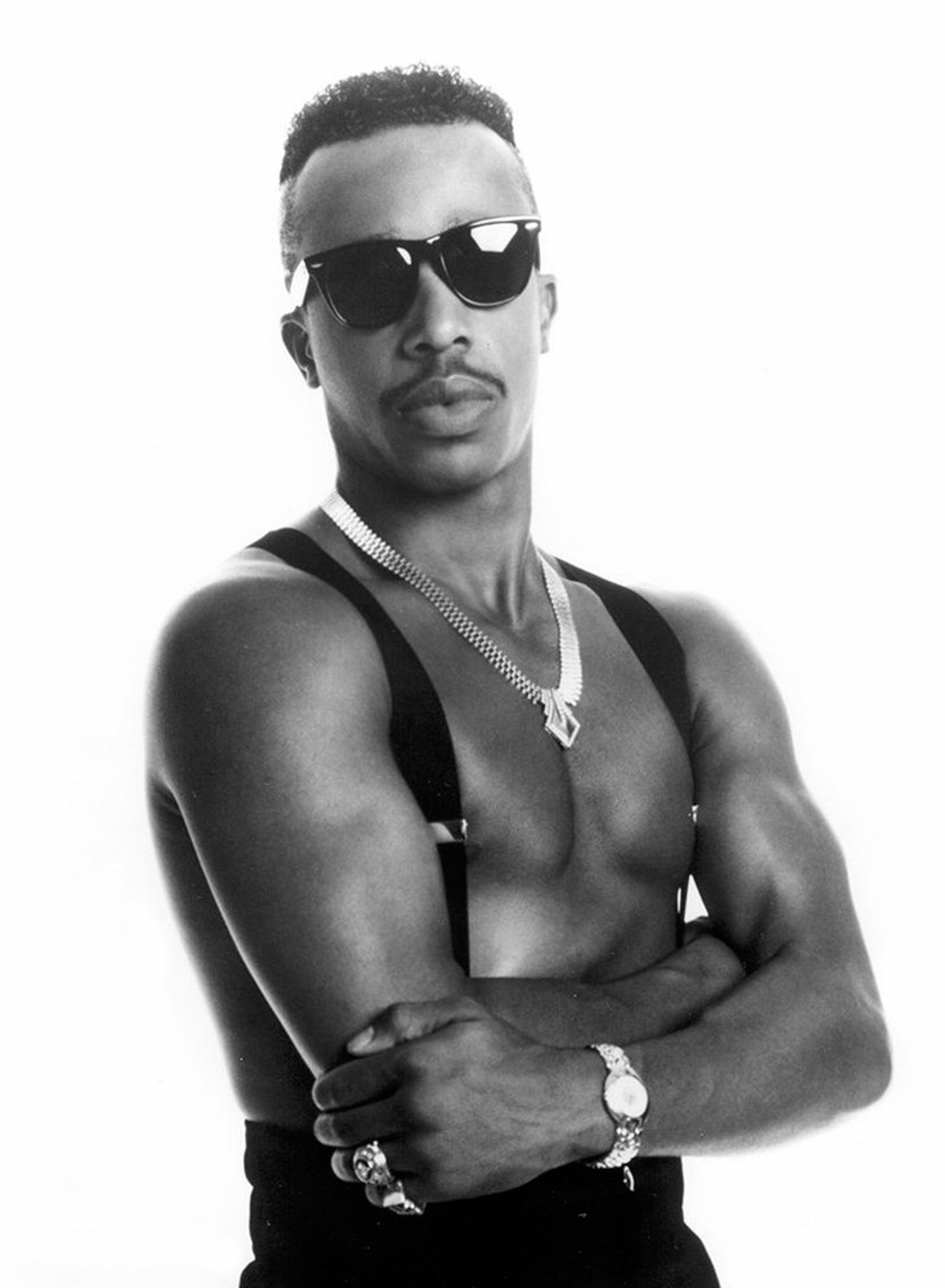
MC Hammer, hip-hop's first Large Ham, real name Stanley Kirk Burrell (born March 30, 1962). He is mostly famous for his dance hit "U Can't Touch This"note and for bringing Rap into the mainstream. In fact, along with Vanilla Ice, he practically was mainstream rap from about 1988 to 1992. Hammer initially started out independently in his hometown of Oakland, California, releasing his debut album, Feel My Power, on his own label, Bustin' Records, in 1986. The album would sell over 60,000 copies; a staggering amount for an independent hip-hop label at the time, and led to a bidding war from multiple major labels; which was eventually won by Capitol Records. Hammer would quickly re-issue Feel My Power under Capitol as Let's Get it Started in 1988, which soon went double platinum, and won multiple awards.
He would follow that up in 1990 with his mainstream breakout, Please Hammer, Don't Hurt 'Em. This was the album that spun off the majority of Hammer's biggest hits, such as "Pray", "Have You Seen Her", "Here Comes the Hammer", and the aforementioned "U Can't Touch This". The album would go on to be Hammer's biggest seller of his career, selling nearly 20 million copies worldwide, and becoming the first rap album to get Diamond certification for sales of 10 million in the US alone. His next album, 1991's Too Legit to Quit also saw some decent success, but only sold a quarter of what his previous album did. By then, Gangsta Rap had become fully mainstream, and there was a growing backlash against Hammer and other pop-rappers of his ilk, being viewed as sellouts by more purist rap fans and critics. This, combined with his sharply declining sales, prompted Hammer to do a hard 180 on his image, and dive headfirst into gangsta rap himself.
After a failed attempt at hardening his image with The Funky Headhunter in 1994, Hammer signed a deal the following year with Death Row Records (yes, that Death Row), to create a collaborative album with heavy contributions from one Tupac Shakur. The album, named Too Tight, due to release in 1996, never saw the light of day until much later, due to Tupac’s passing and the label’s many judicial issues. The tragic death of his friend led to a lot of questioning on Hammer’s part, and his later work started to have more religious leanings.
Nowadays, Burrell is a Pentecostal minister, and he has a TV show, Hammertime, on A&E.
Discography:
- Feel My Power (1986)
- Let's Get It Started (1988, an Updated Re-release of Feel My Power)
- Please Hammer, Don't Hurt 'Em (1990)
- Too Legit To Quit (1991)
- The Funky Headhunter (1994)
- Inside Out (1995)
- Too Tight (1996, unreleased, written entirely by Tupac Shakur)
- Family Affair (1998, notable for featuring Tupac Shakur's "Unconditional Love", albeit re-recorded by Hammer)
- Active Duty (2001)
- Full Blast (2004)
- Look Look Look (2006)
- DanceJam the Music (2009)
"U Can't Trope This":
- Adam Westing: On the rare occasion Burrell is seen on TV nowadays, it's usually as an exaggeration of his Hammer persona, or referencing his Fall from Grace. His ministry is rarely brought up.
- Anyone Remember Pogs?: People really did wear MC Hammer-inspired Hammer Pants while the fad lasted.
- Arson, Murder, and Jaywalking: Musician Magazine's review of Please Hammer, Don't Hurt 'Em lists the album's messages as "Drugs Are Bad. Save The Children. I Can Dance."
- Awesome, but Impractical: His concerts. A big reason he lost his fortune so quickly was that his stage shows were beyond extravagant, with dozens of dancers, musicians, giant screens, and a lot of pyrotechnics. A hell of a show, but also a hell of a money drain.
- Badass Preacher: He was raised in the Pentecostal faith and although he wasn't officially ordained until 1997, dedicated at least one song per album to God.
- Be Careful What You Wish For: His song "Brothers Hang On" ends on this note, as it tells the story of a man who lives in poverty, envying the wealth of all the hustlers and drug dealers, only to find a way into that life himself, living large until he's gunned down by rivals. In his dying moments, he wishes he could go back to his old life.
- Berserk Button: Do not diss him, and, most importantly, never, EVER speak ill about his mother on a track. Redman
 and MC Serch are just two emcees who nearly got killed by Hammer and his entourage over the latter.
 - Beware the Silly Ones: Even at his peak, he was often clowned by his contemporaries for his goofy "Hammer Pants", seemingly unabashed willingness to sell-out and generally lackluster rhyme skills. But Hammer, while not a thug, was not only raised on the notoriously dangerous streets of Oakland, California, he was also a Navy veteran. That, combined with the numerous gang members he had on his payroll, meant he wasn't afraid to step to anyone who dissed him, even hardcore gangster rappers like Ice Cube. As the man himself said on the title track of The Funky Headhunter:"Cause we can get it on, Don't let the dance steps fool ya,
Cause if I catch ya slippin', I'mma have to do ya." - Boastful Rap: How he starts "U Can't Touch This".My, my, my, my
Music hits me so hard
Makes me say "Oh, my Lord
Thank you for blessing me
With a mind to rhyme and two hyped feet"
It feels good when you know you're down
A super dope homeboy from the Oaktown
And I'm known as such
And this is a beat, uh, you can't touch - The Cameo: MC Hammer managed to get in a video game... as a hammer, in the Japanese version of The Legend of Zelda: A Link to the Past."You got the M.C. Hammer!
BANG BANG, pound the likes of stakes!
BANG BANG pound, pound other things too!" - Celebrity Toons: Hammerman — named after another alias for Mr. Burrell — where Hammer is a superhero with magical shoes. The opening theme will fill you in on the finer details.
- Cover Version: He recorded a rap version of "Have You Seen Her" by the Chi-Lites that was pretty faithful to the original, despite Hammer rapping instead of singing.
- Crouching Moron, Hidden Badass: While Hammer is widely seen as a walking punchline and pop-rap has-been, he actually had a reputation for checking anyone who dared cross him and could be very intimidating to anyone who got on his bad side, cowtowing Ice Cube into an apology within seconds. Many of his contemporaries claimed he had strong ties with Bay Area gangsters, and as mentioned above, tried to seriously hurt two rappers who dissed his mother.Redman (talking about Hammer confronting him): We was already in Oakland with EPMD, and we damn near had to bounce up outta there for that! Cuz they had niggas back here [...] We had to get the fuck outta here; they wasn't playing! We was almost boxed in! And I'm at a young age, too; I'm like, "Yo... this nigga is not playin'!"
- Darker and Edgier: Hammer tried this with The Funky Headhunter by trying to look and sound like the more popular gangsta rap artists of the time, but it didn't take.
- He later attempted this again by signing a deal with Death Row Records in 1995, and recording an album called Too Tight, with the majority of its lyrics penned by close friend and labelmate, Tupac Shakur. Pac's death caused Hammer to jump ship from Death Row, leaving Too Tight to get shelved.
- Distracted by the Sexy: "U Can't Touch This" features a scene where Hammer suddenly stops dancing to admire the backside of the girl dancing in front of him.
- The Dreaded: Yes, really. Believe it or not, Hammer was very much this to other rappers who found out the hard way that just because he wore flashy outfits and danced a lot, it did not mean he would take being insulted or pushed around, and it was an open secret among rappers that Hammer was absolutely not someone you ever wanted to get on the wrong side of; so much so that Snoop Dogg (who was an active Crip during that period) outright said he was the most intimidating rapper on the Death Row label, and made clear he was not joking.
- Good Shepherd: In his case, "M.C." means "Man of Christ". Even before that, a line in U Can't Touch This thanks God for blessing him with "a mind to rhyme and two hype feet". And of course, there's "Pray."
- Great Balls of Fire!: The music video for "2 Legit 2 Quit", and indeed, many of his high-energy stage performances, were filled with these.
- Greatest Hits Album: Greatest Hits, The Hits and Platinum. There's also Back To Back Hits where his hits are mixed in with Vanilla Ice's (admittedly, a pretty good idea).
- Hidden Depths:
- His religious leanings notwithstanding (and not very hidden), he's also a veteran - he served in the United States Navy for three years.
- Another lesser known fact is that he produced or co-produced almost every album he's ever put out, Too Tight being the only exception.
- Large Ham: His stage persona and his concerts were larger than life.
- Lyrical Cold Open: "U Can't Touch This" and "This Is What We Do".
- Meaningful Name: When Burrell worked as a batboy for the Oakland A's, Reggie Jackson nicknamed him "Hammer" due to Burrell's resemblance to a young "Hammerin' Hank" Aaron.
- The Moral Substitute: He was marketed as this to the violent crime-oriented Gangsta Rap genre, then in it's early stages of popularity, keeping his lyrics family-friendly and making a point of including a Christian song on every album. When gangsta rap would up becoming the dominant subgenre of hip hop, he tried to shed this and go in a Darker and Edgier direction with The Funky Headhunter, alienating his fanbase in the process.
- New Sound Album: The Funky Headhunter, which contained a more harder and aggressive sound than his earlier albums.
- Riches to Rags: One of the more infamous celebrity examples. Hammer's lavish lifestyle and dwindling album sales eventually resulted in him being $13 million in debt. He filed for bankruptcy in 1996.
- Song of Song Titles: He spends the final seconds of his song "Burn It Up" acknowledging seven of his past hits.
- Stuffy Old Songs About the Buttocks: "Pumps and a Bump" from The Funky Headhunter
- Stop and Go: "STOP! Hammer Time!"
- Totally Radical: Many of the songs on The Funky Headhunter make liberal use of the phrase "OG" in their lyrics. It's safe to assume that no other rappers at the time considered Hammer an "original gangster," let alone believed he knew that was what that meant. Ironically, Hammer, despite his clean image, actually had gang connections, and many of those same rappers later admitted Hammer was a lot more gangster than they gave him credit for.
- Trope Codifier: MC Hammer was the first rapper to achieve mainstream popularity, although his poppy, upbeat style would fall out of style in the mid-1990s when gangsta rap became popular. He is also largely responsible for the mainstream public notion that most rapper names start with "M.C." (By extension, he was largely the reason why most rapper names don't.)