

Two worlds exist and the physical laws, geographies, inhabitants, or contents of one bleed over into the other.
This sometimes begins a little at a time — an anachronistic lamp, the wrong face on a coin, unusual plants or animals, an odd number of Dimensional Travelers — that becomes worse and worse until or unless the process is stopped. If allowed to run unchecked, this can result in the "invading" reality completely replacing the old one, the two merging into a fused whole, or the two incompatible realities destroying one another.
This usually takes one of two forms:
- A world with very simple rules and internal logic entered by somebody from an Earth-like world. These works are more prone to humor as the native inhabitants fail to understand or loudly disbelieve things which would be obvious to normal humans.
- A world which has an alien set of physical laws (or somebody from it), that then interacts with an Earth-like world. These worlds are almost always in the horror genre.
This may happen between Layered Worlds or between worlds with a Thin Dimensional Barrier. Often causes Portal Endpoint Resemblance. This might be the beginning of a process that ends with a Merged Reality.
Compare All of Time at Once, when different time periods of a single world merge together, and Cross-Dimensional Conflict, for when people from another dimension invade yours without necessarily dragging their reality along.
Simple worlds invaded by "real world" elements
- Barbie (2023): This is part of the nature of Barbieland as a Tulpa dimension formed of thoughts and ideas, as real world concepts inherently shape it. However, properties of the real world such as depression, cellulite, and other aspects of genuine humanness that are not usually present in Barbies begin bleeding over into Barbieland due to America Ferrera's character's imagination affecting Barbies.
- Doctor Strange (2016): Near the finale, Strange introduces the normally timeless Dormammu to the concept of time he explicitly brings with him from Earth. The prospect of being stuck in an endless time-loop is so terrifying that Dormammu agrees to leave the Earth in peace, never return, and take his Zealots with him.
- Pleasantville: The protagonists are high school students from our world who enter the world of a black and white 1950s TV serial, in which everything is excessively pleasant and patterned after '50's moral standards (besides colour, there's also no rain, crime, homelessness, fire, sex or toilets). Throughout the film, the protagonists' actions impact the world around them and colours and concepts from the real world (like fire, sex and rain) start to appear as a result.
- Flatland: A. Square is visited by a sphere from the mysterious dimension of "up" and interacts with the strange world of the third dimension. A sphere manifests as a circle that grows and shrinks, able to bypass all flatlander doors and walls and even touch "inside" a flatlander. The protagonist eventually learns to think multi-dimensionally and is considered insane by most. What makes it this trope is subtle, when taken from one dimension to another (for example when he is in the 3-D world), the normally 2-dimensional A Square is able to perceive higher and lower dimensions. (So in the 3-D world he can see the interior of 2-D people.)
- Erfworld: The world's rules reflect those of a traditional turn-based tabletop game. For example, terrain is divided into hexes and units can only move a certain number of spaces each turn. The protagonist is from Earth. He experiments with the physical laws of the world in an effort to better understand the rules of the game and attempts to cheat with them (even without cheating, mastering the system makes him a tactical genius). He also has several interesting and unique properties that are a hold-over from reality (such as a lack of visible stats, blood, and the ability to get distracted and forget direct orders).
- Unicorn Jelly: The dimension of Tryslmaistan periodically intersects with other dimensions, including that of Earth, leaving those residing in those portions of the other worlds stranded in Tryslmaistan. While the physics (and inhabitants) of Tryslmaistan are somewhat hostile to terrestrial life, it is similar enough that human castaways are able to form a civilization on the Myrmil Worldplate before catastrophe struck and they needed to move on to other Worldplates. The Distant Finale shows a group of Humano-Jellese welcoming a new group of castaways from yet another dimension.
Earth-like worlds invaded by alien elements
- Anime-Gataris: The conventions of the anime world gradually overwrite reality. People are neutral to apathetic over the impossible feats they can now accomplish or a Fourth Wall they can now notice and play with, and barely react to their own bodies changing to a different art style or even gender. The Big Bad invoked this so the anime staff that now controls the world could reset it... for the heinous crime of giving him an Embarrassing First Name.
- Berserk: The Big Bad and Reality Warper extraordinaire Femto is able to redirect the force of Skull Knight's attack using a sword able to cut the fabric of reality itself so as to cause the various supernatural layers of the Layered World to fuse with the mundane layer in which we exist, resulting in monsters and creatures of myth suddenly populating the world of humans.
- Digimon: The digital world and its denizens bleeding or crossing over into the physical world is something of a recurring theme in the various anime series:
- Digimon Adventure:
- Adventure opens with news of the climate going haywire all over the world, with events like snow in summer or in the tropics, drought in wetlands and jungles, flooding in deserts and heatwaves in the arctic or in the depths of winter. This is later revealed to be due to Digimon that have entered the real world enough to affect it, with beings such as the fiery Meramon causing heat waves, Frigimon brining sudden frosts or Seadramon causing floods.
- The villain Myotismon is singularly focused on invading and conquering the physical world, which he attempts to do by bringing across a large army to take control of Tokyo while he tries to destroy the Digidestined. For most of the latter half of his arc, Tokyo becomes overrun by rampaging monsters, culminating in the Odaiba island district being cut off from the rest of the city by a general failure of machinery and an impenetrable wall of fog caused by Myotismon's influence.
- Digimon Savers is based on the premise that the barrier between the Digital and Human Worlds is breaking down, causing Digimon to randomly manifest on Earth.
- Digimon Adventure:
- Nasuverse: Background material speaks of Type Mercury, the avatar of Planet Mercury, which crash landed in a South American rainforest in 5000 BC after answering Gaia's call prematurelynote . Mercury's crash site has since transformed into a "Crystal Valley" filled with beautiful yet horrifying crystal spires. This is a replication of planet Mercury's environment, and Type Mercury's mere presence has turned that patch of Earth into a patch of Mercury. It is said that its full force is activated by Type Mercury's movement, which means wherever it goes, it will leave a trail of Mercurian crystal.
- Re:CREATORS: Characters from various fictional worlds appear in the real world, and any superpowers they have still work. Eventually, characters are fighting each other with powers from different fictional worlds, in a world that shouldn't even have physics that support these powers. Meteora is a little concerned that this might destabilize reality.
- Uzumaki: The inhabitants of a small isolated town begin to notice a repeating spiral pattern that manifests in a number of disturbing ways. People, objects, plants, galaxies, space and time eventually twist into a spiral shape drawing the inhabitants in. The closing scenes show the spiral world below and the narration suggests that this spiral world invades the mundane on a regular basis, leaving only ruins behind when things return to normal.
- Big Finish Doctor Who: The plot of "Jubilee" is kicked off by a serious TARDIS malfunction, which causes the Sixth Doctor and his companion Evelyn to arrive at the same location in London but a century apart simultaneously; one version of them arriving in 1903 and another version arriving in 2003, the latter of which has become a Bad Future, due to the Doctor who arrived in the past's interference. The Doctor, who is stuck in the Bad Future, only gradually figures this out, as he gets in sporadic mental contact with his alternate self, who has taken The Slow Path and is still alive, being kept as a prisoner by the local dictator, and to his horror he realises that the universe is struggling to resolve the paradox resulting of this rather serious Time Crash, causing the 1903 and 2003 timelines to bleed into each other with rather disastrous results.
- The DCU:
- DC/RWBY: The presence of Grimm in Gotham City is causing normal humans (including Batman) to gain Semblances while Team RWBY suddenly experience a Fisher Kingdom moment with their looks and weapons being changed.
- Doom Patrol (1987): The main plot of the Orqwith arc is that a fictional city starts to bleed into reality.
- Shazam! (2018): Mr. Mind’s plan is to merge the Seven Magiclands into one realm with a magic spell. He forces Billy to recite the spell at the end of issue 13, which causes the realms to start merging together, and the kids’ hometown suddenly has a lot of strange creatures from the other realms running around, such as flying monkeys and little clowns. Luckily, in the next issue, Billy uses another spell to undo the first spell and keep the seven lands separate.
- Zero Hour: Crisis in Time!: Various people, such as Alpha Centurion and a healthy Barbara Gordon Batgirl, and places, such as a 25th Century New York City, start appearing from alternate timelines into the modern day universe. In the latter case, this is a bad thing since it was slowly levitating downward and preparing to crush the original.
- Judge Dredd: In "Helter Skelter", interdimensional travel by supervillains from other universes starts to fracture the fabric of reality, causing elements from different dimensions to bleed over into each other. One alternate dimension in particular is referenced that collided completely with another one, merging the two into a never-ending World of Chaos.
- Marvel Universe:
- Tomorrow Man, Zarrko the time traveler, is introduced in a Hulk story arc as existing in perception of fourth dimensional space. His presence gives off an energy that causes different time periods to bleed into the present moment, illustrated as bystanders switching to different period clothes from across the world between panels without noticing.
- In Inferno (1988), the villains open a portal to the hellish dimension of Limbo which causes Manhattan to transform into a demonic version of itself. The overall goal was to spread it to the entire world.
- My Little Pony: Friendship Is Magic (IDW): Reflections: Due to young Celestia's frequent travels to Alternate Universe in order to meet her lover, there is a growing Synchronization between Prime!Equestria and Mirror!Equestria as two parallel realities become gradually more intertwined — to the point that actions taken in one of them directly affect the other one. It ranges from minor, inconsequential things (like cooks making the same dish on the same day) to crucial events (like previously righteous Mirror!Luna falling to the dark side when Prime!Luna is returned to the side of good). In the story arc's climax, both universes begin to effectively merge with each other as walls between realities fall down entirely.
- Blood on the Hands of a Healer: Thanks to the activation of Kamen Rider Chronicle, the real world has become a fictional world in of itself due to it becoming a video game, allowing the crossing over of other fictional worlds and characters into there.
- The Conversion Bureau: Equestria has been transplanted to Earth in the future, not too far off the shore of the USA, by forces unknown. Its magical field is slowly expanding to cover the planet. The field purifies any air, soil, water, plant life, and so on within. Unfortunately, the magic is fatal to humans and the expansion is beyond the power of the Princesses to stop. A special potion is devised to transform humans into ponies, changing their bodies while preserving their minds and souls, to let them survive. This is what happens at the eponymous bureaus. In spite of technological advances, Earth is presented as an Earth That Used to Be Better, with deliberate implication by the author that some event between the present day and the fic's time left a lingering effect that causes much of humanity to essentially act smoozed. Ponification undoes this, often causing the transformed to feel very chipper.
- Danger Than Fiction: At the end of the story, the bookwalking spell begins to break down. This results in different versions of the same book merging (like "Jack and the Beanstalk") or completely different stories getting mashed together because of vague similarities in setting (like the Rime of the Ancient Mare-iner / Iron Filly / Moby-Dick / Arthur Gordon Pym crossover at the end).
- Oversaturated World: This is the Apocalypse How trying to be solved in the first story, as a full collision would lead to the annihilation of both universes.
- Policing the Fellowship, a Discworld/The Lord of the Rings Crossover fic, has Samuel Vimes accompany the Fellowship of the Ring. Over the course of the story, the fellowship characters start acting like Discworldian archetypes of themselves (Aragorn starts acting like an Upper-Class Twit, albeit still a far more competent one than most Discworld nobility, the various nobles the group encounters become much more cynical, etc.). On the flipside, without Vimes, the Discworld becomes more like Middle-earth, with Captain Carrot (long-lost heir to the throne, who prefers to be a policeman) manifesting the same kind of white flame on his brow that Aragorn does, and being propositioned by three elven princesses. This is somewhat downplayed, however, as the first one was bitten by Angua (Carrot's werewolf girlfriend), the second one's pointy ears washed off in the rain, and the third turned out to be Nobby Nobbs, who was "just getting into the spirit of things".
- Tales of the Otherverse: The titular parallel Earth is invaded and destroyed by hostile other-dimensional creatures when the barriers protecting that dimension become weaker.
- My Little Pony: Equestria Girls – Friendship Games: After Human Twilight's device absorbs the magic of the portal, it starts tearing open portals between the human world and Equestria whenever it is opened, allowing through things like jackalopes and Man-Eating Plants. When Twilight transforms into Midnight Sparkle, she starts ripping holes to Equestria to access the magic there, not caring that she's destroying her own world in the process.
- Spider-Man: Into the Spider-Verse: The plot is driven by the Kingpin's use of an atomic collider to create an interdimensional bridge. At first this simply pulls multiple versions of Spider-man into the movie's main universe, but as Kingpin continues his experiments multiple versions of New York start to be overlaid onto one another in a highly disruptive manner that risks causing the creation of a black hole unless stopped.
- The Super Mario Bros. Movie: In the climax, Mario destroys the interdimensional Warp Pipe with a Bomber Bill, leading to a chunk of the Mushroom Kingdom, including all of Bowser's Castle, being transported to the streets of Brooklyn.
- Cool World: As the film reaches its climax, the toon world begins to infringe more and more on the real world.
- Jumanji: The flora and fauna of Jumanji that invades the "real world" is able to do things that would be impossible for real life equivalents (monkeys that can ride a motorcycle, plants that grow incredibly quickly, a pelican that can fly the board game without trouble etc...)
- Last Action Hero is a quasi-example. On the one hand, when an action hero crosses over from the world of movies into the real world, he nearly dies from a gunshot he'd normally shrug off as Just a Flesh Wound; similarly, a villain who makes the same leap is delighted to discover that in the real world the bad guy winning is actually possible. However, when Death crosses over into reality from the movie world, he's still able to kill people just by touching them. We also see that, when the movie hero shoots the movie villain in his cybernetic eye, it causes a ridiculously huge explosion, even when they're both in the real world. It could be said to be somewhat consistent since only supernatural or futuristic elements kept their original properties.
- Tomorrow Calling (an adaptation of The Gernsback Continuum by William Gibson): A photographer starts hallucinating giant propeller-driven flying wings and Crystal Spires and Togas, the "semiotic ghosts" of an envisioned reality that never happened. To get rid of them he reads tabloid trash and watches porn movies, to drive away this perfect alternate future with our own sordid reality.
- Alternate Routes: A secret government project is studying an otherworld where the laws of reality are much looser. Over the course of the novel, it increasingly leaks into our world, and it turns out the villain is trying to merge the two worlds entirely, which would result in our physical laws being dissolved in the otherworld's chaos.
- The framing device of Ash: A Secret History features a historian translating a medieval text about the life of mercenary woman Ash. Her world seems to feature strange and supernatural creatures and events - for example, "stone golems", which are essentially robots - which the historian assumes to be imagination or religious imagery. But then the remains of one of the supposedly mythical golems is dug up at an archaeological site, indicating that Ash's reality is bleeding into ours as her story is uncovered.
- Battle Ground (2020): Defied when a Divine Conflict takes place in Chicago. The magical power involved is so great that the dragon Ferrovax's sole task in the battle is to prevent the the physical world and the Nevernever from collapsing into each other.
- Cthulhu Mythos: The stories often involve aliens that dwell in more than the traditional three dimensions and who occasionally interact with Earth. The twisting of logic and geometries involved by interacting with these alien space gods usually drives people mad as they are unable to comprehend them.
- Death & Taxes (2026): When the Ergosi open trade relations with Earth, Ergos' Sentient Cosmic Force starts leaking through and killing anyone who tries to study it.
- Discworld:
- Mort: The titular character saves the life of a princess who was supposed to die. A bubble of reality forms around her where she is still alive, while the rest of the world outside the bubble proceeds as if she had died. The living-princess bubble is gradually supplanted by the dead-princess reality; at one point, Mort is in a pub when the bubble's edge passes over it, resulting in the pub now being named after the dead princess, as well as several other minor changes.
- Lords and Ladies: When The Fair Folk invade Lancre, their country tries to come through as well, Crop Circles being caused by this. At one point the characters witness the two realities fighting for supremacy.
- Doctor Who Missing Adventures: In Millennial Rites, our universe gets merged with both the one that preceded it and the one that will follow it, becoming a trifold realm being slowly torn apart by its three mutually-conflicting sets of physical laws. London becomes known as the Great Kingdom, ruled by the gods the Great Intelligence (Yog-Sothoth, of the Pre-Universe), Saraquazel (of the Post-Universe)... and Lady TARDIS (of... guess where). Notably, none of the three planned this, and only the Great Intelligence is at all pleased with the results.
- Forest Kingdom: In book 2 (Blood and Honor), with King Malcom dead and nobody else able to actively control Castle Midnight's own magic, the energies of the Unreal threaten to overthrow all natural laws within the building. The only way to reverse the damage is for a new king to be crowned and take charge of the castle's magic.
- The Gods Themselves: The plot revolves around a discovery of how to exchange matter between parallel universes and get free energy out of this. The protagonist slowly realizes that, as they exchange matter between worlds, some of the cosmological constants also change very slightly, but enough to have potentially apocalyptic consequences.
- Good Omens: A powerful and impressionable young Reality Warper reads too many New Age magazines, and causing things like Tibetan tunnels and alien visitations to start becoming true.
- Idlewild: Immersive Virtual Reality allows students to program their own personal domains. When they make personal phone calls to each other, the system mashes the domains together.
- The King of Elfland's Daughter: First, trolls and other denizens of Elfland begin to intrude in Erl, then a unicorn is spotted. In the end, the King uses his third spell to expand Elfland's reality and makes Erl part of it.
- Other Covenants: In "The Time-Slip Detective", our world's Tel Aviv starts crossing over with an alternate version of the city called Herzlberg, where the entirely-Jewish population speaks Yiddish.
- The Place Of The Lion by Charles Williams: The higher reality of Platonic archetypes begins bleeding through into our world, replacing all the mundane examples of each Platonic Form. So, for instance, the titular Lion, which represent Power, starts draining all the strength and energy out of everything near it.
- Rod Allbright Alien Adventures: The second book in the series reveals that BKR and Smorkus Flinders were working on this, intending to create a permanent door between Dimension X (home of Reality Quakes, which periodically cause random and usually temporary shifts in reality, though the effects are sometimes permanent) and Dimension Q (where Earth exists) that would let the Reality Quakes leak over and eventually fuse them into one dimension "where reality can shift like sand" (BKR's motivation is pure nastiness, while Smorkus Flinders, who was once a normal being until a Reality Quake permanently transformed him, is doing so as a means of lashing out at the world in retaliation). However, after Smorkus Flinders is taken into captivity and BKR subsequently escapes from custody, the latter decides to focus on one of his other, older plans instead.
- Star Trek Expanded Universe: In Q-Squared, a Trelane from an alternate universe starts merging three different realities into one, just for the hell of it. Three Enterprises start to intersect: the Prime Universe's, the one where the Enterprise-C never went back in time and the Federation is at war with the Klingons, and one where Jack Crusher is the captain of the Enterprise with Picard as his Number Two (and Data is a human body with a positronic brain). In the end, Prime Picard and Prime Q stop Alternate Trelane, splitting the realities. However, while the Prime Universe is largely unaffected, the second reality is worse off with both Second Picard and Second Riker dead, and Second Data stuck in the third reality. In the third reality, Jack Crusher accidentally kills Third Beverly and then eats his phaser, leaving Third Picard in command.
- Sidewise in Time by Murray Leinster centers on a worldwide phenomenon in June of 1935, where pieces of the Earth begin swapping places with their counterparts from alternate realities.
- Swellhead: The British government sends a team to investigate why an Elaborate Underground Base has appeared out of nowhere on the island of Skerra. Turns out an alternate reality — in which one member of the team is a supervillain and the other his James Bond-type antagonist — is bleeding into ours.
- "Tlön, Uqbar, Orbis Tertius": An encyclopedia is discovered with a detailed description of the fictional planet of Tlön, which was created over centuries by an Ancient Conspiracy of philosophers, scientists and writers. Everyone is fascinated by the discovery and discusses endlessly all aspects of Tlön. Then, gradually, objects from Tlön start appearing in the real world. The ending implies that reality will be completely replaced and the Earth will eventually become Tlön.
- The Witcher: In the backstory, the Conjunction of the Spheres was an event where different dimensions intersected at the same time and dumped several unnatural things into the world, including monsters, magic, humans in flying metal airships and elves into the world, unfortunately for the planet's original inhabitants: dwarves.
- Young Wizards: For preserving the Masquerade, there is a particular spell that allows the caster to copy an alternate reality and paste it into their universe. If a bunch of monsters invaded Grand Central Park in New York City, for instance, the wizards can find an alternate reality where Central Park is monster-free, cast the spell, and now not only are the monsters gone, there never were any monsters in the first place, except in the Ripple-Effect-Proof Memory of the wizards.
- Buffy the Vampire Slayer: In Season Five, the exiled hellgod Glory is trying to re-enter her dimension, but the effort would cause all dimensions to collide (thus destroying the multiverse). Small glimpses of this process can be seen in "The Gift", when places on Earth get changed and twisted and creatures from other dimensions including Xenomorph-like demons and a dragon enter our realm.
- Eureka: The majority of the season one finale takes place in an alternate timeline created by Henry to prevent Kim's death. Soon after jumping to the alternate (future) timeline, the two timelines begin merging with destructive consequences.
- Fringe:
- There's an alternate dimension, and the walls are breaking down. Things in one universe begin to affect the other, or are even forced to exist in the same place at the same time, to disastrous effect. The other world has it worse and is becoming nearly unlivable, but "ours" is on the same path, and if unchecked both worlds will be destroyed.
- In another sense, Peter Bishop is a walking reality bleed, since the new timeline was created in which Walter failed to save him as a child, but he still reappeared as an adult. Eventually reality goes through another shift when Olivia regains all her memories from the original timeline.
- Star Trek: The Next Generation:
- "Parallels": Worf is somehow jumping between parallel universes thanks to a rift in reality. The next-to-last commercial break ends with realities clashing together and thousands of Enterprises appearing near the rift.
- "Schisms": Aliens from another universe with very different physical laws invade the main universe and start running experiments on the Enterprise crew. They manage to create a temporary environment where the laws of physics allow inhabitants from both universes to co-exist, but normal parameters within that universe do pretty crazy things to people's body chemistry.
- Star Trek: Voyager: Played for Laughs in "Bride of Chaotica!" where energy beings from another dimension mistake The Adventures of Captain Proton for reality and go to war with the Emperor Scientist supervillain. Unfortunately, they can't detect our dimension so don't believe Voyager's crew telling them it's just a holodeck program.
- The Witcher: Blood Origin concludes with a front-row seat to the Conjunction of the Spheres. Orange fire burns at the edges of interdimensional portals in the sky, revealing multiple planets from a satellite view. These portals merge and give the appearance of When the Planets Align, concluding with some kind of flash that leaves everyone in all worlds unconscious as volumes are swapped with one another. The first survivors are beached on the shoresnote who start asking each other questions only to discover they speak wildly different languages. The details are fudged from the original novels, as elves had already conquered the world of the dwarves 1,500 years ago, and some of the humans transported were still in the Age of Sail rather than post-cyberpunk.
- Arkham Horror: Some scenarios in 3rd Edition use an Anomaly mechanic to represent Cthulhu Mythos powers encroaching on Earth. When a neighbourhood accumulates too much Doom, its Random Encounter deck is replaced with alternate encounters in which otherworldly locations appear in Arkham; to remove the Anomaly, the investigators need to clear all the Doom in the area.
- Dark Conspiracy: Parts of the U.S. have been taken over by Dark Minions invading through portals from their home dimensions. These areas are known as "Demonground", and they're filled with the corruption flowing from the portals. Common elements include bizarre vegetation and weird organic tunnels.
- Dungeons & Dragons:
- Planar breaches are temporary, small-scale events where the Material Plane feels the influence of another plane, which can be dangerous when a once-safe area gains the fire-dominant or negative energy-dominant trait, or some of the other plane's inhabitants come along for the ride. Sometimes these breaches are "natural" events, other times they're a side-effect of plane-hopping magic. They were introduced to let lower-leveled parties, who lack spells like plane shift, experience other planes of existence.
- The Far Realm, a Lovecraftian non-place outside of reality, sometimes encroaches on the Material Plane through "cerebrotic blots" — places where the laws of physics are subtly distorted. Some blots have a second layer accessed through invisible portals, which is Bigger on the Inside and far more heavily corrupted.
- Eberron has a milder example in the form of manifest zones, where traits from another plane impose themselves on the material world. While some of these are harmful, others are beneficial. The massive towers of Sharn, the world's largest city, for instance, can only support their own weight due to being built in a manifest zone to Syrania, the plane of air. Each plane also has an astrological "orbit" which can have effects on the world as a whole, such as resurrection magic acting strangely if the realm of the dead is too near or too far.
- Exalted:
- Creation itself is a reality as defined by Primordials, which was grown by devouring the Wyld and absorbing everything. This is not a good thing if you're a Raksha. Inversely, when the reality of Creation doesn't keep the Wyld at bay strongly enough, the chaos and narrative logic of the Wyld start to intrude into, mutate, and eventually dissolve Creation.
- The Underworld is reality as defined by slain Primordials, and they try to drag Creation with them to Oblivion. When the Underworld seeps into Creation, it creates Shadowlands, where the shades of the dead walk and life is tenuous.
- Finally, Hell is reality as defined by broken and imprisoned Primordials, and they try to wrestle Creation back from their conqueror by overlaying Hell with Creation via demonic cults. Keyword here being try — it very rarely actually works.
- Fate Core: The Slip World of Adventure setting is all about an odd variety of alternate realities bleeding through to Earth, with the player characters by default belonging to a global secret-ish grassroots organization dedicated to fighting back against such intrusions for the good of humanity. Aside from dealing with the bleed events themselves and any otherworldly denizens that may be involved, they also have to face competition from a shadowy and decidedly more ruthless second human organization interested in the same phenomena while hopefully eventually discovering and dealing with the root cause of it all.
- Mage: The Awakening
- The Abyssal intruders, some of which overwrite the local laws of reality or the timeline when they visit the Fallen World. One example is the Twisting Maze Zone, which will usually overwrite an apartment building and turn it into a labyrinthine superstructure that extends in all dimensions, including time. Eventually, the building — and everyone in it at the time — gets written out of existence because it was never there in the first place. The only way to cure it is to walk through it exactly as it is in the real world, ignoring all deviations — basically forcing the way it should be back into place.
- The Nemesis Continuum is a set of physical laws from the Abyss, and every time you understand one, the next one makes a little more sense. And as people understand them, they become real. Suddenly, the Square-Cube Law no longer applies, or objects of a certain size are no longer subject to friction... the worst part is that just looking at them for long enough can get them into your head, and as for trying to get rid of them — well, how do you fight math?
- Magic: The Gathering:
- In the Invasion storyline, the Phyrexians invaded Dominaria by merging it with an already-conquered plane called Rath. Dominaria was warped to incorporate locations and inhabitants from Rath (including the Phyrexian army), sometimes warping individual creatures or structures into hybrids combining both planes and sometimes simply dumping creatures and entire geographical features from Rath into Dominaria, such as the Skyshroud (an expansive jungle floating like a raft over the sea) getting plopped in the middle of the frozen north.
- The "Shards of Alara" block is one long example of this. Ages ago, an unknown disaster split the plane of Alara into five subplanes. Each "shard" had access to only three of the five colors of magic (each shard having one central color and its two allies), and lacked the two other colors and their associated forms of thought and behavior. Over the ages, the shards were shaped by the local limits on magic, developing into five profoundly different realms. When the shards began to merge back together, not only did the physical terrain of each shard begin to emerge in the others, but each shard had to deal with the return of colors of magic that it had not had to deal with for millennia. The arrival of philosophies and ideas people had previously found literally inconceivable shook each shard's specialized society to the core.
- Bant, the White shard, was an orderly, pastoral Arcadia of rigidly structured traditionalist societies, selfless heroism and little in the way of cultural change and flexibility. With the Conflux, Bant's rigid societies found themselves exposed to alien ideas like "treachery", "chaos" and "self-interest", while creatures, beasts and monsters from the other shards invaded the peaceful fields of Bant. In the end, this proved too much for Bant's people to adapt to, and most of the shard's civilizations collapsed under the strain.
- Esper, the Blue shard, was a City Planet whose inhabitants lived for constant progress and self-improvement, heavily augmented their bodies with metal, lived under a strict hegemony and had little use for emotion. The Conflux flooded Esper's hegemonic society with chaos and emotions the Esperites didn't know how to deal with — and the constant dragon attacks did little to help.
- Grixis, the Black shard, was a hellish wasteland where demons and necromancers ruled over a landscape of corpses and bones. It is probably the only shard that could be said to have benefited from the Conflux — the influx of Green and White mana brought life to the wastelands, while the demons and undead swarmed into the other shards to prey on their abundant and unprepared native life.
- Jund, the Red shard, was a savage, lawless Death World of dragon-ruled volcanic peaks rising above swamps and jungles full of predators and barbarians. When Blue and White mana began to enter it, the aggressiveness and natural instincts of many of its inhabitants began to simply fade away. Combined with the dragons that ruled the shard migrating away to seek new prey and targets in the rest of the world, this caused the collapse of much Jund's food chain and societies.
- Naya, the Green shard, was a vast jungle of towering trees home to human, elf and Cat Folk tribes and an endless array of creatures, all ruled by hill-sized beasts called gargantuans. While the gargantuans were able to keep most invading creatures out, the alien magic and mindsets still entered, and the Nayan jungles became infested with undeath and demonic cults.
- Kaldheim is a plane composed of many distinct realms, which are normally separate from one another and inhabited by very different species and societies. However, these realms are constantly orbiting around the World Tree, and sometimes overlap. These events, known as Doomskars, are very violent and dangerous and cause devastating earthquakes and other tectonic disasters in the affected realms. The large number of rifts created by them also leads the two realms' races to spill into each other's domains, inevitably causing war.
- Pathfinder:
- The setting's most notable example is the Worldwound, an enormous Hell Gate to the Abyss that swallowed most of a nation. Besides being filled with demons, the influence of numerous demon lords and the Abyss itself have twisted the surrounding land into something horrible. The remaining plants and animals are either undead or horribly mutated, the land is barren, blasted and wracked by earthquakes and geysers of filthy water, most lakes and rivers have drained into rifts to the Abyss, the sky is tinted in strange colors, snow and rain are oily and foul or replaced by insects, blood or worse, and in the most corrupted places even the sun, stars and moon don't look or move like they should.
- This happens in the second and fifth installments of the Reign of Winter adventure path, both times due to overlaps of the First World, the strange and chaotic world of the fairies and an alien and supernatural place even by the standards of the regular High Fantasy setting, with the material world.
- In The Shackled Hut, Queen Elvanna of Irrisen captures Baba Yaga's dancing hut and chains it on display in her capital's market square. The hut defends itself by forcing a breach to the First World, causing an impassably thick forest of conifers, which grow back as fast as they're cut down, to grow overnight in the square and spread for several blocks before being stopped. The result is a patch of Enchanted Forest sitting incongruously in the middle of a large city's merchant district, filled with a mix of stranded locals and of First World beasts and natives that found themselves dragged into the material world alongside the forest.
- Later, Rasputin the Mad Monk combines magic and Nikola Tesla's technology to bridge the two worlds and take over the Thrice-Tenth Kingdom, Baba Yaga's First World domain. The machinery used to breach the fabric of reality and the overlap with the First World severely affect the area around the Siberian monastery where Rasputin is hiding — the landscape becomes a fusion of those of Earth and the First World, and the monastery itself fluctuates between its actual ruined state and a beautiful, lighted and restored version of itself as the worlds overlap and move apart. Meanwhile, the arcane energies washing across the land have animated trees and clouds of mustard gas to malevolent life and allowed slain Cossacks to rise as undead dullahans — things normally quite impossible in magic-poor Earth.
- RuneQuest: The universe exists as a bubble within the Primordial Chaos, which is itself defined primarily by its own nonexistence, and under ideal conditions the two remain strictly separate. However, certain actions — most prominently kinstrife and the breaking of sacred duties and taboos — weaken the universe, which allows contact between it and Primal Chaos. This results in a mutual pollution of the two, which manifests in the universe as visible Chaos deities, cults and monsters, who know that they are abominations that should not exist and have no place in either ordered reality nor the pure entropy and nothingness of Primal Chaos, and enviously hate the world as a result.
- TORG: The Earth is invaded by a number of other worlds that each have their own genre-like set of laws that overwrite those of mundane reality when they take over a specific area. In the prehistoric-themed North America, for instance, technology does not work and groups of people devolve into small tribes, whilst in the Pulp-themed Middle-East people drift into stereotypes, their allegiances become easily changeable and good triumphs over evil. The playable characters are those rare individuals who are able to carry their own native laws of physics around with them and exercise them against others.
- Warhammer: The Realm of Chaos is a universe with physical laws vastly different from our own; in Warhammer 40,000, it is not a world of physical matter at all but the collective mental world of the galaxy, shaped by emotions and ideas. Wizards/Psykers can tap it for power, but they risk physical mutation and insanity. Further, if for any reason the boundaries between universes are weakened, the Realm of Chaos will begin to overwrite physical reality, twisting living beings, inanimate matter and physical laws to increasingly severe degrees until the area is wholly absorbed into the Realm of Chaos itself.
- WitchCraft: In "Armagedon", elements of this appear in areas that are captured by the enemy, such areas are changed radically into something alien and inhospitable to normal life as we know it. Victims end up fused together in collective masses of flesh and otherwise twisted beyond all recognition.
- Witch Hunter The Invisible World: Hellpoints are direct doorways to Hell itself. The areas around them are filled with malign influence and evil creatures. Demons may easily enter the world at these places.
- Abiotic Factor mostly takes place in a massive scientific facility that's been overrun not only by an invading army and rogue mercenaries, but also numerous creatures from other dimensions, ranging from a comprehensible species of dog-and-bug-like aliens to something just called the Reaper. Later in the game, portal storms which deposit a variety of hostile creatures become an issue. The players also spend a lot of time traversing other worlds as well, usually to bypass blocked or damaged parts of the facility.
- BioShock Infinite takes place in the city of Columbia, which due to the background presence of Elizabeth — a caged, but increasingly powerful Reality Warper — is frequently infested with "Tears" into Alternate Universes. Infinite effectively uses these quantum anomalies as its Applied Phlebotinum, factoring in both the gameplay (Elizabeth can summon goodies from other universes to assist in combat) and in the plot (where the nature of the multiverse and crossover therein becomes increasingly more important for its resolution).
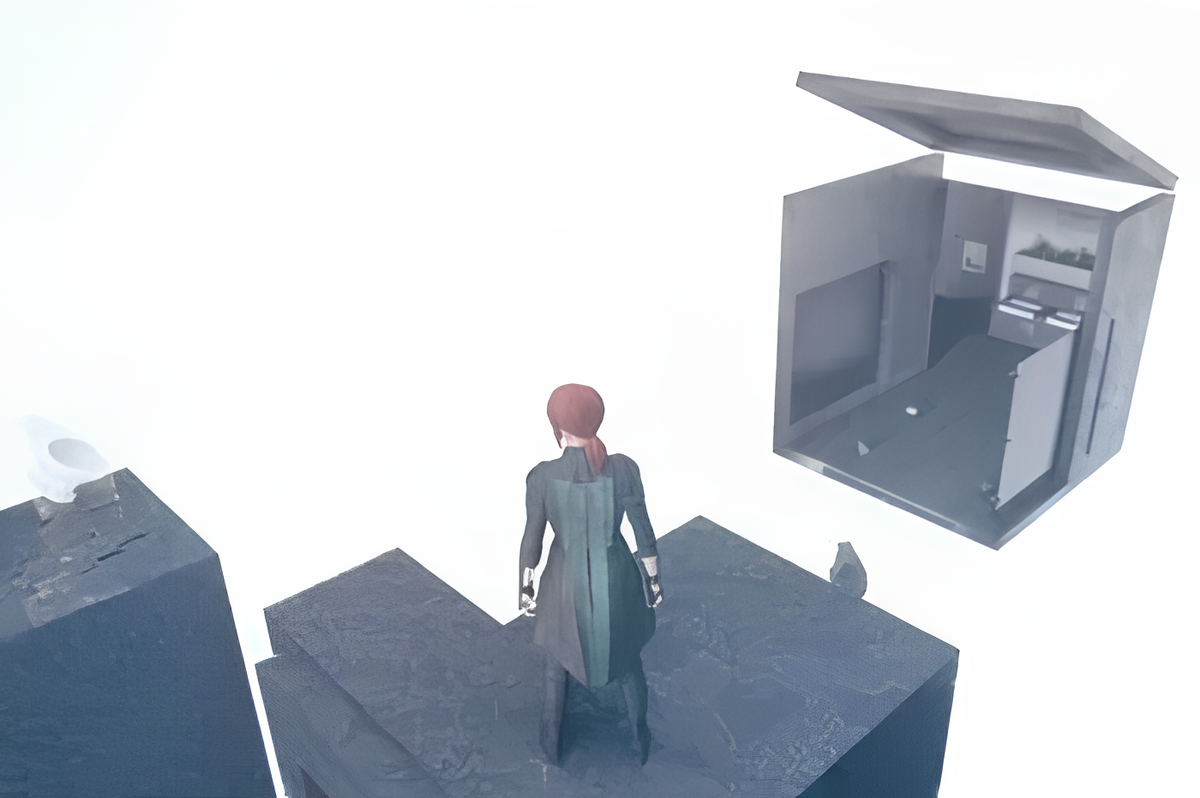
- Control establishes the physical realm, as well as the Astral Plane, an anomalous psychic dimension of mostly white void primarily occupied by the Federal Bureau of Control's ultimate overseer and ontologically ambiguous entity, the Board. The plot of the Foundation DLC hinges around parts of the Astral Plane merging with the caves below the FBC's headquarters — creating odd sights like a long-abandoned restroom leading into fragmented white space — due to damage towards a universe-binding structure called the Nail, with the mission being to repair it to stop the merging.
- Corpse Party takes this trope to extreme lengths. The protagonists are trapped in what are mentioned "closed spaces layered over closed spaces". In each chapter, the main characters you play as are all in the same school, but a different rendition of it, with events taking place before or after each other that seep into the others' dimensions. The best example is how Ayumi leaves candles for others that act as a Save Point after she and Yoshiki look for Seiko when she screams... yet when you play as Naomi and Seiko in Chapter 1, the candles were already there.
- Digimon Story: Cyber Sleuth: In the latter half and the interquel Digimon Story: Cyber Sleuth - Hacker's Memory, the Big Bad Ensemble manages to successfully merge the Digital World with reality, resulting in confused Digimon running amok across Japan and hackers being able to execute programs that function in the real world.
- Fatal Frame III: The Manor of Sleep and the waking world seem mostly separate at the beginning of the game. As the story progresses, however, things such as the photographs taken in the manor and even the manor's ghosts begin to appear in the waking world.
- Grey Area (2023): In Chapter 5, Hailey finds that various dimensions, including the Grey Area, are starting to merge with her reality.
- Guild Wars Nightfall: The world that the players inhabit becomes more like the Realm of Torment as the game goes on. Completing the merge is the goal of the bad guys, while the players are attempting to stop and reverse the process. A couple of zones actually change for particular missions in the story, and later zones in the story have a more Nightfallen feel to them as the process occurs.
- The Legend of Zelda: Twilight Princess: The Encroachment of the Twilight Realm upon Hyrule, which fills the region with terrifying beasts, many of them former natives and wildlife of the land corrupted into monstrous forms by the Twilight, and turns humans and hylians into spirits (and in Link's case, a wolf). Unlike most Dark Worlds seen in the Zelda series, very little of the Twilight Realm itself is seen except when overlaid onto Hyrule.
- The Longest Journey: The technological world of Stark and the magical Arcadia are usually insulated from each other. However, when the Balance between them begins to falter in the beginning of the game, weird stuff begins to happen in both worlds, such as a TV show about rainforests transporting the viewers into an actual rainforest, or a handheld calculator trapping a mage tampering with it inside. The sequels also establish that some of the more fantastic technology in Stark (FTL and the like) were only possible due to the bleed from Arcadia, and once that rift was sealed, all that fancy tech stopped working, creating a major societal disruption.
- Persona:
- Persona 2: The Big Bad starts making every false rumor and conspiracy theory become real just For the Evulz. The good guys exploit the bad guy's efforts by spreading rumors convenient to them.
- Persona 3: The Dark Hour is the result of a realm in the collective unconscious briefly merging with the real world, making P3 the only game, barring one Non-Standard Game Over in P4 below, where Shadows appear in the real world, as opposed to the heroes traveling to such a realm whose Shadows are causing trouble in the real world.
- Persona 4: The mysterious fog from the Midnight Channel begins to form a perpetual cloud over Inaba in the last act of the game as a result of Adachi's plan to cause The End of the World as We Know It and merge the two realities, allowing the Shadows to run wild in the real world and kill people indiscriminately. This comes to pass in the penultimate Non-Standard Game Over if you fail to defeat Adachi in time.
- Persona 5: The Final Boss Yaldabaoth gradually merges Mementos and the real world as part of his plan to exert control over the collective consciousness of mankind. In Royal, Well-Intentioned Extremist Dr. Maruki sought to create a "utopian" version of reality by using the Reality Warper abilities he gained from Yaldabaoth's defeat to create a Lotus-Eater Machine style overlay on top of it, creating a Race Against Time to stop him before his reality completely overwrites the real one.
- Persona 5: The Phantom X: The Crossroads of Fate arcs are speculated by the Phantom Thieves in-universe to be this, as elements of the Palace Rulers of The Phantom X are merging with a past/currently explored palace that the Phantom Thieves of Hearts are working through at the time of their meeting. This results in things like Miyazawa's appearance being overlaid on top of Kaneshiro's humanoid boss form, or puzzles from Kiuchi's Baseball-themed Palace being integrated into Kamoshida's castle. The Spaceport arc has the Thieves comment on the merged worlds, and where they are is separate from either reality and ponder on what kind of godlike power could do such a thing.
- Pokémon Legends: Z-A's Mega Dimension expansion revolved around Hyperspace Lumiose, a Dream Land created by Mega Darkrai's Super-Power Meltdown where normal rules of reality like the level cap don't apply. Portals to it start appearing all over the city, and the Player Character is tasked with finding a way to stop it from leaking into reality any further and flooding the world with unnaturally strong Pokémon.
- Puyo Puyo Tetris: The Excuse Plot for Story Mode is that the worlds of Puyo Puyo and Tetris are colliding for some reason, causing Primp Town to be covered in Tetriminoes and Tee's spaceship to be flooded with Puyos.
- Shadow Warrior 2 sees the Shadow Realm merging with the human world as a result of Lo Wang's actions in the first game, with the wildlands constantly changing, creating a strange and savage new order where humans and demons live side by side.
- In Shin Megami Tensei V, the remnants of humanity live in a tiny bubble of reality imitating the pre-apocalypse Tokyo. However, late in the game, it's shown the bubble is running on finite energy and the false reality is starting to collapse into the devastated real world, leaving everyone on a countdown to take control of the Temple of Eternity and fix the world before the remaining humans get dumped on a hostile desert surrounded by hungry demons.
- Visions & Voices is an RPG Maker work set in a small village that starts out relatively normal. Then mirrors become portals to bizarro versions of the real world, other objects become portals to fantastic dungeons, strange buildings appear, and finally every building in town becomes linked through a bizarre, monster-filled flesh dungeon.
- Wild ARMs 2: The source of most of the plot's conflict is an "encroaching Alternate Universe". The only way to fight this is through a LOT of magic and plot twists that temporarily give it physical form.
- Xenoblade Chronicles 3: Aionios is a result of the worlds of Bionis and Alrest coming into contact and colliding. The people of both worlds build an ark—Origin—that would record the lives and data of the worlds and their people in order to reboot them after the collision annihilates both worlds. However, Z, the embodiment of humanity's anxiety over Origin's success, hijacked Origin, froze both worlds mid-collision, and created Aionios as an "endless now" where no one has to worry about the future. The protagonists' goal is to defeat Z and get Origin running again, at the cost of Aionios and the new life that spawned there. The ending as well as the prequel DLC Future Redeemed shows that Origin succeeds, and the worlds eventually merge properly without destroying each other.
- Gravity Falls: According to the Author of the Journals, the weirdness of the titular town is largely being drawn from a decaying parallel dimension of chaos and nightmares. The ultimate plan of the Big Bad Bill Cipher is to merge this Nightmare Realm with the physical world in order to turn it into a nightmarish World of Chaos for him and the rest of the Dream Demons to invade and rule as their personal playground. After Bill successfully unleashes Weirdmageddon upon Gravity Falls in the finale, Dipper must find and rally his allies to fight back and liberate the town before Bill can spread his influence throughout the entire universe.
- The Real Ghostbusters:
- "Knock, Knock": After opening a doorway that was supposed to remain closed until Doomsday, the ghost world starts entering our plane and turning things into monstrous versions of themselves (for example, trains into worm-like monsters). This was intended to be what would happen to the world After the End.
- "You Can't Teach an Old Demon New Tricks": After travelling to a demonic dimension through a magician's cabinet (and finding dozens of beautiful assistants and doves), the Ghostbusters meet a demon obsessed with becoming a magician. He agrees to let them back to their home dimension if Ray teaches him magic. Unfortunately, after Peter opens the doorway, both dimensions start mixing and New York starts turning into the demon's hellish dimension.
- Young Justice: Granny Goodness' Evil Plan in a story arc involves building a machine that will overlay the Ghost Dimension across the universe. This will provoke an instinctual reaction in the Mother Box turned human Halo to broadcast the Anti-Life Equation, enthralling all mortals exposed to it into Darkseid's total control.
- One of the hypotheses for the CMB Cold Spot
 , also known as the Eridanus Supervoid — a zone of the universe where the cosmic microwave background is much colder than other areas and matter is relatively scarce — is that it's a scar left behind when our universe brushed up with another.