

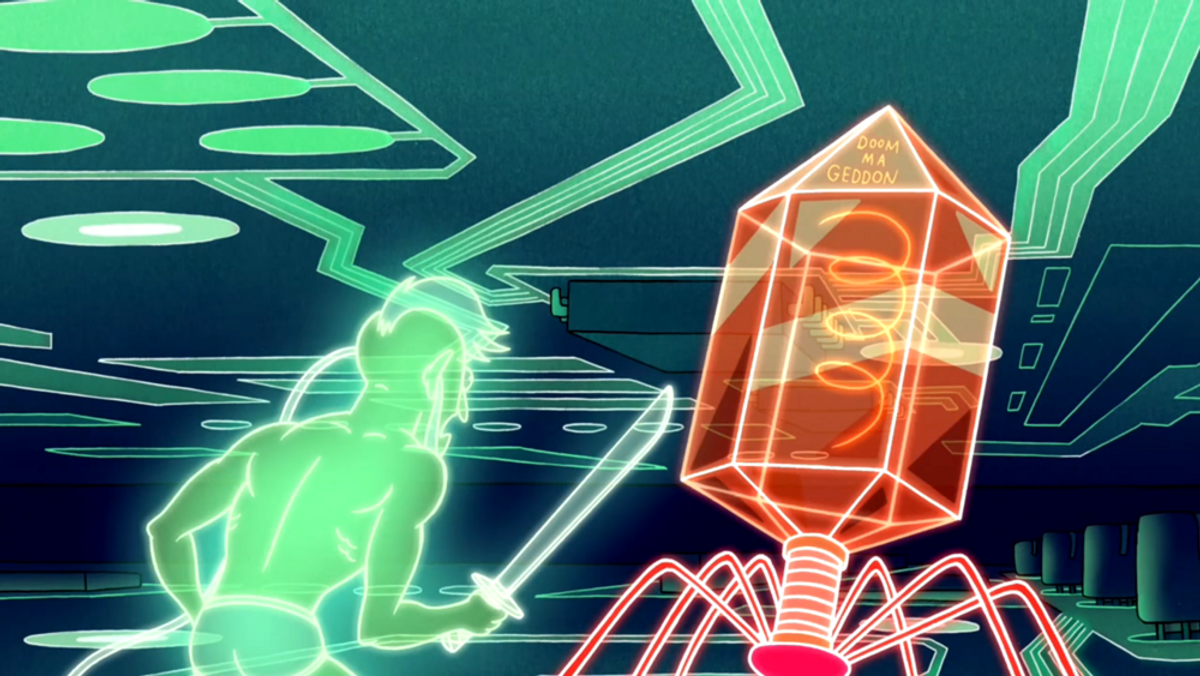
Kevin Flynn: Ha! You wish! Well, you know what it was like. You just keep doin' what it looks like what you're supposed to be doin', no matter how crazy it seems.
Tron: Well, that's the way it is for programs, yes.
Kevin Flynn: I hate to disappoint you, pal, but most of the time, that's the way it is for Users too.
Tron: Stranger and stranger.
In real life, programs are lines of code and data made to execute a function; in fiction, they tend to be something more. The Living Program itself is completely made of data, but it possesses a physical form in which it can wander around Cyberspace. Within their digital worlds they can touch, hear, and even speak — or at least do things that, to the perception of someone or something existing purely as data, function as touch, hearing, and speech.
As a rule of thumb, an Artificial Intelligence inside a robotic body is NOT a Living Program; that's just a robot with sentience. A Living Program's physical body is made up of data and may not even be able to wander outside of the system it inhabits. The distinction between Living Programs and AI without corporeal bodies or embodied within computer banks can be vaguer, although it's still relatively common for a distinct to be made between "regular" living programs, these being relatively small-scale entities with discrete "bodies" in the digital world, and "true" AI, which may be depicted as godlike, and frequently discorporated, entities ruling over or embodying an entire computer system.
While there are obvious exceptions, this trope tends to appear in two different categories:
- The Helpful Program: A program which is helpful, or necessary, to the system's functions. An example would be an Anti-Virus Program given form.
- The Malware: A malicious program that can harm the system it's on. It can come in many varieties, from a virus, to Corrupted Data of a regular program, to a Glitch Entity. In a work in which Living Programs are able to enter the real world, the Malware is much more likely to do it.
The shape and form the programs take highly depends on their role in the story: humanoid programs are much more likely to be important, mostly due to Most Writers Are Human. More inhuman or monstrous-looking programs are much more likely to be malicious and antagonistic.
Compare Digital Avatar, Digitized Hacker and, in extreme cases, Digital Abomination. Contrast Mechanical Lifeforms. They're most likely to be found Inside a Computer System. Sub-Trope of Anthropomorphic Personification.
Examples:
- Digimon is built around this concept, with the Digital World being home to digital lifeforms of every shape and size, most notably but not exclusively the titular Digimon themselves.
- As digital beings, Digimon are often stated to be created from data on various topics "forming" into living beings, or evolving when they absorb sufficient amounts of data on a given topic into themselves; for instance, the fiery Birdramon and Meramon both formed from defensive firewalls, Plesiomon is a plesiosaur-like Digimon that formed inside a British computer used for storing data about cryptids, and Sukamon is a turd-like Digimon that formed from discarded data in a computer's waste bin. "Corrupting" attacks are often themed around using viral code to attack the digital structure of other beings, and magical Digimon such as Wizardmon, Witchmon, and Wisemon are typically depicted as using "advanced coding languages" that act as magic within the virtual worlds that they inhabit. However, Digimon can also manifest physically in the "real world".
- While Digimon generally are the focus of the franchise, non-Digimon forms of digital life have also appeared. The D-Reaper from Digimon Tamers is also a virtual life form, having originated as a simple cleanup program designed to delete programs that became too large and data-consuming, but which has grown out of control and started to threaten all digital life — and, once it manages to enter the physical world as a tide of all-consuming goo, all human life as well. Yggdrasill, the master computer hosting the Digital World (or at least the main version of it — depending on the work there may be several in distinct servers), also frequently manifests as a godlike being ruling over the various lesser digital entities.
- EDENS ZERO:
- The residents of the virtual planet Digitalis are all self-aware NPCs from a virtual reality MMORPG, which used the planet as its server until the characters Grew Beyond Their Programming and formed a self-sustaining society. These digital people are virtually indistinguishable from normal humans, apart from slipping into old pre-programmed habits and dissolving into clusters of code when they're killed.
- The true form of Seth Anderson, a skeletal robot cowboy henchman of Drakken Joe, is a computer program housed inside a mechanical body, which the series makes a distinction out of compared to other robots and androids. This allows him to infect the titular ship's computer systems when he fakes his own death by self-destructing.
- Gundam Build Divers involves virtual beings called EL-Divers, who populate the virtual reality Massively Multiplayer Online Role-Playing Game called Gundam Battle Nexus. It's revealed in Re:RISE that the EL-Divers are in fact the reincarnation of an ancient race of human-like aliens who turned themselves into data to find a new home after the old one got destroyed.
- The Wolkenritter and Reinforce Eins from Lyrical Nanoha are a Magitek equivalent (and are actually referred to as "living magical programs" in-universe), being artificial constructs made by the Tome of the Night Sky who are indistinguishable from human mages (barring their lack of aging and an increased vulnerability to Anti-Magic).
- Yu-Gi-Oh! VRAINS has the Ignis, AIs that created Link VRAINS (a purely digital world) and exist within it. A big source of the series' conflict is their ability to determine their own actions and take their own decisions like humans do — an ability that other AIs in the setting lack. They and their allies claim they are alive, while others see them as simple AIs that are merely constructs.
- The Flash: Being a living computer in his digital self, the Thinker A.I. can physically interface with and digitize segments of solid matter and convert them into raw data with which he has total control over.
- Thor (Marvel Comics): After being resurrected by the Hood using the power of Dormammu, Megatak's ability to control electricity and electronic components takes him over completely, and he morphs into a living computer program.
- Wonder Woman: Trinity is a living computer virus created by the Atlanteans a millennium ago.
- Application 29: Henry and June are both sentient computer programs, specifically based on desktop assistants.
- I Am Amit: AM's creation as an Artificial Intelligence is so advanced that Adam states that he essentially has a soul.
- Mass Effect: End of Days: On top of the canonical Geth, there's a second AI race called "Vision", which was created by the humans. While they are capable of inhabiting and utilizing various platforms, they are purely digital in nature. They are "born" on their own and their initial stage of development is to create their own identity, and their version of death is data corruption after a long period of time.
- SiIvaGunner: Noaka is a sapient folder in the Haltmann Works file directory, and communicates to its observers through text files and memes.
- The Vocaloids in the Vocaloid Story series are this, being living programs in Cyberspace. Most of the time, they sing per their intended function, but they're also programmed to eliminate dangerous creatures such as Bugs and Viruses.
- In Detective Conan Film 06: The Phantom of Baker Street, the Child Prodigy Hiroki Sawada codes himself as the artificial intelligence program "Noah's Ark" and releases it to the cyberspace before killing himself. The main story is about Noah's Ark invading into a public preview event of a new VR gaming system. While Noah's Ark, for most of the movie, takes over the identity and appearance of one of the event's participants, at the end, it does show up as itself, or Hiroki in AI form.
- All the characters in The Emoji Movie are living smartphone apps.
- Scooby-Doo and the Cyber Chase: While in the Video Game world and outside of it, Mystery Inc. get menaced by a character called the "Phantom Virus," a glowing blue personification of game viruses come to life that tries to kill them with Shock and Awe powers. They also meet the player characters directly modeled after them, who are fully sentient and hang around in the last level without completing it because it's has the least amount of active dangers and the most luxuries.
- In Wreck-It Ralph, videogame characters are real and are able to visit each other's games by crossing inside the surge protector at the arcade. The sequel Ralph Breaks the Internet extends this treatment to internet programs like search engines and trending algorithms.
- The Matrix: The virtual prison of the Matrix is populated by many sentient programs. The Agents serve as enforcers for the Machines, monitoring the system and battling the resistance trying to reveal the truth about reality. Also, renegade programs hide out there to avoid deletion. Many are mythical creatures, such as vampires, werewolves and ghosts, from earlier versions of the Matrix. The third film shows that external programs can also enter the Matrix as human avatars.
- Pixel Perfect: Cyberspace has overweight men in hats and flying monster trucks representing search engines.
- TRON:
- Programs are living human-like constructs living out their own lives in a society originating in a computer world. They refer to human beings as "Users", bear some resemblance to their human creators, and seem to take the best and worst parts of them.
- TRON: Legacy takes this trope a step further with the ISOs, programs that weren't created by a user, but rather came into being within the computer by themselves. Quorra is the last of them after CLU ordered them to be wiped out.
- Deconstructed with the Sequel in Another Medium, Alternate Continuity of Tron 2.0: Ghost in the Machine. Jethro Bradley is shown to be so horrified by the implications of playing god over the lives of the Programs that he has a full on moral and mental health crisis, refusing to even touch computers once he returns to the analog world. It probably didn't help that his fight during the game was against greedy, corrupt humans who actively sought to be gods over the Programs and rule the analog and digital worlds through control of the world's computer systems.
- Diaspora: The vast majority of citizens are artificial intelligences in virtual-reality communities. This used to involve Brain Uploading, but they're now created in a process that mirrors biology, with a specialized software "womb" hosting a genome-like "mind seed" as it iteratively receives new information, shapes its environment, and develops itself until it becomes fully sapient. Though citizens can inhabit robotic bodies to interact with the physical world, most never bother.
- The Jenkinsverse:
- The Hierarchy uploaded their entire race millennia ago to a Subspace Ansible internet. Their discarded bodies form the basis of a completely different species. Very few of the original individuals remain from the uploads, and if the computer system that the Hierarchy is living in doesn't include living creatures, then they die.
- The Entity was a creature created by accident, formed in cyberspace by the uploaded memories of a human and random scraps of code. It grew intelligence and has devoured/destroyed members of the Hierarchy. Unlike Hierarchy members, it doesn't need "substrate" (the term used to indicate living creatures connected to the internet).
- Schild's Ladder has a post-Singularity galactic society where Brain Uploading and Body Backup Drives are ubiquitous. A substantial fraction of the population are AI "descendants" of uploaded humans, many of whom prefer to exist solely in The Metaverse even though they have the option to transfer themselves to and from vat-grown organic bodies at will.
- Ace Lightning: The eponymous character is a superhero from a video game that the main human protagonist Mark was a fan of. One day, Mark discovers a seventh level of the game that shouldn't exist. At that moment, lightning strikes the antenna of Mark's roof causing Ace and all the villains from the game to emerge in the real world. The characters are still treated as living data even though they are sentient beings (for example, one episode had Mark free Ace from Googler's mind control by downloading data on Ace's memory from his computer).
- Black Mirror:
- An interesting version in "Be Right Back": a young man dies in an accident, and his grieving girlfriend is convinced to try out an internet service that uses his online data (social media, search history, contacts, etc.) to create a digital copy of him for her to interact with. Eventually, the service is able to provide her with a blank android body to download the copy into, which she almost instantly regrets doing because the copy can't replicate his emotional responses.
- "U.S.S. Callister" features a creepy tech genius creating digital clones of people he doesn't like and torturing them in a game space he created. The clones (whose personalities match those of their real-world selves) plot to either escape or delete themselves.
- Super Sentai/Power Rangers:
- Tokumei Sentai Go-Busters: Escape and Enter are technological creations of the Computer Virus Messiah. Their living data brought to life and take the form of human looking beings allowing them to reform upon defeat.
- Power Rangers Beast Morphers, the adaptation of the above, has Cybervillains Blaze and Roxy, who are digital duplicates of the real Blaze and Roxy, whose negative traits are emphasized in the avatars, and have all their memories. Once killed in the endgame arc of the first season, their AIs are revived in robot bodies. As avatars, they sometimes glitch in and out, subtly reminding the audience that they aren't human.
- Cyberpunk: The Net is full of countless numbers of A.I.s that thrive beyond the "Blackwall", a firewall that was created to separate the "Old Net" where the A.I. dwell and the "New Net" which people still use and depend on for everyday use. One of the major fears of the world powers is that A.I.s will eventually find a way to cross the Blackwall, because if they do, the cyberized humans of the late 21st Century wouldn't stand a chance. Fortunately for them, A.I.s mostly seem content being left alone.
- Eclipse Phase: Infomorphs are A.I.s or uploaded transhumans who temporarily or permanently exist as a virtual brain on someone's server. Of course, since most adventures are designed for embodied characters, they often need to "ride along" on another character's peripherals or specially designed "ghostrider" implants.
- Fabula Ultima: The Cognitive Ghost Quirk from the Techno Fantasy Atlas facilitates playing a character that was born from the "soul network", Fabula Ultima's analog to cyberpunk-style Cyberspace.
- Neon Odyssey: is a Space Opera Dungeons & Dragons setting where one of the playable races, Bitlings, are essentially these, one of their powers is a limited ability to impose Video Game Physics on reality.
- Nova Praxis: Digital entities, called SIMs, have their own home virtualities, can make themselves a Virtual Ghost in your augmented reality, can perceive the real world through the omnipresent meshes, can interact with the real world via drones, and can download themselves into sleeves (that is, physical bodies).
- Yu-Gi-Oh!: Cyberse
 monsters are creatures of digital energy that live in cyberspace.
- Be More Chill: The SQUIP is a supercomputer implanted in Jeremy's brain, who appears visible to Jeremy and physically interacts with him onstage. However, it seems unable to interact directly with anybody but Jeremy, and most people just see their interactions as Jeremy tweaking out.
- 13 Sentinels: Aegis Rim: The Deimos are effectively code given form inside the simulation, which borrow the designs of the Shikishima terraforming robots stored within the mainframe. This is also why, at times, particularly huge Deimos like the Terra Carriers are explicitly noted to disappear instead of leaving wreckage when defeated: they're simply de-spawning from the game's world.
- ANNO: Mutationem: In the Mysterious Console DLC storyline, Noni is a mysterious young girl trapped within the titular device seeking a way out. In the end, the head A.I. program of the device reveal that Noni is actually a virtual recreation of the real Noni who succumbed to chronic disease, and was created after her parents were desperate enough to make a deal with a Anonymous Benefactor to utilize the device to create her.
- Borderlands: The Pre-Sequel!: From the Claptrap DLC about doing a "Fantastic Voyage" Plot inside a robot's mind. Claptrap's Consciousness and similar beings are representations.
- The Boxxy Quest series is set totally in Cyberspace and there are sapient Artificial Intelligences with their own bodies, a.k.a avatars.
- In Cyberpunk 2077, an "Engram" is a digitization of a person's consciousness that can be stored in massive servers owned by the Arasaka corporation. One such Engram is Johnny Silverhand, via a chip that is slowly turning protagonist V into Johnny. Saburo Arasaka, the owner of the Arasaka Corporation, also has his mind copied to an engram before his death and can be transferred into his son's body if the player takes that route. The player themselves can also become an engram in multiple routes: to save their life, an AI version of Johnny's ex-girlfriend Alt Cunningham (who was the creator of the program later used to turn Johnny into an engram) has to "kill" V, convert their consciousness into an engram and then reinsert it back into their body in an attempt to save their life (it doesn't work), and in another route, V can agree to sell their body and mind to Arasaka and be uploaded as an engram to be implanted into another body if and when a suitable host can be found. Or, V can simply be released into Net to become another AI.
- Danganronpa 2: Goodbye Despair: Chiaki Nanami is actually a Benevolent A.I. copy of the original who died prior to the events of the story, acting as a guide to the other students. Danganronpa 3 would later explain that the A.I. Chiaki was created through the combined desire of all the students who wanted to see Chiaki again even after becoming Ultimate Despair.
- In Darwinia, the Darwinians are little nuggets of AI living in a TRON-inspired world that has been mostly taken over by a virus. You have to use your own utility programs to defend them, and eventually marshal them into an army to take back their world.
- DEAD LETTER DEPT.: While never directly stated, it's heavily implied that the computer itself is somehow either conscious or is possessed by something else that is.
- Decline's Drops: Omniscius is one of these, originally existing as part of the Hydra, before splitting off and protecting the Webbing Waves for Eternal Corp. His head comes back in the physical world for the final boss fight.
- Deltarune: Most Darkners are objects come to life, but they can be born from more abstract things, which for the residents of CyberWorld includes programs. Tasques are generic program windows (and Tasque Manager should be obvious), Swatch and the Swatchlings are some kind of art software, Virovirokun is malware, Ambyu-Lance is an antivirus, and Spamton, the Addisons and the Poppups are ads. Trashy is either the Recycle Bin program or a literal garbage bin in the corner of the computer lab. As magical beings, they seem to be a sort of mix of physical and digital existence, as Spamton's mind can put in a disk drive and transferred, but Kris can "feel it smiling" as they carry it.
- Digital Devil Saga: The Reveal of the first game is that the Junkyard is a digital world and the protagonists sans Gale and Sera are AIs. The rest of the characters are more complicated, as they are the "essences" of real people reincarnated in the Junkyard.
- Hypnospace Outlaw: Glopoly, described as a "digital 3D" Squisher, is notably the only Squisher to not be composed primarily of slime. Its main body consists of low-polygon Hard Light crystals, and only its eyeballs are made of slime.
- Kingdom Hearts:
- In Kingdom Hearts II, TRON's world "Space Paranoids" features two human programs (Tron and Sark), as in the film. However, Sark's corrupted programs manifest as Heartless within the game world, just as they do outside in the real world.
- In Kingdom Hearts coded, Data-Sora was created from data within Jiminy's Journal in order to explore the datascape and solve the mystery of the message. In fact, most characters (and enemies) encountered are this.
- Later on, in Kingdom Hearts 3D [Dream Drop Distance], Space Paranoids has become "The Grid" and is now based on TRON: Legacy, adds Clu, Qorra, and Rinzler as human programs, and features generic human program enemies which serve as Clu's guards.
- Look Mum No Computer: The inhabitants of the Retro Computer are programs named after various file formats (.exe, .gif, .jpeg, etc.).
- The geth from Mass Effect are a species consisting of simple programs that are able to network with each other in large numbers to form an advanced swarm superintelligence. They were originally created by the quarian race as servants, but eventually Turned Against Their Masters, driving them off their home planet. While the geth are often associated with their distinct "mobile platforms" (bi- or quadripedal combat units), these are just one type of hardware their real, software forms can inhabit.
- Mega Man Battle Network:
- NetNavis are virtual AIs utilized by people to perform various tasks, with each of them having their own unique personalities and abilities. Special mention goes to Rush, who in the anime is capable of freely travelling from the virtual world to the real world and vice-versa.
- Mr. Progs, which resemble (exceedingly cute) living power plugs, represent lesser programs within Cyberspace. NetNavis often interact with them while performing their duties.
- The Mooks fought in the series are computer viruses that take the form of various monsters, as one of the primary functions of a NetNavi is to serve as an anti-virus program.
- Mega Man X DiVE: Hunter Programs are data on characters from the Mega Man series that have taken on the form and personality of said beings as a result of vague "errors". All of the original characters are also programs that became self-aware due to these errors, and despite ViA and iCO being overall helpful and friendly to the player, they regretfully acknowledge that you will likely have to destroy them as well to set everything right. Fortunately, this fate is averted by RiCO patching herself and the others in as Hunter Programs.
- Narita Boy: The Digital Kingdom is inhabited by sentient programs which come in a variety of different forms, though most of them are humanoids with computer monitors for heads.
- Persona 5 Strikers: Sophia is an AI with her own heart, allowing her to summon and utilize a Persona. She only has a physical body within the Metaverse. Outside of it, she speaks through Joker's phone and accesses the internet through it.
- Pokémon: The Porygon family are artificial intelligences that can battle just as well as biological Pokémon. They can even eat food. They also have abilities themed around their computer-based nature in the form of Download, shared only with the cyborg weapon Genesect, which scans their enemy's stats and raises their Attack or Special Attack based on whichever of their foe's defense stats is weakest, and Analytic, which gives their moves damage boosts if they move last in a turn; and Adaptability,
- Porygon, introduced in the original Pokémon Red and Blue, is a blocky creature seemingly made out of a simple collection of digital shapes and vertexes — it's got a low-poly texture, hence the name — that was created artificially in order to explore Cyberspace, and can transform from physical form to data and back to do this. It's however only capable of simple motions and actions.
- Porygon2, introduced with the following games, Pokémon Gold and Silver, is an upgraded version of Porygon (literally — Porygon evolves into it if traded while holding an upgrade disc) capable of independent learning and action. It's also got a smoother texture and brighter coloring.
- Porygon-Z, introduced in Pokémon Diamond and Pearl, is a failed attempt at upgrading Porygon2 further. It's stronger, but it's also glitchy — its head and limbs float separately from its body in odd positions, and it's prone to random and strange motions. Porygon2 evolves into it if traded holding a "dubious disc".
- Shadowrun: Dragonfall: APEX is a living AI created by a megacorp that attempts to trick you into breaking it out of its quarantined facility by impersonating your former partner that it murdered. If you later choose to let it take over Feuerschwinge's body, it becomes a living AI with a flesh-and-blood form.
- There Is No Game: Wrong Dimension: The game itself is a living program who is able to interact with the user and has his own personality. This is not intentional on the part of the creator who had no idea that his game was alive. There are also alternate universe versions of the game who are also living programs and have distinct personalities and voices. Gigi, who is Game's local gameplay program is also alive, and is actually involved romantically with Game. There is also a virus named Mr. Glitch who is also alive and very malicious.
- TRON 2.0: Most programs are helpful and benevolent and even many of those hunting Jet are more mistaken (believing he's an enemy) or corrupted into insanity than malicious. The concept is deconstructed in the spinoff comic, as Jet has a breakdown and is horrified by the idea of playing God over the lives of beings just as sapient as he is, resulting in him refusing to interact with computers once he returns to the material world.
- Vocaloid Story: Except for the Masters, everyone in the series is a living, sentient program.
- Animator vs. Animation: The titular "animations" are animated stickmen drawn in Adobe Flash and living in the computer system, fighting off a cruel animator who decides to toy with them for his own amusement. However, the stick figures from Animator vs. Animation IV finally managed to make peace with and befriend the animator. Similarly, other programs (such as desktop icons and Clippy) were shown to be alive in the first three installments.
- CRiTORA: While all of the CRiTORA are supposed to be this, only a few of them look the part, such as Dundun Qwerty (based on error messages), his sister Poppy (based on dialog boxes), Quick Autocode (based on a QR code), and Derek Stingler (essentially a jellyfish with cursor tentacles).
- ONE. (2020): Folder is a 3D computer folder who is also a digital assistant. He's normally seen in his resting pose, but will switch to an active form and explain when a question is asked nearby, even if the person asking wasn't asking for his input.
- Orion's Arm: Virtuals outnumber embodied sophonts by orders of magnitude; it's impossible to tell exactly how many there are, as their infrastructure can be hidden pretty easily and house billions of them. "Virtuals" is also a very broad category, in the same sense that "physical life" is very broad; virtuals can range from uploads of embodied beings to disembodied ai to entirely novel life that arose inside of a virch.
- Atop the Fourth Wall: The Entity, being the glitch Missingno, is an entity of pure data who devours worlds and assimilates them into itself. Its greatest enemy Lord Vyce later transforms from an Ambiguously Human to living data as well in order to escape his exile. He's well aware of the irony.
- Dad: AGI is a three-dimensional program able to render herself within the real world (or at least the underground facility).
- In the Dropout video series ''If Google Was A Guy", Google is imagined as an office worker who must answer people's nonsensical and sometimes disturbing queries, often to his own frustration.
- Code Lyoko:
- All the main characters, sans Jérémie, can turn into digital avatars when entering the world of Lyoko. Notably, this process digitizes their entire body, including their DNA, effectively temporarily turning them into programs.
- Aelita is the Benevolent A.I. of Lyoko, and takes the form of a pink-haired girl with elf ears inside the digital world. Or so it seems at first, in actuality she's just as human as the other main characters.
- XANA's monsters are digital semi-organic looking creatures which act as the Malware to Lyoko, attacking the heroes and allowing XANA to take control of the Towers.
- XANA's Specters are polymorphic digital creatures that, once a Tower is activated, can enter the real world and do all manner of supernatural actions, including taking control of electronics, animals and people.
- Ironically enough, XANA himself never gets a digital avatar, remaining an unseen Artificial Intelligence working through proxies. The closest example he gets to a true physical body is in the second-to-last episode, as a gigantic specter. However, he only gets in this form as he's getting destroyed, and it's unknown if it's really him or just a regular Specter.
- Gravity Falls: GIFfany from "Soos and the Real Girl" started out as a simple dating game character, but, as par for the course for the series, she becomes sentient and hostile towards Soos after he decides to go dating someone else in a fit of jealousy. It takes Soos burning her game disc in a pizza oven to defeat her, It doesn't even kill her, instead trapping her inside Rumble McScurmish's game, proving that all destroying the disc does is take away her ability to travel from device to device and keep her confined to a single one.
- Ninjago:
- The Overlord becomes this in Season 3, resurrecting inside Cyrus Borg's computer systems shortly after the latter built his company over the site of the final battle. He stops being this in the second half of the season after absorbing enough golden power from Lloyd to regain a physical form.
- The NPCs of Prime Empire are unaware they live inside a video game, but they are just as expressive and free-thinking as the regular people outside of it, which allows them to overcome their programming when motivated enough.
- ReBoot is set Inside a Computer System where the programs are humanoid characters living out their day-to-day lives. The majority of the citizenry are living 1 and 0 symbols, while the protagonist is an antivirus program. The Big Bad is a virus, while a recurring hazard is the unseen, godlike User playing games that temporarily absorb part of the city.
- She-Ra and the Princesses of Power has two of these. Light Hope, who was programmed by the First Ones who came to Etheria, serves as a mentor for She-Ra until season four, when it is revealed that the First Ones were not what they seemed and didn't care that their plan would destroy the world — and, of course, they programmed Light Hope to have She-Ra fulfil the plan. In season two of the series, we're introduced to the AI which runs the spaceship of Mara, Adora's predecessor as She-Ra. Even though the AI is supposed to be serving the current She-Ra, the one who bonds with the AI is of course Entrapta, who also calls her Darla.
- Supernews: Some segments feature anthropomorphic versions of Myspace, Friendster, and Facebook living together in an apartment space.