
In this world, we engage in many practices to satisfy a wide range of aspirations and needs.
However, not all of them are very well thought out, which means that they have the tendency of eventually bringing us down.
And that's where the sustainabilitist framework, and the sustainabilitist philosophy in general, come in handy.
Table of Contents
Part 1
Introduction
Sustainabilitist philosophy summarized

In a nutshell, the sustainabilitist philosophy is simply the belief that:
All human activities, across various levels and disciplines, should be carried out in a way that addresses our needs in a sustainable way.
Here, "sustainable" simply means "able to be maintained or continued", which means that a sustainabilitist is simply a person who engages in the management of well-being — through a long-term, omni-directional perspective.
In practice, this means that they are committed to getting their needs met without destabilizing their surroundings. This is done by subjecting their practices within the "hard limits" of the system — instead of the other way around.
On the surface, this seems like a very basic thing to do, not to mention that the word "sustainable" is really kind of weak. After all, no one wants to get by at a merely baseline, "sustainable" level.
However, since sustainability automatically implies long-term, omni-directional viability, being sustainable is actually generally difficult. If anything, being sustainable usually implies an ideal way of fulfilling our needs.
Because of that, sustainability doesn't need to be replaced by other "stronger" notions such as regeneration or abundance. If anything, these notions might limit our scope or harm the system as a whole.
So the point here is that "sustainable" is actually a very, very strong word. And since many aspects of our lives are far from ideal, this leaves the sustainabilitists with an interesting role to play in this world.
Part 2
Sustainabilitist Principles
The 6 foundational criteria of sustainable practices

The world we create for ourselves is highly complex, and not all of our practices are sustainable.
Because of that, some criteria are needed to ensure that we don't destabilize the system again and again. These criteria form the basis of the so-called sustainabilitist principles, and they are:
Minimalism
Sustainable practices are minimal in terms of structure and cost. This can help reduce the amount of potential points of failure, thereby preventing catastrophes from occurring as a result of over-leverage.
Example: Adoption of minimally-processed food
Efficiency
Sustainable practices have very few bottlenecks and are efficient at getting the job done. They are often the hallmark of an elegant design.
Example: Running as a way of maintaining health
Durability
Sustainable practices can last a long time, sometimes even up to perpetuity without ever collapsing.
Example: Use of 100% ceramic cookware
Resilience
Sustainable practices are resistant against impacts and unforeseen events, and are good at absorbing the damages caused by them.
Example: Taking a daily 10-hour fast
Holism
Sustainable practices are holistic by nature, and exhibit minimal side effects on other areas of endeavor. As a result, the progress gained by them is often omni-directional.
Example: Developing ideal human characters
Self-Sufficiency
Sustainable practices function with little reliance on external sources, which makes them more autonomous and less prone to dysfunctions and inefficiencies.
Example: Daily routine of introspection
By evaluating our different practices along these six principles, we can compare and contrast their relative sustainability levels — and hopefully avoid costly mistakes many decades down the road.
Part 3
Applications
Scope of sustainabilitism, from large to small

Usually, when people talk about sustainability, they are referring to Sustainability 2.0 and the macro-level topics such as:
Environment
Deforestation, air pollution, biodiversity, soil degradation, water quality
Energy
Coal and oil extraction, nuclear proliferation, solar energy, hydroelectricity
Economy
Urban development, circular economy, inflation, sovereign debt management
Society
Ethical consumerism, public education, poverty, affordable housing
Policy
Direct democracy, resource redistribution, social services, population control
Waste Management
Zero-waste movement, biodegradable plastic, composting, landfill management
However, we can also apply the sustainabilitist philosophy to other more practical, relatable areas of human endeavors such as:
Habits
Procrastination, self-destructive habits, effective planning, habit formation
Relationship
Attractive character, authentic vulnerability, relationship management, toxicity avoidance
Lifestyle
Artificial stimulation, human domestication, music therapy, sustainable home
Business
Sustainable marketing, offer crafting, fair trade, culture building
In other words, while the sustainabilitist philosophy might sound relatively obscure, its applications are not:
If anything, sustainabilitism can be thought of as a meta-philosophy grouping many existing topics—without necessarily adhering to any particular ideology.
However, since topics related to personal sustainability are rarely explored, these will be the ones that we give an added focus to: things that actually concern us; things that we can act upon.
Part 4
Foundational Concepts
Recurring concepts critical to an accurate understanding of sustainability issues

When discussing sustainability, certain key concepts often recur in a wide variety of contexts. These concepts include, among others:
Sustainability Awareness
Sustainability often starts with the awareness that something is unsustainable or suboptimal. This awareness is what makes sustainabilization possible.
Example: Realisation of being stuck in a codependent relationship
Pseudo-problems
Non-problems that appear like problems due one's lack of long-term holistic perspective.
Example: Failure to satisfy populational energy demand
Pseudo-solution
An ill-thought-out solution which appears to solve an issue by masking the symptom — leaving the causes of the issue unsolved or destabilizing the system elsewhere.
Example: The use of blue-light blocking glasses
False Dilemma
The false illusion that only two extreme choices are possible, when in fact many intermediate alternatives are available.
Example: Veganism vs carnivorism
Snowball Effect
The effect where the impact shifts from negligible to unavoidable as a result of aggregation or compounding. It results in virtuous circle if it's good and vicious cycle if it's bad.
Example: Cross-pollination of genetically modified seed
Ripple Effect
The effect in an interconnected system where a tiny change triggers multiple consequences. It can manifest as either side benefits or unintended externalities.
Example: Consumption of refined carbohydrates on general health
Omni-directional Sufficiency
The idea of merely bypassing the thresholds in all designated dimensions — as opposed to maximizing a single metric at the cost of other metrics.
Example: The concept of freedom vs. the concept of abundance
Hormesis
The phenomenon where things that are damaging in large quantities can be actually beneficial — when administered in small quantities in a controlled setting.
Example: High-intensity interval training exercises
Duality
The phenomenon of possessing qualities of both opposing extremes. It is a necessary component of a sustainable system, where minor perturbations allow the system to self-improve and evolve.
Example: How violence leads to the reduction of violence over time
Although some of these concepts can seem a bit abstract or counter-intuitive, their understanding are crucial in getting an accurate assessment of our reality.
Part 5
Bottom-Up Approach
Sustainability stemming from the micro to the macro

Sustainabilitists are obsessed about sustainabilizations. For them, sustainability is their identity and a principle driving everything they do.
Unlike many, they understand that individuals form the basis of our system, and that without a solid grounding on sustainability awareness and practices, changes at the higher-up structures can remain temporary and futile.
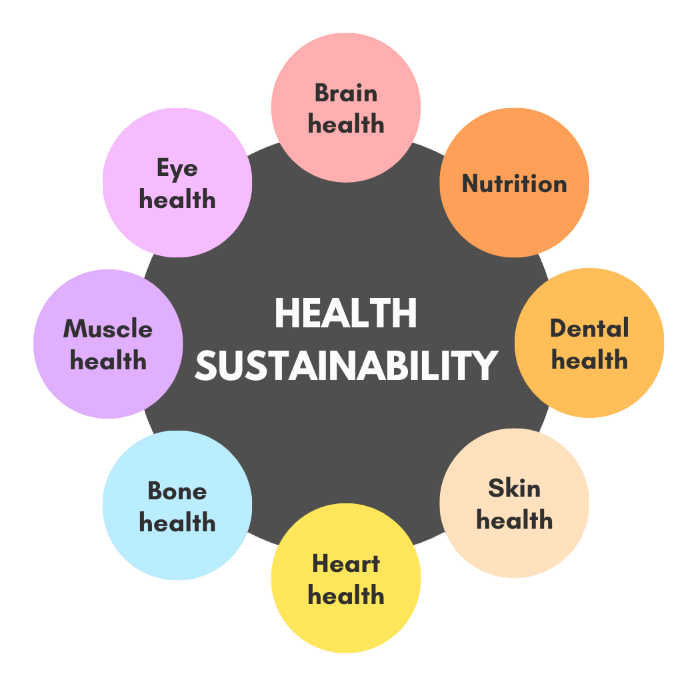
Because of that, they may begin by putting the different aspects of their health on a solid ground—by focusing on the so-called Circle of Health Sustainability.
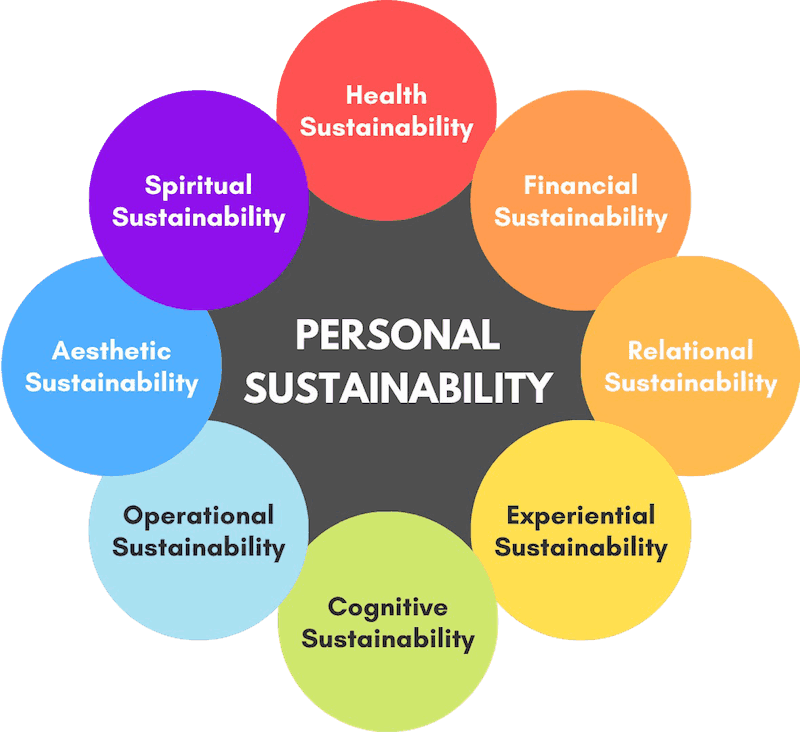
At the same time, they also understand that their health is only one of the factors at play, which is why they also take each dimension in the Circle of Personal Sustainability seriously.
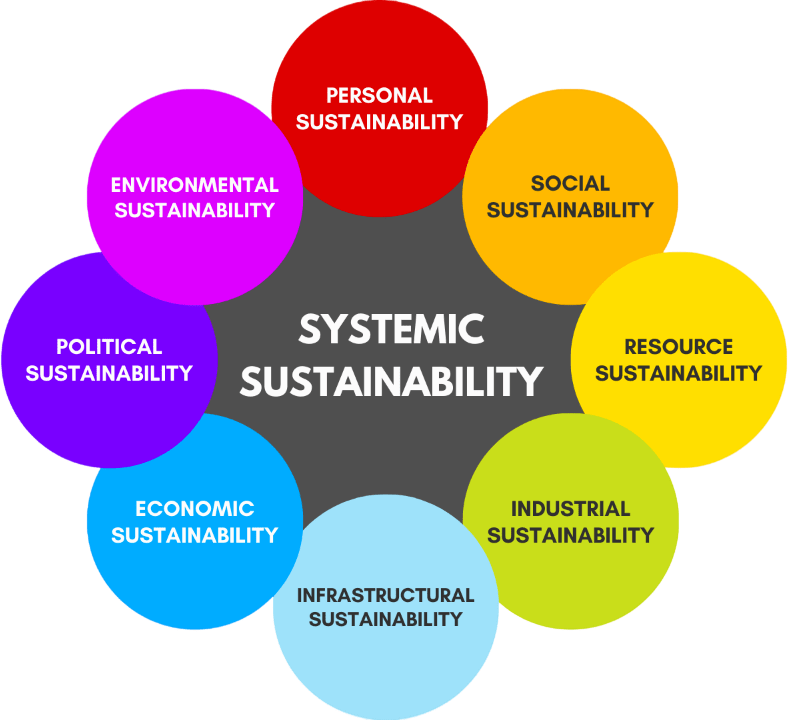
Beyond that, they also recognize that they are only a small part of the system, which is why they strive to align their actions with the entire Circle of Systemic Sustainability.
And with that, they champion sustainability by first building a strong foundation for themselves—before integrating it into every aspect of human society.
As theoretical as it is, you will be glad to know that in practice this is quite simple, because it can be summarized in the four steps outlined below:
1
Take a look around your life and surroundings
2
Identify aspects where your practices are unsustainable or suboptimal
3
Devise plans to improve the sustainability level of these practices
4
Act on the best plan and make pivots accordingly
In fact, you can even kickstart this very process right now — by taking a look at your health, finances, relationships and hobbies. You don't have to be on the verge of collapse to be a sustainabilitist — just a will to optimize the state of the matters around you will do.
After all, our time and resources are running out regardless of what we do, so it's not a bad idea to dedicate our lives to collective long-term harmony. This is why we are still here practicing and refining our craft — so that we can continue to sustainabilize ourselves and improve our external surroundings.
Better health, better finance, better community, better world
Start with our Introduction Series to see how the sustainabilitist approach can do for your life and your surroundings.