Friendship is the best (Coupling)

Fact of the Day 30th October

I've been quite lax with these this term, which is a shame because there have been some good ones!


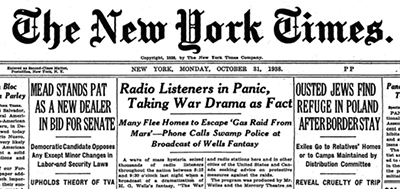
1938 Orson Welles’ radio adaptation of The War of the Worlds was first broadcast, as part of a series of one-off radio plays The Mercury Theatre on the Air.

The first two thirds of the 60-minute broadcast were presented as a series of simulated news bulletins, which suggested to many listeners that an actual alien invasion by Martians was currently in progress. Compounding the issue was the fact that the Mercury Theatre on the Air was a sustaining show (it ran without commercial breaks), adding to the program's realism. Although there were sensationalist accounts in the press about a supposed panic in response to the broadcast, the precise extent of listener response has been debated.

In the days following the adaptation, however, there was widespread outrage and panic by certain listeners, who had believed the events described in the program were real. The program's news-bulletin format was described as cruelly deceptive by some newspapers and public figures, leading to an outcry against the perpetrators of the broadcast. Despite these complaints--or perhaps in part because of them--the episode secured Welles' fame as a dramatist.
No Surprises (Coupling)

Happy Wellesely Day!


1st May 1769 – Arthur Wellesley was born in Ireland, the son of the 1st Earl of Mornington. Wellesley was commissioned as an ensign in the British Army in 1787. Serving in Ireland as aide-de-camp to two successive Lords Lieutenant of Ireland he was also elected as a Member of Parliament in the Irish House of Commons. A colonel by 1796, Wellesley saw action in the Netherlands and later in India, where he fought in the Fourth Anglo-Mysore War at the Battle of Seringapatam. He was appointed governor of Seringapatam and Mysore in 1799, and as a newly appointed major-general won a decisive victory over the Maratha Confederacy at the Battle of Assaye in 1803.

Wellesley rose to prominence as a general during the Peninsular campaign of the Napoleonic Wars, and was promoted to the rank of field marshal after leading the allied forces to victory against the French at the Battle of Vitoria in 1813. Following Napoleon's exile in 1814, he served as the ambassador to France and was granted a dukedom, becoming the 1st Duke of Wellington. During the Hundred Days in 1815, he commanded the allied army which, together with a Prussian army under Blücher, defeated Napoleon at the Battle of Waterloo. Wellesley's battle record is exemplary, ultimately participating in some 60 battles throughout his military career.

He was twice prime minister under the Tory party and oversaw the passage of the Catholic Relief Act 1829. He was prime minister from 1828–30 and served briefly in 1834. He was unable to prevent the passage of the Reform Act 1832 and continued as one of the leading figures in the House of Lords until his retirement. He remained Commander-in-Chief of the British Army until his death.

There's a pretty extensive and detailed page about him over here on Wikipedia.
Friendship is the best (Coupling)

Facts of the Day!

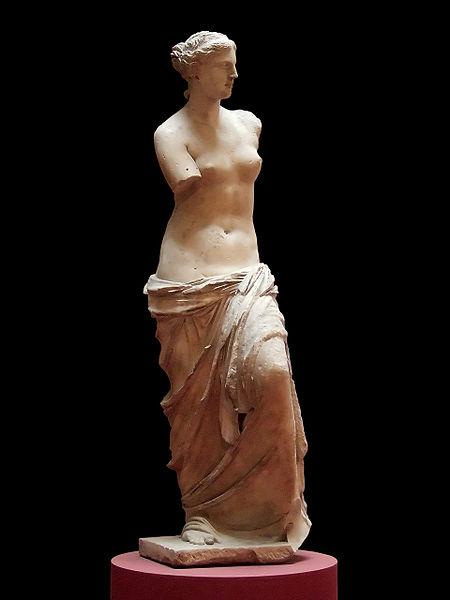
8th April 1920 – The Venus de Milo is found on the island of Milos. It was found by peasant named Yorgos Kentrotas, inside a buried niche within the ancient city ruins of Milos, the current village of Tripiti. The statue was found in two large pieces (the upper torso and the lower draped legs) along with several herms (pillars topped with heads), fragments of the upper left arm and left hand holding an apple, and an inscribed plinth. The statue was excavated by a French Naval Officer and purchased by the French ambassador to Turkey, Charles-François de Riffardeau, marquis, later duc de Rivière. It was taken to the Louvre and reassembled there, and was found to have been carved from at least six or seven blocks of Parian marble: one block for the nude torso, another block for the draped legs, another block apiece for each arm, another small block for the left foot, another block for the inscribed plinth, and finally, the separately carved herm that stood beside the statue. Created sometime between 130 and 100 BC, it is believed to depict Aphrodite, the Greek goddess of erotic love and beauty. (Venus is her name in the Roman Pantheon)

The statue used to be on the seal of the American Society of Plastic Surgeons (ASPS), one of the oldest associations of plastic surgeons in the world.


8th April 1842 – Elizabeth ‘Libbie’ Bacon was born in Monroe Michigan. Her three siblings and mother died before she was 13, and as the only surviving child she was doted on by her father, an influential judge. She graduated from her school in 1862 at the head of her class, and met her husband in the autumn of that year during the civil war - George Armstrong Custer and they married in 1864.

Once married, Libbie followed Custer wherever the army took them, refusing to be left behind. However, following the defeat of her husband’s column at the Battle of Little Big Horn – where he was also killed – many in the press, army and government placed the blame on Custer. Concerned that he was to be made a scapegoat by history, Libbie launched a one-woman campaign to save his image. She wrote many articles and gave talks – her three books Boots and Saddles (1885), Following the Guidon (1890) and Tenting on the Plains (1890) were considered brilliant pieces of literature aimed at glorifying her husband’s memory. Her efforts were hugely successful, and her portrayal of him is fixed in American lore.

Libbie never remarried, and after an initial period of difficulty dealing with Custer’s debts, she spent the rest of her life in comfort as a result of her literary career and lecture tours. She died in New York, four days before her 91st birthday, in 1933, and was buried beside her husband. Before her death, she told a writer that her greatest disappointment was that she never had a son to bear her husband’s name.