
Welcome to Softbites!

Softbites brings you digestible summaries of the latest research in soft matter.

If you have a soft spot for the science of bubbles, liquid crystals and other squishy materials you might have heard of soft matter! If you have not, this branch of physics is a fascinating interdisciplinary field studying various kinds of materials from gels to biological systems. They all share the fact that they are soft, which means they are not exactly solid nor liquid. For instance, if you poke a bit of foam, it will resist like a solid at short times, but it will flow at longer times.

Read our posts to find out more about soft matter!

Recent posts

Check out our latest posts!

We write about colloids, gels, biomechanics and many other squishy subjects! We are inspired by the most recent papers and the classics as well.

Untangling the mystery of shape-morphing worm swarms

Many of us would have tied several knots very easily, but we all remember the frustration when trying to untangle the cords of a headphone – an experience that often tests our patience. Now imagine a creature that not only creates a tangled ball out of itself and its companions in minutes but can also untangle the entire knot in milliseconds if it senses danger. Meet the California blackworm (Lumbriculus variegatus), a small yet remarkable organism that is teaching researchers innovative lessons about managing tangles.

The Cell with the Dragon Tattoo?

Introducing the tattoo your boss won’t see, researchers at Johns Hopkins University have developed a “cell tattooing” system that can be used to print patterns onto individual cells. And if that wasn’t enough, it’s gold! The work might not turn out to be the next big thing in fashion, but may allow us to track the health of individual cells as an early indicator of organ-level diseases.

“Spleen-on-a-chip” gives an inside view of sickle cell disease

Though they may not realise it, anyone who’s taken the subway at rush hour knows how a red blood cell feels passing through the human spleen. Almost home now, just need to get through the gates; but wait, someone’s ticket isn’t working, the crowd is starting to push, the gates are getting jammed… Maybe you should have called a cab.

Who are we?

Softbites is run by a group of young scientists who want to attract a wider audience to the beautiful world of soft matter.

We are researchers with a common interest in Soft Matter  science from all over the world. Writing for Softbites is a way of sharing our passion for soft matter. We would especially love to attract younger students to research by explaining fascinating research papers, which are often technical and intimidating for people outside the field.

Meet the Softbites team!


Where are we from?

Softbites’ authors write from all over the world!


How do we work?

Softbites is a peer-reviewed science communication blog. Each of our posts is managed by an editor who sends it to a team of reviewers (a content reviewer and a style reviewer). Our goal is to make sure the original article has been faithfully presented. We also want to provide our authors and reviewers with a science publishing experience. We are happy to share with you our style guide, if you want to dig more into our writing organization!

Become a writer

If you want to become a Softbites writer, or you just want to get in touch with us, please reach out at [email protected]!

Our friends

We are proud to be part of the ScienceBites galaxy.

Following the concept developed by Astrobites since 2010, other ScienceBites sites write bite-sized science posts. You should definitely check them out!

Thanks to The Lutetium Project!

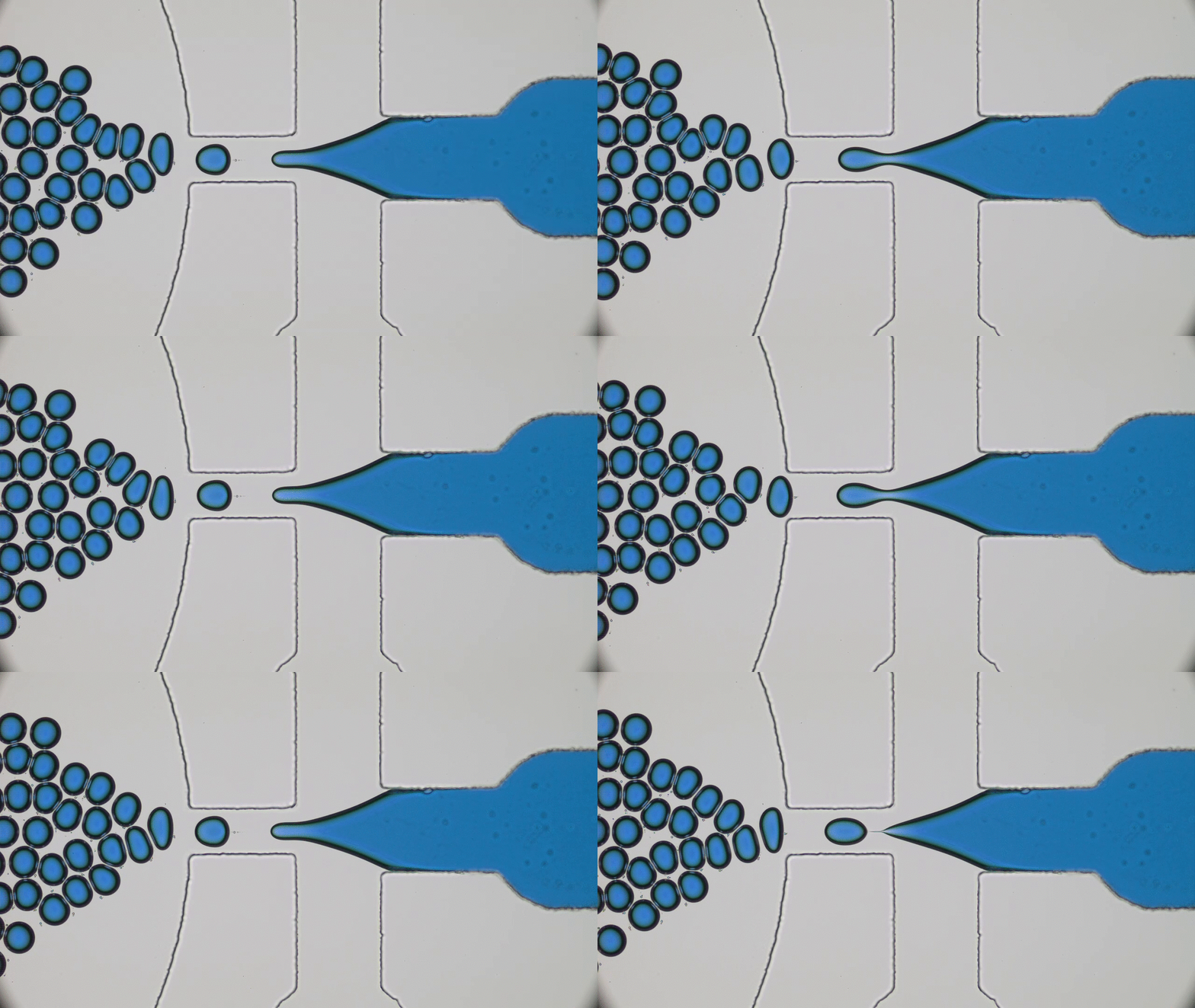
Most of the beautiful pictures and videos illustrating this website have been kindly provided by our friends from the Lutetium Project. They run a YouTube channel featuring the connections between art and soft matter. You MUST check them out! Especially this video, which most of the footages illustrating this website have been extracted from.

Supporting partners

We are deeply grateful to the American Astronomical Society for hosting our website!

They are long-standing partners of the ScienceBites sites.