
Resources
SAR’s Indian Arts Research Center has served thousands of students through curricula, virtual exhibitions, student tours and community program. Exhibiting institutions around the world borrow or work with IARC collections for exhibitions and programs. These educational and museum resources offer ways to engage with the collections on campus and extend the impact of our community’s scholarship beyond campus.

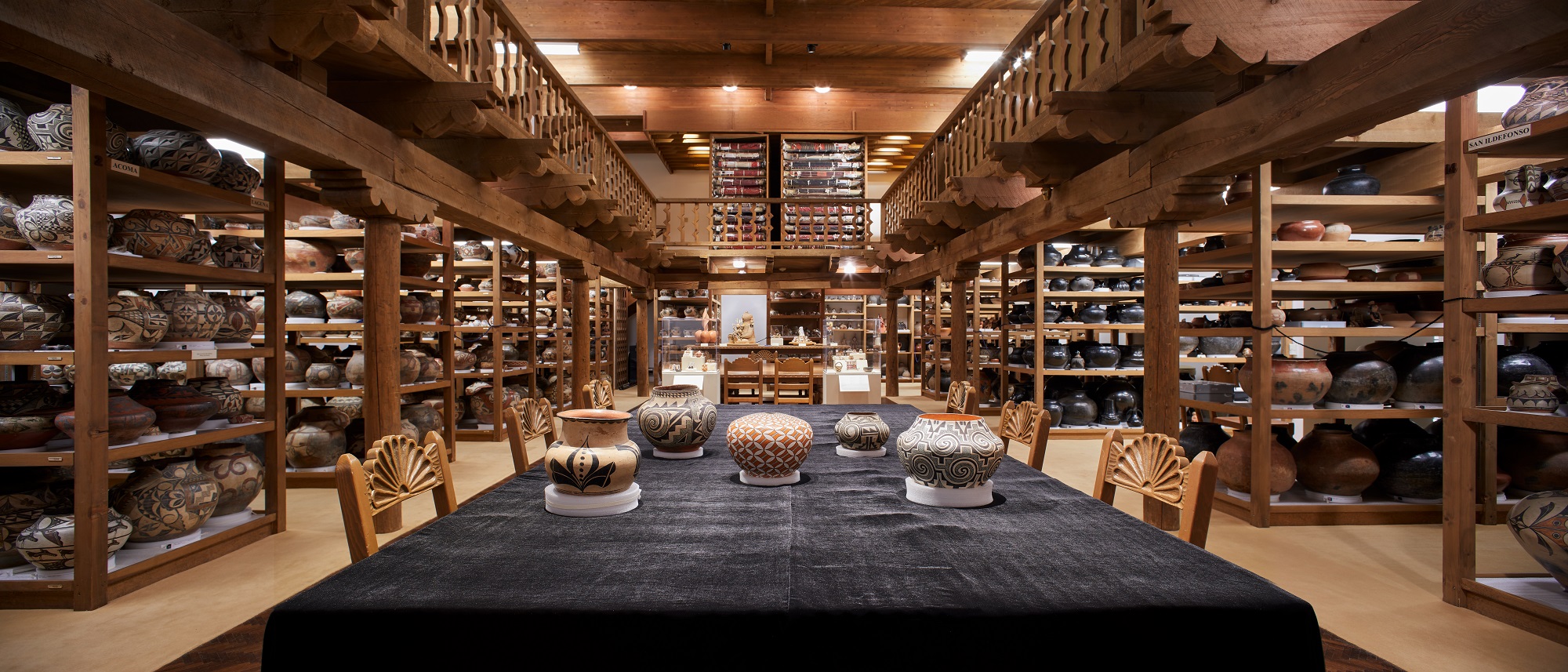
Kevin Aspaas in the IARC, 2024
Educational Resources
Bring SAR into your school with the IARC classroom resources that engage students and scholars of all ages in topics related to Native American cultural heritage.
From curriculum created for specific learning stages, to online exhibits for all ages, these resources offer ongoing support for educators looking to increase awareness of Native American arts and culture.
Curriculum
Grounded in Clay Curriculum
Grounded in Clay: The Spirit of Pueblo Pottery, was a deeply collaborative traveling exhibition that drew from the IARC collections and the Vilcek Foundation collection in New York.
The exhibition, developed with over 60 community curators explored the deep connections between Pueblo pottery, culture, and history, offering a rare first-person perspective on the stories, experiences, and relationships embodied in these timeless vessels.
The lesson plans included in this curriculum guide, like the exhibition itself, are intended to both teach about Pueblo pottery and its history as well as encourage students to understand the ways in which “objects” hold and carry stories.
Through process-driven art activities, students are given the opportunity to engage in inquiry and in practices that are aligned not only with Pueblo artistic conventions – but also with cultural values themselves.

Trade, Trails, and Mapping the Southwest Curriculum
This downloadable curriculum was developed as a six-week unit (four days a week, one hour per day) for 21st Century Learning After School Programs and examines “Trade, Trails and Mapping the Southwest.”
The curriculum is geared toward 3-5th grade after school programs, but can easily be implemented in the classroom, scaled up or down, extended or shortened.
Collaboratively created by the Museum of International Folk Art, New Mexico Museum of History, and the School for Advanced Research, this unit explores art and history through the lenses of the Indigenous Southwest, the El Camino Real, and the Santa Fe Trail. Lessons focus on hands-on activities and include projects such as pottery-making, tinwork, and weaving.

Online Exhibitions
Our online exhibitions give visitors a peek into the IARC collections and associated materials through topics related to the School for Advanced Research’s mission.
Museum Resources
Research & Study Access
IARC welcomes research inquiries on a case-by-case basis. To request access:
- Submit a Research Request Form at least one month before your intended visit.
- Research access is subject to staff availability and IARC approval.
- Research appointments are not available from August 1 – September 1 due to staff commitments.

Lynda Teller-Pete in the IARC, 2024. Photographer: Paloma Lopez.
For questions or to submit your request, contact the IARC Collections Manager at (505) 954-7205.
Loan Requests for Exhibitions
IARC collaborates with museums and institutions to loan collection items for exhibitions. To request a loan:
1. Submit a formal written request to the IARC Director at least:
a. 6 months in advance (for fewer than 10 items).
b. 12 months in advance (for larger loans).
2. Confirm availability with an informal phone call before submitting your request.
3. Include in your request:
a. The specific items requested.
b. Exhibit details (location, display methods).
c. An American Association of Museums Standard Facilities Report.
4. Loan Approval Process:
a. The IARC will conduct a condition report on each item.
b. If conservation work is needed, the borrowing institution will cover costs.
c. If needed, a professional appraisal will be completed (cost added to loan invoice).
d. Loans must be approved by the IARC Loan Review Committee.
e. If it is determined that the item cannot be safely transported or exhibited, the IARC staff reserves the right to refuse a loan request and will work with the borrowing institution to identify a suitable alternative.
5. Borrowing Institution Responsibilities:
a. Provide proof of insurance coverage.
b. Cover crating and transportation costs.
c. Separate Rights & Reproduction permissions apply for images of loaned items.
For more details, contact IARC at (505) 954-7205.
Your content goes here. Edit or remove this text inline or in the module Content settings. You can also style every aspect of this content in the module Design settings and even apply custom CSS to this text in the module Advanced settings.
Image Rights & Reproductions
Requesting Use of Collection Images
To use images of IARC collection items:
- Submit an Image Reproduction Request Form one month in advance.
- Allow 4–6 weeks for processing. Rush requests may be considered for double the regular fee (minimum $50).
- The IARC Image Use Review Committee will evaluate your request.
- Upon approval and payment, high-resolution images will be provided.
Copyright & Permissions
- IARC does not hold copyright for many collection items.
- Requestors must obtain permissions from copyright holders where applicable.
- Some reproductions require tribal authorization—official letters from the tribal governing body may be necessary.
- Out of respect for descendant communities the IARC does not authorize reproduction of images containing human remains or associated funerary objects.
For image requests, email iarc@sarsf.org or call (505) 954-7205
Forms
Submit this form to initiate a research request.
Submit this form to initiate an image reproduction request.
Image reproduction fees, curatorial fees, and institutional loan fees are detailed in the service fee schedule form. Fees are subject to change at any time. Adjustments of fees for uses not covered in the form are be made at the discretion of the collections manager or the registrar and are subject to negotiation.