


The adorkable grumpy elf!

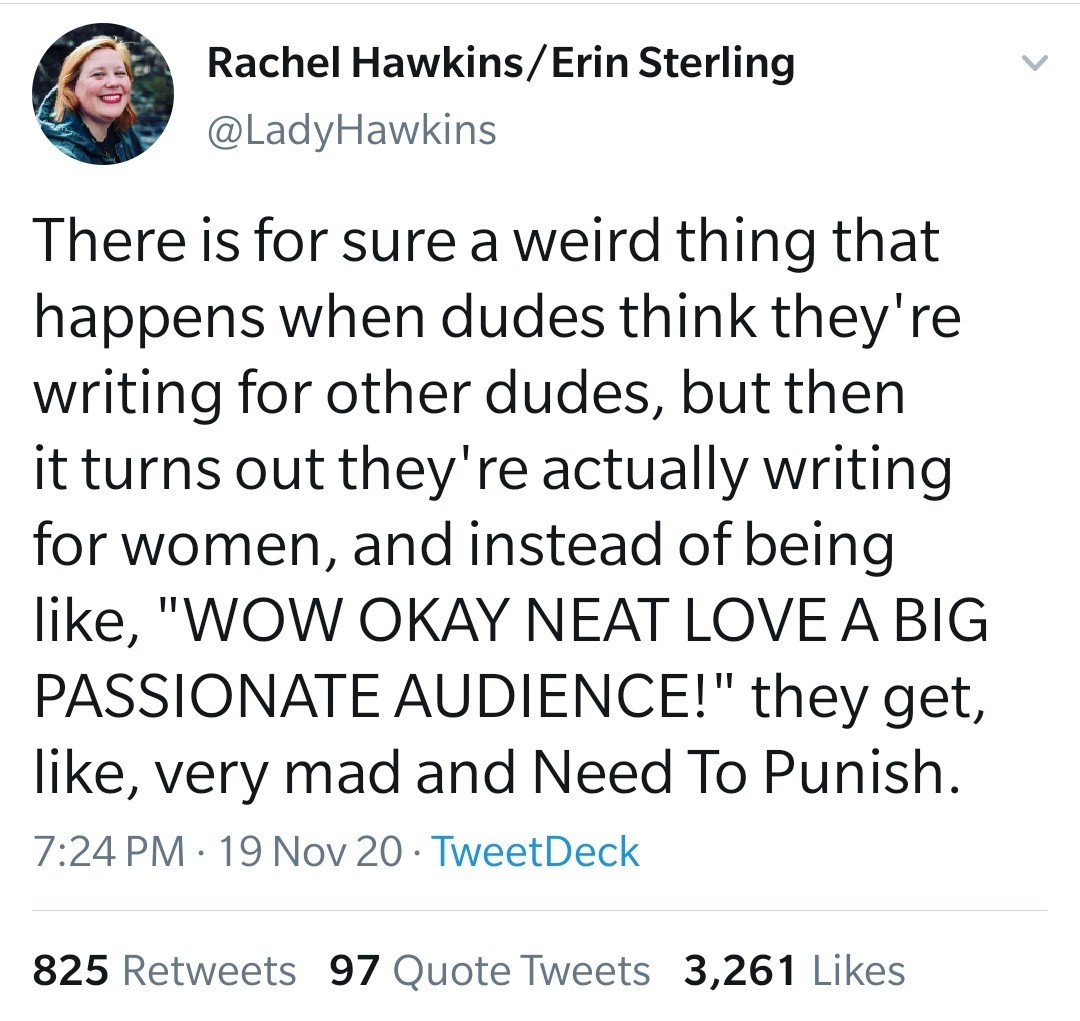

I don’t mean to be rude; but I don’t think I’ve ever seen this, does anyone have any examples?

- Supernatural
- Doctor Who (Steven Moffat specifically)
- Sherlock (Steven Moffat specifically)
- Actually Steven Moffat is basically just this sentiment given human form.
- A version of this happened with The Magicians, tbh. Though instead of expectation: men, reality: women it was expectation: smug nihilists, reality: mentally ill queer folks.
- Arguably Game of Thrones.
If we broaden it outside of television…I think Star Wars falls into this, at least the sequel trilogy. Maybe the MCU as well. And I can’t help but think of every band that’s ever complained that their fanbase is mostly women. 5 Seconds of Summer comes immediately to mind.
In general, most white male creators seem to have this massively entitled mindset where they want–and think they deserve–the time, attention, and enthusiasm that creative fandom (i.e. the side of fandom more dominated by women) is known for.
They want our eyes for ratings, our word-of-mouth for free publicity, our metas for social media buzz, and our spending power for merch and cons. But they don’t want us. And they don’t really want the responsibility of telling a story to a thoughtful, engaged audience, regardless of that audience’s demographic makeup. They just want to be praised for whatever schlock they cough up.
And like any other spoiled brat, they will break their toys before they share them.

It goes all the way to the top for kids shows. Toy sales will crash a show. Makes sense, but if those toys are gendered for boys instead of the female viewers, they won’t usually switch up the marketing and move them to the girl aisle. They cancel the show outright.
Mind you it is perfectly possible to make the switch in marketing, but execs would rather throw it all out than have something that doesn’t perform well with male viewers. For example the Rey merch was not expected to be popular, for some reason, there had to be public outcry to get merch of one of the main 3 protagonists. A PROTAGONIST. The fact that she wasn’t a huge part of the 1st launch says a lot already.
And what happened when female fans got too invested in the Sequel Trilogy? The entire writers room didn’t necessarily lash out, but they sure forgot how to behave.
Paul Dini: Superhero cartoon execs don’t want largely female audiences
#WhereIsRey (initial)
#WhereIsRey (ongoing)
Star Wars: The Rise of Skywalker was designed to be the opposite of The Last Jedi

You’re all sitting on the hot take of the decade tbh

And yet when they fond out that boys were watching MLP:FIM in droves, they had NO PROBLEM with it.

#SONS OF ANARCHY!!!!!!!!!!!!!#LITERALLY SONS OF ANARCHY IS THE BIGGEST EXAMPLE OF THIS LIKE EVER#kurt sutter wrote that show for MEN and ended up with an overwhelmingly female audience#because he’s actually a good writer and knows how to develop characters well and wrote excellent female characters#but once he realized that his audience was almost entirely women he literally took it out on tara and gemma in the show#but like tara specifically#he resented her character for being a huge draw for female viewers so he tore her development to shreds and killed her#in the most brutal gut wrenching way possible#kurt sutter you will pay for your crimes#i actually wrote a manifesto about this on one of my old blogs i should try to find it sldkjsldfjsdljf#long post (via@m-oonknight)
OMG YES. I LOVED Sons of Anarchy, especially the women and then I got to season 6 and it was like - everything was just tossed in the trash? And like, why did Sutter hate that Tara drew tons of attention? That should have been a good thing! He should have been like “Hey folks, this girl’s getting us more viewers, let’s put her in more scenes!” It just doesn’t make sense to me. MEN don’t make sense to me.

The 100 too. I’ll never forget how Jason Rothenberg would attacked female fans on Twitter and mock them in interviews, and then post links to male fan discussions on Reddit to praise and thank them. In his goodbye letter to the show he SPECIFICALLY thanked Reddit and it was so disgusting.

Star Trek from TNG on was also a boy’s club, even though the TOS fans were mostly women. Women, in fact, who literally created modern fandom with their zines. But after TNG it was all, “Women don’t understand Star Trek, only smart men hur dur.”

I think it would be harder for us to find examples of when this DIDNT happen than when it did. It happens all the time.

Doesn’t stop it from boggling the mind
(though it could probably start to make some sense if you follow the money past audience bases to maybe a couple of investors or like a rich patron … 🤔)

Stooooop I just wrote a masters thesis on this shit. Media creation and distribution is a means by which dominant power structures consolidate their hegemony. Dominantly situated creators get upset when the audience they attract isn’t the audience they wanted, because they view the whole creation and sharing of the fiction as an exercise to sustain kyriarchal conditions that benefit themselves. When the audience is Other, they see it as a failure of those efforts and lash out.
Simply, they’re trying to assert a particular worldview via fiction, and upon getting confronted with something else, begin foot stamping. It’s not just men wanting male attention and gatekeeping. It’s that the fiction in the first place was an attempt to curate dominance and whoopsie! they miscalculated.
(anyway if anyone wants to read 35k words of philosophy about this, hmu)

I think a lot about an interview I heard with Bo Burnham a few years ago, where he talks about this phenomenon with his own work. He gained a large audience of teenage girls, and people in comedy spaces would look down on him for that or say what a shame it was, but he responded differently:
“The real truth is, I would perform my show and I would meet kids after and young girls would come up to me and they understood what I was expressing in that bit onstage way more than guys my own age. Way more. So if there was a bridge between us that I had to cross to write the movie [Eighth Grade], it was built to me by them. I felt understood by them before I presumed to understand them.”
Instead of trying to change his comedy, he decided to lean into and celebrate the audience that he actually had by making a movie specifically about the experiences of a teenage girl. It’s fascinating to hear him talk about how he got there, but also to acknowledge how rare that reaction is.

This is all true but help-help-i-need-an-adult asked if there are any examples where this didn’t happen. And I literally only know of ONE.
Behold! The ONE thing that bothered to relate its female audience with positivity:

Source: June 1998 issue of Newtype, in a special supplement/booklet titled 「まるごと富野」 (“Marugoto Tomino” / “All About Tomino”)
Clip from the NHK documentary where Tomino says this AGAIN and continues on to say that if they wanted a movie he knew they had to hold on to this part of the fandom. https://x.com/tayuta0079/status/1577387893135384577

Shout out to Gundam creator Yoshiyuki Tomino for being a real one.

The Beizi Across Three Dynasties: How One Open-Fronted Robe Outlived the Song
Most introductions to the beizi (褙子) stop at the Song dynasty. That is understandable — the Song is where the garment is best documented and most visually distinctive — but it undersells the thing that makes the beizi genuinely interesting: it is one of the very few Han garment types that stayed in continuous, ordinary use across a dynastic break, changed shape while doing so, and is still legible today as the same item of clothing.
What the excavated evidence actually shows
The single richest source for Song women's dress is the 1975 excavation of the tomb of Huang Sheng (黄昇) in Fuzhou, a young woman of the Southern Song who died in 1243. The burial preserved several hundred textiles and garments, and among them a substantial number of beizi. What those pieces show is a garment far more consistent than the modern market suggests: a straight-cut body falling from the shoulder without a defined waist, a centre-front opening that does not overlap, sleeves that are long but comparatively narrow, and — the detail people most often get wrong — decorative bands (领抹, lingmo) running down both sides of the front opening and around the collar.
Those bands matter, because they are the feature most frequently omitted in contemporary reproductions. A Song beizi without lingmo is not wrong, exactly, but it is reading the silhouette while skipping the grammar.
The second thing the Huang Sheng material makes clear is that beizi came in weights. Some are unlined gauze — summer garments, near-transparent, meant to be seen through. Others are lined and padded. This is worth saying plainly, because the modern assumption that a beizi is "the layering piece" flattens what was in fact a whole category with a seasonal range.
The terminology problem
Anyone reading around this topic will run into a disagreement about the name. Beizi is written both 褙子 and 背子, and there is a long-running argument about which is original and what the word described. One line of explanation connects it to a garment worn behind or over — hence 背, back. Another treats 褙 as the later, clothing-radical standardisation of a colloquial term. Song and later texts are not consistent, and Ming sources sometimes use the word for garments a Song reader might not have recognised.
The honest position is that the written record is messier than the archaeological record. Most sources date the garment's emergence to the Northern Song, with antecedents in the Tang banbi and in the various open-fronted robes of the preceding centuries — but "commonly dated to" is doing real work in that sentence.
Men wore it too
A persistent modern impression is that the beizi is women's wear. It is not, and Song painting is unambiguous on the point: men are depicted in beizi in informal and semi-formal settings throughout the period, worn over an inner robe and belted or left open. The men's cut tends to be longer and plainer, with the side seams left open below the hip — a construction detail that reads as very contemporary now, and one reason the men's beizi has become an easier entry garment for people who find full ritual dress intimidating.
What changed in the Ming
By the Ming, the garment that inherits the beizi's role has broadened. The body is fuller, the sleeves are considerably wider, and the piece sits within a different system — one increasingly organised around the ao (袄) and qun (裙) pairing, with the pifeng (披风) taking on much of the open-fronted-outer-robe function. Whether the Ming pifeng "is" a beizi is a question that generates more heat than light; what is uncontroversial is that the functional slot — an unfastened outer layer worn over a coordinated inner set — persisted, and that the Ming version reads as noticeably more generous than its Song ancestor.
That is the trajectory worth holding onto: not a garment that vanished with a dynasty, but a garment whose proportions were renegotiated while its job stayed the same.
Why this matters for how people wear it now
The revival market has largely settled on the Song cut, and that is a reasonable default — it is the best-evidenced, and the most flattering to a modern eye trained on long, lean outer layers. But knowing that the category was seasonally graded, worn by men, and carried forward in altered proportions through the Ming gives you a much wider set of legitimate choices than "buy the standard Song beizi."
Practically: if you want something for warm weather, the unlined gauze precedent is right there in the Fuzhou material. If you want something with more presence, the Ming-width silhouette is equally defensible. And if you are buying, the lingmo bands are a cheap and reliable authenticity check — their presence usually indicates a maker who has looked at the excavated pieces rather than at other people's product photos.
If you have a beizi, which cut did you end up with — and did you pick it on purpose? Reblog and tell us.


Hawke is a pick up disaster I wonder why they didn’t add this line hahaha (probably someone already draw it i dunno i haven’t seen!)
And it’s even more hilarious that these stupid lines WORK for Fenris
i just can’t aSDFGHJ


Pro-censorship wattpad refugees drama is so funny to me because when I started using ao3 as a kid I was a devout mormon and I thought that reading anything even remotely pornagraphic was a sin and would ruin my life. So when I was 13 and found ao3 I went "oh awesome I found a fanfic website with a filtering system so I won't ever randomly stumble into porn. This is great! I was really worried about seeing something I didn't want to see on the other platforms." I didn't read any smut online until like three years later. If a mormon 13 year old can figure out 'don't like don't read' wattpad users can too cmon you guys i believe in you.


Chinese Mythology: Chang'e and Hou Yi
I’m fairly sure many cultures have myths surrounding the sun and the moon, for several reasons.
- Big
- Round
- Shiny (oooh)
- Glows!
- Right fucking there
China is no different! We have many myths surrounding the sun and the moon. Most famous, probably, are the two stories of Chang’e and Hou Yi.
Let’s start with Hou Yi. His story is titled Hou Yi Shoots the Suns 后羿射日, and it’s… quite literally what it sounds like.

Back in the ages before dynasties, in the times of ancient people like Great Yu (see this post for who Great Yu is) and Emperor Yao (before the Qin Dynasty started by Qin Shi Huang), there were 10 suns in the sky. These 10 suns were either 10 brother-deities or the 10 grandsons of the Jade Emperor, the head honcho up in heaven.
Man, the Jade Emperor’s family really likes to cause trouble, hmm? Just look at the Weaver Girl and Erlang Shen. No wonder the Heaven Haters boyband hates him.
The 10 suns scorched the earth, causing crops to die and the people to ask for help. Obviously having ten fucking suns shining down at you isn’t exactly great for civilisation (even the world’s best SPF can’t help you there), so Emperor Yao asks a great archer named Hou Yi to do something about it.
Hou Yi goes outside (presumably with a pair of very nice sunglasses and some top-notch sunscreen) to yell at the suns. First, he tries the diplomatic route. Basically:
Hou Yi: What the fuck are you doing? Stop scorching everyone and go home!
10 Suns: Go fuck yourself!
Hou Yi: …
Hou Yi is like, okay, well if diplomacy won’t do, I’ll just be efficient. He gets his big bow and arrow and aims up in the sky and starts to shoot every single sun out of the sky. Remember- they’re living deities, not just great balls of fire, so they can be killed. Still don’t know how a guy (even a guy as amazing as Hou Yi) manages to shoot the fucking suns out of the sky, but it’s mythology- don’t think too much about it.

Eventually he gets to the ninth sun and everyone is like “WOAH! You can stop there! We need at least one of them!”. Hou Yi is like, “do I haveeee to” and the Jade Emperor/Emperor Yao are like “YES YOU HAVE TO!”
So he leaves one of them alive, reluctantly. The last remaining sun is thoroughly terrified and resolves to stay hanging up there in the sky like a good little lamp and not make Hou Yi angry enough to shoot him down too.
That’s why the sun is in the sky. Hou Yi scares him. Everybody say thank you Hou Yi.
Hou Yi’s wife, Chang’e, is the central character in the myth behind the moon. Her myth is titled 嫦娥奔月, or Chang’e Rises to the Moon.
After Hou Yi shoots down all the suns, he’s regarded as a great hero by the people. He is rewarded with a pill of immortality or an elixir of immortality. He’s a good husband, so he decides he’s not going to drink it and leave his wife Chang’e behind, so he leaves it at home for safekeeping while he does more good deeds to hopefully get another elixir for Chang’e. Hou Yi takes in some disciples, who hope to learn his great archery skills.

One day, Hou Yi goes out hunting. One of his disciples, Feng Meng, is a big dickhead, and he resolves to steal the elixir for himself while the defenseless Chang’e is home alone without Hou Yi to protect her. He sneaks into the house and attempts to steal it. Just as he’s about to get it, Chang’e swallows it herself to protect the elixir from Feng Meng. Now immortal, she ascends up to the moon.
Chang’e is really lonely up on the moon- her only companion is the jade rabbit, or the moon rabbit. You know how Westerners see a man on the moon? Well, ancient Chinese people saw a rabbit instead- that’s the moon rabbit, now the pet of Chang'e. After Hou Yi comes back and realises what happened, he mourns Chang’e, because even though she’s immortal, the two of them can no longer be together.
He might also have killed himself, IDK exactly.

See the rabbit? I personally think it's a better theory than the man on the moon, but whatever.
In some other versions of the tale, Hou Yi is crowned king after he shoots down the suns. He becomes a brutal tyrant, and in order to prevent his total oppression of the people, Chang’e steals the elixir from him so he won’t live forever. I like to believe in the first version.
China’s space probes on the moon are called Chang’e in her honour.

This is Chang'e 5, the latest version.
The little robots that the space probes deploy are called Jade Rabbit as a nod to the myth.

This is Yutu (Jade Rabbit) moon rover!
Many of the creations of the Chinese space agency are named after myths, including the Magpie Bridge relay satellite (which you might recognise from the story of the Cowherd and the Weaver Girl!)

Also Chang’e is the inspiration behind Sailor Moon. That’s why she’s called Usagi (Rabbit).
The Mid-Autumn Moon Festival 中秋节 is one of China’s most important holidays, to celebrate the full moon and the time of the harvest. The festival honours Chang’e as we eat tangyuan (big white round sweet boiled glutinous rice balls, which look like the moon) and moon cakes (decorative round sweet cakes filled with a variety of fillings). It is said that the jade rabbit on the moon produces moon cakes to honor Chang’e. The Mid-Autumn Moon Festival is what inspired Tsukimi (Japan) and Chuseok (Korea).
 ellipsus-writes