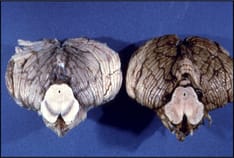
Parkinson's disease ranks among the most common neurologic disorders. The condition's two hallmark neuropathologic findings are the loss of pigmented dopaminergic neurons of the substantia nigra pars compacta and the presence of Lewy bodies and Lewy neurites. More than 6 million people are diagnosed with Parkinson's disease globally. Its incidence and prevalence increase with age, with an average of approximately 60 years. Parkinson's disease is about 1.5 times more common in men than in women, a predilection which may increase with age. In most populations, 3%-5% of Parkinson's disease is linked to known Parkinson's disease genes, representing monogenic Parkinson's disease.
Can you recognize the signs and symptoms of Parkinson's disease? Check your knowledge with this quick quiz.
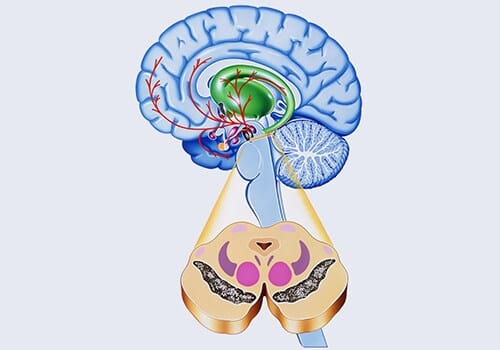
Figure 1. Illustration of the brain depicting the neurologic disorder of Parkinson's disease.
Parkinson's disease has four hallmark signs. To make the clinical diagnosis, a patient must demonstrate two of these three symptoms: resting tremor, rigidity, or bradykinesia. The fourth hallmark sign — postural instability — manifests late in the disease course, usually after at least 8 years. To confirm diagnosis, a patient must both demonstrate these core features and respond to dopaminergic therapy. Presenting symptoms can be heterogeneous, thus informing a patient's classification into motor subtypes: tremor dominant, postural instability and gait difficulty, or indeterminate.
Many patients with Parkinson's disease also experience postural and/or kinetic tremor to a certain extent, though resting tremor is the classical presentation of the disease.
Learn more about the presentation of Parkinson's disease.
Nonmotor, or prodromal/premotor symptoms, may arise up to 10 years before the emergence of motor symptoms. These signs include hyposmia, anosmia, depression, constipation, rapid eye movement sleep behavior disorder, visual changes, anxiety, and other autonomic disturbances. Olfactory testing may reveal hyposmia, which precedes motor signs by several years, thus providing evidence that points toward Parkinson's disease. However, olfactory loss is not specific and can also occur in Alzheimer's disease.
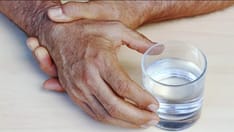
When motor signs do arise in Parkinson's disease, they are typically asymmetric. The most common initial finding is a resting tremor in an upper extremity. As the disease progresses, patients experience bradykinesia, rigidity, and gait difficulty. Axial posture becomes more flexed and strides become shorter. Postural instability is also a hallmark of Parkinson's disease but develops later in the disease course.
Soft voice and sweating with other thermoregulatory abnormalities are typical presenting symptoms of Parkinson's disease. Aphasia is not a typical symptom of the condition and can represent an absolute exclusion during diagnosis.
Learn more about the physical examination in Parkinson's disease.
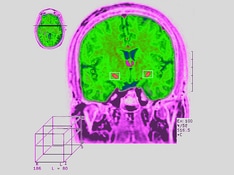
Parkinson's disease is a clinical diagnosis based mostly on motor features (though nonmotor symptoms should not be overlooked). No laboratory biomarkers can be relied on for this condition, though the measurement of cerebrospinal fluid alpha-synuclein aggregates has offered encouraging preliminary results so far. However, dopamine transporter single-photon emission CT (SPECT) can improve the accuracy of diagnosis. PET and SPECT may also reveal findings that point to Parkinson's disease.
Findings on MRI and CT are usually not valuable in diagnosing Parkinson's disease, and ultrasounds are insufficiently sensitive or specific in the diagnosis of Parkinson's disease and atypical parkinsonism.
Learn more about the workup of Parkinson's disease.
The Movement Disorder Society recently published new Parkinson's disease diagnostic criteria. Under these guidelines, cortical sensory loss represents one of nine absolute exclusion criteria. Other criteria include, but are not limited to, unequivocal cerebellar abnormalities; clinical features being restricted to the lower limbs for 3+ years; or documentation of an alternative condition that may contribute to symptomology. Of note, when symptoms of parkinsonism occur with rapid onset together with other symptoms, they are unlikely to be due to Parkinson's disease.
Early bulbar dysfunction and recurrent falls (caused by impaired balance) within 1 year of onset represent red flags in diagnosing Parkinson's disease. For a patient to be diagnosed with the condition, no red flags are allowed. However, a patient may be diagnosed with clinically probable Parkinson's disease if one red flag is present, so long as it is counterbalanced by supportive criteria; if two red flags are present, at least two supportive criteria are needed.
Learn more about the differential diagnosis of Parkinson's disease.
Early in the disease course, differentiating Parkinson's disease and atypical parkinsonisms (ie, multiple system atrophy, progressive supranuclear palsy, corticobasal ganglionic degeneration) can present a diagnostic challenge, and there is a high diagnosis error rate between Parkinson's disease and essential tremor. Rest tremor does occur with essential tremor, but it can amplify during movement — a feature not seen in Parkinson's disease.
Supranuclear palsy of vertical gaze is a common symptom of progressive supranuclear palsy but does not occur in Parkinson's disease. Alien limb phenomenon is one of the most common features of corticobasal ganglionic degeneration. In multiple system atrophy, tremor is typically jerky instead of resting, with minipolymyoclonus.
Learn more about atypical parkinsonisms.
Editor's Recommendations