
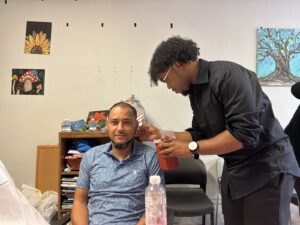




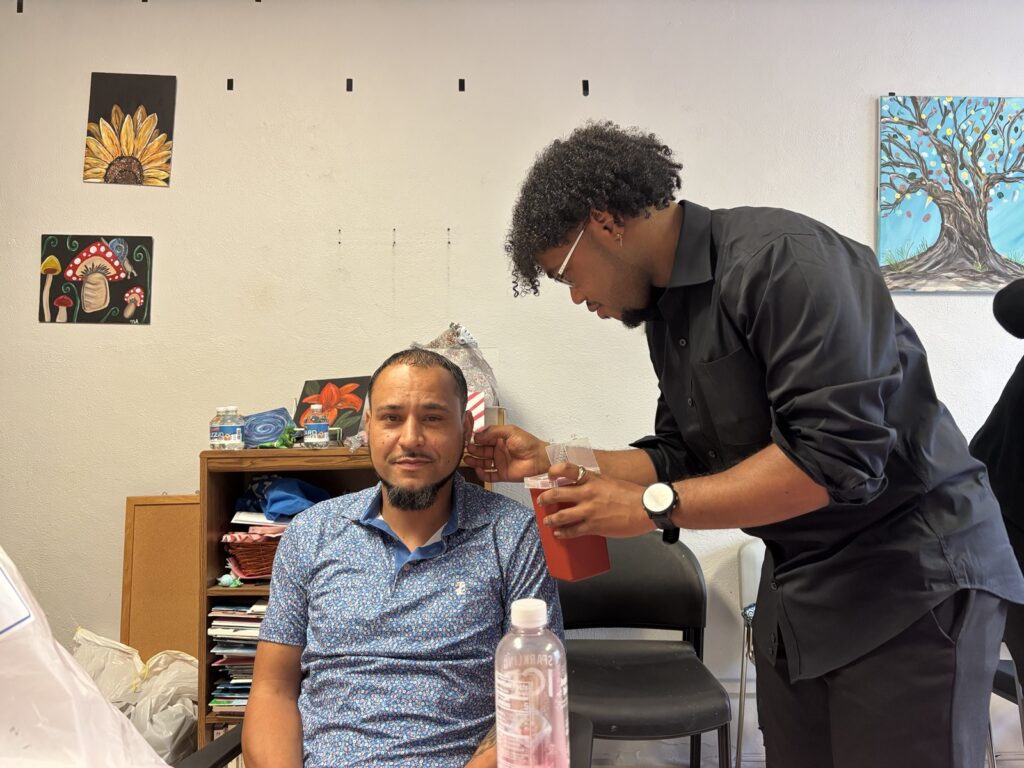
On an early July morning, a small group sat around a table at CODAC, Rhode Island’s oldest nonprofit addiction treatment center, with acupuncture needles protruding from their ears. Program coordinator Daryl Walker Jr. methodically inserted a set of needles into the center’s security guard, who had lent his ears for the free clinic so trainees could practice the five-needle ear acupuncture protocol (5NP).
“I don’t mind it,” the security guard said, laughing.
Around the room, several social workers and other healthcare professionals employed by CODAC chatted excitedly.
Each was hoping to inch closer toward their goal of performing 5NP on forty supervised ears to earn a certificate of completion from the People’s Organization of Community Acupuncture (POCA)—an organizing body that has trained about 3,000 non-acupuncturist healthcare professionals in the United States. So far, about 300 individuals in Rhode Island have received such a certificate from POCA, and another 30 or so from the certifying body National Acupuncture Detoxification Association.
Once certified, healthcare workers can legally give ear acupuncture to patients experiencing stress, anxiety and addiction.
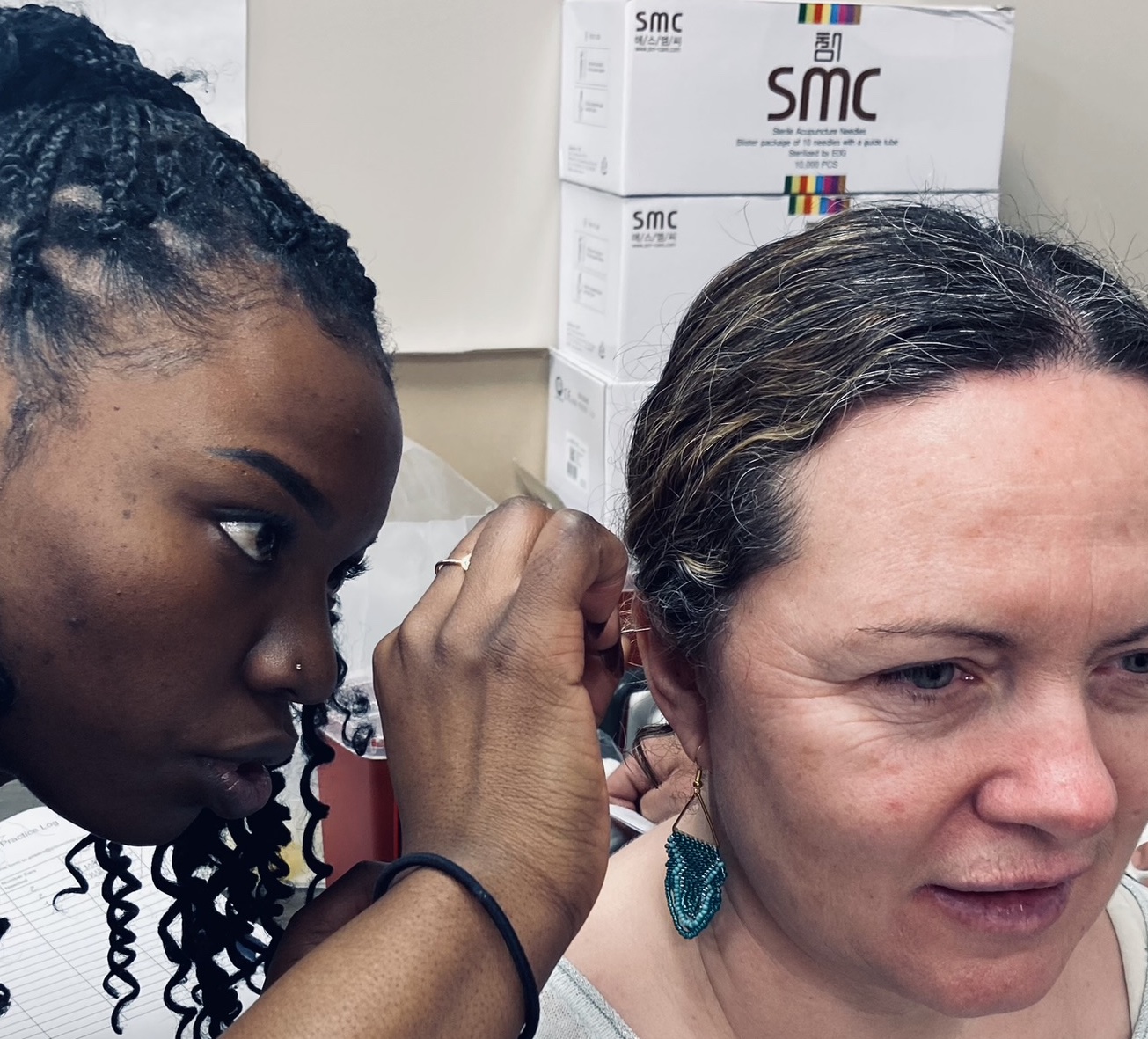
“Do you want to try it too?,” asked Clinical Supervisor and trainee Nicole Hutto, her voice competing with several conversations that nearly drowned out the spa music playing in the background. I agreed. As she swabbed my ear with alcohol, she explained that the five points correspond to different parts of the body. The lung point at the lower part of the inner ear helps with grief and sadness. The sympathetic point, tucked under the rim near where the ear meets the head, calms the nervous system.
As she needled, I noticed a few points pinched slightly and others weren’t sensitive at all. Despite all the hubbub, I felt a warm calming buzz spread throughout my body within minutes. My thoughts subtly slowed down.
Experiences like these begin to explain ear acupuncture’s increasing popularity outside of acupuncture clinics across the state. “Patients love it,” said Ray Lorraine, a licensed chemical dependency professional at CODAC and one of the first in the state to receive his NADA certification nearly a decade ago.
“Sometimes they said it heals things that I’m not sure it’s supposed to.” One patient said it cured their tingling ankle. “If that’s their experience, great,” he shrugged. “Most often they say it helps with stress.”
Other practitioners at CODAC echoed similar sentiments. Laura Levine, director of outpatient services, has been offering it to her more anxious patients before talk therapy for years. She has found that it helps calm them down during their sessions.
“They leave in a much better place,” she said. She told a story about one of her patients, a Spanish-speaking woman who relied on a translator for treatment, who came into the center crying a lot after being arrested for something her son did. Mostly interested in meditation, Levine asked her if she wanted to try ear acupuncture while she meditated. She said yes.
“She started coming in laughing a lot more, and was able to move through her trauma,” said Levine. “We didn’t even talk, we didn’t process anything. It wasn’t traditional therapy, it was acupuncture and meditation.”
Driving much of this forward, are licensed acupuncturists from Providence Community Acupuncture, Cris Monteiro and Micaela Foley, who are also trainers with POCA.
“It’s one of the most tactile, practical ways for people to regulate their nervous systems,” Foley told The Providence Eye. “And then it has all these other potential health benefits.”
Expanding Access
It used to be illegal for non-acupuncturists to insert needles into their patients’ ears in Rhode Island. In 2016, at the height of the opioid epidemic, Monteiro co-wrote and helped pass legislation allowing Licensed Chemical Dependency Professionals to use the five needle ear acupuncture protocol after receiving proper training. Monteiro helped pass another bill in 2021 that expanded access even further, authorizing social workers, nurses, peer recovery specialists, and some other licensed healthcare workers to use ear acupuncture to treat a wide range of symptoms.
“We’re trying to lower all the barriers with cost and access,” said Monteiro. “It just made more sense to put the tools in the hands of the people who were doing the work.”
Support for the legislation also came from patients. In written testimony to lawmakers, one CODAC patient described how ear acupuncture made it easier to participate in therapy by calming their anxiety. “And it’s [sic] been helping me with insomnia,” they wrote. “I haven’t had to use any medication to go to sleep since using the treatment.”
The legislative landscape opened up after controversial local character Dr. Tadeusz Sztykowsk—known as Dr. Tad—attempted to pass a bill in 2016 that would make it more difficult to become licensed as an acupuncturist. (His career took an ironic turn several years later when he was arrested for practicing acupuncture without a license.) The bill mobilized a crew of self-stylized “acupunks”—local community acupuncturists who are part of a lineage advocating for the practice to become more affordable and accessible.
“The Dr. Tad thing was our opportunity,” said Monteiro, who blasted Dr. Tad for trying to pass legislation meant to protect his turf at the expense of safe access to care. “We were like, ‘Okay, so we want to stop Dr. Tad from making it harder to get licensed. This is what we need to do.’”
Nearly a decade later, Monteiro and Foley are building on the legislation by hosting ear acupuncture trainings for healthcare workers every couple of months. The trainings are always paired with a free clinic, where trainees invite friends, family members and patients to lend their ears for supervised practice.
Monteiro recounted how a therapist invited her patient—who was also a drug and alcohol counselor and an acupuncture patient at PCA—to the clinic to help her practice. The counselor told Monteiro that it had been the first time she saw her therapist as a human being because she was visibly nervous while needling her. “The hierarchy had been levelized, or even flipped, in that moment,” said Monteiro.
About six months later, the counselor decided to get trained to provide ear acupuncture too. During the process, she treated Monteiro. “That was a flipping of a hierarchy again. Not only was I her instructor and had been her [acupuncture] provider, but now she’s treating me,” said Monteiro. “It really felt like that was like an embodiment of what this is, that it really is peer-to-peer.”
A Politicized Lineage
The five needle protocol—and the peer-to-peer ethos that accompanies it—likely would not exist without direct action.
On July 14, 1970, members of the Black Panther Party, The Young Lords, and others physically occupied the Lincoln Hospital demanding better care for their communities at the height of the heroin epidemic. The occupation ultimately gave birth to The People’s Drug Program on November 10, which was renamed the Lincoln Detox Center. It functioned as a community gathering space, with political education courses, in addition to treatment programs.
Acupuncture was introduced to the center by Dr. Mutulu Shakur—a member of the Republic of New Afrika and affiliate of the Black Panther Party who saw his son recover from a car accident with the aid of acupuncture. Shakur and other revolutionaries also saw acupuncture as an empowering tool for community self-determination after learning about so-called “barefoot doctors” in Mao’s China. Throughout the 1960s and 70s, more than a million Chinese peasants were given basic training in Western and Chinese medical practices to treat other peasants who lacked access to healthcare.
With revolutionary China in mind, members of the Black Panther Party experimented with ear acupuncture points at the Lincoln Detox Center. Patients became practitioners, and thousands were treated before the city—using a task force of 200 police officers—shut it down in 1978. “Hospitals are for sick people, not for thugs,” said the white Democratic Mayor Edward Koch.
The ear acupuncture movement has since managed to adhere to its original radical principles, despite the odds, in a heavily commercialized healthcare ecosystem.
POCA has achieved this, in part, by having trainees sign an ethics pledge that requires them to keep fees within the reach of marginalized communities. “[A]cupuncture belongs to the people who need it most,” according to the pledge, “the people with the fewest resources, the people for whom its simplicity makes it uniquely accessible.”
Most trainees abide by these principles. But Foley and Monteiro recently learned that one of their trainees is charging more than $175 for ear acupuncture treatments at her spa. “They’re coming from a perspective of the commodification of healthcare versus healthcare being an essential piece of our lives,” said Monteiro.
If she doesn’t change the prices, POCA may rescind her certification.
Foley and Monteiro plan on using her as a negative example at the next training in August. “We are going to say, ‘If you’re planning on doing that, you can leave at the break, and we will refund your money,’” said Monteiro. “We’d rather not train you.”
When I recounted this story to CODAC practitioners, the whole room erupted with shock.
“That’s not in the spirit of what this is,” said Levine.
All ear acupuncture group sessions at CODAC will be free to patients.
It’s a goal that’s moving the “needle” closer to Monteiro’s vision for Rhode Island. “We want there to be ear acupuncture in every community,” she dreamed. “You show up for your social work appointment, and the social worker offers it to their client. It’s in high schools, it’s in libraries, it’s at the Creative Reuse Center. Yeah, we want it to be commonplace.”
Ella Fassler is an independent journalist and researcher based in Federal Hill. They are a contributor to Truthout, and have been published in The Boston Globe, Teen Vogue, The Nation, In These Times, and elsewhere. They run newsletters that feature essays, national reporting and local news.


Want to comment? Click!