Related
- Kinsella, Ralph Raico, R.I.P.
- An Interview with Ralph Raico (Feb. 20, 2013)
- Grow Up, Canada, by Ralph Raico (April 24, 2002)
- Switzerland, Immigration, Hoppe, Raico, Callahan (2010)
- The Liberty Magazine Polls: 1988, 1999, and 2008: Flagpoles, Parental Obligations, Private Nukes
Ralph Raico (1936-2016) presented this informal session at Mises University in Auburn, Alabama, on August 11, 2005.
Professor Raico (Mises.org/Raico) was Professor Emeritus in European history at Buffalo State College and a senior fellow of the Mises Institute. He was a specialist on the history of liberty, the liberal tradition in Europe, and the relationship between war and the rise of the state. [Mises media]
I was reminded of this in a recent tweet by David Beito:
{ }
Originally published at The Rude Awakening.
The Rude Awakening (May 21, 2026)
By Sean Ring
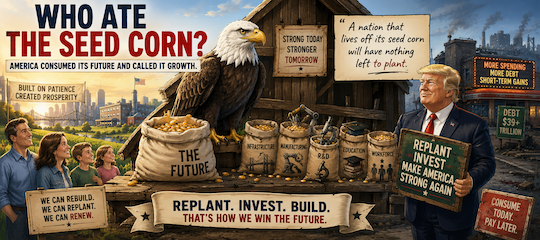
 We’ve named time preference and interventionism so far. Here’s the next important step on our map: capital consumption.
This is what Donald Trump is trying to prevent in the United States, in his own way… with mixed results so far.
Why?
Because he knows it’s the one thing most responsible for America’s manufacturing decline. It’s one thing for a better team to beat you. It’s another thing entirely for your team to give the game away to foreigners. [continue reading…]
{ }
From the archives: Doug French: The Injustice System, Darrow’s Resist Not Evil, interviewed for Liberty.me by Kyle Platt (May 14, 2014). Doug’s Introduction to the Mises Institute’s 2011 reprint of Darrow’s Resist Not Evil is appended below.
Kyle Platt speaks with Doug French, Executive Editor or Agora Financial and former President of the Ludwig von Mises Institute, about Clarence Darrow‘s almost forgotten book, Resist Not Evil, and the the implications of this scathing critique of the American justice system.
[continue reading…]
{ }
Kentucky Congressman Thomas Massie is the closest thing to a libertarian in the U.S. Congress. He opposes the American-Israeli genocide in Gaza and the unprovoked invasion of Iran. He voted against Trump’s explosive spending bill that he said will only spawn inflation and economic decline. He authored legislation to make the Epstein Files public. Perhaps his biggest “crime,” in the eyes of the Washington establishment, was to go on the Tucker Carlson podcast and reveal to the world that every member of the U.S. Congress except himself had an AIPAC (American Israel Public Affairs Committee) “handler” whose job was to assure that all members of Congress always vote in Israel’s interest even if it is against the interests of the average American. The genocide in Gaza and the invasion of Iran would be two examples. And oh yes, he offered a bill that would eliminate the Israeli exemption from U.S. foreign influence lobbying law. In addition to being the closest thing to a libertarian in Congress, he is also the closest thing in Washington to an America First politician.
Well. For that the Israeli First lobby got three left-wing Jewish billionaires (who are not from Kentucky) to “donate” tens of millions to defeat Massie in his primary election. They picked an “Israel-First Neoconservative” nobody named “Ed Gallrein” who used to be a Democrat and who refused to debate Massie as his opponent. Trump himself hurled his usual juvenile insults at Massie and his hundreds of thousands of Kentucky voters. Naturally, he lost.
{ }
Originally published at The Rude Awakening.
The Rude Awakening (May 20, 2026)
By Sean Ring
Welcome to the second article in this series of developing your economic map. Today, we’ll talk about the government’s interference in the markets. To start, I give you this priceless quote from none other than Ringo Starr:
Everything government touches turns to crap.
With that in mind, let us begin.
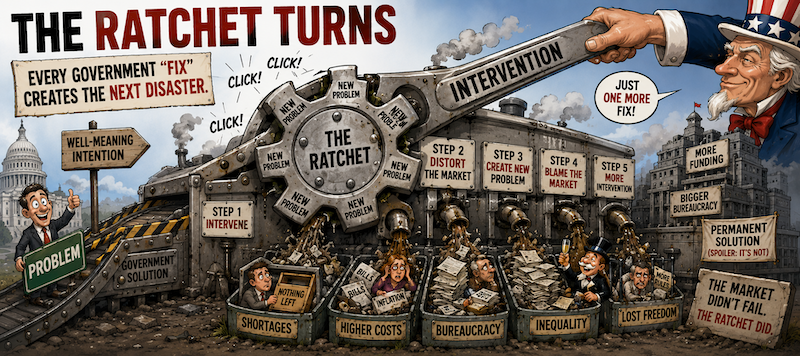
There’s a tool in every mechanic’s box called a ratchet.
It only turns one way. [continue reading…]
{ }
The Reality Index:
What inflation actually costs the American family.
The Consumer Price Index gets the cheap stuff right and the expensive stuff wrong. The Reality Index measures the gap between what the government reports and what families actually pay.
Grok summary:
The Reality Index argues that official CPI inflation understates the real cost increases for American families by a lot — especially on big expenses like housing and healthcare, while overstating rises in cheap stuff like food. [continue reading…]
{ }
Originally published at The Rude Awakening.
The War on Waiting
The Rude Awakening (May 19, 2026)
By Sean Ring
I’m perfectly fine with receiving feedback from subscribers who disagree with my view. After all, reasonable people disagree all the time. And since I live in a different part of the world and hold a different perspective, inevitably, readers will sometimes wonder what I’m getting at.
After writing Uncle Sam’s Invisible Hand for the Daily Reckoning last week, I received what I’ll politely call the most misguided criticism I’ve ever received. It was positively inane and missed my point by what Elaine from Airplane! would call “a tad.” I won’t print it for those reasons. [continue reading…]
{ }
Related
- Kinsella, Corporate Personhood, Limited Liability, and Double Taxation, LibertarianStandard.com (Oct. 18, 2011), including:
- KOL100 | The Role of the Corporation and Limited Liability In a Free Society (PFS 2013) (Sep. 22, 2013)
- KOL211 | Corporations and the Corporate Form
- Libertarian Answer Man: Legal Entities and Corporations in a Free Society (Feb. 29, 2024)
- The Over-reliance on State Classifications: “Employee” and “Shareholder”
- KOL418 | Corporations, Limited Liability, and the Title Transfer Theory of Contract, with Jeff Barr: Part II (Aug. 18, 2023)
- KOL414 | Corporations, Limited Liability, and the Title Transfer Theory of Contract, with Jeff Barr: Part I (Aug. 11, 2023)
- KOL170 | Tom Woods Show: Are Corporations Unlibertarian? (Jan. 24, 2015)
“How Corporate America Went Full Left,” Stateless Standard (May 19, 2026):
Corporate America didn’t “go woke” because its executives suddenly discovered compassion or equality. They danced with the left because that’s where the power and protection rackets live.
How Corporate America Went Full Left – And Why It Was Never About Woke
This isn’t idealism, it’s the oldest scam in the book: the powerful using government to rig the game against the stateless rest of us. Let’s rip the mask off with some real history.
The Socialist Razor Baron
Back in 1924, King Camp Gillette — the guy who made his fortune with disposable razor blades — teamed up with Upton Sinclair, the muckraker who wrote The Jungle. Together they pushed a book promoting Gillette’s longtime obsession: a single, gigantic, vertically integrated socialist corporation that would run everything from mines to your dinner table, enforcing equality through central planning. [continue reading…]
{ }
 From HansHoppe.com:
La Grande Fiction: L’État, cet imposteur (Éditions Le Drapeau blanc, 13 Oct. 2016), a French translation of The Great Fiction, with a preface by Guido Hülsmann. Translation of the Prefance by Stephane Geyres below.
Read more>>
{ }
Saifedean Ammous, “Javier Milei’s Austrian Scam By the Numbers,” Property and Freedom Journal (May 18, 2026)
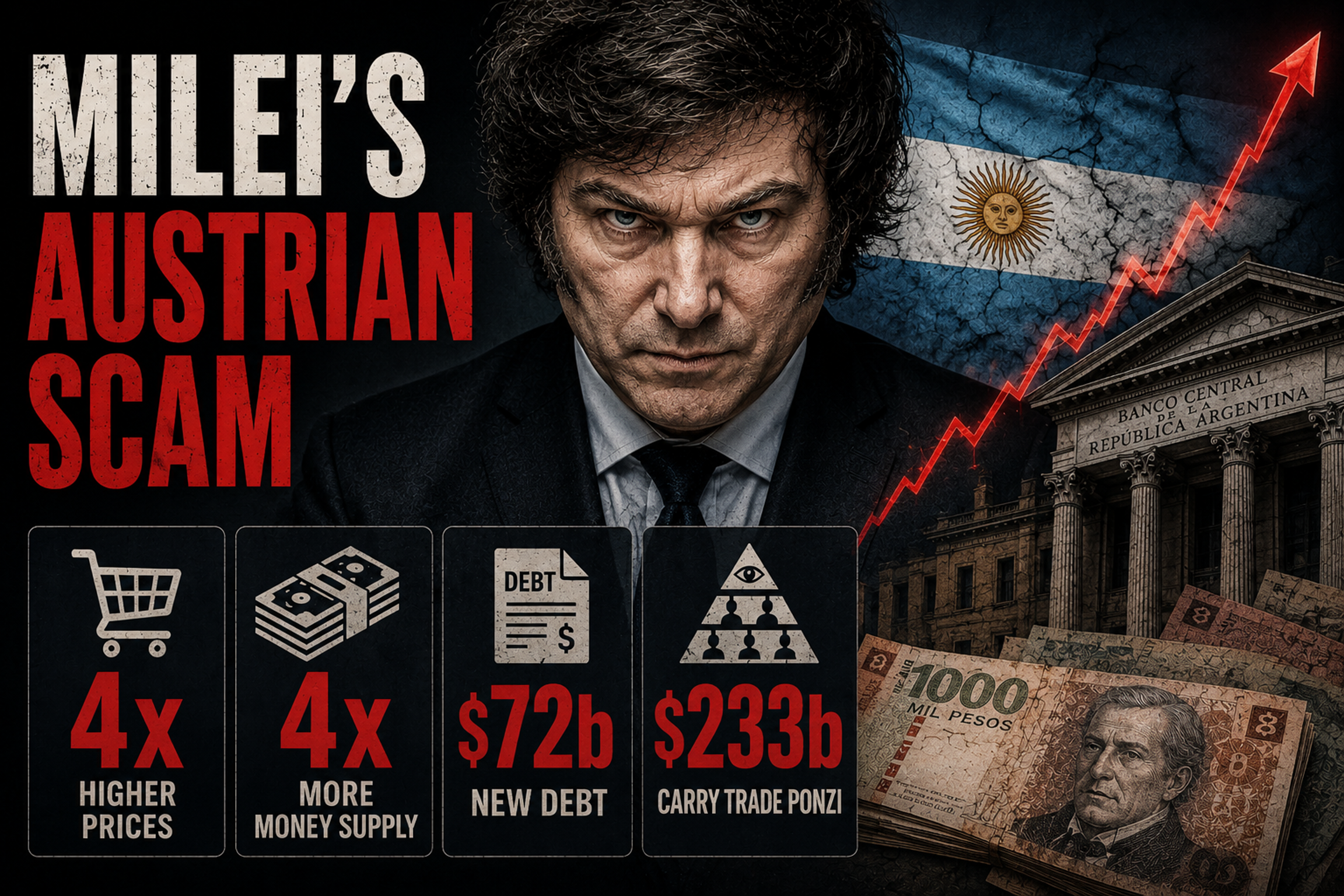
As a libertarian anarchist and Austrian school economist, I was interested in following the election of the first president in the world who professed to share my ideas. He said a lot of the right things on TV, and his radical policies seemed similar to what I would want implemented. After 30 months of close observation, I can confidently say Javier Milei’s policies bear no resemblance to what an Austrian economist would do, and he has used Austrian economics as a cover to run one of the most inflationary presidencies in Argentina’s highly inflationary history. Predictably, and in light of the most recent inflation and growth data, it is now safe to call Milei’s presidency a failure on all the important questions. Ignoring inconsequential rhetoric, Milei has been just another Latin American inflationist demagogue, selling his citizens pipe-dreams financed through inflation and debt that will burden and impoverish them for generations. In the 30th month of his presidency, when the seed of economic recovery planted early in the term should be bearing fruit, prices continue to rise, economic activity is declining, and the unsustainable government debt ponzi is larger than ever, suggesting much more pain to come.
Read more>>
{ }
Podcast: Play in new window | Download (Duration: 24:30 — 8.4MB)
Property and Freedom Podcast, Episode 326.
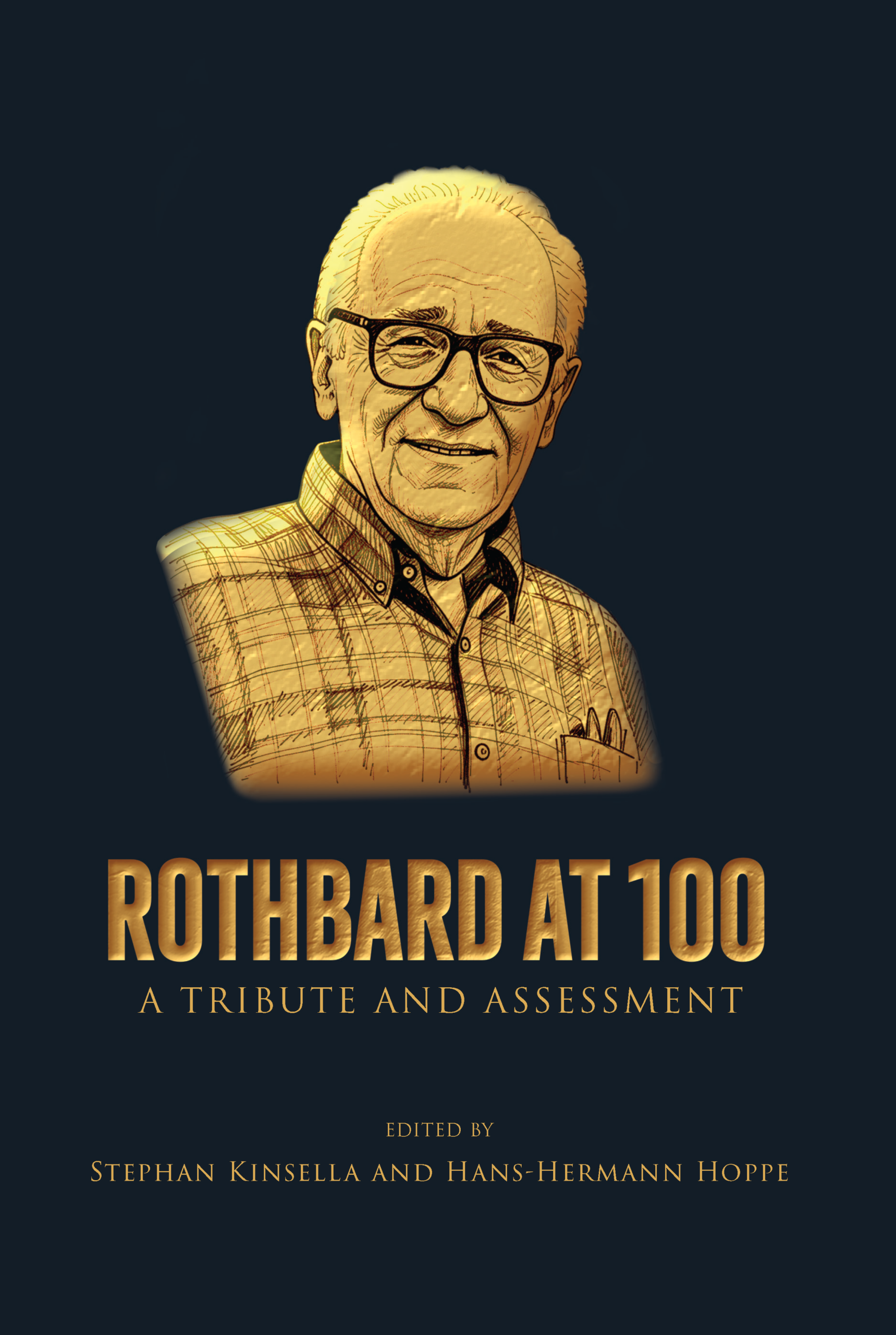 AI-assisted audio narration of the main chapters of Rothbard at 100: A Tribute and Assessment (Papinian Press and The Saif House, 2026) is available at this PFS Youtube Playlist; the mp3 files may also be downloaded in this zip file.
The first two chapters—my “Preface” and Hans’s “Introduction”—were published the week of Rothbard’s birthday here on the Property and Freedom Podcast (PFP315 and PFP314). The other main chapters will be released sequentially weekly on Mondays. The next in the queue:
11. Juan F. Carpio, “Murray Rothbard, Statelessness, and the Kritarchy: Five Millennia of Evidence for Competitive Lawmaking”
{ }
Tyler Kubik, “Murray N. Rothbard Bibliography: 1940–2019,” Property and Freedom Journal (May 16, 2026)
Editor’s note: We are pleased to present a comprehensive bibliography of the works of Murray N. Rothbard by Tyler Kubik. Kubik sent it to me after he noticed some various information about Rothbard posted on the PFS page for Rothbard at 100: A Tribute and Assessment (2026) including David Gordon’s bibliography, “Murray N. Rothbard: Chronological Bibliography (1949–1995),” a 54-page bibliography compiling work published between 1949 and 2005; and an Italian Bibliography, from Rothbard.it, which purports to cover Rothbard publications from 1947 to 1996. Kubik’s contains far more entries than these and covers a larger time period, from the early 1940s to 2019. [continue reading…]
{ }
Alan Bickley, “The Quiet Strangling of English Liberty,” Property and Freedom Journal (May 12, 2026)
 The traditional English defence of freedom of speech did not begin with modern liberalism. It emerged instead from a long and uneven struggle against authority. The medieval Church wished to supervise doctrine. The Tudor and Stuart monarchies wished to supervise printing. The political nation, when it slowly emerged from the seventeenth century, discovered by painful experience that censorship is not merely an inconvenience, but an instrument by which every other liberty may be dissolved.
Read more>>
{ }
Myth and Truth About Libertarianism
Murray N. Rothbard
[This article, first published in Modern Age 24, no. 1 (Winter 1980): 9–15 (pdf; Mises Daily) is based on a paper presented at the April 1979 national meeting of the Philadelphia Society in Chicago. The theme of the meeting was “Conservatism and Libertarianism.”]
Libertarianism is the fastest growing political creed in America today. Before judging and evaluating libertarianism, it is vitally important to find out precisely what that doctrine is, and, more particularly, what it is not. It is especially important to clear up a number of misconceptions about libertarianism that are held by most people, and particularly by conservatives. In this essay I shall enumerate and critically analyze the most common myths that are held about libertarianism. When these are cleared away, people will then be able to discuss libertarianism free of egregious myths and misconceptions, and to deal with it as it should be on its very own merits or demerits. [continue reading…]
{ }
Andreas Tank, “Sore Limbs Cannot be Cured by Lavender Water,” Property and Freedom Journal (May 11, 2026)
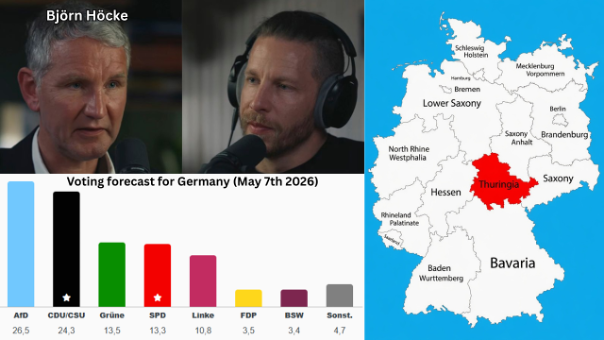
In 2026, basically every country has their evil right-wing boogey man. Some countries, like the United States with Donald Trump, are already governed by the political right. Germany is not and has not yet been under a right-wing government. The AfD (Alternative for Deutschland) is the right-wing party but the guy who is considered to pull the strings behind the curtains did not even make his way to the politics on the federal level but is the head of the AfD in the state of Thuringia. His name is Björn Höcke and he was recently invited to a big German podcast where he talked 4 and a half hours about his past as a history teacher and his political world view. This podcast episode, which is currently above 4 million views on YouTube, produced a huge meltdown all over German social media. Everyone in the mainstream media was shocked that this podcast could be aired without a certain classification by an expert—in other words: without left-wing censorship. Of course, nobody cried for censorship when the head of the leftist party was on the same podcast. The desperation was so big, that a few days later, three of the biggest left-wing parties (SPD – Social Democrats, Grüne – Green Party and Linke – Leftists) of Germany and with them a lot of politicians announced that they will leave X (formally Twitter) for good. Their plan is not yet obvious but a good prediction is, that most of them switch to bluesky—a twitter fork—now and after the launch of W Social—a bluesky fork, introduced by the WEF in 2026 and currently in its beta phase—they will have their officially state-owned social media.
Read more>>
{ }












 Alessandro Fusillo
 Doug French
 Fernando Chiocca
 Greg Morin
 Hans-Hermann Hoppe
 Jay Baykal
 Juan Fernando Carpio
 León Isidoro
 Martin Cabrera
 Oscar Grau
 PFS
PFS Sean Ring
 Stephan Kinsella
 Stéphane Geyres
 Thomas Jacob
 Tom DiLorenzo
Follow Us!