Skip to content
Program in Islamic Law

Program in Islamic Law

Promoting research and providing resources to advance the academic study of Islamic law

SCROLL DOWN
Scroll down to content
  • About
    • About Us
      • Who We Are
      • What We Do
      • What We Cover
    • Events
      • Harvard Events
      • Event Videos
      • Islamic Law Calendar
    • News
      • News & Announcements
      • Monthly Newsletters
      • Podcasts
  • People
    • Faculty & Staff
    • Fellows & Students
    • Advisors & Affiliates
  • Projects
    • SHARIAsource Portal
    • SEARCHstrata
    • CnC: Data Science Tools
  • Publications
    • Book Series
    • Journal & Online Forum
    • Islamic Law Blog
  • Resources
    • For Students
      • Courses and Degrees
      • Research Opportunities
      • Paper Prize
    • For Scholars
      • Fellowships
      • Editorships
      • Affiliation
    • For All
      • Jobs, Grants, CFPs
      • Related Links & Orgs
      • Policies & Guides

NewsletterFebruary NewsletterThe Program in Islamic Law’s (PIL) monthly newsletter is out for the month of February! This newsletter takes a look our spring calendar of events,  the ongoing Roundtable on Knowledge in the Islamic Court, and much more! Subscribe to receive the newsletter every month! View previous newsletters which are packed with updates and research in the field of Islamic Law and Data Science.

CalendarThe Program in Islamic Law at Harvard Law School (PIL) is pleased to announce an exciting lineup of virtual events this Fall 2025. We host myriad public events and provide other programming and support for students, research fellows, and scholars working in the field of Islamic legal studies, with attention to the intersection of those studies with data science. About the Program. PIL is a research program dedicated to promoting research and providing resources for the academic study of Islamic law and history, using data science, through a host of online and offline programs, including the following: SHARIAsource Portal: for primary sources, special collections, and data science tools Islamic Law Blog: cutting-edge commentary by leading scholars and curated roundups Journal of Islamic Law: featuring peer-reviewed scholarly articles, and a Forum for debate Harvard Series in Islamic Law: our book series with Harvard University Press Professor Intisar Rabb leads the Program as Faculty Director and editor-in-chief of the Publications. Subscribe to our blog for regular developments and subscribe to our mailing lists for updates on events and publications by visiting our website. PIL FALL 2025 EVENTS PIL convenes an Islamic Law Speaker Series that provides a forum for established and emerging scholars to talk about their own recent scholarship, works-in-progress, or developments in the field. Unless otherwise noted, all sessions will be convened and moderated by Dr. Rami Koujah, the 2025-2026 PIL Research Fellow at the Program in Islamic Law. The SHARIAsource Lab, convened by Professor Intisar Rabb, brings together students and researchers to focus on emerging tools in the Islamic digital humanities / data science space, and to developing new components of our in-house data science tools. TUE 14 OCT 2025 | 12.30-1.30p US EST | Zoom Islamic Law Speaker Series :: Rami Koujah (Harvard Law School) The Invention of Islamic Legal Personhood: Artifact to Ontology On Tuesday, October 14, 2025, at 12:30-1:30PM US EST via Zoom, Dr. Rami Koujah (Harvard Law School) will present "The Invention of Islamic Legal Personhood: From Artifact to Ontology," a chapter from his forthcoming book, Islamic Legal Personhood: A Genealogy of Rights and Responsibilities (Harvard University Press). This talk explores the conceptual history and significance of "baseline personhood" in Islamic law, focusing on the changed meaning and usage of the term dhimma across the tribal setting of pre-Islamic Arabia, the legal discourses that developed to accommodate the burgeoning market economy of the early Muslim Empire, and the subsequent theorizations of an Islamic jurisprudence infused with a covenantal theology. The talk draws attention to the creative dynamics of Islamic legal reasoning, including the critical role played by shifting epistemic frames between legal logic and the legal imagination. The talk concludes by showing how dhimma emerged in the 11th century as a constitutive element of a metaphysical anthropology, the ontological ground of an Islamic homo juridicus. Professor Mohammad Fadel (University of Toronto) will respond. Registration is required. TUE 11 NOV 2025 | 12.30-1.30p US EST | Zoom Islamic Law Speaker Series :: Youssef Belal (United Nations) "Thinking the World with Islamic Knowledges" On Tuesday, November 11, 2025, at 12:30-1:30PM US EST via Zoom, Youssef Belal (United Nations) will present "Thinking the World with Islamic Knowledges” from his book The Life of Shari'a: A Comparative Anthropology of Law (University of California Press, 2025). Is there a way to think about contemporary life with knowledge that is neither modern nor Western? Rather than confining Islam to a “religion” and sharīʿa to its “law,” Belal argues that Islamic shariʿa is a mode of knowledge with its own concepts and scholarly categories through which the world and the self are grasped. The Life of Sharīʿa considers two intertwined lineages: how Islamic scholars have formulated sharīʿa knowledge from the classical period to today and how Westerners have understood the law and its origins. By melding these two traditions, Belal formulates a new genealogy of modern law from the perspective of sharīʿa. Through a new conceptualization of sharīʿa, he offers an argument for its continued relevance to the life of contemporary Muslims. Registration is required. TUE 10 FEB 2026 | 12.30-1.30p US EST | via Zoom Islamic Law Speaker Series :: Sohaira Siddiqui (Georgetown University in Qatar) Siddiqui, Sohaira Z. M. Islamic Law on Trial: Contesting Colonial Power in British India. University of California Press, 2025.   On Tuesday, February 10, 2026, at 12:30-1:30PM US EST, Professor Sohaira Siddiqui will introduce her latest monograph, Islamic Law on Trial: Contesting Colonial Power in British India, which reexamines long-held assumptions about Islamic law under British rule. The book uncovers how colonial interventions disrupted existing legal traditions while revealing the strategies through which Muslim elites navigated, negotiated, and at times reshaped the new institutions imposed on them. Islamic Law on Trial interrogates the broader project of juridical colonization and shows that, even amid the violent displacement of Muslim legal authority, local actors found ways to articulate, defend, and at times even advance Islamic law from within the colonial judiciary itself. Their efforts produced a paradoxical legal landscape—one that appeared legitimate to both Muslim practitioners and English administrators, while complicating conventional narratives about continuity and rupture and resistance and collaboration.   Webinar Registration Link: https://harvard.zoom.us/webinar/register/WN_zINet7KPTvez3xjiEyL_Ng   TUE 10 MAR 2026 | 12.30-1.30p US EST | via Zoom Islamic Law Speaker Series :: Ihsan Yilmaz (Alfred Deakin Institute for Citizenship and Globalization, Deakin University) Yilmaz, Ihsan. Shari’a as Informal Law: Lived Experiences of Young Muslims in Western Societies. London: Routledge, 2024.   On Tuesday, March 10, 2026, at 12:30-1:30PM US EST, Professor Ihsan Yilmaz will discuss his monograph Shari’a as Informal Law: Lived Experiences of Young Muslims in Western Societies (Routledge, 2024). The book takes a comprehensive approach to investigate how sharīʿa manifests in and influences the everyday lives of young Muslims, aiming to unravel the meaning and relevance of sharīʿa-driven laws and practices in English-speaking Western societies. The study recognizes the diverse nature of the Muslim community, comprising both migrants and local converts who form integral parts of multicultural societies. Drawing on in-depth interviews with 122 young Muslims from Australia, the United States, and the United Kingdom, the research explores a diversity of opinions, interpretations, and practices. Moving beyond theoretical debates, it offers concrete insights into the practical implications of sharīʿa in Western contexts. The book also sheds light on how digital technologies shape information and knowledge acquisition, examining how young Muslims seek religious knowledge in the twenty-first century. It will be of interest to academics, researchers, and policy-makers in Law, Political Science, Minority Studies, Religious Studies, and Islamic Studies.   Webinar Registration Link: https://harvard.zoom.us/webinar/register/WN_6GjAct_tQ6yvgD1mei09cw   TUE 7 APR 2026 | 12.30-1.30p US EST | via Zoom Islamic Law Speaker Series :: Sherman Jackson (University of Southern California) Jackson, Sherman A. The Islamic Secular. Oxford University Press, 2023.   On Tuesday, April 7, 2026, at 12:30-1:30PM US EST, Professor Sherman Jackson will give a talk on his publication The Islamic Secular (Oxford University Press, 2023). The basic point of the secular in the modern West is to "liberate" certain pursuits—the state, the economy, science—from the authority of religion. This is also assumed to be the goal and meaning of "secular" in Islam. Professor Jackson argues, however, that this assumption is wrong. In Islam, the "secular" was neither outside "religion" nor a rival to it. "Religion" in Islam was not identical to Islam's "sacred law," or "sharīʿa," nor did classical Muslim jurists see sharīʿa as the all-encompassing, exclusive means of determining what is "Islamic." In fact, while—as religion—Islam's jurisdiction was unlimited, sharīʿa’s jurisdiction—as a sacred law—was limited. In other words, while everything remained within the purview of the divine gaze of the God of Islam, not everything could be determined by sharīʿa or on the basis of its revelatory sources. Various aspects of state policy, the economy, science, and the like were "differentiated" from sharīʿa and its revelatory sources without becoming non-religious or un-Islamic. Given the asymmetry between the circumference of sharīʿa and that of Islam as religion, not everything that fell outside the former fell outside the latter. In other words, an idea or action could be non-sharʿī (not dictated by sharīʿa) without being non-Islamic, let alone anti-Islam. The ideas and actions that fall into this category are what Jackson terms "the Islamic Secular." Crucially, the Islamic Secular differs from the Western secular in that, while the whole point of the Western secular is to liberate various pursuits from religion, the Islamic Secular differentiates these disciplines not from religion but simply from sharīʿa. Similarly, while both secularization and secularism play key roles in the Western secular, both of these concepts are alien to the Islamic Secular, as the Islamic Secular seeks neither to discipline nor to displace religion, nor expand to its own jurisdiction at religion's expense. The Islamic Secular is a complement to religion, in effect, a "religious secular." Nowhere are the practical implications of this more impactful than in Islam's relationship with the modern state. In his book, Jackson makes the case for the Islamic Secular on the basis of Islam's own pre-modern juristic tradition and shows how the Islamic Secular impacts the relationship between Islam and the modern state, including the Islamic State.   Webinar Registration Link: https://harvard.zoom.us/webinar/register/WN_x1CMqEeISPSTqGMktyLD7g
VideoOn April 16th at 12pm EST, the Roundtable on Knowledge in the Islamic Court was held via Zoom, marking the concluding event in the ISLAMICLAWblog essay series. The discussion brought together scholars to examine how Islamic courts construct and evaluate truth in practice. Key themes included what counts as valid proof in Islamic judicial settings, how judges navigate competing claims, and how evolving technologies reshape evidentiary standards. The conversation also raised broader questions about how Islamic law can be understood when attention is centered on its adjudicative procedures, as well as what defines an “Islamic” court or judge in the first place. Through five case studies, participants reflected on the role of evidence, proof, and legal procedure in shaping judicial reasoning. Focusing primarily on modern and contemporary contexts, the presentations highlighted how rapid social and technological change continues to transform conceptions of proof within Islamic legal systems. Convened by Nurul Hoda Mohd. Razif (University of Bergen) and Ari Schriber (University of Erfurt), the roundtable featured contributions from Aya Bejermi (University of Bordeaux), Léon Buskens (Leiden University), Dominik Krell (University of Oxford), Irene Schneider (University of Göttingen), and Mashal Saif (Clemson University).  Watch the video today!

VideoOn Tuesday, April 7, 2026, from 12:30–1:30 PM US EST, Professor Sherman Jackson (University of Southern California) gave a talk on his publication The Islamic Secular (Oxford University Press, 2023). The basic point of the secular in the modern West was to “liberate” certain pursuits—the state, the economy, and science—from the authority of religion. This was also assumed to be the goal and meaning of “secular” in Islam. Professor Jackson argued, however, that this assumption was wrong. In Islam, the “secular” was neither outside “religion” nor a rival to it. “Religion” in Islam was not identical to Islam’s “sacred law,” or “sharīʿa,” nor did classical Muslim jurists see sharīʿa as the all-encompassing, exclusive means of determining what was “Islamic.” In fact, while—as religion—Islam’s jurisdiction was unlimited, sharīʿa’s jurisdiction—as a sacred law—was limited. In other words, while everything remained within the purview of the divine gaze of the God of Islam, not everything could be determined by sharīʿa or on the basis of its revelatory sources. Various aspects of state policy, the economy, science, and the like were “differentiated” from sharīʿa and its revelatory sources without becoming non-religious or un-Islamic. Given the asymmetry between the circumference of sharīʿa and that of Islam as religion, not everything that fell outside the former fell outside the latter. In other words, an idea or action could be non-sharʿī (not dictated by sharīʿa) without being non-Islamic, let alone anti-Islam. The ideas and actions that fell into this category were what Jackson termed “the Islamic Secular.” Crucially, the Islamic Secular differed from the Western secular in that, while the whole point of the Western secular was to liberate various pursuits from religion, the Islamic Secular differentiated these disciplines not from religion but simply from sharīʿa. Similarly, while both secularization and secularism played key roles in the Western secular, both of these concepts were alien to the Islamic Secular, as the Islamic Secular sought neither to discipline nor to displace religion, nor to expand its own jurisdiction at religion’s expense. The Islamic Secular was a complement to religion, in effect, a “religious secular.” Nowhere were the practical implications of this more impactful than in Islam’s relationship with the modern state. In his book, Jackson made the case for the Islamic Secular on the basis of Islam’s own pre-modern juristic tradition and showed how the Islamic Secular impacted the relationship between Islam and the modern state, including the Islamic State. Watch the video today!

VideoOn Tuesday, March 10, 2026, from 12:30–1:30 PM US EST via Zoom, Professor Ihsan Yilmaz (Alfred Deakin Institute for Citizenship and Globalization, Deakin University) discussed his monograph Sharia as Informal Law: Lived Experiences of Young Muslims in Western Societies (Routledge, 2024). The book took a comprehensive approach to investigating how sharīʿa manifested in and influenced the everyday lives of young Muslims, aiming to unravel the meaning and relevance of sharīʿa-driven laws and practices in English-speaking Western societies. The study recognized the diverse nature of the Muslim community, comprising both migrants and local converts who formed integral parts of multicultural societies. Drawing on in-depth interviews with 122 young Muslims from Australia, the United States, and the United Kingdom, the research explored a diversity of opinions, interpretations, and practices. Moving beyond theoretical debates, it offered concrete insights into the practical implications of sharīʿa in Western contexts. The book also shed light on how digital technologies shaped information and knowledge acquisition, examining how young Muslims sought religious knowledge in the twenty-first century. It was of interest to academics, researchers, and policy-makers in Law, Political Science, Minority Studies, Religious Studies, and Islamic Studies. Watch the video today!

NewsletterJanuary NewsletterThe Program in Islamic Law’s (PIL) monthly newsletter is out for the month of January! This newsletter takes a look back at all that was accomplished in 2025, including the top blog posts of the year and much more! Subscribe to receive the newsletter every month! View previous newsletters which are packed with updates and research in the field of Islamic Law and Data Science.

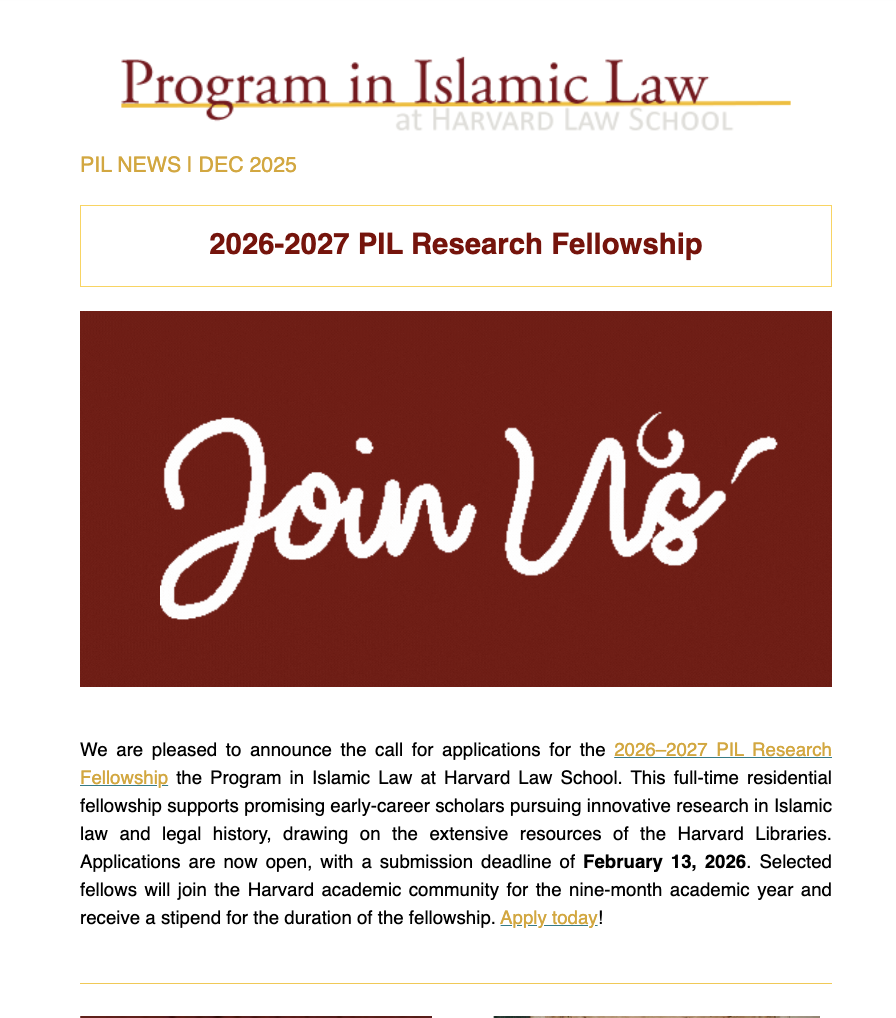
NewsletterDecember NewsletterThe Program in Islamic Law’s (PIL) monthly newsletter is out for the month of December! This newsletter features the call for applications for the PIL Research Fellowship, essay by last the ISLAMICLAWblog's recent Guest Blog Editor, and much more! Subscribe to receive the newsletter every month! View previous newsletters which are packed with updates and research in the field of Islamic Law and Data Science.

PIL NewsWe at the Program in Islamic Law at Harvard Law School mark the passing of Baber Johansen, Professor of Islamic Studies Emeritus at Harvard Divinity School. As HDS recently announced, Prof. Johansen passed away in late January 2026. He leaves behind a legacy as a distinguished scholar of Islamic law historically, and as a scholar who left a lasting impact on the modern study of Islamic law and on the many students and scholars he mentored throughout his career. Professor Johansen's scholarly research explored the relationship between legal reasoning, ethics, and social practice in Islamic societies, bringing historical depth and nuance to the study of Islamic law. Through influential works such as Islamic Law on Land Tax and Rent (Routledge, 1988) and Contingency in a Sacred Law (Brill, 1999), he illuminated the interpretive richness and internal diversity of Islamic legal traditions and demonstrated how jurists grappled with questions of authority, morality, and changing social realities. Across Harvard, Professor Johansen contributed to a wide intellectual community. He joined Harvard Divinity School in 2005 and played a key role in strengthening the study of Islam across Harvard University, including as one-time acting director at the Islamic Legal Stidies Program at Harvard Law School (predecessor to PIL), from 2006 to 2010. In addition, he was affiliated with the Department of Near Eastern Languages and Civilizations, served as a faculty associate emeritus at the Weatherhead Center for International Affairs, and directed the Center for Middle Eastern Studies from 2010 to 2013. Through these roles, he helped deepen the University’s engagement with the study of Islam and fostered interdisciplinary conversations among scholars of law, religion, and history. Through his many intellectual engagements  at Harvard and beyond, Professor Johansen's contribution to the study of Islamic law was profound and enduring. His scholarship brought a rare combination of rigor, depth, and intellectual independence that helped shape the field in lasting ways. He challenged students and colleagues alike to think more carefully, more historically, and more critically about Islamic legal traditions, both past and present. May that legacy continue to resonate. In the coming weeks and months, as we grapple with news of this loss, we invite the larger community to reflect on his scholarly impact and the role he played in building the intellectual community that many of his students and one-time colleagues still inhabit. May he be remembered with the seriousness and care that he brought to his work.

VideoOn Tuesday, February 10, 2026, from 12:30–1:30 PM US EST, Professor Sohaira Siddiqui (Georgetown University in Qatar) introduced her latest monograph, Islamic Law on Trial: Contesting Colonial Power in British India (University of California Press, 2025), which reexamines long-held assumptions about Islamic law under British rule. The book uncovers how colonial interventions disrupted existing legal traditions while revealing the strategies through which Muslim elites navigated, negotiated, and at times reshaped the new institutions imposed on them. Islamic Law on Trial interrogates the broader project of juridical colonization and shows that, even amid the violent displacement of Muslim legal authority, local actors found ways to articulate, defend, and at times even advance Islamic law from within the colonial judiciary itself. Their efforts produced a paradoxical legal landscape—one that appears legitimate to both Muslim practitioners and English administrators, while complicating conventional narratives about continuity and rupture, and resistance and collaboration. Watch the video today!

VideoOn Tuesday, October 14, 2025, at 12:30-1:30PM US EST via Zoom, Dr. Rami Koujah (Harvard Law School) presented “The Invention of Islamic Legal Personhood: From Artifact to Ontology,” a chapter from his forthcoming book, Islamic Legal Personhood: A Genealogy of Rights and Responsibilities (Harvard University Press, forthcoming). This talk explored the conceptual history and significance of “baseline personhood” in Islamic law, focusing on the changed meaning and usage of the term dhimma across the tribal setting of pre-Islamic Arabia, the legal discourses that developed to accommodate the burgeoning market economy of the early Muslim Empire, and the subsequent theorizations of an Islamic jurisprudence infused with a covenantal theology. The talk drew attention to the creative dynamics of Islamic legal reasoning, including the critical role played by of shifting epistemic frames between legal logic and the legal imagination. It concluded by showing how the concept of dhimma emerged in the 11th century as a constitutive element of a metaphysical anthropology, —the ontological ground of an Islamic homo juridicus. Professor Mohammad Fadel (University of Toronto) responded. Watch the video today!

AnnouncementWe are please to announce the publication of the sixth volume of the open-access, peer-reviewed Journal of Islamic Law, with a special issue titled “Between Divine Mandate and the Modern State: The Contested Legacy of Ḥudūd in Islamic Criminal Law.” A total of eight contributions to the volume examine ḥudūd laws across a range of contemporary Muslim-majority contexts including Indonesia, Iran, Morocco, Pakistan, and Saudi Arabia. This volume features articles by Muhammad Zubair Abbasi (Royal Holloway, University of London), Hazim H. Alnemari (Islamic University of Madinah), Anggi Azzuhri (Universitas Islam Internasional Indonesia), Mohsen Borhani (University of Tehran), Tabinda Mahfooz Khan (El Colegio de México), Mohamed Mitiche (University of Johannesburg), and Mohammadamin Radmand (independent researcher) as well as essays by Hamidreza Asimi (University of Tehran) together with Jamshid Gholamloo (University of Turin), and Yannis Mahil (GISTU University). Explore the issue today!

NewsletterNovember NewsletterThe Program in Islamic Law’s (PIL) monthly newsletter is out for the month of November! This newsletter features the work currently underway in the SHARIAsource Lab, essay by last the ISLAMICLAWblog's recent Guest Blog Editor, and much more! Subscribe to receive the newsletter every month! View previous newsletters which are packed with updates and research in the field of Islamic Law and Data Science.

PreviousNext

Upcoming Events

Loading view.
  • May 2026

Calendar of Events

M Mon

T Tue

W Wed

T Thu

F Fri

S Sat

S Sun

1 event, 27

2026-04-24

Conference: American Society for Premodern Asia Annual Meeting, Los Angeles, CA, April 24–27, 2026

Conference: American Society for Premodern Asia Annual Meeting, Los Angeles, CA, April 24–27, 2026

April 24 - April 27

Conference: American Society for Premodern Asia Annual Meeting, Los Angeles, CA, April 24–27, 2026

From the organizers: The 236th Meeting of the American Society for Premodern Asia will be held Friday, April 24, 2026 through Monday, April 27, 2026, in Los Angeles, CA USA.  …

Continue Reading

0 events, 28

0 events, 29

0 events, 30

2 events, 1

2026-05-01

Conference: 40th Annual Middle East History and Theory Conference (MEHAT), University of Chicago, May 1–2, 2026

Conference: 40th Annual Middle East History and Theory Conference (MEHAT), University of Chicago, May 1–2, 2026

May 1 - May 2

Conference: 40th Annual Middle East History and Theory Conference (MEHAT), University of Chicago, May 1–2, 2026

The 40th Annual Middle East History and Theory Conference (MEHAT) at The University of Chicago will take place on May 1-2, 2026.   About the Conference. Since its inception four decades ago, …

Continue Reading
2026-05-01

Language School: Persian Language Summer School, Armenian School of Languages and Cultures, Yerevan, Armenia, May 1, 2026

Language School: Persian Language Summer School, Armenian School of Languages and Cultures, Yerevan, Armenia, May 1, 2026

May 1

Language School: Persian Language Summer School, Armenian School of Languages and Cultures, Yerevan, Armenia, May 1, 2026

From the organizers: The Armenian School of Languages and Cultures – ASPIRANTUM is organizing a Persian language summer school in Yerevan, Armenia. The program starts on June 21, June 28, …

Continue Reading

1 event, 2

2026-05-01

Conference: 40th Annual Middle East History and Theory Conference (MEHAT), University of Chicago, May 1–2, 2026

0 events, 3

1 event, 4

2026-05-04

Summer School: Philology and Manuscripts from the Muslim World, Leiden University, May 4, 2026

Summer School: Philology and Manuscripts from the Muslim World, Leiden University, May 4, 2026

May 4

Summer School: Philology and Manuscripts from the Muslim World, Leiden University, May 4, 2026

From the organizers: Date: 17 August – 28 August 2026 Costs: €600 Level: The course is meant for graduate students (MA and PhD) and researchers. Language: English. Non-native speakers are required …

Continue Reading

0 events, 5

0 events, 6

0 events, 7

0 events, 8

0 events, 9

0 events, 10

0 events, 11

0 events, 12

1 event, 13

2026-05-13

Call for Participation: Digital Medieval Studies Institute, International Congress on Medieval Studies, Western Michigan University, May 13, 2026

Call for Participation: Digital Medieval Studies Institute, International Congress on Medieval Studies, Western Michigan University, May 13, 2026

May 13

Call for Participation: Digital Medieval Studies Institute, International Congress on Medieval Studies, Western Michigan University, May 13, 2026

Applications now are being accepted for the fourth annual Digital Medieval Studies Institutes, organized by Dr. Laura Morreale and Dr. N. Kıvılcım Yavuz. The first will take place on 13 …

Continue Reading

0 events, 14

0 events, 15

0 events, 16

0 events, 17

0 events, 18

0 events, 19

0 events, 20

0 events, 21

0 events, 22

0 events, 23

0 events, 24

0 events, 25

0 events, 26

0 events, 27

1 event, 28

2026-05-28

Conference: Law and Society Association Annual Meeting, San Francisco, May 28–31, 2026

Conference: Law and Society Association Annual Meeting, San Francisco, May 28–31, 2026

May 28 - May 31

Conference: Law and Society Association Annual Meeting, San Francisco, May 28–31, 2026

From the organizers: The LSA Annual Meeting will take place in San Francisco, California, USA, from May 28-31, 2026. The conference will be held at the Hilton Union Square. This …

Continue Reading

1 event, 29

2026-05-28

Conference: Law and Society Association Annual Meeting, San Francisco, May 28–31, 2026

1 event, 30

2026-05-28

Conference: Law and Society Association Annual Meeting, San Francisco, May 28–31, 2026

1 event, 31

2026-05-28

Conference: Law and Society Association Annual Meeting, San Francisco, May 28–31, 2026

April 24
All day

Conference: American Society for Premodern Asia Annual Meeting, Los Angeles, CA, April 24–27, 2026

  • There are no events on this day.
  • There are no events on this day.
  • There are no events on this day.
May 1
All day

Conference: 40th Annual Middle East History and Theory Conference (MEHAT), University of Chicago, May 1–2, 2026

All day

Language School: Persian Language Summer School, Armenian School of Languages and Cultures, Yerevan, Armenia, May 1, 2026

May 1
All day

Conference: 40th Annual Middle East History and Theory Conference (MEHAT), University of Chicago, May 1–2, 2026

  • There are no events on this day.
May 4
All day

Summer School: Philology and Manuscripts from the Muslim World, Leiden University, May 4, 2026

  • There are no events on this day.
  • There are no events on this day.
  • There are no events on this day.
  • There are no events on this day.
  • There are no events on this day.
  • There are no events on this day.
  • There are no events on this day.
  • There are no events on this day.
May 13
All day

Call for Participation: Digital Medieval Studies Institute, International Congress on Medieval Studies, Western Michigan University, May 13, 2026

  • There are no events on this day.
  • There are no events on this day.
  • There are no events on this day.
  • There are no events on this day.
  • There are no events on this day.
  • There are no events on this day.
  • There are no events on this day.
  • There are no events on this day.
  • There are no events on this day.
  • There are no events on this day.
  • There are no events on this day.
  • There are no events on this day.
  • There are no events on this day.
  • There are no events on this day.
May 28
All day

Conference: Law and Society Association Annual Meeting, San Francisco, May 28–31, 2026

May 28
All day

Conference: Law and Society Association Annual Meeting, San Francisco, May 28–31, 2026

May 28
All day

Conference: Law and Society Association Annual Meeting, San Francisco, May 28–31, 2026

May 28
All day

Conference: Law and Society Association Annual Meeting, San Francisco, May 28–31, 2026

View Calendar

Live Updates

Live updates
SUBSCRIBE TO OUR LISTS
FOLLOW US
  • Twitter
  • Facebook
  • Instagram
  • LinkedIn
  • RSS Feed
  • About
    • About Us
      • Who We Are
      • What We Do
      • What We Cover
    • Events
      • Harvard Events
      • Event Videos
      • Islamic Law Calendar
    • News
      • News & Announcements
      • Monthly Newsletters
      • Podcasts
  • People
    • Faculty & Staff
    • Fellows & Students
    • Advisors & Affiliates
  • Projects
    • SHARIAsource Portal
    • SEARCHstrata
    • CnC: Data Science Tools
  • Publications
    • Book Series
    • Journal of Islamic Law & Forum
    • Islamic Law Blog
  • Resources
    • For Students
      • Courses and Degrees
      • Research Opportunities
      • Paper Prize
    • For Scholars
      • Fellowships
      • Editorships
      • Affiliation
    • For All
      • Jobs, Grants, CFPs
      • Related Links & Orgs
      • Policies & Guides

Contact Us | Donate

© 2021 Presidents and Fellows of Harvard College | Credits

Subscribe to PIL Lists