

conan wishes you a happy trans pride


I am in the car rn on the way to the airport so i can go to france and this is the first thing on my dash when i open tumblr
Ye, you are an NPC in my campaign of Mutuals and Misfits, sorry you had to find out this way.
random PSA, I know a lot of people use duckduckgo as a Google alternative search engine, but it always kind of annoyed me when I was using it because it felt like No Name Brand Google
I have switched to using Startpage.com and vastly prefer it. for one thing, instead of displaying an "AI summary" at the top of the search results (unless you turn it off, yes I know), it displays the first paragraph of the Wikipedia article, with link, whenever it finds one that's relevant.
also a waaayyyyy better sense of design than duckduckgo
also private, European based, least annoying search I've used lately (RIP old "don't be evil" Google)
Keeping a list of Google alternatives just in case…
i have one of those, scraped from multiple different rec posts:
www.refseek.com - Academic Resource Search. More than a billion sources: encyclopedia, monographies, magazines.
www.worldcat.org - a search for the contents of 20 thousand worldwide libraries. Find out where lies the nearest rare book you need.
https://link.springer.com - access to more than 10 million scientific documents: books, articles, research protocols.
www.bioline.org.br is a library of scientific bioscience journals published in developing countries.
http://repec.org - volunteers from 102 countries have collected almost 4 million publications on economics and related science.
www.science.gov is an American state search engine on 2200+ scientific sites. More than 200 million articles are indexed.
www.base-search.net is one of the most powerful researches on academic studies texts. More than 100 million scientific documents, 70% of them are free.https://cosine.club/ is an electronic music similarity search engine

She got the idea for the study while walking with her advisor at Stanford to discuss her thesis topic, and the paper she eventually published in the Journal of Experimental Psychology in 2014 is sharp enough that it should have ended the seated meeting on the day it came out.
She ran 4 experiments on 176 people. Same person tested twice. Once sitting, once walking. The creativity tasks were the standard ones psychologists have used for decades to measure how good a brain is at generating novel useful ideas.
The skeptical question is the obvious one. Maybe it was the fresh air. Maybe it was the scenery passing by. Maybe it was the change of environment doing the work, not the walking itself.
Oppezzo killed every one of those explanations with one experimental decision. She put people on a treadmill facing a blank wall. No scenery. No fresh air. No environmental change. Just legs moving in place while staring at white drywall. The 60% boost held.
Then she ran the experiment that closed the case completely. She took participants outside in two conditions. Half of them walked through a Stanford courtyard. The other half were pushed through the exact same courtyard in a wheelchair. Same outdoor stimulation. Same scenery passing at the same speed. The only difference was whether the legs were moving.
The walkers produced dramatically more novel high-quality ideas than the wheelchair group. The outdoors did almost nothing on its own. The walking did everything.
She also tested the opposite kind of thinking. Convergent thinking. The kind where there is one right answer and you have to narrow down to it. Word puzzles where 3 words share a hidden fourth word that connects them. The seated participants did slightly better on these. Walkers got slightly worse.
Walking is not a general intelligence enhancer. It does one specific thing. It opens up the divergent search inside your brain. The part that generates options. The part that produces unexpected connections. The part that takes a problem and finds five ways into it instead of one.
When you need to converge on the single right answer, sit down. When you need to find the answer in the first place, get up.
The mechanism is now well understood. Walking selectively activates what neuroscientists call the default mode network, the system inside your brain that runs when you are not consciously focused on anything. The DMN is where mind-wandering happens. Where memories cross-reference each other. Where ideas that have been sitting in separate folders inside your head finally bump into each other.
When you sit at a desk and force yourself to concentrate, you suppress the DMN. When you walk at a natural pace, the executive part of your brain gets just busy enough handling the walking that the DMN comes online and starts doing the work that focus was blocking.
The most useful finding in the entire paper is the one almost nobody quotes. The boost did not turn off the moment people stopped walking. Participants who walked first and then sat back down stayed elevated. Their next round of seated creativity work was still significantly better than people who had been sitting the whole time. The rest lingered for at least several minutes after the legs stopped moving.
You do not need to do creative work while walking. You need to walk before the creative work. The brain holds the state.
Edited down a long tweet. (x)
For all the many flaws of the tagging system on this hellsite, it is so perfect for Sending Home. A man's not dead while his name is still spoken, and what are the tags but the Overhead of tumblr? They aren't the posts themselves, but they are metacommentary on posts, notes to friends, info to be passed on. The message has been logged and is continuing to be sent on. GNU
Coming into a fandom early and watching it become an angry clusterfuck


Being in a dormant fandom that suddenly comes alive again after a new book/movie

Don’t forget about those who come in the midst of a fandom war.

Accuracy at its best
Being in a fandom and not even knowing there’s a war going on…

all of this shit…lol
When You’re Not In The Fandom But You’re Nosy AF

When you get into a fandom only to discover it’s dead
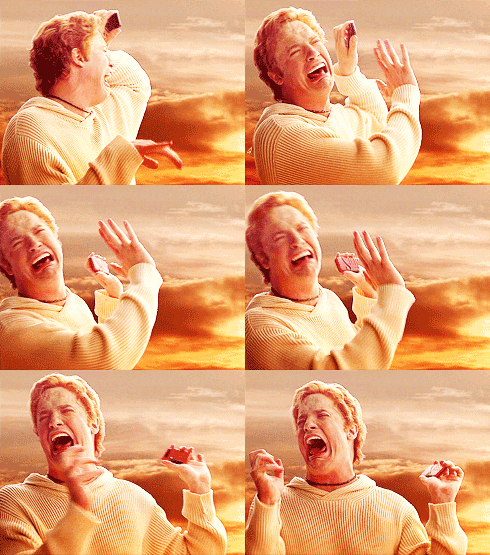
This gets better every time I see it.
Being in a dead fandom…

Or being in such a tiny fandom that it feels like youre the only one

The accuracy hurts.
Being in a fandom that had a shit ending.

When you’ve been fangirling long enough, you’ve experienced all of the above.

Being in a fandom meant for kids.

This just gets better..
When you realize that joining the fandom has ruined you

Fandom hell in general


Yes.
This^^^ just… ALL OF THIS.
Being in so many fandoms that you don’t even know what’s going on


THIS IS THE SKULDUGGERY FUCKING PLEASANT FANDOM IN ONE POST!!
Trying to recruit people to your fandom

Annnnnnndddd it’s back

Being in a fandom which has so many antis

I’ve probably reblogged this before, but that was before these great additions.
Being in a fandom that actually works together


Why is this so true? All of it.
being in a fanbase but all your mutuals suddenly turn into Kpop blogs

I always enjoy it when a good post comes around again and has been improved by the reblogs like the years for a fine wine.
Being in a fandom when shit goes down and everyone has different opinions

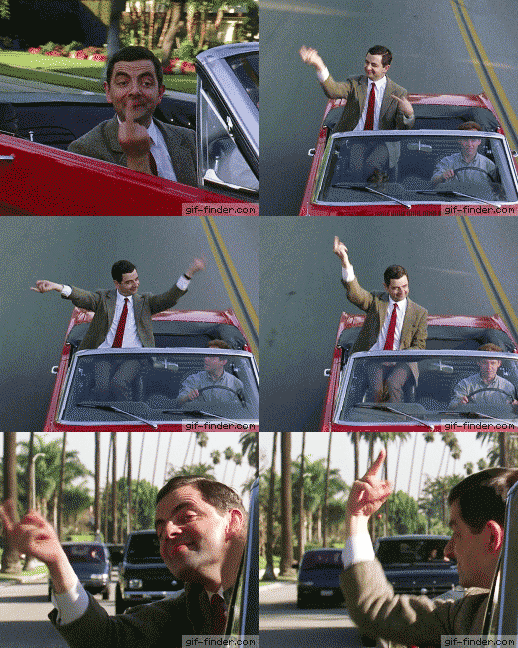
When you are in a fandom and don’t care for others people opinion…..even if they are right…(believe me, I have met several of those)
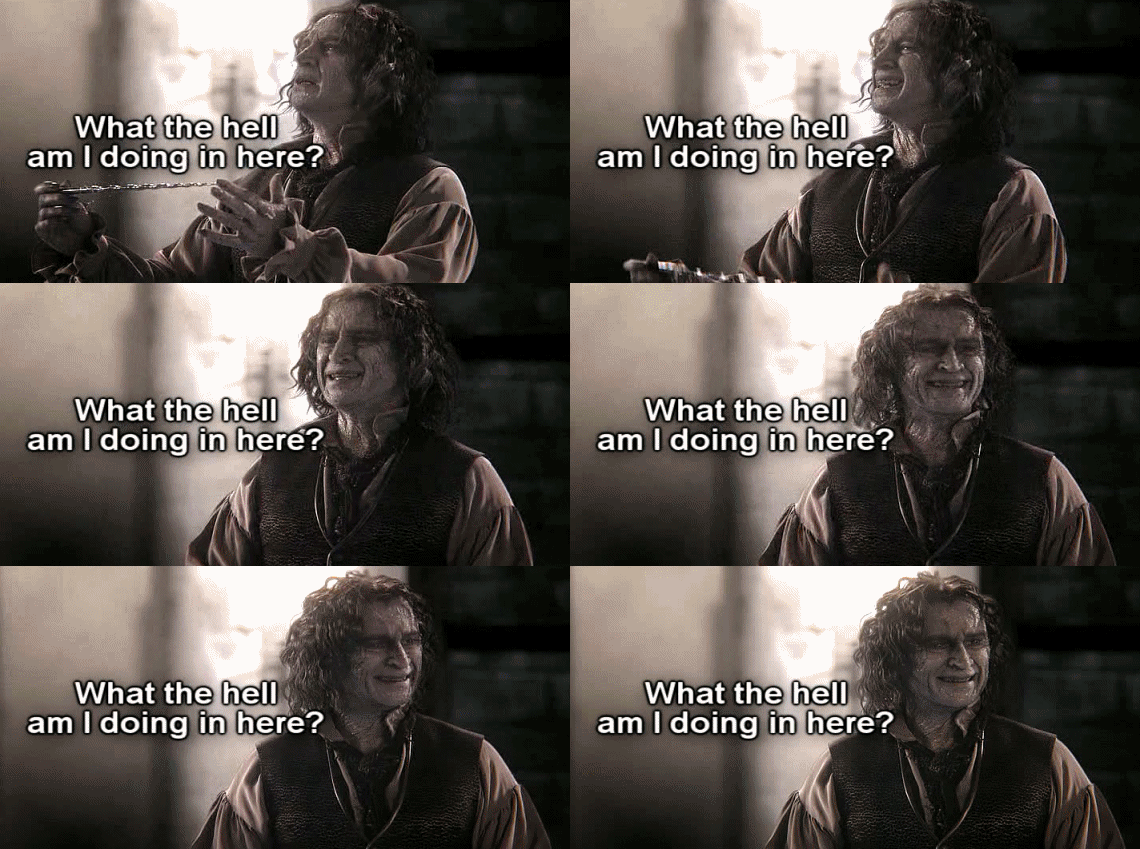
Being in a fandom you never meant to join

I love this. and it’s gotten better

After abandoning a fandom you’re still a little bit emotionally invested in….
All of these are me. Lol
Being in a fandom on Tumblr

And it reached its epic conclusion
I CHOKED ON FUNDIP
HISTORY HAS BEEN ENGRAVED INTO THIS POST
To start off with: The recent backlash against calling characters "Mary Sue" is valid as hell — the term is often sexist, racist, and simply unfounded. However. I do think that there is still a baby somewhere in that bathwater, and that "this character is so perfect it becomes a major flaw in the story" can still be a meaningful criticism.
Argument 1: "Mary Sue" is a valid criticism to the extent that a character like that can create the problem of excessive match between the challenges of a plot and the strengths of a character. That story is always going to be completely lacking in tension and excitement. If Jim is the world's best wizard ever to wizard, and now there's an entire book about Jim using wizardry to solve wizard-related problems... Yaaaawn. No challenge for Jim means no uncertainty, no investment in the character.
Tl;dr: the "Mary Sue" character can be a serious problem for a story because a character extremely well-equipped to solve their own plot problems will pretty much never create tension or interest for the audience.
Pt. 2 | Pt. 3 | Pt. 4 | Pt. 5 | Pt. 6 | Pt. 7
*Going to constrain my examples to white male protagonists that someone else has called "Mary Sue", as part of my argument that it's not all sexism.
Gee, maybe if they hadn't started out by STEALING all that dystopian SF to train their autocomplete machine, this wouldn't be happening... :/


 dduane
