
When you keep getting easily distracted while writing:



Different materials were used as toilet paper, which depended on the country, weather conditions, personal preference, and status in society. For example, wealthy people often used wool, lace or hemp.
The first recorded use of something resembling toilet paper comes from 6th century China where the more affluent members of society would use wads of paper (squares made from ricepaper which was cheap and plentiful) to clean their nether regions. The Chinese emperor commissioned large 2ft x 3ft paper sheets to use. However, even after the invention of the flush toilet in 1596, commercially produced toilet paper didn’t catch on until 300 years later.
In Ancient Rome, they were a bit more sophisticated than the Greeks when it came to cleansing. The wealthy used wool and rosewater to clean themselves. But the rest of the people cleaned themselves after using a public latrine with a sponge lashed to a long stick, which was stored in a bucket of salt water or vinegar. It was considered polite to give the sponge a cursory rinse and a squeeze before putting it back in the bucket to get it ready for the next person.
In Ancient Greece, they too had a sponge on a stick called a xylospongium, but the preferred method was pieces of ceramic called pessoi. These were used in a left to right scraping motion and historians have estimated that your average wipe would use three pieces. Sometimes these pottery fragments would be inscribed with the name of an enemy before being used.
In Ancient Japan, they used a flat wooden sticks called a chügi that looked similar to a tongue depressor to clean themselves. In earlier days seaweed was used for cleaning, but by the Edo period, these had been replaced by toilet paper made of washi (traditional Japanese paper). In the mountainous regions, wooden scrapers and large leaves were used too.
For those living in the cold, northern regions of the world, tundra moss was readily available during the summer, and clumps of snow would do the trick for the rest of the year.
People in the Middle East and the Indian subcontinent use the water (from the tap and a jug or maybe even the luxury option of a little hose pipe) and their left hand to direct the stream of water to their nether regions. Of course, they make sure to thoroughly wash their hand afterwards. This method is still in use in some developing countries, which is why it’s offensive to greet someone with your left hand or to use it to eat with, even touching food.
Parts of Europe, too, use strategically aimed jets of water, or separate fixtures known as bidets. In those cases, toilet paper is simply used to dry off. In Europe it was common to use rags which could be washed and used again, many of these rags ended up in the sewer system, so it’s impossible to know how many times these rags were used before being thrown away.
In the Middle Ages, the wealthy had built stone toilets called ‘garderobes’, which jutted out of the sides of their castles. The waste would fall threw the vertical chute and land outside in the courtyard or bailey. Some garderobes emptied into the moat (or ocean, depending on where the castle was built). The wealthy people might’ve used sheep’s wool to wipe their behinds (or cloth in which their servants would wash it for them). Chamber pots existed too and they were often used to collect waste overnight. When they were finished, the contents would be thrown over the balcony or out the window (some would be toss out into the river). Ordinary people often used a plant called common mullein or woolly mullein. They might’ve even used hay, grass, moss or rags too.
In pre-colonial America the Native Americans dug latrines away from their homes and fresh water. During the most brutal weather, these latrines would be placed close by. Human waste froze in the winter and didn’t smell nearly as much as in the summer. They used whatever that was available: twigs, dry grass, small stones, leaves, and even oyster or clam shells.
Pioneers would used grass, leaves or just plain dirt. Bark was also a option. When they made camp, they would find a private spot away from a source of water and dig a deep hole. It would be for everyone to temporarily use until it was time to travel again. The dirt they dug out would be off the side with a shovel and when someone poop, the dirt would be sprinkle on top.
The rural agrarian communities had outhouses and would used handfuls of straw as toilet paper. But the most common material was the corn cobs, specifically when the corn kernels had been removed from the cob. This was a popular option because the cobs were readily available and surprisingly soft and flexible (especially when boiled first).
Later on they realized they could use squares of old newspapers, and catalogues to clean themselves with. Some would even resort to using the pages of the Old Farmers’ Almanac, which was often faithfully (and conveniently) hanging in the outhouse. There was also a bag of lime with a scoop usually placed in the corner of the outhouse. After every use they would sprinkle a scoop of lime in the hole as a chaser to keep down the smell. As for what happens when the outhouse gets full, easy—they’d simply dig a new hole, and move the outhouse over it.
It wasn’t till 1857 that Joseph Gayetty came up with the first commercially available toilet paper in the United States. They were sold in packages of flat sheets that were moistened and soaked with aloe. Gayetty’s toilet paper sold for about 50 cents a pack ($12 today), with 500 sheets in that package. This wasn’t terribly popular, presumably because up to this point most people got their wiping materials for free from whatever was at hand. Such as old newspapers, or something more natural like a piece of moss, piles of dirt, or a bit of fur, or even in some cases mussel and oyster shells.
But in 1867 Philadelphia, the brothers Thomas, Edward, and Clarence Scott managed to successfully market their own toilet paper. It was much cheaper because it wasn’t coated with aloe or moistened, but was just rolls of somewhat soft paper (often with splinters). This was the year when the perforated toilet paper in rolls, as we know it today, saw a wider use.
I saw and reblogged this one a while back, but it’s always worth repeating, and this time I’m adding a bit of background info comparing common fantasy sword features to the Real Thing (with pictures, of course.)
Leaf-bladed swords are a very popular fantasy style and were real, though unlike modern hand-and-a-half longsword versions, the real things were mostly if not always shortswords.
Here are Celtic bronze swords…

…Ancient Greek Xiphoi…

… and a Roman “Mainz-pattern” gladius…

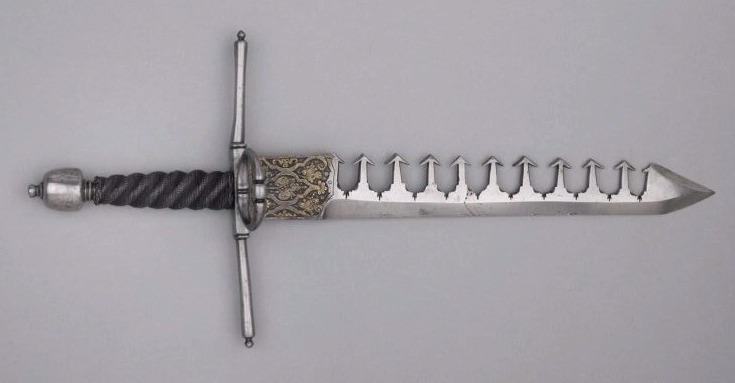
Saw or downright jagged edges, either full-length or as small sections (often where they serve no discernible purpose) are a frequent part of fantasy blades, especially at the more, er, imaginatively unrestrained end of the market.
Real swords also had saw edges, such as these two 19th century shortswords, but not to make them cool or interesting. They’re weapons if necessary…


…but since they were carried by Pioneer Corps who needed them for cutting branches and other construction-type tasks, their principal use was as brush cutters and saws.
This dussack (cutlass) in the Wallace Collection is also a fighting weapon, like the one beside it…

…but may also have had the secondary function of being a saw.

A couple of internet captions say it’s for “cutting ropes” which makes sense - heavy ropes and hawsers on board a ship were so soaked with tar that they were often more like lengths of wood, and a Hollywood-style slice from the Hero’s rapier (!!) wouldn’t be anything like enough to sever them. However swords like this are extremely rare, which suggests they didn’t work as well as intended for any purpose.
I photographed these in Basel, Switzerland, about 20 years ago. Look at the one on the bottom (I prefer the basket-hilt schiavona in the middle).

A lot of “flamberge” (wavy-edge) swords actually started out with conventional blades which then had the edges ground to shape - the dussack, that Basel broadsword and this Zweihander were all made that way.
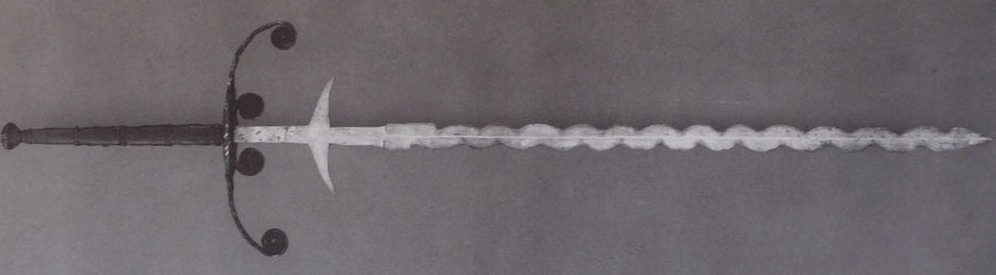
The giveaway is the centreline: if it’s straight, the entire blade probably started out straight.
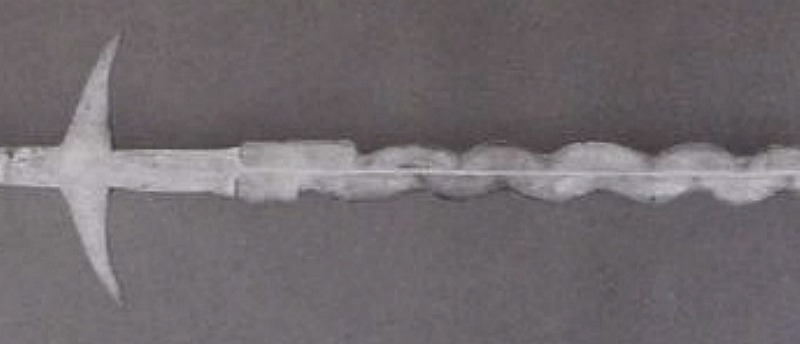

Again, the clue is the centre-line.
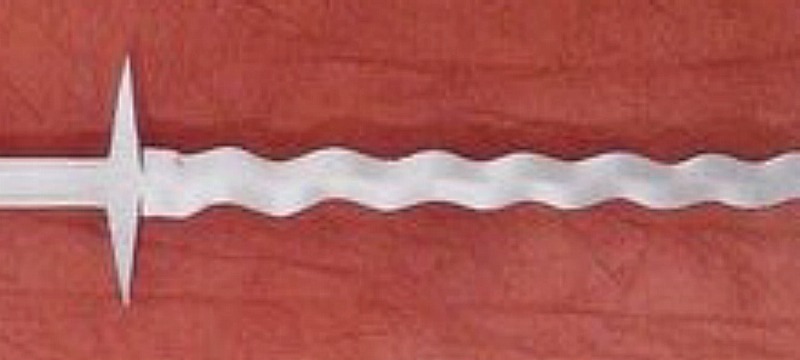
Incidentally those
Parierhaken (parrying hooks - a secondary crossguard) are among the only
real-life examples of another common fantasy feature - hooks and
spikes sticking out from the blade.
Here are some rapiers and a couple of daggers showing the same difference between forged to shape and ground to shape. The top and bottom rapiers in the first picture started as straights, and only the middle rapier came from the forge with a flamberge blade.
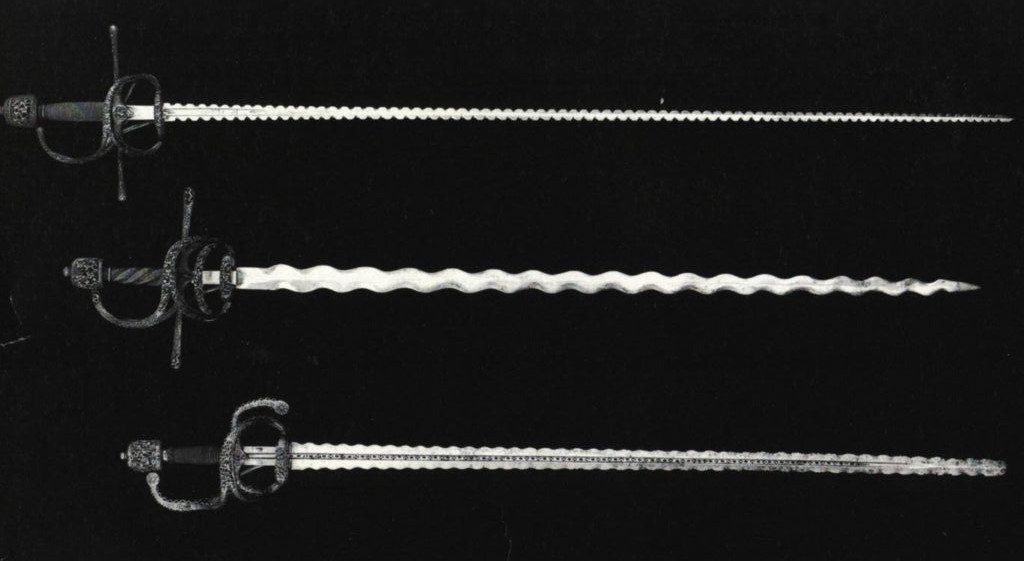
There’s no doubt about this one either.
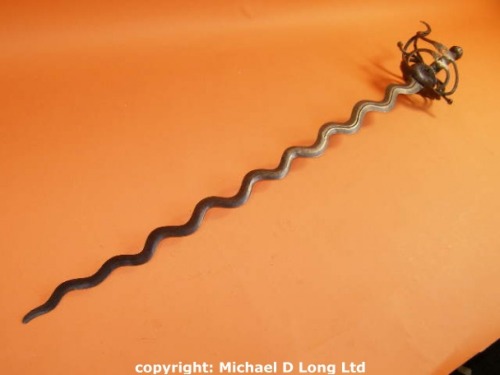
The reason - though that was a part of it - wasn’t just to look cool and show off what the owner could afford (any and all extra or unusual work added to the price) but may actually have had a function: a parry would have been juddery and unsettling for someone not used to it, and any advantage is worth having.
However, like the saw-edged dussack, flamberge blades are unusual - which suggests the advantage wasn’t that much of an advantage after all.
Here’s a Circassian kindjal, forged wiggly…

…and an Italian parrying dagger forged straight then ground wiggly…
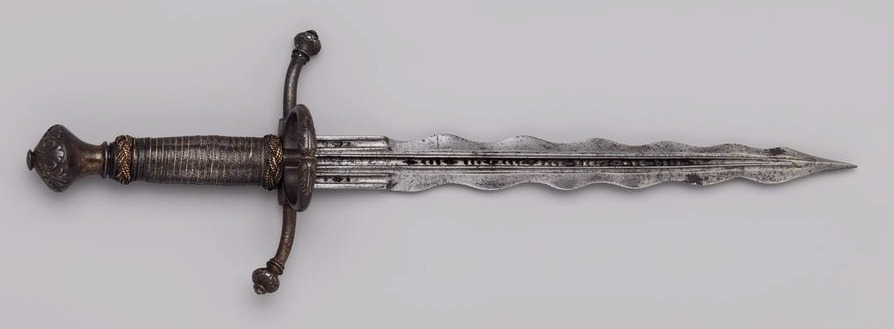
There were also parrying daggers with another fantasy-blade feature, deep notches and serrations which in fantasy versions often resemble fangs or thorns.
These more practical historical versions are usually called “sword-breakers” but I prefer “sword-catcher”, since a steel blade isn’t that easy to break. Taking the opponent’s blade out of play for just long enough to nail him works fine.

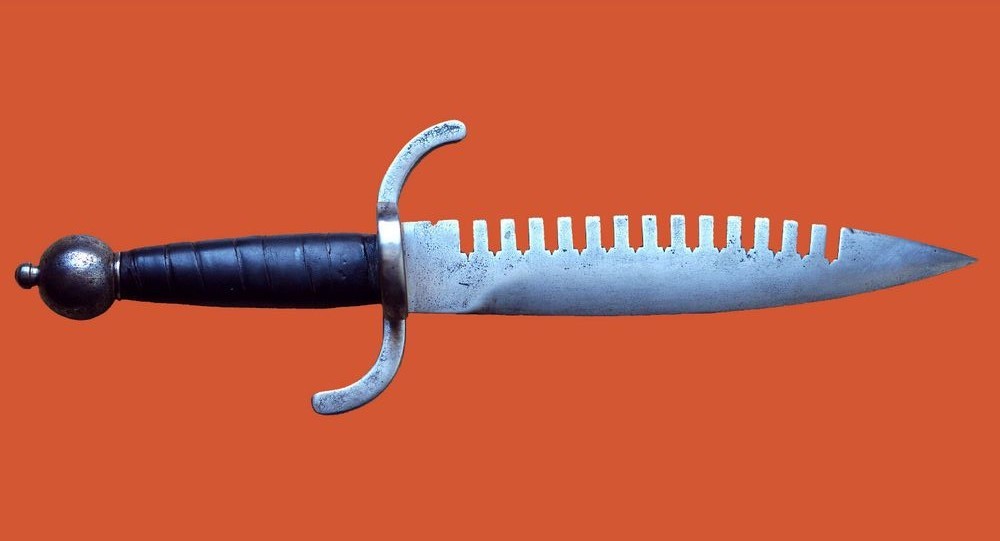
NB - the curvature on the top one in this next image is AFAIK because of the book-page it was copied from, not the blade itself.
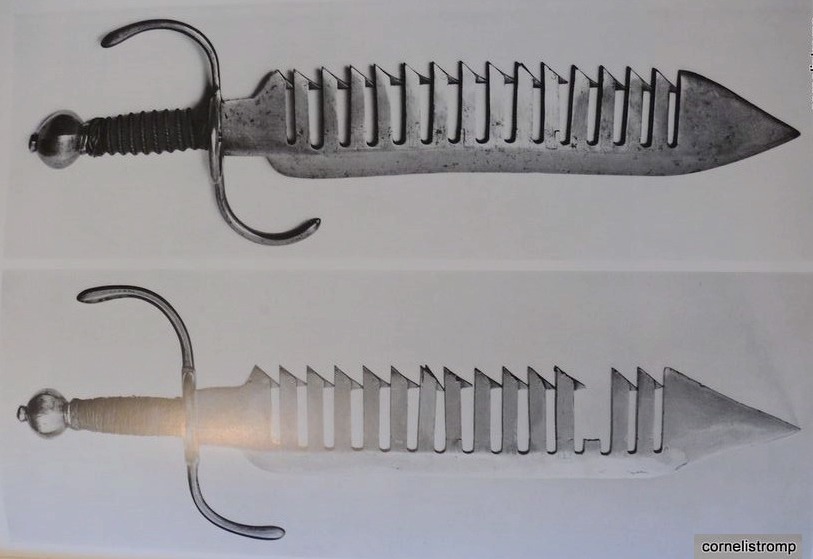
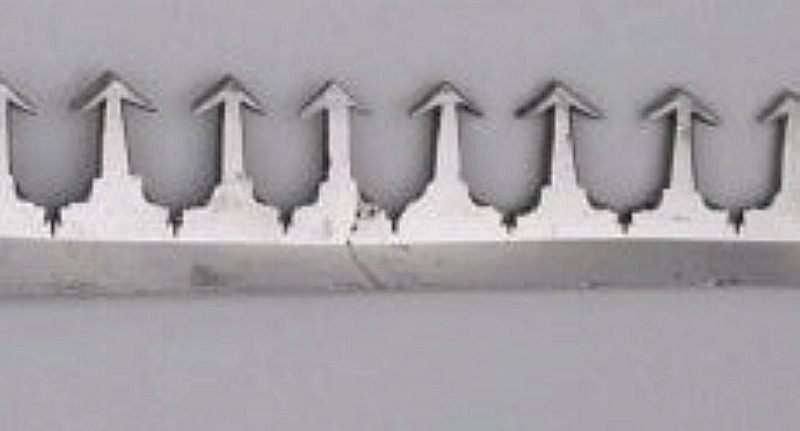
The missing tooth on that second dagger, and the crack halfway down this next one’s blade, shows what happens when design features cause weak spots.
So there you go: a quick overview of fantasy sword features in real life.
Here’s a real-life weapon that looks like it belongs in a fantasy story or film - and this doesn’t even have an odd-shaped blade…
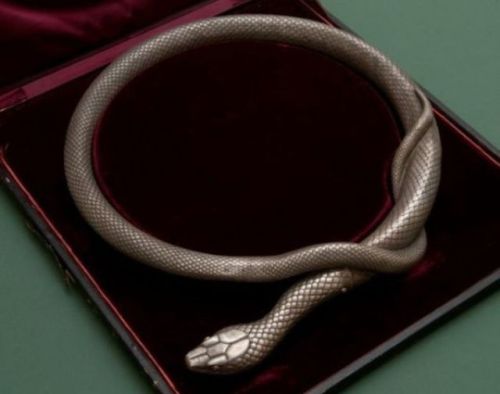
Just a very flexible one…

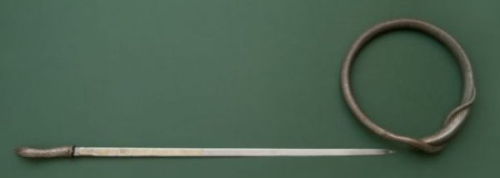
If you want more odd blades, Moghul India is a good place to start…

i could not ask for a better addition to my meme post than blade education thank you so much
I love this more than I love my left foot. (Seriously, fuck you left foot, why aren’t you a freaking wiggly sword? Huh?).


Alvens: These are Water faeries who float around on bubbles and hate fish. During a full moon, they come on land to dance and play. They are not particularly friendly.
Amadan Dubh: This is a particularly dangerous type of faery that is greatly feared among the Gaels. They are known as the “fairy fools,” and the bringers of madness and oblivion. They play faery enchantments on their reed pipes on hilly slopes and precipices after sunset.
Banshee: The name “banshee” means a woman of the faery. It corresponds to the “Fear Sidhe” or faery man. The wild banshee wanders through the woods and over the moors at dusk, and some- times lures travelers to their death. Banshee can also travel at will to great distances. Appearing in tattered gray clothes, they are basically a sociable faeries who have become solitary through sadness and grief. They are the honor- able ancestral faery women of the old clans of Ireland, who are heard, but rarely seen. They wail a blood-curdling lament just before mis- fortune, illness, or death occurs in their ancestral families. Their wail can kill or instantly age mortals who hear it. Banshee also avenge the death of their descendants. They generally appear either as beautiful maidens or gruesome crones. Salt water and silver can harm them.
Bendith Y Mamau: They have the ill disposition and ugly appearance of goblins, but the glamour of the faeries. Living in underground caverns, they don’t care very much for mortals and they have been know to steal cattle and children, to kill farm animals, and to break important tools.
Billy Blin: A household familiar who is popularized in English and Scottish songs.
Boggart: They are known for breaking things and making trouble, but seldom do serious harm. Most old homes have a boggart. The supernatural boggart is sly, annoying, mischievous, and a prankster. They pull the covers from sleeping mortals, rap or pound on the door at odd times, or rearrange the furniture at night when you are sleeping.
Brownie: They are from 1 to 2 ft. tall and are scattered throughout the highlands and lowlands of Scotland as well as the northern counties of England. They have brown, wizened faces and hair growing all over their body, so they don’t need to wear clothes (although sometimes they are seen wearing brown cloaks with hoods). As household faeries, they do unfinished jobs such as mowing, threshing, caring for the laying hens, and tending the sheep and cattle. They bring good luck to a family, providing that the family treats the brownie well. Brownies also love animals and will take care of the household pets. They adore gifts of food and drink such as milk and honey cakes, but abhor gifts and wages. Urisks are the Scottish version of brownies.
Buccas: Residing in Cornwall, they are magickal beings that inhabit mines. Also called tinmine demons, they are the wind goblins that foretell shipwrecks.
Bwca: This is a sort of Welsh version of a brownie, but a more particular one. They can be great help around the house, but if offended they can become harmful, throwing things around the house, spoiling the milk, and ruining the beer.
Callicantzaroi: Naked, they ride about on chickens. They live in troops and are zealous in their celebrations of Yule.
Clim: A mischievous goblin that resides in chimneys and peeks out at children, scolding them when they are bad.
Clurichaun: Residing in southwest Ireland, they are renowned drunkards who both guard and raid wine cellars. The Clurichaun sing in Gaelic and have beautiful, magickal voices.
Coomlaen: These “elven steeds” appear as tall, thin, white or silvery horses who live in the forest and are always in the company of elves. As shapeshifters, the coomlaen can take the shape of their de- sires, but must return to the shape of a horse once during each day for at least six hours. They are fiercely devoted to one rider at a time and the bond lasts for the lifetime of the rider. The two communicate telepathically. Because the Coomlaen defends its rider, in order to befriend a coomlaen you must first befriend its rider. Coomlaens adore gifts of apples and honeysuckle. Iron is harmful to the coomlaen.
Cooshie: Also known as the “elfin hound,” they live in the forest and appear as large, silver-furred wolves that move quickly with the grace of a large cat. The cooshie stay with their elfin masters, and have heightened senses, including knowing when there is any magickal, spiritual, or physical presence in their territory. Like elves and coomlaens, they have an aversion to iron. Cooshies can heal sick or injured travelers and calm troubled minds and hearts.
Corrigans: From Brittany and Cornwall, they live in the woods, near streams. Corrigans are winged faeries who like to play pranks, such as taking human babies and replacing them with changelings.
Daoine Sidhe: The immortal polytheistic group of goddesses and gods of Pagan Ireland who merged with the land, these are the cream of the crop of faeries that form a faery nation. They appear in human form, dressed in green, and are called the peaceful faeries. They preside over the faery kingdom, play sweet music, dance, ride milk-white faery horses, and are generally accompanied by their faery hounds.
Dryad: They are happy, friendly, and playful wood nymphs who live in and take care of the trees. They are born of the same seed as the place they live. Dryads are the color of tree bark or leaves and their dark green hair is extremely long and flows about them. They can disappear by stepping into a tree, as if stepping into a dimensional door. Sometimes their skin is dappled like a tree trunk. Dryads are usually very charm- ing, sing beautifully, and particularly like willow and oak trees. Damaging a dryad’s tree harms the dryad as well, but the dryad can defend its tree by creating storms and lightning.
Dwarfs: Both male and female, dwarfs are usually from 3 to 5 ft. tall, with broad shoulders, large muscles, long arms, stumpy legs, and lots of facial hair. They are quick tempered, loyal, and immune to physical damage. Working with Earth, Fire, and stone, they are found underground under moun- tains and hills where they mine metals and gems, especially copper. Their craftsmanship is unmatched in the mortal world. They adore gifts of both precious metals and gems.
Eash Uisge: They are the Highland water horses known for being fierce and dangerous. They have the ability to shift into the shape of young, hand- some men.
Elves: According to Norse mythology, elves and dwarves are created in the time before humans from the body of Ymir, the giant. Inhabiting one of the upper worlds, and often found in Natural settings such as woodlands and forests, elves are somewhere between mortal and divine. Originally between 5 and 7 ft. tall, they were thin, strong, flexible, and quick. Their hair was usually red, blond, or light brown, and they had cat-like ears. Their cat-like eyes are green, blue, silver, or gold with slitted pupils. Through time, the elves became Elemental spirits of the land, sea, and forest, who are sometimes por- trayed as small, good-natured creatures with brown skin and delicate features. Iron does not kill elves, but it can injure them. They adore gifts of quartz crystal, pearl, moonstone, and silver. In the Western world, Santa Claus and his helpers are elves.
Ferrishyn: The Manx name for the faeries, also known as the “sleigh beggey.”
Fir Dearg: Also known as the “fear darrig” or the “red men,” they are a mischievous, rare breed of faery, who dress in red and have red hair. Their only interest seems to revolve around playing practical jokes on humans.
Ganconer (Gean-canogh): Also known as a love faery, the ganconer is a leprechaun-type faery who appears as an incredibly handsome young male. Called the “lover-talker,” he spends most of his time seducing milkmaids and shepherdesses. Appearing in lonely valleys and fields, they are known for playing beautiful songs on their pipes, but their fate is ultimately to be alone.
Gnomes: They are elderly dwarf people who stand from 1 to 2 ft. tall, and like dwarfs, live under- ground except for the few times when they come up to roam in the deep forest. Male gnomes grow long beards. Gnomes live under old oak trees in heavily forested areas, and like gifts of beautiful stones.
Gray Elves: Not choosing to associate with any other magickal beings, they live in isolated meadow- land. Gray elves have either silver hair and amber eyes, or pale, golden hair and violet eyes. They are very intelligent and extremely rare.
Gwartheg Y Llyn: The Welsh name for faery cattle, said to be usually milk-white in color. A farmer who gained the favor of this magickal cow was said to be richly rewarded, but the farmer who tried to lift a hand to hurt the animal would find misfortune would come to the farmer.
Gwradedd Annwn: The Welsh name for the “lake maidens,” they are beautiful and desirable, but are not like sirens and nixies. They are known for marry- ing mortals much like the Silkee or “seal maidens.”
Hobgoblins: They are the English cousins to the Scottish brownie and Welsh bwca. A house faery, a hobgoblin’s favorite place is behind the kitchen fire, once known as a “hob.” Once settled, they rarely leave the house, and when feeling ne- glected, they are known to hide keys in the most unlikely places. They are vulnerable to iron and gold. In folklore and literature, both Robin Goodfellow and Puck are hobgoblins.
Knockers: In Cornwall, they are generally helpful mine sprites that are particularly attracted to rich veins of ore. Miners of old were said to follow the sound of the knockers’ tools pounding the rocks to find a strike. Knockers are also known to warn against cave-ins and floods, and as such, the miners always leave them gifts of food and drink. In Wales, knockers are known as “coblynau.”
Kobold: The German name for the “little people,” originally they were tree sprites who were captured and brought home in wooden boxes. The per- son who captured the kobold could open up the box and the kobold would do things for her or him. But if anyone else opened the box, the kobold would take revenge for being confined. They formed the basis for the original jack-in- the-box for children. They are old men the size of small children who wear pointed hoods or caps and green clothing. Loud noises and strong winds scare them. For gifts of food and milk left out at night, they will do any little job around the house and barn, such as washing the dishes, preparing meals, sweeping the floor, making the fire, or tending the farm animals. Kobolds also have the ability to cast binding spells and will go to great efforts to protect the members of the household. If mistreated, they can become truly nasty.
Leanhaun (Leanan) Sidhe: They are the faery mistresses or sweethearts of Scotland and Ireland. They crave love, and try to gain power over their lovers, treating them like slaves and draining all the life out of them before moving on to new lovers. Said to be an inspiration to poets and musicians, these magickal faeries act as sort of muses, giving the artist’s work an otherworldly quality.
Leprechauns: They usually manage to trick their way out of surrendering their gold. Only a select few get away with a leprechaun’s riches. Solitary faeries of Ireland, witty, fascinated with gold, they can pass by as a swirl of dust, knocking off your hat. They are generally 2 to 3 ft. tall, with wizened faces, bright eyes, and red noses. They dress mainly in greens and browns, and are known for their excellent shoe-making skills.
Lorilei: A solitary faery, who is beautiful and bewitching, she is known for lounging on rocky heights while singing a song of enchantment.
Lunantishee: They guard the blackthorn bushes particularly on Samhain and Beltane. If you cut a stick from the bush on either one of those days, you will suffer misfortune.
Mermaids/Merrows: They live in the airy palaces be- neath the waves. They wear red-feathered caps to swim from their underwater world to ours. If a mortal steals the cap, the merrow can’t get back home. The females are beautiful, the males are ugly with green faces and red pig noses. Both have fish tails and webbed fingers. Taking mortal lovers, their offspring are covered with scales.
Muryans: Cornish faeries, the word “muryan” means “ant.” These are faeries the size of ants, who are shapeshifters. Every time they shift shape, they get smaller, eventually getting so small, they disappear from sight.
Nixie: They are Water sprites that inhabit lakes and seldom venture onto land. Their houses are made from seaweed and are guarded by giant fish. They are known for charm spells that convince humans to do their bidding.
Nymphs: Nature spirits who evolved into faeries, they live in clear lakes, streams, and crystalline caverns. Intelligent and beautiful, they do not like intrusion, but will be friendly if approached by a good-hearted mortal. Nymphs have the power of prophecy and take mortal lovers. They are also said to be extremely hard to avoid once they have taken an interest in you, and can occasionally be dangerous if they become obsessed with you. Often traveling in pairs, nymphs are mobile, but they can also permanently align themselves with trees, rock outcroppings, mountains, rivers, and springs. They appear as young, extremely gorgeous women, who are frequently dancers, artists, and musicians. They are amorous and have insatiable sexual appetites. According to folklore, a nymph’s lifetime was the same as that of the phoenix, who outlived nine ravens, who out- lived three stags, who outlived four crows, who outlived nine generations of aged mortals.
Oakman: A wood faery who lives in oak trees, the oakman is a guardian of the animals. The familiar saying “faery folks are in old oaks” speaks of their kind. The oak is considered the tree of the dead and the abode of departed spirits. Oakmen resemble drawfs with red noses, wear red toadstool caps, and have an affinity with bluebells.
Pechs (Pehts): The name used for the faeries of the Scottish Lowland, Pechs are said to be like the feens of the Highlands and the trows of Shetland.
Phouka (Pooka): Originally deadly sea horses with glossy coats and metallic-like hooves, phoukas are now often viewed as wild, mischievous creatures who are related to the leprechaun. Phoukas can employ the shape of an animal in order to play wild pranks and kill mortals. In contrast, in some stories that are told about them, phoukas that are treated kindly are known as friendly beings that help farmers.
Piskies (Pixies, Pigsies): Found frequently in Cornwall, Devon, and Somerset, England, they stand 1 ft. high (or smaller), are slim, and wear green clothes and pointed red hats. They have blond hair and green eyes, pointed ears and chins, and turned- up noses. They can also levitate and move tiny objects from one place to another. Usually friendly, they can also be mischievous, and are known to steal horses and ride them around in circles, creating Faery Rings as they do.
Portunes: These are teeny tiny faeries that are about a finger’s length or less in size.
Redcaps: They live in castles and towers where evil deeds have been done so they can feed off the energy and create more of their own. They look like brownies, but wear caps made red by the blood of passing strangers at whom they have thrown stones.
Salamander: They are the powerful Spirit faeries of Fire because the salamander embodies the in- tuitive Element of Fire. Without the salamander, Fire would not exist. They come in all sizes and differ in appearance, but they are most often seen as being similar to a 1-ft. long lizard. They can grow larger or smaller at will. Sometimes they are seen as a ball of gold, orange, or red light. They are very devoted and quick to defend a friend. Working with the salamander helps you develop and strengthen your intuitive side.
Seelie: A good-hearted and benevolent group of faeries who glow as they ride the winds in search of humans needing help. The court of the kindly faery host is called the “Seelie Court.” “Seelie” means “blessed” in Gaelic. These benevolent faeries give gifts of bread and seed corn to the poor and pro- vide all kinds of help to their favorite mortals.
Sheoques: Appearing human-like, they live in ancient thorn bushes and faery forts that are surrounded by ditches. Also known for their bagpipe playing, they enchant and steal children, most times returning them unharmed and happy.
Shock: They appear as a horse, donkey, large dog, or calf. They are frightening and something to get away from if, by chance, you encounter one.
Sidhe: The word means “people of the faery mounds.” A distinction is often made between the “sidhe” who are seen walking on the ground after sunset, and the “Sluagh Sidhe,” the faery host who travel through the air at night and are known to abduct mortals. There are also guardian “sidhe” associated with the lakes of Ireland and Scotland. These distinct categories of “sidhe” beings tie in with the testimonies of seers who divide the “sidhe” into Wood spirits, Water spirits, and Air spirits, i.e., the Elemental spirits.
Sidhe Draoi: Gaelic for “faery druids,” folklore says that they took their name from the faery nymphs who taught them the magick of the trees. They are related to dryads.
Silkee: Usually found in seas and oceans, silkee first appear as seals, but become beautiful women when they shed their skin. They use their seal- skin to move from their world to this world. If their skin is taken from them, they can no longer move back and forth.
Sithich: Active Highland sprites known for being mischievous and having weapons that do their bid- ding, they are dexterous, child abductors, and intrude on women during childbirth. Their weapons are made of stone, shaped like a barbed arrowhead, and thrown with great force like a dart.
Sirens: They are Greek sea nymphs. The sirens’ enchantingly beautiful song entices sailors, leading them to their death.
Skillywidden: Small, young faeries who cannot shift their shape or alter their size.
Sleigh Beggey: The Manx name for the faeries.
Slievegallion: Known as the “hosts,” they are the spirits of mortals who have passed on into the otherworld. They fly about in great clouds, up and down the landscape. On clear, frosty nights they can be seen, and heard, fighting their battles in the air. They sometimes put mortals
Slyphs: under their spells to help fight their battles. Living for a thousand years without seeming to age, they are beautiful, changeable crea- tures that parallel nymphs, only they exist in the Element of Air. Living on the tops of high places such as mountains and cliffs, slyphs vary in size, are winged, transparent, elusive, and surrounded by a glowing radiance. For a very brief time, they can take on human form. They move by floating about with the wind, and as such, are known as the Spirit faeries of the Air. They inspire mortals, especially those individuals involved in the creative arts.
Spriggans: They guard the treasures of other faeries. Spriggans are ugly and dour, standing stone sprites that are said to have come over from Brittany where they are known as “korreds.” Folklore suggests that they brought the origi- nal standing stones to Cornwall. They can be seen around old ruins, standing stones, bar- rows, giants’ quoits and castles, and places where treasure is buried. They bring blight to crops, whirlwinds over crop fields, and storms. Spriggans are the ghosts of old giants, who appear small but can become gigantic at will.
Sprites: Very shy, delicate, and reclusive, sprites are winged spirits that dwell in meadows and wood- land glens. There are many types of sprites, depending upon their Element. Fire sprites are very rare. As William Shakespeare describes them in The Tempest, “Sprites are spirits: they do not have bodies as fairies do.” They adore gifts of nuts, acorns, and sweet treats, and love to be flattered by mortals.
Trolls: Originally supernatural beings in Scandinavian folklore, later they became huge ogres with great strength and little wit. Trolls are known for guarding castles and treasure, hunting in packs in the deep forest, and being deadly to mortals. They can outrun any mortal. Fire and sunlight will harm them. Never try to befriend one.
Trows: They are the Shetland Island version of trolls. They live in caves near the ocean or in sandy hillsides. Thought to be somewhere between dwarfs and giants, trows are dimwitted, un- friendly, and ugly. Sunlight turns them to stone or makes them explode. The Scottish Highland name for trows is Feens or Fians.
Undines: As Elemental Water spirits usually found within forest pools, waterfalls, marshlands, rivers, lakes, and riding the ocean waves, the beautiful voices of the undines can sometimes drift above the sound of the water. They inhabit underwater caves, river banks, and lake shores. They are able to influence the flow of water in streams, rivers, lakes, and oceans, as well as the plants that grow in and under the water. Undines can appear human-like and are generally shy, but friendly. Peaceful, graceful, and attractive, their skin shimmers blue-green, green, or aqua like the water. The undines are ruled by love and adore gifts of sweet-smelling perfumes.
Unseelies: They are dark, malevolent faeries, who have excessive pride, are unkind, and have malicious ways. In contrast to the seelie court, the unseelie court is one of the malevolent faeries, who are hostile and harmful. Stay away from them and do not engage them in any way.
Water Sprites: They are closer to the traditional concept of a mermaid, and are the marine counterparts of leprechauns.
Wight: A supernatural being or creature that is very hardy. Every tree has a wight who is its guardian. An old Scottish verse says, “If you call me blessed wight, I’ll be your friend both day and night.”
Soooo helpful for A Thing™ I wrote that I needed help with. Look at this. Help has arrived.

– This is a subject that I see brought up a lot in book reviews by readers, but not very often when it comes to the writing community. I decided to search the internet and my own experience for as many tips and as much advice as I could find to put in one place for you all. I also addressed a lot questions (in fact, more than usual because I know this is a weak point for most fiction authors) in the common struggles section. I hope this is useful to those of you who have a lot of trouble finding help on this. It should help me as well because I’m in the middle of tackling it for my own series. Happy writing!
Patreon || Ko-Fi || Masterlists || Work In Progress || Studyblr || Studygram
Not all aspects of a political system in a fictional universe are important to the story-telling, especially when the story is more character or plot driven, rather than driven by the world building. It’s important to deliver relevant information to your reader in pieces, and at a pace that enhances their understanding of events and meaning rather than their knowledge of trivial details.
For certain genres and age-demographics, your world building in the area of political systems and implications should be matured or simplified. The majority of your readership should be able to understand what’s going on, and the way you makes sure of that is know who you’re writing the story for. Certain genres also require a lot less complicated detail in political world building. For instance, YA romance should have less political world building than, say, adult fantasy. Sure, maybe in the case of writing a YA romance, there could require some, but definitely not as in-depth as that of the latter.
If you’re going to do it, especially as a beginner, you need to pick some form of inspiration or something similar to what you’re going for. There are so many governmental systems out there that already exist, and if you should research plenty of them and them mix and match, add and subtract, and twist until you have something that serves your story.
Every detail that you make prominent in the reader’s mind should be thought out in terms of the implications. Ask yourself how this affects different groups of people, how it’s evolved over time, what it means for the system as a whole, etc. This will make your story more three-dimensional in the reader’s mind.
Most government tension (throughout history, at least) has come from inequality in the distribution of power. Whether it be between races, classes, branches of government, figures in politics, or groups of people with different opinions, or all of the above combined, most issues stem from the struggle for power, control, and influence over others. Explore this and find new ways to think of how this could be interpreted from your story.
Culture has a major hand in how politics works. A society’s values, religious majorities and minorities, gender roles, environment, what an average citizen looks like, how citizens are expected to look, act, use their time, etc. These things all impact political situation and how it changes over time with culture, so explore this heavily.
– The common struggles section of my “guide to__” posts are general questions sent in by readers on the topic at hand. If you have a question that has not been addressed thus far, you’ll probably find the answer in this section. As always, you’re welcome to send other questions to my inbox if you don’t find the answer in this post. –
~ How do I illustrate the evolution of a society’s politics?… I would choose a few major events and make the causation behind them more prominent than the actual events themselves. History repeats itself, and that’s very important in political foreshadowing and often how a society deals with political situations.
~ How do I write conversations about my world’s politics?… It depends on the tone of these conversations. The way casual conversations about politics are written can tell the reader a lot about your world’s political climate, and can be a very useful device. Heated conversations can be useful in showing different passionate sides of a political issue in your world. I would say, write them carefully and with intention.
~ How do I make the reader invested/interested in the world’s politics?… Show the reader why they should care, make them relate to it, and then make them relate your story to their reality. You have to use literary devices as well. Show, don’t tell works really well here. Don’t show the main character reflecting that the conflicts at the war front are bad. Show the war front. Show the severity. Make them feel the heavy emotions of the people. Show them the real stakes of the political decisions being dealt with in the story.
~ How do I create believable racial tensions?… Again, just mirror reality. Understand why racial tensions exist and mirror that in your story’s context. Racial tension is majorly caused by fear, prejudice, and response to the “other side”. It’s often a long, ongoing battle because it’s rooted in the way people are raised and the constant environment around them. Racism is taught, so show it’s bigger, more outstanding moments, as well as its less prominent ones. No political issue arises exclusively from large, explosive moments. It’s made up of a few big ones, notable ones, and then the many, millions of little contributing moments and factors.
~ How do I write reasonable opposition groups?… You’re the author, so you have the unique opportunity of setting the reader up to see the reasoning behind both or all sides. You can show the evidence and logic behind each one, and make the reader understand why each side believes what they believe, and the personal engagement that leads each side to fight so hard.
~ How do I connect a caste system to political tension?… Political tension within caste systems are commonly caused by people’s natural desire for power and control, which leads to dissatisfaction in cases of being on the less fortunate side of inequality. Caste systems are also typically a pyramid, which means there’s more of the underdogs. These things combine to create political storms because on one side you have few people and lots of power that add up to just a bit more than a lot of people with less power individually, but more when pooled.
~ How to I create a corrupt government without too many clichés?… The most cliché thing about typical corrupt governments is the one-dimensional evil figures that lead to corruption. Very few authors explore what leads a human who’s only job is to protect the people to turn against them. Explore their motivations and their personal struggle and justifications and you’ll have a more interesting and impactful corrupt government.
~ How do I illustrate a positive government that doesn’t come off as suspicious?… Work hard on perfecting tone, be very careful with what could be interpreted as foreshadowing, and show genuine goodness in not only the government’s words and actions, but actual results. Show your government talking the talk, and then walking the walk.
~ How do I set up the climax of a political issue?… Show the slow burn, and then the inciting events that set off the inevitable explosion. You need to establish to the reader that something is going to happen no matter what, but make the actual consequence and its place in time a surprise.
~ How do I develop a governmental system from the ground up for the sake of the plot itself?… As I said in a previous point, use a model or several to take inspiration from. In the case of world building being the centre of your story, build your world and your plot together so they complement one another.
I originally posted a post in French here, which I intended to translate, and then I changed my mind and decided to create an all new post in English instead. A lot of the information from that first post will end up here, but it will be phrased differently and will have some new features.
Well, let’s dig in.
(This is very long, consider yourself warned)

Credit: Assemblée Nationale
When we talk about governments in fantasy settings, we generally think royalty, kings, queens and all that jazz. But this is very reductive of all shapes of governments which have existed on Earth through all times. Even if we focus only on the Middle Ages period, not every nation was lead by a royalty. As a reminder, Middle Ages lasted from 5th to 15th centuries approximately. That’s a long time!! Venise elected its first doge in 697, Florence was an oligarchy (the republic officially date from 1115), many city-states of the time had similar tradition of electing their leaders… But before we plunge into the shapes of governing, let’s talk about power.
(credits to Senna Lily)
Any person who leads a state needs power. It can be physical force, obviously, but there are other means:

Credit: picture from Miss Sloane, edited by @carol-danvers
Monarchy
Literally, monarchy means the government by one person, the monarch. Though we generally picture a royalty, it could also be a presidency (where the president has all powers: executive, legislative and judicial) or a dictatorship.
But even monarchies can present themselves in different shapes: elective (the Pope), constitutional (where a Constitution specify and/or limit the monarch’s powers), parliamentary (where an assembly forms a countervailing force), or absolute.
Oligarchy
In an oligarchy, a few people govern the many. A criterion determines which few lead the nation. It can be revenue, gender, age, expertise, or a combination of all.
Oligarchies are either institutional or de facto. In the first situation, the oligarch government is formalised in the laws, and it is clear who can and who can’t participate in it. In Florence, a law was created specifically to discard the nobility from the government, allowing the merchants and members of the main corporation to govern their city.
In a de facto oligarchy, the government is progressively controlled by an elite without any formalism needed. Think about how rich people have the power to exclude others just by making things (education, means of transportation…) more costly and thus less accessible to the many.
Democracy
The government by the people can be exercised directly or indirectly. Directly, everyone (some limits, such as age, can be implemented) votes for every decision. Indirectly, everyone elect representatives who then vote for every decision. You can also find democracies which mix both system, where certain decisions must be taken by everyone, while others are left to their representatives.
I mentioned only age as a limit, as it is an obvious one (people need to be able to understand the decision they’re making), but there are others. Nationality comes to mind. Just be careful not to limit citizenship too much or you could end up with a government who is a democracy in name only, like Athens was.
Empires (a side note)
Technically, empires are not a form of government. They are defined by the union of more than one people or country under a centralised power (some definitions also add expansion ambitions, and feelings of superiority). Though most infamous examples generally are monarchies, empires could very well be oligarchies or democracies.
Empires who lasted the longest had an ideology under which they could rally their population, mostly with a common religion (Christianism for the roman empire, Islam for the caliphates, Orthodoxy in Russia, Catholicism for the Habsburg…). But, though their shared ideology strengthened them, no empire ever lasted millenniums.
Every government subscribes to a certain set of ideologies, which shapes the laws and regulations they chose to implement over the people they govern.
Patriarchy / Matriarchy / Egalitarian society
(Please note, this part might give the impression, there are only two genders. My intention is not to erase non binary, genderfluid or genderqueer people, but to keep things simple, so in advance: I am sorry if I hurt anyone’s feelings).
Patriarchy and matriarchy happen when one gender take over the control of the totality or the majority of the power sources. The government will be lead by people of the dominating gender, so will be companies and religions. Values associated with the gender in power will be admired by society and laws will reinforce their status. If a person of the dominating gender shows qualities which are perceived to belong to the dominated one, they will be put on the ban of society and seen as a deviant (and same thing the other way around, btw), making them unlikely to hold any power unless they also happen to possess some useful resources or relationships.
If you create a matriarchy, please, by all means, do not make it a mirror of a patriarchy. What I mean is, don’t have women be warriors and men take care of the children. Instead, have pregnant women keep their government position without it ever being questioned, have laws which regulate the men bodies, have contraceptive drugs for men only, have values such as quietness and moderation as the highest ones, have physical strength seen as debased, have dismissive comments about men and their testosterone, have jobs associated with women seen as the most valuable (like nursing or teaching) and with the highest earnings, consider not having a marriage per say as there can be no question of who is a child’s mother…
As for egalitarian societies, they should not have any gender dominating the other, and so a government should have parity. Non-gendered inheritance laws should already exist. If your society is egalitarian, but its government is 70% male, I will call you a liar. Or you better come up with a good justification other than “women prefer to take care of their home”. In such a society, a profession can still be seen as lower, not because it is mostly occupied by one gender, but because it is associated with another taboo (think about jobs in relation with death in Japan). Laws will reflect equality between genders, either by having them forcibly inclusive (which could indicate society was not all always egalitarian), or by having them implicitly inclusive through the use of a genderless language*.
* I am not saying the language of a society, which was always egalitarian, is necessary genderless, but that the law will use words which erase gender: instead of man/woman, you’ll use person/citizen.
Capitalism / Socialism
Though capitalism and socialism are the two antonymous economic systems, most States have implemented mixed systems, leaning more on one side of the equation than the other depending from the set of values their leaders adhere to. All States, even the most liberal, are forced to embrace some social values as the only mean to ensure the creation and maintenance of basic infrastructures such as roads.
In capitalism, all the means of production are privately owned in the aim of profit. In consequence, investments are decided by the owners of resources and, in theory, prices and distribution are decided through competition. Other common characteristics to capitalist systems include: accumulation of capital, waged labor, price system, competitive markets, voluntary exchange (often formalized with a contract).
Different models of capitalism exist. Corporate capitalism is dominated by hierarchical and bureaucratic corporations. In State capitalism, the state-owned companies dominate the market where they seek to make profits. Advanced capitalism is our global modern system characterized by the concentration of activities in a few large firms or groups, a reliance on the State to stabilize the markets, and wages used as incentives. Financial capitalism is dominated by the people who own the funds (the banks or private loaners) and generally born from a commercial capitalism…
Socialism was first and foremost thought as the opposite of individualism. Other words have been used to qualify a socialist economy, such as co-operative, mutualist, associationist and communist. The distinction between socialism and communism only date from the Bolshevik Revolution of 1917.
Obviously, because of the way it was constructed, socialism is very critic of capitalism. Its main reproaches are the creation of wasteful industries and practices, a will to create demand instead of satisfying the pre-existing one, the pursuit of irrational activities which results in economic bubbles and the concentration of power and wealth in the hands of a few people.
Socialism’s goal is to reduce poverty, social oppression, and disparities in wealth. To accomplish this, it puts community first and encourage the shared ownership of resources. Its main means are economic planning and scientific administration. It also tries to achieve, through incentives coming from the top (i.e. the government) a social environment which would be more favorable to the system.
Finally, socialism also considers creativity to be essential to human nature, and one of the finality of this ideology is to reduce the length of labor to ensure everybody has the time to engage in their creativity.
Fascism / Nationalism
Though both ideologies have a few things in common, they are not one and the same. Also, not everybody agree on what past governments should be called fascist (some suggest that Nazi Germany is not, some say it is…).
Nationalism is, for a people, to preserve or gain sovereignty over its “homeland” (the limits of said homeland may go beyond what the people of the nation inhabit and result in expansionist strategies). Nationalism implies the definition of a national identity with its culture, its language, its religion, its belief in a singular history. Generally leaders of such a movement/State will talk about a cultural renewal (or its preservation), and use rallying symbols recognizable by all (such as flags, anthems, clothes…).
Let’s note, it is possible to imagine a multinational nationalist State, where every national minority would be able to express freely its national identity (with even the possibility of having representatives for each minority). The feeling of unity, of a nation would emerge from the will of the people to continue to live together in a multicultural society. Common symbols would reflect the diversity of its people.
As for fascism, though we find the same mythic core and use of symbols, it distinguishes itself from nationalism by its inherently violent nature. Indeed, fascism consider that not all violence is negative and that political violence, war and imperialism can bring national rejuvenation.
Fascism is also characterized by the suppression of all opposition, often with the complicity of the elites in place, by a mixed economy to attain the goal of self-sufficiency through protectionism and interventionist policies, by military citizenship where everybody’s role is well defined and masculinity is promoted, by self-determined culture and victimhood to oppose a previous period of decadence (often imaginary) and give birth to a cult of unity and purity, which can only be achieved through the purge of the “degenerates”.
Religion
Religion and power instances have been intertwined throughout History, either by the interpretation of omens (such as flying birds) before an important decision, or by providing advisors to the State (Mazarin and Richelieu’s names come to mind), or by establishing a temporal State lead by a timeless authority (the Vatican).
Religion have permeated our cultures and our laws. Even secular States, such as modern France, are still under the influence of religion. Breaking away from it has required social changes followed or paralleled by legal changes.
Sometimes, these changes have merely reflected the passing of a religion’s influence in favor of another (the Roman empire was polytheist before embracing christianism).
What taboo, what family structure are seen as prominent by the dominant religion will very likely be reflected in the laws and in the government structures. Furthermore, in the presence of a well organized religion, such as the Catholic Church, one must acknowledge not only its moral power, but also its economical one. It is not without good reason the French Revolution chose to abolished all Church’s privileges (suppression of a special tax, nationalization of its properties…).
Conservatism / Progressivism
Conservatism is defined, first and foremost, by its attachment to traditions. Obviously, depending of where and when, what people call traditions may look very different. A conservative government will do its best to keep the statu quo, to slow changes and transformations, especially social and economic ones. Conservatism also embrace organic solidarity (born from the specialisation of economic actors and forcing them to collaborate because of their interdependence), stability and continuity, as well as the defence of property rights.
When conservatism tends to radicalism, its discourse will change from maintaining the traditions, to their regeneration, implying the model (often idealised past) has been lost and needs to be restored for the wellbeing of society.
On the other hand, progressivism embrace change and reforms as a way to improve society. It encourages changes at all levels (social, economic, scientific, technologic…) as the one and only way to improve human condition. This definition may give you the impression progressivism is necessarily better, but let’s not forget that, in the past, it has been associated with eugenics and alcohol prohibition. What is seen as progressive depends greatly on what is perceive as tradition in your universe.
In all honesty, I could keep talking about ideologies, because they are so diverse and cover so many subjects. In the end, you should remember only two points when it comes to ideology : how your government think society should work, and how it intends to achieve that ideal.
Resources
Links:
- 16 types of governments infography
- List of forms of governments on Wikipedia
- Ted-Ed Athenian Democracy
- On Mythcreants: Matriarchies, patriarchies and beyond, Creating matriarchies
- Amazing series about politics by Senna Lily “Politics : The Game, The Board, The Players” - 1st part (credits go to her for the first part of this article)
a few articles by @wondrousworldbuilding about Politics and about Factions,
Books: (I could not find translations for the titles in French)
- Nouveau manuel de science politique, Editions La Découverte (a class book for politic sciences, very heavy, maybe start with something else to read on the subject)
- La cité dans le monde grec, Raoul Lonis, Editions Armand Colin (3rd part mostly)
- The prince, Machiavel
- Bréviaire des politiciens, Cardinal Mazarin, Editions Arléa
- The Communist Manifesto, Karl Marx and Friedrich Engels
- The Analects, Confucius
- The Spirit of the Laws, Montesquieu
- The Art of War, Sun Tzu (the book talks about war strategies, but they can apply to other contexts, including politics)
- The Republic, Plato
- Politics, Aristotle
you can find a pretty nice goodreads list here, it references a lot of classics about politics.
Final Words
If you’re still here, congratulations, you’re done !!
I merely wanted to write one last thing: if you have questions, you can drop me a message anytime. It doesn’t matter if your question is directly related to this post or not, or if it is something very specific in relation to the politics of your universe. I may not be an expert on the subject but I’m more than willing to give you my two cents, if you need help :)
A Knight in shining armor is a man whose metal has never been tested.
Or one who regularly cleans it…but yeah, “Black Knights” were called so because their armor was in terrible condition, and they were usually much more experienced, so they usually won tournaments.
@we-are-knight Am I correct? Anything to add?
I’m curious mainly where you got this concept from…
“Black Knights” need to be distinguished by context. I’m on my phone right now so I can’t link you all the sources I’d like to use, so please pardon me for that.
So, the concept of “knight in shining armour” comes from the idea of the knight-errant in medieval fiction, the sort of person who is on a quest, is all shiny and new, ready to test themselves. It also is a nod to the maintenance of equipment, or the wealth of a Knight; in the late medieval and Renaissance periods, well-off knights might have a suit of armour for warfare, a suit for tournaments, and a suit for formal occasions. These being used for different things, they were meant to be maintained well and show status and wealth.
So, where does the concept of a black Knight actually come from?
Surprisingly, most cases come from the idea of the tournament. Knights were meant to display who they were, “show their colours” (ie, heraldry), and show off their skills in combat. But if course you had some knights who didn’t want to show who they were, who they were fighting for, or which lady they favoured, etc. This sounds like a chivalric fantasy, and honestly, that’s what tournaments really became as time went by and the events became more formal.
Now, early “black Knights” , were those who did not wear dark or black armour, but in fact those who did not use their own heraldry, disguising themselves. Again, they may do this for various reasons, but the concept is they hide their identity. Occasionally, they might actually paint their shields black.
We also have the examples from the hundred years war where French and English knights painted their armour different colours: black for the French, Red for the English.
Some knights actually WOULD favour black armour or heraldry to the point they got called “black Knights”, and not as a derogative. The Polish Knight, Zawisza Czarny (pronounced “Zah-vu-shah Shar-ny”, approximately) become known for his feats of arms, and by his dark armour.
Linking back to the original quote, a Knight in shining armour could well be a black knight, as such. But more commonly, it meant he was either wealthy, or highly skilled at arms.
Or both. :P
I’ve seen enough period art to convince me that “shining armour” was often a lot darker than the chrome-plated image which the term suggests.
I’ve also long thought that the whole business of “knights in shining armour” wasn’t a medieval concept at all, certainly not the default one, but was a Regency / early Victorian fictional conceit from Romance poets and Sir Walter Scott’s historical fiction. (About 10 years ago an actual expert said more or less the same thing, leaving actual amateur me feeling rather smug…) :->
This illumination features armour that’s black or dark blue in colour, but with
the carefully-delineated highlights
of a shiny surface. There are many other like it.

Armour was coloured for both decorative and practical purposes; chemical blueing with acid produces a very dark, lustrous and effectively rust-resistant finish like the one in the medieval illustration. I once had an Arms & Armor rapier with that finish on the hilt: it looked like this…

Heat-blueing, which was more blue than black, was a popular treatment for Greenwich armour of the Elizabethan period, as was browning and russetting (all of which were and are used on firearms), processes which used heat, chemicals or controlled “good rust” to create colour and also prevent uncontrolled “bad rust”.
Here’s the helmet of Sir James Scudamore’s Greenwich harness, which was once blued and gilt.

The image on the left is how it looks now, after being thoroughly scrubbed with wire wool, sand or other abrasives at some stage in the 19th century to make it “shining armour”. The image on the right is a CGI restoration of its original appearance, based on still-visible traces of colour in the grooves beside the gold strapwork.
Here’s the browned and gilt “garniture” (armour with extra bits for different styles of combat, like a life-size action figure) of George Clifford, Earl of Cumberland. I don’t think grinding this beauty down to bright metal would be an improvement…

Henry VIII’s tonlet (skirted) armour for foot combat at the Field of the Cloth of Gold now looks like this:

Originally it would have been shiny black or dark blue with gilt details and the engraved panels picked out in coloured paint or enamelling - red Tudor Roses, green leaves etc., but that wasn’t “shining armour”, so…
This detail shot shows the fine score-marks left after it was sanded “clean”, with dark pigmentation in the grooves as a memorial of how it once looked.

This Renaissance painting, “Portrait of Warrior with Squire”, shows black armour on the warrior and bare-metal armour on his squire, so it’s clear that armour in art wasn’t painted black simply because artists couldn’t properly represent burnished steel.

In this article, Thom Richardson, Keeper of Armour at the Tower of London and Royal Armouries in Leeds (the actual expert I mentioned at the beginning) comes straight out and calls Scott responsible for “shining armour” vandalism:
The sets of armour are not in their original black and gold because of over-aggressive polishing in the 19th century when, said Richardson, “they were polished with brick dust and rangoon oil to within an inch of their life” to fit the aesthetic of what armour should look like, all shiny and silvery. “Walter Scott is to blame,” Richardson added ruefully.
Scott can also be blamed, according to the Oxford English Dictionary, for creating or at least popularising that clunky, inaccurate term “chain-mail”. It cites the first appearance in 1822 (recent when talking about mail) when a character in “The Fortunes of Nigel” says:
“…the deil a thing’s broken but my head. It’s not made of iron, I wot, nor my claithes of chenzie-mail; so a club smashed the tane, and a claucht damaged the tither.”
Plate armour was also painted, either crudely…

…or with much more care (this style is actually called black-and-white armour); since the paint was oil-based, it also had a rust-proofing effect…

I have a notion that the more white there was on black-and-white armour, and thus the more work (by servants, of course!) needed to keep it looking good, may have been an indication of rank, status or success. Just a guess…

Armour left rough from the hammer - therefore cheaper than armour polished smooth, since every stage of the process had to be paid for - was also treated with hot oil in the same way cast-iron cookware is seasoned, again to prevent rust.
There were terms for bright-metal armour - “alwyte harness” and “white
armour” - but the existence of such terms suggests to me that they arose
from a need to describe an armour finish which needed a tiresome amount of maintenance to keep it that way. I’m betting that the last stage of a clean-and-polish was a good layer of grease, or even a beeswax sealant like the coatings used by museums today.
White armour may have been a demonstration of wealth or conspicuous consumption in the same way as black or white clothes: one needed servants constantly busy with polishing-cloths, the others needed really good colour-fast dye or lots of laundering, and all of those cost money.
One thing is certain: a knight in shining armour wasn’t the one who sweated to keep it shining. That’s what squires were for…
I am a simple man: when Peter speaks, I listen.
Also! Oiling and then fire blackening is a very common way for blacksmiths to finish steel. This gives that dark almost ruddy black thats more reminiscent of what you see in the illustrations.
Also shining armour is a really shitty idea because it can be spotted a mile away, ruining any attempt at ambushing and overall making it easier for the enemy to discern your armies movements. Contrary to popular belief medieval people weren’t stupid and were would almost certainly take this into account.
Side note about grooming as a job: when people ask me what I do for work and I tell them I’m a groom in often met with “Oh it must be so nice to brush horses all day! ☺️”.
That’s not what the job is.

@sonnyolee123, I don’t know you or your familiarity with horses so I’m just going to break this down into the most basic ways I can think of in the hopes nothing gets conveyed incorrectly due to a reliance on in-group speech.
Aka, I’m doing to dumb this down real low like a children’s book on horses please don’t get mad I’m just trying to make sure no one who could ever read this would be confused.
“I grew up thinking everyone cared for their own horse.”
So, when we’re talking horse ownership outside of subsistence use (horses owned not because they’re needed to a lifestyle of farming, herding, hunting) you basically have two kinds of horse ownership methods:
Obviously the difference between a boarded horse and a “backyard” horse in terms of who is caring for them is that a boarded horse has more people looking after it (theoretically).
Daily care (feeding, watering, cleaning) certainly doesn’t have anything to do with riding, training, exercising, or grooming/tacking up a horse. Just because a horse is not kept at someone’s personal property doesn’t mean the horse is receiving that kind of care/attention from anyone other than their owner).
“I have never heard of a groom… What are they, specifically?”
The definition of a groom or what tasks fall under a groom’s job are certainly different regionally and from facility to facility.
The description that would be most universal would be: someone who works for a professional equestrian tacking, untacking, and managing horses.
Some grooms are expected to clean stalls as part of their work, others are not.
Some grooms are given riding or lunging duties, others are not.
It’s highly dependent on the size of the facility you work at, the professional you work for, and an individual’s skill level.
The main purpose though is that a groom is in charge of getting horses ready for the professional to ride and then putting those horses away when they’re done.
Grooms do not exist for “personal use” (perhaps with the exception of extremely wealthy people, but even then the groom is usually employed by the facility or horse professional and not the person who owns the horse).
My own experience as a groom has been as follows:

NEVER NEGLECT *THE LIST*
Another example of a groom: I worked as a part-time groom for an individual who had her personal 6 horses in her backyard (by backyard I mean a swanky 10 acre facility with a barn, huge, arena and manicured fields lol) because she had a full-time job and a new baby and so she just didn’t have time (and after giving birth obviously she can’t clean stalls) so I came 2-3 times a week to care for the horses and maintain the property. The owner or her husband took care of the horses on the other days. That was a much more laid back example of a groom’s job but it was still even then a lot of work!
Sue Sareen (British, b. Merseyside, England, based Nottingham, England) - 1: Cheerful Cat Rufford 2: Sleepy Cat 3: Curled Up Cat Drawings
– This is a thorough guide to writing love that has faded, either quickly or over time, and hopefully you romance writers will find it useful. There’s some general tips outlined, some common questions answered, and some resources linked at the bottom. Happy writing!
You can also find this article (and more) at wordsnstuffblog.com
Patreon // Ko-Fi || Masterlists || Work In Progress || Studyblr || Studygram
It’s important to slowly reveal why the love faded, and the manner in which it did. Was it a slow, slippery fall into a routine of just.. not trying? Was it a quick burst of passion that lead to quick commitment and then ended up being extremely short? Reveal that to the reader, and do it carefully. Tug at their heartstrings, and make them feel it. Don’t reveal it too quick either. Show them the good days, and then show them rotting. It’s that much more bitter sweet that way.
It’s important to remember that your story will actually read by real people, and whether or not you mean for it to, the story will send a message. It’s vital to keep in mind that no matter the ending to your lovers’ story, they need to be the ones to propel it. No exterior factor can fix or break a relationship. Financial struggle, infidelity, distance, difference, and betrayal are not the causes of a failed relationship, or a faded love. A good rule of thumb is to think “if this factor couldn’t bring the love back, then it couldn’t drive it away either”, and that will always bring you to the conclusion that the only thing that can resolve an issue is the lovers themselves.
Not all faded love comes back. Not all faded love stays dull forever. What’s more important than the love returning, is the fate of those who felt it in the first place. Both characters should learn something important, and both characters should be on the path to where they’re meant to be by the end, even if that isn’t with each other.
I know this is a difficult thing to understand, especially with the way love it typically framed in fiction, but at the heart of every larger-than-life romance, is the choice that was made to conceive it. Love is preserved in the choices people make to keep it alive. There isn’t a person out there who would tell you that they had a perfect love story without any compromise or conscious decision to stay and conserve it. If the love has gone away, it’s not because the couple was unlucky, it’s because one or both of them made a choice. Explain what choice(s) that was and why it was made in the first place.
It is never one big event or argument or struggle that makes love fade. It’s lots of little things, that each partner overlooks because “it’s not a big deal”, “they’ll get over it”, or “we’ve been through worse and gotten through it”. Show this, and make it hit home. This is the time to insert relatability, and the time to make the reader reflect on their own relationship(s), past or present.
~ Couples who recognize early on that the fire is going out… There are three types of couples: the ones who try desperately to fix it before it gets critical, the ones who let it simmer and get worse, or the ones who give up immediately. Determine which type your couple is based on their personalities and motivations, then go from there.
~ Depicting faded love vs. evolved relationship dynamic… Faded love is just that. When two people love each other, it’s easy to tell that they’re more comfortable than they are bored or even unhappy. Show this through the little things, and through the way both parties react in mundane situations.
For instance, when choosing a paint color, two people who love each other may bicker, but it would show that they’re both confident that no matter the outcome, it will be a compromise and that the tension won’t long because, in the end, it’s just paint. For a couple whose love has faded, the paint would act as a channel for bigger issues, and the argument wouldn’t really be about paint. That would show in the way their argument escalates.
~ Showing the confusion between love and infatuation… This isn’t always the case for faded love, and for the most part I’d say it usually isn’t because time passing is a major factor in this category of failed relationship, but two people failing to differentiate these two things can often lead to what is mistaken for faded love. Your love can’t fade if you were only ever infatuated with each other, so be careful in this territory.
Stories that are meant to be about faded love, but are based on infatuation that went too far, often fall flat, and the necessary trends that are exclusively for faded love will leave a nasty taste in the reader’s mouth. Arguments between two people who loved each other, but now don’t, are completely different than ones between two people who thought they were in love, but never were. The latter often comes across as abuse, rather than tragic loss of true connection, because the tropes don’t work.
~ How do you show what love fading feels like?… You have to have experience, or have a really practical imagination. Simply, put yourself into different shoes, even if they’re yours from the past, and trust your instincts based on what you have been through. We all know someone who has experienced this in some form, if not ourselves, so don’t be ashamed of asking for others’ stories and recollection. Emotional research is just as valid as any other, and just like representing a mental illness, you will be representing this experience differently than anyone else has ever felt it, so accept that.
~ Parents hiding their situation from the kids… This is a tricky one, because this area is where it gets real, and it starts insinuating aspects of your perspective. A lot of why a lot of couples who don’t love each other stay together (realistically) is religion, traditional values, and shame. These are viewed very differently by any given reader, and is the easiest spot to push some buttons and accidentally push your personal voice through to the point of them noticing.
That aside, I would approach this, like the emotional aspect, from an empathetic angle. Imagine how the kids would feel, how the tension would build, why it would build, how the parents would feel, how the parents’ interactions with the kids would be impacted, etc. Simply, put some time aside to think long and hard about this situation and all its implications.
~ How would a couple revive their love for one another?… That depends on the individuals in the relationship. As I said before, there are three ways a couple would respond to this, and the way they respond greatly impacts the way they would solve the issue. Some would fight for a while and wait for the love to just.. come back. Some would simply call it quits. Some would be in complete denial. You decide, and base it on the characters’ personalities and motivations. Not just what they want in general, but what they want out of the relationship, because whatever they have to fight for is what will determine they strategy they use to do so.
Anonymous asked:

astudyinphd answered:
Hi!
So for my SOP, I kept it VERY simple and straight to the point:
Tagging @caffeinatedcraziness and @cancerbiophd in case I miss anything important!

For this portion, you should go through the school’s faculty page and make a list of professors and their research that you’re interested in and mention these in your SOP.
Bolding this because this is EXTREMELY important, especially if you’re applying to a small department. If possible, reach out to some of these people ahead of time, or have some “in” to their work- maybe you’ve cited it before, maybe you’ve seen them talk, maybe you have an advisor or professor who knows them. Don’t just pick names at random!

We all love disaster movies! The cool special effects, the underdog stories, the underlying themes of hope. As cool as they are, they do tend to use misconceptions about natural disasters. This normally wouldn’t be an issue since Hollywood will always embellish but it’s important to know the true science behind these phenomena should you ever encounter them.
1) Pyroclastic flows will kill you almost instantly, you cannot survive a direct hit
Movies guilty of this: Jurassic World: Fallen Kingdom, Dante’s Peak
Pyroclastic flows exceed 100km/h and reach temperatures over 1,000°C. You definitely cannot outrun it in either car or on foot. The boiling hot toxic gas, ash, and lava in the flow will kill you instantly and pummel your smoking corpse into oblivion. Sorry, Chris Pratt.


2) Tsunamis do not crest, they are more like a sudden flood than a wave
Movies guilty of this: Literally any movie with a tsunami ever
Tsunamis are massive and sudden floods caused by the displacement of ocean water due to earthquakes or massive landslides. They’re not tidal waves and thus do not crest. It’s poetic, but inaccurate.

3) Hail is always spherical and doesn’t fall in big cinder blocks of ice
Movies guilty of this: The Day After Tomorrow
Hail can get quite large and can definitely be fatal, but they are exclusively spherical. Hail is formed by water droplets cycling through the updrafts of a thunderstorm and the rotational movements make the resulting hail a ball.

Looks more like a stage hand is throwing the remains of an ice swan than a hail storm
4) You cannot freeze instantaneously. Not even in space.
Movies guilty of this: The Day After Tomorrow, Geostorm, The Cloverfield Paradox, Sunshine
Space, and certain places on Earth, can get exceedingly cold. The coldest temperature ever recorded on Earth was −89.2 °C. That’s damn cold. But you still wouldn’t flash freeze into a peoplesicle within mere seconds. Intense cold can kill you quickly if you’re completely exposed but it would still take time before your body would be a thoroughly frozen chunk of meat. As for space, it can get quite cold, but it’s also an empty vacuum. There’s nothing around you but empty void, which means there’s also nothing to transfer your body heat away from you. Without convection, your body heat would be lost via radiation and that can take a long time.

5) Earthquakes over 10 on the Richter scale are physically impossible on Earth.
Movies guilty of this: 10.5
You would need a massive fault line to carry that sort of energy. Something on the scale of going through the earth’s core. Which does not exist . Even then, if such an earthquake would occur, the planet would literally explode.A 15 magnitude earthquake would release energy on the magnitude of 1x10^32 joules. That, coincidentally, is the same amount of energy contained in the gravitational binding of the Earth. Simply put, anything greater than 9.9 on the Richter scale is impossible and would cause the Earth to explode.
6) California will and can not sink into the Pacific like a big slab, and it can’t break away from the rest of the US.
Movies guilty of this: 2012, 10.5
Most movies cite the San Andreas fault as the reason for the cleavage, but even this isn’t enough. The San Andreas fault is a transform fault, meaning the North American plate and the Pacific Plate are slowly horizontally grinding past each other, not pushing away. As California is a part of the greater Pacific plate, it literally could not snap free from it to “sink into the sea”. Because if the entire tectonic plate underneath California where to flip over and sink then the entire ocean would drain away into the mantle.

7) You can’t sink in lava. You also can’t stand near it without being burned.
Movies guilty of this: Volcano, Lord of the Rings: Return of the King
Lava is molten rock, and is incredibly dense. In fact, it’s three times as dense as humans, who are mostly water. If you were to cannonball into a lava pit, you would dip in a bit before bouncing to the top and floating. You would also burn up and die super quickly. Because fresh lava can exceed 1,200°C! Even standing a couple feet away from a lava flow, you would feel the intense heat radiation. You would lose your eyebrows and probably the top layer of your skin if you stood too close. There’s a reason why volcanologists wear protective suits. Sam and Frodo would have been roasted.

Can we make one of this but with Anatomy, biology and microbiology facts against Horror and Slasher movies?? Some mistakes are funny to watch but they’re so common that they became annoying.


