mount_oregano: and let me translate (translate)

Eastern gray squirrel


The Spanish word esquirol looks like the English word “squirrel,” but that’s not what it means. The name for the animal in Spain is ardilla, which comes from an old Iberian language word. In Spanish, esquirol means “strikebreaker.”

Here’s what happened: In Catalonia, in eastern Spain, the word in the Catalan language for the animal is esquirol, which comes from the Latin sciurus, which comes from the Greek skiouros. The English word shares the same root.

Toward the end of the 19th century, in a town near Barcelona named Santa Maria de Corcó, an inn had a pet squirrel in a cage at its entrance. Eventually the town began to be called “L’Esquirol” after the Inn of the Squirrel.

In 1902, 1908, and 1917, textile workers in the nearby towns went on strike, and workers from L’Esquirol offered to work in place of the strikers. So “strikebreaker” became esquirol — a term of disrespect, like scab in English.

That’s how the Latin-based word for “squirrel” finally entered the Spanish language. But the term has no connection with the cute little animal except for that minor historical accident.

When words travel from one language to another, they don’t always arrive safely.

Squirrels themselves are concerned about their own safety. Urban squirrels seem to believe that they’re safer close to noisy streets, even though they might become roadkill, because cars scare away their predators.

Here in Chicago and many parts of the United States, the animal that symbolizes a strikebreaker is a rat, specifically a rat named Scabby. The giant inflatable rat, often used by labor unions in street protests, is protected by free speech laws.

Chicago’s actual rats are preyed on by our urban coyote population, which traveled from the countryside to our streets, and we’re glad to have them.


mount_oregano: portrait by Badassity (Default)

My favorite words are “but” and “what if.” One day I thought about the way the laws of thermodynamics begin with zero. What if magic had rules that started with zero, too? Our understanding of thermodynamics gives us great powers, but what powers would the rules of magic give us? My story offers one answer, but what if there are better answers? This flash fiction story was published at Daily Science Fiction in 2021.

***

Magic Rules Zero Through Four

by Sue Burke

Rule 0. Magic works. But few people believe in it.

A half-dozen students awaited their teacher in a secluded garden. The sorcerer, they thought, would be an elderly man with a long white beard and wise sad eyes. Instead a carefree young woman strolled in, wearing a fashionable hoop skirt, bell sleeves, and corseted waist. She hummed as she sat on a wicker bench.

Years later, you labor in the War Department in utter secrecy. If anyone asks, you manage a special procurement research project, which your coworkers believe is a cover for espionage. You never correct them.

***

Rule 1. The forces of the world will work in accord with magic. But they must be persuaded or beguiled.

“Magic is a matter of will.” Her voice warbled like birdsong. “Human beings are endowed with an enormous force of will. We live for our plans and desires.” The way she said desires made the entire class fall in love, or at least lust. Then she showed how she did that.

You’re not a spy, but your country has excellent spies. The enemy hopes to change the course of the war with an invasion. You know exactly when and at which section of the coast.

***

Rule 2. The past and present cannot be changed. But the future can, and the further into the future, the more easily it can be changed.

She pointed to a nearby rosebush with impossible, sky-blue flowers. “Two years ago I introduced the sky to the rosebush and let them see each other’s beauty. A love charm today can alter the course of a dynasty.” She waved her hand, and a tiny cloud condensed around her wiggling fingertips. “A major storm? Oh, it might take weeks to convince the right tempestas.”

You spend sleepless days and nights negotiating with kobolds, flirting with undines, and chanting to the volcano goddess Pele’s forgotten Atlantic Ocean cousin.

***

Rule 3. Every part of reality in the past, present and future is connected; thus one change can affect many things. But all those connections must be understood.

She suddenly grew grim. “I have much to learn about the causes of famines. I also made a series of sad errors regarding Napoleon Bonaparte.”

Your troops, vastly outnumbered, clear civilians from a coastline and send cannonballs and bullets to slow the onslaught, but the enemy establishes a beachhead. At the right moment, the ocean floor snaps and a tsunami races toward shore. Your soldiers withdraw just in time, and the enemy is ravaged.

***

Rule 4. Rarely can accurate predictions be made about the future. But the future must be considered at every move.

“I have lived for two hundred forty-seven years,” she said, “and experience has taught many hard lessons.”

You fear that sooner or later, the enemy will begin at zero.

mount_oregano: portrait by Badassity (Default)


“Tiny” means one millimeter or less: a tungsten carbide ball sintered (fused) at 1400ºC for hardness, then polished, but not perfectly smooth. The ball at the tip of a ballpoint pen is textured. Tens of thousands of tiny pits called divots on the surface are connected by channels to assure the presence of ink and to grip the writing surface. The ball fits into a machined brass socket that holds it snugly and ensures the consistent flow of ink from the internal reservoir.

A ballpoint pen exemplifies the marvel of precision engineering. It’s something I use every day but could never make myself, even if I could get the raw materials.

The quill pen was used for writing by my European ancestors in medieval times. I suppose I could stroll into the park next door, tackle a Canada goose (unwise), nab some feathers, and make my own pen. But a common ballpoint pen costs about a dollar (when you can’t get them free as a give-away), less than the medical care needed after a goose attack. In that way, acquiring a ballpoint pen shifts the danger of production onto other people. Sintering sounds potentially hazardous.

But — did the ball point pen kill cursive handwriting?

Probably. Cursive was originally developed to accommodate the limits and flourishes of quill, steel-nib, and fountain pens.

In “How the Ballpoint Pen Changed Handwriting,” Josh Geisbricht wrote (probably on a keyboard), “Fountain pens want to connect letters. Ballpoint pens need to be convinced to write, need to be pushed into the paper rather than merely touch it.”

Likewise, Justin Ohms wrote in his Medium column that fountain pens love gliding. “Cursive is a perfect match for this, flowing, continuous, it just happens to be the handwriting style that treats a fountain pen like it’s on a moving sidewalk.”

Myself, I was required to learn cursive as a child, but as an adult, I worked for a long time as a newspaper reporter back when we had no better technology for taking notes than a rugged (ballpoint) pen and paper. I learned to write fast, a jumble of block letters and ligature that incorporated shorthand strokes. Cursive is beautiful, but it’s artificial, slow, tedious, and unnecessary, and I have no more patience for it than today’s young people.


mount_oregano: novel cover art (Semiosis)


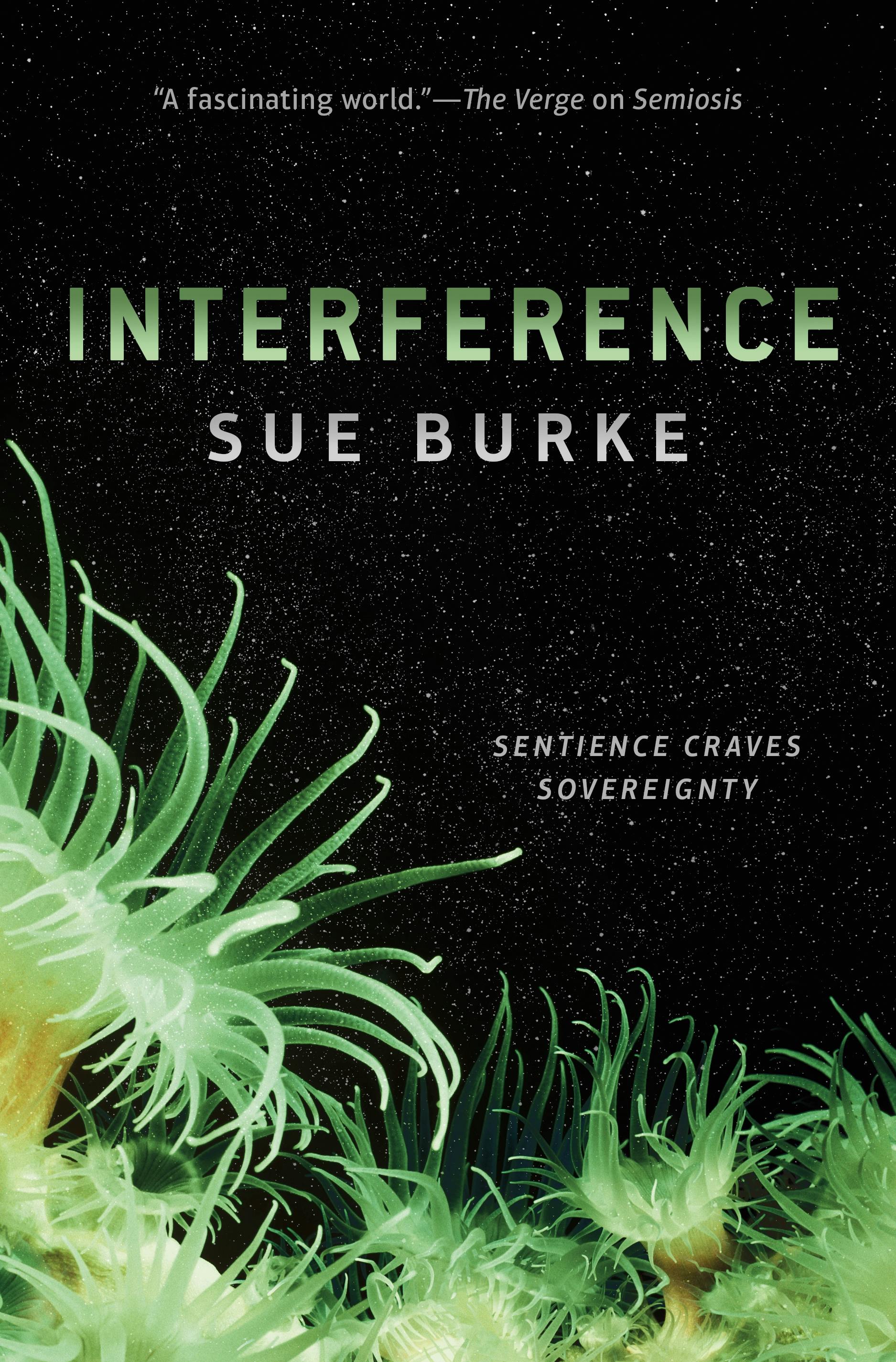
As part of an Audible sale, my novel Interference will be available for $6.99 from June 4 to June 26! This sale is only offered to Prime membership subscribers in the US. This is also a cash sale, meaning it will not affect those using an Audible credit to purchase.

Interference is the second novel in the Semiosis trilogy. More than two hundred years after the first colonists landed on Pax, a new set of explorers arrives from Earth on what they claim is a temporary scientific mission. But the Earthlings misunderstand the nature of the Pax settlement and its real leader. Even as Stevland attempts to protect his humans, a more insidious enemy than the Earthlings makes itself known.

“Narrators Caitlin Davies and Daniel Thomas May reprise their roles, and between them, they’ve once more captured the essence behind the voices of multiple characters, and even more impressively, this time there are non-humans thrown into the mix.” — Bibliosanctum Book Blog.


mount_oregano: portrait by Badassity (Default)


I’ve been asked if there’s anything new coming out. I have some short stories looking for a home, and if they’re published, I’ll announce it here.

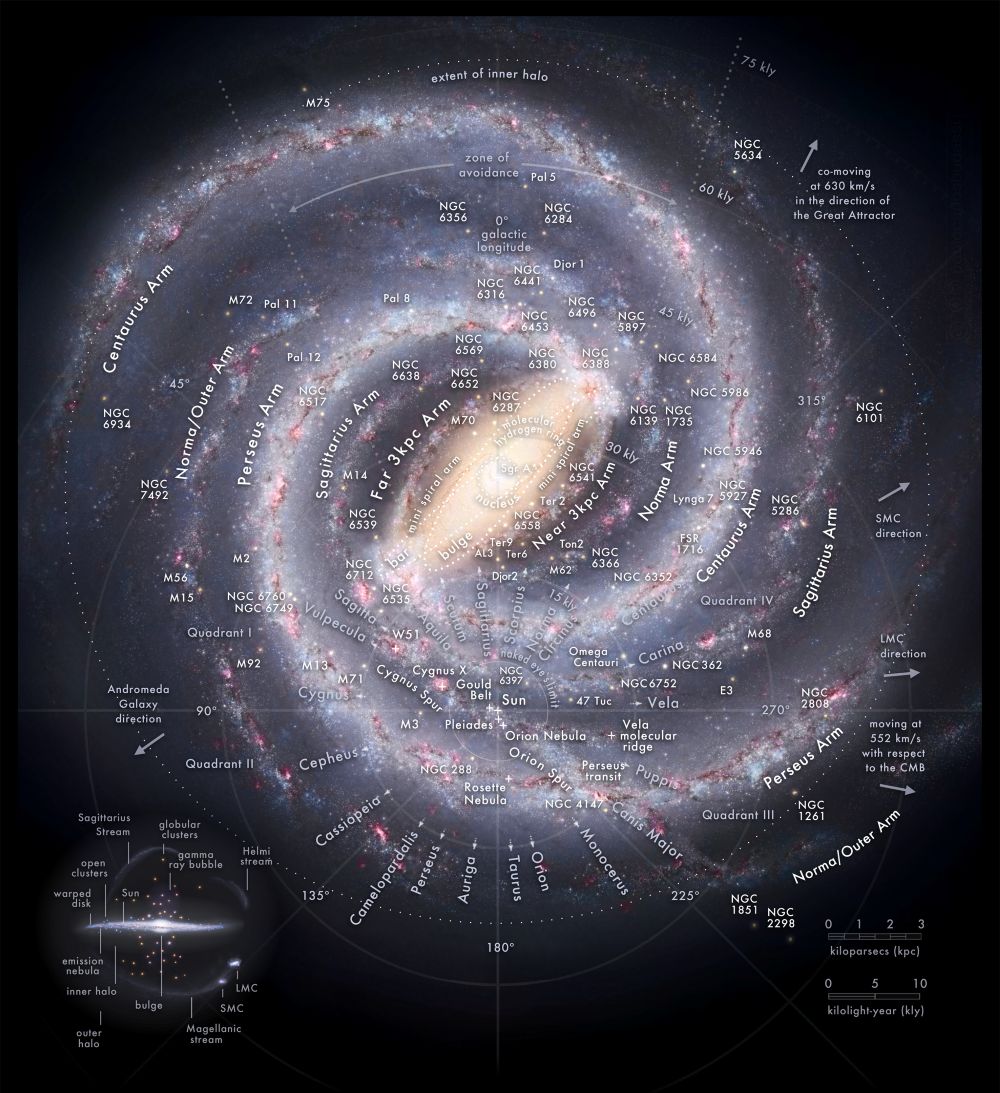
As for another novel, I’m most of the way through a very shitty first draft tentatively titled A Nice Galaxy. It tries to deal seriously with the size of the Milky Way, which is almost unimaginably vast. Suppose we humans have settled the galaxy. How can humanity remain united when even something as basic as a radio transmission becomes too attenuated to decipher less than a quarter of the way across the galaxy, not to mention the thousands of light-years it would take to arrive?

Imagine no handwavium shortcuts like faster-than-light travel. Then imagine humanity’s many self-destructive foibles and the problems of survival in a galaxy mostly hostile to human life. That is, imagine trying to carry out the impossible task of keeping humanity connected.


mount_oregano: and let me translate (translate)


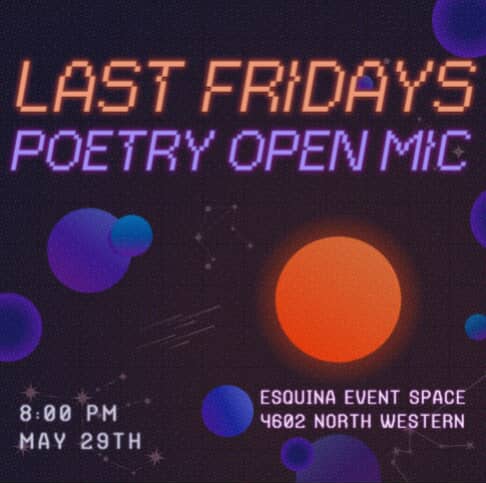
I’ll be reading at the Last Fridays Poetry open mic on Friday, May 29, 8 p.m., at Esquina event space, 4602 N. Western Ave., Chicago. It’s a supportive environment, and all are welcome. This time, I won’t be reading poetry, I’ll be talking about poetry, specifically about translating poetry. Here’s what I plan to say:

***

Today, I won’t be reading poetry, I’ll be talking about poetry, specifically about translating poetry. I’ve lived in Spain and the United States, and sometimes I write poetry in English and Spanish, and there can be problems with translation.

For example, the Spanish language doesn’t have a verb equivalent to “finesse.” You can express the idea, of course. “She finessed her way into the party,” can be said in Spanish: Se las ingenió para entrar en la fiesta. “She used ingenuity on things to get into the party.” Not quite the same, but close.

That technique, using “ingenuity” to approximate “finesse,” is called compensation. Here’s another example. My English-language haiku:

nodding heads —

lavender flowers

weighted by bees

My translation into Spanish:

abejas

meciendo las flores

de lavanda

In Spanish, you nod by asentir con la cabeza or “to agree with the head.” A literal translation would not work. The closest word, mecer, means “to rock,” as in “the hand that rocks the cradle.” So I wrote a Spanish version that means, literally, “bees / rocking the flowers / of lavender.” It supplies the same physical picture, but the implied meaning is different.

You can also paraphrase, which may or may not get you what you need. In Spain, the famous festival in July in Pamplona, known for its running of the bulls, honors St. Fermin, so the fiesta and by extension the run are known as los sanfermines. The Spanish haiku:

sanfermines

el semáforo parpadea

amarillo

Literal translation:

the running of the bulls in Pamplona

a stoplight blinking

yellow

It still needs a little work.

Another problem is cultural, which can be solved with adaptations. In Europe, the bird called a blackbird is the Turdus merula, basically an all-black version of the American robin, Turdus migratorius. (The European robin is a flycatcher, Erithacus rubecula. New World blackbirds don’t exist in Europe. Yes, it’s confusing.) For both these Turdus birds, their beautiful song is a harbinger of spring, so if I’m writing for an American audience, I might adapt the name of the bird to avoid confusion.

But the following haiku has another problem that also requires a compensation. In Spanish, the adverb ya emphasizes the time of the event. What time? Now, then, soon, already, immediately, finally, never … you know from the context, and there’s no exact English equivalent. Consider this haiku:

el mirlo canta

cigüeñas rumbo al norte

¿ya? ¿cómo que ya?

The Spanish version, translated over-literally, is “the blackbird sings / storks in direction to the north / ~time? how that ~time?

My translation:

the robin sings

storks headed north

now? so soon?

A particular problem is wordplay and puns. In this example, Spanish words often distinguish gender, although English words can’t. The translation of this poem is exact, but the humor doesn’t quite come through.

lectores - lectoras

los servicios de

la Feria del Libro

In English:

male readers - female readers

the rest rooms

at the Book Fair

Of course, poems can also employ rhyme, rhythm, assonance, figures of speech, and all the other resources that form the art of language. They tend to resist translation, but these exacting challenges are what makes translating poetry as much fun as writing it.


mount_oregano: Let me see (judgemental)


On April 26, 1986, the Chernobyl Nuclear Power Plant exploded, creating one of the
world’s worst nuclear accidents. A haibun is a Japanese poetic form that combines prose and haiku, usually describing an event or travel. This is a haibun about my guided tour in April 2006 of Chernobyl.

I visited Chernobyl, and I also visited the National Chornobyl Museum in Kyiv, which tells the heartbreaking story of what happened and holds irreplaceable artifacts. Over the weekend, Russia deliberately destroyed the museum.

***

A military checkpoint marks the entrance to the Exclusion Zone, the contaminated area roughly 30 kilometers around the Chernobyl Nuclear Power Plant. More than 100,000 people were evacuated within days of its explosion and meltdown in April 1986. At the Chernobyl Interinform Agency, in a room filled with maps, we met our tour guide, Yuriy, who cheerfully answered our questions in Ukrainian and English. Then we reboarded our bus to head toward the areas marked in red on the maps.

his pocket dosimeter

ticking ever faster

our guide keeps smiling

As we approached the nuclear power plant complex, we passed the rusting cranes and beams of buildings whose construction had been halted overnight. But there is a new building.

Visitor Center —

women plant tulips

wearing face masks

The cesium and plutonium that spewed out during the disaster washed into the soil, so digging requires precautions. Plants pull radioactivity back up through their roots, as a Geiger counter set on the pavement and then on the lawn can prove.

keep off the grass:

twice the dose

as asphalt

We moved on to Pripyat, a city built for the power plant’s workers and families. Its 50,000 inhabitants were told they were only leaving for three days, although authorities knew it would be effectively forever: the radiation will subside to livable levels in one thousand years.

busy ants —

do they notice?

the city is empty

It was a model Soviet city, with lovely tree-lined boulevards and many amenities. Its designer even had one rose bush planted for every inhabitant.

among the weeds

still a few

roses

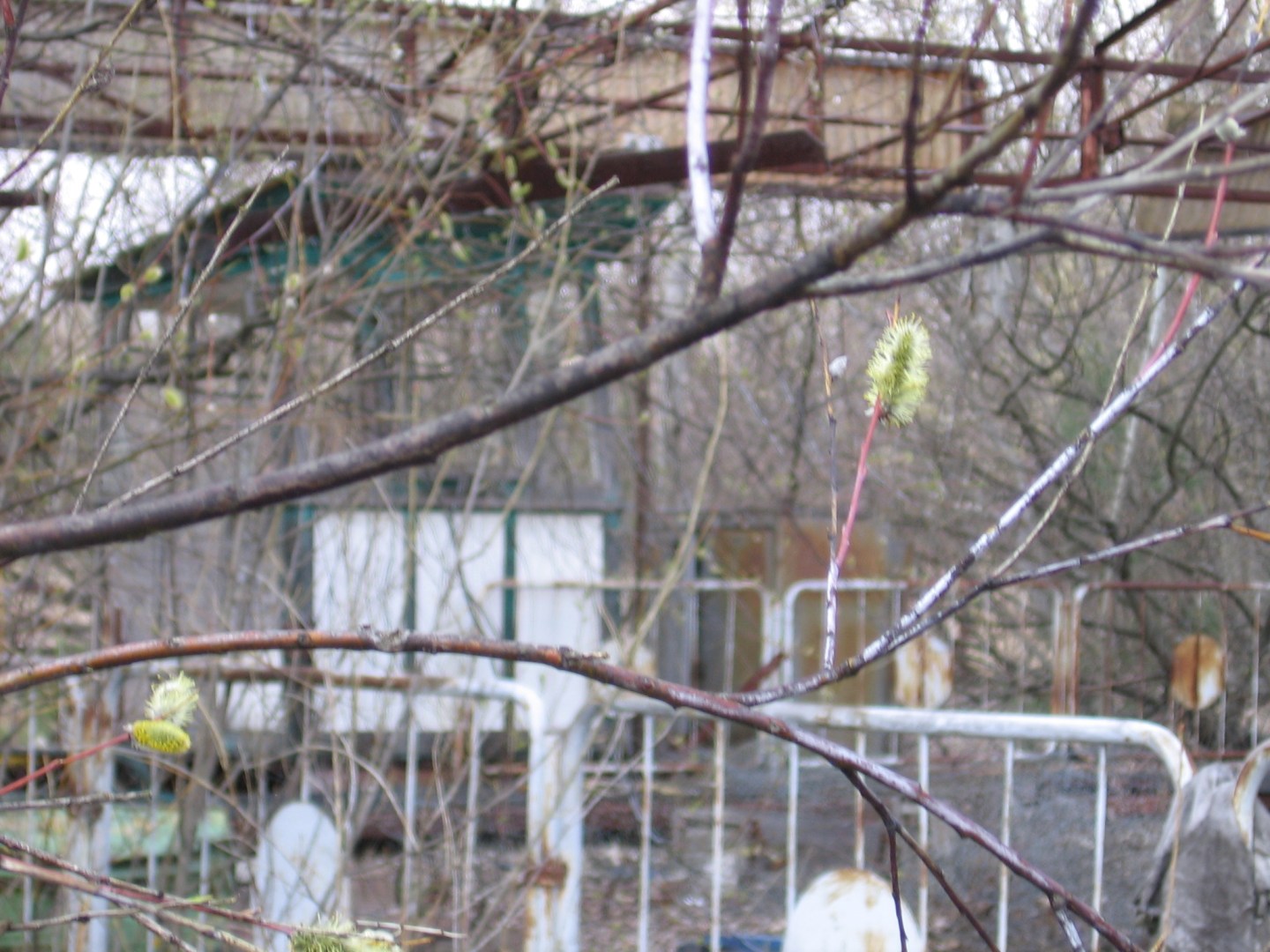
We visited on the day after Palm Sunday. With no palm trees in Ukraine, the faithful gather willow buds and bring them to churches to be blessed. Willows were growing in Pripyat.

pussy willows

nine hundred eighty more

quiet springs

The tour company owner, Alexander Sirota, had been a boy in Pripyat when the disaster happened, a third-grade student at School No. 1. It was partially collapsed, spilling books, furniture, and students’ possessions across the cracked and mossy sidewalk.

a string of beads

on the ground: everyone looks

no one touches

We got back on the bus and passed through the “Red Forest.” These were pine trees growing next to the power plant that were directly under the path of the worst fallout. The pine needles turned red overnight; the trees died, were cut down and buried where they had grown.

Red Forest

dust to dust — only

Geiger counters wail

Our guide pointed out a tall metal grid: the early warning radar screen for Chernobyl II, a supposedly top secret nuclear missile site close to the power plant. An American spy satellite passed over the area 28 seconds after the explosion, and US analysts, who knew about the site, thought a missile had been fired and considered a nuclear strike in retaliation. Then they thought a missile had exploded in its silo because it didn’t move. Finally they realized it was the nuclear power plant exploding.

Chernobyl II

the bigger danger next door:

who knew?

And so we left, with one final stop at a Ukraine Army checkpoint to test our radioactivity. We all passed. Our irradiation during the seven-hour visit had been slight. No tee-shirts, no souvenirs.

like a small x-ray

but with nothing

to show for it


mount_oregano: and let me translate (translate)

Magazine cover


I’m interviewed in the May 2026, Issue #1, of Small Planet, the Science Fiction in Translation Magazine. It includes columns on forthcoming books, reviews of older and newer SFT, interviews with translators (me), wish-lists of books for translation into English, and reports from countries around the world on their SF scenes.

In the interview, I answer questions from Cristina Jurado including: What is it about Spanish that appeals to you? What genre do you find more challenging? Can you share with us examples of key decisions you had to make in order to translate a story?

***

I’m interviewed about Goal-Based Sci-Fi Research by Beth Barany for the May 18, Episode 205, of her podcast How To Write The Future. We talk about how to know when to stop researching and start writing, how research can find conflicts that lead writers away from clichés, and surprises hiding in rabbit holes.

The podcasts are meant to offer fiction writing tips for science fiction and fantasy authors who want to create optimistic stories. A vision of what is possible can make it so. Beth Barany is a science fiction and fantasy author and fiction writing coach.


mount_oregano: novel cover art (Semiosis)

The short story “Spiders” (you can read it here) has been translated into Spanish as “Arañas” by Sergio Gaut vel Hartman (you can read it at Microficciones y Cuentos).

The story is set between Chapters 3 and 4 of my novel Semiosis. When Roland was a boy, his father took him out for a walk. This story was also published at Asimov’s Science Fiction magazine in March 2008 and Year’s Best SF 14 in 2009.


mount_oregano: Let me see (judgemental)
Ad Infinitum: A Biography of LatinAd Infinitum: A Biography of Latin by Nicholas Ostler

My rating: 5 of 5 stars


This might be a hard book to appreciate if you don’t understand a little Latin, the way reading a book about the history of algebra might be frustrating if you don’t understand a little algebra. It also might help to know a little about European and world history because this “biography” recounts the development of Latin and how its use and misuse shaped the Roman Empire, then Europe and the world up to the present day. It gets into the details, with plenty of footnotes and appendices. That is, this book is a deep dive, but if you take the plunge, you’ll find pearls.

I was particularly intrigued by the way Latin as a language affected events after Rome fell, eventually giving rise to New Latin. Language shapes human communication, and for a time, it was Europe’s common language. But the rise and fall of Latin depended on who needed to communicate with whom about questions not only of intellectual importance but about political power. This book explains the ways in which the world and its need for Latin changed and keeps changing over the millennia. (Millennia itself is a word combining elements from both Latin and New Latin).

Latin is a language of the past, but we will hear its echoes for a long time to come. We still need it, just not very often.

By the way, I also know Spanish (as well as English, which seems obvious but needs to be said), and I can hear and speak Spanish every day here in Chicago. (And I can hear Chinese, Arabic, Russian, and more — Chicago is a big, wide city.) Latin … is hard to come by. Conversational Latin? Maybe at the Vatican, but not many people there, either. Latin doesn’t live where I do, so studying it takes me elsewhere. Sometimes this feels like a relief.


View all my reviews

mount_oregano: and let me translate (translate)


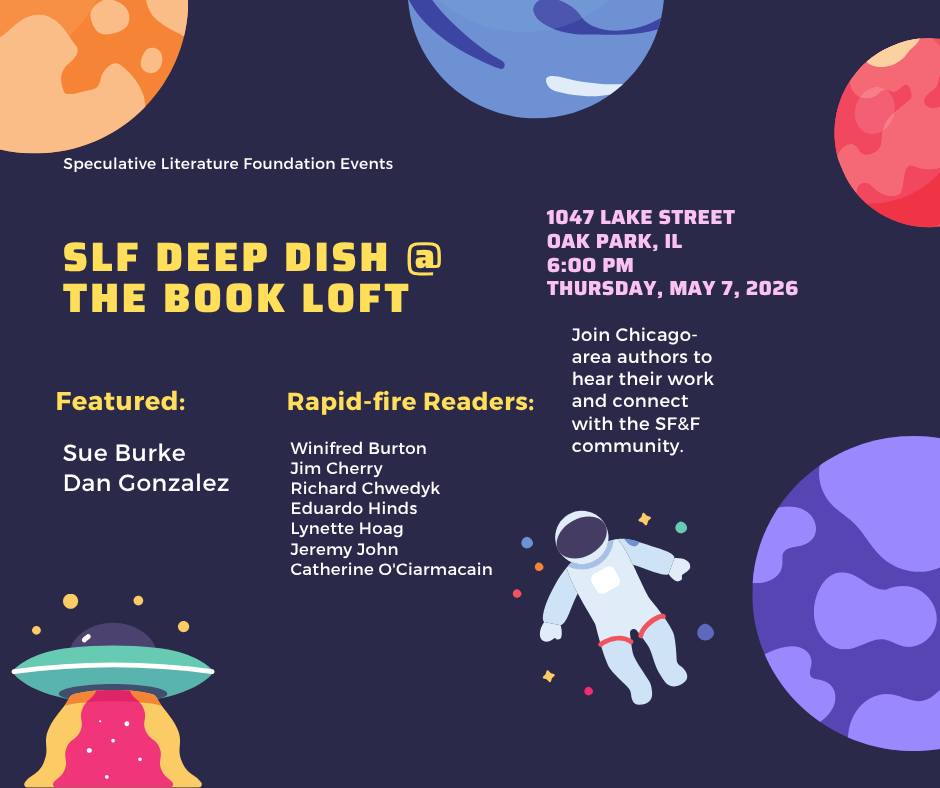
I’ll be reading my translation of the short story “Francine (Draft for the September Lecture)” by Maria Antònia Martí Escayol at the Deep Dish reading at 6 p.m. Thursday, May 7, at The Book Loft, 1047 Lake Street, Oak Park, Illinois. Nine other outstanding writers will also present their work. The event, organized by the Speculative Literature Foundation, is free and open to the public.

Maria Antònia Martí Escayol is a science fiction writer and an environmental historian who teaches at the Autonomous University of Barcelona, Spain. Her haunting tale investigates the death and posthumous life of Francine, the daughter of Renée Descartes.

If you can’t make the event, you can read the story in Apex Magazine. It also appears in the anthology World Science Fiction #1: Visions to Preserve the Biodiversity of the Future, where it is one of sixteen outstanding works by some of the world’s finest SF authors.


mount_oregano: portrait by Badassity (Default)
The Emotional Craft of Fiction: How to Write the Story Beneath the SurfaceThe Emotional Craft of Fiction: How to Write the Story Beneath the Surface by Donald Maass

My rating: 5 of 5 stars


I came to writing fiction after years of just-the-facts journalism, so infusing my writing with emotion remains a challenge. That’s why I found this book helpful. In the first chapter, Donald Maass challenges writers to ask themselves: “How can I get readers to go on emotional journeys of their own?”

Perhaps because he reads a lot for his job as a literary agent, he has opinions about the direction of emotional journey, too. “The ultimate in emotional craft is nothing more than trusting your own feelings. Having faith. Confidence.” But not all feelings, he says. “You can sense when fiction is masking cynicism or anger.... Cynical writing tries too hard.”

Instead, he suggests that readers are seeking an emotional experience, and they want to come away feeling positive rather than crushed, uplifted rather than disappointed, authentic rather than desperate. “How do you get your best self on the page? Let’s look at some practical ways.”

He offers plenty of examples and questions to ask yourself about characters, scenes, themes, stakes, and plot. I learned a lot, and I recommend this book to other writers.


View all my reviews

mount_oregano: portrait by Badassity (Default)

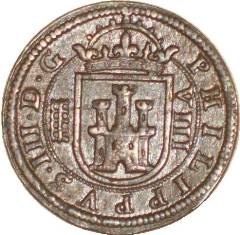
Originally published in 2010 when I lived in Madrid, Spain. The photo is of an eight maravedí coin from 1607, during the reign of King Felipe III, minted in Segovia.

***

What did Miguel de Cervantes earn from Don Quixote de la Mancha? We don’t know, but we have enough clues to try to guess. Cervantes was poor before it was published and poor after it was published, so it wasn’t a huge amount of money. Everyone agrees on that.

A little background

Don Quixote de la Mancha was published in two parts, the first in 1605 and the second in 1615. Cervantes didn’t plan on a second part, but after another author wrote a continuation, he decided to write his own.

In 1604, Cervantes was 50 years old and living in Valladolid. He had written a short story about Don Quixote, and he presented the idea of a novelization to publisher Francisco de Robles, who agreed and urged Cervantes to get it ready fast. Then the book was hastily edited (which explains the many errors in the text), printed on cheap paper with worn type, and rushed to the market.

Probably no one considered it a universal masterpiece, but the first edition of 1,000 copies sold well — in fact, it was immediately pirated in Lisbon. Cervantes had already won notice as a playwright, and this book, which satirized popular novels of chivalry and contemporary society, cemented his reputation as a major writer (at age 50, which was old at the time).

He had received a 10-year royal privilege to print Don Quixote, which he sold to Robles for an unknown amount; the paperwork was lost. But he had sold an earlier novel, La Galatea, to Robles’ grandfather for 1,336 reales, of which he eventually only received 1,086.

Nieves Concostrina, a journalist with Radio Nacional de España, reported in the series Acércate al Quijote that he received no more than 100 ducados (which equals 1,100 reales or 37,500 maravedíes) for the copyright, which she estimates as worth only about €200 today.

Daniel Eisenberg, the former editor of Cervantes, the scholarly journal of the Cervantes Society of America, wrote that he probably received 1,500 reales (51,000 maravedíes), which he says would have been worth 500,000 pesetas in 1992, or €5,503.72 today. That’s better, but still not a lot of money.

Maravedíes today

Their estimates in reales are reasonably close, so that’s a start. I don’t know how they arrived at modern currency, though. Converting antique currencies into present-day currencies can never be done well because, among other problems, the things that money can buy have changed. Cervantes never bought gasoline, for example. I don’t buy firewood.

But both Cervantes and I live in Madrid, and we both buy food. The Instituto de Cervantes, in its on-line footnotes to Quixote, has published the prices of several food items in New Castille in 1605. So let’s go shopping and do some math.

• A half-kilo of mutton sold for 28 maravedíes, according to the footnote. Mutton is no longer sold here, but a half-kilo of hamburger goes for €2.50 at my local grocery store. On that basis, 1 maravedí equals €0.089

• A chicken, 55m. The average price according to government’s Food Price Observatory’s latest statistics is €3.52. 1m = €0.064

• A dozen oranges, 54m. Food Price Observatory average is €4.26. 1m = €0.079

• Laying hen, 127m. Common price in local ads is €12. 1m = €0.094

• A ream of writing paper, 28m. A packet of A4 110 gr. Pioneer brand paper at Carlin, a major chain, €2.93. 1m = €0.104

• A dozen eggs, 63m. Food Price Observatory average is €1.33. 1m = €0.021 (This figure is an outlier, as you can see. The price of eggs has gone down a lot over the centuries. These days agribusinesses produce eggs in giant factory farms. Things change. For the better?)

The average of all these prices gives us 1m = €0.075. A weighted average would be better, I know, but how many laying hens do most of us buy now, so how much should they “weigh”? Not to mention the disparity in egg prices.

If we go with 7.5 euro cents per maravedí, the price of a copy of Quixote, set by law at 290.5 maravedíes, would have been €21.78. That sounds a bit low. We know that books were expensive items in those days. But that price was “en papel,” in paper — that is, as loose pages. The purchaser had to have them bound and covered at additional expense.

On the other hand, most people earned rather little. They would have spent a big part of their income, perhaps most of it, merely on food. According to the novel, Don Quixote spent three-fourths of his income on food for his household, and they ate frugally. A book would have taken a big bite out of tight budgets.

Not a get-rich quick scheme

If we accept that exchange rate — 1 maravedí = 7.5 euro cents — then Concostrina’s estimate of 37,400 maravedíes yields €2,805. Eisenberg’s 51,000 maravedíes yields €3,825.

It’s not a lot. Cervantes seems to have had income from other sources at the time. I hope so.

Those of you in the United States may be wondering what this is in US dollars. Yeesh. The dollar-euro exchange rate fluctuates daily, and there’s a worldwide currency war going on right now. On November 1, 2010, the value was USD$3,911.24 for Concostrina’s estimate and USD$5,333.50 for Eisenberg’s, but that will change. Go to Oanda for the latest numbers.

What Cervantes thought

In Book II, Chapter LXII of Don Quixote, our knight-errant meets an author in a printing shop in Barcelona and has this conversation:

“I would venture to swear,” said Don Quixote, “that you, sir, are not known in the world, which always begrudges its reward to rare wits and praiseworthy labors. What talents lie wasted there! What genius thrust away into corners! What worth left neglected! … But tell me, sir, are you printing this book at your own risk, or have you sold the copyright to some bookseller?”

“I print at my own risk,” said the author, “and I expect to make a thousand ducados at least with this first edition, which is to be of two thousand copies that should sell in the blink of an eye at six reales apiece.”

“A fine calculation you are making!” said Don Quixote. “It seems you don’t know the ins and outs of the printers, and the false accounting that some of them use. I promise you when you find yourself weighed down with two thousand copies, you will feel so careworn that it will astonish you, particularly if the book is unusual and not at all humorous.”

“Then what!” said the author. “Sir, do you wish me to give it to a bookseller who will give three maravedíes for the copyright and think he is doing me a favor? I do not print my books to win fame in the world, for I am already well-known by my works. I want to get something out of it, otherwise fame is not worth a farthing.”


Petty Love

Apr. 24th, 2026 11:08 am
mount_oregano: portrait by Badassity (Default)

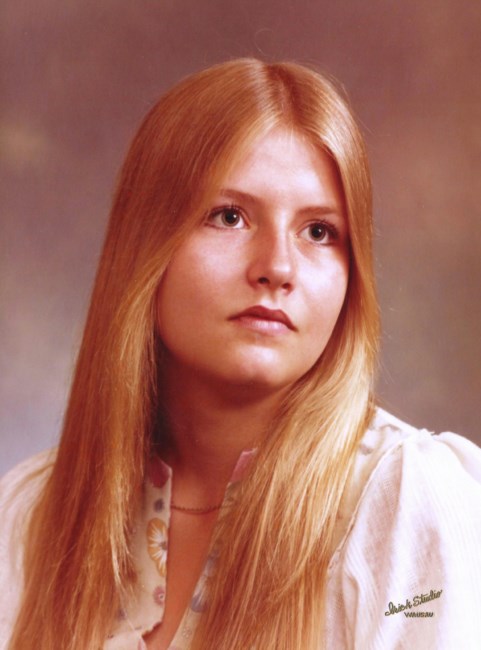
This sonnet is about my sister, who died in 2014 and would have been 66 years old today. Small love can do what big love can’t. The poem was published in UU World, Summer 2015.
 

Petty Love

God thinks too big, too many galaxies

to count, each one filled with billions of stars

and dramas at each one. God hardly sees

every sparrow who falls or stops to parse

the consequence of out-of-control cells

in a lung. God simply loves every one,

every cell and star, and nothing compels

second thoughts or divine hesitation.

We who love partially, with small design

and small cares, discriminate good from ill

because all of creation is not fine

if we cannot bend it to our own will.

Love small enough to curse a cell or sky

can have strength to grow watching someone die.


mount_oregano: Let me see (judgemental)

This year I found a common theme in the novelettes nominated for the Science Fiction and Fantasy Writers Association’s Nebula Awards: reconciliation with family or found family. Novelettes are at least 7,500 words but fewer than 17,500 words. The award will be presented at the Nebula Conference on June 6 at a ceremony in Chicago that will almost certainly be live streamed.

“Our Echoes Drifting Through the Marsh” by Marie Croke (Beneath Ceaseless Skies 1/9/25) — Colonialism upsets traditional burial practices, resulting in familial strife. But, of course, they reconcile.

“The Name Ziya” by Wen-Yi Lee (Tor) — Magic, colonial exploitation, identity, and the price of ambition and assimilation. A sad story, not a new theme, but beautifully told.

“We Begin Where Infinity Ends” by Somto Ihezue (Clarkesworld 2/25) — A trio of children embark on an ecological mission, but they are too emotionally immature to handle the interpersonal dynamics. The story ends sentimentally.

“Never Eaten Vegetables” by H.H. Pak (Clarkesworld 1/25) — A ship is carrying human zygotes for a corporation to colonize a planet, and it has a malfunction. Eventually, it discovers its purpose. A complicated human story with a fairly simple ending.

“The Life and Times of Alavira the Great as Written by Titos Pavlou and Reviewed by Two Lifelong Friends” by Eugenia Triantafyllou (Uncanny 3-4/25) — Two friends read a trilogy together and differ about it, and their friendship flags. But time goes by… Cute, heartwarming, and fun.

My vote: “Uncertain Sons” by Thomas Ha (Uncertain Sons) — A father and his somewhat dead father hunt monsters. Actually, it’s far more complex, tense, and mesmerizing. I liked it so much I decided to buy Uncertain Sons.


mount_oregano: Let me see (judgemental)

Relatively few people usually vote for the shorter works for the Science Fiction and Fantasy Writers’ Nebula Awards, and we only had a month to evaluate all the works on the ballot with its many categories, so I started with the short stories, which was doable. This year, I wasn’t entirely impressed. I thought some of the stories were simple and shallow — but not all of them.

“Because I Held His Name Like a Key” by Aimee Ogden (Strange Horizons 6/16/25) — An immortal being seduces a human, and we all know what’s going to happen next. This is a low-energy retread of a familiar story.

“Laser Eyes Ain’t Everything” by Effie Seiberg (Diabolical Plots 5/25) — A woman who uses a wheelchair discovers that superpowers will not overcome indifference to accessibility needs. The story works better as grievance catharsis than literature.

“The Tawlish Island Songbook of the Dead” by E.M. Linden (PodCastle 2/18/25) — The ghosts left behind on Tawlish Island feel lonely as the descendants go on with their lives elsewhere. Nostalgia and sadness make for a sweet but oft-told story.

“Through the Machine” by P.A. Cornell (Lightspeed 5/25) — An actor’s image is used to make movies that he never participated in, and he feels bad about it. Although the storyline is timely, it is explored with little emotional nuance, and the telling struck me as simplistic.

“In My Country” by Thomas Ha (Clarkesworld 4/25) — In a strange country, people are permitted by law to speak plainly or not at all. This story is sort of a parable, and its telling is not plain, and that kind of story can make you feel.

My vote: “Six People to Revise You” by J.R. Dawson (Uncanny 1-2/25) – Liza is sure she needs to change to find peace because a corporation is persuasively selling its services for change to vulnerable, anxious people. But what to change and why? It’s hard to find good advice. The unflinching characterization told me early on that Liza was self-deluded. What could make her wise up?

mount_oregano: portrait by Badassity (Default)


Best Poem and Best Comic are new categories for the Science Fiction and Fantasy Writers Association’s Nebula Awards this year, joining Novel, Novella, Novelette, Short Story, Middle Grade and Young Adult, Game Writing, and Dramatic Presentation awards.

Poetry in general isn’t popular among the average reader, I think because so much of contemporary poetry is bad. The dominant mode is tediously confessional, and much of those confessions are mere complaints, petty and aggrieved, delivered in a deliberately solipsistic manner. Poetry critic Thomas M. Disch in The Castle of Indolence lamented the poetaster who “writes about almost nothing except himself and his fowl moods, from self-pity to reproachfulness.” And this when the poetry is readable.

Good news! Speculative poetry is different! You will understand every one of these poems. None of them is a personal confession. You might even enjoy reading them.

That said, I’m a little disappointed by the level of craft, free verse without much rhythm, rhyme, figures of speech, or formal structure. Still, for a poem to be understandable and enjoyable is a virtue.

“They Said Robots Are” by Casey Aimer (Penumbric 6/25) — Surprising final line.

“Though You Always Are” by Linda D. Addison & Jamal Hodge (Everything Endless) — A paean to “Poets of the 21st Century on Spatial Location Sol III.”

“Care for Lightning” by Mari Ness (Uncanny 1-2/25) — Strong voice, probably a goddess.

“To Be the Change” by Nico Martinez Nocito (Strange Horizons 3/10/25) — The prophecy cannot come to pass … until it does, but not in a way anyone expected.

“The Mourning Robot” by Angela Liu (Uncanny 9-10/25) — Exactly that, mourning robots, with intense imagery.

My vote: “The World To Come” by Jennifer Hudak (Strange Horizons 12/22/25) — The dead might not wish to arise. Plenty to admire in the technical execution, including assonance and rhythm.


mount_oregano: and let me translate (translate)


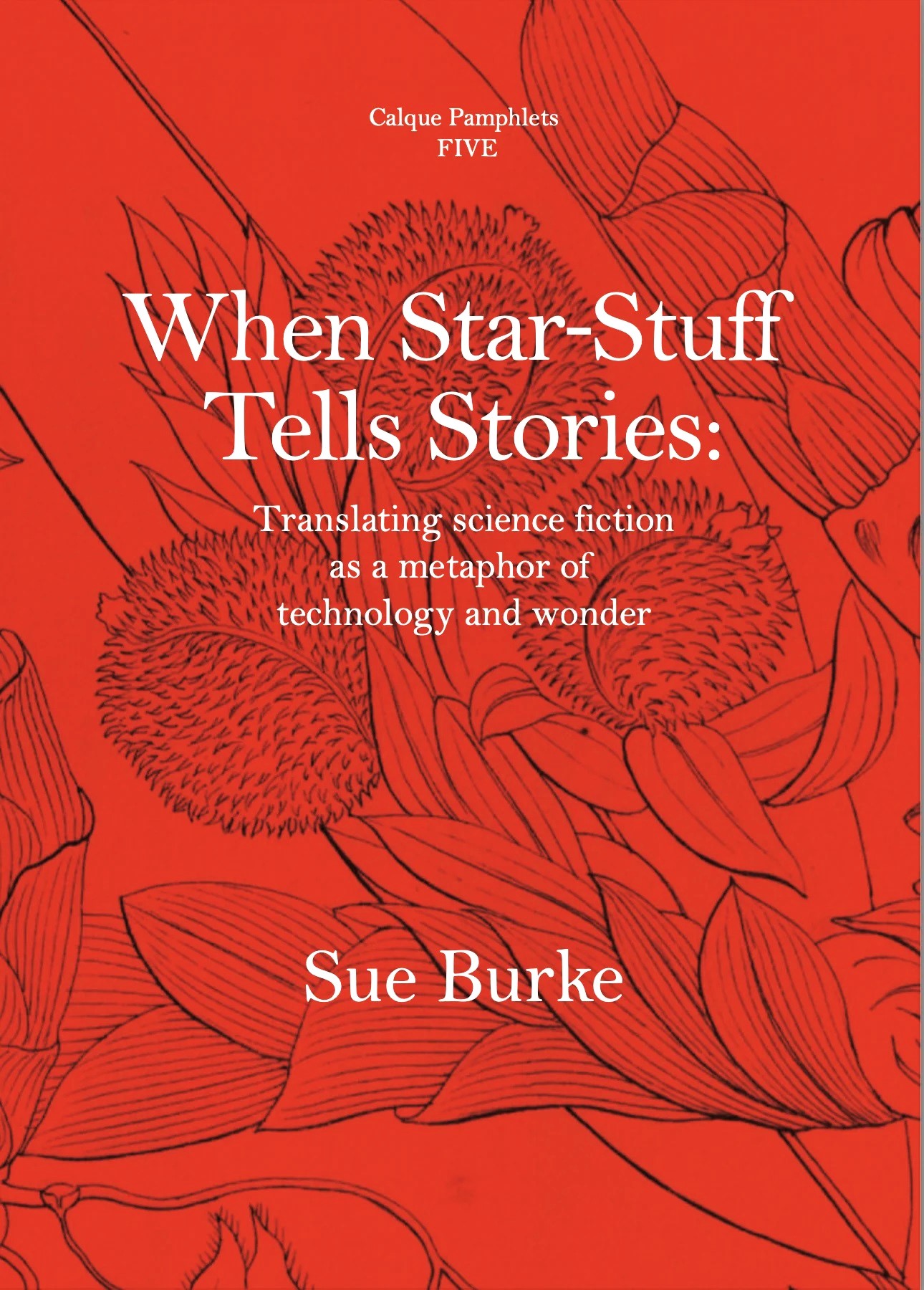
“If and when aliens make first contact, who should answer? Maybe humankind should turn to people like me, translators of science fiction. We’ve already thought through this kind of problem.”

Those are the opening sentences of my essay “When Star-Stuff Tells Stories: Translating science fiction as a metaphor of technology and wonder.” You can read the essay here.

It was originally published by Calque Press in 2024. In it, I explore the development of human language and the challenges it poses to translation here and now, and how the lessons learned from translation and from science fiction can help us if we come into contact with extraterrestrial intelligence.

Whomever we find, wherever they are from, they too will be made of star-stuff, and that should be enough to let us find a way to know each other.


mount_oregano: and let me translate (translate)

Art of a woman surrounded by stars


My short story “To Defeat Water” has been translated into Spanish as “Derrotar al agua” and published by Microficciones y Cuentos. Lealo aquí/read it here.

The site is run by Sergio Gaut vel Hartman, in Buenos Aires, Argentina. He is one of the founding fathers of Spanish-language science fiction, and his novels have won major awards.

I often translate other people’s work from Spanish into English, and it’s an honor to have my work published in Spanish, especially by someone as prominent as Sergio. ¡Gracias!

If you want to read the story in English, it was originally published here by The Lorelei Signal.


mount_oregano: portrait by Badassity (Default)


I received a preview copy this book in exchange for writing a blurb if I liked it. The description intrigued me: a science fiction story from an outstanding author about translation. A psychic connection allows a linguist to impersonate a species upon whom space travel depends.

But I didn’t get the story I expected. Here’s my blurb:

I felt shattered, betrayed by all my hopes. Everything we believe about linguistics says shared language leads to greater understanding and compassion. This is why I translate. But language is also a technology, and technologies can destroy. S.L. Huang shows how lies using language can create an unthinkable disaster.

I can’t say more without spoilers. The Language of Liars will be published on April 21. You won’t be disappointed


Page generated Jul. 9th, 2026 03:58 am
Powered by Dreamwidth Studios