
Mayors’ Messages

During the last decades of the 20th century, Morrison’s mayors faced complex, and sometimes controversial, issues. A few of them left reports of some of the key happenings during their respective tenures, taking time to summarize their terms in office, saving us from wading through years of minute detail in Town Board minutes and other records. This post, of course, only scratches the surface.

Note: Some of the dates of service are subject to change. We’re still trying to sort it out as sources disagree.

Rolf Paul, Mayor 1980-1984; Trustee, 1974-1980, 1984-2000

Rolf Paul was a central figure in Morrison’s civic life from 1974 to 2000, dedicated to the Town’s well being and progress, but rarely without criticism or controversy. At the end of 1981 and again after 1982, he wrote summaries of significant events and progress in those years. Some of the projects he highlighted were:

  • Assumed operations of the town’s wastewater facility [previously managed by a special district], eliminating separate septic systems
  • Completed a Planning and Design Study by University of Colorado at Denver (UCD) students
  • Gave the Town Hall “a facelift” and oversaw its use by several civic groups, as well as the new Morrison Opera Company
  • Completed a $700M water project, replacing water mains and an old water tank and completing a raw water operational reservoir on Open Space near town
  • Looked forward to development of the Mitel Corporation’s $20 million facilities and employment boost to the area [this project did not materialize]
  • Entered into an agreement with the Mount Carbon Metropolitan District to treat water and wastewater in exchange for facilities improvements [an amended agreement dated 7/31/2025 is still in effect]
  • Worked with the town businesses and new Morrison Chamber of Commerce to sponsor parades, ‘big tent’ antique shows, art shows, pumpkin fests, etc.

In the 1981 summary, Paul wrote:

To the east of us within the next few years there will be a C-470 corridor, and the way in which the land just east of that corridor is utilized is of great concern both to Morrison and to the City of Lakewood. We are working with the City of Lakewood within the capabilities of both municipalities to do what we can to assure development that will prove to be an asset to both communities.

Sometimes it all seems somewhat overwhelming— so few people and so much to consider but we’ve been incorporated since 1906 and feel we really have something very “special” here, and I guess that’s what does keep us going.


Mary Gaylord, Mayor 1984-1990

The efforts Rolf Paul, Dick Scott, and others made to secure Morrison’s future in the preceding years led to a contentious election in 1984. Mary Gaylord ran against Paul, and won the mayor’s role by only 8 votes. After the election, the Rocky Mountain News reported that Gaylord ran on a campaign of making the town’s government ‘more open and less confrontational’:

“We’ll build bridges and get on with the business of the town,” she said. “I never really felt that what Rolf and I wanted for the town was that much different. The difference was in how we delivered the services.” Gaylord praised Paul’s role in putting together a $4.7 million water and sewer project, saying it gives the town some “bargaining chips it never had before.”

Gaylord inherited the job of carrying out the Mount Carbon agreement. Paul and Scott remained on the Board and, along with other Board members, continued to deal with the complexities it brought for years afterward.


Jim Jordan, Mayor 1990-1992; Trustee

During Jordan’s single term, the Town recruited new staff and hired outside bookkeeping services and a back-up sewer and water company. The latter was intended to relieve hard-working DeWayne Rhodig, who was Morrison’s jack-of-all-trades for many many years, from snowplowing to construction. In his resignation letter, Jordan wrote:

My primary effort as Mayor was to introduce a more business-like approach to governing Morrison. The Town now has a conscientious staff that not only maintains regular hours but also keeps compensation time to a minimum. …. I am proud of the fact that the Town Board has managed Morrison well.


Mary Poe, Mayor 1992-1998; Trustee, 1990-1992

In 1998, Mary Poe provided a three-page bullet list of key events and accomplishments (with dates) of the previous eight years, including:

  • Nixed the gambling proposal to bring casinos to Morrison (1992)
  • Negotiated with Bancroft Fire Dept. the land swap east of the Hogback for 321 Highway 8 property (new fire station for them, new town office for Morrison, 1992-1994)
  • Supported the efforts of volunteers… in getting MNHM [Morrison Natural History Museum] off the ground (1992 on)
  • Changed the image of Morrison from being a “Biker Town” to being a “Family Friendly Town” (1993)
  • Put Morrison businesses and attractions on the internet [first town website, 1997]
  • Annexed Cooley Gravel (1.5 years of intense negotiations, 1994-95) [to secure water storage]
  • Successfully completed the Town Hall Renovation, turning a ho-hum, rundown building into a building with style (1996)

She wrapped up the challenges of the job:

Most of these accomplishments required hours and hours of hard work and hard thought, even the one liners. Believe it or don’t, these are what I consider just the highlights of the past 8 years. Maintaining the charm of our small town as a great place to live, while keeping it economically viable is an incredible balancing act and requires constant attention. The Board has strived to do that in a responsible, careful, and yes, frugal manner.

Peter Fischer’s Rock and Other Stories

“Where is Peter Fischer’s Rock?” asked an interested descendant early in my tenure as a Morrison historian of sorts, maybe about 1996. Answering questions was a key part of the job, but this one had me stumped. I’d never even heard of Peter Fischer, though I’m confident Morrison’s earlier historian, Lorene Horton, probably had. His early arrival and many contributions to the area qualify him for “pioneer” status. Why did he seem so little known, hardly remembered?

Peter’s story as adapted and abbreviated from a summary by his great-great-granddaughter Melanie Holmberg:

Peter Fischer, Morrison pioneer

Peter Fischer was born in Germany in 1826 and immigrated to Illinois in 1849 with his family (including parents, brothers, and sister). At age 33, he left the family farm in Illinois (and his wife Catherine) and moved alone to Cherry Creek in the spring of 1859, where he established a nursery business on the shores of Cherry Creek. Catherine joined him in 1860. In 1872 (before the railroad line to Morrison was completed), Peter, Catherine and 6-year-old Clara Fischer moved to Morrison, perhaps because he’d heard about the coming railroad.

After Peter moved to Morrison he “engaged in improving his farm and experimenting on fish and is now in possession of a beautiful beer garden.”1  “Laurelei [also Lorelei] Park, near the mouth of the canon, is the favorite resort of the people of Morrison, and the surrounding country. Its proprietor, Mr. Peter Fischer, has spared neither pains or expense in fitting up a nice place for a summer resort, and seems to be reaping a rich reward for his enterprise.”2

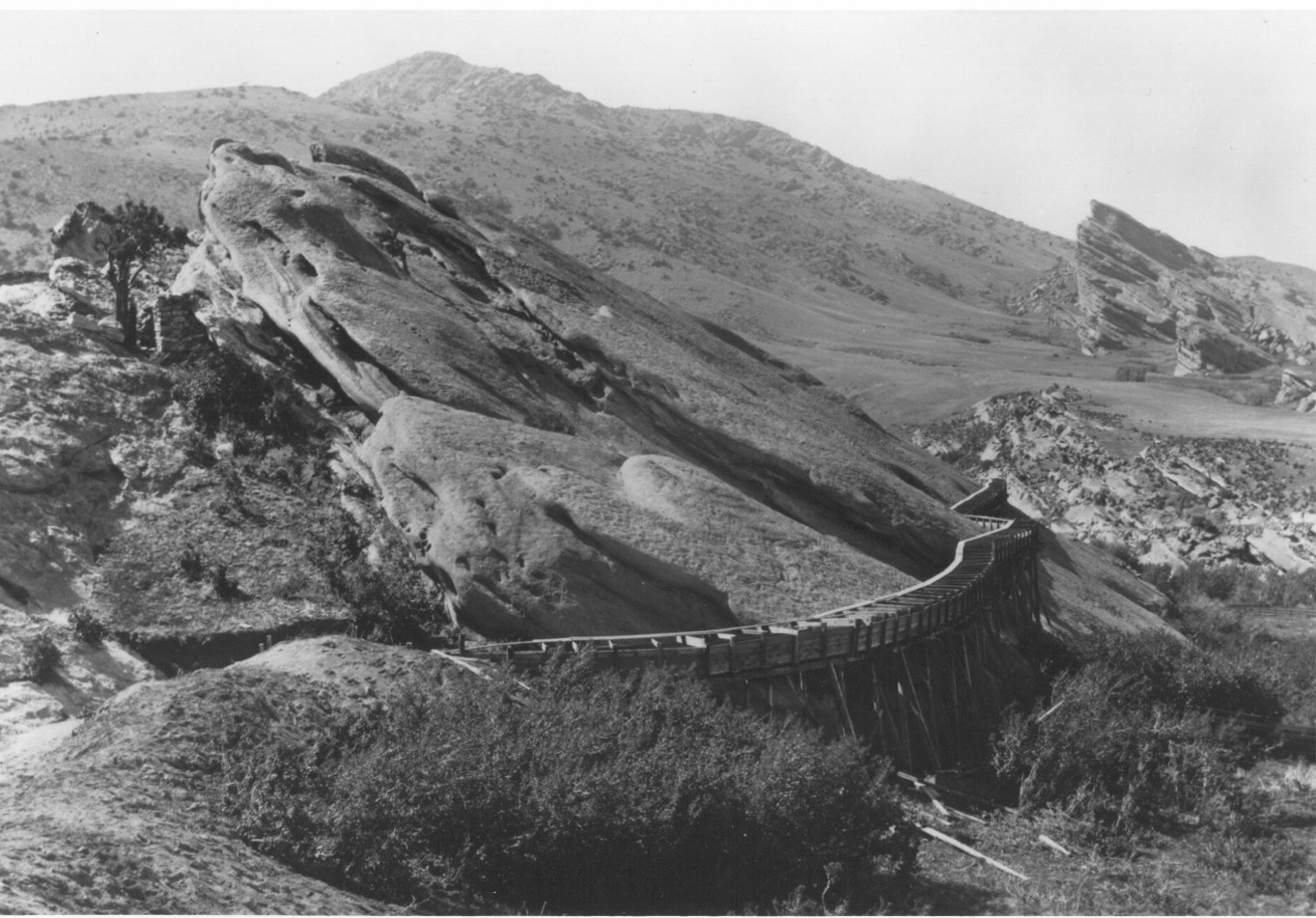
Fischer’s Flume, constructed across Peter Fischer’s Rock “above” Morrison.

Peter may have owned land on “Fischer’s Mountain,” aka Mt. Fischer, now Mt. Falcon. He was also the owner of Fischer’s Ditch and Flume. “Fischer’s Rock,” or “Peter’s Rock,” is the large red sandstone outcrop overlooking Morrison on which he built Fischer’s Flume “to carry water around Mt Glennon to Turkey Creek.”3 He constructed two ponds, one to serve as a swimming pool and bathing area (for which he charged admission) and a lower one to water his livestock and farm (perhaps also for the above-referenced fishery).

After his daughter’s move to Denver and his second wife’s death, Peter suffered multiple financial setbacks and failures. He eventually left Morrison for Denver, impoverished, and was living in a “county home.” He apparently didn’t have a close (or any) relationship with his daughter and grandchildren. At his death, in 1900, he was reported to have dementia.

Melanie Holmberg with son Tim, descendants of the Fischers, on a visit to Fischer’s Rock in 2010.

The story of the Fischer family is, of course, far more complex than this overview. Although Clara was the Fischers’ only surviving child, her marriage to Sabatino Tovani (another story) resulted in six children and an array of descendants.

The flume was short-lived and was therefore sometimes known as “Fischer’s Folly.” Evidence of its presence remains in faint traces on the landscape (see photo below).  


Sources:

1 “Morrison Matters: A Word or Two About This Enterprising Foot-Hill Hamlet. Her Business, Agricultural and Grazing Facilities Commented On.” The Rocky Mountain News (Daily), Volume 25, April 27, 1884. 

2 “Lively Morrison: A Rough Sunday’s Work—A Man Kicked to Death on Sunday—Notes of Business Progress and Social Gossip.” The Colorado Transcript, July 20, 1881

3 Kowald, Francis. “A Brief Historical Sketch and Some Reminiscences of The Sacred Heart College,” typed manuscript, circa 1935, housed in Archives and Special Collections, Regis University.

Aerial photo of Morrison area labeled showing approximate location of Fischer’s Flume.

Ginny Paul and the Country Store

Ginny Paul standing next to the Morrison Country Store sign in 2009, with graphic logo designed by Rolf Paul.

Virginia Paul and her husband Rolf came to Morrison in 1969, where he set up a small printing business in their home. In 1984, she launched her own small business, the Morrison Country Store,* which would become one of the town’s lasting enterprises, drawing customers from across the metro area and beyond. I visited Ginny and documented her charming shop in these photographs in 2009.

Where Rolf was, Ginny writes, “an activist & a mover & a shaker” who served on the Town Board and even as Mayor for a time, she preferred to “stay out of all the controversy… and just be a good citizen.” And a very successful businesswoman, as evidenced by the longevity of the Morrison Country Store, a gift and décor oriented shop with a loyal clientele much like that once drawn by Thee Deacon’s Bench and the town’s many antique stores. The shop was closed in 2018, just two years before Ginny’s death in 2020.

Ginny at the Morrison Country Store in 2009. One of the plaques above her has a Helen Keller quote: "Your success and happiness lie in you."
Ginny at the Morrison Country Store in 2009. One of the plaques above her has a Helen Keller quote: “Your success and happiness lie in you.”

Despite Ginny’s reticence, she did end up serving on the Town Board for several years after Rolf’s death, where she was “an advocate and voice for local businesses.”

Ginny Paul standing with some of the displays at the Country Store, 2009.
Ginny Paul standing with some of the displays at the Country Store.

Rolf and Ginny supported cultural events and organizations in Morrison and beyond, including the Jefferson Symphony and the Morrison Natural History Museum.

Ginny considered the museum “a great addition to the Town” and a “gift of culture to the metropolitan area.”

Ginny Paul and her Morrison Country Store are well remembered by Morrison residents and long-time visitors. Today the Morrison Mercantile carries on some of Ginny’s legacy, in another form.

Quotes above are from Ginny’s letter to the Town Board in February 2002, shortly after Rolf’s death, when she was drawn into ‘controversy and turmoil’ and spoke her mind in response to an edition of Lew’s News.


Remembering Virginia (Ginny) Paul
(Morrison Hogback newsletter, October 2020)

We would like to remember the life of long-time resident, Ginny Paul. She was the definition of “Keep Morrison, Morrison” from her care and dedication to the Town, to her radiating entrepreneurial spirit and fruitful local business, Morrison Country Store. Ginny served her community well. She selfishly [sic] volunteered her time to the Planning Commission and Board of Trustees throughout her years. During Ginny’s time on the Board and Planning Commission, she was an advocate and voice for local businesses, an integral part in the Rooney Valley Development discussions and Town Comprehensive Plan update in 2008. Her insight as a resident and business owner allowed for a unique perspective that was appreciated and valued in the Boards’ policy making. Ginny will be greatly missed, and we send our sympathy to her friends and family. Morrison will not be the same without her.


* Actually, even before Ginny began her business, the location was known as the Morrison Country Store, run for many years by Tom and Bonnie Hicks, who specialized in antiques and collectibles.

The Morrison Greys (or Reds?)

The Morrison baseball team, about 1915. Front row: Lawrence Knolls, Dan Schneider, Ted Schrock, Billie Sawyer. Standing: Henry Recks(?), Joe Schrock, Mrs. Kirby, Jim Groom, Tom Fleming.

Morrison fielded baseball teams regularly in the last century. The ballfield was east of town, where the wastewater management plant now stands. “Mrs. Kirby,” Lizzie C. Kirby (aka “Babe”), lived on Spring St. and served in Red Rock Circle No. 130 of the Women of Woodcraft in 1906 (Jeffco Graphic, 2/16/1906) and as a lecturer in the Bear Creek Valley Grange in 1912 (Arvada Sun, 1/19/1912).

Morrison Baseball Timeline

  • May 1902: Morrison Baseball Club (MBC) defeated Littleton 12 to 13(?). “The game was well played, close, and exciting.” Battery for Morrison included Nay, Evans, and Johnson; Littleton: Norton, Smith, and Bell. (RMN, 5/31/1902)
  • 1908: “The Morrison Greys are showing fine form this year in scoring a 12 to 9 victory over the Twenty-first infantry team in a game at Morrison.” Howell and Boyd formed the winning battery. (RMN, 4/29/1908) 
  • March 1910: “Morrison Reds will play any amateur team Sunday for expenses”; telephone D. Durham. (RMN, 3/26/1910)
  • May 1910: Morrison team defeats Manchester Athletic club, 12 to 6. (5/30/1910)
  • June 1910: Morrison wants a game for next Sunday. (RMN, 6/17/1910)
  • May 1927: Mt Morrison organizes a team; holds a dance to raise money for the “suits”
  • June 1927: “Morrison will entertain the Mines & Smelter team of Denver” Sunday. (RMN, 6/5/1927)
  • August 1930: Guy Hill team will play Morrison nine on Labor Day (Jeffco Rep, 8/28/1930)
  • Sept 1930, Golden Reds played Morrison in RR Park; Morrison won 8 to 4. (Jeffco Rep, 9/11/1930)

RMN = Rocky Mountain News Jeffco Rep = Jefferson Co. Republican

Businesses Old and New

Some of Morrison’s historic downtown buildings have hosted businesses for more than a hundred years. Here’s a quick walk through several historic enterprises, and a handful of newer ones. Click any image to enlarge and/or view as slideshow.


Morrison promotional graphic "Experience Morrison" with town logo and slogan "The nearest faraway place."

In the 1980s-2000s, Morrison promoted itself as a destination for the metro area. Mayor Rolf Paul (1980-84), a graphic artist, contributed a town logo, and Mayor Mary Poe (1992-98) adopted “the nearest faraway place” as a slogan.

Some of the later 20th-century businesses cycled through so quickly they were soon forgotten; others endured for decades. Here are a few to test or refresh your memory.