

It’s time to clean up some stuff and have some conversations. This post is about what’s changing this week regarding open-ended questions.
The story thus far
In the summary below, I’m writing as if I’m catching you up on a TV/streaming series. This levity is not meant to minimize the daily impact these changes have had on the community, curators, and mods.
Previous episodes of this ongoing series can be reviewed starting with this October 2025 post Exploring new types of questions on Stack Overflow, if you wish. When we last tuned in, open-ended questions were meeting with modest success. Popular with people who want to ask open-ended questions, and some have written pretty good questions. Also popular (at least in principle) with people who welcome a Stack Overflow that includes a broader range of content. Not as popular with much of the core community since the format lacked the moderation and curation options that have kept the quality bar high on Stack Overflow for more than a decade. The narrative got to a certain point, the season finale left everyone wondering what was going to happen next, and the wait has been somewhat painful. (If this story sounds familiar, you might be thinking of season one. (Discussions update: Expansion to all tags))
Caught up? Here’s what happens next, and following that I’ll also talk about what happens after that. And then I’ll hand things over to the author of the next part of the story.
What happens next?
tl;dr
As of today:
Open-ended questions will continue to be welcome on Stack Overflow, with the parameters to be defined by the community.
These questions will be created and presented in the standard Q&A format, including the familiar moderation and curation options.
Specialized tags will be used to designate open-ended questions from traditional Q&A.
The details
This section describes the mechanics of managing a question's type and why we think this is an optimal approach. And that’s what this is: an approach. This is not a feature, or even a “product” in the novel sense. This is an approach to managing a broader range of content using the tools that we have at our disposal, most of which are familiar.
Asker experience
This remains largely unchanged from how it’s been recently. There is a type selector at the top of the page, and a field to define tags below the body field. The asker chooses a type, or leaves the default selection in place. Depending on the type chosen, different guidelines and options might be shown.
The default selection – for now, at least – is “How-to / Troubleshooting” (recently changed from “Troubleshooting / Debugging”).
As opposed to previously, where the type selection set a non-modifiable value, the type selection now defines a tag for the question if one of the non-default options is chosen. This is one of several specialized tags, and it appears in the tag field right away.

Published state
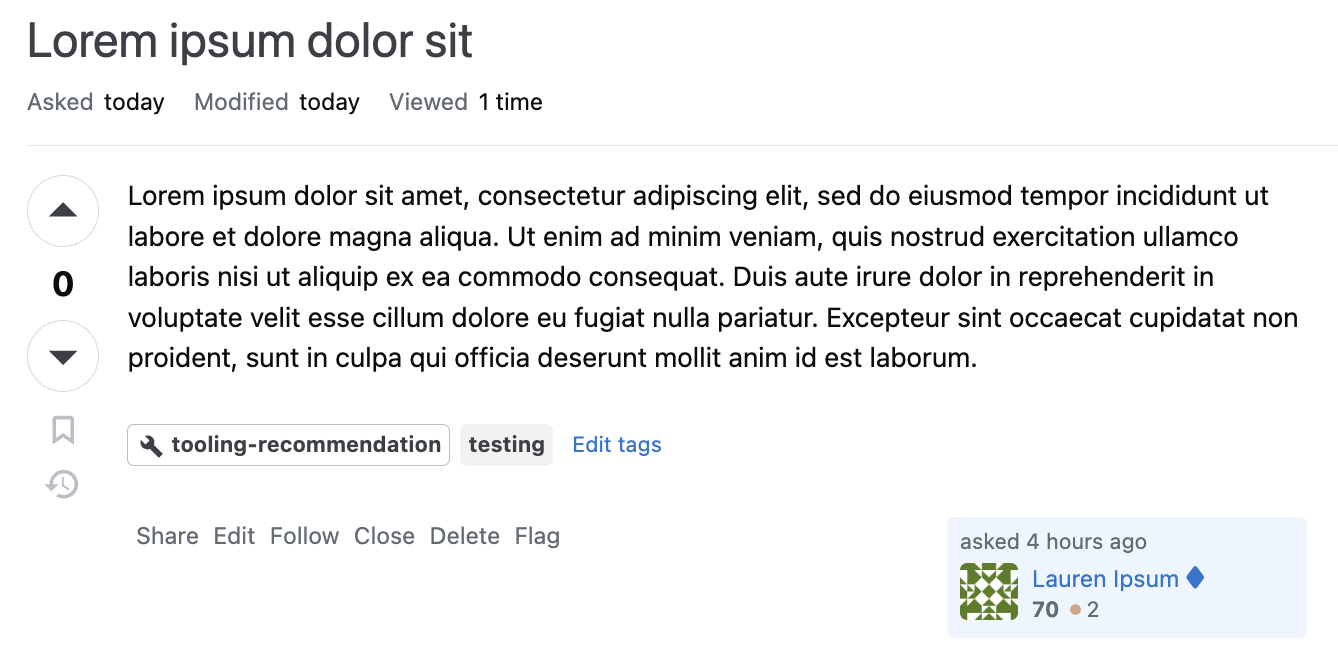
The specialized tag displays along with the other tags below the question body. It’s styled like the “opinion-based content” (OBC) labels were previously, so in that sense it’s not a big visual change. This specialized tag will always be shown before the other tags. The specialized tags – for now, at least – are: tooling-recommendation, best-practices, and advice.
Editing and managing the question
When editing a question, swapping one specialized tag out for another is how a question is moved from one open-ended type to another. Users with enough reputation to edit a question are able to make such a change.
Moderation and curation options for a question remain largely the same. Question closure in general remains available, just to be clear.
The specific option to close a question as “opinion-based” is no longer available, instead obscured with a message to ease all types of users into the adjusted paradigm where open-ended questions are permitted. We can link to guidance from this message (as reflected in the image below; right now there is no such link). As community conversation kicks off, let us know where such a link should lead.
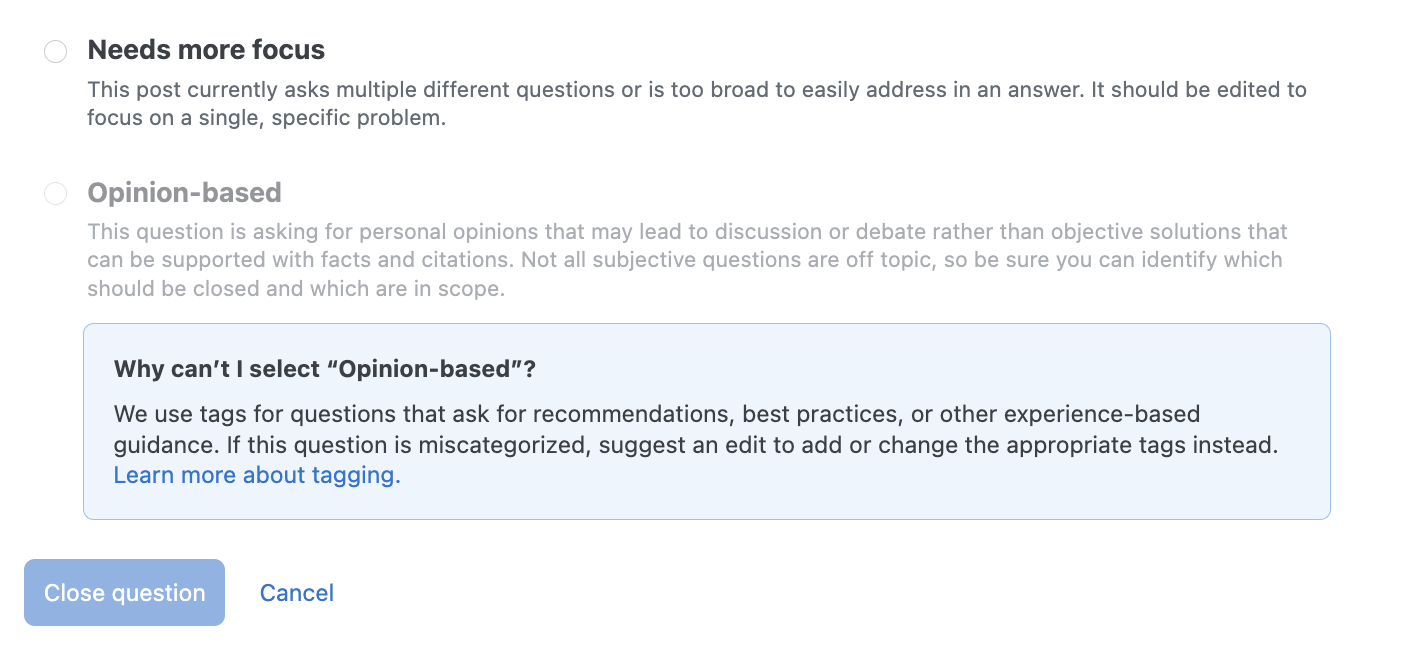
The community-specific close reason “seeking recommendations” is now obscured in the same way. That made sense given that tooling-recommendation is one of the open-ended question types.
We're interested to know if you'd suggest updating any other moderation/curation options. More on that in today’s other post Looking ahead, starting conversations, and seizing the moment.
Built-in focus and personalization
The tag-based approach has many benefits. The usage of tags allows users to leverage existing functionality to navigate the expanded scope of content. Most notably, tags can be used in search and in filtering lists.
For users who don't wish to see or engage with open-ended questions, the tags can be ignored and other user-managed customizations can be keyed into those tags and leveraged as needed.
At the feature level, tags also provide a nice way to focus things when needed. For example, we’ll be looking to the community to determine the best way to proceed with review queues and open-ended questions. If open-ended questions should not be put through a specific review queue, excluding those tagged questions from the queue seems like a good approach. (We don’t have any plans to change review queues unless we hear from you that’s what’s needed; this is just an example.)
The tags themselves can be adjusted as updated policies and norms take shape. Content from the tag wikis can potentially be displayed in places where guidance might be helpful, and the wikis can be updated as needed to change that copy.
What’s next after today’s updates?
Next up will be migration of the ~4.5k “opinion-based content” posts into the standard Q&A format. We’re still working through some of the nuances of how that will work, and we’ll post more about that soon.
And what’s after that?
At the top of the post, I said I would be handing things over to the author of the next part of the story. Spoiler alert: it’s all of you. How we move forward with this approach is very much in the hands of the Stack Overflow community. Today’s companion post Looking ahead, starting conversations, and seizing the moment lays out more about that. (Yes, I also wrote that post, so I guess I’m technically handing things off to myself, but read the post and you’ll see what I mean.)
FAQ
You probably have lots of questions. Here’s answers to some of them.
What happens with reputation and score?
This is an important consideration as the community thinks about curation, moderation and content quality. For now, we’ve made the call that open-ended questions will operate the same as other Q&A with regard to reputation and the standard functionality (e.g. accepted answers, bounties).
We’ve made that call to keep the scope of the current changes manageable, both technically and socially. Down the road, we’re open to looking at this topic again.
Migrated “OBC” posts will enter their new state of being with a score of zero.
What about redefining the question types/tags, or adding to the list of types?
We do imagine that these may need to change, and there is certainly substantive discussion to be had about that, which should not be rushed. That includes the type tied to traditional Q&A (currently “How-to/Troubleshooting”). We will need to stick with the three current open-ended question tags (tooling-recommendation, best-practices, and advice) until that migration has been completed. After that, we look to you for what should happen.
What about Comments?
There are some issues and loose ends to resolve with Comments, stemming from the format experiments last year. Notably the fact that questions and answers currently have different styles of comments. We see this as a standalone project to take on when the changes related to open-ended questions are completed.
What if I don't think the scope of content allowed on Stack Overflow should be broadened?
Put simply, this expansion is needed if we want Stack Overflow to persist. Traditional Q&A will always have an important and central place, and any user is welcome to restrict their focus to that. The proposed usage of tags will make that fairly easy. But a broader scope for the site is the path forward.
If I am opted out of experiments via my user preferences, what changes for me?
You will see newly-created open-ended questions starting today. You may not see the type selector on the Ask page until further changes are made. Questions in the "opinion-based content" format will continue to be hidden from you.
What about how this impacts {something else not mentioned here}?
All the ripple effects of this change are things to be assessed and discussed. As I said above, how we move forward with this approach is very much in the hands of the Stack Overflow community. [Check out today’s companion post https://meta.stackoverflow.com/questions/440089/ for more about that.
