-12

It’s time to clean up some stuff and have some conversations. This post is about what’s changing this week regarding open-ended questions.

The story thus far

In the summary below, I’m writing as if I’m catching you up on a TV/streaming series. This levity is not meant to minimize the daily impact these changes have had on the community, curators, and mods.

Previous episodes of this ongoing series can be reviewed starting with this October 2025 post Exploring new types of questions on Stack Overflow, if you wish. When we last tuned in, open-ended questions were meeting with modest success. Popular with people who want to ask open-ended questions, and some have written pretty good questions. Also popular (at least in principle) with people who welcome a Stack Overflow that includes a broader range of content. Not as popular with much of the core community since the format lacked the moderation and curation options that have kept the quality bar high on Stack Overflow for more than a decade. The narrative got to a certain point, the season finale left everyone wondering what was going to happen next, and the wait has been somewhat painful. (If this story sounds familiar, you might be thinking of season one: Discussions update: Expansion to all tags.)

Caught up? Here’s what happens next, and following that I’ll also talk about what happens after that. And then I’ll hand things over to the author of the next part of the story.

What happens next?

tl;dr

As of today:

  • Open-ended questions will continue to be welcome on Stack Overflow, with the parameters to be defined by the community.

  • These questions will be created and presented in the standard Q&A format, including the familiar moderation and curation options.

  • Specialized tags will be used to designate open-ended questions from traditional Q&A.

The details

This section describes the mechanics of managing a question's type and why we think this is an optimal approach. And that’s what this is: an approach. This is not a feature, or even a “product” in the novel sense. This is an approach to managing a broader range of content using the tools that we have at our disposal, most of which are familiar.

Asker experience

This remains largely unchanged from how it’s been recently. There is a type selector at the top of the page, and a field to define tags below the body field. The asker chooses a type, or leaves the default selection in place. Depending on the type chosen, different guidelines and options might be shown.

The default selection – for now, at least – is “How-to / Troubleshooting” (recently changed from “Troubleshooting / Debugging”).

As opposed to previously, where the type selection set a non-modifiable value, the type selection now defines a tag for the question if one of the non-default options is chosen. This is one of several specialized tags, and it appears in the tag field right away.

The Stack Overflow Ask page with "Best Practices" selected on the Type selector at the top of the page, and the corresponding tag with that name added to the Tags field, styled with a border and a trophy icon preceding the tag name

Published state

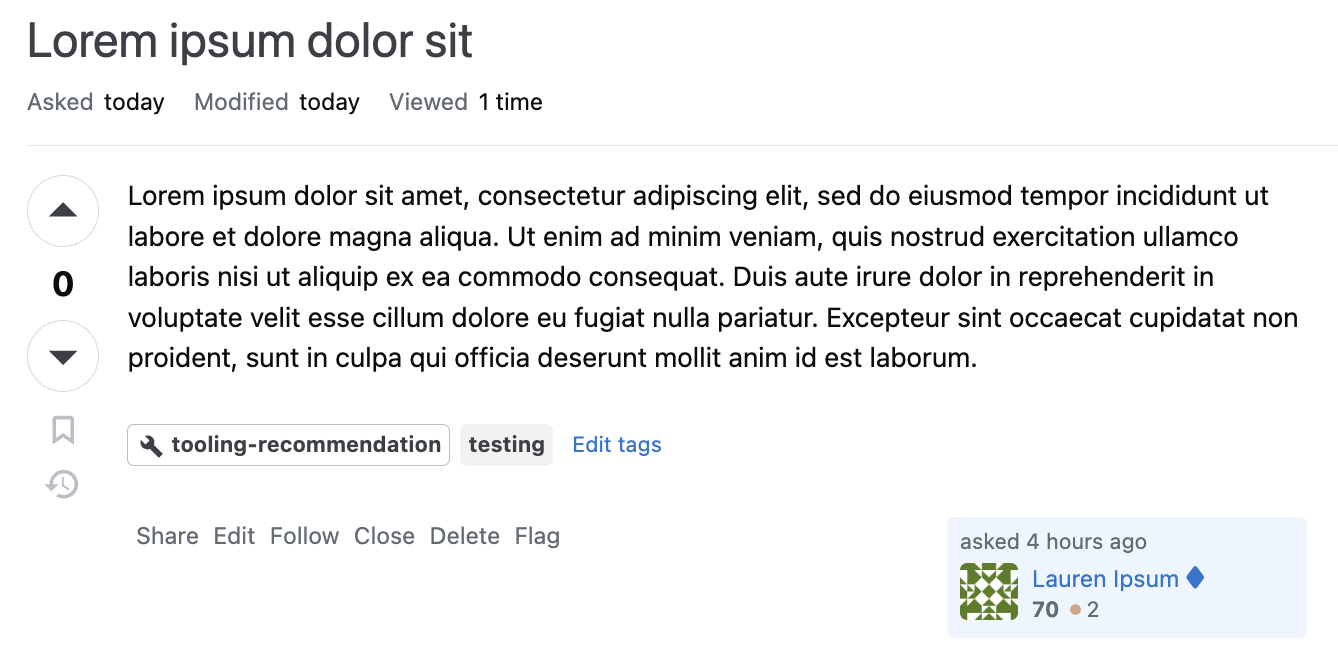
The specialized tag displays along with the other tags below the question body. It’s styled like the “opinion-based content” (OBC) labels were previously, so in that sense it’s not a big visual change. This specialized tag will always be shown before the other tags. The specialized tags  – for now, at least –  are: , , and .

An example published question that displays the open-ended type tag, presented first, ahead of another tag, and styled with a border and icon

Editing and managing the question

When editing a question, swapping one specialized tag out for another is how a question is moved from one open-ended type to another. Users with enough reputation to edit a question are able to make such a change.

Moderation and curation options for a question remain largely the same. Question closure in general remains available, just to be clear.

The specific option to close a question as “opinion-based” is no longer available, instead obscured with a message to ease all types of users into the adjusted paradigm where open-ended questions are permitted. We can link to guidance from this message (as reflected in the image below; right now there is no such link). As community conversation kicks off, let us know where such a link should lead.
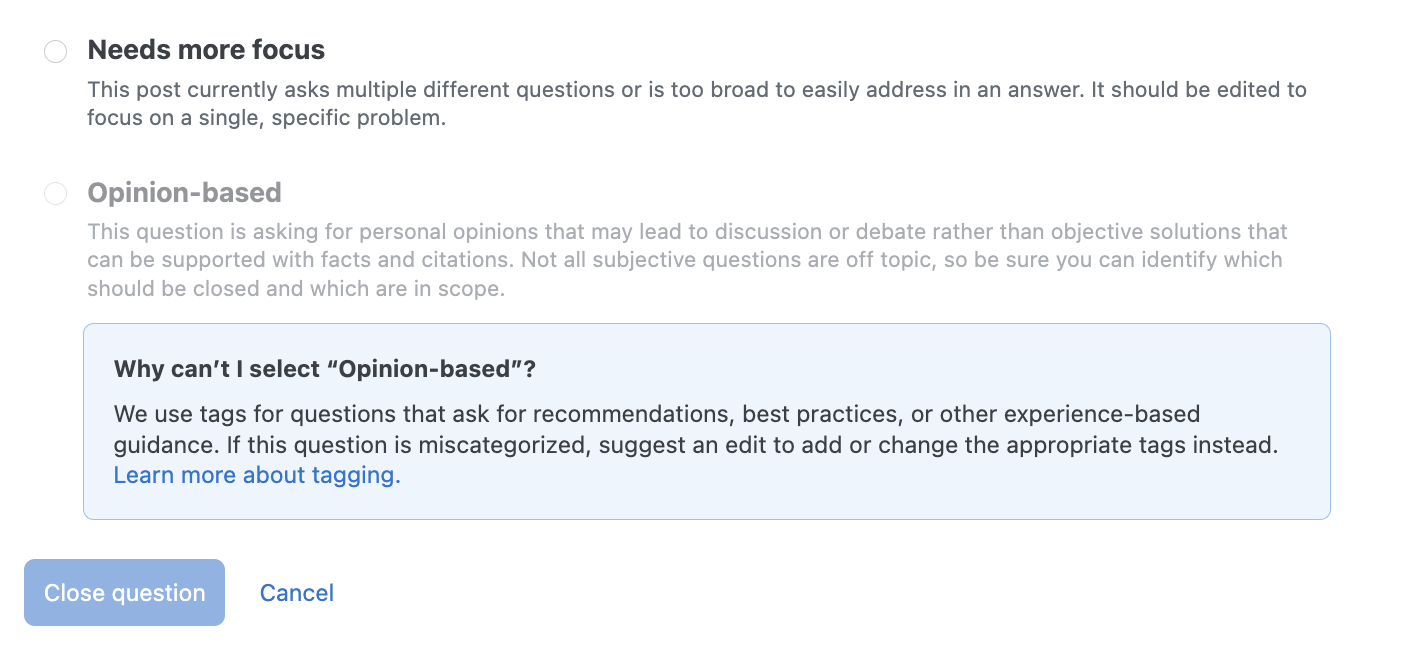
The bottom of the first-level question close modal with the close reason "opinion-based" grayed out and a blue area below that with text stating that the close reason is no longer available and suggesting that the reader try editing the post or editing its tags

The community-specific close reason “seeking recommendations” is now obscured in the same way. That made sense given that is one of the open-ended question types.

We're interested to know if you'd suggest updating any other moderation/curation options. More on that in today’s other post Looking ahead, starting conversations, and seizing the moment.

Built-in focus and personalization

The tag-based approach has many benefits. The usage of tags allows users to leverage existing functionality to navigate the expanded scope of content. Most notably, tags can be used in search and in filtering lists.

For users who don't wish to see or engage with open-ended questions, the tags can be ignored and other user-managed customizations can be keyed into those tags and leveraged as needed.

At the feature level, tags also provide a nice way to focus things when needed. For example, we’ll be looking to the community to determine the best way to proceed with review queues and open-ended questions. If open-ended questions should not be put through a specific review queue, excluding those tagged questions from the queue seems like a good approach. (We don’t have any plans to change review queues unless we hear from you that’s what’s needed; this is just an example.)

The tags themselves can be adjusted as updated policies and norms take shape. Content from the tag wikis can potentially be displayed in places where guidance might be helpful, and the wikis can be updated as needed to change that copy.

What’s next after today’s updates?

Next up will be migration of the ~4.5k “opinion-based content” posts into the standard Q&A format. We’re still working through some of the nuances of how that will work, and we’ll post more about that soon.

And what’s after that?

At the top of the post, I said I would be handing things over to the author of the next part of the story. Spoiler alert: it’s all of you. How we move forward with this approach is very much in the hands of the Stack Overflow community. Today’s companion post Looking ahead, starting conversations, and seizing the moment lays out more about that. (Yes, I also wrote that post, so I guess I’m technically handing things off to myself, but read the post and you’ll see what I mean.)

FAQ

You probably have lots of questions. Here’s answers to some of them.

What happens with reputation and score?

This is an important consideration as the community thinks about curation, moderation and content quality. For now, we’ve made the call that open-ended questions will operate the same as other Q&A with regard to reputation and the standard functionality (e.g. accepted answers, bounties).

We’ve made that call to keep the scope of the current changes manageable, both technically and socially. Down the road, we’re open to looking at this topic again.

Migrated “OBC” posts will enter their new state of being with a score of zero.

What about redefining the question types/tags, or adding to the list of types?

We do imagine that these may need to change, and there is certainly substantive discussion to be had about that, which should not be rushed. That includes the type tied to traditional Q&A (currently “How-to/Troubleshooting”). We will need to stick with the three current open-ended question tags (, , and ) until that migration has been completed. After that, we look to you for what should happen.

What about Comments?

There are some issues and loose ends to resolve with Comments, stemming from the format experiments last year. Notably the fact that questions and answers currently have different styles of comments. We see this as a standalone project to take on when the changes related to open-ended questions are completed.

What if I don't think the scope of content allowed on Stack Overflow should be broadened?

Put simply, this expansion is needed if we want Stack Overflow to persist. Traditional Q&A will always have an important and central place, and any user is welcome to restrict their focus to that. The proposed usage of tags will make that fairly easy. But a broader scope for the site is the path forward.

If I am opted out of experiments via my user preferences, what changes for me?

You will see newly-created open-ended questions starting today. You may not see the type selector on the Ask page until further changes are made. Questions in the "opinion-based content" format will continue to be hidden from you.

What about how this impacts {something else not mentioned here}?

All the ripple effects of this change are things to be assessed and discussed. As I said above, how we move forward with this approach is very much in the hands of the Stack Overflow community. Check out today’s companion post Looking ahead, starting conversations, and seizing the moment for more about that.

38
  • 28
    swapping one specialized tag out for another is how a question is moved from one open-ended type to another ... Can you use this mechanism to move an open-ended type question to a normal question? One of the biggest issues we saw with phase 1 (beyond the lack of/insufficient moderation capabilities) was people accidentally choosing the wrong question type because they were confusingly named. Commented Jul 9 at 15:30
  • 29
    Overal, I welcome this change because I think Stack Overflow should have a place for open-ended questions, but the implementation you present here is again half-arsed. You didn't address the problem of reputation. You didn't give advance notice and users who don't have meta open 24/7 are now confused how did the new tags appear. You kept the confusing dropdown without explaining what it implies. You should have first made an announcement and wait for community's feedback. Commented Jul 9 at 15:34
  • 12
    This is a much better solution than what we have; (lack of) curation on opinion-based content was a serious problem. It's great that we now have this. This, however, is going to likely need a lot of shaping over the coming weeks, as you note; there's very few guidelines at the moment on what's permitted and I suspect the mods are going to get some interesting flags. That'll hopefully help us identify what isn't appropriate, and what is borderline/grey; the latter is likely going to be the areas the mods needs the most input from the community on if it's something we want to retain. Commented Jul 9 at 15:39
  • 12
    I still think this is extremely problematic for some non-SO communities. I'm specifically looking at "Best Practice" (which, by the way, we all know don't exist) and how that plays with Software Engineering or "Tooling Recommendation" and how that plays with Software Recommendations and Hardware Recommendations or "General Advice" and how that plays with, well, lots of other communities. Commented Jul 9 at 15:48
  • 5
    Looks like the SG might have been missed, @chivracq, please raise that as a [bug]. I'm about to pop out, but if i see if when i get back, I'll happily [status-review] it. Commented Jul 9 at 15:59
  • 40
    "How we move forward with this approach is very much in the hands of the Stack Overflow community." Are you pulling our legs? We’ve heard this story before. It’s time to take it off the air. Commented Jul 9 at 16:12
  • 6
    It looks like I can remove the tag and it will be a normal Q&A stackoverflow.com/questions/79978390/… I guess this is expected, because they haven't implemented anything new other than the fancy tag icon. Commented Jul 9 at 16:17
  • 10
    @Dharman I'd say "intentionally minimal" rather than half-arsed. Reputation as a whole is its own can of worms, and changes there can follow policy updates, not dictate them. The UX changes are pretty minimal. This was sudden, but I'm not sure an abstract summary a week ahead of time would have been that helpful. If the drop-down feels confusing, let's talk about a better approach. We purposely did not want to change the asking experience too much right now since new users have gotten used to this one. And I'd say we've been in feedback mode on this concept since Discussions launched. Commented Jul 9 at 16:34
  • 5
    Will the new "type" tags take up a tag slot, like the required tags do on meta? Commented Jul 9 at 16:49
  • 6
    Please edit the title into something descriptive that conveys "opinionated off-topic questions are now integrated into the main content". Commented Jul 9 at 16:56
  • 7
    @Berthold "Problematic" is the right word. Activity metrics are down, and this feature, instead of promoting communities of highly specialized experts on a topic, will lead to posts on Stack Overflow. On top of AI tools drawing people away, SO is now drawing people away from other network sites by encroaching on their scope. Commented Jul 9 at 17:59
  • 9
    "writing as if I’m" This just makes reading tedious since the time for "levity" is long past. Commented Jul 9 at 19:07
  • 8
    @philipxy Personally I think there's usually room for a little bit of levity. And my hope was that mixing it in with a frank take on how we fumbled this in the past might be appreciated by some. Maybe it fell flat. Maybe I just watch too much TV. Commented Jul 9 at 19:48
  • 16
    The Rebirth of Meta Tags Commented Jul 10 at 7:45
  • 8
    Here is a good example of what's happening in real life: the question is correctly tagged tooling-recommendation, it meets all criteria for a perfectly reasonable open-ended question, and it got closed anyway, by using the "needs focus" reason in lieu of "opinion-based". You're like Henry VIII trying to change politico-religious opinion by fiat: you can make new rules and even make everyone take an oath, but the community will go on thinking what it thinks. Commented Jul 11 at 15:14

16 Answers 16

43

Considering that tooling recommendation has a potential to attract overly promotional content and even outright spam. I would like to propose one restriction when it comes to self answering.

We should not allow self answered recommendation questions as it is very likely that this would open a flood gates for people posting questions merely to promote their own products. This is a simple rule and explaining it in the appropriate help and FAQ pages, as well as enforcing it, should not be a problem.

8
  • 3
    Do you think that disallowance can reside in the flagging and moderation process? Or would you like to see something more proactive from the platform? It feels like there might be some opportunity for that at the intersection of tag warnings and the messages that users already see when self-answering. Commented Jul 9 at 18:58
  • @Berthold flagging is always one of the options when some guidance is broken. Commented Jul 9 at 19:07
  • 2
    I think I'm more concerned by the question than the answer in cases like this. The Software Recommendations site hasn't needed a rule like this, I don't think. A disclosed, well-written answer could be useful to someone, and if it's undisclosed or lazy can probably be curated or moderated away already under current rules. I really dislike fake questions unless they're for a truly useful service, like canonicals. Should we more clearly disallow posting questions from the standpoint of the author's clients? Or is that already covered? Commented Jul 9 at 21:34
  • 1
    @DanGetz We could likely deal with such posts under current rules, too. But it is easier if we explicitly prevent intentional advertising. There are too many people posting low quality, AI generated, or undisclosed self-promotion as-is. And tooling recommendation is a perfect place where such posts could be completely self injected. I would prefer having some guardrails now, and we can see how things will develop in that area later, and make appropriate adjustments. Commented Jul 10 at 6:34
  • 1
    Not allowing self-answers to recommendation questions is a half-measure. Any software company that wants to shill their product on SO using this method can have two SO accounts. I think self-answering the question would be the more honest and transparent approach and we should not ban it. Commented Jul 10 at 9:06
  • 3
    Intentional advertising is already prohibited as spam, and tooling recommendation questions already existed in the OBQ experiment. As you know, overpromotion with disclosure by a new account is regularly deleted by spam flags, and the self-promotion guidance points that out. Without seeing clear examples of what problematic content would be kept without this rule, I see no upside and only downsides to the proposed rule. @julaine, using two accounts for shilling is also already prohibited. Commented Jul 10 at 13:21
  • 2
    Personally, I would downvote any answer to a tooling question, that simply suggests a tool without some “meat and potatoes” on the reason it’s the right tool and it better be more than a cut and paste of the company advertisement specifications for the tool. Commented Jul 11 at 0:51
  • 1
    Yeah, what they said. Spam is spam, and bad answers are bad answers, and we already have tooling to deal with both on the platform. No need for arbitrary new rules in anticipation of some further issues. Commented Jul 12 at 19:22
36

You say "this expansion is needed if we want Stack Overflow to persist." but I'm not sure we can actually pull that off. In the last months I mostly remember lots of useless open-ended questions. Really lots. Not only "what is best" without a definition of relevant factors but also simple spam. The genuine useful open-ended questions were few in between.

Therefore my guess is that this will be lots of curation work for little gain. This or a general pollution of the content with very mediocre questions, which could be seen as better than nothing, but I'm not so sure.

Wouldn't it be better to take a step back and ask what we have learned from this experiment? What worked, what not? Would LLMs be better at answering these questions or which ones would be better answered by us? How can we get a certain kind of open-ended questions without having to do lots of work to fend off all other kinds?

I personally may not care much about this, but others may do and should ask all these questions and find a way to experiment on smaller scales.

One thing I observed: people are really bad in classifying their own posts. Let the community do it or give much better guidance. The moment you introduced question types, you added additional ways to make errors. I remember you publicly stating that it was measured and users can do that, but in reality they couldn't or didn't want to. There must have been a serious flaw in internal research to not capture it.

5
  • 7
    To be fair, the horrendous format and lack of moderation was partly responsible for the uselessness. I am sure that we won't see a huge jump in the quality of those posts, but I think we'd see better posts here and there. Commented Jul 10 at 17:04
  • @M-- I agree although I'm not sure how many that will be in the end. There was a Q&A where people could post positive and negative examples and there wasn't a single positive example. How many "what is the best way for a beginner to learn programming in 20XX?" questions can you ask before they become duplicates and need curation work? I don't want to say that everything is bad but we should have realistic expectations of how many pearls are there. Categories that I can think of that might be helpful would be best practices for specific tasks or approximate strategies for complex problems maybe Commented Jul 10 at 19:36
  • But a lot of other questions will simply be ordinary programming questions missing some details, where people think that labeling them open-ended will still give them answers but with less work. Commented Jul 10 at 19:39
  • 2
    We can close them now including duping, can't we? Or edit them out of OEQ and make? I haven't looked close enough, I should say. Commented Jul 10 at 19:54
  • 1
    @M-- You're right. We can do that. It's much better. But it will still be much work and what is left will be little. Asking good open-ended questions isn't that much easier than asking good ordinary questions. I hope people come up with them, and with clear guidelines or scopes. Commented Jul 10 at 21:55
24

I am pleased with the current changes. From the day one, I was advocating for using the same Q/A format as regular questions for this kind of content and the ability to easily move questions between sections.

In my time here as a regular user and now as a moderator, I have cast close votes on many questions (over 50K), I handled flags and curated Discussions and new Opinion based content. I am rather familiar with all kinds of good and bad content we will be seeing.

Considering that Stack Overflow traffic is rather low, and we still have plenty of curators, I do think we are in pretty good position to broaden the scope of Stack Overflow for programming related questions and define what kind of posts work and what kind of posts don't work well.

To all curators, I would like to ask you to give this content expansion a chance. This means if you are not sure about whether something fits or not, let it be. Ask for clarifications and add guidance instead of just closing. Don't cast delete votes immediately unless the question is outright nonsense. There will be plenty of poor and garbage posts that will need to be cleaned up. Please focus on those first, try to polish and fix the ones which have attracted good answers. Go to Meta if you think there is a need to discuss particular kind of questions and whether they are acceptable or not.

I know that there is still plenty of work ahead of us in defining what works and what doesn't. We did have a sneak peek preview of what kind of posts don't work well, but there were also some which produced good answers.

Over the years I have seen plenty of programming related questions which were closed as they were considered inappropriate for Stack Overflow. At the same time, many times I have found a good suggestions and solutions in answers to such questions. I see this as an opportunity to revive some of the old, high quality content which fits into the new rules and getting solutions for problems which would otherwise be out of scope for Stack Overflow.

If you need to ask about some tooling recommendation or have some programming related problem which doesn't fit into existing, rather narrow guidance of what is allowed, what better place you could possibly have to get good, answers from the actual experts in their fields.

Of course, we do want quality, and we do want good answers to such questions, not low quality one liners. We also want to have good questions which can be answered. Even opinion based and tooling recommendation questions can be too vague to answer and can lack details.

When it comes to the reputation, I know that many people will not look fondly at the current setup where open ended questions and their answers will also earn reputation. I have thought about it for a long time, and having equal reputation rules is the only simple and viable way to incorporate this content into the site with the ability to easily move (retag) questions without causing too much friction and have problems with the system abuse.

If we focus on quality, especially answer quality, reputation should not become a problem. After all, good answers deserve reputation regardless where they are posted. And it is not like we never had simple questions earning plenty of reputation for their askers on the regular Q/A. In that regard open ended questions are not too much different from the ones we allowed so far.

24

I appreciate that you're tagging things so that users can easily filter out non-factual content. I fear that you've misunderstood how most people use the site, however.

The search function on this site has always been rather primitive and lackluster. Whenever I search for something, I generally have to trudge through 4 or 5 pages of results and read multiple questions before I find one that actually matches what I'm looking for. Or, I can use any modern search engine (or also Bing) and the StackOverflow page answering my question will be in the first 3-5 results listed. It's also the only way to find answers that might be on a more specialized sister site (Superuser, etc). I probably use external search engines 100 times more often than the internal search.

This is now a problem because tag filtering only works with the site's built-in search. I have no way of filtering out non-factual content when coming from an external search engine. Whenever I see a SO link in search results, I now have to roll the dice on whether it contains a verifiable answer or just some open-ended discussion that either never actually gets anywhere or is only meaningful to that one specific asker's case. You've said before that the lion's share of your traffic is driven from search results. Doing anything that can dilutes the value of a SO link in a search listing will likely do you more harm than good in the long run.

The easy solution is to use a new, separate stack site for such questions. That avoids polluting Q&A with non-Q&A content, gives non-Q&A content a place where it's encouraged, makes filtering easy (even from search engines), and allows site customizations to be made to accommodate non-Q&A workflows that won't impact everybody else. It also avoids potential issues regarding points, and doesn't require new development work on your part. If you're afraid that would limit the number of people that see them, then there are a number of things you can do. Surface those results in searches on the main SO site alongside standard SO content. Add a box between "related" and "HNQ" that's dedicated to questions from the other site. Give the new site professional-looking branding on par with the main site and put some serious effort into advertising it outside the StackExchange network (Reddit's annoying ads are everywhere and they talk about all the various subreddits, but I haven't seen a StackExchange ad in many years, and they never mention anything except StackOverflow).

We actually already have a site dedicated to one of the existing categories (software recommendations). It's not the most heavily trafficked, but again that's mostly an awareness issue and there are lots of ways to solve that. Splitting that content between two different sites is a disservice to both groups.

4
  • shouldn't it be clear what the question is from the question title? unless the question title is horribly unclear, but that's an orthogonal problem Commented Jul 10 at 5:40
  • 6
    @starball In my experiences, title isn't enough to tell a Q&A question apart from a non-Q&A question. You could prepend the advice tag or whatever to the title I suppose, but that's not how the site currently works. Commented Jul 10 at 5:47
  • 1
    Instead of providing the community better tools to find existing answers to their questions or better community moderation tools, we once again get a broke MVP, which will never actually be improved. I would even take tools to link existing answer(s) to multiple questions that are sort of duplicates and/or relevant answers. The existing system sometimes doesn’t even show the best relevance results (definitely need human in the loop verification and improvement) Commented Jul 11 at 0:48
  • You use internal search? (I'm torn whether I should add a wink emoji. I almost thought nobody does, ever. Also not on almost all other internet sites, SO/SE is no exception here. What for?) Commented 2 days ago
22

Now that this is just regular Q&A format, why is this on SO itself?

It seems that just about any concern – scope, reputation, …, even us old geezers pouting – would be moot if this were just another SE community. Even the SO branding doesn’t seem like much of a concern that way, with SOFA already inheriting the SO name. Heck, even migration is already there to move questions in/out of open-ended scope.

So why insist on cramming all of this into classic SO?

11
  • 11
    Because that is the only way we can properly moderate such posts. We had plenty of questions posted in wrong place. This allows easy migration and we still have ability to remove garbage. We had plenty of questions asked in OBC section when they belonged to the main site, and we also had questions which would fit OBC but were asked on main Q/A and closed as result. Commented Jul 9 at 19:18
  • 4
    @DalijaPrasnikar This seems like hardly the only way. Things can be moderated on other SE sites just fine and we already have a literal migration mechanism. And it doesn't address why "we" have to moderate this in the first – lots of "us" have made it clear this isn't what we're here for. Commented Jul 9 at 20:57
  • 3
    What I am saying that opinion based question format was not good one for moderation. The whole point of this is that people do come here and ask programming related questions we decided that are not "on topic". Why would developers have to go to Software Recommendation site to ask about programming related tooling recommendation when the most developers are here. We already allow answers which suggest libraries and similar, but only if the question is not explicitly asking for tools. Instead of dancing around the problem, why we wouldn't allow people to directly ask such questions here. Commented Jul 9 at 21:34
  • 2
    Also other sites like Software Engineering have their own "off topic" reasons, and they also don't allow full scope of useful questions and answers people might want to ask. There is plenty of room for extending what kind of programming related questions are on topic here without sacrificing the quality of the site. Yes, there will be poorly asked questions, but we have a way to deal with such questions, just like we have been dealing with them on regular Q/A. Commented Jul 9 at 21:38
  • 1
    @DalijaPrasnikar People don’t come to SE to ask questions anymore. That’s the entire problem the company is trying to solve. The pull of SO itself is gone. Everything else you say would work just as well on a (new) SE page that isn’t SO. Commented Jul 10 at 5:04
  • 2
    The only way more people can come here and stay, if we give them some more room. How would opening completely new site for programming based questions help SO? Having broad range of experts capable of answering was what made SO popular in the first place. Those experts can answer and were answering the opinion based questions, too. If we want SO to survive, we need to keep people here, not scattered somewhere else. This solution with integrating broader range into existing Q/A format is million times better than moving SO into some new direction where moderation will be just an afterthought. Commented Jul 10 at 6:27
  • 2
    @DalijaPrasnikar The thing that needs to grow is the network, not SO by itself. The network has well proven for years that experts are willing to move between sites. SO being strong has helped other sites, there is no reason why another new site growing strong shouldn’t help SO – especially considering that cramming something antithetical to SO into it doesn’t look like such a clear win either. Commented Jul 10 at 7:10
  • 1
    Again, this extension broadens the scope beyond what is on topic on other sites, too. I am not saying that we should allow non programming related questions here, but there is no reason why SO cannot be home for most programming related questions, including some which would also be on topic on other sites. We allowed some overlap before. Also we could talk about growing network when SO was at its peak. We are fighting for survival, now. Experts and answerers are here, only some hang out on other sites. Commented Jul 10 at 7:22
  • 2
    We have to adapt to the reality. Unfortunately, some changes that could have helped in growing the rest of the network should have been implemented ages ago. But they haven't, and while it would still be nice to have, we have more pressing matters on the table. Commented Jul 10 at 7:26
  • 6
    @DalijaPrasnikar Okay. If SO Inc only cares whether experts are here because of those changes - so be it. There’s obviously no desire to preserve the value for which I was here. Commented Jul 10 at 8:18
  • In short: traffic. Commented Jul 10 at 17:05
18

It will be interesting to see how the "Needs Focus" close reason gets implemented by the community. I've seen a lot of open-ended questions that included 5+ questions in one post. This could be problematic when migrating those posts to the new format. Not a deal-breaker, in my opinion, but asking more than one question was even common in regular Q&A posts. Closing questions as "needing focus" was another pain point for newcomers.

However, I'm not against closing open-ended questions as needing focus. It's difficult to chip in an answer when the OP is going in so many different directions; their focus helps my focus, which helps me answer their question.

To us long-time members: please, please, please, please, please be patient with people. If a traditional Q&A is better suited as one of the OEQ types, just change the tags. Post a friendly comment explaining why you made the change, and don't sweat it.

One of the most frequent complaints I've read (and directly heard from people) is that we moderate (down-vote, close, and delete) posts WAY too fast. Remember that we all have fulltime jobs outside of posting on Stack Overflow. We live in every time zone. Some of us work a Monday-Friday schedule. Some of us don't. People can take over a day to respond, maybe more, and still not abandon their posts.


Some "needs focus" closures I'd like to track for future reference:

5
  • 1
    I think the main rebuttal to the "you guys moderate too fast" critique was always that curation actions are inherently set up to be reversible– but the caveat has always been that reversing actions, especially more severe ones like deletion, move at a snail's pace in comparison to DVs and closure. Maybe the new tag-driven types setup will feel less harsh for more people than closure does. Commented Jul 9 at 19:10
  • 12
    Most newcomers don't realize closing a post is meant to be temporary. They tend to see it as a dead end, especially if the post was down-voted. Our actions get interpreted differently by new members than how I might interpret it if you closed one of my questions. Unfortunately, that's one of the things driving people away. People just don't want to learn our social customs the hard way. And I don't blame them. Commented Jul 9 at 19:17
  • 2
    For newcomers there can and must be better onboarding. But dont forget the huge base of frustrated long term users that have internalized the notion of downvotes as an act of aggressiveness and closures as a way to refuse help. Imho downvotes and closures need a rebranding. The mechanics could be the same, but we need a narrative that is fine for all involved rather than one that makes everybody frustrated. In a perfect world everybody is helped by a downvote and a closure. Of course reality is not that, but when reality is so far off, one should reconsider. Commented Jul 10 at 19:05
  • A simple wording change to "your question is on hold" when displaying the close notice to the asker might help with getting the point across that it's a temporary state. And removing the time limit for undoing a vote action for the "way too fast" thing. Neither of which has anything really to do with the OE stuff. Commented Jul 10 at 21:06
  • 1
    @RoddyoftheFrozenPeas: Ironically, closed questions used to be labeled "on hold" for the first few days after being closed, but that was changed to label them consistently as closed years ago. Commented Jul 12 at 21:24
14

Open-ended questions will continue to be welcome on Stack Overflow, with the parameters to be defined by the community.

The community repeatedly told you that such questions should not be welcome at all, and that that was precisely how we were "defining the parameters": none of this, please.

The staff and owners have repeatedly ignored this overwhelming consensus across multiple meta posts, so I can't take posts like this one seriously. It is simply not a good-faith interaction. You (collectively) are presenting yourselves as caring about something that you clearly do not at all care about.

And as long as that is the case, there is no more incentive to use the site normally.

Put simply, this expansion is needed if we want Stack Overflow to persist.

I don't think it will persist anyway. But regardless, if this is what's required, I would rather it didn't.

0
13

Personally I'm not strongly opposed to the changes themselves, if ignored tags are "stronger" than watched tags; watching but ignoring should hide a question with both tags from the feed. I think this is already the case, but I'm not 100% certain.

But what struck me while reading the post is that the summary is quintessentially "the core community voiced concerns", and the resolution for every concern is "ignore and move forward as planned". Here's in quotes what I mean:

The situation:

  • open-ended questions were meeting with modest success
  • Not as popular with much of the core community
  • lacked the moderation and curation options that have kept the quality bar high

Decision:

  • Open-ended questions will continue to be welcome
  • will operate the same as other Q&A with regard to reputation
  • Moderation and curation options for a question remain largely the same

The reason given is not "a majority of the existing community wants it", but "a broader scope for the site is the path forward", which is not the decision of the community, but an assumption made by the company.

It feels like once again the company is bull-dozing forward to roll out a broadening of scope, jeopardizing the USP (quality and focus), alienating the established community core in favor of ephemeral fly-by-traffic, leading to a hollowed out community.

Again, I'm not as opposed as apparently the average "core community", but it sure feels like exactly the same situation as with "Discussions".

6
  • Ignored tags have never been hidden, just made less visible. If you don't want them displayed, I suggest using a custom filter, then you can, for example, add and not [advice] to the tag filter. Commented Jul 9 at 17:06
  • I am watching c# and had multiple questions for playwright in my feed. As soon as I ignored playwright, all those questions disappeared. Hence I assumed a match for any ignored tag disqualifies a question to be listed (in the feed, not a search result). Commented Jul 9 at 17:10
  • 5
    The decision was to stop making open-ended questions second-class content by hiding it in a corner, letting people pretend it's not there, and not providing the proper tooling to manage it. It sounds like you agree that it deserves a chance to flourish as first-class content. The decision was to do that, and have the community decide on the quality parameters. We're coming out strong on broadening the scope because we feel that is the only viable path for this site. Maybe a line in the sand, but not a bulldozer. You get to drive the heavy equipment here. Commented Jul 9 at 17:15
  • 4
    options are (and have long been) presented in the right sidebar: "Hide questions in your ignored tags" | "Gray out questions in your ignored tags", and from a brief test, it appears that they do take precedence over watched tags. Commented Jul 9 at 17:53
  • 5
    Well, the line "What if I don't think the scope of content allowed on Stack Overflow should be broadened? Put simply, [we right you wrong]" feels VERY condescending, so are you really surprised? Commented Jul 9 at 18:06
  • @Berthold I am indeed agreeing that open ended questions could add a field of valuable content. "How do you ... in general" opens up a new field of answers à la "when to use which pattern", a chance to discuss nuances that "How do you ... in my specific case" rarely offers. But what feels half-baked is that the solution for "lacked the moderation and curation options" is "go forward without options". It may well be that the best way to find out which tools are necessary is "as we go", but that call should be made by the mods after discussing that, not the company on their behalf. Commented yesterday
13

If I'm reading this change correctly:

  • We can vote to close off-topic questions like "what should I study in university"
  • We can vote to close over-broad questions like "here are three pages of requirements for an AI-based frobnicator, what is a recommended architecture and tooling"
  • We can create canonical questions for things like "how do I learn to program" or "what is a roadmap for learning data structures and algorithms"
  • The overall experience is the same if something is "advice" or "troubleshooting", and there's not really any consequences to picking the wrong one

This all having been said, I also feel like a goal of the opinion-based questions experiment was to reduce actions perceived as negative on content that's on the margins of what's allowed. The meta.SE question Partnering with Communities to Modernize Policies & Norms also leans in this direction.

One positive thing I saw in OBQ world was people engaging with good-quality programming-related questions that happened to have answers elsewhere. An asker might be addressing some complexity in a particular languages with an MRE. With "close as duplicate" not a choice, people tried to actually answer the question, with a reference to the high-scoring canonical. This was almost certainly a better experience for the asker, and I personally didn't find this class of novice-to-intermediate legitimate question as problematic or repetitive.

I wonder if it makes sense to allow answers to closed questions, with enough reputation (or maybe with a high enough tag badge). That would allow you to say "this question is the same as this other one", but also if you feel like it to write out what this asker should do with their code to resolve it. Maybe that's specifically for duplicates and not other closure types?

8
  • 4
    This touches on something I've been thinking about lately, which intersected with some thoughts Jeff had back in 2010 - Some duplication is good! Duplicate closure is good because it points users towards helpful Q&As that provide answers to their questions, but duplicate closure can be bad when it shuts out the ability to provide tailored answers to a specific problem. The "bad" part is felt far more by the question author than future visitors, though. Commented Jul 9 at 18:35
  • 3
    These thoughts are also expressed in this post on Meta SE, and I've been thinking about how we can approach the concepts expressed there. Perhaps duplicate closure could come in two flavors: Blocking and non-blocking, one for perfect exact duplicates and one for more broad "Here's some linked knowledge that may help, but users can provide a more tailored answer below". Or... Some variation thereof. What do you think? Commented Jul 9 at 18:36
  • @Spevacus - Not a bad idea, but you have to be careful. The dangerous case is when you have two duplicate questions (whether marked as dup or otherwise) that have conflicting answers. Now you can't trust either of them. Too many of those and people won't trust the site. IMO your "non-blocking dupe" category sounds to me like it's not actually a duplicate at all. A better response would be to reference the existing answer and then provide additional context specific to the question. Commented Jul 10 at 2:43
  • 1
    'We can create canonical questions for things like "how do I learn to program" or "what is a roadmap for learning data structures and algorithms"' - how is that not "over-broad", and how would you even begin to write a halfway decent answer to that which is specific enough to be useful? Commented Jul 10 at 11:47
  • 1
    The daily "how do I learn to program" OBQ all had basically the same answer: ignore your AI-generated roadmap, don't over-focus on data structure academic knowledge, actually write stuff. "Should I learn Python or Javascript?" Yes. "A bunch of questions that have the same answer" sort of lean towards a canonical question for me. I'm just relieved it's possible to take some moderation action now. Commented Jul 10 at 12:20
  • 1
    @DavidMaze all of that just sounds like "bad content that should not be on SO" to me. But the company is trying to be reddit, I guess... Commented Jul 10 at 14:23
  • What exactly is “OBQ”? Commented Jul 11 at 0:52
  • Opinion-Based Questions Commented Jul 11 at 1:43
10

Are there are any plans to re-open any/all past questions en masse that are currently still closed as Opinion-based or Seeking recommendations?

If so, I would implore the decision-makers here to think about the moderation effort said retroactive amelioration would incur; many of these currently-closed questions would still fall short of quality expectations covered by the other remaining close reasons.

10
  • 9
    The decision-makers on that are everyone who can vote to re-open closed questions. Commented Jul 9 at 17:18
  • @Berthold Certainly so - but not en masse - that would be something that not everyone could affect, and would be the course by which this could turn into a huge nightmare for the community and moderators. The decision-makers I'm thinking about are Staff who would be able to do that fairly swiftly, should that decision be made. Commented Jul 9 at 17:20
  • 2
    @esqew I take from berthold's answer that it wouldn't be automated indiscriminately, and it's up to us what we want to reopen, if we do. (berthold, let me know if I'm misinterpreting) Commented Jul 9 at 17:49
  • Also, never say never. I don't think we're opposed to a mass migration, but want to follow the communities lead here. I, for one, really like the idea that anything closed as looking for a tooling recommendation would just now be a valid question with the tooling-recommendation tag, but we also don't want to blindly make those types of changes without input / buy-in. Open up a meta post, litigate it, say the word, and I'll write the script. Commented Jul 9 at 18:12
  • What @KyleMit said :) We're not going to do that indiscriminately or on our own, but it's an option on the table if there's a push from the community to do it in a targeted way. Commented Jul 9 at 18:45
  • 7
    I would say that we would have to deal with existing questions on case by case basis. Many of such Q/A which are still alive have rather poor answers, and reopening those doesn't make much sense. The ones we might want to start reopening are style guides and similar. Commented Jul 9 at 18:45
  • 3
    Also, my rule of thumb is to always do 10/20/50 of something before you automate 1k so you can bake in the learnings during that process. If we have reliable evidence to figure out which questions we want to programmatically re-open that the community has found, that's a helpful starting point, but as @DalijaPrasnikar said, case-by-case is a good starting point to figure out which don't make sense to open. Commented Jul 9 at 18:47
  • 5
    Just adding my 2 cents that I think "yes" , we should reopen (and retag) good quality posts that fit into this new category. But good is an important thing here; the closed, low score ones, are not worth the effort, but we definitely have some questions out there with high scores, and some that are historically locked, that would benefit from the change deployed today. Commented Jul 9 at 22:05
  • 3
    @KyleMit my vote would be for zero posts to be reopened programmatically; this should all be done manually. Any automatic process would have false positives and reopen crap that would need to be closed again. Even for "good" recommendation questions with enough details and no other quality issues, reopening may be inappropriate for lots of reasons (such as age - a good recommendation question needs details about requirements and context, but if it's a decade old then in most cases the dev world moved on and the context isn't applicable anymore, see e.g. the entire JS tag). Commented Jul 10 at 10:34
  • 1
    @KyleMit not a good starting point, just how we'd want to deal with the existing OB/TR questions. I know what you mean in general, regarding testing out something before doing it en mass, but Dalija's point echoed by others here is not about testing the waters: we're against programmatically reopening those questions and we deal with them case by case, indefinitely. Commented Jul 10 at 17:10
10

Not that the company is going to listen to any community feedback anyway, I already gave ignored feedback here: https://meta.stackoverflow.com/a/436460/584518.

MVP for this feature is roughly as follows:

  • Sane UI with a useful editor, suitable for source code.

  • Sane categories, not the current ones which are made up by some layman who doesn't understand programming.

  • In particular we shouldn't allow opinion-based questions - nobody is interested in that. It is explained in the linked post what an opinion-based question is. Whoever designed this doesn't seem to grasp the nuances.

  • Actual posting policies written down somewhere, as well as moderation guidelines. It needs to be made very clear who moderates what and on which terms.

  • Separate comments/clarifications etc from replies/inputs to the topic.

The state of the feature is very far from MVP. It is to put it bluntly, utter trash, still. It is much worse than Discussions ever was. It is just as bad now as it was in November 2025.

4
  • 1
    One of the problem with nuances is that we had plenty of questions closed because they contained word "best", even when questions were perfectly answerable with facts. Some things may be opinions, but we can still argument those opinions. Style guides were off topic, but still there are usually only few variants and developers mostly follow those. If the Q/A format on software rec is good enough for recommendations, then it should work here, too. There is no reason why we wouldn't apply similar standards as they have regarding such questions and answers, the list goes on. Commented Jul 10 at 12:38
  • 3
    @DalijaPrasnikar Best is not a problem as long as you define best. And there needs to be guidelines stating that or we can't have a category with a poor name like "best practices". Commented Jul 10 at 12:40
  • 2
    Guidelines are to be determined by community. It will take some time to flesh them out and to see what kind of questions don't yield anything useful. Also you might be mistaking the existing OBC content format with the current one, as the new format has all the bells and whistles of the Q/A format + additional tag. They are the same formats. Commented Jul 10 at 12:42
  • 1
    As far as the tags are concerned it is written in the announcement that for the time being, until the migration of existing content is not completed, same tags will be used, but after that we can refine tags and add ones which work better. Commented Jul 10 at 12:51
6

Why disable the close reasons, instead of redirecting them to edit? I am not against having the messages explaining the change.

5

This format is vastly better, as we can now close them for issues besides opinion-based, and downvotes now work.

Next up will be migration of the ~4.5k “opinion-based content” posts into the standard Q&A format.

Good, but what is the plan looking like so far?

Also, are there any plans to mass-reopen existing Q&A closed as opinion-based and tag them as opinion-based?

1
  • 1
    For the question you added in the edit, see the comment thread on this answer. Commented Jul 11 at 13:49
5

How should we be handling purely speculative questions? These used to get closed as "primarily opinion-based", but now that option is not available to us. However, I don't think these kinds of questions have any value or place here on Stack Overflow even with this forced change of scope.

I'm talking about questions like

  • "when will Apple change this feature to work the way I want it?"
  • "Has Google really removed this feature for good?"
  • "when will <vendor> add support for <thing>"?

In other words, questions that ask us to predict the future via a magic crystal ball.

3
  • 4
    "Too broad" / needs more focus. Or not related to programming; "feature" is related to programming, but vendor business decisions are not. Commented 11 hours ago
  • there are variations of these that I think are valid: asking at what version a feature was added or at what tool/platform (ex. compiler, JS runtime) version the feature is available in (or similarly for removal/deprecation of something in a library/api/sdk/devtool/platform/runtime/whatever). they may be (subjective) boring questions, but I don't see why they're invalid. Commented 4 hours ago
  • and I challenge this as a framing issue. if the question is "does <feature/behaviour> I'm looking for exist in <dev thing I'm using>, and if so how can I get it", that's perfectly valid. and in that case, in my view, the most efficient thing for someone with close vote privileges is to just use their edit privileges. (similar to "In those cases, the solution is to get rid of that line") Commented 3 hours ago
3

Regarding the Opinion-based closure, or lack thereof. It sounds like the company wants to allow these new types of questions, but in a special place. But simultaneously you're now removing the one way we have of keeping them out of the part of the site where we don't want them.

(Bear with me.)

Previously, if I asked an opinion-based question, it would get closed. If I didn't rework the question to be properly on topic and send it through the reopen queue, it would remain closed. Opinion-based questions were not welcome in the Q&A.

Now, if I ask an opinion-based question, someone is going to show up and slap a tag on it. Nothing is stopping me from removing that tag/reverting the edit. The migration between question types is not final, like the original closure was. Opinion-based questions are still not welcome in the Q&A, but there's no longer a way of enforcing this because anyone can remove that tag and push that unwanted content back in.

1
  • 1
    "constructive subjective" Q&A is allowed. and my understanding o the way this stuff functions is that it mostly behaves like a tag. it's not quite a "place" (or content type in the same way articles, discussions, etc. are/were) Commented 3 hours ago
-1

When will you be deleting/closing the Software Recommendations Stack Exchange site to new activity now that it has no point of existing? Will you be mass-migrating all those questions here?

2
  • 5
    I think Software Recommendations could in be for recommendations for any software, but tooling-recommendation questions here are for programming related software only. Commented 2 days ago
  • 4
    @CPlus Then we should definitely see Software Recommendations.SE added as a permanent, choosable migration target for non-programming software recommendation questions that are posted here. Commented 2 days ago

You must log in to answer this question.

Start asking to get answers

Find the answer to your question by asking.

Ask question

Explore related questions

See similar questions with these tags.