

Abstract
This paper aims to examine how key organizational factors—strategy, organizational culture, leadership, technology infrastructure, and trust—shape knowledge management (KM) practices and, in turn, influence organizational performance (OP) in a transition economy context. Focusing on Serbia, the research addresses a notable gap in KM literature related to transition economies characterized by institutional and structural specificities. To provide a more comprehensive understanding of studied relationships, the research integrates partial least squares structural equation modeling (PLS-SEM) and fuzzy-set qualitative comparative analysis (fsQCA), enabling the analysis of both linear effects and complex causal configurations. The findings confirm that all examined factors positively affect KM, while KM significantly enhances organizational performance. By combining PLS-SEM and fsQCA, the study reveals that KM is a necessary but not sufficient condition for high performance, identifying six organizational configurations through which KM contributes to superior outcomes. These results highlight the importance of aligning organizational elements to fully leverage KM as a strategic resource, particularly in developing and transition economies.
Introduction
Today, knowledge is widely recognized as one of the most valuable economic assets, playing a critical role in organizational performance (OP) and long-term survival in the market. In an uncertain and dynamic market conditions, a strong commitment to the effective use of knowledge management (KM) systems is crucial for achieving and sustaining long-term competitive advantage. Although many organizations invest in KM systems, research shows that the outcomes of KM initiatives remain highly inconsistent across firms. This is because KM effectiveness does not depend solely on technological solutions, but is also strongly influenced by a combination of organizational factors, including culture, leadership, strategy, trust, and information technology infrastructure [127]. However, most existing studies treat these factors either in isolation or as independent predictors of KM, without considering how they jointly interact to shape KM effectiveness and performance outcomes.
In addition, the majority of prior research adopts symmetric, variance-based approaches such as partial least squares structural equation modeling (PLS-SEM) [34, 99, 117]. While these methods are valuable for identifying net effects between variables, they are limited in explaining causal complexity and asymmetric relationships that are typical in organizational settings. As a result, there is still limited understanding of how different combinations of organizational conditions jointly lead to high organizational performance. To address this gap, recent studies [76, 106, 107, 148] have increasingly called for the integration of symmetric and configurational approaches. In particular, fuzzy-set qualitative comparative analysis (fsQCA) has been recommended as a complementary method to PLS-SEM because it enables the identification of multiple, alternative pathways (configurations) that can lead to the same outcome [113]. However, empirical studies that integrate PLS-SEM and fsQCA in the context of KM remain scarce [85], especially in transition economies.
This gap is particularly relevant in the context of Serbia. As a Western Balkan transition economy, Serbia has a unique setting with changing market systems, mixed ownership, and uneven development of knowledge infrastructure. Recent studies show that KM practices in Serbia are more developed in large, foreign-owned, and financially stable organizations, while smaller and locally owned firms tend to adopt systematic KM practices more slowly [78]. Ongoing institutional changes and structural instability also limit innovation and organizational learning [118].
Therefore, this study makes two key contributions. First, it integrates five key organizational drivers, organizational culture, leadership commitment, organizational strategy, information technology, and trust, into a single comprehensive model to explain KM and its impact on OP. Second, it combines PLS-SEM and fsQCA to provide a more complete understanding of both net effects and complex causal configurations leading to high organizational performance. By doing so, this study contributes to the KM literature in three important ways: (1) It advances understanding of KM as a multidimensional and context-dependent organizational capability, (2) it demonstrates the value of combining symmetric and asymmetric methods in KM research, and (3) it provides empirical evidence from a transition economy context, which remains underexplored in existing literature.
The remainder of the paper is structured as follows: Section "Literature review and hypotheses" presents the literature review and develops the theoretical framework, leading to the formulation of research hypotheses. Section "Methods" describes the research methodology, including the sampling procedure, data collection process, measurement instruments, and analytical techniques. Section "Results" reports the empirical results obtained through PLS-SEM and fsQCA analyses. Section "Discussion and conclusions" discusses the findings in relation to existing literature and theoretical perspectives, and outlines the main conclusions, theoretical and managerial implications, as well as limitations and directions for future research.
Literature review and hypotheses
Theoretical background
This study draws on multiple complementary theoretical perspectives, including the Resource-Based View (RBV), Knowledge-Based View (KBV), Dynamic Capabilities (DCs), Organizational Learning Theory (OLT), Contingency theory, Sociotechnical Systems (STS) theory, Knowledge Management Capability (KMC) and Complexity theory to explain how organizational drivers shape KM and its impact on OP. Together, these perspectives provide an integrative framework for understanding both linear and configurational effects of KM.
Knowledge is widely recognized as a critical strategic resource enabling sustained competitive advantage in dynamic environments. Rooted in RBV, firm success depends on valuable, rare, inimitable, and non-substitutable resources [23, 139] (Sirmon et al. 2011), with early studies emphasizing the primacy of internal resources over external conditions [16, 24, 132, 154]. Knowledge, as a key component of intellectual capital, is particularly valuable due to its inimitability [32]. Extending this logic, KBV conceptualizes firms as repositories and integrators of knowledge, where knowledge creation, transfer, and application drive value and performance [56, 57]. In knowledge-intensive environments, effective knowledge utilization enhances innovation and OP [88, 93, 109, 151], positioning KM as a central organizational function [69, 77].
However, KBV does not fully explain how firms adapt their knowledge base in rapidly changing environments. This limitation is addressed by the DCs perspective, which emphasizes the ability to integrate, build, and reconfigure competencies in response to change [144]. Competitive advantage thus depends on both resource possession and the capacity to renew resources [14, 22]. DCs, understood as activities enabling adaptation and innovation [59, 100], position KM as a capability supporting knowledge acquisition, sharing, and application [42, 157].
Complementarily, OLT explains how organizations continuously develop knowledge through experience-based processes of acquisition, sharing, and application [19, 48, 90]. These processes enhance innovation and performance [54, 149], while learning-oriented cultures supported by leadership foster continuous capability development [10, 73, 92]. Accordingly, organizational learning is closely aligned with KM practices [17, 25].
Since KM effectiveness depends on organizational context, Contingency theory argues that there is no universally optimal way of managing knowledge; effectiveness depends on alignment between organizational characteristics and contextual factors [37, 140, 146]. Organizations are open systems adapting to environmental uncertainty [145], where success depends on the fit between context and configuration [46, 134]. In KM research, this implies aligning KM practices with organizational context and decision needs [47, 63, 64, 141]. The principle of equifinality further suggests that similar outcomes can arise from different configurations [29], highlighting the role of organizational drivers such as structure, culture, leadership, and technology.
In line with this, STS theory emphasizes that organizational outcomes result from interactions between social and technical subsystems, which must be jointly optimized [18, 35]. Changes in one subsystem affect the other [116], implying that effective KM requires integrating human factors with technological infrastructures [5, 91]. Empirical evidence shows that such alignment enhances knowledge sharing, innovation, and resilience [26, 50, 161], supporting sustainable KM systems [44, 119].
A growing body of literature links KM to improved OP through KMC, defined as the ability to systematically manage knowledge processes [89]. KMC integrates technological and social dimensions, enabling learning, knowledge recombination, and value creation [6, 13, 105]. As a dynamic capability, it supports opportunity recognition, innovation, and adaptation [28, 65, 162], thereby positively influencing OP [67, 110].
Nevertheless, the relationship between KM and OP is neither linear nor uniform but shaped by complex interactions among organizational elements. Complexity Theory conceptualizes organizations as adaptive systems characterized by nonlinear dynamics and emergent outcomes [27, 96, 120], where small changes can produce disproportionate effects [103, 128]. This is particularly relevant for KM, which relies on evolving knowledge flows and interactions [30, 111]. The principle of Equifinality highlights that similar outcomes can emerge from different configurations [49], a logic captured through configurational approaches such as fsQCA [108, 114, 156]. Consequently, understanding KM effectiveness requires moving beyond universal models toward a configurational perspective in which different configurations of organizational drivers and KM practices lead to high performance.
Organizational drivers
In every organization, KM activities are not isolated from other activities. Various organizational components may affect the successful realization of KM actions [9]. Bearing this in mind, several authors have examined key factors which can lead to the successful implementation of the KM concept in the company [86, 99, 127]. Based on the defined research aim, this study focus on a set of key organizational drivers, encompassing both structural and behavioral dimensions, which are expected to influence KM practices and, indirectly, OP.
Organizational culture (OC)
To shape organizational behavior and mindsets to achieve shared corporate goals, management teams establish a shared framework of beliefs, norms, and values called “organizational culture” [15, 150], and it has been recognized as a key driver of innovation if it is based on the values of flexibility, trust, creativity, diversity, and sustainable development [86], directly influencing the effectiveness of KM practices [31]. Organizational learning and culture are important variables for the implementation of KM practices [97]. To respond to rapidly changing markets and customer demands, firms are encouraged to develop a knowledge-based culture. Knowledge-based culture is often cited as a key factor in ensuring the efficient flow of knowledge among organizational members. Sahibzada et al. [133] found that KM enablers and procedures have enormous potential to enhance business innovation capabilities. In a study by Zheng et al. [165], organizational culture (OC) was found to have the strongest impact on KM, among other factors. Aldulaimi [11] found that OC is positively related to both KM and organizational effectiveness. Rezaei et al. [127] demonstrated that OC exerts a direct and significant influence on KM effectiveness. Similarly, Lam et al. [86] reported a strong association between culture and KM practices. More recent studies extend these findings by showing that culture not only supports the implementation of KM, but also indirectly improves OP through knowledge-based capabilities [40, 41, 83, 133]. Moreover, Azeem et al. [21] provide compelling evidence that OC significantly influences competitive advantage. Contrary to expectations, a study by Valaei et al. [147] finds that OC is only associated with knowledge conversion and protection, with no relationship with knowledge acquisition and application. Considering the aforementioned studies, the following hypothesis is proposed:
H1
Organizational culture positively impacts knowledge management.
Leadership commitment (LC)
Leadership commitment (LC) and managerial support are increasingly recognized in the recent literature as vital for successful KM implementation in modern organizations. In particular, transformational and empowering leadership styles have been shown to foster mutual trust among employees, encourage proactive knowledge-related behaviors, and facilitate the integration of KM practices into daily organizational routines [60, 82]. Effective leadership promotes open communication and coordination between leaders and their team members, enabling the achievement of goals and optimal results [104]. A study by Kimpah et al. [80] indicates that managerial support and encouragement empower subordinates to gain autonomy, which leads to greater involvement in decision-making and, ultimately, enhanced creativity and work performance [166]. Furthermore, research by Singh et al. [138] suggests that management’s appreciation of the value of knowledge encourages employees to share their insights, thereby supporting organizational success through innovation. Managers who demonstrate support and adopt a person-centered approach can inspire employees to actively engage in learning and adapting both new and existing knowledge [86]. Donate and de Pablo [45] suggest that leadership commitment directly influences KM processes by motivating employees to create, share, and apply knowledge, while also strengthening interpersonal trust and collective learning mechanisms within organizations. Similarly, findings from Aldulaimi [11] confirm the connection between leadership and knowledge initiatives. Moreover, recent research shows that leadership knowledge not only facilitates the implementation of KM but also indirectly improves OP by enhancing knowledge-based capabilities and fostering a learning-oriented organizational environment [86, 137] (Rezai et al. 2021). Hence, the next hypothesis is defined:
H2
Leadership commitment positively impacts knowledge management.
Organizational strategy (STG)
Organizational strategy (STG) defines long-term priorities, resource allocation and coordination mechanisms, which directly encourage the creation, acquisition, sharing, integration and exploitation of knowledge in the organization [163]. Treating knowledge as a strategic resource allows companies to compete more effectively in dynamic environments [75, 138]. When KM initiatives are aligned with business strategies, organizations experience enhanced competitiveness and improved efficiency in task execution [3, 102, 165]. Huynh et al. [71] highlight integrating KM into the organization’s overall strategy to keep efforts consistent and sustainable. Supporting this approach, research by Kılıç and Uludağ [79] confirmed that a well-defined KM-oriented strategy positively influences innovation outcomes and overall OP by aligning knowledge processes with strategic priorities. Latifah et al. [87] validated that the strategies used in business indirectly influence the performance of SMEs. Further, most studies indicate a positive direct and indirect correlation between strategic thinking, KM, and organizational effectiveness [3, 165], although some research does not find a significant impact [127]. Therefore, the following hypothesis is proposed:
H3
Organizational strategy positively impacts knowledge management.
Information technology infrastructure (TI)
Investment in information technology (IT) has been proven to be crucial for the integration of knowledge and the support of systematic KM processes [4]. Aviv et al. [20] recognized KM infrastructure as consisting of both social (human resources, organizational structure, and culture) and technical systems (IT tools that facilitate knowledge flow). The technological capabilities of an organization encompass its software, hardware, and systems [126] and serve as a crucial element of technological advancement while enhancing OP [7]. Information technology tools assist in identifying the essential knowledge, while technology enables the transformation of tacit knowledge into explicit knowledge [74]. Furthermore, it aids in preserving explicit knowledge within formal documents, making it accessible in the future, thereby transforming individual knowledge into organizational knowledge. This infrastructure fosters effective collaboration among stakeholders, promotes knowledge sharing and problem-solving, and enhances efficiency while lowering costs by simplifying the collection and analysis of information [83]. Additionally, Mitrović et al. [98] and Islam et al. [74] indicate that incorporating various technological platforms aids in the dissemination of existing knowledge. Organizations that structure their strategies around knowledge can considerably enhance their product quality by strategically leveraging technological resources, thus boosting their performance through promoting innovation and competitiveness within the market [125]. The application of technology in KM creates new possibilities [147] within business processes. The authors Roldán et al. [131] highlight that having access to precise information and data is vital for generating trustworthy knowledge. Study by Kudozia et al. [83] also confirmed the significant correlation between technological infrastructure and KM processes. Technical resources positively and significantly affect innovative capacity, which subsequently enhances business performance [143], aiding the digital transformation of business practices via effective knowledge transfer [124]. Given these points, the following hypothesis is proposed:
H4
Information technology infrastructure positively impacts knowledge management.
Trust (TR)
Open communication with leaders is essential to building trust (TR) among employees. Trust is the willingness of one party to rely on another based on expectations of certain actions [95]. It serves as both a driver and an outcome of interpersonal relationships [159], enhancing connections and fostering mutual trust, which is crucial for improving KM behavior [159]. It is an essential part of productive and effective teamwork. When TR is present, employees are more willing to share knowledge, engage in cooperative problem-solving, and participate in knowledge-based initiatives, thereby enhancing the overall effectiveness of KM practices [9, 82, 112]. Company members commit more to a knowledge-based strategy when there is trust among organizational members [86]. Moreover, trust in leaders and between partners significantly influences the KM process [159]. Furthermore, recent research emphasizes that trust not only enhances knowledge sharing but also indirectly contributes to improved OP by reinforcing knowledge-based capabilities and reducing coordination and communication costs [40, 41, 133]. Hence, the next hypothesis is proposed:
H5
Trust in the workplace positively impacts knowledge management.
Knowledge management (KM) and organizational performance (OP)
The literature emphasizes the significance of KM practices for the overall success of organizations. Knowledge serves as a strategic element for achieving sustainable competitive advantage and organizational success in times of rapid business change [94]. Knowledge-based resources are critical strategic assets that foster operational knowledge through the creation, sharing, and use of knowledge, thereby improving learning, decision-making, and productivity [72]. Numerous researchers have assessed the relationship between KM and OP [39, 72, 99, 117, 133]. By harnessing knowledge through KM, organizations can significantly enhance their performance [4, 112, 160, 164]. Research conducted by Kılıç and Uludağ [79], Rezaei et al. [127], Sahibzada et al. [133] and Mohammadi et al. [99] highlights the mediating effect of KM on OP, demonstrating a significant association between KM and infrastructural factors. Additionally, various scholars, including Hosseini et al. [68] and Lam et al. [86], underline the positive impact of KM on both innovation and OP. Wee and Chua [153] argue that organizational success relies more on knowledge, experience, and skills than on physical or financial resources. Knowledge is a strategic asset that enhances both individual and organizational performance. Singh et al. [138] have shown that top management’s commitment to knowledge encourages knowledge-sharing practices, promotes open innovation, and fosters improved OP. Therefore, the next hypothesis is proposed:
H6
Knowledge management significantly impacts organizational performance.
Figure 1 presents the conceptual model of the proposed relationships between the examined organizational factors, KM, and OP (H1–H6).
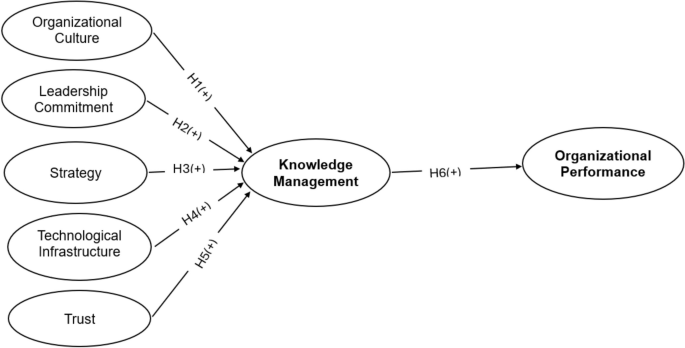
Conceptual model
Methods
This section outlines the methodological framework employed in the study, including the sampling approach, data collection procedures, measurement instruments and data analysis methods.
Sampling and data collection
This study aims to explain how specific organizational elements, both hard and soft, influence KM practices and OP in organizations operating in the Republic of Serbia. The research is designed as a quantitative, cross-sectional study with data collected over the period from June 2024 to March 2025. The target population consisted of 637 employees working in various large and middle-sized organizations. For the purpose of data collection, a non-random sampling approach was applied, relying on personal contacts to reach relevant organizations. Efforts were made to include companies that had already adopted at least fundamental knowledge management (KM) practices. The authors personally administered the survey, which allowed them to clarify any potential ambiguities and address respondents’ questions directly. Prior to distribution, the questionnaire was reviewed by managers from the studied organizations and refined in accordance with their feedback. Although this sampling approach may reduce the generalizability of the results and limit causal inferences, it is suitable when the target population is difficult to access (especially in organizational studies when the access to companies depends on permissions), making random sampling impractical [135].
The initial questionnaire was created based on the questionnaires from similar studies. The first five questions collect demographic information (industry type, firm size, gender, education, and professional experience). The remaining questionnaire items were grouped into seven constructs reflecting key organizational dimensions. Specifically, OC was measured using six items adapted from Gold et al. [55], Wang et al. [152], Islam et al. [74], Lam et al. [86], organizational STG was assessed through three items adopted from Wang et al. [152], Islam et al. [74], TI was captured by four items based on Gold et al. [55], Islam et al. [74], LC was measured using five items derived from Carless et al. [33], Shamim et al. [137], Lam et al. [86], employee TR was operationalized through three items adapted from Carless et al. [33], Park and Lee [115], Shamim et al. [137], KM practices were measured using eight items adopted from Gold et al. [55], Park and Lee [115], Yang et al. [158], and OP was assessed through six items adapted from Darroch [43], Gold et al. [55]. All items were measured using a five-point Likert scale.
The sample mainly consist of male employees (60.7%), with a high school diploma (41.0%), less than five years of work experience (32.4%), indicating a relatively young workforce.
Data analysis techniques
This study used both partial least squares structural equation modeling (PLS-SEM) and fuzzy-set qualitative comparative analysis (fsQCA) to examine the relationships among the variables. The combination of PLS-SEM and fsQCA is adopted to address the complexity of organizational phenomena, which cannot be fully captured using a single methodological approach. Specifically, PLS-SEM represents a symmetric, variance-based method that estimates net effects of independent variables on dependent constructs, assuming linear, additive, and unidirectional relationships [34, 62]. In contrast, fsQCA is an asymmetric, set-theoretic approach that captures causal complexity by identifying multiple combinations of conditions (configurations) that can lead to the same outcome, as well as the possibility that causal relationships differ depending on the presence or absence of conditions [113, 123]. The integration of these two approaches enables a more comprehensive understanding of the relationships under study. While PLS-SEM provides insights into the net effects and statistical significance of individual predictors, fsQCA complements this by uncovering configurational patterns of causality, revealing how different combinations of knowledge management drivers jointly lead to high or low organizational performance. This dual approach is increasingly recommended in organizational and management research, as it allows researchers to capture both theory testing through PLS-SEM and theory elaboration through fsQCA [49, 113, 122, 155].
The PLS-SEM approach was employed to examine the hypothesized relationships among latent constructs. Following the recommendations of Hair et al. [62], the SEM procedure was conducted in two sequential stages. The first stage focused on assessing the measurement model to confirm construct validity and evaluate the model fit. The second stage involved testing the proposed research hypotheses through structural model analysis. To complement the outcomes obtained from PLS-SEM, fsQCA was applied. fsQCA is a set-theoretic method designed to identify combinations of conditions that are sufficient or necessary for a given outcome, allowing multiple causal paths to lead to similar results [123]. Unlike symmetric methods, fsQCA explicitly accounts for equifinality, conjunctural causation, and causal asymmetry, making it particularly suitable for examining complex organizational phenomena such as KM implementation [49, 107]. In this research, the analysis was performed using IBM SPSS Statistics v.24.0 and SmartPLS software (version 4) [130].
Results
Potential common method bias (CMB) was minimized by ensuring respondent anonymity and data confidentiality during the data collection process. For statistical checking, Harman single-factor test was used, and the results have shown that CMB does not pose any significant concern in this research, since a single factor explains 37.21% of the total variance, which is less than 50%, suggested by Fuller et al. [53]. In addition, the full collinearity test was performed, which is according to Kock [81], the most suitable methods for identification of CMB in PLS-SEM. Full collinearity was assessed using the Variance Inflation Factor (VIF). The construct-level VIF values range from 1.466 to 2.899, remaining well below the recommended threshold of 5 [62], indicating that multicollinearity does not threaten the validity of the estimates.
Measurement model assessment
The evaluation of the measurement model involved determining the construct reliability and validity of the measurement instrument. For that purpose, Cronbach's alpha (CA), Composite Reliability (CR), and Average Variance Extracted (AVE) are used, as detailed in Table 1.
According to Table 1, the CA and CR values exceed the recommended threshold of 0.70, as suggested by Hair et al. [61]. The CA values ranged from 0.772 to 0.898, indicating satisfactory internal consistency for all the constructs. Also, the CR ranged from 0.868 to 0.918, providing additional support for the reliability of the constructs. Further, convergent validity is assessed using the Average Variance Extracted (AVE) statistic. As recommended by Fornell and Larcker [51], an AVE value equal to or greater than 0.50 indicates that the items converge to measure the underlying construct, thus establishing convergent validity. In this study, the AVE values for the constructs were higher than 0.5, so convergent validity was also confirmed.
In addition, it is important to confirm the discriminant validity of the model, proving that the conceptual variables are not correlated with the measurement variables of other conceptual variables. According to Henseler et al. [66], the heterotrait–monotrait ratio of correlations (HTMT) is the most suitable method to check discriminant validity. Franke and Sarstedt [52] suggest that the values of the ratio should be 0.90 or lower. In current study, this criterion is met for each pair of constructs, verifying that each construct in the model is discriminant to other constructs (Table 2).
Structural model assessment
The bootstrapping method is used for conceptual model testing, and the findings are displayed in Table 3.
The path coefficients (β) indicating the impact of the independent variables on KM, and further KM on OP, are all positive and statistically significant. Accordingly, the proposed conceptual model is confirmed.
Finally, the evaluation of obtained R2 (the coefficient of determination) and f2 (the effect sizes of the paths) supplements the previous analysis (Table 4).
The R2 value has been calculated to estimate the explained variance of the dependent variables in relation to the total variance. Chin [36] proposed the desired R2 values: 0.190 indicates a weak fit, 0.333 signifies a moderate fit, and 0.670 reflects a strong fit. The findings in Table 4 indicate that the overall model explains 74.3% of the variance in KM. Also, the model explains 53.4% of the variance in variable OP, which means that some other factors (not included in the model) impact KM and OP.
Value f2 is the effect size measure that assess the impact of each independent variable on dependent variable. Cohen [38] set some limit values, suggesting that an f2 value from 0.02 to 0.149 is perceived small, 0.15 to 0.35 is perceived medium, and higher than 0.35 is perceived large. Based on results in Table 4, it can be concluded that the relation between KM and OP has a large effect size (1.148), while a small effect size is noted in the relation between OC, LC, STG, TR on one side and KM on the other. Medium effect was observed between TI and KM.
Fuzzy-set qualitative comparative analysis
To complement the variance-based findings and account for causal complexity, a fuzzy-set qualitative comparative analysis (fsQCA) was conducted. The analysis involved the calibration of variables into fuzzy sets, the examination of necessary conditions, and the identification of sufficient configurational paths leading to the outcome of interest.
In fsQCA, calibration is a critical step that transforms raw data into set-membership scores ranging from 0 (full non-membership) to 1 (full membership), thereby enabling set-theoretic reasoning [123]. Using the direct calibration method, three qualitative anchors were specified for each condition: the threshold for full membership, the crossover point, and the threshold for full non-membership. The crossover point (0.5) indicates maximum ambiguity, where cases are neither more in nor more out of the set, while values approaching 1 or 0 indicate stronger degrees of membership or non-membership, respectively [129].
Consistent with prior research, the calibration thresholds were determined using a percentile-based approach, which is widely recommended in management and social science research [49, 58, 113]. Specifically, the fifth percentile indicates complete non-membership, the 50th percentile marks the crossover point (highest ambiguity), and the 95th percentile indicates full membership. This approach is particularly appropriate for Likert-scale data, as it avoids arbitrary threshold selection and reflects the data's actual distribution. Table 5 presents the percentile-based thresholds used for direct calibration. The calibration reveals heterogeneity across constructs. Most causal conditions (OC, LC, STG, TI, and TR) exhibit high crossover points (6.00) and high full-membership thresholds (6.50–7.00), indicating generally elevated levels of these dimensions in the sample. Namely, KM shows relatively low fifth percentile values (2.25) and a lower crossover point (4.00), indicating substantial dispersion and a comparatively lower level of KM practices. In contrast, OP exhibits higher threshold values (4.17 for full non-membership and 6.33 for the crossover), suggesting that very low performance levels are less prevalent and that high performance is required for full set membership. These differences in calibration anchors further support the presence of asymmetry and justify the use of fsQCA as a complementary analytical approach capable of capturing configurational effects.
Table 6 presents the necessity analysis for high and for low/medium (~ OP) performance. In fsQCA, a condition is typically considered necessary if its consistency exceeds the commonly accepted threshold of 0.90 [123]. The bolded results in Table 6 indicate that KM is a necessary condition for high OP, with a consistency of 0.996, well above the threshold (refer to the bolded values in Table 6). None of the other organizational drivers (culture, leadership, strategy, technology, trust) meet the necessity criterion individually, highlighting that high performance cannot be attributed to any single organizational factor in isolation. For low/medium performance, the absence of KM (~ KM) shows high coverage, reinforcing the critical role of KM in differentiating performance outcomes.
Table 7 shows the configurational solutions associated with high and low/medium OP. Multiple sufficient configurations (S1–S5) lead to high OP, confirming the principle of equifinality. Across all high-performance solutions, KM consistently appears as a core condition, underscoring its central role. Other organizational drivers such as STG, TR, LC, OC, and TI function as either core or peripheral factors in various combinations, suggesting that different organizational approaches can lead to equally high-performance results.
Discussion and conclusions
For some traditional businesses, knowledge has been a reliable source of competitive advantage for hundreds of years. So, it cannot be said that this is a novel idea. However, in modern business, KM has become a key strategic resource that, when shared and applied, enhances organizational performance. Many organizations, especially in developing countries, have problems with the effectiveness of some organizational elements, such as OC and structure, lack of management participation in KM activities, low awareness of the benefits of KM and lack of employee motivation systems, which slows down the KM process, and it is a reason of their poor market position. Accordingly, this study examines the factors identified in prior literature as most relevant to KM success (STG, OC, LC, TI, and TR) and analyzed their direct effects on KM practices.
The statistically significant positive impact of OC on KM obtained in this study confirms H1. This aligns with prior research emphasizing that OC directly enhances KM effectiveness [86, 127] and knowledge-committed culture facilitates efficient knowledge flow among employees [40].
LC has a statistically significant positive impact on KM, confirming H2. Empowering and proactive leaders foster trust, encourage knowledge behaviors, and embed KM practices into daily activities [60]. LC motivates employees to create, share, and apply knowledge while strengthening collective learning [80]. By promoting learning, enabling efficient resources allocations, and acting as role models, leaders enhance KM effectiveness and indirectly improve OP through knowledge-based capabilities and a learning-oriented environment [1, 101].
TI also plays a positive role in enhancing KM, confirming H3. Consistent with prior studies, TI facilitates knowledge sharing, converts tacit knowledge into explicit knowledge, and enables effective storage of knowledge [4, 7]. The developed TI supports innovation, improves product and service quality, and strengthens OP [12, 125, 147], while underdeveloped TI can lower KM effectiveness and performance [136].
The results indicate that STG has a significant positive impact on KM, confirming H4. This aligns with prior research emphasizing that a clear and knowledge-oriented strategy defines how knowledge is created, shared, and applied enabling the achievement of long-term goals of organization (Kilic and Uludag 2021). By integrating KM into the organizational strategy, firms ensure that knowledge practices are aligned with strategic priorities of the company, which enhances innovation and OP [70, 142].
TR also shows a significant positive impact on KM, supporting H5. This result is consistent with previous literature, highlighting that TR encourages knowledge sharing, cooperative problem-solving, and participation in KM activities [159]. When TR is ensured, employees are more committed to a knowledge-based strategy and more willing to contribute to KM initiatives [82, 84]. Moreover, trust indirectly enhances OP by strengthening knowledge-based capabilities and reducing coordination and communication costs [41], demonstrating its critical role as an enabler of effective KM practices.
The results of this study indicate that KM has a significant positive impact on OP, confirming H6. This aligns with prior research demonstrating that effective KM practices enhance the ability of organizations to achieve goals efficiently and improve overall performance [8, 39, 41, 133]. Also, these findings are consistent with the RBV, which highlights knowledge as a key source of competitive advantage and OP [23, 32, 154] and KBV, which emphasizes that effective knowledge creation and application drive OP [56, 151].
The fsQCA results offer valuable insights that add to and enhance the PLS-SEM findings. While PLS-SEM confirms the significance of individual drivers, fsQCA demonstrates that these drivers operate in combination, highlighting the importance of configurational logic and reinforcing the complementarity of symmetric and asymmetric approaches. This configurational insight is consistent with Complexity theory, which views OP as the result of nonlinear interactions and interdependencies among multiple factors rather than isolated effects [27, 96, 120, 128] and Contingency theory, which emphasizes that OP depends on the fit between organizational factors and context, and the possibility of achieving similar OP through different configurations [29, 46, 134, 146].
In that sense, integrating PLS-SEM and fsQCA yields deeper insights into the underlying causal mechanisms. The PLS-SEM analysis identifies OC, LC, STG, TI and TR as significant predictors of knowledge management, while the fsQCA findings reveal that these factors do not operate independently, but rather in combination with other conditions. The fsQCA analysis highlights KM as a necessary condition for achieving high OP, which supports previous research that considers KM a fundamental organizational capability [2, 41, 121]. However, the fsQCA results reveal that KM alone does not guarantee high performance, and it rather must be part of certain organizational configurations to be effective. These findings suggest that regression-based results capture the average effects of individual variables, whereas configurational analysis uncovers how these variables interact in different organizational contexts. In this sense, fsQCA complements PLS-SEM by revealing that the same level of organizational performance can be achieved through multiple alternative pathways, thereby providing a more nuanced and context-sensitive understanding of KM-driven performance. In this sense, there are six configurations for successful KM implementation in Serbian companies, that results in high OP.
S1 configuration is based on STG and TR that jointly shape how knowledge is created, shared, and applied. KM operates as an execution mechanism through which strategic objectives are realized, while TR facilitates open knowledge exchange without the need for strong cultural or leadership formalization. High OP are achieved since KM effectively converts strategic intent into coordinated organizational action.
S2 configuration reflects situation where LC and STG strongly determine the structure and application of KM practices. Knowledge processes are formalized and often technology-supported, while coordination of KM processes relies primarily on managerial authority rather than established trust. In this strategy, KM acts as a controlled and strategically aligned mechanism through which leaders implement organizational goals and achieve high OP.
S3 configuration is characterized by KM primarily related on a strong OC and high level of TR. Knowledge is generated and shared through informal routines and social interactions, while formal STG have a limited role. KM functions as a socially embedded mechanism that supports performance by fostering continuous learning and collaboration supported by TI.
S4 configuration highlights a strategic orientation in which KM is strongly institutionalized. LC, OC, and TR collectively create an environment in which knowledge is consistently shared and applied, even in the absence of explicit strategic formalization.
S5 configuration represents a highly integrated configuration in which OC, LC, and STG jointly shape KM practices, while TI enhances their efficiency. KM functions as the central integrative mechanism linking formal and informal organizational factors, enabling sustainable high OP in complex, dynamic and competitive environments.
S6 configuration emphasizes the dominance of social and leadership drivers in shaping KM practices. LC, OC, and TR jointly create a relational context in which knowledge is willingly shared and applied, while formal systems and TI play a supportive role. KM operates as a relational mechanism that connects people and facilitates performance outcomes.
It is important to note that TI appears as a supportive factor in four out of six configurations, indicating that its role in KM is primarily enabling rather than dominant. This finding is consistent with STS theory, which emphasizes that technology contributes to OP only when aligned with social factors such as trust commitment, leadership and collaboration [35, 91, 116] and KMC theory, highlighting that TI enhances KM outcomes only in interaction with broader organizational capabilities [65, 89, 110]. Also, the finding that OC, LC, and TR appear as core conditions in four out of six configurations highlights their central role in shaping effective KM practices. This can be explained by the DCs perspective, which emphasizes that the ability to adapt and reconfigure resources relies on internally embedded processes and managerial actions, particularly those related to leadership and organizational context [59, 100, 144]. Furthermore, OLT suggests that knowledge development and application are driven by experience-based processes supported by a learning-oriented culture, leadership commitment, and trust, reinforcing their importance for sustained performance [10, 19, 73].
Theoretical implications
This study contributes to the theoretical understanding of KM in transition economies, since empirical research on this topic remains scarce. In particular, the study addresses a notable gap in the literature by combining PLS-SEM and the fsQCA approach that has not yet been systematically applied to examine the interplay between KM drivers and OP in transitional contexts. By integrating both PLS-SEM and fsQCA, it demonstrates the value of combining symmetrical and asymmetrical analytical approaches to capture the complex and multifaceted relationships between organizational factors, KM practices, and OP. The findings highlight that KM is not driven by single factor in isolation but emerges from the interplay of multiple organizational, strategic, and technological conditions. Moreover, by grounding the analysis in an integrated theoretical framework that combines the RBV, KBV, DCs, KMC, STS theory, Contingency theory, and Complexity theory, this study advances KM literature by bridging variance-based and configurational perspectives, offering a more holistic explanation of how KM contributes to performance. In doing so, it responds to recent calls for multi-theoretical approaches and extends existing KM theories by demonstrating that knowledge-driven outcomes are context-dependent and configuration-specific rather than universally determined. Consequently, this approach extends the findings not only by enhancing existing KM theories but also by establishing a methodological framework for future research examining complex organizational processes in transitional and emerging economies.
Practical implications
The findings indicate that managers in Serbian organizations (but also in other transition economies) should treat KM as a strategic priority and integrate it with STG, OC, LC, TI, and TR to achieve high OP. Managers can enhance KM effectiveness by clearly communicating KM goals, fostering a supportive OC, promoting TR through team-building activities, implementing recognition and reward systems for knowledge-sharing behaviors, and leveraging technology not only as a technical infrastructure but also as an enabler of collaboration, learning, and knowledge exchange.
The fsQCA findings further suggest that managers should view KM as a central mechanism for achieving high OP whose effectiveness depends on how well it is shaped by complementary organizational drivers rather than as a standalone practice. High OP can be achieved through different KM-driven configurations, meaning that firms should avoid one-size-fits-all solutions and instead align KM practices with their dominant organizational drivers, depending on their organizational context and resource constraints. This implies that managers should first assess their internal organizational strengths (e.g., strong leadership, cohesive culture, or advanced technological systems) and then design KM practices that reinforce these strengths rather than attempting to uniformly implement standardized KM models.
Adopting a configuration-based approach to KM allows managers to translate existing organizational strengths into sustainable OP, especially in transition economies, like Serbia, where firms often face challenges related to institutional uncertainty, limited financial resources, and uneven technological development. In such contexts, flexibility in KM design becomes a key managerial competence, as different combinations of OC, LC, STG, TI, and TR can lead to equal OP. Implementation of effective KM practices, therefore, requires a gradual shift from traditional bureaucratic structures toward more collaborative, knowledge-oriented organizational models. In environments dominated by hierarchical or autocratic leadership styles, employees may be less willing to share knowledge, which can significantly reduce innovation capacity and weaken OP. Strengthening participative leadership and trust-based relationships becomes essential for unlocking employees’ knowledge potential. This study demonstrates that in Serbian firms, STG, OC, LC, TI, and TR jointly align with KM practices, creating the conditions for sustainable competitive advantage. Importantly, each of these factors plays a critical role, and neglecting any single element can undermine KM effectiveness, reinforcing the need for balanced and integrated managerial attention across all organizational drivers.
Limitations and future research directions
Despite its contributions, this study has several limitations that should be considered when interpreting the findings. First, the use of a non-random sampling approach based on personal contacts may limit the generalizability of the results beyond the analyzed sample. Although appropriate for organizational research, future studies should employ probability-based sampling techniques to enhance external validity. Second, the study focuses exclusively on medium and large organizations, excluding small firms. Given that small and medium-sized enterprises (SMEs) represent a significant segment of transition economies such as Serbia, future research should include these organizations to provide a more comprehensive understanding of KM practices across different organizational contexts. Third, the cross-sectional research design restricts the ability to draw causal conclusions or observe changes over time. Longitudinal studies are, therefore, recommended to better capture the dynamic nature of KM processes and their impact on organizational performance. Additionally, the study relies on self-reported data, which may be subject to common method bias and subjective perceptions, despite the applied statistical controls. Future research could address this limitation by incorporating objective performance indicators or collecting data from multiple sources. Finally, although this study integrates PLS-SEM and fsQCA, offering both symmetric and configurational insights, it is limited to a single-country context. Future studies could extend this approach through cross-country or comparative analyses, particularly among transition and emerging economies, to validate the robustness and generalizability of the identified configurations.
Building on these limitations, future research could further explore additional organizational and environmental factors influencing KM, such as innovation capability, digital transformation, or institutional support. Moreover, the use of mixed-method approaches, combining quantitative and qualitative data, could provide deeper insights into the mechanisms through which KM contributes to organizational performance.
Data availability
All data supporting the findings of this study are available in the paper and its Supplementary Information. Data samples are provided in the Supplementary file.
References
Abbas J, Zhang Q, Hussain I, Akram S, Afaq A, Shad MA (2020) Sustainable innovation in small medium enterprises: the impact of knowledge management on organizational innovation through a mediation analysis by using SEM approach. Sustainability 12(6):2407. https://doi.org/10.3390/su12062407
Abou-Moghli A (2025) The interplay between knowledge management and organizational performance measurement through the mediating effect of innovation capability. Knowl Perform Manag 9(1):45–61. https://doi.org/10.21511/kpm.09(1).2025.04
Abu-AlSondos IA (2023) An empirical study of critical success factors in implementing knowledge management systems (KMS): The moderating role of culture. Uncertain Supply Chain Manag. https://doi.org/10.5267/j.uscm.2023.7.016
Abubakar AM, Elrehailb H, Alatailatc MA, Elc A (2019) Knowledge management, decision-making style and organizational performance. J Innov Knowl 4:104–114. https://doi.org/10.1016/j.jik.2017.07.003
Adaba GB, Kebebew Y (2018) Improving a health information system for real-time data entries: an action research project using socio-technical systems theory. Inform Health Soc Care 43(2):159–171. https://doi.org/10.1080/17538157.2017.1290638
Adamides E, Karacapilidis N (2020) Information technology for supporting the development and maintenance of open innovation capabilities. J Innov Knowl 5(1):29–38. https://doi.org/10.1016/j.jik.2018.07.001
Akram MS, Goraya MAS, Malik A, Aljarallah AM (2018) Organizational performance and sustainability: exploring the roles of IT capabilities and knowledge management capabilities. Sustainability 10(10):3816. https://doi.org/10.3390/su10103816
Al Ahbabi SA, Singh SK, Balasubramanian S, Gaur SS (2019) Employee perception of impact of knowledge management processes on public sector performance. J Knowl Manag 23(2):347–369. https://doi.org/10.1108/JKM-06-2022-0461
Alaarj S, Abidin-Mohamed Z, Bustamam USBA (2016) Mediating role of trust on the effects of knowledge management capabilities on organizational performance. Procedia Soc Behav Sci 235:729–738. https://doi.org/10.1016/j.sbspro.2016.11.074
Alagaraja M, Herd AM (2022) Understanding multi-level learning in organizations: a comparison of lean and the learning organization. Perform Improv Q 34(4):521–546. https://doi.org/10.1002/piq.21364
Aldulaimi S (2015) Exploring the effect of organizational culture, leadership and strategy on organizational effectiveness with mediating effect of knowledge management. Int J Econ Commer Manag 3(4):121–132
AlMulhim AF (2023) The impact of administrative management and information technology on e-government success: the mediating role of knowledge management practices. Cogent Bus Manag. https://doi.org/10.1080/23311975.2023.2202030
Alpenberg J, Scarbrough DP (2021) Practice theory in a collaborative context. J Bus Res 123:415–422. https://doi.org/10.1016/j.jbusres.2020.09.046
Alshukri T, Seun Ojekemi O, Öz T, Alzubi A (2024) The interplay of corporate social responsibility, innovation capability, organizational learning, and sustainable value creation: does stakeholder engagement matter? Sustainability 16(13):5511. https://doi.org/10.3390/su16135511
Al-Swidi AK, Gelaidan HM, Saleh RM (2021) The joint impact of green human resource management, leadership and organizational culture on employees’ green behaviour and organisational environmental performance. J Clean Prod 316:128112. https://doi.org/10.1016/j.jclepro.2021.128112
Alvarez SA, Busenitz LW (2001) The entrepreneurship of resource-based theory. J Manag 27(6):755–775. https://doi.org/10.1177/014920630102700609
Anand A, Brix J (2022) The learning organization and organizational learning in the public sector: a review and research agenda. Learn Organ 29(2):129–156. https://doi.org/10.1108/TLO-05-2021-0061
Appelbaum SH (1997) Socio‐technical systems theory: an intervention strategy for organizational development. Manag Decis 35(6):452–463. https://doi.org/10.1108/00251749710173823
Argote L, Miron-Spektor E (2011) Organizational learning: from experience to knowledge. Organ Sci 22(5):1123–1137. https://doi.org/10.1287/orsc.1100.0621
Aviv I, Hadar I, Levy M (2021) Knowledge management infrastructure framework for enhancing knowledge-intensive business processes. Sustainability 13:11387. https://doi.org/10.3390/su132011387
Azeem M, Ahmed M, Haider S, Sajjad M (2021) Expanding competitive advantage through organizational culture, knowledge sharing and organizational innovation. Technol Soc. https://doi.org/10.1016/j.techsoc.2021.101635
Baía EP, Ferreira JJ (2024) Dynamic capabilities and performance: how has the relationship been assessed? J Manag Organ 30(1):188–217. https://doi.org/10.1017/jmo.2019.88
Barney J (1991) Firm resources and sustained competitive advantage. J Manag 17(1):99–120
Barney JB (1986) Organizational culture: can it be a source of sustained competitive advantage? Acad Manag Rev 11(3):656–665. https://doi.org/10.5465/amr.1986.4306261
Battisti M, Beynon M, Pickernell D, Deakins D (2019) Surviving or thriving: the role of learning for the resilient performance of small firms. J Bus Res 100:38–50. https://doi.org/10.1016/j.jbusres.2019.03.006
Baxter G, Sommerville I (2011) Socio-technical systems: from design methods to systems engineering. Interact Comput 23(1):4–17. https://doi.org/10.1016/j.intcom.2010.07.003
Berger ES, Kuckertz A (2016) The challenge of dealing with complexity in entrepreneurship, innovation and technology research: an introduction. In: Complexity in entrepreneurship, innovation and technology research: Applications of emergent and neglected methods. Springer International Publishing, Cham pp 1–9
Bocken N, Geradts T (2020) Barriers and drivers to sustainable business model innovation: organization design and dynamic capabilities. Long Range Plann 53(4):1–23. https://doi.org/10.1016/j.lrp.2019.101950
Bokeno M (2007) Effective (linear) and emergent (nonlinear) mentoring: a practical context for practicing chaos. Dev Learn Organ 21(5):18–20. https://doi.org/10.1108/14777280710779445
Borzillo S, Kaminska-Labbé R (2011) Unravelling the dynamics of knowledge creation in communities of practice though complexity theory lenses. Knowl Manag Res Pract 9(4):353–366. https://doi.org/10.1057/kmrp.2011.13
Cadorin E, Johansson SG, Klofsten M (2017) Future developments for science parks: attracting and developing talent. Ind Higher Educ 31:156–167. https://doi.org/10.1177/0950422217700995
Campbell JM, Park J (2017) Extending the resource-based view: effects of strategic orientation toward community on small business performance. J Retail Consum Serv 34:302–308. https://doi.org/10.1016/j.jretconser.2016.01.013
Carless SA, Wearing AJ, Mann LA (2000) Short measure of transformational leadership. J Bus Psychol 14:389–405
Cepeda-Carrion G, Cegarra-Navarro JG, Cillo V (2019) Tips to use partial least squares structural equation modelling (PLS-SEM) in knowledge management. J Knowl Manag 23(1):67–89. https://doi.org/10.1108/JKM-05-2018-0322
Cherns A (1987) Principles of sociotechnical design revisted. Hum Relat 40(3):153–161. https://doi.org/10.1177/001872678704000303
Chin WW (2009) How to write up and report PLS analyses. In: Handbook of partial least squares: Concepts, methods and applications. Springer, Berlin, pp 655–690. https://doi.org/10.1007/978-3-540-32827-8_29
Citrin AV, Lee RP, McCullough J (2007) Information use and new product outcomes: the contingent role of strategy type. J Prod Innov Manag 24(3):259–273. https://doi.org/10.1111/j.1540-5885.2007.00249.x
Cohen J (2013) Statistical power analysis for the behavioral sciences. Routledge. https://doi.org/10.4324/9780203771587
Corcione SG, Jovanović I (2025) The knowledge management process and its relation to organizational performance: a case study of carnival cruise lines. Serbian J Manag 20(1):223–245. https://doi.org/10.5937/sjm20-51115
Corcione SG, Veličković M, Fedajev A, Puiu S (2026) Determinants of knowledge management and organizational performance: mediation of human capital and organizational learning. Strateg Manag Int J Strateg Manag Decis Support Syst Strateg Manag. https://doi.org/10.5937/StraMan2600009G
Cristache N, Croitoru G, Florea NV (2025) The influence of knowledge management on innovation and organizational performance. J Innov Knowl 10(5):100793. https://doi.org/10.1016/j.jik.2025.100793
Cyfert S, Chwiłkowska-Kubala A, Szumowski W, Miśkiewicz R (2021) The process of developing dynamic capabilities: the conceptualization attempt and the results of empirical studies. PLoS ONE 16(4):e0249724. https://doi.org/10.1371/journal.pone.0249724
Darroch J (2003) Developing a measure of knowledge management behaviors and practices. J Knowl Manag 7(5):41–54
Davis MC, Challenger R, Jayewardene DN, Clegg CW (2014) Advancing socio-technical systems thinking: a call for bravery. Appl Ergon 45(2):171–180. https://doi.org/10.1016/j.apergo.2013.02.009
Donate MJ, de Pablo JDS (2015) The role of knowledge-oriented leadership in knowledge management practices and innovation. J Bus Res 68(2):360–370. https://doi.org/10.1016/j.jbusres.2014.06.022
Drazin R, Van de Ven AH (1985) Alternative forms of fit in contingency theory. Adm Sci Q. https://doi.org/10.2307/2392695
El Sawy OA, Majchrzak A (2004) Critical issues in research on real‐time knowledge management in enterprises. J Knowl Manag 8(4):21–37. https://doi.org/10.1108/13673270410548469
Farzaneh M, Ghasemzadeh P, Nazari JA, Mehralian G (2021) Contributory role of dynamic capabilities in the relationship between organizational learning and innovation performance. Eur J Innov Manag 24(3):655–676. https://doi.org/10.1108/EJIM-12-2019-0355
Fiss PC (2011) Building better causal theories: a fuzzy set approach to typologies in organization research. Acad Manag J 54(2):393–420. https://doi.org/10.5465/amj.2011.60263120
Flinchbaugh C, Valenzuela MA, Li P (2018) Developing employee socio-technical flexibility in a multigenerational workforce. J Manag Organ 24(4):517–532
Fornell C, Larcker DF (1981) Evaluating structural equation models with unobservable variables and measurement error. J Mark Res 18(1):39–50
Franke G, Sarstedt M (2019) Heuristics versus statistics in discriminant validity testing: a comparison of four procedures. Internet Res 29(3):430–447
Fuller CM, Simmering MJ, Atinc G, Atinc Y, Babin BJ (2016) Common methods variance detection in business research. J Bus Res 69(8):3192–3198. https://doi.org/10.1016/j.jbusres.2015.12.008
García-Morales VJ, Ruiz-Moreno A, Llorens-Montes FJ (2007) Effects of technology absorptive capacity and technology proactivity on organizational learning, innovation and performance: an empirical examination. Technol Anal Strateg Manag 19(4):527–558. https://doi.org/10.1080/09537320701403540
Gold AH, Malhotra A, Segars AH (2001) Knowledge management: an organizational capabilities perspective. J Manag Inf Syst 18(1):185–214
Grant RM (1996) Toward a knowledge-based theory of the firm. Strateg Manag J 17(S2):109–122. https://doi.org/10.1002/smj.4250171110
Grant R, Phene A (2022) The knowledge based view and global strategy: past impact and future potential. Glob Strateg J 12(1):3–30. https://doi.org/10.1002/gsj.1399
Greckhamer T, Furnari S, Fiss PC, Aguilera RV (2018) Studying configurations with qualitative comparative analysis: best practices in strategy and organization research. Strateg Organ 16(4):482–495. https://doi.org/10.1177/1476127018786487
Gupta N, Sardana D, Lee R (2024) Dynamic capabilities that matter for business failure versus survival. Ind Mark Manag 116:40–50. https://doi.org/10.1016/j.indmarman.2023.11.004
Gürlek M, Çemberci M (2020) Understanding the relationships among knowledge-oriented leadership, knowledge management capacity, innovation performance and organizational performance: a serial mediation analysis. Kybernetes 49(11):2819–2846. https://doi.org/10.1108/K-09-2019-0632
Hair JF, Anderson RE, Babin BJ, Black WC (2010) Multivariate data analysis: a global perspective, 7th edn. Pearson, Upper Saddle River, NJ
Hair JF, Hult GTM, Ringle CM, Sarstedt M, Danks NP, Ray S (2021) Partial least squares structural equation modeling (PLS-SEM) using R: a workbook. Springer international publishing
Handzic M, Ozlen K, Durmic N (2016) A contingency approach to knowledge management: finding the best fit. Int J Knowl Manag (IJKM) 12(1):31–44. https://doi.org/10.4018/IJKM.2016010103
Hansen MT (1999) The search-transfer problem: the role of weak ties in sharing knowledge across organization subunits. Adm Sci Q 44(1):82–111. https://doi.org/10.2307/2667032
Heider A, Gerken M, van Dinther N, Hülsbeck M (2021) Business model innovation through dynamic capabilities in small and medium enterprises–evidence from the German Mittelstand. J Bus Res 130:635–645. https://doi.org/10.1016/j.jbusres.2020.04.051
Henseler J, Ringle CM, Sarstedt M (2015) A new criterion for assessing discriminant validity in variance-based structural equation modeling. J Acad Mark Sci 43(1):115–135. https://doi.org/10.1007/s11747-014-0403-8
Hock-Doepgen M, Clauss T, Kraus S, Cheng CF (2021) Knowledge management capabilities and organizational risk-taking for business model innovation in SMEs. J Bus Res 130:683–697. https://doi.org/10.1016/j.jbusres.2019.12.001
Hosseini SS, Tekmedash YN, Karami A, Jabarzadeh Y (2019) The impact of knowledge management strategy on service innovation performance in private and public hospitals. Iran J Manag Stud (IJMS) 12(1):1–24. https://doi.org/10.1108/BPMJ-03-2018-0079
Hughes M, Hughes P, Morgan RE, Hodgkinson IR, Lee Y (2021) Strategic entrepreneurship behaviour and the innovation ambidexterity of young technology-based firms in incubators. Int Small Bus J 39(3):202–227. https://doi.org/10.1177/0266242620943776
Hussinki H, Ritala P, Vanhala M, Kianto A (2021) Intellectual capital, knowledge management practices and firm performance. J Intellect Cap 18(4):904–922. https://doi.org/10.1108/JIC-11-2016-0116
Huynh HTN, Nguyen NTT, Vo NNY (2024) The influence of knowledge management, green transformational leadership, green organizational culture on green innovation and sustainable performance: the case of Vietnam. J Open Innov Technol Mark Complex 10(4):100436. https://doi.org/10.1016/j.joitmc.2024.100436
Iqbal A, Latif F, Marimon F, Sahibzada UF, Hussain S (2019) From knowledge management to organizational performance: modelling the mediating role of innovation and intellectual capital in higher education. J Enterp Inf Manag 32(1):36–59. https://doi.org/10.1108/JEIM-04-2018-0083
Iqbal Q, Ahmad NH (2021) Sustainable development: the colors of sustainable leadership in learning organization. Sustain Dev 29(1):108–119. https://doi.org/10.1002/sd.2135
Islam MZ, Jasimuddin SM, Hasan I (2015) Organizational culture, structure, technology infrastructure and knowledge sharing: empirical evidence from MNCs based in Malaysia. Vine 45(1):67–88. https://doi.org/10.1108/VINE-05-2014-0037
Jami Pour M, Asarian M (2019) Strategic orientations, knowledge management (KM) and business performance: an exploratory study in SMEs using clustering analysis. Kybernetes 48(9):1942–1964. https://doi.org/10.1108/K-05-2018-0277
Karadağ H, Şahin F, Karamollaoğlu N, Saunila M (2024) Disentangling the dynamic digital capability, digital transformation, and organizational performance relationships in SMEs: a configurational analysis based on fsQCA. Inf Technol Manag. https://doi.org/10.1007/s10799-024-00437-y
Kaur V (2025) Leveraging design thinking to foster knowledge-based dynamic capabilities. J Bus Res 189:115177. https://doi.org/10.1016/j.jbusres.2024.115177
Kavalić M, Nikolić M, Stanisavljev S, Đorđević D, Pečujlija M, Stojanović ET (2021) Knowledge management and financial performance in transitional economies: the case of Serbian enterprises. Bus Econ Manag (JBEM) 22(6):1436–1455. https://doi.org/10.3846/jbem.2021.15540
Kılıç M, Uludağ O (2021) The effects of transformational leadership on organizational performance: testing the mediating effects of knowledge management. Sustainability 13(14):7981. https://doi.org/10.3390/su13147981
Kimpah J, Ibrahim HI, Rothmann S, Jaaffar AH (2023) Participative decision-making, autonomy, and creative performance: evidence of match-up employee relations between engineers and managers. Serb J Manag 18(2):331–351. https://doi.org/10.5937/sjm18-38188
Kock N (2015) Common method bias in PLS-SEM: A full collinearity assessment approach. Int J e-Collab (IJEC) 11(4):1–10
Koohang A, Paliszkiewicz J, Goluchowski J (2017) The impact of leadership on trust, knowledge management, and organizational performance: a research model. Ind Manag Data Syst 117(3):521–537. https://doi.org/10.1108/IMDS-02-2016-0072
Kudozia R, Kudozia C, Owusu-Donkor D (2023) Knowledge management infrastructure in organisational knowledge management processes—A case of Aquantuo LLC. Open J Bus Manag 11:1248–1270. https://doi.org/10.4236/ojbm.2023.113070
Kuo TH (2013) How expected benefit and trust influence knowledge sharing. Ind Manag Data Syst 113(4):506–522. https://doi.org/10.1108/02635571311322766
Kusa R, Suder M, Duda J, Czakon W, Juárez-Varón D (2024) Does knowledge management mediate the relationship between entrepreneurial orientation and firm performance? J Knowl Manag 28(11):33–61. https://doi.org/10.1108/JKM-07-2023-0608
Lam L, Nguyen P, Le N, Tran K (2021) The relation among organizational culture, knowledge management, and innovation capability: its implication for open innovation. J Open Innov Technol Mark Complex 7(1):66. https://doi.org/10.3390/joitmc7010066
Latifah L, Rahmawati R, Setiawan D, Aryani YA (2020) Business strategy – MSMEs’ performance relationship: innovation and accounting information system as mediators. J Small Bus Enterp Dev 28(1):1–21. https://doi.org/10.1108/jsbed-04-2019-0116
Lee LT, Sukoco BM (2007) The effects of entrepreneurial orientation and knowledge management capability on organizational effectiveness in Taiwan: the moderating role of social capital. Int J Manag 24(3):549
Lei H, Khamkhoutlavong M, Le PB (2021) Fostering exploitative and exploratory innovation through HRM practices and knowledge management capability: the moderating effect of knowledge-centered culture. J Knowl Manag 25(8):1926–1946. https://doi.org/10.1108/JKM-07-2020-0505
Linden AI, Bitencourt C, Muller Neto HF (2019) Contribution of knowing in practice to dynamic capabilities. Learn Organ 26(1):60–77. https://doi.org/10.1108/TLO-04-2018-0058
Liu H, Wei S, Ke W, Wei KK, Hua Z (2016) The configuration between supply chain integration and information technology competency: a resource orchestration perspective. J Oper Manag 44:13–29. https://doi.org/10.1016/j.jom.2016.03.009
Maclean M, Appiah MK, Addo JF (2023) How organizational learning dimensions influence firms’ competitive strategy and performance in a lower-middle-income country: a mediation model. Cogent Bus Manag 10(3):2256073. https://doi.org/10.1080/23311975.2023.2256073
Mansoor T, Hussain S (2024) Impact of knowledge oriented leadership on sustainable service quality of higher education institutes. VINE J Inf Knowl Manag Syst 54(4):705–724. https://doi.org/10.1108/VJIKMS-09-2021-0176
Masa’deh R (2016) The role of knowledge management infrastructure in enhancing job satisfaction at Aqaba five star hotels in Jordan. Commun Netw 8:219–240. https://doi.org/10.4236/cn.2016.84021
Mayer RC, Davis JH, Schoorman FD (1995) An integrative model of organizational trust. Acad Manag Rev 20(3):709–734. https://doi.org/10.5465/amr.1995.9508080335
McMillan E (2003) Complexity, organizations and change. Routledge
Meher JR, Mishra RK (2019) Assessing the influence of knowledge management practices on organizational performance. VINE J Inf Knowl Manag Syst 49(3):440–456. https://doi.org/10.1108/VJIKMS-04-2019-0050
Mitrović Z, Obradović V, Suknović M (2018) Knowledge management in the public sector - the case of Serbian local government. Serb J Manag 13(2):293–309. https://doi.org/10.5937/sjm13-15037
Mohammadi M, Samizadeh M, Pouya S, Arabahmadi R (2023) Examining the mediating effect of knowledge management on the relationship between organizational culture and organizational performance. J Soft Comput Decis Anal 1(1):63–79. https://doi.org/10.31181/jscda1120235
Nayal P, Pandey N, Paul J (2022) Covid-19 pandemic and consumer-employee-organization wellbeing: a dynamic capability theory approach. J Consum Aff 56(1):359–390. https://doi.org/10.1111/joca.12399
Nguyen M, Sharma P (2024) Interactive impact of transformational leadership and organizational innovation on online knowledge sharing: a knowledge management perspective. J Knowl Manag 28(4):1164–1182. https://doi.org/10.1108/JKM-09-2022-0758
Nikabadi MS, Bagheri S, Mohammadi-Hoseini SA (2016) Effects of knowledge management strategy and organizational learning capability on innovation-driven performance in an oil company, knowledge management & E-learning. Int J 8(2):334–355
Nkurunziza G, Ntayi JM, Munene JC, Kaberuka W (2018) Knowledge management, adaptability and business process reengineering performance in microfinance institutions. Knowl Perform Manag 2(1):59
Novak A, Breznik K, Natek S (2020) How leaders can initiate knowledge management in organizations: role of leadership style in building knowledge infrastructure. Hum Syst Man 39(1):37–50. https://doi.org/10.3233/HSM-190596
Ode E, Ayavoo R (2020) The mediating role of knowledge application in the relationship between knowledge management practices and firm innovation. J Innov Knowl 5(3):210–218. https://doi.org/10.1016/j.jik.2019.08.002
Olan F, Liu S, Neaga I, Alkhuraiji A (2016) How knowledge sharing and business process contribute to organizational performance: using the fsQCA approach. J Bus Res 69(11):5222–5227. https://doi.org/10.1016/j.jbusres.2016.04.116
Olan F, Liu S, Neaga I, Chen H, Nakpodia F (2019) How cultural impact on knowledge sharing contributes to organizational performance: using the fsQCA approach. J Bus Res 94:313–319. https://doi.org/10.1016/j.jbusres.2018.02.027
Olya HG, Altinay L (2016) Asymmetric modeling of intention to purchase tourism weather insurance and loyalty. J Bus Res 69(8):2791–2800. https://doi.org/10.1016/j.jbusres.2015.11.015
Oo NCKK, Rakthin S (2025) Knowledge-oriented leadership and organizational resilience in SMEs during a crisis: the mediation role of innovation quality. J Innov Knowl 10(5):100775. https://doi.org/10.1016/j.jik.2025.100775
Ouyang Y, Guo B, Lu X, Han Q, Guo T, Yu Z (2018) CompetitiveBike: competitive analysis and popularity prediction of bike-sharing apps using multi-source data. IEEE Trans Mob Comput 18(8):1760–1773
Pacheco C, Paul B (2025) Applying complexity theory perspective to knowledge management in the innovation context. VINE J Inf Knowl Manag Syst 55(2):421–444. https://doi.org/10.1108/VJIKMS-08-2022-0279
Paliszkiewicz J, Gołuchowski J, Koohang A (2015) Leadership, trust, and knowledge management in relation to organizational performance: developing an instrument. Online J Appl Knowl Manag 3(2):19–35
Pappas IO, Woodside AG (2021) Fuzzy-set qualitative comparative analysis (fsQCA): guidelines for research practice in information systems and marketing. Int J Inf Manag 58:102310. https://doi.org/10.1016/j.ijinfomgt.2021.102310
Pappas IO, Kourouthanassis PE, Giannakos MN, Lekakos G (2017) The interplay of online shopping motivations and experiential factors on personalized e-commerce: a complexity theory approach. Telemat Inform 34(5):730–742. https://doi.org/10.1016/j.tele.2016.08.021
Park JG, Lee J (2014) Knowledge sharing in information systems development projects: explicating the role of dependence and trust. Int J Proj Manag 32(1):153–165. https://doi.org/10.1016/j.ijproman.2013.02.004
Pasmore W, Winby S, Mohrman SA, Vanasse R (2019) Reflections: sociotechnical systems design and organization change. J Change Manag 19(2):67–85. https://doi.org/10.1080/14697017.2018.1553761
Payal R, Ahmed S, Debnath RM (2019) Impact of knowledge management on organizational performance: an application of structural equation modeling. VINE J Inf Knowl Manag Syst 49(4):510–530. https://doi.org/10.1108/VJIKMS-07-2018-0063
Petrov V, Ćelić Đ, Uzelac Z, Drašković Z (2020) Three pillars of knowledge management in SMEs: evidence from Serbia. Int Entrep Manag J 16(2):417–438
Pillai R, Srivastava KB (2024) Smart HRM 4.0 practices for organizational performance: the role of dynamic capabilities. Benchmarking Int J 31(10):3884–3908. https://doi.org/10.1108/BIJ-05-2023-0288
Poutanen P, Soliman W, Ståhle P (2016) The complexity of innovation: an assessment and review of the complexity perspective. Eur J Innov Manag 19(2):189–213. https://doi.org/10.1108/EJIM-03-2014-0036
Qu J, Batool H, Ullah K (2025) A study of the effects of knowledge management on enterprise innovation performance. Emerg Sci J 9(4):2275–2291. https://doi.org/10.28991/ESJ-2025-09-04-030
Radić A, Arsić S, Nikolić Đ, Bobek S, Sternad Zabukovšek S (2026) Factors influencing ERP system usage in manufacturing and service industries: a comparative study using PLS-SEM and fsQCA. Serb J Manag 21(1):15–36. https://doi.org/10.5937/sjm21-59899
Ragin CC (2009) Redesigning social inquiry: fuzzy sets and beyond. University of Chicago press
Ramadan M, Daouk A, Bou Zakhem N, El Fawal A, Ashaal A, Youssef S, Baydoun H, Elia J (2023) Toward digital transformation and business model innovation: the nexus between leadership, organizational agility, and knowledge transfer. Adm Sci. https://doi.org/10.3390/admsci13080185
Rasool SF, Samma M, Mohelska H, Rehman FU (2023) Investigating the nexus between information technology capabilities, knowledge management, and green product innovation: evidence from SME industry. Environ Sci Pollut Res 30:56174–56187
Razzaq S, Shujahat M, Hussain S, Nawaz F, Wang M, Ali M, Tehseen S (2019) Knowledge management, organizational commitment and knowledge-worker performance: the neglected role of knowledge management in the public sector. Bus Process Manag J 25:923–947. https://doi.org/10.1108/BPMJ-03-2018-0079
Rezaei F, Khalilzadeh M, Soleimani P (2021) Factors affecting knowledge management and its effect on organizational performance: mediating the role of human capital. Adv Hum-Comput Interact. https://doi.org/10.1155/2021/8857572
Rickles D, Hawe P, Shiell A (2007) A simple guide to chaos and complexity. J Epidemiol Community Health 61(11):933–937
Rihoux B, Ragin CC (eds) (2009) Configurational comparative methods: qualitative comparative analysis (QCA) and related techniques, vol 51. Sage
Ringle CM, Wende S, Becker JM (2024) SmartPLS 4. Bönningstedt: SmartPLS. https://www.smartpls.com
Roldán JL, Real JC, Sánchez Ceballos S (2018) Antecedents and consequences of knowledge management performance: the role of IT infrastructure. Intang Cap 14:518–535. https://doi.org/10.3926/ic.1074
Rumelt RP (1991) How much does industry matter? Strateg Manag J 12(3):167–185. https://doi.org/10.1002/smj.4250120302
Sahibzada UF, Jianfeng C, Latif KF, Shah SA, Sahibzada HF (2023) Refuelling knowledge management processes towards organisational performance: mediating role of creative organisational learning. Knowl Manag Res Pract 21(1):1–13. https://doi.org/10.1080/14778238.2020.1787802
Schoonhoven CB (1981) Problems with contingency theory: testing assumptions hidden within the language of contingency" theory". Adm Sci Q. https://doi.org/10.2307/2392512
Sekaran U, Bougie R (2016) Research methods for business: a skill building approach. Wiley
Sha X, Chen JE, Teoh SY (2020) The dynamics of IT-business strategic alignment: evidence from healthcare information systems implementation. Inf Technol People 33(5):1465–1488. https://doi.org/10.1108/ITP-08-2019-0414
Shamim S, Cang S, Yu H (2019) Impact of knowledge oriented leadership on knowledge management behaviour through employee work attitudes. Int J Hum Resour Manag 30(16):2387–2417. https://doi.org/10.1080/09585192.2017.1323772
Singh SK, Gupta S, Busso D, Kamboj S (2021) Top management knowledge value, knowledge sharing practices, open innovation and organizational performance. J Bus Res 128:788–798. https://doi.org/10.1016/j.jbusres.2019.04.040
Sirmon DG, Hitt MA, Ireland RD (2007) Managing firm resources in dynamic environments to create value: looking inside the black box. Acad Manag Rev 32(1):273–292. https://doi.org/10.5465/amr.2007.23466005
Slater SF, Hult GTM, Olson EM (2010) Factors influencing the relative importance of marketing strategy creativity and marketing strategy implementation effectiveness. Ind Mark Manag 39(4):551–559. https://doi.org/10.1016/j.indmarman.2008.03.007
Snowden D (2002) Complex acts of knowing: paradox and descriptive self-awareness. J Knowl Manag 6(2):100–111. https://doi.org/10.1108/13673270210424639
Song B, Li Y, Zhao L (2019) Complementary effect of knowledge management strategy on firm performance: evidence from Chinese firms. Sustainability 11(13):3616. https://doi.org/10.3390/su11133616
Taleb TST, Zakaria N, Hashim N (2023) Mediating effect of innovation capability between entrepreneurial resources and micro business performance. Bottom Line 36(1):77–100. https://doi.org/10.1108/bl-07-2022-0112
Teece DJ, Pisano G, Shuen A (1997) Dynamic capabilities and strategic management. Strateg Manag J 18(7):509–533
Thompson JD (2017) Organizations in action: social science bases of administrative theory. Routledge
Tosi HL Jr, Slocum JW Jr (1984) Contingency theory: some suggested directions. J Manag 10(1):9–26. https://doi.org/10.1177/014920638401000103
Valaei N, Nikhashemi SR, Javan N (2017) Organizational factors and process capabilities in a KM strategy: toward a unified theory. J Manag Dev 36(4):560–580. https://doi.org/10.1108/JMD-04-2016-0057
Vargas-Zeledon AA (2023) Knowledge management requirements for information systems in small ventures: a fuzzy-set qualitative comparative analysis (fsQCA). Small Bus Int Rev 7(1):e570. https://doi.org/10.26784/sbir.v7i1.570
Vu HM (2020) A review of dynamic capabilities, innovation capabilities, entrepreneurial capabilities and their consequences. J Asian Finance Econ Bus 7(8):485–494. https://doi.org/10.13106/jafeb.2020.vol7.no8.485
Wang CH (2019) How organizational green culture influences green performance and competitive advantage: the mediating role of green innovation. J Manuf Technol Manag 30(4):666–683. https://doi.org/10.1108/JMTM-09-2018-0314
Wang N, Liang H, Zhong W, Xue Y, Xiao J (2012) Resource structuring or capability building? An empirical study of the business value of information technology. J Manag Inf Syst 29(2):325–367. https://doi.org/10.2753/MIS0742-1222290211
Wang Z, Wang N, Liang H (2014) Knowledge sharing, intellectual capital and firm performance. Manag Decis 52(2):230–258. https://doi.org/10.1108/MD-02-2013-0064
Wee JCN, Chua AYK (2013) The peculiarities of knowledge management processes: The case of Singapore. J Knowl Manag 17(6):958–972. https://doi.org/10.1108/JKM-04-2013-0163
Wernerfelt B (1984) A resource-based view of the firm. Strateg Manag J 5(2):171–180. https://doi.org/10.1002/smj.4250050207
Woodside AG (2013) Moving beyond multiple regression analysis to algorithms: calling for adoption of a paradigm shift from symmetric to asymmetric thinking in data analysis and crafting theory. J Bus Res 66(4):463–472. https://doi.org/10.1016/j.jbusres.2012.12.021
Wu PL, Yeh SS, Woodside AG (2014) Applying complexity theory to deepen service dominant logic: configural analysis of customer experience-and-outcome assessments of professional services for personal transformations. J Bus Res 67(8):1647–1670. https://doi.org/10.1016/j.jbusres.2014.03.012
Xu H, Qiu L, Liu B, Liu B, Wang H, Lin W (2021) Does regional planning policy of Yangtze River Delta improve green technology innovation? Evidence from a quasi-natural experiment in China. Environ Sci Pollut Res 28(44):62321–62337
Yang LR, Chen JH, Wang HW (2012) Assessing impacts of information technology on project success through knowledge management practice. Autom Constr 22:182–191. https://doi.org/10.1016/j.autcon.2011.06.016
Yasir M, Majid A, Yasir M (2017) Nexus of knowledge- management enablers, trust and knowledge-sharing in research universities. J Appl Res High Educ 9(3):424–438. https://doi.org/10.1108/JARHE-10-2016-0068
Yoshikuni AC, Albertin AL (2020) Leveraging firm performance through information technology strategic alignment and knowledge management strategy: an empirical study of IT-Business Value. Int J Res-Granthaalayah 8(10):304–318. https://doi.org/10.29121/granthaalayah.v8.i10.2020.2088
Yu X, Xu S, Ashton M (2023) Antecedents and outcomes of artificial intelligence adoption and application in the workplace: the socio-technical system theory perspective. Inf Technol People 36(1):454–474. https://doi.org/10.1108/ITP-04-2021-0254
Yuan B, Li C, Yin H, Zeng M (2022) Green innovation and China’s CO2 emissions–the moderating effect of institutional quality. J Environ Plan Manag 65(5):877–906. https://doi.org/10.1080/09640568.2021.1915260
Zack MH (1999) Developing a knowledge strategy. Calif Manag Rev 41(3):125–145
Zack M, McKeen J, Singh S (2009) Knowledge management and organizational performance: an exploratory analysis. J Knowl Manag 13(6):392–409. https://doi.org/10.1108/13673270910997088
Zheng W, Yang B, McLean GN (2010) Linking organizational culture, structure, strategy, and organizational effectiveness: mediating role of knowledge management. J Bus Res 63(7):763–771. https://doi.org/10.1016/j.jbusres.2009.06.005
Zulfqar A, Valcke M, Hussain B, Devos G (2022) Analyzing the relationship between transformational leadership and participative decision making with related outcomes at Pakistani higher education. J Educ Soc Stud 3(3):300–310
Funding
The research presented in this paper was supported by the Ministry of Science, Technological Development and Innovation of the Republic of Serbia, within the funding of scientific and research work at the University of Belgrade, Technical Faculty in Bor, according to contract with registration number 451-03-34/2026-03/200131.
Author information
Authors and Affiliations
Contributions
S.G.C., M.V. and A.F wrote the main manuscript text. S.G.C., M.V. and S.A. prepared figures and tables. A.F. analysed the results and reviewed the manuscript.
Corresponding author
Ethics declarations
Ethical approval and consent to participate
The Ethics Committee approved, mentioning that no personal data were collected, the survey being anonymous.
Consent for publication
Publication consent was obtained from all authors and participants.
Competing interests
The authors declare no competing interests.
Additional information
Publisher's Note
Springer Nature remains neutral with regard to jurisdictional claims in published maps and institutional affiliations.
Supplementary Information
Rights and permissions
Open Access This article is licensed under a Creative Commons Attribution 4.0 International License, which permits use, sharing, adaptation, distribution and reproduction in any medium or format, as long as you give appropriate credit to the original author(s) and the source, provide a link to the Creative Commons licence, and indicate if changes were made. The images or other third party material in this article are included in the article's Creative Commons licence, unless indicated otherwise in a credit line to the material. If material is not included in the article's Creative Commons licence and your intended use is not permitted by statutory regulation or exceeds the permitted use, you will need to obtain permission directly from the copyright holder. To view a copy of this licence, visit http://creativecommons.org/licenses/by/4.0/.
About this article
Cite this article
Golubović Corcione, S., Veličković, M., Fedajev, A. et al. Knowledge management drivers and organizational performance: a PLS-SEM and fsQCA approach. Futur Bus J 12, 220 (2026). https://doi.org/10.1186/s43093-026-00922-6
Received:
Accepted:
Published:
Version of record:
DOI: https://doi.org/10.1186/s43093-026-00922-6