

Abstract
In the context of researching public space in non-Western contexts, the paper seeks to explore an analytical framework that examines public space within contextual embeddedness. The framework combines a space–order publicness model and a typology approach. It is then empirically tested using public-space cases in Shanghai, drawing on data from observation and desktop research. By interpreting these cases with a new typology of public space comprising symbolic public space, entrepreneurial public space, community public space, and spontaneous public space, I argue that to examine public spaces as embedded in their unique contextual complexities, it is important to see publicness as a layered quality and public spaces on the ground as comprising varying compositions of different ideal public spaces (rather than public space ideals). This research contributes to existing scholarship by de-Westernizing publicness and offering an alternative perspective for interpreting public spaces in a non-Western urban context.
Introduction
In the burgeoning public space research in non-Western contexts, there is an ever-present thread of debates around to what extent public spaces in these contexts can be seen as unique/different and to what extent they are truly public spaces, with the latter predominantly, and perhaps unsurprisingly, judged against Western values and norms for (inquiries into) public space. Take the case of Chinese public spaces as an example. On the one hand, commentators such as Hassenpflug (2010) reject the use of ‘public space’ in the Chinese urban context, arguing that it is better called ‘open space’ because it only ‘fills the expanse between meaningful spaces with nothingness’ (p. 27) without embodying Western societal and democratic norms. On the other hand, others advocate for a more grounded and situated approach to understanding what constitutes public space in China. For example, Kiang (2008) notes that, historically, alternative urban elements rather than the Western public square played important roles as centers for public activities in China. Gaubatz (2008, 2021) also highlights various public spaces rooted in the unique urban development process in China, with examples of which covering a continuum of spaces from those formally designed to those ephemeral and/or left in-between. While drawing attention to the uniqueness of these spaces, she also argues that ‘a wide range of spaces in [Chinese] cities is used in a manner consistent with “public space” elsewhere in the world' (Gaubatz 2021, p. 1241). Such debates are not unique to studying public space in the Chinese context. For instance, Radović (2020) discusses how the Japanese language has no words to express ‘public’ in the conventional Western sense, arguing that even though various shared spaces in the Japanese context are not public spaces in the Western sense, they nevertheless have their own cultural and social significance. Other observers like Davidson (2013) instead focus on rationalizing the importance of turning to a specific micro context for studying public space, in this case, the Japanese residential suburbs, rather than contesting the concept of public space itself.
My interest in these discussions lies not so much with the question of whether there is public space in a certain context as with whether public spaces can be studied both locally and potentially in parallel across contexts. Approaches to researching public space can be broadly categorized into two directions. One is more prescriptive or normative, seeing public space as necessarily defined by a range of (often Western-centric) values such as public stewardship, inclusiveness, and accessibility. The other is more interpretivist and socially constructed, seeing public space as an inherently context-specific phenomenon subject to 'locally constituted interpretations of public vs. private space and the different roles/hierarchies of these spaces according to local politics, culture, customs, and traditions' (Luger and Lees 2020, p. 73). The present paper, using these contrasting understandings of public space and publicness as a starting point, asks: How can public spaces be studied as embedded in the particular socio-economic and cultural dynamics that produce them? Here, I adopt a broad and pragmatic approach to defining public space and consider all the spaces outside private households irrespective of their formal legal ownership status. While the cases discussed in the paper are all outdoor open spaces, my work does not exclude indoor spaces in principle.
Following a brief review of literature on public space and publicness in the next section, the third section of the paper proposes a conceptual approach that combines a novel space–order publicness model with a new public space typology to explore a contextual interpretation of public space. The paper then adopts the approach empirically to interpret selected public spaces in Shanghai by presenting a series of space vignettes (Sect. “Interpreting public spaces in Shanghai with the publicness–typology approach”). My overarching argument in this paper is that to read public spaces locally, a non-normative understanding of publicness is first necessary, where publicness is seen as a layered quality and a particular state of space rather than a quantifiable value. At the same time, a typology approach would be useful for interpreting public spaces as differing qualitatively, comprising varying compositions of different ideal types of public spaces that are rooted in a particular urban context (Sect. “Discussion”).
Public space: Ideals and complexities
Challenging the normative public space and publicness
In a way, the scholarly interests in public space began ‘only when its possible physical “disappearance” became an issue’ (Nadal 2000, p. 30). Consequently, much scholarship on public space has sought to describe and prescribe the ‘universal, absolute and immutable values to which any public space should aspire’ (De Magalhães and Sieh 2024, p. 33). Such understandings of the ideal public space are often captured by ‘publicness’, where much existing literature has approached publicness as comprising multiple dimensions of the ideal public space (Li et al. 2022). Various publicness models have collectively highlighted similar normative values such as public ownership and management, accessibility and inclusiveness in terms of use, co-existence and free expression, and intersubjectivity and civility (Benn and Gaus 1983; Altman and Zube 1989; Carr et al. 1992; Madanipour 2003; Kohn 2004; Orum et al. 2009; Varna and Tiesdell 2010; Németh and Schmidt 2011; Langstraat and van Melik 2013; Varna 2016; Bjerkeset and Aspen 2020), many of which also have implications on the spatial justice of public space (Jian et al. 2020). Beyond the spatial design and planning discipline, publicness is also prominently embedded in studies of the public sphere and social media (Karaçor and Ögçe, 2023b). In addition to untangling the dimensions of publicness, emerging studies also discuss the interconnected impacts of publicness, such as effectiveness, fairness, sense of ease, meaningfulness, and friendliness (Zeng et al. 2025).
Increasingly, however, these normative pillars of publicness have been contested, not least because each one of these ideals needs to be interrogated further in specific contemporary contexts. First, questioning the assertion that public space is necessarily underpinned by public ownership, commentators have pointed out the bias against multiple modes of public–private governance (Langstraat and van Melik 2013). Empirical studies have suggested that the transfers of management responsibilities away from the public authority ‘do not per se compromise the access and use attributes of publicness’ (De Magalhães and Freire Trigo 2017, p. 754), and that the actual space use and quality are not solely determined by ownership status (Ho et al. 2020; Karaçor and Ögçe, 2023a). Similarly, understanding publicness through accessibility and inclusion could be problematic as the idea of a universal and ideal public made of all social members has been profoundly challenged in the face of the fragmentation of society, and to whom public space should be open and accessible becomes increasingly contested (Neal 2010). Romanticizing public space as universally accessible might even produce ‘false publics’ that mask structural oppressions (Struch 2022). Therefore, it is important to 'recognize the subjective, situated viewpoints from which users of these spaces operate' (Németh and Schmidt 2011, p. 9). Last but not least, it is questionable whether these normative values can be simply quantified and aggregated (Zhang and He 2019, p. 756) when such methods of investigation are very prevalent.
Public space from elsewhere
Many aforementioned complications with public space and publicness can be attributed to the ‘context’, the different circumstances of public space being designed, built, and used over time in a given location and across different cultures. This leads to the argument that in studying public spaces comparatively, it is important to go beyond seeking a universal definition of public space and turn to ‘notions that cover the broad spectrum of public space manifestations globally’ (Mady 2026, p. 377). Research on public spaces in non-Western contexts has gained traction over the past decades alongside critiques of the West-centric normative perspectives. Arguably, however, although shaped by their distinctive economic, social, and cultural contexts, public spaces in non-Western cities do not differ from those in the West ontologically (Qian 2014). For example, across different Western and non-Western contexts, public space expanding in quantity but withering in publicness due to privatization and commercialization has been widely noted (Cybriwsky 1999; Yang 2007; Miao 2011; Flock and Breitung 2016; Wang and Chen 2021).
Despite such similarities, non-Western public spaces face their unique complexities and challenges. For instance, public spaces in East Asian cities are notably characterized by the dominance of the social-political elites’ agenda and preferences (Qian 2019) and the interplay between state power and bottom-up practices (Qian 2018). On the one hand, many have discussed how, in many non-Western contexts, public spaces are so produced as to serve the dominant political ideology and facilitate the engineering of social norms, values, and identities (Hee and Ooi 2003; Qian 2014). Ideal public spaces, ‘conceived and planned for a model citizen’ (Ho 2024, p. 258), are used for staging spectacles of success, and in this process, excluding the poor and the marginalized (Flock 2024). In addition, the often pro-development state powers in these contexts often work with market powers to produce marketized and commodified public spaces that manifest a mix of state-making, global aspirations, the dominance of corporate power, and spatial injustice (Miao 2001; Kiang and Liang 2009; Pomeroy 2011; Chan 2023; Jiang and Nakajima 2023; Jiang et al. 2025). On the other hand, many non-Western contexts also feature a historically blurred boundary between the public and private, as has been widely observed in cases such as the appropriation of streets and sidewalks (Drummond 2000; Miao 2001; Thomas 2002; Kim 2012; Oranratmanee and Sachakul 2014; Piazzoni and Jamme 2020). For example, in the Chinese context, some commentators turn to collective space/realm to examine the locally unique connotations of public and state–society relations (Jacoby 2020; Sun 2023). These manifest a ‘messiness’ quality found in many Asian cities (Chalana and Hou 2016), where the root of messiness lies in ‘individuals and even institutions acting on their diverse and sometimes confusing interests and agendas’ (ibid., p. 241). As a representation of such messiness, spatial characteristics of spaces are in constant flux, with relationships among different users evolving (Cao 2026). This gives rise, simultaneously, to conflicts between users, the ambiguous yet constant negotiation of top-down governance and bottom-up resistance, and new opportunities for social interactions and spatial interventions (Xiao and Qu 2022; Zhang et al., 2023; Flock and Breitung 2016; Hou 2021; Kim 2012; Oranratmanee and Sachakul 2014). This brief review is not exhaustive and does not attempt to cover all non-Western contexts equally. The purpose is to demonstrate the variety of complexities that considerations of context can bring.
Contextual reading of public space: A publicness–typology approach
To summarize, there is abundant literature on public space and publicness focusing on delineating the essential qualities for a true and/or good public space and on empirically evaluating spaces against these normative values. While important and helpful, research along this line does not adequately address the question of context, where ideas for good public space may be different, and publicness should be examined with more contextual embeddedness. Given the endless contextual complexities, how can public spaces be interpreted, potentially across different contexts, without being subject to a set of seemingly universally applicable normative values? Here, I propose an exploratory approach that combines a non-normative publicness model and a typology approach. The former establishes a framework that facilitates parallel discussions across contexts without imposing normative criteria, and the latter enables the consideration of key local forces and dynamics that shape public spaces.
A space–order publicness model
Elsewhere, I have elaborated on building a non-normative heuristic publicness model as an interpretative framework to understand how public space is shaped and maintained (Zhu, 2025a). To reiterate the key ideas behind the proposed model, to begin with, my approach to publicness is seeing it as a particular ‘public’ state of space. Taking into account the different aspirations and actions of varying actors involved in making public space, this public status or publicness is not normative or prescriptive but rather descriptive, echoing Tornaghi's (2015, p. 25) definition of publicness as 'a (varying and relational) way of being “space”'. Second, despite Németh's (2012, p. 814) argument that 'any model of publicness must account for both the material and the conceptual realms’, many of the prior discussions of publicness conflate the two, contributing to much confusion when it comes to describing the physical quality of space and its social meanings. For this reason, I distinguish between the material space and the non-material space in the heuristic publicness model. In Low’s (1996, 2000, 2017) terminology, the two aspects are respectively the social production of space and the social construction of space. The former encompasses all the processes that lead to the creation of the material setting, whereas the latter examines how space transforms and acquires meanings through social interaction, embodied experience, language and discourse, and so on (1996, 2017). While the material and the non-material are co-constructive and cannot be neatly separated, it is useful to distinguish the two analytically so as to distinguish the different ways space might be made public. Third, in discussing publicness, the unavoidable normative question concerns who/whom—who makes space public and for whom space is public. While these questions are crucial in conceptualizing the publicness model, I want to capture the relational and interpretivist quality of public and to turn away from the normative judgment of space as a product being good or otherwise to the interrogation of the process. I therefore focus on the order that shapes space, or rather the ordering process, and draw on the arranged order and polycentric order discussed by Hayek (1964, 1979), introduced by various scholars to discuss planning theories and practices in relation to complexity, spontaneity, and self-coordination (Cozzolino 2018, 2022; Moroni et al. 2020). Both the production and construction of public space comprise a continuum from arranged order—created by ‘the ordering activity of an ordering mind’ (Hayek 1979, p. 504)—at one end and polycentric order—‘result[ing] from the action of individuals without their intending to create such an order’ (ibid., p. 506)—at the other. The publicness model thus built does not dictate predetermined norms or ideals of good public space, nor does it evaluate the degree of publicness quantitatively. It instead interprets the different ways of space being produced and constructed as public through the work of different forms of order.
A typology approach based on ideal type
Previously, I have drawn on this publicness model to interpret different layers of publicness of public spaces in two urban projects/initiatives (Zhu 2025a, 2025b). In the present paper, I explore whether the model has wider applicability in interpreting a larger number of cases in a given context while accounting for important contextual factors. I choose to introduce a typology approach into the publicness model because it is useful for reducing a large number of individual cases into a smaller and more analyzable number of items without losing the information provided by the original cases (Franck and Huang 2020). There have been many different attempts at classifying or producing different typologies for public spaces, one of the most common approaches being classification by morphology and function, as exemplified by the work of Carr et al. (1992) and Carmona and Wunderlich (2012). Less widely adopted approaches include those based on macro and micro socio-economic processes, property rights, social relations, and activities (Burgers 2000; Tonkiss 2005; Dines and Cattell 2006; Chiodelli and Moroni 2014; Bjerkeset and Aspen 2020; Schroeder and Bisbal Grandal 2025). For example, Burgers (2000, p. 16) identifies erected space, displayed space, exalted space, colored space, and marginal space as urban public spaces shaped by ‘important changes that have affected society’. Tonkiss (2005), focusing on the different interpersonal relationships in public, distinguishes between ‘the city square’, ‘the cafe’, and ‘the street’. In the present research, my approach is inspired by Weber’s ideal type, which is ‘obtained by means of a one-sided accentuation of one or a number of viewpoints and through the synthesis of a great many diffuse and discrete individual phenomena … into an internally consistent mental image’ (Weber 2012, p. 125). Here, ideal means a mental construct rather than being good or desirable. My rationale for following this ‘accentuation’ approach is that by highlighting distinct local factors in building a conceptual, simplified public space typology, the actual and diverse cases can be interpreted to identify their similarities and differences. The public space typology presented here is abstracted from characteristics and elements of many different public spaces, but the typology is not meant to comprehensively represent all the characteristics of any particular case.
Contextualizing a public space typology in China
While the space–order publicness model provides a framework for discerning the processes and mechanisms behind public space that can potentially be applied in different contexts, the typology approach helps ground it in a particular context. In the present paper, I tentatively apply the publicness–typology approach to the Chinese context and propose a public space typology in China as an interpretive framework. Here, I mainly considered three notable features of Chinese urban development as a backdrop for public space production and construction. First, collectivism has featured heavily in Chinese culture and society and partly produced the prevalence of enclosed urbanism, features of which include the prevalence of walls and various gating practices (Huang 2006; Douglass et al. 2012). Second, and to greatly simplify a complex story, after the establishment of the market economy and the ensuing land reform, power decentralization, and tax-sharing mechanisms, local governments have great incentives to pursue local land and property development in coalition with the private sector (Logan 2002; Wu and Gaubatz 2013; Huang and Chan 2018), which has profoundly transformed the country’s urban landscape. Third, the power of urban planning can be simultaneously strong and ambiguous. While the regulating power of the seemingly strictly top-down and rigid statutory planning system is often compromised when local governments are eager to follow the developers’ lead in urgent regeneration projects (Chen 2016), increasingly more ‘top-combined-with-bottom’ planning experiments are being conducted to tackle new urban development and regeneration challenges.
Based on these key contextual considerations in Chinese urbanism, I map four ideal types of public spaces against different forms of orders in the material and non-material formation of space (Fig. 1).
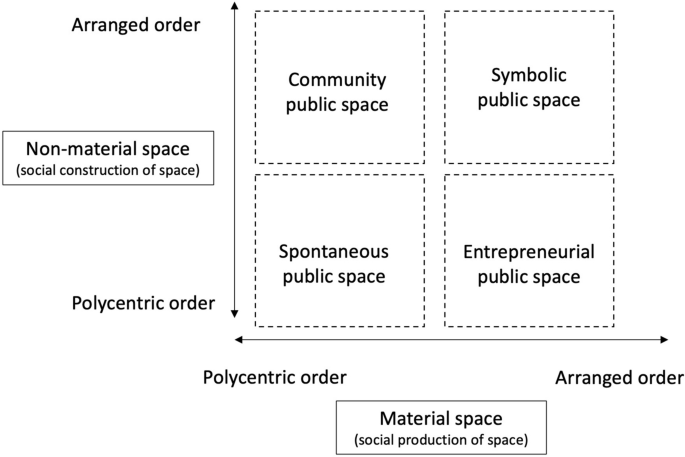
The order–space publicness model and a typology of Chinese public spaces, Source: author
Symbolic public spaces
Public spaces can be intentionally designed or appropriated to express particular meanings, values, and ideals, and, as such, they manifest arranged order in both material production and non-material construction. These spaces, for example, through specularization (Flock 2024), can reflect images staged by dominant socio-economical, cultural, and political forces. Or they may become sites of overt resistance where people reinterpret or subvert the intended space program and create their counter-narrative. Ultimately, the symbolism of public spaces depends on 'who is the agent in charge of this selection and description and the methods of narration and representation' (Madanipour 2013, p. 57).
Entrepreneurial public spaces
Though often contested, public spaces can be shaped by market-oriented logics ranging from street vending to state-backed entrepreneurialism characterized by the ‘dense web of interconnections between governments, state-led enterprises and private businesses’ (Xie et al. 2020, p. 5). Beyond spaces for micro-livelihood and macro-economic growth, consumption-oriented entrepreneurial public spaces provide ‘an environment that people can relate to emotionally and make a part of their lifestyles’ (Muratovski 2012, p. 197) as consuming a certain spatial atmosphere serves similar purposes as consuming products to help customers to construct their identities (Henningsen 2012). While the materiality of entrepreneurial public spaces inevitably serves profit-seeking, the meanings of these spaces may be variously shaped by those who produce or use them. As such, entrepreneurial public spaces are usually created through arranged order through intentional processes, but compared to symbolic public spaces, their meanings are subject to less collective definition and more polycentric order.
Community public spaces
These are public spaces embodying collective culture and values but taking diverse physical forms shaped by different historical and social contexts. In China, a community has triple meanings as a geographically defined residential area, a group with shared values, and an urban administration unit. Community public spaces therefore can emerge through top-down governance or bottom-up social interaction, reflecting different interpretations of “community”—either as a basic urban governance unit employed by the state to construct a clear and controllable social order (Ding and Xu 2019) or as a collective sphere fostering shared identity and everyday connection. Community public spaces are thus often shaped by arranged order for non-material space as a manifestation of collective values, but due to the relatively incremental nature of local actions, the material space is usually shaped through polycentric order.
Spontaneous public spaces
They emerge through people transforming the otherwise undefined and unused space into 'architectural realities where everyone present is the co-producer of the emerging space along with transitory boundaries of collectives that are generated, presented and perceived' (Zhu 2019, p. 45). They are not created through intentional design or social rules and therefore are characterized by polycentric order for both material and non-material space. Spontaneous public spaces mediate between formal urban plans and lived urban realities, developing distinct spatial forms and uses over time and reflecting how people actively shape and reinterpret their environments.
Interpreting public spaces in Shanghai with the publicness–typology approach
Data collection and analysis
In the remainder of the paper, the conceptual approach discussed in the previous section will be applied to the empirical context of Shanghai. The public spaces observed were located in 20 purposely selected samples, each 1 km × 1 km in size. This scale, which ‘hovers between China’s typical urban planning and architectural design scales and is often neglected’ (Sha et al. 2014, p. 19), made it possible to record details of public spaces of different sizes, functions, and social uses while exploring the wider local contexts. The samples were selected following the purposeful and ‘information-oriented’ principle that ‘maximizes the utility of information from small samples and single cases’ (Flyvbjerg 2006, p. 230). To facilitate this, I drew on Sha et al.’s (2014) interpretation of Shanghai as comprising three distinct yet overlapping temporal-spatial layers: the history city (dense built fabrics within the old walled city and the former foreign concession areas), the socialist city (the urban expansion area for productive functions and the affiliated living quarters, formed since the establishment of the PRC), and the contemporary city (new neighborhoods, massive infrastructural projects in and around the central city, and smaller-scale redevelopment projects in the dense historic urban fabrics). These layers also correspond to the key chapters of urban planning and design for the city, overlaying the pre-modern city building guided by cosmic beliefs and technical principles, the first modern planning experiments in the semi-colonial city (Wu and Gaubatz 2013), socialist planning practices that arrange the functions within the city to maximize production, the contemporary hierarchical formal planning system established since the 1989 City Planning Act (Chen 2016), and the emerging, more bottom-up, ‘open-door planning’ experiments.
The samples were purposely selected within all three layers discussed above and so located as to capture the representative spatial features (Fig. 2). Overall, my on-site fieldwork consisted of two phases, which were, borrowing Spradley’s (1980, pp. 77–80) terms, ‘grand tour observations’ and ‘mini tour observations’. Grand tour observations were based on semi-structured walks (Carmona and Sakai 2014) to observe the sites at different times, experience their sensory and affective qualities, and capture user experiences influenced by various human and non-human elements of space (Low 2000; Adams et al. 2020). Mini tour observations were also facilitated by semi-structured walks but I resorted to prolonged presence on the site and stationary observation to capture more details of places as well as ‘smaller aspects of experience’ (Spradley 1980, p. 79). Both types of observation together helped understand the local contexts, the overall qualities of the public spaces, the spatial features, and user activities. The walking, in particular, allowed the bodily experiences of each place’s spatial and social characteristics in relation to its immediate urban context.

Twenty sample areas chosen for the research, Source: author
I conducted the phase one grand tour observation through a 2-week pilot study in August 2018 to visit the sample areas and confirm the observation of 20 sample areas as manageable. During the grand tour observations, I took photos and annotated satellite maps to record the characteristics of each area, potential sites of interest, and their key spatial and social features. I selected 60 distinct public spaces from the twenty sample areas for further observation (Fig. 3). Some of these were specifically designed as public spaces while others were used by individuals and groups organically over time. Some places, formally designated or otherwise, were well used, whereas others were less so. Notably, the sample areas collectively contain much more than these 60 public spaces. I purposefully chose these for analysis at the end of the grand tour observations after reviewing the site impressions because on the one hand they collectively presented a good variety of public spaces and on the other hand they well captured the characteristics of the three temporal-spatial layers of Shanghai discussed earlier, as well as the architectural, spatial, and social features of the sample areas.

Sample areas and public spaces for analysis, Source: author
I then conducted the phase two mini tour observations from March to September 2019. Each mini tour observation lasted two to three hours, during which I recorded the spatial features and uses of spaces with photographs, video clips, and mobile phone memos as data. I wrote field notes based on the digital information recorded at the end of each day. Photos and video clips also helped me reconstruct the observation. I revisited all sites multiple times at different times of day and week to record the dynamics of different spaces. Accompanying both stages of observation was desktop research for which I conducted a background document review of relevant academic studies, planning documents, and local annals and chronicles to understand the general historical and policy context for the city and its various public spaces.
Some space vignettes
In the following section, I present a selected series of ‘vignettes’, or short cases, captured during the empirical research. I do not intend to use the vignettes to exemplify any single one of the ideal types above, and instead they show how the ideal types are layered in the real public spaces. Notably, when presenting the vignettes, I inevitably refer to the forms and/or functions of spaces. I use these terms descriptively rather than prescriptively.
Shanghai landmarks
Shanghai boasts many landmark places that showcase the city’s cultural identity, often linked to the city’s semi-colonial past, and present the city’s modernization progress and achievements. In the formation and transformation of these landmark spaces over the years, state intervention, entrepreneurial redevelopment, and more incremental changes are intertwined. For example, while the refurbishment of the East Nanjing Road in the 1950s embodied the ethos of decolonization and building a new society (Zhao 2010, pp. 113–114), the later pedestrianization of the road in 1999 was more functional than ideological oriented, capitalizing on the huge commercial opportunities offered by the newly established '2-day weekend' and Shanghai's quest to for boosting consumption, tourism and culture (Tao 2005).
Not all of the landmark places are pleasant to visit. For example, Century Avenue was built in the early 1990s as part of the Pudong development and as symbols of openness and hope for the future. Altogether, the 100-m-wide main road connecting Century Square and the heart of Lujiazui in Pudong, Century Avenue was designed to be “one meter wider than the Champs-Elysées” in order to denote the triumph of the making of this physically significant urban element’ (Arkaraprasertkul 2008, p. 44). There has been criticism since its conception that the avenue is far too wide and is deprived of livelihood and casual activities (Sun 2006), as a result of which the municipal government installed some pocket gardens and flower beds on the wide pedestrian sections of the avenue to ‘humanize their size’ (Arkaraprasertkul 2008, p. 48). Ironically, what in the end ‘humanize’ the avenue is not these purposely added landscape elements but the scenes of local residents bringing their own stools or appropriating the flowerbeds as benches and hanging out with their neighbors (Fig. 4).

Different sections of Century Avenue: the empty space vs. the ‘humanized’ space, Source: author, March 2019
That the landmark spaces are not completely devoid of convivial and everyday scenes can also be observed elsewhere. One only needs to go to the Bund at five in the morning to see how this normally touristic space is transformed by joggers, amateur photographers and a few elders who have been flying kites here for decades. These scenes transform the landmark spaces full of symbols of progress and cultural significance into those of everydayness. However, this does not mean spontaneous and sometimes ‘transgressive’ activities are always tolerated (Fig. 5).

Transient spontaneity at the Bund. A flash mob event attracted much attention, but the participants were very quickly asked to leave by the security guard nearby, Source: author, June 2019
Parks and recreation
The ‘conspicuously huge plazas’ like People’s Square, built to ‘create symbols of socialist superiority and provide stages on which to choreograph expressions of supporting masses’ (Flock and Breitung 2016, p. 159), are hardly popular everyday recreational places. Despite the reconstruction in the 1990s aiming to give ‘a humanistic touch’ by leaving some space for activities and at the same time to show the ethos of ‘big, solemn, generous and concise’ (Zhou 1998, p. 48), this design strategy in the end created ‘a by-product of the laying out of transport, infrastructure, the carving out of lots and their being occupied by buildings isolated one from the other’ (Clement 2004, p. 148).
Instead, parks are more popular places, serving as crucial social spaces for residents who rely on them to maintain local social bonds (Yu and Yan 2011). Beyond their recreational values, parks have long played a role in civic education in Shanghai. During the socialist period, constructing parks was part of the modernization agenda to enlighten the masses (Zhou and Chen 2009). Even now, despite the waning ideological significance of parks, they are still deemed ‘windows of civility’ that encourage civil and considerate uses from parkgoers. Some parks have introduced some oddly specific rules against tents and loudspeakers, reflecting how park spaces are actually used in a spontaneous and sometimes transgressive way (Fig. 6), against the desired behaviors in the society’s ‘windows of civility’.

Transgressive uses in parks: despite the rule to reduce volume, people still gather in the park to sing aloud in group, even appropriating an entire pavilion (left), and visitors camp and picnic next to the ‘keep away from the grass’ sign (right), Source: author, August 2019 and April 2019
Not all public leisure spaces are intentionally designed. Sometimes, undefined spaces in cities are used for casual activities. For example, a strip of space connecting the City God Temple commercial area and the nearby metro station shows how leftover space can be filled with spontaneous uses (Fig. 7). Since it is close to the busy commercial area, people use it to rest and relax. They square dance there during the day and night, transforming the space into a place of leisure and performance.

From space for passage to space for recreation, Source: Author, June 2019
Life on the streets
Streets occupy an important place in the Chinese public space system with the ‘street-centered’ pattern constituting the early public space system in pre-modern Chinese cities (Ye 1999). In many old, dilapidated neighborhoods in central Shanghai, interior space is so limited that residents and businesses extend the private domain into the public realm, making the streets where the life and work of the local people play out (Fig. 8). Even in newer neighborhoods with better living conditions, the extension of shop space was once quite common practice, until subsequent streetscape improvement campaigns cleared many local streets of street vendors and roadside shops, ostensibly reducing noise, pollution, and safety hazards while restoring an orderly streetscape. These campaigns very often eliminate the activities that bring vibrancy to the streets, leaving only tidy but bleak walls (Fig. 9).

Extending work and social life to the street, Source: Author, July 2019

Before and after roadside shop demolition, Source: top-left image from Tencent online map street view, September 2014; top-right image from Baidu online map street view, May 2016; bottom left and bottom right photos by author, March 2019
Many of Shanghai’s once-thriving commercial streets, like the East Jingling Road, have declined in the past decades due to lack of investment and maintenance and changing consumer habits and preferences. With the demise of these traditional commercial streets came the rise of ‘lifestyle streets’, marking the turn from consumption of goods to consumption of culture, lifestyle, and social status. Newly developed, masterplanned communities prioritize creating attractive streets to showcase the quality of life offered by their property developments. Examples of such lifestyle streets such as Gubei Pedestrian Promenade and Daxue Road, though developed at different times and serving master planned neighborhoods with different themes, share design elements such as spacious central plazas, shops, cafes, and elaborate landscape decorations that create an atmosphere reminiscent of a ‘petite bourgeoisie’ (Fig. 10). Such kind of urban design creates a distinct air that caters for the younger population and the growing middle class’s imagination of a high-quality lifestyle.

Cafes and pubs along the roads represent a high-quality lifestyle, Source: photos by author, August 2018 and April 2019
Revitalizing old neighborhoods: Micro-regeneration vs. the neglected
For two decades, Shanghai has worked to revitalize its declining inner-city old neighborhoods. While until the mid-2010s the dominant approach was the mass urban renewal paradigm often facilitated by public–private partnerships, more recently, the city has turned to a more quality- and people-oriented urban regeneration mode. In this context, Shanghai has seen the development of the so-called micro-regeneration of community public space in old and dilapidated residential neighborhoods (Zhu 2023). Alongside the top-down initiatives, there are also relatively bottom-up and self-organized cases. A notable case is the KIC garden (Fig. 11), the site of which was originally a leftover space sandwiched between different residential neighborhoods that the local district government had intended to turn into a publicly managed green space. The design team entrusted to do the landscape design however was reluctant to design a regular, inaccessible piece of decorative landscape and instead convinced the local government to transform the space into an accessible and experimental garden for local families and children (Liu et al. 2018). The developer behind the nearby commercial neighborhood, also the same developer that developed the aforementioned Daxue Road, sponsored the initial stage of the KIC garden, hoping it could help promote their company image (Zou and Yu 2017; Zhao 2019). Over the years, the KIC garden, maintained by a social organization specializing in environmental education and community building, has developed into a vibrant community public space, regularly hosting farmers’ markets, community social gatherings and workshops. It has been promoted through different channels as an innovation in space upgrade, community initiative, and collaborative governance. Not all transformations of these community left-over spaces, enabled by local governments or otherwise, can maintain their initial success, and over the years, many renovated spaces have once again become neglected. For most of these cases, even though their renewal might have involved varying levels of community input, the collective meaning-making remains surficial and symbolic. The space upgrade has effectively been a one-off action that does not create or sustain long-term maintenance mechanisms. As a result, the quality of the physical space is prone to deterioration over time, which further leads to underuse or conflictual use of space.

The transformation of the KIC Garden, from residual land (left) to urban farming site (middle) that periodically hosts community activities, Source: left image from Baidu online map street view, December 2015; middle and right photos by author, August 2018 and August 2019
The real public space as a layering of ideal types
The vignettes presented here by no means encapsulate all the ways public spaces are designed, built and used in Shanghai but they collectively showcase that the actual public spaces in the city are the results of the layering of the four ideal types–symbolic public space, entrepreneurial public space, community public space, and spontaneous public space. To briefly revisit the vignettes, the city landmarks tend to be designed and produced to demonstrate the city’s progress and achievements at various points in its history, but their spatial qualities and social meanings can change over time, especially with the use of individuals who humanize the spaces. However, such individual spontaneity can also be considered transgressive against the strictly defined and regulated meanings and desirable uses of spaces, showing the tensions around the layering of spontaneous public space on top of symbolic public space. Parks, as important settings for urban citizens’ daily recreation, may start as windows of civility but over time become important community space. They may not simply be where users gather spontaneously to enjoy themselves but can be intertwined in tensions around conflictual uses and broader civic ideals. Urban streets, where traditionally most everyday public life took place, may decline, survive to continuously support community life, or thrive to become symbols of quality and ambition for both individuals and property developers. As streets always simultaneously sustain livelihood and social life, their redevelopment and beautification over the years accentuate the tension between different visions of liveliness and prosperity and between community public space, entrepreneurial public space, and symbolic public space. Finally, many neighborhood revitalization projects demonstrate the potential of community actions in making meaningful community public space, but the lack of care or too great a degree of spontaneity in use and management can also lead to decline.
These dynamics behind the space vignettes can be mapped onto the publicness–typology diagram, which shows the layering of ideal types as well as public space being simultaneously shaped and transformed by arranged order and polycentric in the social production of the space materiality and the construction of space meanings (Fig. 12). Notably, what cannot be easily mapped in the diagram but cannot be neglected in this discussion is the temporal dimension. A public space shows the co-existence of different kinds of publicness, or different ideal types, in different temporalities. These different types always coexist and evolve, their specific expressions dependent on the broad urban background and the dominant ideologies at a given stage. The relations between different types of public spaces also keep shifting as the underlying ordering forces change; as the spaces are put to different ends, certain meanings could become more dominant while others fade away.

Space vignettes mapped onto the publicness–typology framework, Source: author
Discussion
To return to the research question of this paper, through the preceding analysis, I argue that in order to understand public space embedded in its particular context, the first step should be to move away from the normative-realist approach seeing publicness as an aggregate of desirable qualities that is absolute and external to the real space users and social processes. Instead, it should be acknowledged that public space, publicness, and the public–private distinction are ultimately dynamic and pluralistic (Lofland 1998; Erlhoff et al. 2008; Klein et al. 2021). Publicness should be recognized as layered, ‘dispersed qualities that make particular urban spaces public’ (Xu 2024, p. 802) that are ‘historically and geographically context-specific’ (De Magalhães and Sieh 2024, p. 43). To this end, I propose a space–order publicness model that turns to the different kinds of orders underpinning the material production and non-material construction of public space. Notably, the proposed publicness model does not inherently contradict other publicness models proposed in previous studies though the underlying rationales of the models are different. The existing models are primarily evaluative-prescriptive, with the various publicness dimensions also being qualities that an ‘ideal’ public space should aspire to. Consequently, these models are normative, and despite the increasing number of studies discussing the contextual complexities around public space, the normative values remain largely ‘Western’. The space–order publicness model I propose is descriptive and interpretative. It places less emphasis on evaluating public space as a product or an outcome but interprets the process of the social production and social construction of space. In order to understand space publicness when the public space in question is produced in different contexts and shaped by different socio-economic and cultural dynamics, public space should be examined as a process (cf. Carmona 2014). This approach acknowledges the varying visions and objectives of different actors being construed as public as well as the tension in space transformation and use over time.
Second, I argue that a typology approach is useful in bridging the general discussion of publicness and the contextual specificities shaping public spaces. While the forms and functions of public spaces can be infinite, and for this reason a form or function-based public space typology cannot fully capture the full possibilities of public spaces, my proposed typology approach based on ideal type is not meant to be such a reductive classifying device. Instead, through looking at abstractions of real places, the ideal type-based public space typology represents key forces that shape public space in a particular context. Such a typology is then a layering device; the ideal types are used for constructing the real places that juxtapose and layer different ideal types. The publicness–typology approach, taken as a whole, then shows that public spaces can be interpreted as simultaneously shaped and transformed by arranged order and polycentric in the social production and construction of space. In this sense, the difference in their publicness is better interpreted qualitatively rather than quantitatively. This approach is then distinctly different from previous studies that have proposed publicness models that present the different dimensions of publicness as separate and individually quantifiable variables (e.g., Varna and Tiesdell 2010; Németh and Schmidt 2011; Langstraat and van Melik 2013). These models are useful as they rightfully reflect, for example, the conditions of space use at a given time. They are equally problematic, however, for the implicit assumption that the publicness of different public spaces can be straightforwardly compared. The ‘more public’ vs. ‘less public’ comparison risks not comparing like with like and is too crude an approach to show the complexities of space production and construction by multiple actors over time. The publicness–typology approach I propose in this paper offers a novel method to interpret public spaces qualitatively as comprising varying compositions of different ideal public spaces (abstract and conceptual public spaces that are rooted in the specific context) rather than public space ideals (the supposedly universally good and desirable qualities for public spaces). In studying public space in different contexts, the tension often lies between adopting a uniform set of language, spatial form, and normative ideas in interpreting spaces uniquely local. The proposed approach here also strikes a balance between the universal and the local by acknowledging the diverse forms and processes behind spatial forms and meanings and also having an interpretative framework that can help with cross-context comparison.
There are some caveats for this approach. First, the conceptual model is deliberately formulated as a broad interpretative framework that can be further adapted and operationalized, and it needs to be further fine-tuned analytically. For example, while one of its aims is to consider the different actors’ intentions and actions in shaping public spaces materially and non-materially, in the present analysis, the roles of different actors in the design, development, use, and management of the public spaces are not addressed individually and systematically. Similarly, and as briefly discussed earlier, the temporal changes in ideas and practices shaping public spaces are important but difficult to capture with the publicness model in its present form. Second, the conceptual and analytical approaches in this paper have been formulated in the Chinese context, with the empirical materials coming from Shanghai. While cities across China share many similarities, there are inevitably ‘micro-context’ elements that are more unique to Shanghai (for example, the prevalence of entrepreneurialism). In the same vein, although the publicness model would have good transferability given its non-context-dependent nature, the public space typology would have other possible contextual manifestations and, as a result, there might be alternative ways that the typology is mapped onto the publicness model. Third, methodologically, the research is built on a researcher-led purposeful sampling of cases and data for analysis are comprised of secondary data and the author’s own onsite observations. While the reliance on such data can be justified by the exploratory and interpretative nature of the research, primary data in the form of inputs from relevant public space designers, users, and managers would undoubtedly challenge and help refine some arguments in the present paper. Finally, the empirical materials were collected before the 2020 global pandemic. Any changes in the design, use, and management of public space are not recorded in the present research. This again echoes the reflection point raised earlier on how the historical and temporal changes of public spaces can be better incorporated into the proposed conceptual and analytical approaches.
Conclusions
By proposing the space–order publicness model and combining it with a typology approach, the paper argues for a way to interpret how public space is shaped and maintained rather than to quantitatively measure the degree of space being more or less public. The space–order publicness model looks at the processes of order behind the spaces, thus establishing a baseline for discussing public spaces produced in different socio-economic and cultural conditions without returning to the evaluation of spaces against existing and often Western-centric normative criteria. The typology approach, drawing on the ideal type, then adds the contextual considerations to studying public spaces. More specifically, in the particular empirical context of this research, the paper presents a typology of public space comprising symbolic public space, entrepreneurial public space, community public space, and spontaneous public space to interpret public spaces in China. The typology is illustrated with a series of public space vignettes from Shanghai that collectively show how the different ideal types of public spaces can be layered in one specific place given the specific socio-economic and cultural backgrounds of its production, use, and transformation. The present research contributes to existing scholarship by providing an alternative perspective to interpret public spaces from a non-Western urban context. It is also an attempt to de-Westernize publicness because this conceptualization does not take normative ideals rooted in the Global North, such as universal accessibility, unhindered communication, and self-representation for granted but instead accepts the other possible connotations of being public in other socio-political contexts and the ‘multiple simultaneous realities’ of public spaces (Rawhani and Middelmann 2023).
The typology approach used in this research is not meant as a systematic or comprehensive survey but rather a sense-making interpretative framework. While the present research attempts to balance the systematic survey and a more information-oriented sampling, future research could explore how the typology analysis could be further improved, especially with regards to selecting analytical units and cases. In addition, another aspect of the research to reflect on and a further research direction would be the applicability of the publicness model, the typology approach, and the ideal types proposed in this research in other urban contexts. Future studies can be conducted in different Western and non-Western contexts to, for example, explore how well the publicness model can interpret different historical and new public space projects and experiment with alternative formulations of public space typologies. The typology elaborated in the present research can certainly find resonance elsewhere, especially in other East Asian contexts that share many cultural and social traits with their Chinese counterparts. But each city, despite similarities on the surface, inevitably has its unique space production mechanisms and processes. Without calling for more empirical studies to ‘test’ its proposed approach, the present research hopes to serve as a starting point for discussing the different possible meanings of public space and publicness in different urban contexts.
Data availability
No datasets were generated or analyzed during the current study.
References
Adams, D., et al. 2020. Encounters with a future past: Navigating the shifting urban atmospheres of place. Journal of Urban Design 25 (3): 308–327. https://doi.org/10.1080/13574809.2019.1592668.
Altman, I., and E. H. Zube. 1989. Introduction. In Public places and spaces, ed. I. Altman and E. H. Zube, 1–5. New York: Springer.
Arkaraprasertkul, Non. 2008. Politicisation and the Rhetoric of Shanghai Urbanism. Footprint. https://doi.org/10.7480/footprint.2.1.676.
Benn, S. I., and G. F. Gaus. 1983. The public and the private: Concepts and action. In Public and private in social life, ed. S. I. Benn and Gerald F.. Gaus, 3–27. London: Croom Helm.
Bjerkeset, S., and J. Aspen. 2020. Public space use. A classification. In Companion to public space, 1st edition, ed. V. Mehta and D. Palazzo, 221–233. London: Routledge. https://doi.org/10.4324/9781351002189.
Burgers, J. 2000. Urban landscapes: On public space in the post-industrial city. Journal of Housing and the Built Environment 15:145–164. https://doi.org/10.1023/A:1010120012629.
Cao, X. 2026. From confrontation to concession: reconfiguring public space through public square dancing, Sociological Research Online [Preprint]. Available at: https://doi.org/10.1177/13607804251396937
Carmona, M. 2014. The place-shaping continuum: A theory of urban design process. Journal of Urban Design 19 (1): 2–36. https://doi.org/10.1080/13574809.2013.854695.
Carmona, M., and A. Sakai. 2014. Designing the Japanese city – An individual aesthetic and a collective neglect. Urban Design International 19 (3): 186–198. https://doi.org/10.1057/udi.2013.29.
Carmona, M., and F. M. Wunderlich. 2012. Capital spaces: The multiple complex public spaces of a global city. London: Routledge.
Carr, S., et al. 1992. Public space. Cambridge: Cambridge University Press.
Chalana, M., and J. Hou. 2016. Epilogue: Sites of questions, contestations, and resistance. In Messy urbanism: Understanding the “other" cities of Asia, ed. M. Chalana and J. Hou, 238–243. Hong Kong: Hong Kong University Press.
Chan, E. 2023. Government-driven commodification of public space: The case of Kwun Tong Promenade, Hong Kong. Cities. https://doi.org/10.1016/j.cities.2023.104204.
Chen, F. 2016. The design dimension of China’s planning system: Urban design for development control. International Planning Studies 21 (1): 81–100. https://doi.org/10.1080/13563475.2015.1114452.
Chiodelli, F., and S. Moroni. 2014. Typology of spaces and topology of toleration: City, pluralism, ownership. Journal of Urban Affairs 36 (2): 167–181. https://doi.org/10.1111/juaf.12028.
Clement, P. 2004. Shanghai: Squares and public spaces. In Shanghai: Architecture & urbanism for modern China, ed. P. G. Rowe and S. Kuan, 148–154. Munich: Prestel.
Cozzolino, S. 2018. Reconsidering urban spontaneity and flexibility after Jane Jacobs: How do they work under different kinds of planning conditions? COSMOS + TAXIS 5 (3): 14–24.
Cozzolino, S. 2022. On the spontaneous beauty of cities: Neither design nor chaos. Urban Design International 27 (1): 43–52. https://doi.org/10.1057/s41289-021-00170-w.
Cybriwsky, R. 1999. Changing patterns of urban public space. Cities 16 (4): 223–231. https://doi.org/10.1016/S0264-2751(99)00021-9.
Davidson, R. A. 2013. “Friendly authoritarianism” and the bedtaun: Public space in a Japanese suburb. Journal of Cultural Geography 30 (2): 187–214. https://doi.org/10.1080/08873631.2013.807963.
De Magalhães, C., and S. Freire Trigo. 2017. “Clubification” of urban public spaces? The withdrawal or the re-definition of the role of local government in the management of public spaces. Journal of Urban Design 22 (6): 738–756. https://doi.org/10.1080/13574809.2017.1336059.
De Magalhães, C., and L. Sieh. 2024. Providing public space in a contemporary metropolis: Dilemmas and lessons from London and Hong Kong, 1st ed. Bristol University Press. https://doi.org/10.2307/jj.9692653.
Dines, N., and V. Cattell. 2006. Public spaces, social relations and well-being in East London. Bristol: Policy Press.
Ding, M. and W. Xu. 2019 Chengshi shequ gonggong jiazhi chuangzao: neirong, kunjing yu chulu [An analysis of public value creation in urban communities: Contents, dilemmas and countermeasures], Huazhong shifan daxue xuebao (renwen shehui kexue ban) [Journal of Central Normal University (Humanities and Social Sciences)], 58:28–37. https://doi.org/10.3969/j.issn.1000-2456.2019.04.005.
Douglass, M., B. Wissink, and R. van Kempen. 2012. Enclave urbanism in China: Consequences and interpretations. Urban Geography 33 (2): 167–182. https://doi.org/10.2747/0272-3638.33.2.167.
Drummond, L. B. D. 2000. Street scenes: Practices of public and private space in urban Vietnam. Urban Studies 37 (12): 2377–2391. https://doi.org/10.1080/00420980020002850.
Erlhoff, M., P. Heidkamp, and I. Utikal. 2008. Designing public: Perspektiven für die Öffentlichkeit. Basel: Birkhäuser.
Flock, R. 2024. Creating the spectacular city in everyday life: A governance analysis of urban public space in China. Urban Studies 61 (6): 1094–1110. https://doi.org/10.1177/00420980231201549.
Flock, R., and W. Breitung. 2016. Migrant street vendors in urban China and the social production of public space. Population, Space and Place 22 (2): 158–169. https://doi.org/10.1002/psp.1892.
Flyvbjerg, B. 2006. Five misunderstandings about case-study research. Qualitative Inquiry 12 (2): 219–245. https://doi.org/10.1177/1077800405284363.
Franck, K. A., and T.-S. Huang. 2020. Types. Descriptive and analytic tools in public space research. In Companion to public space, 1st ed, ed. V. Mehta and D. Palazzo, 209–220. London: Routledge. https://doi.org/10.4324/9781351002189.
Gaubatz, P. 2008. New public space in urban China: Fewer walls, more malls in Beijing, Shanghai and Xining. China Perspectives 2008 (4): 72–83. https://doi.org/10.4000/chinaperspectives.4743.
Gaubatz, P. 2021. New China square: Chinese public space in developmental, environmental and social contexts. Journal of Urban Affairs 43 (9): 1235–1262. https://doi.org/10.1080/07352166.2019.1619459.
Hassenpflug, D. 2010. The urban code of China. Basel: Birkhäuser.
Hayek, F. A. 1964. Kinds of order in society. The New Individualist Review 3 (2): 3–12.
Hayek, F. A. 1979. ‘Kinds of order in society.’ In The politicization of society: Essays, ed. K. S. Templeton, 501–523. Indianapolis: Liberty Press.
Hee, L., and G. L. Ooi. 2003. The politics of public space planning in Singapore. Planning Perspectives 18 (1): 79–103. https://doi.org/10.1080/0266543032000047413.
Henningsen, L. 2012. Individualism for the masses? Coffee consumption and the Chinese middle class’ search for authenticity. Inter-Asia Cultural Studies 13 (3): 408–427. https://doi.org/10.1080/14649373.2012.689709.
Ho, D. C., L. W. Lai, and A. Wang. 2020. The effects of “publicness” and quality of publicly accessible open space upon user satisfaction. Environment and Planning B: Urban Analytics and City Science. https://doi.org/10.1177/2399808320903733.
Ho, J., et al. 2024. From people’s park to parks by the people. In The art of remembering, 1st ed., ed. Y. M. Loo, 254–273. London: Routledge. https://doi.org/10.4324/9781003470137-18.
Hou, J. 2021. From conflicts to commoning: Alleyways as sites for social innovations in Taipei. In Asian Alleyways, ed. M. Gibert-Flutre and H. Imai, 159–179. London: Routledge. https://doi.org/10.5117/9789463729604-7.
Huang, Y. 2006. Collectivism, political control, and gating in Chinese cities. Urban Geography 27 (6): 507–525. https://doi.org/10.2747/0272-3638.27.6.507.
Huang, D., and R. C. K. Chan. 2018. On “Land Finance” in urban China : Theory and practice. Habitat International 75:96–104. https://doi.org/10.1016/j.habitatint.2018.03.002.
Jacoby, S. 2020. Urban design and spatialised governmentality: Collective forms in China. In The socio-spatial design of community and governance: Interdisciplinary urban design in China, ed. S. Jacoby and J. Cheng, 3–15. Singapore: Springer Singapore. https://doi.org/10.1007/978-981-15-6811-4_1.
Jian, I. Y., J. Luo, and E. H. W. Chan. 2020. Spatial justice in public open space planning: Accessibility and inclusivity. Habitat International 97:102122. https://doi.org/10.1016/j.habitatint.2020.102122.
Jiang, M., and N. Nakajima. 2023. Chongqing people’s square after 1997: Situated publicness of municipal squares in reform-era China. Urban Research & Practice 16 (4): 489–517. https://doi.org/10.1080/17535069.2022.2028184.
Jiang, M., X. Jin, and N. Nakajima. 2025. State-led touristification through pedestrianisation: An interdisciplinary investigation towards sustainable tourism. Journal of Sustainable Tourism. https://doi.org/10.1080/09669582.2025.2522156.
Karaçor, E. K., and H. Ögçe. 2023a. A comparative analysis of different urban spaces using public space index. Architecture and Urban Planning 19 (1): 152–163. https://doi.org/10.2478/aup-2023-0014.
Karaçor, E. K., and H. Ögçe. 2023b. Evaluating the publicness dimension of public space with bibliometric analysis. Future Cities and Environment 9 (1) : 14. https://doi.org/10.5334/fce.192.
Kiang, H. C. 2008. Chinese public space: A brief account. In Globalization, the city and civil society in Pacific Asia. The social production of civic spaces, ed. M. Douglass, K. C. Ho, and G. L. Ooi, 79–103. London: Routledge.
Kiang, H. C., and L. B. Liang. 2009. New Asian public space: Layered Singapore. Urban Design International 14 (4): 231–246. https://doi.org/10.1057/udi.2009.24.
Kim, A. M. 2012. The mixed-use sidewalk: Vending and property rights in public space. Journal of the American Planning Association 78 (3): 225–238. https://doi.org/10.1080/01944363.2012.715504.
Klein, W., M. R. Dove, and A. J. Felson. 2021. Engaging the unengaged: Understanding residents’ perceptions of social access to urban public space. Urban Forestry & Urban Greening. https://doi.org/10.1016/j.ufug.2021.126991.
Kohn, M. 2004. Brave new neighborhoods: The privatization of public space. London: Routledge.
Langstraat, F., and R. van Melik. 2013. Challenging the “end of public space”: A comparative analysis of publicness in British and Dutch urban spaces. Journal of Urban Design 18 (3): 429–448.
Li, J., A. Dang, and Y. Song. 2022. Defining the ideal public space: A perspective from the publicness. Journal of Urban Management 11 (4): 479–487. https://doi.org/10.1016/j.jum.2022.08.005.
Liu, Y., K. Yin and Ge, J. 2018. Gongzhong canyu, xietong fenxiang, ri zhen wanshan: Shanghai shequ huayuan xi lie kongjian wei gengxin shiyan [Community participation, co-sharing, approaching perfection—A case study of Shanghai Community Garden Space Micro-regeneration]’, Xibu renju huanjing xuekan [Journal of Human Settlements in West China]. https://doi.org/10.13791/j.cnki.hsfwest.20180402.
Lofland, L. H. 1998. The public realm: exploring the city’s quintessential social territory. New Brunswick: London AldineTransaction.
Logan, J. R. 2002. Three challenges for the Chinese city: Globalisation, migration and market reform. In The new Chinese city: Globalization and market reform, ed. J. R. Logan, 3–21. Oxford: Blackwell.
Low, S. 1996. Spatializing culture: The social production and social construction of public space in Costa Rica. American Ethnologist 23 (4): 861–879. https://doi.org/10.1525/ae.1996.23.4.02a00100.
Low, S. 2000. On the plaza: The politics of public space and culture. Austin: University of Texas Press.
Low, S. 2017. Spatializing culture the ethnography of space and place. London: Routledge.
Luger, J., and L. Lees. 2020. Planetary public space. Scale, context, and politics. In Companion to public space, 1st ed, ed. V. Mehta and D. Palazzo, 73–84. London: Routledge. https://doi.org/10.4324/9781351002189.
Madanipour, A. 2003. Public and private spaces of the city. London: Routledge.
Madanipour, A. 2013. The Identity of the City. In City project and public space (Urban and landscape perspectives, ed. S. Serreli, 49–63. Dordrecht: Springer.
Mady, C. 2026. Comparative international studies on public spaces. In The Routledge companion to comparative international planning, 1st edn, ed. E. Babalık, A. I. Frank, and O. Sykes, 371–382. London: Routledge. https://doi.org/10.4324/9781003299004-32.
Miao, P. 2001. Introduction. In Public places in Asia Pacific cities: Current issues and strategies, ed. P. Miao. London: Kluwer Academic Publishers.
Miao, P. 2011. Brave new city: Three problems in Chinese urban public space since the 1980s. Journal of Urban Design 16 (2): 179–207. https://doi.org/10.1080/13574809.2011.548980.
Moroni, S., W. Rauws, and S. Cozzolino. 2020. Forms of self-organization: Urban complexity and planning implications. Environment and Planning B: Urban Analytics and City Science 47 (2): 220–234. https://doi.org/10.1177/2399808319857721.
Muratovski, G. 2012. The role of architecture and integrated design in city branding. Place Branding and Public Diplomacy 8 (3): 195–207. https://doi.org/10.1057/pb.2012.12.
Nadal, L.M. 2000. Discourses of urban public space, United States of America, 1960–1995: A historical critique. Columbia University.
Neal, Z. P. 2010. Locating public space. In Common ground Readings and reflections on public space, ed. A. M. Orum and Z. P. Neal, 1–208. New York: Routledge.
Németh, J. 2012. Controlling the commons: How public is public space? Urban Affairs Review 48 (6): 811–835. https://doi.org/10.1177/1078087412446445.
Németh, J., and S. Schmidt. 2011. The privatization of public space: Modeling and measuring publicness. Environment and Planning B: Planning and Design 38 (1): 5–23. https://doi.org/10.1068/b36057.
Oranratmanee, R., and V. Sachakul. 2014. Streets as public spaces in Southeast Asia: Case studies of Thai pedestrian streets. Journal of Urban Design 19 (2): 211–229. https://doi.org/10.1080/13574809.2013.870465.
Orum, A. M., et al. 2009. Public man and public space in Shanghai today. City & Community 8 (4): 369–389. https://doi.org/10.1111/j.1540-6040.2009.01298.x.
Piazzoni, F., and H.-T. Jamme. 2020. Private uses make public spaces street vending in Ho Chi Minh City and Rome. In Routledge handbook of street culture, ed. J. I. Ross and P. K. Manning, 159–169. Abingdon: Routledge.
Pomeroy, J. 2011. Defining Singapore public space: From sanitization to corporatization. Journal of Urban Design 16 (03): 381–396. https://doi.org/10.1080/13574809.2011.571164.
Qian, J. 2014. Public space in non-Western contexts: Practices of publicness and the socio-spatial entanglement. Geography Compass 8 (11): 834–847. https://doi.org/10.1111/gec3.12183.
Qian, J. 2018. Towards critical urbanism. Urban public space in modern China. In Chinese urbanism: Critical perspectives, ed. M. Jayne, 18–29. London: Routledge.
Qian, J. 2019. Making urban public space amidst modern Chinese urbanism. In Handbook on urban development in China, ed. R. Yep, J. Wang, and T. Johnson, 156–170. Cheltenham: Edward Elgar Publishing Ltd.
Radović, D. 2020. The strange idea of the public. In Companion to public space, 1st ed., ed. V. Mehta and D. Palazzo, 191–203. New York: Routledge.
Rawhani, C., and T. Middelmann. 2023. Public space and the cohesion-contestation spectrum. GeoJournal 88 (4): 3535–3548. https://doi.org/10.1007/s10708-022-10817-y.
Schroeder, S., and I. Bisbal Grandal. 2025. On the discovery of a typology of informally-produced public spaces. Journal of Urbanism: International Research on Placemaking and Urban Sustainability 18 (3): 458–482. https://doi.org/10.1080/17549175.2022.2150266.
Sha, Y., et al. 2014. Shanghai urbanism at the medium scale. New York: Springer.
Spradley, J. P. 1980. Participant observation. New York: Holt, Rinehart and Winston.
Struch, R. 2022. Activist performances on edge: Spatial politics after the end of public space. Urban Geography 43 (6): 848–856. https://doi.org/10.1080/02723638.2022.2053427.
Sun, S. 2006. Chengshi zhongxin yu chengshi gonggong kongjian - Shanghai Pudong Lujiazui diqu jianshe de guihua pinglun [City centre and city public space: A planning review on the construction of Lujiazui area of Pudong District, Shanghai]’, Chengshi guihua [Urban planning review], 30:66–74. https://doi.org/10.3321/j.issn:1002-1329.2006.08.012.
Sun, W. 2023. The collective realms in the Chinese city: Towards an alternative framework for public space’, ARENA Journal of Architectural Research [Preprint]. Available at: https://doi.org/10.55588/ajar.362.
Tao, J. 2005. Xiandai yiyun de buxing jie [A pedestrian street with modern charm], Shanghai difangzhi [Shanghai Chronicles] [Preprint].
Thomas, M. 2002. Out of control: emergent cultural landscapes and political change in urban Vietnam. Urban Studies 39 (9): 1611–1624. https://doi.org/10.1080/00420980220151682.
Tonkiss, F. 2005. Space, the City and social theory social relations and urban forms. Cambridge: Polity.
Tornaghi, C. 2015. The relational ontology of public space and action-oriented padagogy in action. Dilemmas of professional ethics and social justice. In Public space and relational perspectives: New challenges for architecture and planning, ed. C. Tornaghi and S. Knierbein, 17–41. New York: Routledge.
Varna, G. 2016. Measuring public space: The star model, 1st ed. Routledge. https://doi.org/10.4324/9781315594408.
Varna, G., and S. Tiesdell. 2010. Assessing the publicness of public space: The star model of publicness. Journal of Urban Design 15 (4): 575–598.
Wang, Y., and J. Chen. 2021. Privatizing the urban commons under ambiguous property rights in China: Is marketization a remedy to the tragedy of the commons? The American Journal of Economics and Sociology 80 (2): 503–547. https://doi.org/10.1111/ajes.12381.
Weber, M. 2012. The “objectivity” of knowledge in social science and social policy. In Max Weber: Collected methodological writings, ed. H. H. Bruun and S. Whimster, 100–138. London: Routledge.
Wu, W., and P. R. Gaubatz. 2013. The Chinese city. London: Routledge.
Xiao, J., and S. Qu. 2022. “Everybody’s Donghu”: Artistic resistance and the reclaiming of public space in China. Space and Culture 25 (4): 743–757. https://doi.org/10.1177/120633122090298.
Xie, L., et al. 2020. Urban entrepreneurialism and sustainable development: A comparative analysis of Chinese eco-developments. Journal of Urban Technology 27 (1): 3–26. https://doi.org/10.1080/10630732.2019.1680940.
Xu, M. 2024. The making of everyday space of publicness: Insights from a mall in Beijing. Journal of Contemporary Ethnography 53 (6): 796–821. https://doi.org/10.1177/08912416241273245.
Yang, B. 2007. Loss and revival of urban public space. China City Planning Review 16 (1): 56–65.
Ye, A.M. 1999. The logic of space and life. The making of public places in a Chinese residential neighbourhood’. Space syntax the second international symposium proceedings. Available at: http://www.spacesyntax.net/symposia-archive/SSS2/SpSx 2ndSymposium99-2003pdf/2nd Symposium Vol 2 pdf/61 Ye 300.pdf.
Yu, H., and F. Yan. 2011. A story of Shanghai spaces: From the Maoist to the Dengist era. Global Urban Studies 4:31–45.
Zeng, H.-M., et al. 2025. Exploring the impact of the publicness of public space in Hong Kong: A structural equation modelling approach. Land 14 (1) : 91. https://doi.org/10.3390/land14010091.
Zhang, X., and Y. He. 2019. What makes public space public? The Chaos of public space definitions and a new epistemological approach. Administration & Society 52 (5): 749–770. https://doi.org/10.1177/0095399719852897.
Zhang, Z., X. Wang, G. Zhu, W. Zhang, L. Chen, K. Fang, Y. Xie, M. Shen, and N. Furuya. 2023. A micro-scale study on the spontaneous spatial improvement of in-between spaces in Chinese traditional districts considering the relationship between modifications and encroachment. Journal of Asian Architecture and Building Engineering 22 (2): 783–801. https://doi.org/10.1080/13467581.2022.2052300.
Zhao, L. 2010. Shanghai biaoqing [Shanghai expression]. Shanghai: Shanghai Lexicographical Publishing House.
Zhao, D. 2019. Yi chengshi cunliang lvedi gengxin tansuo shequ zhili shishi tujing-ji Shanghai Chuang zhi nongyuan jianshe shi mo [Explore the implementation ways of community governance through the renewal of urban stock green space—taking the construction of Chuan. Chengshi Zhuzhai 26 (12): 46–52.
Zhou, Z. 1998. Shanghai Renmin Guangchang gaijian sheji [Shanghai People’s square renovation design]. Guihuashi [planners] 1:47–51.
Zhou, X., and Z. Chen. 2009. Shanghai gongyuan sheji shilve [A Brief History of Park Design in Shanghai]. Shanghai: Tongji University Press.
Zhu, T. 2019. Performative actions as a method of participation boundary spaces in five Beijing residential neighbourhoods. Built Environment 45 (1): 45–69. https://doi.org/10.2148/benv.45.1.45.
Zhu, J. 2023. Micro-regeneration in Shanghai and the publicisation of space. Habitat International 132:102741–102741. https://doi.org/10.1016/j.habitatint.2023.102741.
Zhu, J. 2025a. A ‘space-order’ publicness model: interpreting public space development in Shanghai’s people-oriented urban regeneration. Journal of Urbanism: International Research on Placemaking and Urban Sustainability. https://doi.org/10.1080/17549175.2025.2570536.
Zhu, J. 2025b. Public space and its publicness in people-oriented urban regeneration: A case study of Shanghai. Journal of Urban Affairs 47 (7): 2319–2338. https://doi.org/10.1080/07352166.2023.2279597.
Zou, H., and H. Yu. 2017. Chengshi gengxin: Cong kongjian shengchan dao shequ yingzao-yi Shanghai “Chuang zhi nongyuan” wei li [Urban regeneration: From space production to community building-taking the example of Shanghai ’KIC Garden’]. Xin Shiye [expanding Horizons] 6:86–92.
Acknowledgements
The author wishes to thank the reviewers for their constructive comments and the editor for providing clear and helpful instructions.
Funding
The paper draws on empirical materials from the author’s PhD research that was sponsored by UCL Overseas Research Scholarship. No additional funding was received for this research.
Author information
Authors and Affiliations
Contributions
J.Z is the sole contributor to the manuscript.
Corresponding author
Ethics declarations
Competing interests
The authors declare that we have no competing interests.
Additional information
Publisher's Note
Springer Nature remains neutral with regard to jurisdictional claims in published maps and institutional affiliations.
Rights and permissions
Open Access This article is licensed under a Creative Commons Attribution 4.0 International License, which permits use, sharing, adaptation, distribution and reproduction in any medium or format, as long as you give appropriate credit to the original author(s) and the source, provide a link to the Creative Commons licence, and indicate if changes were made. The images or other third party material in this article are included in the article's Creative Commons licence, unless indicated otherwise in a credit line to the material. If material is not included in the article's Creative Commons licence and your intended use is not permitted by statutory regulation or exceeds the permitted use, you will need to obtain permission directly from the copyright holder. To view a copy of this licence, visit http://creativecommons.org/licenses/by/4.0/.
About this article
Cite this article
Zhu, J. Interpreting public space through a publicness–typology approach: An exploratory study of public spaces in Shanghai, China. Urban Des Int (2026). https://doi.org/10.1057/s41289-026-00345-3
Received:
Accepted:
Published:
Version of record:
DOI: https://doi.org/10.1057/s41289-026-00345-3