

Abstract
We examine whether negative news media coverage of peer audit firms affects audit quality by mitigating the contagion effect of low-quality audits. We find that when a company issues a restatement, other companies served by the same audit office or within the same city are more likely to subsequently issue a restatement. However, we find that higher negative peer firm news coverage mitigates this contagion effect, particularly when auditors have greater opportunity to improve audit quality (smaller companies) and when media attention amplifies reputational pressures (higher local news intensity). Our findings extend to litigation-related news but not to nonnegative news, suggesting that auditors respond to perceived reputational threats stemming from negative news. Additionally, negative peer news increases auditor attention, consistent with an auditor supply-side effect that improves audit quality. Our findings highlight the media’s role as an informal oversight mechanism.
We regularly would receive input/updates/changes in our thinking … based upon audit issues (both ours and other firms) that would receive national attention in the press.
- Former Audit Partner, Big Four Firm
We always used targeted audit procedures to address any negative media coverage even when we believed the concerns raised had no merit.
- Former Lead Client Service Partner, Big Four Firm
1 Introduction
A broad literature in accounting and finance highlights the news media’s informal oversight function through its ability to uncover, disseminate, and broadcast information (Miller and Skinner 2015). Negative media coverage often carries important reputational consequences that can lead companies, investors, and regulators to adjust their behavior (Smith and Emshwiller 2009; Burke et al. 2019; Abbott and Buslepp 2022; Leonelli 2022). Yet little is known about whether and how the media affects audit quality. Audit firms face an especially high risk from negative media coverage because even moderate public scrutiny at one Big Four firm can be associated with a “contagion-effect risk” that “could spill over into a wider discourse on the profession” (Dunne et al. 2021, p. 2). We build on prior studies that examine the contagion of low-quality audits within audit offices and MSAs (metropolitan statistical areas) (e.g. Francis and Michas 2013; Kedia et al. 2015) to examine how auditors adjust audit quality in response to heightened reputational concerns following negative peer media coverage.
Given the reputational concerns associated with negative media coverage, audit firms have strong incentives to adjust their behavior and proactively identify and address audit quality issues that could attract negative media attention. Although research has examined how investors and clients respond to negative news about their own auditor (Ege et al. 2025) and how auditors respond to negative news about their own clients (Burke et al. 2019; Cahan et al. 2021), evidence on the consequences of media for auditors is scarce. We address this gap by examining the consequences of negative media coverage on audit quality. We expect that reputational threats spread through public news shape auditors’ incentives to adjust audit quality. Thus, we examine whether reputational threats disseminated through negative media coverage of peer audit firms affect quality by mitigating the contagion of low-quality audits both within and between auditors.
Although audit quality is shaped by a variety of incentives, competencies, and regulatory interventions (DeFond and Zhang 2014), research increasingly highlights the role of social and informational networks in shaping auditor behavior (Bianchi et al. 2023). For example, prior research documents that low-quality audit practices can spread within auditor networks, resulting in a contagion effect within clients of the same audit offices (Francis and Michas 2013) and between clients located in close geographic proximity (Kedia et al. 2015).Footnote 1 While existing research provides important insights on the direct connections through which audit practices spread (e.g., a shared audit office), little is known about how indirect connections, like the news media, assist in the spread or suppression of low-quality audit practices.
Recent research underscores the importance of distinguishing between the role of public media channels and private communication channels in shaping auditor responses to reputational threats. Specifically, Lennox et al. (2025) show that auditor reputation following an audit failure is primarily affected through private word-of-mouth communications, such as information exchanged between incoming and outgoing auditors or through law firm or board connections. In contrast, we focus on whether public communications from the news media can affect audit quality by conveying reputational risks broadly enough to change behavior, even among auditors not directly connected to the focal event. By examining the consequences of public (media-based) information instead of private (word-of-mouth) information, our study helps shed light on the distinct channels through which public information about audit failures influences the supply of audit quality.
We begin our study by engaging in discussions with current and former Big Four audit partners and managers. Anecdotally, these discussions reveal three key points. First, auditors follow the news coverage of peer audit firms and ensure that underlying issues prompting negative news coverage at peers are addressed at the audit level within their own audits. Second, auditors work to preempt questions stemming from news coverage that they expect their clients, regulators, or both may ask. Finally, auditors respond to the reputation risks brought on by news coverage, even when they believe the issues raised in the media have no merit, pertain only to a different firm, or are related to distant underlying events.
Motivated in part by these insights, we ask whether and how negative news coverage of peer audit firms influences audit quality. Specifically, we examine the extent to which negative peer auditor news affects audit quality via the contagion effect both within audit offices and between audit firms located in the same MSA. Because the contagion effect of low-quality audits is fundamentally reputational and network-driven (e.g., Francis and Michas 2013), it provides a powerful setting in which to examine whether public media coverage can disrupt the spread of low-quality audit practices. Further, because contagion reflects the spread of low-quality audit practices through reputation spillovers, shared norms, and network interdependencies (Bianchi et al. 2023), it is uniquely suited to test whether media-based reputational threats affect auditor behavior.
We obtain national news coverage of the Big Four audit firms from Factiva, which provides news coverage from leading business publications, such as The Wall Street Journal and The New York Times.Footnote 2 We compute a focal firm’s negative peer news as the natural logarithm of one plus the number of negative news articles that mention at least one of the other three Big Four audit firms but not the focal firm in the 12 months preceding the client’s current fiscal year under audit.Footnote 3 We proxy for negative news using news articles mentioning restatements, because restatements are perceived as negative by companies, investors, and auditors and represent the clearest and “most egregious audit failure” (DeFond and Zhang 2014). As such, we expect articles that highlight and raise awareness of such failures at an audit firm will prompt the greatest response by peer audit firms at the individual audit level.Footnote 4 We measure the contagion effect by taking the natural logarithm of one plus the number of restatements within an audit client’s peer group, where the peer group is defined as either other clients in the audit office or clients of other audit offices in the MSA.Footnote 5
We begin by examining whether negative peer news affects audit quality and the way in which low-quality audit practices travel through a network of peer audits. We expect that negative news disseminates information that prompts awareness of audit quality issues within a network and subsequently prompts auditors to improve audit quality in response to heightened perceptions of reputational risk. We begin by demonstrating the contagion of low-quality audits or a positive association between prior period peer restatements and subsequent restatements at both the office (Francis and Michas 2013) and MSA level (Kedia et al. 2015) and then that negative peer auditor news mitigates contagion. Specifically, we find auditors improve audit quality within an office or MSA following higher negative peer news coverage. These findings provide initial evidence that negative news coverage acts as an informal oversight mechanism by heightening auditors’ perceptions of reputational risk and prompting responses that incrementally improve audit quality.
In additional analyses, we find that negative peer news is most impactful for small companies, where auditors have greater opportunity to improve audit quality, and in areas with higher local news intensity, where media attention amplifies reputational pressures. We also find that negative news coverage of peer auditor litigation reduces contagion of client litigation and low-quality audits, suggesting our findings extend beyond restatement-related news to news about other reputational risks. We then find that negative Big Four auditor news also mitigates audit quality contagion at the office and MSA level for the largest non-Big Four auditors, suggesting the largest non-Big Four auditors also respond to perceived reputational threats. Our next tests show that auditors increase audit attention following negative peer news when there is contagion at the office and MSA level, suggesting a mechanism through which auditors improve audit quality. In an untabulated analysis, we find that negative focal firm news also mitigates contagion but that nonnegative news does not mitigate contagion. Finally, our results are robust to various model specifications, including the use of restatement announcements in place of restatements, as our measure of contagion. Importantly, because restatement announcements publicly signal low audit quality and could prompt auditor responses, this analysis highlights that the reputational effect of negative media coverage differs from the information content of audit failures. Taken together, our results support a supply-side auditor response to negative news coverage.
Our study makes several contributions. First, theory proposes that the supply of audit quality is a function of auditors’ competence and independence, with emphasis on independence arising from reputation incentives (DeFond and Zhang 2014). Whereas prior studies examine how auditor reputations are communicated to other clients following a failure (Lennox et al. 2025) and examine auditor reputation incentives in the face of extreme audit failures (Barton 2005; Weber et al. 2008; Skinner and Srinivasan 2012; DeFond and Zhang 2014), there is little research on how firms seek to preempt or manage external reputation risks that are not also accompanied by substantial changes in regulation or regulatory enforcement. By investigating auditor response to negative peer firm news coverage, we provide evidence on how auditors respond to more frequent and less direct reputation threats and thus help inform how auditors maintain their reputations.
Second, we contribute to the literature on informal oversight by showing that the news media functions as a disciplining mechanism that influences auditor behavior by heightening perceived reputational concerns. While research highlights the role of formal disciplinary bodies (e.g., regulators and litigators) in shaping auditor behavior (e.g., Krishnan and Krishnan 1997; Lamoreaux et al. 2023), little is known about whether informal oversight bodies, such as the media, can provide a disciplining service. Our findings suggest that auditors treat reputational threats conveyed through public news as salient enough to warrant proactive changes in their behaviors and practices. Our evidence on auditor behavior following media attention of peer firm failures complements recent research by Lennox et al. (2025), who find that client behavior is affected by auditor reputation for failed audits through private channel communications. Our findings, coupled with those from Lennox et al. (2025), highlight the multiple ways through which information about audit quality circulates through the market and results in real consequences. In addition, our study is the first to provide evidence on the disciplinary effects of media coverage on nonfocal firms’ audit quality.
Finally, our results contribute to the contagion and peer network literature by showing that negative news media mitigates the spread of low-quality audit practices within and across auditor networks (Bianchi et al. 2023). While research on contagion in the auditing profession largely focuses on how direct intra-organizational ties influence the spread of behaviors (e.g., Francis and Michas 2013; Li et al. 2017; Skomra et al. 2023), we show that indirect network connections, like reputational threats spread through the media, can help constrain the spread of low-quality audit practices within and across auditors. Importantly, our findings that other types of negative news elicit a similar response underscore the importance of the media in conveying perceived reputational threats. Taken together, our findings show that news media can function as an effective oversight body that helps prompt higher quality audits within auditor networks.
2 Background and research questions
2.1 Media as an information intermediary
The news media act as an information intermediary across many professions. Research suggests that the media influence investor, regulator, and corporate behavior by making information public, raising awareness, and influencing perceptions (e.g., Hutton et al. 2022; Leonelli 2022; Buntaine et al. 2024). Several studies demonstrate that news disseminated through the media directly affects investors’ and managers’ ability to collect, process, and interpret information, which, in turn, impacts capital allocation, corporate governance, and investment decisions (e.g., Tetlock 2007; Dyck et al. 2008; Joe et al. 2009; Engelberg and Parsons 2011; Liu and McConnell 2013; Hillert et al. 2014). Additional research suggests that the news media play a crucial role in uncovering, disseminating, and amplifying information about corporate misconduct, including audit failures, through its investigative and broadcasting capacity (Miller 2006). Moreover, research shows that the media’s autonomy enables it to spread meaningful information that can shape individual and public perceptions and prompt companies and their auditors to adjust their behavior (Frost 1991; Joe 2003; Franklin et al. 2005; Siegel 2016; Burke et al. 2019; Gong et al. 2018; Cahan et al. 2021).
Over the past several decades, the news media have played an important role in uncovering and reporting on accounting errors and failures. Perhaps the most jarring example of national news affecting auditor behavior comes from Wall Street Journal investigative journalists Rebecca Smith and John Emshwiller, who discovered and reported on the lies at the center of the Enron scandal and ultimately contributed to the demise of Enron’s accounting firm, Arthur Andersen (Smith and Emshwiller 2009). More recently, the news media implicated audit firm KPMG in the failure of Silicon Valley Bank after the bank collapsed just weeks after receiving an unqualified, or “clean,” audit opinion. Since the collapse and associated media coverage, KPMG has faced extensive regulatory scrutiny, litigation, and investor backlash for its failure to disclose risks related to Silicon Valley Bank’s ability to continue as a going concern, with former SEC chief accountant Lynn Turner noting “common sense tells you that an auditor issuing a clean report, a clean bill of health, on the 16th-largest bank in the United States that within two weeks fails without any warning, is trouble for the auditor” (Weil and Eaglesham 2023).
While news about the Enron and Silicon Valley Bank scandals thrust audit firms Arthur Andersen and KPMG into the national spotlight, the news about these failures also prompted peer audit firms to address related potential issues at their own clients. Further, the news also led market participants to scrutinize the work of competitors (i.e., the other Big Four) and question the credibility of their audits. For example, news about the Enron scandal prompted investigations into work performed by each of Andersen’s peer audit firms (Hilzenrath 2002). Similarly, the highly publicized collapse of Silicon Valley Bank has led politicians, academics, and investors to question broader audit quality trends, including whether the Big Four audit firms are “too big to fail,” even when implicated in scandals as large as the Silicon Valley Bank collapse (Castonguay 2023), and “whether [regulators] can do a better job of supervising accounting firms that audit publicly-traded companies” (Ho 2023). Decades after the Enron scandal, such concerns are not new—as noted by former vice president of the American Institute of Certified Public Accountants (AICPA), Dan Guy, the issues that contributed to news about Andersen’s demise indicated a “problem across the [audit] profession” (Hilzenrath 2002). Ultimately, negative news about these large scandals encouraged both the focal audit firm and peer audit firms to respond in a manner that could help limit the likelihood of being involved in a similar scandal and future negative news coverage.Footnote 6
As the Enron and Silicon Valley Bank scandals highlight, the dissemination of information through the news media may influence auditor behavior by creating awareness of audit quality issues across the profession, increasing audit firms’ perceptions of their own reputational risk, even when they are not directly implicated in the news. As such, when news about an audit failure is broadcast through the media, its impact is unlikely to be confined to the audit firm or company that is directly involved. Rather, when an audit failure occurs, news about it highlights the reputational risks of audit quality issues both within and across auditor networks, which may prompt auditors to incrementally adjust their behavior (Bianchi et al. 2023).
2.2 Audit quality and contagion
Several studies discuss how intra- and inter-organizational transfers of information and practices shape the way behaviors spread both within and between audit firms (see Bianchi et al. 2023 for a review). One such behavior that research suggests spreads through auditor networks is the contagion effect of low-quality audits or the spread of low-quality audit practices within and across auditors. While the contagion effect can occur at the audit office level, the audit firm level, the geographic level, or the industry level, it is ultimately shaped by the sharing of information and practices via intra- and inter-organizational channels (e.g., shared networks, peer learning, and institutional and societal norms) (Bianchi et al. 2023).
Notably, several studies find evidence of the contagion effect at various levels. For example, Francis and Michas (2013) provide evidence of office-level audit quality contagion and show that an audit failure at one company is associated with lower audit quality for others served by the same audit office, presumably because low-quality audit practices spread within the auditor’s office. Similarly, Skomra et al. (2023) document an office-level contagion effect, wherein a late filing at one company is associated with a higher likelihood of late filings at other companies within the same audit office. Li et al. (2017) provide evidence of individual auditor-level contagion in China, showing how individual auditors who experience an audit failure on one engagement are more likely to have audit failures on other audit engagements. Research also documents industry-level contagion, suggesting that financial restatements at one company lead to a higher likelihood of other companies in the same industry announcing restatements and managing earnings (Gleason et al. 2008; Kedia et al. 2015). Further, Gleason et al. (2008) show that a restatement at one industry peer leads to negative investor reactions at other companies in the same industry, particularly for companies with lower audit quality. Their evidence suggests that accounting quality concerns at one company prompt investors to reassess the accounting quality of peer companies, highlighting how the environment in which one operates predictably influences its members’ behaviors (Bianchi et al. 2023).
Together, insights from these studies suggest that practices and information spread via direct connections (e.g., company management or other auditors in the same firm), ultimately influencing the observed contagion effect (Bianchi et al. 2023). While a body of research examines how more immediate or direct connections shape audit quality and the contagion phenomenon, little is known about how indirect connections, such as information shared through the news media, influence audit quality and the contagion effect.
2.3 News media and audit quality via contagion
Given the importance of the news media in disseminating and amplifying information, we anticipate that news about audit failures spreads to peers (e.g., clients of the same audit office or clients in the same geographic area). While we expect that information about audit failures raises awareness of audit practices within a network, it is not immediately clear whether or how negative audit news disseminated through the media might impact auditors’ responses.
If auditors do not perceive a reputational threat from negative news, negative news about audit events could motivate auditors to adjust their behavior in a way that further decreases audit quality via amplifying the contagion effect. Specifically, if negative audit news functions in a way that spreads an acceptance of certain practices and behaviors that lead to low audit quality, news could reinforce poor audit practices rather than prompting corrections. For instance, Kedia et al. (2015) find that firms are more likely to start managing earnings following a restatement announcement by a peer firm, implying that the availability of negative peer audit quality information encourages (rather than discourages) low audit quality within a network. Thus, media coverage may normalize certain low-quality audit practices, particularly in networks where auditors interact frequently (e.g., within an audit office or a geographic area). If this occurs, then news about audit failures may serve to reinforce low-quality audit practices that led to the reported restatements instead of prompting auditors to incrementally improve audit quality within the network. Overall, if media coverage is not perceived to increase reputational risks, then negative news coverage of peers engaging in poor behavior might make their behavior appear more socially acceptable to other firms and companies (e.g., Bianchi et al. 2023).
The news media may also have no effect on auditor behavior. For example, recent research finds that investor and client responses to major negative news events about the Big Four are either nonexistent or negligible and short-lived (Ege et al. 2025; Lennox et al. 2025). This suggests that negative media coverage has only a very limited impact on investor perceptions of Big Four audit quality and client demand for their services, suggesting that negative news may not increase auditors’ perceptions of reputational risk, particularly if the news is about a peer auditor. Additionally, the majority of audits are performed without negative media attention, there is an expectation that auditors provide reasonable rather than absolute assurance (i.e., there exists an expected non-zero failure rate), and market participants may perceive a single audit failure as isolated rather than reflective of a broader problem (Ege et al. 2025). Further, research also suggests that the business press is largely incentivized to attract readership, which may lead to subjective and sensationalized reporting (Miller and Skinner 2015), with reporters often implicating an auditor for a negative event, regardless of whether auditing standards dictate that the implicated audit firm should be held responsible for the failure (Castonguay 2023; Weil and Eaglesham 2023).Footnote 7 In our setting, these findings could mean that the Big Four do not view negative news as a reputational threat and therefore do not incrementally adjust audit procedures in response to negative news coverage.
Alternatively, negative peer news could highlight the reputational risks of low audit quality, disrupt network audit quality norms, and prompt auditors to incrementally adjust their behavior in ways that improve quality. Research outside of accounting finds evidence of a reputation spillover effect, whereby bad news about one company harms perceptions of peer companies. For example, a product recall by a company with a strong reputation for providing reliable products results in negative spillover effects for its competitors, as the news increases market participants’ perceptions that competitors are more likely to suffer from similar issues (Borah and Tellis 2016; Liu and Varki 2021). These negative events and the associated media coverage lead market participants to lose confidence not only in the quality of the product produced by the focal company but also in the quality of products produced by competitors (e.g., Roehm and Tybout 2006; Borah and Tellis 2016). In capital markets, negative peer news attention may increase the incentives for companies to address perceived reputational risks and address quality issues, whether the negative news is about the company or a competitor. If these findings translate to the accounting profession, audit firms may perceive an increase in reputational risk stemming from negative peer news coverage that will prompt them to incrementally adjust their behavior. In other words, if auditors perceive negative news as threatening their reputations, then they may proactively respond by adjusting audit procedures in ways that improve audit quality, which could mitigate the contagion effect of low-quality audits.
Ultimately, it is unclear whether media coverage of negative peer events will motivate auditors to incrementally adjust audit quality. While prior studies provide important insights about how auditors respond to audit failures and news coverage of their own clients, there is no research, to our knowledge, that examines whether peer news coverage affects audit quality. Given that auditors operate in a network in which reputational threats can arise not only from their own failures but also publicized failures of their peers, understanding whether the media influences audit quality is particularly important in advancing our understanding of the indirect network factors that shape audit quality. Further, because the contagion effect examines the spread of practices within and between auditors, the contagion effect is an ideal setting in which to study whether the news media affect audit quality. Thus, we document whether the news media affect audit quality by examining whether negative news mitigates the contagion effect of low-quality audits within and between auditors. Formally stated, we ask the following two research questions:
-
RQ1: Does negative peer news influence the contagion effect of low-quality audits within auditors (i.e., within an audit office)?
-
RQ2: Does negative peer news influence the contagion effect of low-quality audits between auditors (i.e., between auditors within an MSA)?
3 Research design and sample selection
3.1 Data
We obtained national news coverage of the Big Four audit firms by searching for articles from major U.S. news and business publications in the Factiva database (see Appendix C for details).Footnote 8 Importantly, the major business news sources that we examine predominantly publish news articles containing information gathered by reporters from interviews, corporate documents, company press releases, and regulatory filings.Footnote 9 We searched Factiva for articles referencing the Big Four firms and required that the article mention at least one audit-related word (e.g., audit, auditor) to ensure the article is discussing the firm in an audit specific context. We also included search terms for a misstatement or restatement of prior period financial statements. We focus our main analysis on news mentioning a restatement for several reasons. First, these articles are unambiguously negative from a public perspective, as they associate the firm with negative audit outcomes and portray the named audit firm negatively (i.e., by highlighting a failure). Second, these articles clearly reflect client-level audit activities that can prompt an observable response at the individual audit level (as opposed to less specific topics such as auditor independence). Third, they are significant enough to prompt the attention of peer audit firms and likely also disseminated widely enough to garner attention from partners, managers, and other members in the audit network who follow the national business media.Footnote 10
For each audit firm we identify negative peer firm news, representing articles that mention at least one of the other Big Four audit firms but do not mention the focal firm. This process results in a total of 1,622 negative peer mentions when aggregated across the Big Four audit firms for our sample period from 2007 through 2022, as tabled in Appendix C. For descriptive purposes, we graph the unlogged negative peer firm news variable (PEER_NEWS_LAG) by firm-month in Fig. 1. Importantly, we observe substantial variation in the extent of news across audit firms and time with a downward trend most prominent after 2012.

We tie news coverage to audit firms rather than specific clients or audits because we are focused on how auditors respond to the increased reputation risk disseminated through negative peer news (in contrast to research examining how auditors incorporate client news into their client risk assessments). Importantly, we expect that the sheer presence of national news coverage, rather than other attributes of the event (i.e., the specific company involved, the date of the event, or the reason the event is receiving news coverage), will lead auditors to adjust their behavior because the media disseminates information that changes their perception of their reputational risk. We focus our main analysis on peer news coverage instead of focal firm news coverage because of inherent difficulties in separating an audit firm’s response to the news coverage of its own firm from a response to the underlying event that occurred on one of their audits. Nevertheless, we examine auditors’ responses to their own firm’s news in supplemental analysis.
3.2 Research design
We investigate whether media coverage of negative peer audit events motivates auditors to incrementally adjust their behavior such that audit quality improves. Specifically, we examine whether negative peer news coverage in the 12 months preceding the current fiscal year under audit mitigates the contagion effect of low-quality audits both within an audit office and across auditors within an MSA.Footnote 11 To examine this, we use the following OLS modelFootnote 12:
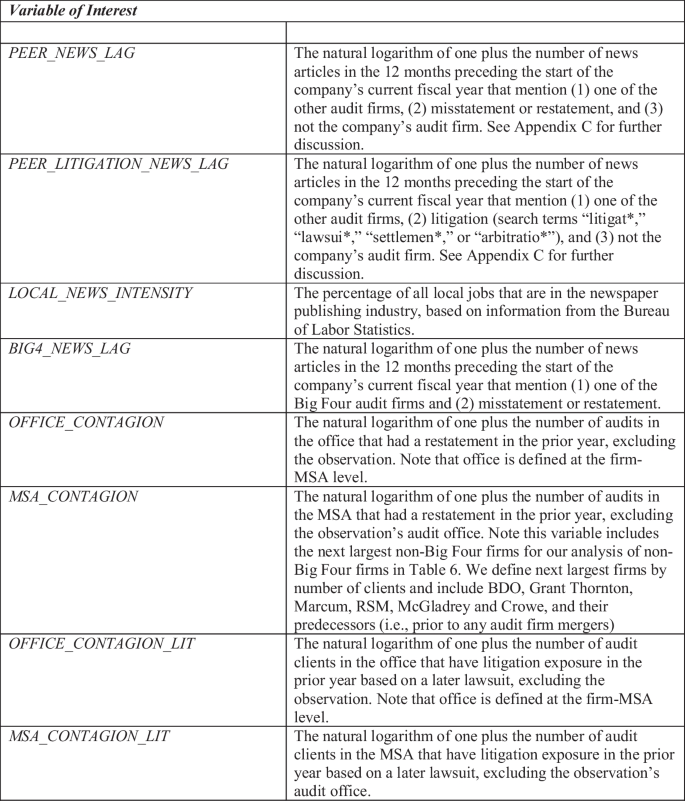
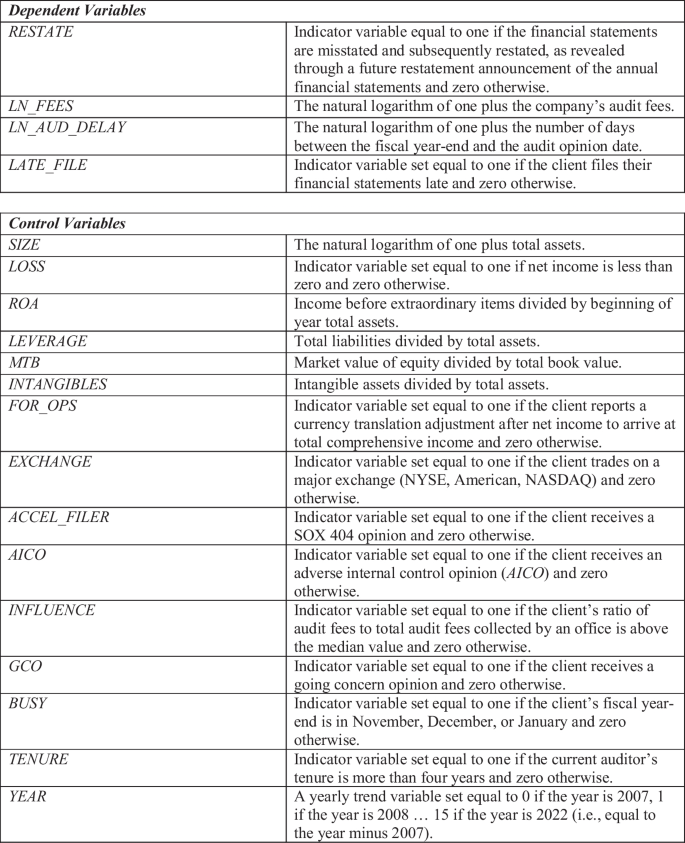
We regress our proxy for audit quality (RESTATE), on our variables of interest OFFICE(MSA)_CONTAGION, PEER_NEWS_LAG and the interaction of the two variables, OFFICE(MSA)_CONTAGION X PEER_NEWS_LAG. RESTATE is an indicator variable equal to one if the financial statements are misstated and subsequently restated through a future restatement announcement of the annual financial statements and zero otherwise. Our primary variables of interest are (1) OFFICE(MSA)_CONTAGION, which captures audit quality contagion within the local audit office (MSA) and is equal to the natural logarithm of one plus the number of audits in the office (MSA) that have a restatement in the previous year, excluding the observation (observation’s audit office); (2) PEER_NEWS_LAG, which captures the amount of negative peer firm news coverage and is equal to the natural logarithm of one plus the number of news articles in the 12 months preceding the start of the company’s current fiscal year that mention (a) one of the other Big Four audit firms (b) misstatement or restatement and (c) not the company’s audit firm; and (3) the interaction of OFFICE(MSA)_CONTAGION X PEER_NEWS_LAG, which captures the incremental effect of negative peer news on audit quality contagion within an office (MSA).
A positive and significant coefficient on β1 indicates that the company is more likely to have a restatement when the audit office (MSA) has had previous restatements (i.e., more likely to experience contagion of low-quality audits), when negative peer news coverage is zero. A negative and significant coefficient on β2 indicates that the audit office (MSA) is less likely to have restatements following negative news coverage of peer audit firms when prior year peer restatements equal zero. A negative and significant coefficient on β3, the interaction term, would reveal that an audit office (MSA) has incrementally higher audit quality following negative news coverage of peer audit firms in the presence of prior period low-quality audits (i.e., negative peer news coverage mitigates the contagion effect of low-quality audits within the office (MSA)).
Throughout our analyses, we include a comprehensive set of controls related to audit quality, as documented by prior research. Specifically, we control for client characteristics, including client size (SIZE, EXCHANGE, ACEL_FILER, INFLUENCE), performance (LOSS, ROA), complexity (INTANGIBLES, FOR_OPS), and risk (LEVERAGE, MTB, AICO, GCO), whether the client has a busy season year-end (BUSY), and the length of auditor tenure (TENURE). In addition, we include a yearly trend variable (YEAR).Footnote 13 Continuous control variables are winsorized at the 1st and 99th percentiles to reduce the effects of outliers. We include industry and MSA fixed effects to control for unobserved heterogeneity that could influence audit quality and news exposure across industry sectors and geographic locations.Footnote 14 We also cluster robust standard errors by company. Detailed variable definitions are provided in Appendix A.
3.3 Sample selection and descriptive statistics
Our primary sample consists of nonregulated publicly traded companies headquartered in the United States with at least $1 million in total assets that are audited by one of the Big Four audit firms from 2007 through 2022. We include all client-year observations with necessary data in Compustat and Audit Analytics to construct the variables in Eq. (1), and our final sample is comprised of 24,894 client-year observations. Table 1 presents descriptive statistics for our primary sample of client-year observations.Footnote 15
4 Main Results and Additional Analysis
4.1 Negative peer news and audit quality
We examine whether negative peer news coverage improves audit quality by mitigating the contagion effect within an auditor’s audit office and across an auditor’s MSA. To answer our research questions, we estimate Eq. (1) and present results in Table 2 Panels A and B, which show the impact of negative peer news on low-quality audits within an audit office and across an MSA, respectively. We begin our analysis by first establishing evidence of audit office contagion in Column 1, then layer in peer news in Column 2, and finally test our main research questions in Column 3 with the interaction of OFFICE(MSA)_CONTAGION and PEER_NEWS_LAG. A negative coefficient on the interaction would suggest that negative peer news improves audit quality by mitigating contagion within an audit office (MSA).
Table 2 Panel A examines whether negative peer news coverage improves audit quality within an audit office (RQ 1). As shown in Table 2 Panel A Column 1, we observe a positive and statistically significant coefficient on OFFICE_CONTAGION, suggesting that when an office experiences a restatement in the prior year, clients in that office are more likely to have restatements in the current year (i.e., office-level audit quality contagion). In Column 2, we observe a negative and statistically significant coefficient on PEER_NEWS_LAG, suggesting that negative news about peer audit firms is associated with an improvement in audit quality (i.e., more negative peer news is associated with a lower likelihood of restatements). In Column 3, we observe a negative and statistically significant coefficient on the interaction term, OFFICE_CONTAGION X PEER_NEWS_LAG, suggesting that audit quality improves as negative peer news increases because news mitigates the contagion effect of low-quality audits.
Table 2 Panel B examines whether negative peer news coverage improves audit quality between auditors within an MSA (RQ 2). As shown in Columns 1 and 2, we find no initial evidence of a contagion effect within an MSA. However, in Column 3, when we include the interaction term MSA_CONTAGION X PEER_NEWS_LAG, we observe a positive and statistically significant coefficient on MSA_CONTAGION, suggesting that the contagion effect of low-quality audits exists only when there is no negative peer news. In other words, the lack of contagion in the first two columns suggests that negative peer news mitigates MSA contagion to such an extent that contagion becomes insignificant when examined independently (i.e., without consideration of how it interacts with peer news). Consistent with our office level findings presented in Table 2 Panel A, we observe a negative and statistically significant coefficient on the interaction term, OFFICE_CONTAGION X PEER_NEWS_LAG, in Column 3, suggesting audit quality improves as negative peer news coverage increases because news mitigates the contagion effect of low-quality audits between auditors in an MSA. Together, findings from this analysis provide evidence that auditors incrementally adjust their behavior in response to negative peer news in a way that improves audit quality (i.e., negative news improves audit quality).Footnote 16
4.1.1 Small and large companies
While our previous analysis suggests that auditors improve audit quality in response to reputational concerns, we expect this supply-side response is likely most observable when auditors have greater opportunity to improve audit quality. As such, we focus on whether auditors incrementally improve audit quality more for smaller clients. Because smaller clients tend to have weaker internal controls, less standardized audit procedures, and weaker information environments, auditors have greater opportunity to adjust the quality for these engagements in response to information from indirect network channels such as the media (Bianchi et al. 2023; Ru et al. 2020). While negative news likely heightens reputational concerns across an auditor’s entire client portfolio, we expect that any resulting observable supply-side response is most likely to manifest across smaller engagements, where auditors have greater flexibility to adjust scope and testing intensity in response to heightened reputational threats.Footnote 17 Thus, we next test whether the effect of negative peer news on audit quality differs based on audit client size.
We split our sample based on median client size (assets) and report results in Table 3 Panels A and B for the office and MSA-level analyses, respectively. As shown in Table 3 Panel A, we find evidence of audit quality contagion at the office level across both large and small clients (i.e., the coefficient on OFFICE_CONTAGION is positive and statistically significant in both columns). However, we observe contagion at the MSA level (Panel B) only when the client is smaller (i.e., the coefficient on MSA_CONTAGION is positive and statistically significant only when the client is small). Across both panels we find that negative peer news improves office-level and MSA-level audit quality only in smaller clients (i.e., we observe a negative and statistically significant coefficient on the interaction term only when the client is smaller).Footnote 18 Together, findings from this analysis provide evidence that negative peer news mitigates contagion predominantly when the auditor has greater opportunity to improve audit quality. This finding is consistent with media-induced reputational concerns prompting supply-side changes in auditor behavior that are most observable when client factors provide greater opportunity for auditors to respond.
4.1.2 Local news intensity
We next examine whether the strength of the local news environment, which could affect the visibility of audit-related issues disseminated through the news media (Allee et al. 2025) and thus the salience of reputational threats influences how negative peer news affects audit quality. Specifically, following Allee et al. (2025), we measure local news intensity as the percentage of all local jobs that are in the newspaper publishing industry, based on information from the Bureau of Labor Statistics.Footnote 19 We then split our sample based on median news intensity by year and rerun our main analyses. We report the results in Table 4 Panels A and B at the office and MSA level.
As shown in Table 4 Panel A, when we examine the effect of local news intensity on audit office quality, we find evidence of audit office contagion within offices located in areas with both low and high news intensity. However, as shown in Table 4 Panel A Column 2, the interaction of OFFICE_CONTAGION X PEER_NEWS_LAG is negative and statistically significant only in the presence of high local news intensity (Column 2), suggesting that negative peer news coverage improves office-level audit quality only when the office is in an area with high news intensity.
In Table 4 Panel B, we examine whether local news intensity influences MSA-level audit quality. Notably, we find no evidence of contagion for MSAs with low local news intensity, suggesting that a strong local news presence is necessary for the contagion effect at the MSA level. Consistent with our office level findings, we find that negative peer news improves MSA-level audit quality only in areas with higher local news intensity.Footnote 20 Overall, these findings suggest that higher local news intensity amplifies reputational pressures for auditors to improve audit quality.
Together, the results from our cross-sectional analyses suggest that network factors influence auditors’ supply-side response to negative news and that negative news improves audit quality 1) when auditors have greater opportunity to improve and 2) when media attention is more likely to amplify reputational pressures.
4.2 Additional analysis
4.2.1 Negative peer litigation news and audit quality
We expect that negative news about other reputation events (beyond restatements) may also heighten auditors’ perceptions of reputational risk and thus prompt a similar response. For example, research finds that auditor litigation leads to general deterrence effects among peer auditors, where nonsued peers are more likely to improve audit quality following peer firms’ litigation events. Cao et al. (2019) suggest that auditors view litigation as a publicly observable reputation threat that influences their behavior, even when the auditor is not directly implicated. Thus, we examine whether media coverage of peer audit firm litigation affects litigation exposure and audit quality. Specifically, we re-estimate Eq. (1), replacing our peer news variable with PEER_LITIGATION_NEWS_LAG, equal to the natural logarithm of one plus the number of news articles related to peer auditor litigation, and replace our restatement contagion variable with OFFICE(MSA)_CONTAGION_LIT, equal to the natural logarithm of one plus the number of clients in the office (MSA) that experience litigation. This yields 5,165 litigation peer media mentions across the Big Four firms during our sample period.Footnote 21 Our main coefficient of interest is β3OFFICE(MSA)_CONTAGION_LIT X PEER_LITIGATION_ NEWS_LAG, which captures the extent to which negative peer litigation news improves audit quality via the contagion effect.
Results of this analysis at the office and MSA-level are reported in Table 5 Panels A and B, respectively. As shown in Table 5 Panel A (B), we observe a negative and statistically significant coefficient on the interaction term, β3OFFICE(MSA)_CONTAGION_LIT X PEER_ LITIGATION_NEWS_LAG, in both panels, suggesting that negative peer litigation news improves audit quality by mitigating the contagion effect within an office (MSA).Footnote 22 Overall, this finding provides evidence that different types of negative news dispersed through the media increase auditors’ perceptions of reputational risks. The results from this analysis also extend the work of Cao et al. (2019) by showing that auditors incrementally adjust their behavior in response to negative reputational events, even when they are not directly involved in the event.
4.2.2 Negative Big Four news and audit quality at non-Big Four auditors
Our previous analyses focus on Big 4 response to negative peer news. While the Big Four have the most national name recognition and thus more significant threats to their reputations, non-Big Four auditors may also view themselves as peers (albeit not as direct). As such, the largest non-Big Four firms, which likely represent the closest peers outside the Big Four, may also respond to negative news about the Big Four auditors.Footnote 23 We thus re-estimate Eq. (1) but replace PEER_NEWS_LAG with BIG4_NEWS_LAG, equal to the natural logarithm of one plus the number of news articles in the 12 months preceding the start of the company’s current fiscal year that mention one of the Big Four audit firms and misstatement or restatement. Similar to our main analysis, we examine contagion within the audit office (OFFICE_CONTAGION) and MSA (MSA_CONTAGION). Our sample is restricted to only companies audited by a non-Big Four firm and is comprised of 5,525 companies audited by one of the non-Big Four firms between 2007 and 2022 meeting the same criteria as our main sample.
Table 6 presents results of this analysis. We find that negative Big Four news improves audit quality via mitigating contagion within non-Big Four auditors at both the office and MSA-level (Panels A and B, respectively). Interestingly, we find a positive and significant effect on BIG4_NEWS_LAG (versus the negative effect observed in our main tests), suggesting that negative Big Four news is associated with incremental improvements in audit quality only when the non-Big Four auditor operates in a low-quality office or MSA. This suggests that the non-Big Four response to negative Big Four news is calibrated to the ex-ante audit quality of the office or MSA rather than the sheer presence of negative news and is consistent with non-Big Four auditors perceiving some reputational risk of negative Big Four news (albeit lower than that perceived by Big Four firms).
4.2.3 Negative peer news and auditor attention
We next examine how improvements in audit quality occur. We expect that the observed improvements in audit quality likely manifest because audit firms incrementally adjust their audit procedures to address audit and reputation risks revealed by negative news coverage. As such, we examine whether negative peer news coverage is associated with higher auditor attention. We re-estimate Eq. (1) but replace the dependent variable with three proxies for auditor attention based on prior literature (Cassell et al. 2019): (1) audit fees (LN_FEES), (2) audit opinion delay (LN_AUD_DELAY), and (3) late filings of financial statements (LATE_FILE). A positive and significant coefficient estimate on our variable of interest, OFFICE(MSA)_CONTAGION X PEER_NEWS_LAG, indicates higher audit fees, longer audit opinion delay, and increased incidences of late filings in the presence of higher negative news, which would provide support for higher auditor attention following negative peer firm news.
As shown in Table 7 Panels A and B, we find evidence of higher auditor attention following negative news coverage of peer audit firms when the office or MSA has low audit quality. We find a positive association between the interaction and audit fees, the length of audit opinion filing delay, and the likelihood of late financial statement filings for both office and MSA peer groups. The effect is statistically significant for all these variables except audit fees at the office level.Footnote 24 Collectively, the results from this analysis suggest that audit firms increase audit attention in response to negative news coverage of peer audit firms, suggesting how negative news drives improvements in audit quality.
5 Supplemental and robustness analysis
5.1 Negative focal firm news and audit quality
Given the difficulties in separating an observed response to news from a response to the underlying event, we focus our main analyses on peer news. We expect that when news is about a peer firm, any observed change in auditor behavior is more likely attributable to the news coverage itself, rather than to internal responses to the failure by the audit firm. Nevertheless, we also examine whether negative news coverage about the focal audit firm affects audit quality. Specifically, we re-estimate Eq. (1) but replace PEER_NEWS_LAG with AUDITFIRM_NEWS_LAG, equal to the natural logarithm of one plus the number of news articles in the 12 months preceding the start of the company’s current fiscal year that mention the company’s own audit firm and mention misstatements or restatements.
We find (untabulated) that negative focal firm news improves audit quality by mitigating the contagion effect at the office and MSA level, consistent with our main findings. However, unlike negative peer news, the effect does not vary across network characteristics (client size and local news intensity). This suggests that the supply-side response to focal firm news likely originates through formal channels (e.g., national office guidance, internal risk reviews, updated firm policies, etc.) that prompt a more uniform response across audits. In contrast, the supply-side response to peer news prompts a more decentralized engagement-level response that is sensitive to various network and client characteristics. Collectively, our results suggest that while both peer and focal news operate through the same underlying reputational mechanism, each prompts a different organizational response, with firm specific news prompting a coordinated, centralized, firmwide response, and peer news prompting a decentralized, network-reactive responsive. Thus, while both types of news affect audit quality by mitigating the contagion effect, the improved audit quality appears to operate through different channels.
5.2 Other peer news and audit quality
While our previous measures of peer news capture news stories about restatements and litigation and are unambiguously negative, auditors are often in the news for reasons unrelated to audit failures, such as firm expansions, leadership changes, promotions, external hires, acquisitions, and new client engagements. These types of news stories, while informative, do not necessarily convey negative information about the firm and could be used by the firms to strategically promote themselves (e.g., highlight strengths of new national partner or firm expansions). As such, this news is not expected to highlight audit firm reputation risks or prompt concerns over low audit quality, particularly when the news relates to a peer firm. If our previous results are a product of auditors responding to heightened perceptions of reputational risks conveyed through negative news, then we should not observe a similar response to other nonnegative news (i.e., nonnegative news should not improve audit quality). Thus, we next consider whether other peer news (i.e., news mentioning peer audit firms but lacking any mention of restatements or litigation), elicits a response from auditors.
We re-estimate Eq. (1) but replace PEER_NEWS_LAG with OTHER_PEER_ NEWS_LAG, equal to the natural logarithm of one plus the number of news articles in the 12 months preceding the start of the company’s current fiscal year that (1) mention one of the other Big Four audit firms; (2) do not mention misstatement, restatement, litigation, or lawsuits; and (3) do not mention the company’s audit firm. We find no evidence (untabulated) that other nonnegative peer news mitigates the contagion effect of low-quality audits either within an office or MSA. Overall, these findings suggest that the previously documented response to negative peer news is likely driven by auditors’ responses to increased perceptions of reputational risks brought about by the dissemination of negative news, rather than the sheer presence of peer audit firms in the news.
5.3 Robustness tests
Finally, we perform several additional robustness tests. Our main results are robust to measuring contagion at the office and MSA level using more severe restatements (i.e., BigR restatements and those with greater than a 10% adverse impact on net income), providing further assurance that they are driven by reputation risk disseminated through news and not the severity of the restatement contagion. Further, we use concurrent peer audit quality instead of prior period to measure contagion, we drop companies with prior year restatements, and we drop companies with news mentions. We also use the raw count of negative news articles instead of the natural logarithm. Our results are robust to each of these alternative design choices.
Our findings are also robust to alternatively using restatement announcements in place of restatements to construct office and MSA contagion measures. Importantly, because restatement announcements publicly signal previous low-quality audits and could provide information similar to that contained in negative news coverage, restatement announcements by themselves could prompt peer auditors to incrementally adjust their behavior. However, research finds that clients begin managing earnings following peer restatement announcements (i.e., decrease audit quality) (Kedia et al. 2015); thus, our evidence suggests that negative news is unique from other sources of negative audit quality information and suggests that auditors are responding to reputational risks inherent in the news and not simply the publicly available information. Lastly, we reperform our analysis with peer group defined at the industry level but fail to find evidence of audit quality contagion (and thus find no evidence of a mitigating effect of negative peer news), consistent with recent research that finds that industry-level contagion dissipates after 2008 (Lewis-Western et al. 2024).
6 Conclusion
We investigate whether news media affects audit quality and find that negative news improves audit quality by mitigating the contagion of low-quality audits both within audit offices and across MSAs, particularly among smaller clients and clients in areas with higher local news intensity. We also find that negative peer litigation news improves audit quality, suggesting that our findings generalize beyond restatement-related news to other types of reputational threats. Importantly, we find no evidence that other (nonnegative) news improves audit quality via the contagion effect, suggesting that negative news (rather than news itself) heightens auditors’ perceptions of reputation risks and prompts changes in their behavior. Finally, we find that auditors increase audit attention in response to negative peer news, suggesting how audit quality improvements occur. Taken together, our findings suggest that the news media heightens perceptions of reputational risk by disseminating information through auditor networks, raising awareness of audit quality issues and prompting auditors to incrementally improve audit quality.
Our findings make several contributions. First, while many studies on auditor reputation focus on extreme audit failures (e.g., Barton 2005; Weber et al. 2008; Skinner and Srinivasan 2012; DeFond and Zhang 2014), little research addresses how firms seek to preempt or manage more frequent reputation shocks that are not also accompanied by substantial changes in regulation. We provide empirical evidence that media coverage increases reputation concerns and prompts supply-side auditor responses. Our findings also complement the work of Lennox et al. (2025), who find that private, word-of-mouth communications drive responses to auditor reputation threats. Taken together, our results highlight the multiple ways through which information about audit quality circulates through the audit market and results in real consequences. Next, while audit research highlights formal oversight bodies (e.g., regulators and litigators) as disciplining mechanisms that prompt auditors to adjust their behavior (e.g., Krishnan and Krishnan 1997; Lamoreaux et al. 2023), our study highlights the news media as an informal disciplining mechanism that shapes auditor behavior through the dissemination of reputational threats. Our findings also contribute to the broader contagion literature by showing that negative news can mitigate the spread of low-quality audit practices within and between auditors. Finally, our findings have practical implications, suggesting that clients, investors, and regulators can use negative news as a credible signal of reputational pressure that is likely to prompt changes in auditors’ behavior.
Data availability
All data used are publicly available from sources cited in the text.
Notes
Our main analysis examines the Big Four because they are the closest peer group, and they have sufficient negative news coverage during our sample period. The next largest audit firms do not have sufficient negative media coverage to conduct analysis, but we examine how these firms respond to Big Four news in an additional analysis.
One potential concern is that auditors respond solely to the underlying event rather than news of that event. Our focus on national news of peer firms and peer restatements that are not yet public makes it unlikely that the auditor is simply responding to the underlying event. We perform analysis of auditor response to focal firm news in Sect. 4.
We define office peers as auditees in the same office audited by the same audit firm and MSA peers as auditees in the same MSA not audited by the same audit firm. As such, office peers and MSA peers are mutually exclusive.
For example, peer audit firms released responses to the Silicon Valley Bank failure, with Deloitte noting that “recent post-mortems reflect firm-specific issues as well as … supervisory challenges” (Deloitte 2023) and PwC issuing publications discussing how “recent market events highlight the importance of financial risk management” (PwC 2023).
For example, news coverage of the Silicon Valley Bank failure and the press’s portrayal of KPMG suggest as least some level of misunderstanding of what an audit is intended to accomplish and the level of responsibility KPMG had in the Silicon Valley Bank failures (Castonguay 2023; Weil and Eaglesham 2023).
Our search included The Wall Street Journal, The New York Times, The Washington Post, Chicago Tribune, Forbes, The Economist, The Economic Times, Kiplinger, Accounting Today, Wired, and CFO Magazine.
Our analysis of news articles indicates that these major news publications do not simply rebroadcast company press releases but add additional commentary and analysis; thus, the news we examine is incremental to that contained in restatement announcements, which represent news announced by individual companies.
As one former audit partner we spoke with phrased it: “Things happening in the news are impacting leadership at the national office and then the people in the national office are driving the directives that come raining down to all the partners.” Consistent with this sentiment, in response to front-page Wall Street Journal coverage for its role in the Wirecard failure, EY issued a statement that “[the firm] is launching a ‘redesigned audit quality strategy’ that will include a continuing focus on ‘developing a culture of professional skepticism’” (Kowsmann et al. 2020).
Given that research suggests the audit planning typically occurs ahead of the first quarter (Burke et al. 2019), we use negative news that appeared prior to the start of the client’s current fiscal year to ensure that audit planning and test work for the year occur following the negative news. Our main results are robust to using concurrent news.
We use OLS for all our models to preserve our sample size. Inferences are unchanged if we instead use Probit models when the dependent variable is binary.
YEAR is a yearly trend variable set equal to 0 if the year is 2007, 1 if the year is 2008 … 15 if the year is 2022. We use a time trend instead of year fixed effects because there is very little variation in peer news within firms each year (i.e., most of a firm’s clients have December year-ends and there is no within-year variation in peer news for these clients), given our news variable is computed as the number of news articles in the preceding 12 months.
Our MSA contagion results are robust to the exclusion of MSA fixed effects.
The correlation between PEER_NEWS_LAG and OFFICE_CONTAGION is 0.14, and the correlation between PEER_NEWS_LAG and MSA_CONTAGION is 0.15. VIFs on our main model without the interaction are all less than 4; the VIFs on the interaction terms in the interaction model are high as expected, given the interaction is the product of the individual terms and thus correlated.
For economic significance, we find that, at the mean level of OFFICE_CONTAGION of 0.837 (MSA_CONTAGION of 1.496), a one standard deviation increase in PEER_NEWS_LAG of 0.494 is associated with a 1.1 (1.2) percentage point decrease in restatements, holding all other factors constant. In an untabulated analysis, we dichotomize our contagion and peer news variables at the top 25th percentiles, and we find that at the office (MSA) level, companies are 5.4 (1.6) percent more likely to have a misstatement if there is high office (MSA) peer contagion and that high negative peer news reduces this effect by 3.0 (1.8) percentage points.
Larger audit clients tend to operate under stricter quality control and review protocols, which limit the ability to observe incremental adjustments in audit effort and procedures.
An untabulated analysis shows that the coefficients on the interaction are statistically significantly different between large and small clients at the audit office contagion level but not at the MSA contagion level.
We thank Allee, Cating, and Rawson for making their measure available to us. Due to data limitations, the sample used for our tests involving local news intensity ends in 2019.
The coefficients on the interaction terms differ significantly across local news intensity at both the office and the MSA level (untabulated). We drop MSA fixed effects from the seemingly unrelated regression used to test the difference between the coefficients in each model because local news intensity is measured at the MSA level.
While litigation news is more prevalent than restatement news, we use restatement news for our main analysis because restatements represent a clear audit failure with more direct audit-level implications, while litigation news can include other less direct audit-quality related issues with less clear audit-level implications.
In an untabulated analysis, we examine the interactive effect of litigation news and restatement contagion (i.e. OFFICE(MSA)_CONTAGION X PEER_ LITIGATION_NEWS_LAG) and find a statistically significant negative interaction effect at the p < 0.01 level in both the office and MSA tests.
We examine the next largest auditors by number of clients and include BDO, Grant Thornton, Marcum, RSM, McGladrey and Crowe, and their predecessors (i.e., prior to any audit firm mergers). There is minimal national news coverage of non-Big Four auditors. However, to the extent that non-Big Four auditors view Big Four as peers, we expect non-Big Four auditors may still perceive reputational risks associated with negative Big Four media coverage.
It is unsurprising that audit offices would be constrained in their ability to increase fees when the low-quality contagion is based in their office.
References
Abbott, L.J., and W.L. Buslepp. 2022. An investigation of the market’s pricing of auditor competence: Evidence from PwC’s Oscars blunder. Accounting, Organizations and Society 98: 101310. https://doi.org/10.1016/j.aos.2021.101310.
Allee, K. D., R. Cating, and C. Rawson. 2025. No news is bad news: Local news intensity and firms’ information environments. Review of Accounting Studies 30:1–32.
Barton, J. 2005. Who cares about auditor reputation? Contemporary Accounting Research 22:549–586.
Bianchi, P. A., M. Causholli, M. Minutti-Meza, and V. Sulcaj. 2023. Social networks analysis in accounting and finance. Contemporary Accounting Research 40 (1): 577–623.
Borah, A., and G. J. Tellis. 2016. Halo (spillover) effects in social media: Do product recalls of one brand hurt or help rival brands? Journal of Marketing Research 53 (2): 143–160.
Buntaine, M., M. Greenstone, G. He, M. Liu, S. Wang, and B. Zhang. 2024. Does the squeaky wheel get more grease? The direct and indirect effects of citizen participation on environmental governance in China. American Economic Review 114 (3): 815–850.
Burke, J., J. R. Hoistash, and U. Hoitash. 2019. Auditor response to negative media coverage of client environmental, social, and governance practices. Accounting Horizons 33 (3): 1–23.
Cahan, S. F., C. Chen, and R. Wang. 2021. Does media exposure affect financial reporting quality through auditors? Journal of Accounting, Auditing & Finance 36 (4): 750–775.
Cao, S.S., Y. Fan, G.S. Narayanamoorthy, and S.P. Rowe. 2019. Auditor Litigation: Deterrence Implications for Non-sued Auditors. Working Paper. Available at SSRN: https://ssrn.com/abstract=2736934. Accessed 23 Apr 2026.
Cassell, C., E. Hunt, G. Narayanamoorthy, and S. P. Rowe. 2019. A hidden risk of auditor industry specialization: Evidence from the financial crisis. Review of Accounting Studies 24 (3): 891–926.
Castonguay, J. 2023. Don’t blame KPMG audits for the three regional bank breakdowns. Bloomberg Tax. Available at https://news.bloombergtax.com/tax-insights-and-commentary/dont-blame-kpmg-audits-for-the-three-regional-bank-breakdowns. Accessed 23 Apr 2026.
Chen, S., K. Schuchard, and B. Stomberg. 2019. Media coverage of corporate taxes. The Accounting Review 94 (5): 83–116.
Core, J., W. Guay, and D. Larcker. 2008. The power of the pen and executive compensation. Journal of Financial Economics 88 (1): 1–25.
DeFond, M., and J. Zhang. 2014. A review of archival auditing research. Journal of Accounting and Economics 58: 275–326.
Deloitte. 2023. Prepare for more stringent regulation and agile supervision after bank failures. Available at https://www2.deloitte.com/content/dam/Deloitte/us/Documents/Advisory/us-advisory-deloitte-upcoming-banking-regulation-and-supervision-changes-may-2023.pdf. Accessed 23 Apr 2026.
Dunne, N. J., N. M. Brennan, and C. E. Kirwan. 2021. Impression management and the Big Four auditors: Scrutiny at a public inquiry. Accounting, Organizations and Society 88:101170.
Dyck, A., N. Volchkova, and L. Zingales. 2008. The corporate governance role of the media: Evidence from Russia. Journal of Finance 63:1093–1135.
Ege, M., D. Wang, and N. Xu. 2025. The consequences of reputation-damaging events for Big Four auditors: Evidence from 110 cases with media coverage between 2007 and 2019. Review of Accounting Studies 30:2015–2070.
Engelberg, J., and C. A. Parsons. 2011. The causal impact of media in financial markets. Journal of Finance 66:67–97.
Francis, J. R., and P. N. Michas. 2013. The contagion effect of low-quality audit. The Accounting Review 88 (2): 521–552.
Franklin, B., M. Hamer, M. Hanna, M. Kinsey, and J.E. Richardson. 2005. Key concepts in journalism. London: SAGE.
Frost, C. 1991. Loss contingency reports and stock prices: A replication and extension of Banks and Kinney. Journal of Accounting Research 29 (1): 157–169.
Gleason, C. A., N. T. Jenkins, and W. B. Johnson. 2008. The contagion effects of accounting restatements. Accounting Review 83 (1): 83–110.
Gong, S.X., F.A. Gul, and L. Shan. 2018. Do auditors respond to media coverage? Evidence from China. Accounting Horizons 32 (3): 169–194.
Hillert, A., H. Jacobs, and S. Müller. 2014. Media makes momentum. Review of Financial Studies 27: 3467–3501.
Hilzenrath, D. 2002. Big Four firms face post-Enron scrutiny. The Washington Post. Available at https://www.washingtonpost.com/archive/business/2002/06/07/big-four-firms-face-post-enron-scrutiny/03e2e634-a9df-47ed-9fa3-94b5bce7c549/. Accessed 23 Apr 2026.
Ho, S. 2023. Audit regulatory board mum on bank failures as critics question clean audit opinion for Silicon Valley Bank. Thomson Reuters. Available at https://tax.thomsonreuters.com/news/audit-regulatory-board-mum-on-bank-failures-as-critics-question-clean-audit-opinion-for-silicon-valley-bank/. Accessed 23 Apr 2026.
Hutton, A. P., S. Shu, and X. Zheng. 2022. Regulatory transparency and the alignment of private and public enforcement. Journal of Financial Economics 145:297–321.
Joe, J. R. 2003. Why press coverage of a client influences the audit opinion. Journal of Accounting Research 41 (1): 109–133.
Joe, J., H. Louis, and D. Robinson. 2009. Managers’ and investors’ responses to media exposure of board ineffectiveness. Journal of Financial and Quantitative Analysis 44 (3): 579–605.
Kedia, S., K. Koh, and S. Rajgopal. 2015. Evidence on contagion in earnings management. The Accounting Review 90 (6): 2337–2373.
Kowsmann, P., M. Maurer, and J. Yang. 2020. String of firms that imploded have something in common: Ernst and Young audited them. The Wall Street Journal. Available at https://www.wsj.com/articles/string-of-firms-that-imploded-have-something-in-common-ernst-young-audited-them-11602863319. Accessed 23 Apr 2026.
Krishnan, J., and J. Krishnan. 1997. Litigation risk and auditor resignations. Accounting Review 72 (4): 539–560.
Lamoreaux, P. T., M. Mowchan, and W. Zhang. 2023. Does Public Company Accounting Oversight Board regulatory enforcement deter low-quality audits? Accounting Review 98 (3): 335–366.
Lennox, C., B. Li, and J. Qu. 2025. Are auditor reputations affected by private communication channels? Accounting Review 100 (4): 331–355.
Lewis-Western, M.F., T.A. Seidel, and M.S. Wilkins. 2024. Do peer revenue restatements still generate contagion? Available at SSRN: https://ssrn.com/abstract=4852374. Accessed 23 Apr 2026.
Leonelli, S. 2022. Are newspaper deserts an oasis for leniency? The effect of information dissemination on regulator activity. Available at SSRN: https://ssrn.com/abstract=3953866. Accessed 23 Apr 2026.
Li, L., B. Qi, G. Tian, and G. Zhang. 2017. The contagion effect of low-quality audits at the level of individual auditors. Accounting Review 92 (1): 137–163.
Liu, B., and J. J. McConnell. 2013. The role of the media in corporate governance: Do the media influence managers’ capital allocation decisions? Journal of Financial Economics 110:1–17.
Liu, D., and S. Varki. 2021. The spillover effect of product recalls on competitors’ market value: The role of corporate product reliability. Journal of Business Research 137:452–463.
Miller, G. 2006. The press as a watchdog for accounting fraud. Journal of Accounting Research 44 (5): 1001–1033.
Miller, G., and D. Skinner. 2015. The evolving disclosure landscape: How changes in technology, the media, and capital markets are affecting disclosure. Journal of Accounting Research 53 (2): 221–239.
PwC. 2023. Our Take special edition: PwC’s financial services update. March 2023. Available at https://explore.pwc.com/first-take#page=1. Accessed 23 Apr 2026.
Roehm, M. L., and A. M. Tybout. 2006. When will a brand scandal spill over, and how should competitors respond? Journal of Marketing Research 43 (3): 366–373.
Ru, Y., J. Xue, Y. Zhang, and X. Zhou. 2020. Social connections between media and firm executives and the properties of media reporting. Review of Accounting Studies 25 (3): 963–1001.
Siegel, R. 2016. Why the public perception of crime exceeds the reality. National Public Radio. Available at https://www.npr.org/2016/07/26/487522807/why-the-public-perception-of-crime-exceeds-the-reality. Accessed 23 Apr 2026.
Skinner, D. J., and S. Srinivasan. 2012. Audit quality and auditor reputation: Evidence from Japan. The Accounting Review 87 (5): 1737–1765.
Skomra, J.R., D. Sellers, and P.A. Skomra. 2023. Office level contagion: Impact of a non-timely filing by a major busy season client. Managerial Auditing Journal 38 (6): 758–782.
Smith, R., and J.R. Emshwiller. 2009. 24 days: How two Wall Street Journal reporters uncovered the lies that destroyed faith in corporate America. Harper Collins.
Tetlock, P.C. 2007. Giving content to investor sentiment: The role of media in the stock market. The Journal of Finance 62: 1139–1168.
Weber, J., M. Willenborg, and J. Zhang. 2008. Does auditor reputation matter? The case of KPMG Germany and ComROAD AG. Journal of Accounting Research 46 (4): 941–972.
Weil, J., and J. Eaglesham. 2023. KPMG gave SVB, signature bank clean bill of health weeks before collapse. Wall Street Journal. Available at: https://www.wsj.com/articles/kpmg-faces-scrutiny-for-audits-of-svb-and-signature-bank-42dc49dd. Accessed 23 Apr 2026.
Acknowledgements
We are grateful for helpful comments and suggestions from Miguel Minutti-Meza (editor) and an anonymous reviewer. We thank Cory Cassell, Mikhail Pevzner (discussant), Tim Seidel, Jonathan Shipman, Mason Snow (discussant), Hongkang Xu (discussant), conference participants at the 2021 AAA Auditing Section Midyear Meeting, 2021 AAA FARS Section Midyear Meeting, 2021 Hawai’i Accounting Research Conference, and workshop participants at the University of Arkansas for their helpful comments and suggestions. We also thank several anonymous audit firm partners for helpful discussions.
Author information
Authors and Affiliations
Corresponding author
Additional information
Publisher's Note
Springer Nature remains neutral with regard to jurisdictional claims in published maps and institutional affiliations.
Appendices
Appendix A: Variable definitions
Appendix B: Summary of discussions with audit professionals
To further our understanding of how negative news coverage impacts auditor behavior, we discussed this topic with several current and former audit practitioners. Our informal conversations with each professional included discussions of whether the practitioner adjusted audit procedures in response to concerns related to an item highlighted in the national news and, if so, whether concerns were raised by the client, the audit firm, or both. We discussed this topic with six current and former Big Four audit professionals, including those at the manager, partner, and lead client service partner levels. As detailed below, five of six practitioners revealed they have had personal experience with addressing negative news coverage on the audits on which they worked. One did not have personal experience with this issue but acknowledged that they were aware of how their firm handled such issues. In conjunction with our discussions, the audit professionals provided the following written responses.
2.1 Respondent 1: Former Partner, Big Four Firm
In your time at the firm did you ever adjust your audit procedures in response to concerns related to an item highlighted in national news?
Our audit methodology and approaches were led by a team in our National office. We regularly would receive input/updates/changes in our thinking…. many times based on evolving thinking coming from the regulatory front (PCAOB experience)… but also based upon audit issues (both ours and other firms) that would receive national attention in the press.
Were these concerns raised by the client or the audit firm or both?
My sense was that … occasionally … we did change our approaches to be responsive to evolving thoughts on best/expected practices around these issues that were receiving press attention.
Feel free to elaborate on anything further related to how negative news coverage of audit firms has impacted you on the job.
I would say the changes were an attempt to be responsive/proactive … and were not associated with any input or pressure by our clients.
2.2 Respondent 2: Current Partner, Big Four Firm
In your time at the firm did you ever adjust your audit procedures in response to concerns related to an item highlighted in national news?
Yes – there have been multiple instances where national news items have impacted our audit procedures. They can be related to the industry in which the client operates, the audit profession as a whole or the client itself. I wouldn’t necessarily say these result in wholesale changes to the audit, but certainly impact risk assessment, additional procedures or other considerations (for example positive or negative evidence to support an impairment analysis, etc.)
If yes, were concerns raised by the client or the audit firm or both?
Both – if brought up by the client it is typically as a result of an overall industry item or related to a competitor.
Feel free to elaborate on anything further related to how negative news coverage of audit firms has impacted you on the job.
In my experience negative news coverage has typically impacted risk assessment as well as management estimate considerations (for example something comes up in the news around the industry that the company should take in to consideration in their impairment or recovery analysis). Another example is if a fraud is discussed in the media, we consider if this is something that could happen at our client and if we need to modify procedures to directly relate to that.
2.3 Respondent 3: Former Lead Client Service Partner, Big Four Firm
In your time at the firm did you ever adjust your audit procedures in response to concerns related to an item highlighted in national news?
Yes, many times. We always used targeted audit procedures to address any negative media coverage even when we believed the concerns raised had no merit.
Were these concerns raised by the client or the audit firm or both?
Typically, by the audit firm. Normally the client was supportive of our targeted procedures as the client was also working on its response to the concerns raised in the media. Occasionally, the client would initiate its own investigations under attorney/client privilege so we would need to wait for those results. I never had a situation where the client refused to share the full results of such an investigation, but I am aware of occasions where this has happened under the pretense that revealing such results would constitute a waiver of attorney/client privilege.
Feel free to elaborate on anything further related to how negative news coverage of audit firms has impacted you on the job.
Our firm typically requires us to specifically address any issues raised in negative media coverage, even if they are not directly financial in nature. Also, I have been involved in several PCAOB inspections and they have always come armed with copies of media coverage related to the client being inspected. They specifically tailor their inspections to review audit procedures related to issues disclosed in negative media coverage. It has also been my experience that an SEC comment letter or inquiry frequently follows any negative media coverage on issues that could have a financial or accounting impact.
2.4 Respondent 4: Former Manager, Big Four Firm
In your time at the firm did you ever adjust your audit procedures in response to concerns related to an item highlighted in national news?
Yes. The expectation by everyone involved, (i.e. the firm, the client, the PCAOB, the SEC etc.) was that the audit should be evolving and improving to address emerging issues. Often times these emerging issues first became really public when highlighted in the news.
Were these concerns raised by the client or the audit firm or both?
Both. Every year at our firm’s national partner and manager training there was a session that discussed trends in accounting and auditing oversight. In this session our standards group would discuss financial statement areas that were receiving more attention in the media or at the PCAOB. Apart from the firm highlighting specific areas, one of my public company audits had a very active audit committee chair who would specifically ask how we were addressing areas that were receiving national media attention. There were at least 2 specific areas that I recall him inquiring about. (1) He asked about what we were doing to make sure that the company was not doing any option backdating, and (2) when the financial crisis hit he was very concerned about how the company determined the value of investments and also how it monitored those values and other impacts to the company. In both of these situations we increased audit work related to these areas.
Feel free to elaborate on anything further related to how negative news coverage of audit firms has impacted you on the job.
Anytime one of the Big Four audit firms made the news for a failure or weakness I tried to preempt questions from the audit committee by adjusting audit procedures to make sure it was not also an issue at my client (this would ensure we were ready if asked and could show responsiveness when presenting to the audit committee quarterly). We also made sure that the audit documentation for that area was very clean to help avoid potential issues from internal inspections or PCAOB inspections, whose focus often seemed to follow the media attention. If our firm was the subject of the negative news coverage then we would pre-emptively reach out to the CFO and the audit committee to discuss the implications of the issue for their audit.
2.5 Respondent 5: Former Partner, Big Four Firm and Former Regional Associate Director PCAOB
In your time at the firm did you ever adjust your audit procedures in response to concerns related to an item highlighted in national news?
I will answer by working through a few scenarios that come to mind.
-
1.
PCAOB Inspection Report About My Firm Published – The audit firms know about the results from the comment form process long before the inspection report is published. The firms are good at getting information out to the line audit partners and staff about the lessons learned and things to do differently long before the public report is published.
-
2.
There have been a few times over the years where a problem bubbled up [in the media] on public company audits where everyone in the accounting industry needed to ask, “Does this impact any of my work? The three most significant items of this nature that come to mind are:
-
a.
Stock compensation where the exercise price was adjusted to a lower price per share after the option grant date. The notion that this was happening caught a lot of auditors off guard and many of us went back quickly to see how well our audit procedures addressed these situations.
-
b.
The failure of auctions for Auction Rate Securities surprised a lot of people that the fair value could be much different than the notional amount. Again, auditors went scurrying.
-
c.
There was a lessee accounting issue about rents incurred prior to the date operations commenced inside a leased facility that caught a lot of people off guard. Again, auditors went scurrying.
-
a.
-
3.
Whenever there was bad news about a legal settlement for my firm (Big Four), the line partners were generally given “talking points” as part of an effort to calm the clients and our audit staff.
-
4.
When the credit crisis hit, everyone struggled with how to value “difficult to value securities.” The regulators were caught off guard too. There was intense pressure from the regulators placed upon the standard setters to pass guidance that was workable.
-
5.
Anytime there was a restatement by a competitor within a client’s industry group, such an event usually triggered a review to see whether a similar problem existed in our client’s financial statements.
-
6.
In the pharmaceutical industry, FDA findings about adverse side-effects of a drug would typically trigger a revisit of any capitalized intangible assets related to the drug. You might put a “triggering event” label on this type of news. In a general sense, it is important for auditors to stay current on world events that could have an accounting consequence.
-
7.
Similarly, a recall announcement could send auditors scurrying to evaluate the applicability and implications to an audit client.
-
8.
News about new IRS scrutiny of certain transactions that may have been part of a tax avoidance strategy would also warrant a revisit of reserves for uncertain tax positions.
-
9.
News about a major customer having financial difficulty (or filing for bankruptcy) could trigger a revisit of the bad debt reserve.
-
10.
Any industry information about market share losses could have implications to going concern considerations (including the achievability of projections).
2.6 Respondent 6: Current Partner, Big Four Firm
In your time at the firm did you ever adjust your audit procedures in response to concerns related to an item highlighted in national news?
I did not, however, in certain instances [Big Four firm] would adjust their audit approach/procedures based on events that occurred at a client or industry (i.e., financial crisis, oil spill). I know [the] question is focused on negative news about [Big Four firm] or audit profession but [I am] not aware of instance[s] where we changed anything as a result of that. We will look at the nature of the news and see if anything needs to change. I know recent[ly] we have had to] focus on some conflicts of interest or independence issues at other firms and [our Big Four firm] would send out reminders to us to follow our policies but [there] was no need to change our policies. We feel confident in our audit approach and policies and will adjust if needed based on feedback from our regulators or factual news/information.
Were these concerns raised by the client or the audit firm or both?
Audit firm and client will ask questions about it and any reaction we have of the particular news coverage.
Feel free to elaborate on anything further related to how negative news coverage of audit firms has impacted you on the job.
No impact on me and see above on how [Big Four firm] may handle it.
Appendix C: News Coverage Composition
To create our sample of news coverage, we utilized Factiva and searched for articles in major business news sources. Specifically, we searched for articles in The Wall Street Journal, The New York Times, The Washington Post, Chicago Tribune, Forbes, The Economist, The Economic Times, Kiplinger, Accounting Today, Wired, and CFO Magazine. These sources were determined by both their availability in Factiva and their widespread coverage of major business news.
For each of the Big Four, we required the presence of the firm name in the article. We note that with the exception of KPMG, abbreviated reference of the firm (e.g., E&Y or PwC) always comes after referencing the firm by its official name since the firms use their full names for marketing and promotional purposes. KPMG rarely utilizes its full name (Klynveld Peat Marwick Goerdeler) in its own materials, and we did not identify any news articles that referred to the firm by its full name.
For negative auditor news coverage, we require the presence of at least one “audit*” word where the * represents a wildcard that can be a space or any character. We do this to capture any audit related derivative word such as “auditing” or “auditor.” To identify negative restatement news (PEER_NEWS_LAG), we capture articles using the search terms “misstat*” and “restat*.” To identify negative litigation news we capture articles using the search terms “arbitratio*” or “lawsui*” or “litigat*” or “settlemen*.” For each audit firm, we identify negative peer firm news and negative firm news separately. Negative peer firm news represents articles that mention at least one of the other audit firms but do not mention the target firm. Negative firm news represents the number of articles that mention the target firm. We tabulate the corresponding article counts below.
Firm Name(s) Searched | Deloitte | Ernst & Young Ernst and Young EY E&Y | KPMG | Pricewaterhouse Pricewaterhouse Coopers PwC |
|---|---|---|---|---|
Peer News | 402 | 424 | 390 | 406 |
Peer Litigation | 1,351 | 1,293 | 1,292 | 1,229 |
Firm News | 249 | 229 | 262 | 247 |
Rights and permissions
Open Access This article is licensed under a Creative Commons Attribution 4.0 International License, which permits use, sharing, adaptation, distribution and reproduction in any medium or format, as long as you give appropriate credit to the original author(s) and the source, provide a link to the Creative Commons licence, and indicate if changes were made. The images or other third party material in this article are included in the article's Creative Commons licence, unless indicated otherwise in a credit line to the material. If material is not included in the article's Creative Commons licence and your intended use is not permitted by statutory regulation or exceeds the permitted use, you will need to obtain permission directly from the copyright holder. To view a copy of this licence, visit http://creativecommons.org/licenses/by/4.0/.
About this article
Cite this article
Cowle, E.N., Rawson, C. & Rowe, S.P. Does news media affect audit quality? Evidence from variation in the “contagion effect”. Rev Account Stud (2026). https://doi.org/10.1007/s11142-026-09986-9
Received:
Accepted:
Published:
Version of record:
DOI: https://doi.org/10.1007/s11142-026-09986-9