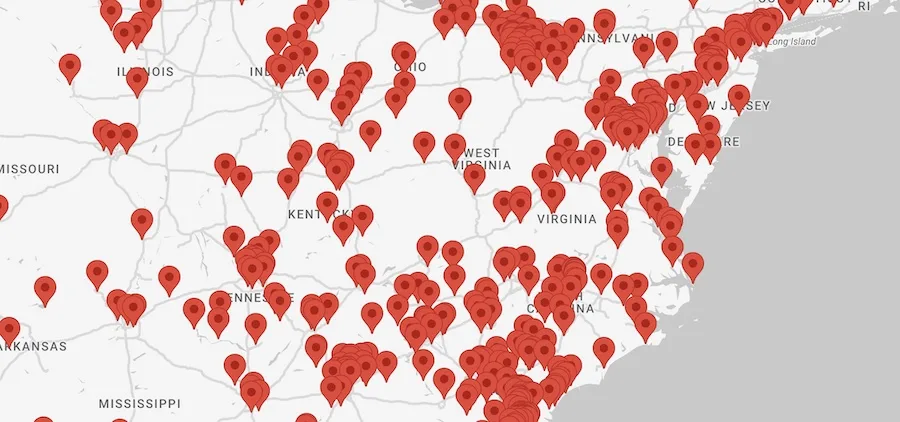

United Methodists this week are approaching a total of more than 7,000 congregations successfully disaffiliating by the conclusion of the year, approaching one quarter of all churches in the denomination.
Many of these disaffiliated congregations will eventually affiliate with the new Global Methodist Church (GMC), one of what I term “mainline-adjacent” denominations including the Anglican Church in North America (ACNA), North American Lutheran Church (NALC), and Evangelical Covenant Order of Presbyterians (ECO). These denominations uphold creedal orthodoxy, as evangelicals do, and also have an ongoing interest in ecumenical relations, as mainline Protestants do.
But while each of these four denominations shares common history with mainline Protestantism, their geographic distribution is distinct. Christians within these traditions can realize a fruitful ecumenical partnership with one another through this complementary geographic presence.
Congregations in the ACNA are disproportionately located in either major metropolitan areas, including urban cores, or in college towns.
Disaffiliated former United Methodist congregations that have already joined the Global Methodist Church are disproportionately found in rural areas, small towns, and exurban areas.
In Virginia, 227 congregations have disaffiliated from the United Methodist Virginia Annual Conference, the vast majority of which expect to join the GMC. However, only two of those congregations are located in the state’s populous northern Virginia suburbs outside of Washington, D.C. Neither is large or located near a major highway.
In contrast, the Anglican Church in North America has few rural congregations (my diocese has exactly one located in the West Virginia panhandle), but successfully planted churches across heavily populated Northern Virginia (north Arlington, Alexandria, Springfield, south Arlington, Burke, Chantilly and Vienna), Richmond, and the college towns of Charlottesville (University of Virginia), Blacksburg (Virginia Tech), Harrisonburg (James Madison University), Fairfax (George Mason University) and Williamsburg (William & Mary).
One reason for this geography is the relatively high bar that United Methodist congregations must reach in order to disaffiliate: two-thirds of a congregation must vote to approve disaffiliation, preventing a significant number of congregations with a traditionalist majority, but not a supermajority, from leaving the denomination with property.
My colleague John Lomperis has already written about patterns emerging in UMC disaffiliations. I would like to add how the geography of disaffiliation can assist in an ecumenical partnership between the GMC and the ACNA.
The usual caveats apply. Both the ACNA and GMC have significant church planting endeavors underway. In some cases, new Global Methodist-affiliated church plants have emerged from core groups that departed UMC churches, but without church properties. Just because there isn’t presently an Anglican or Global Methodist church in a place doesn’t mean there won’t be in the future. Also, the disaffiliation season in the UMC is not yet concluded and hundreds more congregations are expected to complete the process by the conclusion of the Book of Discipline’s time-limited Paragraph 2553 on December 31, 2023.
Friendly high level contacts between the ACNA and GMC already exist: at the ACNA’s College of Bishops gathering June 19-21 at Christ Church Plano near Dallas, Texas, GMC Bishop Scott Jones was welcomed as an invited guest. There will likely be a reciprocal invitation for Anglicans to the convening General Conference of the GMC September 20 – 26, 2024 in San Jose, Costa Rica.
Institutional contacts also are in place: many ACNA and GMC clergy are graduates of Asbury Theological Seminary, which prepares clergy for ministry in the Wesleyan tradition and has an ACNA-endorsed Anglican Studies Program.
A map of GMC congregations does not yet exist (I trust this project is already underway) but IRD’s compiled list of disaffiliated former UMC congregations shows a geographic footprint that almost perfectly complements that found on the ACNA church finder. Let’s foster this budding relationship and discover what the Lord may have in store for us.



Comment by Nick Thomas on November 10, 2023 at 2:35 pm
Global Methodist is perhaps the stupidest name ever, besides ACNA. Sounds like a 1990s-era start-up.
Comment by Ben on November 10, 2023 at 3:47 pm
Hi Jeff. Unless the last round of disaffiliations is different, it appears that very few churches that have disaffiliated from the Virginia Conference of the UMC have joined the GMC. Do you have special knowledge that the last class of churches disaffiliating in October will be different or that from the previous disaffiliations and/or churches taking much more time in Virginia than they have in other annual conferences to join the GMC?
Comment by David on November 10, 2023 at 11:48 pm
Curious why you don’t consider the Lutheran Church – Missouri Synod and Presbyterian Church of America as mainline-adjacent. Those are the groups in their respective traditions that I think of when I think of the GMC and ACNA.
Comment by Mary Short on November 11, 2023 at 9:21 am
Sadly, all of this is just the formation of another denomination putting God in a box nailed shut with rigid rules of conformity. This cavernous institution called church, with it’s thousands of dominations, all divided, has managed to “survive” through the centuries. There seems to be no interest in what it’s going to take for the church to thrive.
Comment by Elizabeth Cox on November 11, 2023 at 11:07 am
Where I am a member of the UNITED Methodist church, we were lied to, with secret meetings, plotting to take our church and the ENDOWNMENT that these disingenuous heretofore “friends” wanted more than following Jesus’s footsteps. It’s what they proclaim to do, but JUDGE, instead. They are like”‘murican christians” who don’t know the MEANING of what Christians are trying to do. “Love God, and love your neighbor(ALL of them) as you love yourselves.” The shame is theirs.
Comment by TxGal on November 11, 2023 at 11:43 am
That bit about 2/3 the Methodist congregation must vote to leave, thats not necessarily true. In the case of a Pearland/Manvel Tx church (2 locations) the vote was finnagled so the Manvel church would leave. It was what that minister wanted.
Comment by MJ on November 12, 2023 at 11:54 pm
David, the LCMS is a confessional Lutheran body that was never part of the ELCA. It has a much longer history than the ELCA and in that respect might itself be thought of as mainline, not mainline adjacent. On the other hand, the North American Lutheran Church (NALC) and the Lutheran Congregations in Mission for Christ (LCMC) are mostly churches that left the ELCA and are therefore more properly “mainline adjacent”.
Comment by Colin Ross on November 13, 2023 at 7:35 am
Boomers still arguing about gay marriage while their faith has collapsed is hilarious. No wonder people under 70 avoid church. For what it’s worth the break always are probably for the best. The big national churches are basically real estate and retirement trust funds. The episcopal church has so many buildings…yet so few people.
Comment by Tim McGonagle on November 13, 2023 at 8:30 am
“And again I say to you, it is easier for a camel to go through the eye of a needle than for a rich man to enter the kingdom of God.”