


Hi forgottenmaster!
Thank you so much for the thoughtful post — and your dwarf character sounds wonderful. I also answered your questions by email, but I wanted to reply here too so other players who may have similar questions can follow along.
A mountain-colony dwarf who grew up surrounded by mining, singing, drinking, and tradition, but slowly starts wondering what all of it is actually for, is a really strong Solitaria setup. It gives her a cosy change-of-pace journey on the surface, while still keeping a deeper mystery waiting in the background.
Also, thank you for giving the game a chance as your entry into solo journaling RPGs. Solitaria is meant to give structure while still leaving room for personal interpretation, so several of your rulings are absolutely playable. I’ll explain the intended reading for the current edition below.
1. Dream vs. Big Why
This is a very good question, because Dream and Big Why can look almost identical at first.
The easiest way to separate them is:
Your Dream is what your character deeply longs for. Your Big Why is why this Solitaria journey begins now.
Your Dream is your character’s inner north star. It might be something they want to discover, become, heal, prove, recover, or understand.
Your Big Why is the active reason they are here in Solitaria and the purpose that organizes their goals.
For your dwarf:
Dream: “To uncover the truth of what my dwarven society is mining for.”
That works very well as a Dream.
But the Big Why can explain what pushed her to Solitaria and what she needs from this journey before she can face that truth.
For example:
Family version: “I came to Solitaria because my family has mined for generations without knowing why, and I need enough distance from home to question what we were taught.”
Promise version: “I promised someone back home that I would find out what lies beneath the mountain, but I am not ready to return until I have courage, knowledge, and perspective.”
Disillusionment version: “I came to Solitaria because I could no longer keep living a life of mining, singing, and drinking without knowing what any of it was for.”
Curiosity version: “I came to Solitaria because every answer back home led to silence, and I believe this place may give me a new way to understand old mysteries.”
The Big Why does not have to be grand or poetic either. It can be very simple or practical.
For example:
Dream: “To become brave enough to live freely.”
Big Why: “I fell asleep on a ship, woke up in Solitaria, and now I have no way to get home because I have nothing valuable enough to pay for the journey back.”
That Big Why is not a lifelong dream. It is just the situation that starts the character’s current journey.
So yes, your Dream and Big Why can overlap. There is no harm in that. But if you want them to feel more distinct, try this:
Dream: “What do I truly want?” Big Why: “Why am I here in Solitaria now?” Goals: “What steps do I take because of that Why?”
For your dwarf, her Dream may be the truth beneath the mountain. Her Big Why may be that she needed to leave the mountain before she could even understand what questions to ask.
2. Attribute scores, -1 traits, and the Red Trait / Weakness
You are reading the setup correctly: you assign -1, 0, +1, and +2 across the four suits, and the Red Trait / Weakness receives an additional +2. So yes, depending on where you place it, the Red Trait can become a very strong modifier, such as +4.
The important part is that trait modifiers are not automatic.
When a Fate Card is drawn, its suit points to the trait that may apply. You only apply that modifier if you weave that trait into the narration or journal entry for that action.
Why would someone use a -1 trait?
You do not have to use a -1 trait every time it appears. If it does not fit the scene, you can leave it out and resolve the Fate Step without that modifier.
But there are good reasons to use it.
Sometimes it is simply the most honest fit for the scene. Solitaria is a journaling game, so the best moment is not always the one with the highest bonus. Sometimes it is the moment that best reveals who your character is.
For example:
A Brave -1 character rushes across an unstable bridge before checking the ropes. Their bravery is real, but here it becomes recklessness.
A Curious -1 character gets distracted by strange carvings during a dangerous ruin exploration.
A Calm -1 character tries to stay composed during an emotional conversation, but comes across as distant.
An Independent -1 character refuses help and makes the task harder than it needed to be.
A Helpful -1 character tries to assist everyone at once during a festival and ends up overextended.
The Fate Card also matters. You are not freely choosing from all four traits every time. If the card points to your -1 trait, the choice is usually:
Use that trait and take the -1 because it fits the scene, or leave it out and take no trait modifier.
Using a -1 trait can also be a nice way to show growth over time. If that difficult trait keeps appearing in your journal, then later improvement or mastery of that trait feels more meaningful.
Why does the Weakness give such a strong bonus?
Your interpretation is very close to the intent: we want the Red Trait / Weakness to appear in the story instead of being avoided.
The Red Trait bonus does not mean the weakness stops being a weakness. It means that when the weakness enters the scene, it creates a very specific way for the character to act. The character might succeed because of it, despite it, or while paying an emotional cost.
Examples:
A Distrustful character catches a lie because they ask one more question, but the scene still shows that they are guarded and tense.
A character with Fear of Darkness moves slowly through a ruin, one hand against the wall, paying attention to every sound. Because of that fear, they notice a hidden seam in the stone.
A Perfectionist character creates a beautiful lantern because they obsess over every detail, but the journal can still show the stress, frustration, and difficulty knowing when to stop.
A Socially Anxious character notices subtle body language because they are carefully watching the room before speaking.
A Homesick character receives a letter from home and feels the ache of it, but that feeling reminds them why they came to Solitaria and helps them continue.
So the weakness can help the character succeed, but it should still feel like a weakness in the story.
Your house rule of forcing the Weakness to be -1 and always applying it is a valid “harder mode” if that gives you the feeling you want. It makes the weakness more punishing. The intended default is a little gentler: the weakness is encouraged by giving it a strong bonus, not by forcing it to make every scene harder.
3. Returning home, Windwhistle Summit, and camping
For the current edition, the safest default is that your Home Island remains the center of the daily loop. When the day ends, or especially when Energy reaches 0, returning home is the cleanest reading.
The current main gamebook does not yet have a full camping system. So there are not currently full rules for setting up camp, sleeping away from home, managing supplies, or using camp actions.
However, some actions are written as ongoing activities. Summit Hike in Windwhistle Summit is one of those cases because it says the journey is ongoing as long as you remain in Windwhistle Summit, and that you may pause and resume the hike.
For that specific action, you may preserve the progress the action tells you to track, such as accumulated Heads, while your character remains involved in that Windwhistle Summit journey.
But I would not treat that as a general “camp anywhere” rule in the current edition.
So your conclusion, returning home at the end of each day as the default, is a good current-edition ruling.
We are also working on an expansion that explores travel, camping, and staying away from Home Island in more detail, but that system is still in progress and is not part of the current main gamebook yet.
4. Mailbox
The Mailbox can be used to send messages to anyone, anywhere, anytime in the world.
That includes:
Islanders you have met,
NPCs on other islands,
people from your character’s former life,
family and friends back home,
unknown or mysterious recipients,
or even someone you are not completely sure can receive the message yet.
So yes, it is absolutely appropriate to use the Mailbox to communicate with home or the outside world.
It is also still useful for Solitaria-based NPCs because letters can create a different kind of scene than direct travel: delayed replies, emotional distance, private thoughts, rumors, invitations, requests, or offscreen developments.
A simple rule is:
If a letter would enrich your story, the Mailbox can carry it.
5. Starting abilities and custom starter abilities
This is an area where the current text can definitely be clearer.
The intended flexible ruling is:
Template characters begin with one of their listed template abilities.
Custom characters may either begin with no ability, for a stricter progression path, or create one starter ability that is about as strong as a template ability.
For custom abilities, the main question is whether the ability is narrative-only or mechanical.
A narrative-only ability does not add numbers, skip actions, guarantee success, or bypass uncertainty. It simply gives your character permission to be described a certain way. These usually do not need a Power cost.
A mechanical ability changes the game in some way: adding a bonus, saving Time, restoring Energy, changing a Fate Step, revealing information, or improving rewards. These need clearer limits, and stronger ones should usually cost Power.
For your hidden passage idea, I would suggest one of these versions:
Narrative-only version: Secret-Keeper’s Instinct Your character is especially good at noticing signs of hidden construction: odd drafts, mismatched stones, old hinges, unusual echoes, worn floor patterns, or suspicious wall seams.
No Power cost is needed because it does not automatically reveal anything or add a bonus.
Starter mechanical version: Secret-Finder’s Eye Passive. No Power cost. When performing an Adventuring, Island Activity, or Investigate Search Fate Step specifically to find hidden passages, trapdoors, secret routes, or concealed architectural details, gain +1.
This is a good starter ability because it is useful but narrow. It does not apply to all exploration, all ruins, or every perception-related moment.
Stronger active version: Stone-Echo Sense Active. -1P. Before making a Fate Step related to ruins, caves, stonework, underground paths, hidden doors, or old architecture, ask one focused question such as “Is there a hidden route here?” or “What detail feels out of place?” Then gain +1 to the related Fate Step.
This version gives both information and a bonus, so it should cost Power.
As a general custom ability guide:
Small and narrow +1 bonus = usually okay as a starter passive.
Pure narrative permission = no Power cost needed.
Broad bonus, extra information, reroll, outcome change, or automatic discovery = should usually cost Power.
Guaranteed success or skipping major requirements = probably too strong for a starter ability.
6. “Can always do” actions
This is another good question.
Most of Solitaria’s gameplay is structured. When something matters mechanically, you usually choose an action, spend Energy or Power if required, advance Time if required, flip a coin or perform a Fate Step if instructed, resolve the result, and then journal what happened.
The “can always do” actions are different.
They are character-facing prompts that your character can always perform regardless of circumstances. They do not require a specific location, tool, Energy cost, Time cost, Fate Step, or special setup by default.
They are there to help you express your character’s personality even when you are not performing a full mechanical action.
Examples might include:
saying a familiar phrase,
asking a reflective question,
complimenting someone,
quietly observing,
writing a small note,
or reflecting during journaling.
These are not the only free things you can narrate. You can still narrate naturally and freely.
The distinction is:
If you want a mechanical result, such as gaining Favor, gathering resources, completing a Goal, discovering something, crafting an item, or changing the situation, use the proper action and pay its costs.
If you are expressing who your character is, adding flavor to a scene, or using one of the listed “can always do” prompts, you may do it freely.
So the list is not meant to say “only these things are free.” It is saying “these are things your character can always rely on, no matter where they are or what situation they are in.”
7. Rize Sprite and timing
Your instinct here is right.
Rize Sprite is best treated as a pre-day setup and guidance step, not as one of the main actions that consumes your limited daily clock.
So consulting Rize Sprite itself should not spend Time or Energy.
The Rize Sprite helps set the day: weather, mood, possible focus, prompts, or guidance. After that, you choose what your character actually does.
If the Rize Sprite points you toward an action, such as checking the Mailbox, going shopping, tending the garden, or investigating noises, that follow-up action uses its normal Time / Energy cost.
So:
Consulting Rize Sprite = no Time cost.
Following the prompt with a real action = use that action’s normal cost.
This keeps the 3TS day from feeling reduced before the player has had a chance to make meaningful choices.
About your current rulings
Your rulings are totally playable, especially for a first journey while learning the system.
I would summarize the intended version like this:
Having Dream and Big Why close together is fine, but adding “why now?” or “what pushed her here?” will make the Big Why more useful.
Forcing Weakness to -1 is a valid harder house rule, but the default Red Trait is meant to be a strong bonus that encourages vulnerability in the story.
Always applying Weakness when it appears is also a valid harder interpretation, but by default trait use is optional and narrative-based.
Returning home at the end of the day is the safest current-edition default.
Rize Sprite should not consume Time by itself; only the action you choose afterward should.
And thank you for mentioning the discrepancies and typos. We’re collecting these for a cleanup pass, especially around rules clarity, examples, and places where the wording leaves too much room for confusion.
I’m really glad you’re already journaling the invitation and arrival. Your dwarf’s story sounds like a lovely fit for Solitaria: cosy exploration on the surface, with a deeper question waiting beneath the stone.
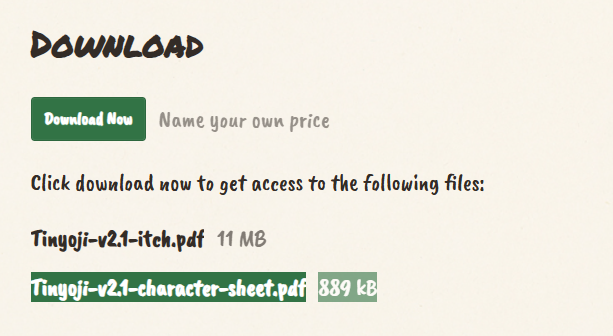 Click Download
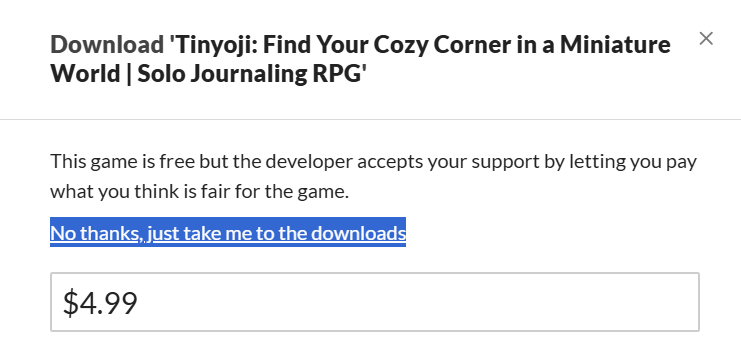 Select “Pay nothing / Take me to downloads”
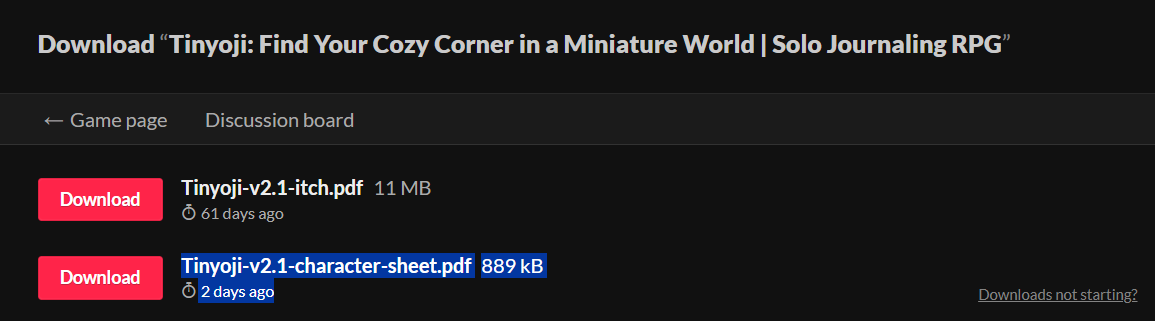 Download Tinyoji-v2.1-character-sheet.pdf
 Instructions: Upload an image (like the cover art below) to your post or link to one hosted online. Use Markdown:
  (Replace this whole line with your actual embedded image!)