| Site News |
|---|
| Warning: This wiki contains spoilers. Read at your own risk! |
Laguz

| “ | What do you think it would be like, to change into a bird or a dragon, as the laguz can? Being part beast is one thing, but being able to transform into that beast, with more strength than we could ever imagine... I mean, they could build a place like this before breakfast. | ” | — Sothe |
|---|
The laguz (pronounced /ləˈɡuz/[key][1]; Japanese: ラグズ laguz) are a sentient race of shape-shifters which inhabit the continent Tellius, appearing in Fire Emblem: Path of Radiance and Radiant Dawn. While they ordinarily appear in humanoid forms, they have the ability to temporarily focus their energies and shift into the form of an animal, gaining great power and strength from these forms. Every laguz is part of one of three tribes—beast, bird, and dragon—with each tribe being made up of several "clans", or unique animal races, each having their own unique set of skills and powers.
Laguz are a counterpart to the beorc, and like the beorc, they are descended from the ancient Zunanma race. While beorc are widely regarded as the "children of wisdom", the laguz are instead called the "children of strength", reflecting their mighty, bestial power. Relations between the two races have long been strained, with centuries of slavery, abuses and derision as "sub-humans" suffered by the laguz at beorc hands leaving many laguz resentful and wary of the beorc. The laguz tribes maintain their own countries away from the beorc. On rare occasions, beorc and laguz interbreed, creating the Branded.
Society
Historically, most laguz lived in the same societies as beorc, but increasing pressure from beorc abuses eventually led the majority to abandon beorc lands and create their own nations. Unlike beorc societies, where responsibility and prestige are often based entirely on a person's bloodline, most laguz societies have a philosophy of rule by the strong. Worthiness for leadership is determined by who the strongest in a group of laguz is, which also extends to the royal families of the laguz nations, which are governed by the strongest laguz of the tribe. It is believed by the laguz that this makes their monarchs inherently more trustworthy, since their abilities are proven.[2] For this reason, the ruler of a laguz nation tends to come from the inherent strongest caste living there, such as the lions or the black dragons.
The clans usually feel a strong kinship with the other clans of the tribe. In many cases all of a tribe's clans will peacefully live together within the same nation-state. The birds are the primary exception to this, but even they both started as one nation and resolved to become one again after the events of Radiant Dawn.[3]
Characteristics
Laguz tribes
Between the three tribes, there are a total of ten unique laguz clans.
The beast tribe is comprised of laguz who can transform into carnivorous land mammals, with the majority of beast clans having feline forms. This tribe mostly inhabits the Kingdom of Gallia, in the forests in Tellius's far west.
- Cats: A lithe beast clan whose members are light on their feet and fight with swift claw strikes.
- Tigers: A bulky, resilient beast clan with mighty defenses and powerful claw and fang attacks.
- Lions: The mightiest of the beast tribe, the lion clan comprise the ruling caste of Gallia. They possess extreme raw strength beyond even the tigers.
- Wolves: Once believed to be entirely extinct in Tellius after the Great Flood, this clan survived in the nation Hatari, on the other side of the Desert of Death. They were rediscovered when Volug and Nailah traveled across the desert with the heron Rafiel and befriended Micaiah.
The bird tribe is comprised of laguz who can transform into various real-life bird species. Unlike the beasts, the birds are divided into numerous nations owing to the differences and disagreements betweeen the clans. This did not change until after the events of Radiant Dawn, where they unified into one country in Serenes under the hawk Tibarn.[4]
- Hawks: A proud bird clan which fights with both might and swiftness.
- Ravens: A cunning bird clan with little raw strength own, but who confound their enemies with their blistering flight speeds.
- Herons: A clan unique among the laguz for both their pacifist ways and for their ability to practice magical arts through the power of their singing. Formerly inhabiting the Serenes Forest, they were driven to extinction in a genocide known as the Serenes Massacre.
The dragon tribe is comprised of laguz who can transform into various types of dragons. The dragon tribe lives in the isolated kingdom of Goldoa, separating themselves from the rest of Tellius as a result of their great power.
- Red dragons: A caste of dragon laguz who tend toward being bulky and physically strong.
- White dragons: An arcane dragon laguz caste which wields power more in line with the magic of humans.
- Black dragons: The rarest of the laguz dragons and their ruling caste. Black dragons are extremely powerful and possess longevity greater than any other laguz clan, and by extension vastly beyond that of beorc.
In gameplay of Path of Radiance, untransformed laguz have their classes labeled as the tribe names ("Beast Tribe", "Bird Tribe", and "Dragon Tribe").
Physical appearance


When in their humanoid forms, laguz usually keep some features of their beast forms. As a general rule, beast tribe laguz keep the ears and tails, and bird tribe laguz keep the wings. The dragon tribe is the exception, as they do not have any features on their dragon forms and instead they have distinctive deep orange skin and, in some cases, tattoo-like markings on their forehead. Other than these features, laguz look very similar to beorc. It is possible for bird laguz, at least, to hide their wings and successfully disguise themselves as beorc, but grave distress will cause them to lose their grip on this ability and reveal their wings.[5]
Needless to say, the animal forms of a laguz generally look identical to the real-life animal in question, with the exception of size. Animals that are actually smaller, such as cats and ravens, have their laguz counterparts instead be at least the same size as a human. Laguz of the beast tribes tend to vary greatly in their fur coloration, while birds and dragons are not known to have much variety in the colors of their feathers and scales.
Life cycle and reproduction
All laguz live longer than beorc. The dragon laguz are by far the most long lived, with the dragon king Deghinsea being well over one-thousand years old, being an adult and participating in the war against Yune. According to the first volume of Tellius Recollection, Dragon laguz have an average lifespan of 1000, with each specific tribe varying by a handful of decades.[6]
Lion, cat, tiger, raven, and hawk laguz average out at around 200 years, give or take a few decades.[6] Lehran, a heron laguz, is at around two-thousand or so, being present for the first conflict with Yune, and also present for Ashunera's awakening in the epilogue in Radiant Dawn, which takes place one-thousand-two-hundred years afterwards.[7] However, Lehran's longevity seems to be unprecedented among herons, as their average lifespan is stated to be 300.[6]
Laguz appear to reproduce in a manner very similar to beorc, with mothers gestating their babies in long periods of pregnancy and eventually giving birth, rather than ways similar to animals. This was not always the case, however, as Janaff claims that hawk laguz, at least, once hatched from eggs.[8] Dragon laguz in particular, like their manakete counterparts in other games in the series, have difficulty reproducing and have extremely low birth rates: Kurthnaga was the last dragon to be born for centuries until the birth of Ena and Rajaion's child.[9] The dragons also appear to have extremely long pregnancies, as Ena's child was born three years after Rajaion's demise and she had presumably been pregnant for years beforehand.
It is possible for beorc and laguz to reproduce with each other, although it is rare for such a couple to successfully conceive.[10] When they do so, the resulting child appears to be an ordinary beorc child but carries laguz blood which gives the potential for great power. This power manifests either immediately in the child or in one of their own descendants, creating a Branded. A Branded usually possesses a unique power depending on the tribe of their laguz parent/ancestor, but the Branded bloodline comes at a cost for the laguz parent, who completely loses their laguz powers.
Mixed relationships between laguz of different clans are not unheard of, and these relationships are able to result in offspring. While there are no known cases of, for instance, a beast pairing with a bird, there are known cases of couples composed of a heron and a raven, and a red dragon and a white dragon, resulting in children. The results differed in both cases: on one hand, the case of Ena, a red dragon with white dragon ancestry, resulted in a mixed dragon with physical traits from both clans, such as her pink coloring in her dragon form. On the other hand, the case of Naesala and Leanne (a raven and a heron, respectively) resulted in the couple having one heron child and one raven child.
Powers

The primary power shared by all laguz is their ability to shift between humanoid and animal forms. This ability depends on their health and stamina. Maintaining the beast form is inherently exhausting for laguz so, with very few exceptions, they are unable to remain in it for long, and after being shifted for a while they will have no choice but to revert and rest until they have the strength to shift again.[11] Injury and exhaustion will prevent them from being able to shift at all for the time being.[12]
One way around this limitation is the act of "halfshifting", or adopting a transitional beast form, through use of a Demi Band or the Wildheart skill. While halfshifting leaves a laguz weaker than they would be had they shifted properly, doing so allows them to remain shifted for as long as they like with no restrictions.[11] Laguz are also able to replenish their strength by consuming herbs or other items such as Olivi Grass or Laguz Stones. Through the Laguz Band item and Formshift skill, Laguz monarchs are uniquely able to remain shifted indefinitely without weakening themselves at all.
Different laguz clans tend to have different abilities from each other. The majority are gifted with great physical strength, with the average laguz being stronger than the average beorc, while some specialize in high speeds or defensive aptitude. Two laguz clans, the herons and the white dragons, are gifted in magic-related powers instead: the white dragons' magic powers are offensive through their breath attacks, while the herons use their magic to cast non-violent galdrar.
Laguz are inherently more affected by chaotic energies than beorc. High levels of chaos in battle will cause laguz to lose control and fight wildly without thought or restraint.[13] The dragon tribe in particular is extremely susceptible to this, made even more dangerous by their immense power.[14]
All laguz clans innately possess some ability to sense the presence of others of their kind. Its strength varies greatly depending on individual clans: tigers, lions, hawks, and ravens have a relatively weak grasp of this ability, cats have an adequate aptitude for it, herons have a greatly developed ability, and all dragon clans have the strongest sense ability of all laguz.[15]
Relationship with the beorc
| “ | You knew no other name for us? Are we really so little to you, human? You, who forced us into slavery? How easily you forget. But we laguz! We remember. We remember how we have suffered at your hands. The king can say whatever he likes, I will not trust you. I warn you now...never speak to me in such a way! | ” | — Lethe |
|---|
The racial conflict between laguz and beorc is technically older than the laguz and beorc themselves, arising back when both were still the Zunanma. When the Zunanma evolved and began to separate into unique races, wars broke out on racial lines with each clan seeking to assert their superiority over the others, and the division of the two between the "laguz" and "beorc" labels was an attempt by Ashunera to try and stop the battle by separating the factions which backfired significantly.[16] The endless conflicts between laguz and beorc was the cause of the Great Flood, and although in its aftermath representatives of all races pledged to Ashera that they would pursue peace, this promise barely lasted two centuries.
At first both beorc and laguz lived together as equals in Begnion, with the exception of the isolationist dragon laguz, but over the years bigotry formed among the beorc toward the laguz, and the beorc slowly moved to consolidate absolute power over Begnion. Within two centuries, the Begnion senate declared that only beorc had the right to rule Begnion and established that the laguz were sub-human, and before long many laguz were captured and subjected to slavery under human masters. After 200 years of slavery, laguz began to escape beorc captivity and fled Begnion to find lands to call their own outside beorc control. The beast tribe was the first to succeed at this with the formation of Gallia in the western woodlands.[17] The hawks and ravens fled to the southern islets and formed Phoenicis after being inspired by the example of the beast tribe. Beorc society itself began to experience schisms over the laguz issue, with both Crimea and Daein being founded in response to changing attitudes about laguz – the Crimeans seceded over a wish to find peace with the laguz during a period of high anti-laguz sentiment, while Daein seceded when the Begnion view became more pro-laguz out of a wish to continue to practice bigotry against laguz.[18]
Sentiment in beorc nations

Even after all was said and done and the four new laguz nations – Gallia, Phoenicis, Kilvas, and Serenes – were formed, the situation in Begnion did not improve. Laguz slavery continued to be practiced, even after it was outlawed by Apostle Misaha's Laguz Emancipation Act, and popular attitudes still maintained casual bigotry toward laguz with the slur "sub-human" remaining frequently used. When the likes of Misaha and Sanaki tried to work toward establishing equality for laguz, the Begnion senate tried to undercut them at every turn and maintained laguz slave trafficking after the emancipation decree. Anti-laguz sentiment was famously used by the senate after the assassination of Misaha, as when they blamed the assassination on the heron clan, the people of Begnion readily reverted to angry anti-laguz rhetoric and committed the Serenes Massacre.
Daein, as a country founded on anti-laguz sentiment, played on this very heavily for most of its existence. Anti-laguz viewpoints were deeply ingrained into education in Daein schools, teaching that all "sub-humans" must be destroyed, and anti-laguz violence was an active part of Daein military service in the form of "sub-human hunts", where the army would find laguz refugees from Begnion hiding in Daein's mountains and forests and murder them.[19] When Daein joined the war with the Laguz Alliance, the army established large bounties for every laguz "hunted" in the course of the war, even though a laguz served in the army.[20] Daein is notorious as the nation responsible for the creation of Feral Ones, a process devised to strip laguz of their humanity and reduce them to tools to be used by Daein to wage its wars.
Even in Crimea, a nation explicitly founded to seek friendship with the laguz, issues arose. For all the pro-laguz rhetoric of the ruling class of Crimea, it never really carried over into the citizens.[21] While the reign of Ramon, Elincia's father, ensured some improvements in Crimean relations with the laguz, citizens of rural towns were still readily swept away by hatred toward laguz at the sight of one and readily believed rumors that Ramon's attempts to build peace with the laguz was the cause of Daein's invasion.[22] Relations were improved again after the Mad King's War, when Gallia provided significant assistance in reconstructing Crimea, but it was evident that the bigotry would still take a very long time to go away completely.[23]
Sentiment in laguz societies
For their part, attitudes toward beorc in laguz societies were far from positive as a result of the centuries of abuses, and a laguz who would truly trust any and all beorc was rare. Laguz societies adopted the term "human" as a slur word for beorc, meant in much the same way as the beorc slur "sub-human".[24]
Gallia, as the closest laguz nation to beorc territory, experienced strong anti-beorc sentiment at the time of the Mad King's War's beginning despite their official alliance with Crimea, an alliance which their citizens respected just as little as Crimea's.[25] At best, some Gallian laguz were instinctively nervous and easily startled around even known friendly beorc.[26] Almost all members of the Gallian army were opposed to the idea of personally travelling with the Greil Mercenaries, save for Lethe (herself not at all fond of beorc) and Mordecai.[27] Some Gallians came up with methods which would supposedly ward away encountered beorc such as pretending to be dead.[28]
The nations of the bird tribes, Phoenicis and Kilvas, adopted extreme anti-beorc attitudes as a response to the Serenes Massacre and the near-extinction of their heron brethren. Tibarn of Phoenicis refused all dealings with beorc and began to actively pirate from Begnion trading ships in protest.[29] Although Naesala of Kilvas agreed in principle, he was willing to continue his shady dealings with beorc if it meant advancing Kilvas's survival.
Laguz relations with beorc nations first began to mend during the Mad King's War through the actions of Ike of the Greil Mercenaries. His defense of Leanne and Reyson from Oliver earned him the trust of Tibarn and later allowed him to unite warriors from Gallia, Kilvas, and Phoenicis under the cause of defeating Daein and freeing Crimea. However, despite these advances, the three laguz nations as the Laguz Alliance declared war on Begnion three years later once they learned of the Begnion senate's role in the Serenes Massacre, although the improved diplomatic state convinced them that known trustworthy members of the Begnion government, such as Sanaki, were not involved. Late in the war, the Laguz Alliance formed a deal with Sanaki and Elincia to assist in defeating the senate in exchange for instituting a clean slate for beorc–laguz relations and putting a permanent end to beorc abuses of laguz.[30]
Treatment of the Branded
| “ | Among the laguz, there are those who detest and revile half-breeds such as yourself. They call you "parentless," and deny you any laguz heritage, honor, or dignity. Take due care. | ” | — Muarim |
|---|
Although the Branded are already treated very poorly by beorc societies, laguz societies tend to treat them far worse. Branded are commonly known as "parentless", a term which rejects that Branded are related to laguz at all, and in Gallia a legend tells that a century of destruction will follow the birth of a Branded.[31] Whether they realize it or not, all laguz can identify a Branded by an instinctive feeling of discomfort and fear around them, though not all laguz realize that the Branded element is what they are sensing.[32][33]
Laguz refuse to interact with or even acknowledge a known Branded, instead pointedly ignoring them and pretending they simply do not exist under ordinary circumstances.[32] The Branded are actively persecuted by laguz in the regions where they hold power and are hunted and executed in honor killings.[34] The poor treatment of Branded by laguz led many Branded, notoriously including Soren, to be actively hateful toward laguz.[31]
Flavor text
| Game | Text (English) |
Text (Japanese) |
|---|---|---|
| Radiant Dawn | Beings known as the Children of
Strength. They are divided into three tribes: beast, bird, and dragon. They transform into their animal forms during combat to fully utilize their physical prowess. |
【力の民】とも呼ばれ、大きく
獣牙族・鳥翼族・竜鱗族の 3種に分けられる。 戦闘時には "化身" し 己の有する能力を最大限に引き出す。 |
Etymology and other languages
| Names, etymology, and in other regions | ||
|---|---|---|
| Language | Name | Definition, etymology, and notes |
| English |
Laguz |
From *laguz, a Proto-Germanic word that can mean "water", "sea", or "ocean". Laguz is also the reconstructed Proto-Germanic name of the rune character ᛚ, which represented the "L" sound. |
| Japanese |
ラグズ |
Officially romanized as Laguz. |
| Spanish |
Laguz |
-- |
| French |
Laguz |
-- |
| German |
Laguz |
-- |
| Italian |
Laguz |
-- |
| Portuguese |
Laguz |
Mentioned in Heroes. |
| Korean |
라구즈 |
Laguz; first used in the trophy description of Ike in Super Smash Bros. Brawl. |
| Traditional Chinese |
拉古茲 |
Laguz; mentioned in Heroes. |
Gallery
-
 A gathering of laguz in a Path of Radiance cutscene.
 -
 A gathering of cats and hawks civilians in Radiant Dawn's ending cutscene.
 -
 Ranulf, a cat laguz.
 -
 Muarim, a tiger laguz.
 -
 Volug, a wolf laguz.
 -
 Giffca, a lion laguz.
 -
 Rafiel, a royal heron laguz.
 -
 Lehran, a non-royal heron laguz.
 -
 Naesala, a raven laguz.
 -
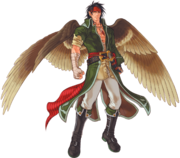 Tibarn, a hawk laguz.
 -
 Gareth, a red dragon laguz.
 -
 Nasir, a white dragon laguz.
 -
 Kurthnaga, a black dragon laguz.
 -
 Concept art of a male beast laguz from Tellius Recollection: Volume 1.
 -
 Concept art of a female beast laguz from Tellius Recollection: Volume 1.
 -
 Concept art of a male bird laguz from Tellius Recollection: Volume 1.
 -
 Concept art of a female bird laguz from Tellius Recollection: Volume 1.
 -
 Concept art of a male dragon laguz from Tellius Recollection: Volume 1.
 -
 Concept art of a female dragon laguz from Tellius Recollection: Volume 1.


References
See also
| Races and animals of the Fire Emblem series | ||||||
|---|---|---|---|---|---|---|
|
| Fire Emblem: Radiant Dawn | ||||||||||||||||||||||||||||||||||||||||||||||||
|---|---|---|---|---|---|---|---|---|---|---|---|---|---|---|---|---|---|---|---|---|---|---|---|---|---|---|---|---|---|---|---|---|---|---|---|---|---|---|---|---|---|---|---|---|---|---|---|---|
| ||||||||||||||||||||||||||||||||||||||||||||||||