(1) DEADLINE APPROACHING TO NOMINATE FOR DRAGON AWARDS. Nominations are being taken for the 2026 Dragon Awards until July 12.

(2) REVISITING THE CODOMINIUM. Mark Atwood says about Baen author Jerry Pournelle’s CoDominium stories – “The CoDominium Was a Warning, Not a Forecast”. Atwood writes “The CoDominium is a setting that got more legible after its geopolitics expired. That’s what happens when you’re diagnosing the disease and everyone else is arguing about the symptoms.”
Jerry Pournelle’s CoDominium stories land in Analog between 1971 and 1973, right as Nixon and Brezhnev are signing SALT I and the ABM treaty. The setting depicts a near-future where the United States and Soviet Union merge their militaries, carve up the world, and collude to suppress any technology that might destabilize the arrangement. Read at a glance, it looks like Pournelle bought the mid-century assumption that both superpowers were converging on the same managerial form. Galbraith’s technostructure with different flags.
He didn’t buy it. He weaponized it.
“Superpower condominium” was a live term of art in 1970s foreign policy. It’s what Peking and Gaullist Paris accused Washington and Moscow of building: a duopoly that carves up the world and colludes to keep everyone else down. Pournelle took the accusation literally and named his setting after it. That’s not agreement with convergence optimism. It’s taking the Chinese critique of détente and saying: yes, exactly, and here’s what it looks like fully ripened.
The intellectual lineage runs through James Burnham, not John Kenneth Galbraith. Burnham’s The Managerial Revolution argued the converging managerial form was coming regardless of ideology, and Burnham was a founding-generation anti-communist Cold Warrior. You could take managerial convergence seriously as a threat model while hating it. Pournelle, PhD in political science, protégé of Stefan Possony at the Hoover Institution, was squarely in that tradition. Notice what the CoDominium actually converges on: not shared values, but the shared class interest of two ruling elites who discover they fear their own populations, nationalist movements, and destabilizing technology more than they fear each other. The ideologies were always liturgical. The apparat is what’s real, and two apparats can do business.
The tell that it’s a nightmare and not a forecast is the technology suppression.
In the CoDominium future, Fleet intelligence assassinates physicists and buries research. This is the precise inversion of The Strategy of Technology, which Pournelle co-wrote with Possony and Francis X. Kane. That book argued technological momentum is the decisive weapon; freezing the competition is suicide-by-stability….
(3) HISTORY SHOWS AGAIN AND AGAIN. [Item by N.] The sequel to Minus One, Godzilla Minus Zero stomps into theaters on November 6.
(4) SIGN UP FOR PKDFEST2026. Registration for PKDFEST2026, The 4th International Philip K. Dick Festival, is open and free. August 20–23, 2026. Fullerton Marriott at California State University. Four days of panels, readings, world premieres, and the first-ever Pink Beam Awards.
(5) CREATIVE ARTS EMMY AWARDS. Animation Magazine lists “2026 Emmy Awards: All the Animation & VFX Nominees”.
…The 78th Emmy Awards, hosted by Emmy Award winner Mariska Hargitay, will air Monday, September 14 at 8 p.m. ET/5 p.m. PT from the Peacock Theater at L.A. LIVE., airing live coast-to-coast on NBC and streaming on Peacock. The Creative Arts Emmy Awards, which include Outstanding Animated Program and Outstanding Special Visual Effects categories, will take place on Saturday, September 5, and Sunday, September 6….
Outstanding Animated Program
- Bob’s Burgers – “Grand Pre Pre Pre Opening” (FOX / 20th Television Animation)
- Rick and Morty – “There’s Something About Morty” (Adult Swim / Rick and Morty LLC, Williams Street)
- The Simpsons – “Homer? A Cracker Bro?” (FOX / Gracie Films, 20th Television Animation)
- Smiling Friends – “Le Voyage Incroyable de Monsieur Grenouille” (Adult Swim / Williams Street)
- South Park – “Sermon on the Mount” (Comedy Central)
- Star Wars: Visions – “Black” (Disney+ / Lucasfilm, David Production)
Outstanding Character Voice-Over Performance
- Pamela Adlon – Bobby Hill, King of the Hill
- Julie Andrews – Lady Whistledown, Bridgerton
- Hank Azaria – Gary Chalmers, The Simpsons
- Trey Parker – Satan, South Park
- Matt Vogel – Kermit the Frog, The Muppet Show
- Steven Yeun – Mark Grayson/Invincible, Invincible
Outstanding Special Visual Effects in a Season or a Movie
- Alien: Earth (FX/Hulu)
- Foundation (Apple TV+)
- IT: Welcome to Derry (HBO Max)
- Monarch: Legacy of Monsters (Apple TV+)
- Prehistoric Planet: Ice Age (Apple TV+)
- Stranger Things (Netflix)
Outstanding Special Visual Effects in a Single Episode
- Gen V – “New Year, New U” (Prime Video)
- A Knight of the Seven Kingdoms – “In the Name of the Mother” (HBO Max)
- Paradise – “Exodus” (Hulu)
- Spider-Noir – “Nightmare on a Gurney” (MGM+/Prime Video)
- The Walking Dead: Daryl Dixon – “Costa da Morte” (AMC)
(6) KGB. Ellen Datlow has shared her photos from “Fantastic Fiction at KGB July 8, 2026” on Flickr.
Sam Rebelein read an excerpt from his chapbook and Victor Manibo read from his work in progress, a novel coming out in 2028. A large and enthusiastic audience!
(7) JY MEMORIES. Here’s a Jane Yolen tribute by her daughter Heidi Stemple: “Lessons from My Mother, Jane Yolen” at the School Library Journal.
…My brothers and I have always known we shared our mom with the world, and these last two weeks really brought that home. Years ago, she told me, instead of a headstone, when she died, she wanted a bench where people could sit and read. She wanted it to say, “She wrote many good books and one great one,” because, she said, she wanted everyone to pick their own favorite.
I may have laughed at the time, but in the online memorials since her death, I can see that this is, indeed, appropriate. Everyone has pointed to their own special Jane Yolen book—not just the classics. Yes, the “How Do Dino” books and Owl Moon, but also dragon books and Merlin books, long out-of-print picture books, nonfictions, and ones even I had forgotten about. It’s like she knew (of course she knew) that each reader connects with a book in their own way. An individual book may not be right for every reader, but with so many, six decades of readers have found their way to at least one of her stories. And made it their own.
She, by the way, will be getting a headstone and the bench.
What can I say that hasn’t already been written? My mom was so smart. She had a once-in-a-lifetime imagination. Everything became a story once she got ahold of it. She was a lifelong learner. Often, at conferences, she would attend sessions other authors were teaching. I never could get her to understand how nerve wracking it must be to have Jane Yolen in the front row of your workshop taking notes….
(8) IAN MAULE (1952-2026). British fan Ian Maule died July 8. Originally a member of the Gannets from Newcastle upon Tyne, he moved to London in the mid-1970s, and later to Surrey where he became a leading member of the Surrey Limpwrists group.
Maule edited the newzine Checkpoint from issue #63 to #73. He also published By British: A Fanthology of the Seventies (with Joseph Nicholas).
(9) GERRY CONWAY (1952-2026). The Comics Journal profiles “Gerry Conway, 1952-2026” who died April 26.
He grew up: that’s the important thing to remember. He had swaggered into the lecture hall in Bloomington that morning with the same confidence he swaggered into Marvel Comics two years earlier: with the assurance of a pro. Gerry Conway had come to Indiana in September 1972 to deliver a guest lecture at Indiana University’s first-of-its-kind “The Comic In Society” course (instigated at the school by future Swamp Thing and Batman film producer Michael Uslan). Conway was, to be sure, a high-profile get for the course’s lecture series: four months earlier, he had taken over from Stan Lee as scripter on Marvel’s Amazing Spider-Man, the first writer to be permanently assigned to Marvel’s flagship title apart from Stan himself.
Still, it must be admitted, the article in the Herald-Times might have oversold him. “Gerry Conway, a New York City writer who created Spiderman [sic], Daredevil, Thor and the Hulk for Marvel Comics assured some 50 members of an Indiana University class Wednesday night they are not looney if they like comic books,” ran the lede, underneath the headline, “Spiderman Creator Says Comic Lovers Not Looney.”
But if Conway himself made no claims to displace Steve Ditko or Stan Lee, what he had to say that morning was just as ambitious as the headline implied. “We are not hacks,” he told the Indiana students. “We are professional writers and artists who have chosen, for a variety of reasons, to work in the comics.” …
… Oddly enough, the Hollywood caste system being what it is, Conway was seldom involved with movie and TV projects based on his own comic book creations — one of whom in particular had been growing up without him. In 1974, Conway, along with artist John Romita, had created the Punisher as a vigilante antihero in the model of Don Pendleton’s Executioner novels. The Punisher appeared initially as a recurring foil for Spider-Man, and in later years Conway would maintain that the character was imagined as a one-off villain, and certainly not a hero in his own right.
To be sure, this wasn’t entirely ingenuous. The Punisher as originally conceived wasn’t a moral paragon, but he wasn’t a villain either, and when the character showed enough success to warrant a spinoff stories in Marvel’s black-and-white magazines, Conway obliged by writing him with the kind of hard-bitten grittiness that had made Dirty Harry a hit at the box office.
But during the early 2000s, the Punisher took on a second life of his own, becoming a kind of mascot for the American far right: “American Sniper” Chris Kyle boasted of putting the Punisher’s skull logo on his unit’s gear during the Iraq War, and by the time Donald Trump was in office, the image and character had become a meme on military and police-centric kitsch. By 2025, Kash Patel was putting the logo on challenge coins handed out to agents at the FBI.
Conway, whose own politics by then skewed toward the left, wanted none of it. “It’s as offensive as putting a Confederate flag on a government building,” he said. In 2020, amid the wave of protests following the murder of George Floyd, he decided, vigilante-style, to take matters into his own hands, selling a line of shirts bearing the logo with all proceeds donated to Black Lives Matter. A few decades earlier, it might have been different. Roy Thomas recalled that in the early ‘80s, Conway was something of a “definite Reaganite, not unlike myself.” In a field not always known for the capacity of its creators to grow and change with the times, Conway was a model of graceful evolution….
(10) TODAY’S BIRTHDAY.
[Written by Paul Weimer.]
July 9, 1944 — Glen Cook, 82
By Paul Weimer: Grimdark before Grimdark was a thing? Maybe. My first encounter with Glen Cook was not the series he is most famous for, which I will talk about shortly. And not his other major fantasy series, which I will also talk about. Instead, I encountered Glen Cook somewhere in the early 1990’s with a book called Tower of Fear. A city under the uneasy rule of an oppressive occupation, a wizard sealed and lost in the titular tower, and a general simmering of a city ready to go over the edge, with the right spark. Think of it as a darker, more sword and sorcery version of Ilmar (City of Last Chances) and you will be in the right ballpark. I was on an S&S kick at the time, so I thought it was just excellent.
A few years later, I came across The Black Company. This is the series that marks Glen Cook as possibly Grimdark before Grimdark was a thing. And also Sword and Sorcery. The premise of the sprawling series, for those who haven’t tried it, is that a mercenary company winds up getting caught in power struggles within and without an evil empire. They literally do work for the Dark Queen but that winds up getting more complicated than even they expect, when they meet the prophecy fueled White Rose, who is supposedly fated to take the Empire down. And oh yeah, the Queen’s ex, locked in a tomb, is looking to break out. It’s a relatively low level look at what happens when a company has to deal with some very high level movers and shakers. The aforementioned Dark Queen has a number of lieutenants, the Taken, who squabble and scheme among themselves (and the poor Black Company caught in the crossfire) as much as actually fight their enemies.
It’s a dark military fantasy, well written for those who like that sort of thing (it got reissued not too long ago as one of the Tor Essentials) The world of the Black Company is not a pleasant world, the Company gets chewed up a lot, and their advancement toward their goals can be slow at best. But they keep on keeping on, even as they often do dark things in the pursuit of their goals, their employers’ goals, or both.
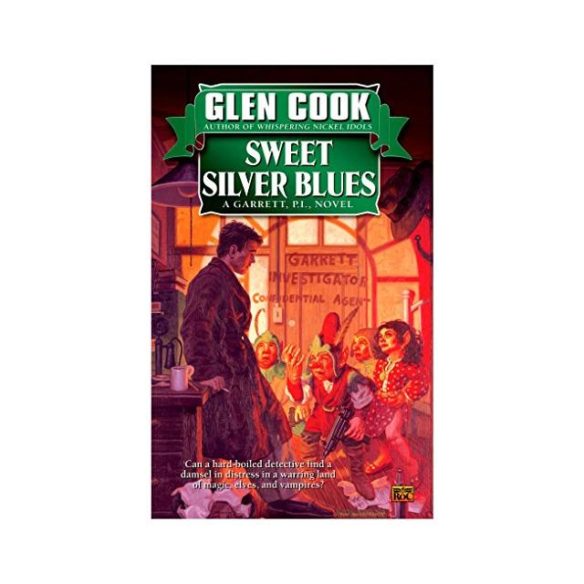
The other major series of Cook that I’ve read is the Garrett, PI books, inspired and suggested to me by a friend who loved them to pieces. Garrett (named for Randall Garrett the fantasy author) is a hard-boiled noir private detective, but in a fantasy city. The novels follow the titular character as he takes cases from the mostly demihuman population of Tunfaire, and follow a lot of the conventions of Noir fiction. Women in trouble, getting into tangles with the law and organized crime, betrayals, reversals, Garrett getting chewed up quite a bit, way in over his head but determined to see the job done. It’s a living. If you like fantasy and you like Noir/detective fiction, this is the series for you, no question.
And all of the Garrett books have a metal of some sort in the name (the first book is Sweet Silver Blues, the apparently last one (after a dozen!) was Wicked Bronze Ambition. Come to think, The Black Company was a pretty long lasting series, too. The man can certainly come up with idea after idea in his world, and make page turners in the progress.
Cook, prolific as he has been over a long career, has other fantasy novel series, as well but I’ve not picked any of them up. I’ve not really cottoned to his science fiction, it’s proven to be not for me, alas.

(11) COMICS SECTION.
- Saturday Morning Breakfast Cereal comments on flight positions.
- Rubes brings in an expert.
- The Flying McCoys features an unwanted change.
- Tom the Dancing Bug reprints the history of a catch phrase.
(12) STATELY WAYNE MANOR FOR SALE. [Item by Daniel Dern.] “Holy Mortgage Busters, Batman!” — “Wayne Manor From ‘Batman’ Could Be Yours For Just $32M” reports Deadline.
The estate that provided the exteriors for the 1960s Batman TV series is on the block — albeit with a Bruce Wayne-sized price tag.
The 18,000-foot Pasadena mansion is listed for a cool $32M. The home has 7 bedrooms, 3 full baths, 4 half baths and 4 three-quarter baths. Bruce Wayne, it seems, likes to bathe….
(13) ZEROES AND ONES ONLY. [Item by Steven French.] Keith Stuart reports on the latest Sony games debacle in this week’s “Pushing Buttons” newsletter: “PlayStation says it will stop making physical games – and that should worry us all” in the Guardian.
Sony’s decision last week to quietly announce the end of physical games production for the PlayStation in 2028 is one of the most perfect PR disasters in recent gaming history – and considering what has been happening with Xbox, that’s saying something.
First, there was the timing. Sony posted the news of its decision on the PlayStation blog, less than a week after admitting that it would be deleting 550 movies from the digital libraries of PlayStation owners due to the end of a licensing deal – thereby perfectly illustrating the dangers of purchasing digital products. (Surprise! You never actually owned them!) The move is in stark contrast with the company’s stance on this very issue back in 2013. When Microsoft was attempting to push Xbox One as a digital-first console with strict controls on the sharing and reselling of its games, Sony brilliantly mocked its rival with a short video on how easy it was to lend physical games to pals on the PS4. Oh dear.
If Sony thought the response to its decision would be meek compliance, it was wrong. TikTok and YouTube are buzzing with vociferous reaction videos by disgruntled gamers, while brands such as KFC, Domino’s and, for heaven’s sake, Dolorean have posted mock announcements to social media declaring their own intentions to go download-only. Satirical news site the Onion soon got in on the joke, with a story claiming popular US snack Twinkies would become exclusively digital. The response from Sony? Four days of total radio silence, because, well, what can they possibly say?…
(14) VERNE IN TRANSLATION AND ANNOTATED. Last week, Imagination Annotated published a new book, From the Earth to the Moon: Annotated for Our Spacefaring Age. Here are the details:

The Imagination, Annotated series presents compelling works of speculative fiction for new readers and contemporary concerns. Inspired by the MIT Press edition of Frankenstein, each volume is annotated by a diverse group of scientists, scholars, and other experts to illuminate the historical context and enduring questions that animate these visions of the future. By exploring speculations from the 19th and 20th centuries, the series invites readers into a continuing conversation about the kind of world we want to live in together.
The first new volume in the series is From the Earth to the Moon: Annotated for Our Spacefaring Age. Edited by literary scholar and historian Anastasia Klimchynskaya, the book presents Jules Verne’s influential 1865 novel in an acclaimed translation by Walter James Miller, with dozens of annotations and essays by contributors including astrophysicist Erika Nesvold, literature scholar Adam Roberts, space historians Asif A. Siddiqi and Jordan Bimm, and fiction authors Samit Basu, Malka Older, and Adam Oyebanji.
Verne is lauded for anticipating many modern-day technologies, including a moonshot launching from Florida with a trio of astronauts almost exactly a century before it happened. But Verne didn’t just dream up exciting gadgetry: he combined the scientific and literary, pondering the relationship between humans, science, and technology and considering the political, social, and ethical stakes of discovery and innovation.
Bridging the sciences and humanities, this edition of From the Earth to the Moon is designed for use in classrooms and reading groups, but also for science fiction fans and students and scholars of the genre.
20% Discount
If you order the book directly from Penguin Random House, you can receive a 20% discount using the code READMIT20. The discount works only if you are shipping to an address in the United States. More details about the discount code are here.
(15) RIGHT HERE ON EARTH. Matthew Byrd found “10 Hard Sci-Fi Movies Not Set in Space” and listed them for Reactor readers.
Hard sci-fi movies are surprisingly rare beasts. As is the case with hard sci-fi video games, it’s a subgenre that has really exploded in popularity in recent years thanks largely to the release of a few tentpole projects. In the case of movies, The Martian and Interstellar most certainly helped kick off a new era of studios slowly realizing there is a sizeable (if sometimes simply vocal) audience for genre movies that feel a bit more scientific and a little less fantastical.
Interestingly, what few hard sci-fi movies we have largely take place in outer space. That’s understandable given that we are still talking about sci-fi movies, but the fact of the matter is that some of the most important and fascinating hard sci-fi films never leave our planet. These are movies that, at the very least, remind us that we have so much to learn about ourselves and our world before we ever start looking toward the stars. And though the classification of some of these movies as hard sci-fi may ruffle a few feathers (don’t such discussions always do so?), these films all show the fantastical possibilities of theories, processes, practices, experiments, and the logical pursuit of the meaning behind advancements and wonders. Above all, these movies are, rather appropriately, quite grounded….
Here’s one of them:
The Andromeda Strain (1971)
Considered to be one of the premier examples of relative scientific accuracy in a movie, Michael Crichton’s The Andromeda Strain has lost little of its potency in the 55 years since its release. It’s an appropriate legacy for a movie that boasts this banger of a tagline:The picture runs 130 minutes…
The story covers 96 of the most critical hours in man’s history…
The suspense will last through your lifetime!The Andromeda Strain begins in the aftermath of a catastrophic event that resulted in the death of all but two residents of a small New Mexico town. A group of scientists soon discover that the event was caused by the return of a satellite that has apparently brought back an unknown deadly substance. For a movie that mostly consists of older gentlemen examining ‘70s technology and discussing hypothetical possibilities, The Andromeda Strain is a true thriller. There is so much joy to be found in watching these incredibly capable scientists realistically breaking down a situation that is both fantastical (quite literally alien) and perhaps a little too close for comfort in modern times.
[Thanks to Mark Roth-Whitworth, Kathy Sullivan, Steven French, N., Keith Giles, Daniel Dern, Joey Eschrich, Mike Kennedy, Andrew Porter, John King Tarpinian, Cat Eldridge, SF Concatenation’s Jonathan Cowie, and Chris Barkley for some of these stories. Title credit belongs to File 770 contributing editor of the day Bill.]