… There is hardly any sense of struggle in On Being Ill. Struggle is what the healthy are doing, beyond the invalid’s window pane. Ant-like, they are rushing to and fro, being clerks and bus conductors and widows and lawyers. The shadowy figure at the essay’s centre – the figure who might be Woolf or who might be us – seems almost delighted to have fallen ill. They float like a stick on a stream; they are as gratefully irrelevant as a dead leaf being blown across a lawn; they watch the clouds mutate and form pictures above a London entirely unconscious of the beauty above its head.
This was an insight that I too gained in illness, and it is part of what I tried to write about in Piranesi: that there is a whole world endlessly going on, endlessly being beautiful, regardless of whether anyone is there to see it or not. Where Woolf and I part company is in what this means. For her it was evidence of the stark indifference of the universe to human beings: “Divinely beautiful it is also divinely heartless.”
For Piranesi, the central character of the book, and for me, the sheer profligate abundance of beauty is evidence of a universe intensely bound up with its creations. Piranesi walks through his world, cataloguing its contents, describing its wonders. This he considers his chief task in life. “The Beauty of the House is immeasurable; its Kindness infinite.”…
(2) EUROCON 2026 REPORTS. James Bacon has written two more installments about this year’s Eurocon in Berlin. Catch them here:
(3) STARTING THE SECOND CENTURY. Nic Farey’s This Here…#101 came out a week ago but has only just been made available for download at eFanzines: This Here… 101 (direct download).
(4) THE GHOST OF WESTERCON WALKS. Westercon, which cannot be allowed to simply die because of the opportunity it affords SMOFs to do business meeting LARPing, convened in a corner at BayCon this weekend and reported this result:
Westercon 80 will be held in conjunction with the 2028 Loscon as determined by the 2026 Westercon Business Meeting. (Westercon 78 will be held in conjunction with the 2027 BayCon, as selected last year.)
The Westercon Business Meeting this year ratified the repeal of the Westercon Bylaws. The 2027 and 2028 Westercons will not hold a Site Selection election or a Business Meeting. That means means that today was The Last Dangerous Business Meeting, and it was my honor to preside over it.
There’s a silent epidemic building in colleges and universities throughout the country — and as you might imagine, it has everything to do with AI.
As one New York financier told Financial Times journalist Gillian Tett, new hires who were seen as “AI natives” are turning out to have alarmingly shallow ideas. So much so, the anonymous finance worker admitted, that his firm now actively avoids seeking out AI-literate STEM graduates, and opts to comb through humanities students instead.
“We want critical thinking, not just AI,” the financier told the FT.
Over the past few years, a veritable tidal wave of headlines, studies, and think pieces have flooded the internet with horror stories about the decline in literacy rates, social skills, and critical thinking abilities of the country’s college students. While there’s a kernel of truth that these factors had already been slowlydwindling prior to the widespread adoption of AI, the tech only seems to be accelerating the drop-off in real-life abilities, particularly among young people for whom it can serve as a cognitive crutch….
Andrew (not Werdna) sent the link with the comment – “Like Y2K led to recruitment of aging COBOL and FORTRAN programmers to rescue companies that needed their (once-outdated) expertise, folks who can put thoughts and words together in a coherent form, using only their little grey cells are going to be pulled back from their retirements to keep the economy running.”
(6) TODAY’S BIRTHDAY.
[Written by Paul Weimer.]
July 5, 1957 — Jody Lynn Nye, 69.
By Paul Weimer: I mainly know the work of Nye as a collaborator and facilitator, working with other people’s work. Sure, she has written a slew of short stories, and several novels of her own. But when I think of her work, I don’t think of those as much as I should. Instead, I think of her work with Robert Asprin, and Anne McCaffrey.
Neither is a surprise. One of the strong arrows in Nye’s quiver is humor, and collaboration with Asprin on some of the later works in the MYTH series must have seemed natural to both of them when they decided to do it. Both engage in both broad humor and subtle wordplay, laugh out loud at the moment, and later poleaxing bits of humor as profound as they are funny. And coming in as she did late in the series, it provided a fresh infusion of ideas for the MYTH series at the time and helped extend the series into the 2000s.
And then there is Anne McCaffrey. The first thing I read by Nye is not her standalone novels, or MYTH, but rather her guide to Pern. Even then, intensely interested in worldbuilding, of course I had to pick this one up (it would be one of several I picked up, including one on Julian May’s Pliocene Exile, the Visual Guide to Castle Amber, et cetera). Only in retrospect did I realize that the Nye who wrote this would be the one who collaborated with McCaffrey in the other arena where McCaffrey is known more: The Ship Who Sang. That original novella, way back in the 1960’s led to Nye and McCaffrey collaborating on more stories and novels about a sentient spaceship. Nye also continued the series on her own, as did other authors like S M Stirling. (In point of fact, Nye seems to like to do that, to continue on series. She did it with MYTH and with some other series as well, extending and building them outward.
And then there is the odd collaborative/shared world Exiled Claw, which is an alternate earth where intelligent bipedal cats (think Kzinti but not as stupidly aggressive ) take on intelligent dinosaurs in a bronze age/early iron age technology verse. Nye shows off yet another arrow in heron quiver in those two volumes. Pity they stopped after two volumes and not even Nye has had the opportunity to write any more. Alas!
It would be a Mythstake, indeed, to discount Nye’s work in the SFF field as “merely” being collaborative. (She also teaches at Dragon Con every year, too). Collaborations and working in other people’s sandboxes is hard, not easier, than original ideas, and Nye has a talent (and clearly, a proclivity) for it.
(9) A 5.3-MILLION-YEAR-OLD DEEP-SEA WHALE NECROPOLIS. [Item by SF Concatenation’s Jonathan Cowie.]Where do large animals go to die? Perhaps the most well-known example of asking this type of question relates to the so-called and mythological ‘elephants graveyard’. However, in real life today as revealed in the journal Nature, a graveyard of whales has just been discovered that dates back over 5 million years.
Researchers largely based at Sanya, China, have discovered a whale graveyard in a 1,200 km long abyssal trench called the Diamantina Fracture Zone, which at places is over 7 km (4.4 miles) deep. Now, so far, the most of the few whale falls that have been found are some tens of metres to around 4,000 m water depth, with the deepest example reaching 4 km in the southwest Atlantic Ocean. The mostly very much deeper Diamantina Fracture Zone itself formed as the Australian and Antarctic continents separated between 60 million and 50 million years ago.
The graveyard has a deep and extensive accumulation comprising five modern natural whale-fall communities and 476 fossil cetacean species recorded. The researchers show that carcasses host specialised communities dominated by brittle stars, bone-boring worms and chemosynthesis-based bivalves.
(10) WHY J.G. BALLARD STILL MATTERS. [Item by SF Concatenation’s Jonathan Cowie.] Over at the YouTube Sci-Fi Scavenger channel, there is a short examination of one of the Brit champions of the New Wave, J. G. Ballard.
From The Drowned World and Crash to High-Rise and Empire of the Sun, Ballard transformed science fiction by shifting its focus away from spaceships and distant planets, and towards what he called “inner space”: the landscapes of the human mind.
[Thanks to John King Tarpinian, Cat Eldridge, SF Concatenation’s Jonathan Cowie, Andrew (not Werdna), Chris Barkley, Mark Roth-Whitworth, Kathy Sullivan, Steven French, Mike Kennedy, and Andrew Porter for some of these stories. Title credit belongs to File 770 contributing editor of the day Jayn.]
…Every society runs on a game. Status, power, and wealth are decided by invisible rules you were never handed, in a game you were born into halfway through. That reality is the basis of Iain M. Banks’s The Player of Games. He built an entire alien empire around it and called it Azad: a name alien enough to trick you into thinking he wasn’t talking about home….
… At the edge of Culture space sits the Empire of Azad. Where the Culture is open and collective, Azad is savage, sexual, and obsessed with rank. And every inch of it is organized around a single, brutally complex game.
In Azad, your place in society—from the lowliest servant to the emperor himself—comes down to how well you play. Win, and you rule. Lose, and you’re ruled. The empire even takes its name from the game, because the game and the civilization are one and the same. A game reveals what a society believes, how it behaves, and what it worships.
Think about the games we play. Chess and Risk mirror our obsession with strategy and conquest. Monopoly and Catan? Our fascination with money and trade. Even Scrabble and trivia nights show off our love of knowledge. Each one takes something our society prizes and crystallizes it into a set of rules. As Banks put it in a 1990 interview with Michael Cobley:
“The morality of games is the rules. Games have a very definite and set morality, you play according to the rules or you don’t play at all. The difference with the games that we play as human beings is that the rules are always changing.”
That’s why Banks makes Azad the main focus of The Player of Games. He takes our instinct to gamify everything, builds an empire on it, and yanks back the curtain on the cruelty underneath….
This summer, plenty of familiar scores will be heard at the biggest orchestras in the country. Of course, there will be symphonies by Mozart and Mahler. But even more famous, perhaps, will be the soundtracks for “Harry Potter” and “Star Wars.”
What used to be a novelty has now become a core staple of symphonic programming in the United States: live soundtracks, performances in which an orchestra plays while a movie screens overhead. As the classical music industry grapples with declining cultural relevance and mounting financial challenges, an evening of “How to Train Your Dragon” is no longer inconceivable.
Orchestra administrators say the programming shift attracts audiences that might not otherwise come to a typical concert. And because of technological advances, there are more films available for programming than ever. Melia Tourangeau, the president and chief executive of the Pittsburgh Symphony Orchestra, said in an interview that live soundtrack shows are the ensemble’s “fastest-growing product line.”
Still, there have been grumbles about the artistic merit of these concerts.
“Trying to get people to go to the symphony by presenting something that’s more familiar is not necessarily a bad thing,” Evan Shinners, a musician and the host of the podcast “W.T.F. Bach,” said in an interview. “It’s just not an effective thing.”
“Despite how lovely film music can be, it’s not classical music,” he added. “It just happens to be playable by the orchestra. What you do when you do present film music in an orchestra is, you reinforce people’s love for films. You don’t cause them to come back to want hear Beethoven.”…
… “The bottom line is that it’s an income generator, and it also brings in new audiences into the concert hall, which orchestras are always trying to accomplish,” said Sarah Hicks, the principal conductor of the Minnesota Orchestra’s Live at Orchestra Hall, a series focused on popular music that includes film concerts. The ensemble has found that 38 percent of those who attend the live soundtrack performances purchase ticket packages that include at least two other programs….
… Although live soundtrack performances bring in much-needed revenue for orchestras across the country, some, particularly the musicians, question whether the concerts devalue their art form.
“I’ll be perfectly honest,” said Ryan Fleur, the president and chief executive of the Philadelphia Orchestra. “We have some musicians that feel very strongly that this wasn’t the reason that they went to conservatory.”
Jim Nova, a trombonist with the Pittsburgh Symphony, said of film scores, “I don’t think anyone is as enthusiastic as I am. I mean, I love this music.”
“I have friends who live in Los Angeles who have played on a lot of film scores, and they say that film scoring is like 95 percent boredom and 5 percent terror,” Nova said. “You’ll be plugging along playing something, and it’s not really that hard, and then you turn the page and there’s something that’s basically almost unplayable.”
Hicks said that there used to be a “certain resistance” to performing live soundtracks because the musicians weren’t trained for them.
“There was some sort of attitude,” she said, “that soundtracks and score music was somehow lesser and orchestras still do have this curatorial responsibility to perform the great works of art.”…
Reports suggest Travis Knight’s Masters of the Universe made just $54m (£40m) globally on debut at the weekend, a figure that, while not exactly fatal, would usually be considered a disappointment for a mainstream movie with a budget of more than $200m. Worse still, this heavily caffeinated, meta take on the 1980s TV show arrived carrying the weight of a major studio relaunch and decades of pent-up nostalgia. On paper at least, its bow looks less like the birth of a cinematic universe than the sort of expensive stumble from which some franchises never recover.
So why then does everyone involved in this thing seem so cheerful? “Travis Knight and the entire cast and film-making team have delivered something truly special,” Amazon MGM’s Kevin Wilson gushed to Variety. “This opening is exactly the kind of critical first moment that validates our holistic distribution strategy – building awareness and engagement that will carry well beyond the theatrical window.”
Meanwhile, Knight has been talking up the possibility of sequels, after the movie appeared to introduce He-Man’s twin She-Ra in a mid-credits scene. “With every movie that I’ve ever made, I’ve always imagined where the characters go outside … the bounds of the movie,” Knight told TechRadar. “You want to tell a self-contained story, and I think we’ve done that with this movie, but there are things within the wider mythology that didn’t fit within that, and the She-Ra character was one of them.”
“Adora is also a character that carries a lot of weight with her,” he added. “A lot of people, myself included, love that character, so we wanted to give a little nod to where that could go if we were given the opportunity to tell more stories.”
So far, so positive. Yet the real question is: why? Data from the opening weekend suggests that nearly 40% of Masters of the Universe’s audience were over 45, hinting that nostalgia for the original show probably fuelled much of the film’s relatively meagre box office take. That doesn’t bode well for the rest of the movie’s run, as it may well be that the core audience have already seen it….
(4) SHELFIES. Shelfies, edited by Lavie Tidhar and Jared Shurin, “Takes a unique peek each week into one of our contributors’ weird and wonderful bookshelves.” A recent entry was Shelfies #92: Mary G. Thompson.
Mary G. Thompson is the author of the forthcoming sci-fi/horror novel Precious Children (2026), One Level Down (2025), Flicker and Mist, The Word, Wuftoom, and other novels. Her contemporary thriller Amy Chelsea Stacie Dee was a winner of the 2017 Westchester Fiction Award and a finalist for the 2018-2019 Missouri Gateway award. Her short fiction has appeared in Dark Matter, Apex, and others. She holds an MFA in Writing for Children from The New School and completed the UCLA School of Theater, Film & Television’s Professional Program in Screenwriting. She lives in Washington, DC.
The casting call seemed simple enough: An unnamed nonprofit was offering $75 in cash to people who could spend a couple of hours acting as zombies in a “mock demonstration.” The scenes would be part of an instructional video, and actors were asked to wear tattered clothing and to be ready to have their faces painted.
But when the group of 40 or so participants arrived at the filming site in Downtown Brooklyn on Thursday evening, things started to take a turn.
First, they discovered that the organization behind the event was a pro-landlord advocacy group known as the Gotham Housing Alliance. The actors were to become zombies to symbolize the “death” of the housing industry at the hands of Mayor Zohran Mamdani, a democratic socialist.
Then it became clear that the “mock” demonstration was, in fact, real. The actors were directed to march down Jay Street in the sweltering heat, moaning and shuffling alongside landlords, some carrying Gotham Housing Alliance flags.
A crowd of at least 50 pro-tenant protesters had also gathered there, and the confluence of the two groups grew tense, with expletives hurled in both directions. (At least one zombie, staying in character, snarled and barked at the pro-tenant group.) As the evening progressed, many of the actors, several of whom identified themselves as renters, grew visibly uncomfortable, hiding their faces behind signs or flags. Several murmured that they felt they had been duped to show up on the “wrong side.”
“To discover, in the moment, that I’m doing something I love, and it’s being utilized against me — that’s especially disturbing,” said Ian Cobb, one of the zombie actors, who said he lives in a rent-stabilized apartment.
Like others, Mr. Cobb, 25, said he had been given no further details about the project beforehand. And while he had played unsavory roles before onstage, this felt different.
Many of the performers said they had felt pressured to take part in the protest even after realizing it was not what they had expected. The casting call, shared with The New York Times by Erik Rivera, an actor and skateboarder who was part of the group, said that people who were hired and did not show up would be put on a “Do Not Cast” list and would be reported to an online casting platform. The casting call made clear that the actors would be paid only at the end of the event….
As ‘Disclosure Day’ hits theaters, The Hollywood Reporter takes a look at the film director’s entire oeuvre, featuring aliens (lots of them!), Indiana Jones (lots of him!) and wars (lots of — well, you know).
And look what’s Number One! Holy cow. I remember how mad I was when this lost to Gandhi for Best Picture. (Yes, I’m probably lucky only Spielberg films are in the running here….)
1. ET: The Extra-Terrestrial (1982)
Darker than you remember. E.T. starts and ends in the forest, the lit city down the hill resembling a night sky full of stars. The most famous image is a black silhouette against the moon: boy, alien, bicycle. Shadows fill the house Henry Thomas’ Elliott shares with his brother, his sister, and his mom. (Dad’s in Mexico with Sally, his absence as palpable as a shark you never see.) The camera hovers down with the young cast, so the toy-stuffed closet feels cavernous as a doom temple. Junk kid’s movies tend to be overlit and colorful, but Spielberg remembers how visceral darkness feels to a child: the witching hour, staying up late at a sleepover, the scary wonder of being awake when your parents are asleep. This is his smallest story on a map — house, neighborhood, woods, a school day cut short by frog liberation — but the emotions reach for cosmic empathy. “Think how other people feel for a change!” Robert MacNaughton’s big brother demands. Empathy is the plot and the primary special effect. Marvelous technique crafted E.T.’s body, but the soul-baring performances (Drew Barrymore!) bring him to life. And no matter how soaring Williams’ score is, there’s no doubt E.T. is the toughest of Spielberg’s alien quintet. Close Encounters and Disclosure Day promise revelation. War of the Worlds and even Crystal Skull fix their broken families. Elliott is the one who says goodbye to someone he loves. But E.T. knows we all have to go sometime. Our eyes will close. The credits will roll. Someday, Steven Spielberg will stop making movies. Put your hand on your glowing heart and repeat this prayer: He’ll be right here.
(7) TODAY’S BIRTHDAY.
[Written by Paul Weimer.]
June 14, 1949 — Harry Turtledove, 77.
By Paul Weimer: Harry Turtledove, The Avtokrator.
That one is not my invention, that would be Steven H Silver, who is the most knowledgeable person I know about the work of Harry Turtledove. I was delighted, back in the day, to encounter Steven’s website about Harry’s work, and he made it very easy to catch up and figure out my gaps in my reading.
I discovered Turtledove in my first big alternate history phase in the late Eighties. I had started reading a (now unreadable, thanks a lot Theodore Beale) anthology series edited by Jerry Pournelle called There Will Be War. I was also into military science fiction of the time at the time. In any event in one of those volumes was a story called “The Long Drum Roll” which was an early version/excerpt from the novel that would become The Guns of the South, his classic “Time traveling South Africans help the Confederacy win the civil war with AK-47s”. I devoured that novel, too, and then started reading his work.
Although Turtledove wrote a lot of fantasy I liked (such as King of the North, The Case of the Toxic-Spell Dump, Between the Rivers) and more, imagine my squee of delight when I discovered Videssos. Videssos was the story of a Roman Legion transported in space to a fantasy world that was extremely similar to Byzantium (so in a sense, they “time travelled” as well). Lots of the setup, incidents and characters in the Videssos novels are based on real Byzantine history.
The Avtokrator has written a lot since. There’s straight up alternate history (How Few Remain) as well as science fiction alternate history (e.g. Worldwar), and of course fantasy novels here and there as well. Turtledove doesn’t always write a form of alternate history, he has written straight up fantasy and SF novels, but alternate history, or secondary worlds that resonate strongly with history, really are the center of his oeuvre.
And he is prolific. He had several books out last year this year alone, and much of his older stuff is being reissued, particularly in ebook, and including stuff he originally wrote under pen names.
The Avtokrator’s realm is large, and there is always more to read.
…. One of my Best Novel nominations even got on the ballot this time! Admittedly, it wasn’t my first choice, but that’s how I expect it to be in a lot of ways. I wasn’t a typical Trufan last year when I first went to Worldcon; I still am not now. Their tastes and mine overlap, but only overlap; they aren’t the same….
Here’s the top pick in one of the categories:
Best Novelette ( defined as 7,500-17,500 words):
1) “Never Eaten Vegetables“ , by H. H. Pak – A poignant story of a sapient spaceship carrying embryos to populate a new colony world, where some start waking up early – and what comes after. The love is visible on the page.
… In a provocative new working paper titled “Is the iPhone Birth Control?” Myers argues that the spread of smartphones could explain between a third and a half of the decline in birth rates during that period.
To test that theory, she makes clever use of an accident of history that creates a kind of natural experiment. When iPhones first came out, they worked only with AT&T.
“In some areas of the country, AT&T had broadband coverage and you could get an iPhone, and in other areas, including where I live in Vermont, that coverage was much more limited,” Myers recalls. “And what you can see in this simplest of comparisons, births start to fall in the places where you can get one, and they’re not falling nearly as much in the places where you can’t.”…
…The drop in birth rates has affected women of all ages, but it’s most pronounced among teenagers. That sounds plausible to Jean Twenge, a professor of psychology at San Diego State University.
In books like Generations: The Real Differences Between Gen Z, Millennials, Gen X, Boomers, and Silents, Twenge has documented the profound behavioral changes that accompanied smartphones, especially among young people.
“The smartphone fundamentally changed the way adolescents spent their time outside of school,” Twenge told NPR. “They started spending a lot more time online and on their phones and a lot less time hanging out with their friends in person and driving around in a car or going to the mall or just hanging out.”
Myers says it’s not a stretch to think that this would result in fewer babies.
“If there’s one thing I learned in abstinence-only sex ed in the ’90s in Georgia growing up, it’s that you’re probably not going to get pregnant if you’re not interacting with people in person — if you’re not having sex,” Myers says.
In the paper, co-authored with her 24-year-old stepson, Ezekiel Hooper, Myers suggests smartphones also placed access to information about contraceptives and abortion in the palm of users’ hands.
Actor Bill Mumy first became known for his childhood appearances on classic series such as “The Twilight Zone,” and later as Will Robinson on “Lost in Space.” Correspondent Jim Axelrod discovers how Mumy, now 72, avoided the dangers that other child actors faced while pursuing a Hollywood career, as an Emmy-nominated songwriter, touring musician and recording artist, and finds out what has kept Mumy grounded.
[Thanks to Steven French, Mike Kennedy, Andrew Porter, John King Tarpinian, Cat Eldridge, SF Concatenation’s Jonathan Cowie, Chris Barkley, Mark Roth-Whitworth, and Kathy Sullivan for some of these stories. Title credit belongs to File 770 contributing editor of the day Jon Meltzer.]
(0) …Shall Ever Medicine Thee To That Sweet Sleep Which Thou Scrolledst Yesterday
(If I make the headline too long, Jetpack definitely won’t send a subscriber notice. It may be too long as it is! But what a wonderful title.)
(1) FILE 770 MEETUP AT GLASGOW ON SUNDAY. Cora Buhlert on her first day at the Worldcon met several Filers — Chris Barkley, Christian Brunschen, Ingvar, Standback a.k.a. Ziv, but thinks it would be great to have a semi-official Filer meet-up in Glasgow.
Cora proposes that Filers meet her on Sunday at 3:00 p.m.at the free library in Hall 4 and then find someplace to sit down. There are several tables and chairs in the area.
Please take pictures!
(2) SEATTLE 2025 MEMBERSHIP SALE. Through Monday the Seattle 2025 Worldcon is giving a $10 discount on memberships. The deal was announced on Facebook.
In honor of Glasgow 2024, A Worldcon For Our Futures, we have a $10 membership discount that is good from today (Thursday) through Monday!
Go to https://reg.seattlein2025.org/ and click on “Add New Registration”. After you fill out the information, go to “Review and Pay”. Next to “Total Cost”, you will see a button marked “Add Coupon”. Click on it and enter “Glasgow” in the text box.
You’ll go back to “Review and Pay” and the total cost will be adjusted.
This issue was edited by Emanuel Ježić-Hammer, Jelena Janjić, Vedran Ilic-Dreven and Mila.
In this issue we present a story from the most recent fantasy collection Project Tulip, and two winners of the SPera Prize for Story, from 2019. in 2024 Here’s a review of events on the local SF scene since 2009. years (there we stopped in one of the older numbers), and one film, to show the Americans and English that we also have power armour for the race. Reports and gossip from Glasgow and Rotterdam caught in one of the following issues!
(5) SUPPORT FAN FUND AUCTIONS AT WORLDCON. Courtesy of David Langford, here are the catalogues for two fan fund auctions being held at Glasgow 2024. In person and online bidding is available. One auction is Saturday evening local time, and the other closes on Sunday. The catalogs tell how to bid online.
(6) SAYONARA. [Item by Dave Doering.] After almost 20 years as an institution in fan events in Utah, Anime Banzai abruptly announced it closing down less than two months before its October edition: See their home page, the only heads up on the cancellation: Anime Banzai – Utah’s Premier Anime Convention.
Anime Banzai family
Utah Anime Promotions has been considering the fate of Anime Banzai 2024 after the convention meeting held on 4 Aug (including the harsh realities that shutting down an event like this entail), but events have outpaced that consideration. The problems are too deep to address long term, and while we had hoped to patch things up internally to still successfully run Anime Banzai 2024 as a farewell for attendees and staff, that is no longer possible.
I would like to deeply apologize directly to Artemis and Warky who were spoken of in this meeting, and clearly state that Utah Anime Promotions vehemently rejects all negative claims made against either. The Board has been in communication with you both since then to discuss the situation, and would like to thank that both of you have continued to express a hope that Anime Banzai 2024 could be provided for attendees, even under these circumstances. Hope can be a hard choice to make, and I regret that we won’t be able to assist with that.
Anime Banzai has always operated on a shoe-string budget, with funds diverted back into running each next event and the expenses that lead up to it. Without a convention in Oct where most of the convention funds are generated, we’re honestly not sure what it will look like to take care of outstanding expenses including pre-registration, vendors, etc. While we’re not sure what this path will look like, we will do our best to make things right.
Utah Anime Promotions has let the community down by not being attentive enough to the signs that manifested over time. As years continued, patterns of complacency and detachment grew. Some members of staff pointed this out over time; I’m sorry we didn’t pay better attention.
We have had many great people involved with Anime Banzai over time; inspiring experiences with energetic guests, panelists eager to share their passions with attendees, cosplayers sharing their delight for costuming and embodying characters they love, editors marrying audio and visual for anime music videos, and staff and volunteers who have worked long and hard hours to help things going. Thank you for the uplifting joy, and I hope people can hold on to more of those positive experiences than be burdened by the negative.
This convention was started by a local group of friends, who had the idea of “How hard would it be to start a convention ourselves?” while on a road trip back from a convention in a nearby state. Anime Banzai grew from that seed with the enthusiasm and joy from the community. As Anime Banzai shuts down, I hope that anime fans in Utah can continue that positive spirit. You have been the best part of Anime Banzai; always remember that, and you can continue to be better, shine brighter, day to day.
Utah Anime Promotions: Steven Jones, Daniel Bentley
They say when refunds will be issued on a first-come, first-served basis.
(8) MORE LEARNEDLEAGUE SFF: BRANDON SANDERSON, OCTAVIA BUTLER, STUDIO GHIBLI, SPECULATIVE BIOLOGY. [Item by David Goldfarb.] We’re in the middle of what’s called the “off-season” in LearnedLeague, when in between regular seasons we have specialty quizzes for one day, and “mini-Leagues” that are more topic-oriented and go for 12 days.
Yesterday we had a One-Day Special about Brandon Sanderson’s Cosmere. Follow the link for the questions, but be warned that they are for serious Sanderson fans. I’ve read every book published in the Cosmere (and a couple that haven’t!) and I got only 8/12. At 56 I don’t have the memory for small details that I used to.
In day 10 of the just-concluded California mini-league (technically “California 2” because there was a previous one on the same topic back in 2007), we had this question:
Give the title of the prescient 1993 dystopian novel by Pasadena-born Octavia E. Butler that has as its protagonist Lauren Olamina, a young woman who creates a religion called Earthseed in a speculative 2024 California, ravaged by climate change and social inequality.
This had a 33% get rate, with no single wrong answer getting to the 5% threshold to be shown.
Filers might also find of interest 1DS’s about Studio Ghibli (the animation studio behind Nausicaa of the Valley of the Wind and Howl’s Moving Castle, among many others) and Speculative Biology (based on books such as Dougal Dixon’s After Man, taking a look at how life on Earth might evolve in the future if humanity were to vanish).
(9) EATING THE FANTASTIC. Scott Edelman keeps the wheel turning even while he’s away at the Worldcon, inviting listeners to breakfast with Bonnie Jo Stufflebeam in Episode 232 of the Eating the Fantastic podcast.
Bonnie Jo Stufflebeam
Bonnie Jo Stufflebeam is the author of the horror novel Grim Root, which was officially released two days after our chat. Her short fiction and poetry have appeared in over 90 publications, such as Popular Science, Lightspeed, and LeVar Burton Reads. Her short story collection Where You Linger & Other Stories and her horror novella Glorious Fiends were both published in 2022.. She’s a two-time finalist for the Nebula Award. By day, she works as a Narrative Designer writing games for a mobile game company.
We discussed how her new horror novel toys with the tropes of reality TV, the importance of balancing multiple POVs in a novel to keep them all equally interesting, our differing views on the revision process, the three years she spent writing 1,000 words per day (and why she stopped), the message she took from her two Nebula nominations, the importance of community, what she learned about herself by rereading her short stories to assemble a collection, why we both believe in ambiguous endings, and much more.
(10) SUPES ON![Item by Daniel Dern.] Some Dern current recommendations on TV/streamers:
(a) The Umbrella Academy is re-opened for business: Season 4, the six-episode final season of The Umbrella Academy, dropped on Netflix on Thursday, August 8, 2024. Having so far watched Episode 1, I’m in.
And here’s the amazing Footloose Dance-Off! segment from Season 3, which I don’t think is in any way a spoiler (btw, there’s a nice short making-of documentary somewhere online):
(b) Orphan Black: Echoes (on Prime Video/AMC, Apple+, etc), starring Krysten Ritter (previously in, among other things, Marvel’s Jessica Jones series). This is a 37-years-later (in the show timelines, set in 2052) follow-up to Orphan Black (which starred Tatiana Maslany (who was on the recent HBO/MAX Perry Mason, and was Jennifer Walters in the (great) Marvel TV series She-Hulk: Attorney at Law).
We’re 7 episodes in, and we’re enjoying it. (I’m sure it makes more sense if you’ve seen Orphan Black; since we’ve seen Orphan Black, I can’t speak to that.)
(c) Season 5 of The Boys (over on Amazon) was, unsurprisingly, good. (Met expectations on the lotta violence, cussing, sex, violence, drugs, politics — note, this was all written and filmed several years ago — more violence and cussing, and great acting.)
ET: adorable interstellar tyke or nightmarish space demon? As a four-year-old in a multiplex in Aberystwyth, west Wales, I was in the latter camp. From the moment he scuttled out of an eldritch mist like the Demogorgon’s weirdo little cousin, my blood curdled. There were tears, almost instantly. What was this monster? This boggle-eyed gonad? This sentient hammer wrapped in flayed human flesh? And other questions I wouldn’t have had the vocab to ask.
She possibly pointed out that my two-year-old sister was such a fan of ET that every off-camera moment left her yelling: “Where TV?” I forget the exact details – all I remember is the sweet relief of being nowhere near the cinema screen. We left shortly after – not quite the pleasant Welsh holiday movie jaunt my parents had hoped for….
In Arthur C Clarke’s short story The Nine Billion Names of God, a sect of monks in Tibet believes humanity has a divinely inspired purpose: inscribing all the various names of God. Once the list was complete, they thought, he would bring the universe to an end. Having worked at it by hand for centuries, the monks decide to employ some modern technology. Two sceptical engineers arrive in the Himalayas, powerful computers in tow. Instead of 15,000 years to write out all the permutations of God’s name, the job gets done in three months. As the engineers ride ponies down the mountainside, Clarke’s tale ends with one of literature’s most economical final lines: “Overhead, without any fuss, the stars were going out.”
It is an image of the computer as a shortcut to objectivity or ultimate meaning – which also happens to be, at least part of, what now animates the fascination with artificial intelligence. Though the technologies that underpin AI have existed for some time, it’s only since late 2022, with the emergence of OpenAI’s ChatGPT, that the technology that approached intelligence appeared to be much closer. In a 2023 report by Microsoft Canada, president Chris Barry proclaimed that “the era of AI is here, ushering in a transformative wave with potential to touch every facet of our lives”, and that “it is not just a technological advancement; it is a societal shift”. That is among the more level-headed reactions. Artists and writers are panicking that they will be made obsolete, governments are scrambling to catch up and regulate, and academics are debating furiously….
Over the past 18 months, Big Finish has undergone a transformational change. We have introduced several new systems which control the essential business functions of Big Finish.
These systems, which include stock control, dispatch and shipping tracking, payment gateways and accounting, email and customer service tools, replaced older software that had reached the end of its life.
They were vital upgrades, needed to ensure that we could continue to fulfil orders to our customers, and all the new “behind the scenes” systems have been tested for many months and are working seamlessly.
The final action of this transformation was the rolling out of our new “shop front”, the Big Finish website and app.
Unfortunately, it is very clear that here a number of mistakes have been made. In particular, the migration of customer data has not gone as planned, and the browsing experience of the website and app is proving to be a frustration. I sincerely apologise to everyone who has encountered difficulties accessing their purchase library since the relaunch, or who feels let down by how we have managed the process.
I know from seeing the many messages coming in via email and social media that these updates are a cause of worry and concern to many listeners. I would like to reassure each and every customer that no purchases will be lost, all the data is safe, and we are committed to improve the functionality, accessibility and reliability of the website, whatever it takes.
If you haven’t yet had a chance to do so, I would urge you to read the new “How tos” page which explains how to reset your password and update address information the first time you visit the site. We could not carry across any of these details in the upgrade due to the requirements of data protection law. It is not possible to browse your purchased items or order new releases without completing these steps.
The team will keep updating the “Work in progress” page with known issues and our timetable for improvements. As you might imagine, the Big Finish customer service team is currently inundated with messages but they will do their best to answer all queries. I thank you in advance for your patience, understanding and loyalty, and for sticking with us during this difficult period.
Finally, please let me just restate how deeply sorry I am for the inconvenience so many of our loyal listeners are experiencing at the moment. I completely recognise the very valid frustrations being expressed and I hope that you can bear with us as we try our utmost to find the best solution to bring you the best website and app experience at Big Finish.
(15) SKILL TREE EPISODE: SIGNS OF THE SOJOURNER. ASU’s Center for Science and the Imagination has released another episode of CSI Skill Tree, their series examining how video games envision possible futures and build thought-provoking worlds. In this episode, they discuss “Signs of the Sojourner”, a deckbuilding game set in a hazily sketched post-crash version of the southwestern U.S. that explores themes of community resilience, trust, and the dynamics of conversation.
The guests are Leigh Alexander, a speculative fiction author, critic, and narrative designer for video games including Reigns: Game of Thrones and Neo Cab, and Mia Armstrong-López, a journalist and editor working on issues of science, health, and justice, and managing editor for our Future Tense Fiction series.
Also, here’s a YouTube playlist with all 16 of Skill Tree episodes thus far.
[Thanks to SF Concatenation’s Jonathan Cowie, Steven French, Ersatz Culture, Dave Doering, David Langford, Scott Edelman, Joey Eschrich, Kathy Sullivan, Teddy Harvia, Mike Kennedy, Andrew Porter, John King Tarpinian, Chris Barkley, and Cat Eldridge for some of these stories. Title credit belongs to File 770 contributing editor of the day Jayn.]
(1) GLASGOW 2024 INITIATES CONSULTATIVE VOTE. The Glasgow 2024 Worldcon committee announced they will hold a “Consultative Vote on Hugo Rule Changes” – specifically, about the two new Hugo categories given first passage at the Chengdu Worldcon Business Meeting. Only WSFS members of the 2024 Worldcon will be eligible to vote. None of the other 12 rule changes passed at Chengdu will be part of the poll.
(Note that despite the phrasing below it was not a “resolution” but multiple amendments to the WSFS Constitution that were passed in Chengdu. A mere resolution would have no binding effect.)
…A resolution passed at the 2023 WSFS Business Meeting in Chengdu would create two new Hugo Award categories: the Best Independent Short Film Award and the Best Independent Feature Film Award. This resolution would need to be ratified by the 2024 WSFS Business Meeting in Glasgow to come into effect from 2025 onward.
At present, we plan to invite all WSFS members of Glasgow 2024 to express their views on the proposed change, in a straight yes-or-no online vote, in the weeks before the convention takes place in August 2024. The proposers will be invited to write a short statement in support of their proposal, and we will offer a similar facility to opponents….
The vote will be conducted immediately before Glasgow 2024—no earlier than the close of Hugo voting, no later than the start of the convention….
Doesn’t this usurp the Business Meeting’s role in changing the constitution?
No. The consultative vote will have no constitutional force. The decisions made by the Business Meeting will be final. Within certain limits, the 2024 Business Meeting can also amend the current proposal before it is ratified, subsequent to the consultative vote.
Why are you doing this?
Among the many potential reforms to WSFS Business Meeting procedures, putting proposals and other matters to a vote of WSFS members is an innovation that has often been mentioned. But it has never been tried. In 2016, the idea of an approval vote for Hugo finalists, as a third round in the nomination process, was passed at the Business Meeting but not ratified in 2017. We therefore propose to test the operation of a consultative vote, to explore if and how such a procedure could become part of the permanent rules….
Why are you not also calling a consultative vote on any other constitutional amendments that are up for ratification in 2024, or on any changes to the standing rules?
Several other constitutional amendments were indeed passed in Chengdu, most notably a proposal to set up an Asian regional convention under the remit of WSFS. Those amendments will also be subject to ratification by the Glasgow Business Meeting, but we do not think that they are suitable material for a consultative vote. Likewise, we don’t believe that amendments to the standing rules, either recent or envisaged, are suitable for this exercise. The Hugo proposal is more straightforward and perhaps of more general interest….
Here are the sff programs on the list. The original Star Trek isn’t on it, only Star Trek: The Next Generation. No, I’m not including St Elsewhere, regardless of its sff ending. Should I have included The Simpsons (4) or BoJack Horseman (55) or South Park (59)?
Science fiction (SF) influences everything in this day and age, from the design of everyday artifacts to how we—including the current crop of 50-something Silicon Valley billionaires—work. And that’s a bad thing: it leaves us facing a future we were all warned about, courtesy of dystopian novels mistaken for instruction manuals.
Billionaires who grew up reading science-fiction classics published 30 to 50 years ago are affecting our life today in almost too many ways to list: Elon Musk wants to colonize Mars. Jeff Bezos prefers 1970s plans for giant orbital habitats. Peter Thiel is funding research into artificial intelligence, life extension and “seasteading.” Mark Zuckerberg has blown $10 billion trying to create the Metaverse from Neal Stephenson’s novel Snow Crash. And Marc Andreessen of the venture capital firm Andreessen Horowitz has published a “techno-optimist manifesto” promoting a bizarre accelerationist philosophy that calls for an unregulated, solely capitalist future of pure technological chaos….
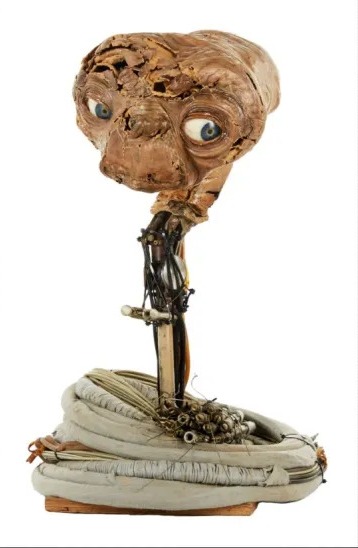
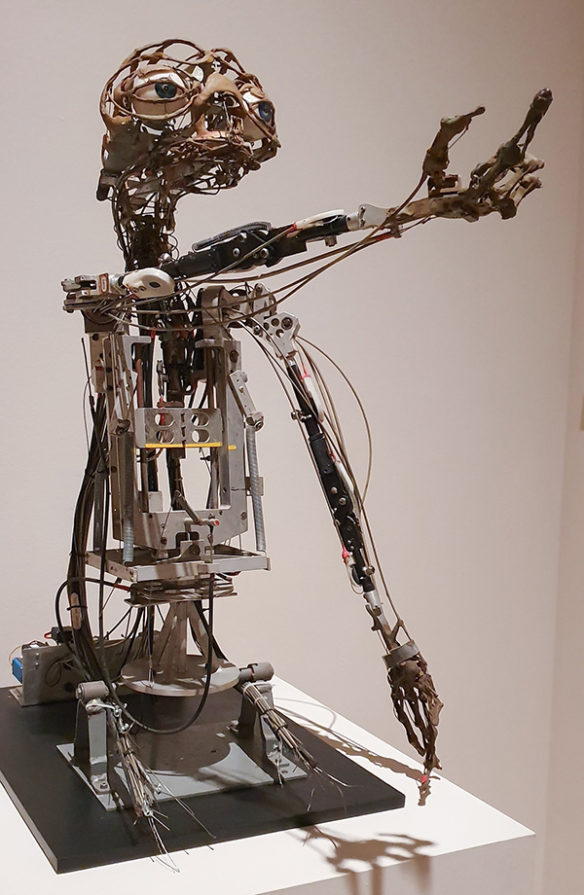
…An animatronic E.T. head used during the production of Steven Spielberg‘s coming-of-age sci-fi classic (the film is available to rent and/or own from Universal Pictures Home Entertainment) recently sold for a whopping $635,000 in a bidding war hosted by California-based auction house, Julien’s Auctions. The lot — which was initially estimated to bring in between $800,000 to $1 million — also included a DVD of the movie, just to sweeten the deal a little. Because if you’re going to drop a load of cash on an immortal piece of cinema history, you might as well get a slightly outmoded form of home entertainment for your troubles….
All Marvellous Michael Anson did was promote her upcoming book — an adult fantasy romance called Firstborn of the Sun. Like many acclaimed fantasies in recent years, this one is influenced by West African culture and magic. In this story, everyone is able to draw power from the sun. Except the heroine, Lọ́rẹ. She instead yields a shadow magic…
Note that Anne Marble is a bit concerned that people may be giving the accuser too much attention, because the complaint is so dubious some suspect she may be doing this to get sales. Or simply trolling everyone.
…History, as taught in school, is about choices made. When I was a kid, this story was not one of the choices made.
This can be, I will note, one of the great advantages of film. Hollywood is always looking for stories, and while it is not afraid of recycling the same ones over and over and over, it still from time to time unearths one that is new, or at least new to a general audience. Some of those stories come from history, recent or otherwise. And while one must always take the history that Hollywood provides with a massive grain of salt (including this one; the general arc of Hidden Figures’ story is true, but specific incidences are pumped up and rearranged for dramatic purposes, and certain characters outside of the three main roles are made up out of whole cloth), it nevertheless has the effect of saying: This is a thing that happened, you didn’t know, and we, in our fashion, are telling you about it….
When I started Dark Matter three years ago, I wondered if anyone would even care. There are so many excellent short fiction publications out there. Why should people pay attention to this one?
I don’t have an answer to how or why readers and writers and artists jumped on board, but I’m forever grateful they did. Thanks to them, Dark Matter will end its third year of publication in December of 2023, having published 21 issues (18 regular issues plus 3 Halloween special issues), more than 180 stories, more than 40 art features, and a number of interviews with industry greats. These past three years have been a dream come true for me. The joy of creating and editing my own science fiction magazine was an honor and a privilege, and one that I’ll never forget. Helping in a small way to create something that people truly enjoy is the best feeling in the world.
So why close now? Well, there are two simple reasons. One is bandwidth. Starting in 2024, Dark Matter will focus exclusively on our growing trade imprints and audio division. The Dark Matter staff is the most talented and dedicated group of people I’ve ever worked with, but we’re still small in number. In order to continue producing the quality readers have come to expect, I needed to streamline our business model and refresh our focus. The last thing I want is to overextend staff or fail to meet promises made to the readers and contributors that trust us with their time, money, and hard work.
The second reason: it’s time to give others a chance….
The publisher is transitioning to producing Dark Matter Presents line of anthologies, published by Dark Matter INK.
(8) GREAT LIVES FEATURES BALLARD. [Item by SF Concatenation’s Jonathan Cowie.] BBC Radio 4’s Great Lives this week looked at the SF author J. G. Ballard. Among the programme’s contributors was his daughter, so the show had some real insights. For example, J. G. Ballard never objected to being called a science fiction writer, but equally did not like being pigeon-holed. Also covered were his predictions including climate change (Drowned World, 1962) and socially divisive housing (High Rise, 1975) and things like YouTube/streaming (accessible video on demand) which he predicted back in the 1970s. The 25 minute programme also covered his life beyond his writing.
Philosopher John Gray chooses as his great life the iconic British writer of dystopian and speculative fiction, J.G. Ballard, in conversation with the author’s daughter Bea Ballard.
(9) BOB JOHNSON (1944-2023). [Item by Steven French.] I remember buying that Steeleye Span album Below the Salt! “Bob Johnson obituary” in the Guardian.
…Exhausted by the touring, Johnson left the band to work with Knight on a 1977 concept album, The King of Elfland’s Daughter, based on the 1924 fantasy novel by Lord Dunsany. Johnson and Knight were joined by a star cast that included Christopher Lee and the blues hero Alexis Korner, but it was not a commercial success. “It was a lovely project and completely Bob’s idea,” said Knight, “but the record company had no intention of promoting it.”
Johnson re-joined Steeleye for the 1980 album Sails of Silver, but by now folk-rock was out of fashion, swept away by punk and disco. The band’s schedule was far less hectic, allowing him to study for a degree in clinical psychology at Warwick University, followed by an MA at the University of Hertfordshire and occasional work as an occupational therapist in Harley Street. Ill health forced him to leave Steeleye once again in 2002, but he returned to contribute two songs and guest vocals for the band’s 2013 concept double-album, Wintersmith, which was based on stories by the author Terry Pratchett, a Steeleye fan….
(10) TODAY’S BIRTHDAY.
[Written by Cat Eldridge.]
Born December 20, 1960 — Nalo Hopkinson, 63. Our Birthday guest tonight is the Jamaican-Canadian writer who I first encountered when I read her Brown Girl in the Ring with its magic realism Afro-Caribbean folklore rooted culture. She won the 1999 Astounding Award for Best New Writer, was a GoH at the 2017 Worldcon in Helsinki, and named a SFWA Grand Master in 2021.
Now I’m going to gush like a true fan here as everything she has done since her impressive debut is most stellar.
Midnight Robber, that draws off the Trinidadian culture and puts it in a SF setting, was nominated for a Hugo Award at The Millennium Philcon and shortlisted for the Nebula Award and the Canadian Sunburst Award. It is an extraordinary coming of age story.
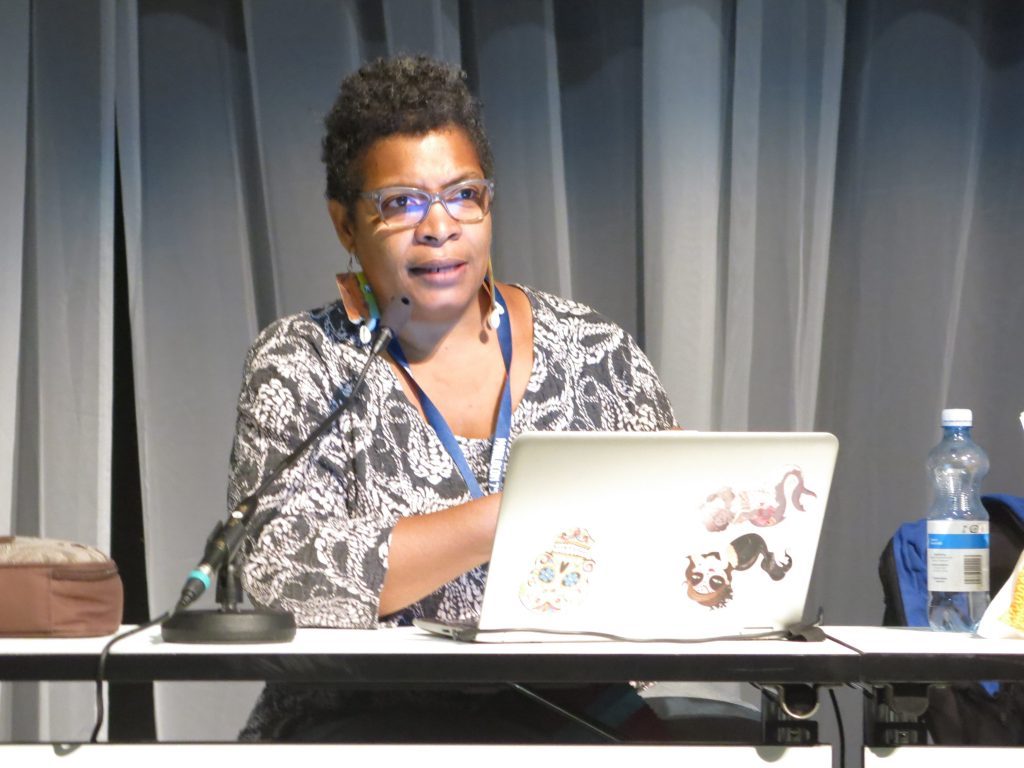
2017 Worldcon GoH session: Nalo Hopkinson. Photo by Daniel Dern.
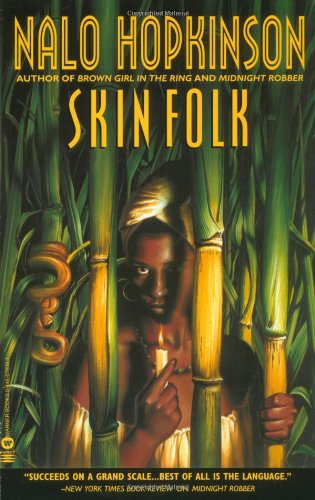
So what’s next? Her short fiction must not be overlooked and Skin Folk which garnered a much deserved World Fantasy Award for Best Story Collection is well worth your reading time.“The Gloss Bottle Trick” herein got nominated for an Otherwise Award, and “Something to Hitch Meat To” got a World Fantasy Award nomination.
And that is one eerie cover, well as done by Mark Harrison.
Back to novels…
The Salt Roads is not light reading. Depending on your trigger points, it definitely could be depressing. Or worse. I can’t say as you’ll need to read it to find out. The best review of it by far was by Gwyneth Jones in the 91st issue of Foundation.
Everyone but Hugo nominators loved her tale of an orphaned child with a mysterious past and the fantastic troubles it causes in the life of a Caribbean woman as told as in the New Moon’s Arms. I’m not kidding. It won both Sunburst and the Prix, and had nominations for a Campbell Memorial, Mythopoetic Award and a Nebula.
She says the sources for her novels often comes from songs or poems with Christina Rossetti’s poem “Goblin Market” is that for her Norton Award winning Sister Mine which is the complicated tale of two sisters. Fascinating read.
I’ll finish off with her writing for The Sandman Universe: House of Whispers which I think is some of the best work done for that series. It is available, as is all of her work, from the usual suspects.
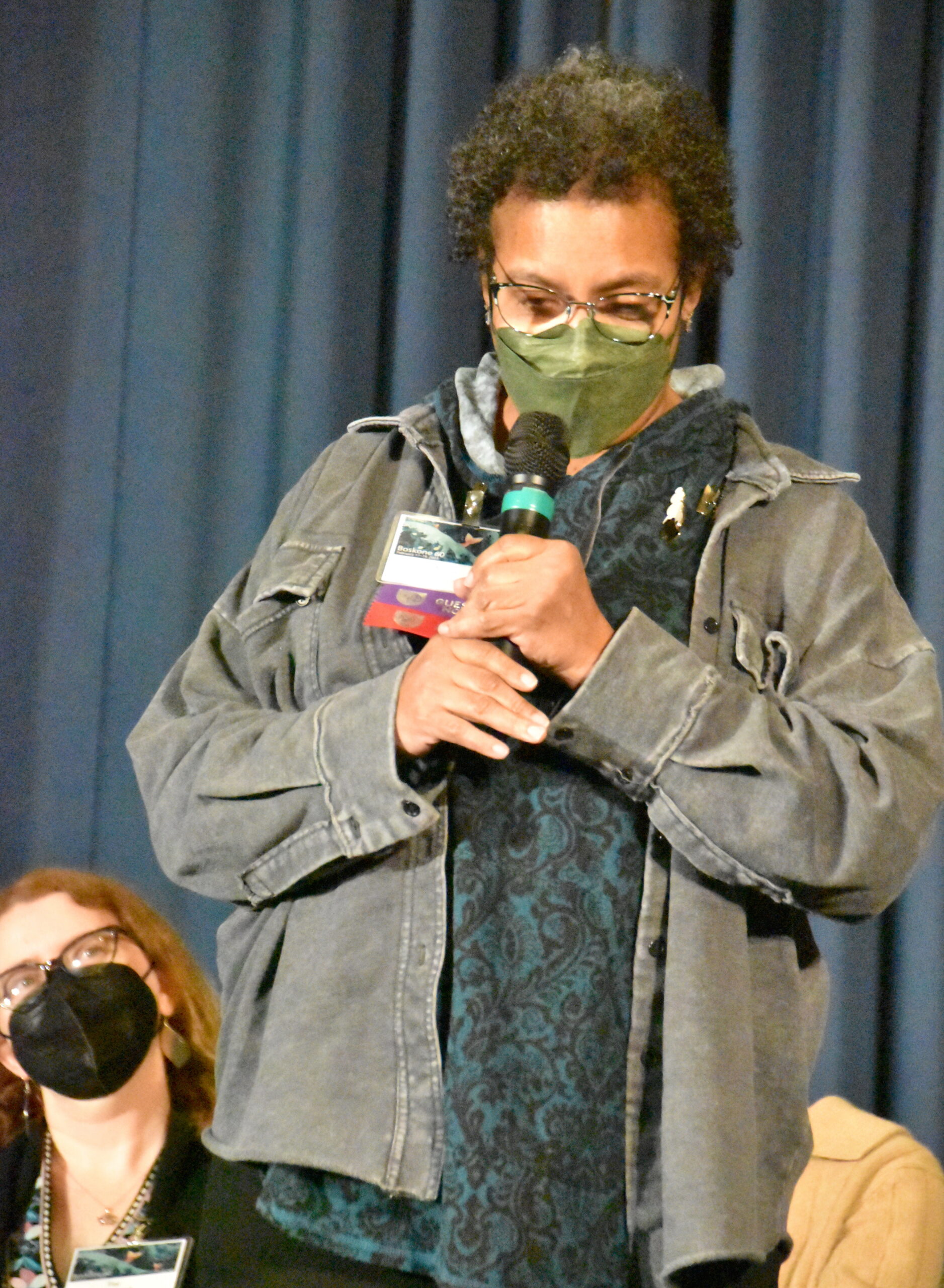
Nalo Hopkinson at 2023 Boskone. Photo by and (c) Andrew Porter.
(11) TIME TO OPEN YOUR GIFTS. The Robert Bloch Official Website tells everyone they’re just in time to receive two “presents” for the holidays.
See artist JB Lee’s rendition of a Lovecraft Mythos Shoggoth, inspired by “Notebook Found in a Deserted House.”
(12) FICTION STORIES FROM THE JOURNAL NATURE. [Item by SF Concatenation’s Jonathan Cowie.] Nature“Futures” now seems to be open access again. They seem to vacillate between being open access and being behind a pay wall (only a couple of weeks ago when I last checked they were behind a paywall as I had to log in to see them (I am a Nature subscriber)).
SF² Concatenation has an arrangement with Nature to re-post what it considers to be the four best of these stories a year subject to author approval. These ‘best of’ ‘Futures’ are all open access. http://www.concatenation.org/futuresindex.html.
Quentin Tarantino fans were sent into a frenzy in late 2017 after it was announced that Paramount and “Star Trek” producer J.J. Abrams had accepted Tarantino’s pitch for a new “Star Trek” movie and were working with “The Revenant” screenwriter Mark L. Smith to iron out the script. The project ultimately never got made, but Smith recently told Collider while promoting his latest project, the George Clooney-directed drama “The Boys in the Boat,” that it would’ve been “the greatest ‘Star Trek’ film.”
“Quentin and I went back and forth, he was gonna do some stuff on it, and then he started worrying about the number, his kind of unofficial number of films,” Smith said. “I remember we were talking, and he goes, ‘If I can just wrap my head around the idea that ‘Star Trek’ could be my last movie, the last thing I ever do. Is this how I want to end it?’ And I think that was the bump he could never get across, so the script is still sitting there on his desk.”
…Tarantino has long said he will retire from feature filmmaking after making his 10th movie. He has nine movies under his belt (he views the two “Kill Bill” movies as one movie), which means there’s only one Tarantino-directed film left. That will be “The Movie Critic,” not a “Star Trek” movie.
“I know he said a lot of nice things about it. I would love for it to happen,” Smith said. “It’s just one of those things that I can’t ever see happening. But it would be the greatest ‘Star Trek’ film, not for my writing, but just for what Tarantino was gonna do with it. It was just a balls-out kind of thing.”
“But I think his vision was just to go hard. It was a hard R. It was going to be some ‘Pulp Fiction’ violence,” Smith continued. “Not a lot of the language, we saved a couple things for just special characters to kind of drop that into the ‘Star Trek’ world, but it was just really the edginess and the kind of that Tarantino flair, man, that he was bringing to it. It would have been cool.”…
An orange tabby cat named Taters stars in the first video transmitted by laser from deep space, stealing the show as he chases a red laser light.
The 15-second video was beamed to Earth from NASA’s Psyche spacecraft, 19 million miles (30 million kilometers) away. It took less than two minutes for the ultra high-definition video to reach Caltech’s Palomar Observatory, sent at the test system’s maximum rate of 267 megabits per second.
The video was loaded into Psyche’s laser communication experiment before the spacecraft blasted off to a rare metal asteroid in October. The mission team at NASA’s Jet Propulsion Laboratory in Pasadena, California, decided to feature an employee’s 3-year-old playful kitty.
The video was streamed to Earth on Dec. 11 and released by NASA this week. Despite the vast distance, the test relayed the video faster than most broadband internet connections here on Earth, said the project’s Ryan Rogalin.
NASA wants to improve communications from deep space, especially as astronauts gear up to return to the moon with an eye toward Mars. The laser demo is meant to transmit data at rates up to 100 times greater than the radio systems currently used by spacecraft far from Earth….
The Warped Side of Our Universe: An Odyssey through Black Holes, Wormholes, Time Travel, and Gravitational WavesKip Thorne & Lia Halloran Liveright (2023)
Physicist Kip Thorne and visual artist Lia Halloran began to collaborate on a magazine article about the strange, warped space-time in and around a black hole more than a decade ago. It was never published — but it inspired a much more ambitious project.
The pair have just released an illustrated book portraying space-time storms generated by colliding black holes and neutron stars, as well as wormholes and the possibility of time machines — with explanations and illustrations all guided by cutting-edge computer simulations. It’s an intimate account, too. Halloran’s paintings depict her wife, Felicia, with her body stretching, spinning and contorting as she nears the gravitational maw of a black hole. Thorne expresses his words in verse….
John Denver and the Muppets: A Christmas Together is a 1979 Christmas television special starring Jim Henson’s Muppets and singer-songwriter John Denver. The special first aired December 5, 1979, on ABC.
This time I took the famous Pink Panther theme song by Henri Mancini and the also famous James Bond Theme by Monty Norman. In my opinion the two themes fit perfectly together but judge yourself. For this Epic song mashup I used my Korg Kronos 61 and Korg Kronos 88. All the sounds you hear are specially designed for this classic theme song mashup.
[Thanks to Andrew Porter, John King Tarpinian, Chris Barkley, Daniel Dern, Rich Lynch, Steven French, Cat Eldridge, SF Concatenation’s Jonathan Cowie, and Mike Kennedy for some of these stories. Title credit belongs to File 770 contributing editor of the day Andrew (not Werdna).]
(1) R’LYEH AND PUPPIES. Francis Gooding’s review of The World We Make includes comments placing it in recent genre history: “Slimed It: On N.K. Jemisin” in The London Review of Books.
…The backstory to this battle with Cthulhu was widely covered when The City We Became first appeared. It stretches back to 2011, when the Nigerian American writer Nnedi Okorafor won the World Fantasy Award for her novel Who Fears Death. The prize came with a trophy – an ugly sculpture of Lovecraft’s head – and Okorafor wrote a thoughtful, measured blog post about her conflicted feelings on getting the award, having discovered just how racist Lovecraft was. A petition was drawn up to have the Lovecraft trophy replaced, and there was something of a furore in the sci-fi and fantasy community about what to do with Lovecraft now that, belatedly, his influence and reputation had to be squared with his racism.
The debate that followed had the disheartening outlines familiar from other culture war clashes of the time. A reactionary bitterness at progressive political gains came to the surface, a sure sign of festering prejudice. A few years later, that lurking ressentiment assumed a more active form: a concerted effort by two organised groups of authors and fans (known as the ‘Sad Puppies’ and ‘Rabid Puppies’), to skew the public nomination process for the prestigious Hugo Awards in sci-fi publishing. In response to a perceived bias in favour of the liberal left in all its manifestations – Black and brown people, women, novels with progressive themes (‘boring message fic’), gay writers and so on – the Puppies flooded the nominations with their own picks. Some of the people involved were connected to the then ascendent alt-right, and racist abuse was aimed at Jemisin herself. But though the campaign succeeded in souring the atmosphere, it didn’t achieve its desired result: in 2016, on a slate dominated by the Puppies’ astroturfed nominees, Jemisin won the Hugo for best novel with The Fifth Season, the first book in her Broken Earth trilogy. She was the first Black writer to win the award. Both the book’s sequels, The Obelisk Gate and The Stone Sky, won the Hugo in subsequent years; a fourth Hugo followed in 2019 for the novella Emergency Skin.
The alt-right of the 2000s and early 2010s was preparing the ground for the subsequent radicalisation of the mainstream. The neofascist ideologies that once lurked in the subcultural margins have since become the basis of the ‘war on woke’, as an endless succession of manufactured outrages have bound small-c conservatives ever more tightly to what were once outré far-right positions. The eldritch bullshit that turbo-charged the Trump era wasn’t put back in its box. Jemisin evidently felt there was unfinished business. ‘The City Born Great’ was a knowing literary confrontation with the noisy and reactionary elements in the sci-fi community for whom Lovecraft remains talismanic.
In the novels, New York’s initial scrap with the Enemy expands to take in wider, ongoing struggles. Lovecraft, however, remains elemental. It eventually emerges that the Enemy is the personification of R’lyeh, the lost city from Lovecraft’s ‘The Call of Cthulhu’. Lovecraft’s stories often feature dead, inhuman cities from an unfathomably ancient past. Jemisin’s cities are the opposite, alive and defiantly human – real people, right now. And Jemisin makes sure to embody them in just the sort of people Lovecraft loathed. All the boroughs (bar Staten Island) are Black, Asian or Indigenous; and Manhattan, Queens, the Bronx and New Jersey – later an honorary sixth borough – are gay or queer…
Neve McIntosh (played Silurians, including Madame Vastra, 2010-2014)
The episode A Good Man Goes to War was so special because they’d killed me off twice before and I was amazed to be asked back, as a goodie not a baddie, with Catrin Stewart as my fabulous kick-ass wife and brand new friend and stunt potato Dan Starkey! The best bit was filming the dematerialisation. The director cries “freeze!”. We are still as statues, two guys from the art department run out and flat-pack the Tardis, then, “action!”, and we all react to the Doctor disappearing off to a new adventure! Of course Madame Vastra is blase about it all but inside I was bursting with delight!
[Ms. Barnhill is the author of “The Ogress and the Orphans.” She experienced a traumatic brain injury in 2021.]
I’ve been trying to write this essay for a very long time. Months, I think. Or maybe even longer, before I ever mentioned it to anyone, before I let anyone know that I was even capable of multiple sentences again. When all I could muster writing was a single sentence on a note card. My brain works differently now than it used to, and differently than I feel that it ought to. I told my speech therapist that I was frustrated that I haven’t been able to write fiction since experiencing a traumatic brain injury — which means that I am still, after nearly two years, unable to do my job.
He nodded with practiced care. “That must feel frustrating,” he said. “But maybe it’s important to focus on what you can do.”
Which is fair, I suppose. But I still wanted to clock him.
Healing from any injury is a process of rebuilding cells and tissues and structures — taking that which is broken and making it new again. Healing a brain injury is the process of rebuilding not only tissues and cells and the connections between those cells, but also memory, thoughts, imagination, the fundamentals of language and our very concept of ourselves.
I am rebuilding myself, you see. Right now. Sentence by sentence.
In December 2021, just a few months before the publication of two of my novels, “The Ogress and the Orphans” and “When Women Were Dragons,” I took a colossal spill down the stairs.
My husband heard me holler and found me in an unconscious heap. I remember none of this. It’s strange not remembering the moment that changed my life, that altered my work and vocation, that disrupted the me-ness of me. I think, though, that my body remembers it, even if I do not. A chaos of movement. A scramble through space. A short, sharp knock at the back of my head. And then a thunderous dark….
The piece discusses the many changes to her life and the challenges in recovery, and ends:
…But lately, I’ve had dreams of writing. I wake up in tears. What story was I writing? No idea. But each neuron shoots forth messages into the dark. A small candle. A lighthouse at the edge of a stormy ocean. I exist. I saw this. Felt this. Know this. Am this. Meanwhile, my sentences have grown. I’ve taken to using larger index cards. Sometimes I go as far as a steno pad. A full sheet of paper is too much — my eyes can’t track it very well. I get lost. I need something small and contained, where I can fit pretty words into a pretty sentence and allow them to become more than themselves.
Recently, I wrote a story. Only six sentences long, but a story nonetheless. With a character, a place and the passage of time. An opening, a turn, a conclusion. Such a small thing, a tiny accomplishment. And yet. I stared at the card for a long time, utterly astonished.
(4) DETAILS OF SERGEY LUKYANENKO’S DECEMBER BOOK TOUR IN CHINA. [Item by Ersatz Culture.] Further to the File 770 post on November 12, Sergey Lukanenko’s visit to China in December has now been publicly announced on Chinese social media. That Weixin/WeChat piece describes him as a GoH of the 2023 Chengdu Worldcon (2023成都世界科幻大会荣誉主宾), despite his non-appearance then.
He will be making four appearances in Chengdu between December 1st and 4th, two in Beijing on the 7th and 8th, and a final one in Shanghai on the 10th. Three organizations are listed as event co-hosts:
The Chengdu Science Fiction Society/Association (成都科幻协会, which for some reason has the acronym CSFC). This is the organization that is/was in charge of the Chengdu Worldcon.
The announcement also indicates a number of people will be appearing alongside Lukyanenko at some of the events:
Yao Haijun – deputy editor-in-chief of Science Fiction World, Hugo finalist and member of the Chengdu concom
Jiang Zhenyu – member of the Chengdu concom
Baoshu – writer of a Three-Body Problem sequel, amongst other works
(5) ILYA SAYS, ‘OPEN CHANNEL BEEB…’[Item by SF Concatenation’s Jonathan Cowie.] There has been a lot the past week on BBC Radio 4 or the Home Service as I like to call it, of likely interest to Filers (and indeed SF² Concateneers)…
This month’s Open Book has a substantive section on book banning in the USA (“Bestselling novelist Michael Connelly talks about his response to the ongoing campaigns banning books in American school libraries.”) We do not have this problem to such a degree over here in Brit Cit but, from coverage in File770, it is clearly a substantive issue in the US mega-cities and especially the Cursed Earth. You can listen to the programme here.
Doctor Who is 60 this year and some of us in Brit Cit remember its first episode, peering out from behind the sofa. Anyway, the BBC has a number of programmes to mark this special anniversary. One of these was Doctor Who: The Wilderness Years that looked at why the original series ended and what happened over the years when the show was not on our screens.
In December 1989 – after 26 years on TV, 694 episodes and seven different Doctors – Doctor Who, the longest running series in the history of British television, was quietly exterminated by the BBC. It remained off air for 16 years until the series was revived in 2005, quite spectacularly under the auspices of Russell T Davies with Christopher Eccleston as the Time Lord. But the period between 1989 and 2005 was a very special interregnum. Known as the Wilderness Years, they belonged to the true keepers of the flame, Doctor Who fans – and never had a wilderness proved so fertile.
iPromise was a cyberpunk stand-alone radio play about a hacker hired by not nice people to break into a quantum computer so as to get at cryptocurrency….
A quantum cryptocurrency audio heist movie and psychological tech thriller exploring the illusory nature of money itself. Bit – real name Rebecca “Becky” Isobel Troughton, BIT, get it? – is in trouble. Big trouble. She’s only gone and hacked into US mainframes and brought the entire eastern seaboard to a standstill. And now she’s on everybody’s Most Wanted list. But Bit is no hacking ‘gun for hire’. She’s driven by principle and she’s the very best at what she does. So when shady government organisations come knocking in a bid to secure her services, she just sends them packing. Well, sort of. .
(6) SF2C EXITS X. [Item by SF Concatenation’s Jonathan Cowie.] I see that a load of folk are leaving Twitter or X or whatever it is these days. Actually, SF² Concatenation left Twitter a few months ago after the Musk takeover. We only used Twitter for site alerts and not chat, and found only a handful of folk signed up to our account. But I had kept it going for those few die-hard followers, sometimes treating them to some early releases before they were announced on our various indices pages. The thing is that that account, @SF2Concat, was set up ages ago using a now defunct e-mail address.
One of the first things Musk did was to insist on strengthening passwords blocking accounts – such as ours – that did not have a password that included a number, symbol and Klingon hieroglyph. To get our account back, I’d have to give Twitter an extant e-mail address. Those that know me are aware that I really hate to sign up to anything (so, for example, for the first time since 1979 I will not be on the science programme of next year’s British Worldcon – Less work for me, so that’s a plus.)
Anyway, seeing the writing on the wall what with Musk’s apparent support of Trump’s ramblings, I decided not to continue with Twitter. The account is still there for future digital archaeologists.
For those wanting alerts, the wonderful Caroline frequently posts something on the BSFA Facebook page (last season edition alert here) which I mention because the BSFA is a worthy page to follow for a plethora of other reasons. And if you are on FB I give a shout out to one of Brit Cit’s local SF group pages North Heath SF.
The rise of artificial intelligence has created reams of new artworks, many of them generated, controversially, on the backs of artist’s existing pieces. Now, one X (formerly Twitter) user has shown a way that A.I. can offer “improvements” to classic works of art, starting with Edward Hopper’s Nighthawks, and even one of the art world’s most beloved critics may have fallen for the gag.
“Using AI, I was able to take some old painting and make it better,” posted X user Sonch (@soncharm) last week, sharing a jpeg of Edward Hopper’s famous scene of urban ennui, Nighthawks from 1942, how housed in the Art Institute of Chicago. “Where even is this? Who are the people? Huh? You’re too far away to really see the setup. Whole left side blank. Nothing here to grab onto,” Sonch complained….
Click on tweets for larger images.
Before/after. See what I mean? There's just no comparison. Which would you rather hang in your entryway? How did the AI 'know' exactly what the starting pic needed to complete it? Amazing. pic.twitter.com/SGQOsagQJK
Born November 24, 1948 — Spider Robinson, 75. Spider’s an American-born Canadian citizen who’s one of my favorite writers and individuals to boot.
This is not a complete listing of what he’s written, just my experiences with him and what I think should be commented upon.
I wasn’t surprised to discover that his first sale, “The Guy with the Eyes”, published by Analog in February 1973, was one of his Callahan stories. Four years later, he released Callahan’s Crosstime Saloon, a collection of Callahan short stories. These stories, and the later novels, make frequent reference to the works of mystery writer John D. MacDonald’s Travis McGee stories.
I’m very fond of the Lady Slings The Booze and Booze and Callahan’s Key as these Callahan’s Crosstime Saloon novels allow him to develop the characters at length more than he dies in the short stories.
It was at this time that he married Jeanne Robinson, with whom he later co-wrote the quite excellent Stardance trilogy. The first, “Stardance”, a novella, won a Hugo at IguanaCon II, and a Nebula as well.
His first published novel, Telempath, was a reworking of the “By Any Other Name” novella.
And there’s Variable Star which as you know was based on an outline by Heinlein. I think it was, errr, ok. Not great, not bad, just ok.
Hugo wise, I mentioned the first “Stardance” novella garnered a Hugo as did his “By Any Other Name” novella at SunCon and “Melancholy Elephants” short story which also got a Hugo at ConStellation. He was an Astounding Award Best Writer as well. And he received a much deserved LASFS Forry Award for Lifetime Achievement.
He hasn’t published anything since 2008 though he’s been working on a novel, Orphan Stars, for the last decade and is said to be working on his autobiography as well.
He was Toastmaster at MagiCon and Torcon 3.
Spider and Jeanne Robinson at MagiCon. Photo by Lenny Provenzano.
…The original Doctor Who series ran from 1963 to 1989 before being mothballed. The report acknowledges that basing the series in Cardiff for its revival at the turn of the century felt like a risk.
But the show, originally starring Christopher Eccleston as the Time Lord and first broadcast in 2005, was an immediate success. Further series were commissioned and the BBC launched the spin-offs Torchwood and The Sarah Jane Adventures.
As well as finding creative people ready to work on the series, the show used settings in and around Cardiff, from the beaches of South Glamorgan to the capital’s castle and museums, prompting a spike in Doctor Who tourism.
The report, by economists within the BBC public policy team using research from the consortium Media Cymru and Cardiff University’s centre for the creative economy, looks at the impact of the show between 2004 and 2021. It estimates that each of the 13 revamped series generated the equivalent of 50 FTE (full-time equivalent) jobs per series in Wales, and 95 within the UK overall. These jobs are in addition to posts for people who directly work on the show.
It describes Doctor Who’s return as a “pivotal moment”, a catalyst for the growth of the Welsh creative industries over the past 15 to 20 years, claiming it paved the way for big BBC-commissioned shows including Merlin, Atlantis and Sherlock. This year, six new dramas have come out of Wales including Steeltown Murders, the story of the serial killer Joseph Kappen, and the thriller Wolf, both of which have won plaudits…
We fire up the LizBat signal and discuss the Chengdews (John’s new pun; he’s extremely proud of it) including WSFS discussion, before moving onto Glasgow 2024’s online plans and Novacon chat. Then we talk about books and games and stuff. In
…[December is] an eye-catching and otherworldly month, in other words, but sci-fi splendor and the heart of the holiday season don’t intertwine all that often, or as often as someone who adores both might wish.
Indeed, “phones homes” is a reference to a certain sweet space traveler, so you can bet you’ll spy E.T the Extra-Terrestrial, or rather an animatronic E.T. head, in the collection.
Other iconic additions to the line-up include a “Fantastic Voyage” ship, a Xenomorph head from “Aliens,” a “Back to the Future Part II” hoverboard, and the oh-so-cuddly Muffit II the daggit, a “Battlestar Galactica” favorite; Marvel and Harry Potter treasures will also be in the spotlight….
(13) THE ART IN ARTIFICIAL INTELLIGENCE. Nature tells readers “How AI is expanding art history”. (Don’t worry, nothing in here about “Nighthawks”.)
From identifying disputed artworks to reconstructing lost masterpieces, artificial intelligence is enriching how we interpret our cultural heritage.
Artificial intelligence (AI), machine learning and computer vision are revolutionizing research — from medicine and biology to Earth and space sciences. Now, it’s art history’s turn.
For decades, conventionally trained art scholars have been slow to take up computational analysis, dismissing it as too limited and simplistic. But, as I describe in my book Pixels and Paintings, out this month, algorithms are advancing fast, and dozens of studies are now proving the power of AI to shed new light on fine-art paintings and drawings.
For example, by analysing brush strokes, colour and style, AI-driven tools are revealing how artists’ understanding of the science of optics has helped them to convey light and perspective. Programs are recovering the appearance of lost or hidden artworks and even computing the ‘meanings’ of some paintings, by identifying symbols, for example…
Some segmented sea worms like the syllid worm go through a reproductive process called stolonization. The stolon is the worm’s posterior organ and it is full of eggs or sperm depending on the worm’s sex. During stolonization, the stolon completely detaches from the rest of the worm’s body for reproduction.
This detached butt swims around by itself and spawns when it meets another stolon of the opposite sex. This autonomous swimming is believed to protect the original body of the worm from dangers in the environment and help the eggs and sperm travel longer distances.
In order to swim by themselves, the stolon have to develop their own eyes, antennae, and swimming bristles while still attached to their original body. How this happens has been a mystery. The formation of the stolon itself begins when the gonads near the worm’s butt mature. A head is then formed in the front of the developing stolon, with the eyes, antennae, and swimming bristles following close behind. It develops its nerves and the ability to sense and behave independently before the stolon detaches from the rest of the body….
[Thanks to SF Concatenation’s Jonathan Cowie, Mike Kennedy, Andrew Porter, Ersatz Culture, Lise Andreasen, Steven French, John King Tarpinian, Chris Barkley, and Cat Eldridge for some of these stories. Title credit belongs to File 770 contributing editor of the day Daniel Dern.]
… Ultimately, Qven’s determination to have eir pronouns recognized is fundamental to the entire story: whether you can be recognized on your own terms, or whether you must have categories of identity (such as gender, ethnicity, species, and legal citizenship) inflicted upon you or withheld from you by others, is the central problem the book addresses. But for Qven, everything comes down at key moments to the way Pirate Exiles inspires em to joyfully envision emself as “a princex in disguise,” like Kekubo. “What would a princex in disguise do?” Qven asks emself multiple times as the novel builds toward its climax, and eir most important decisions are consistently influenced by the inspiration they draw from identifying with Kekubo.
This thematic emphasis—the way that small details (like a character’s obsession with trashy adventure serials) can ultimately shape and influence the largest possible events (such as the fall of an empire)—is one of the hallmarks of Leckie’s work. Her recurring argument is that minor details, events, actions, and influences are never truly minor: everything has consequence, even if it is not immediately visible….
(2) SAFETY LAST. Evgeny Morozov, author of To Save Everything, Click Here: The Folly of Technological Solutionism, wrote an opinion piece about “The True Threat of Artificial Intelligence” for the New York Times.
…The mounting anxiety about A.I. isn’t because of the boring but reliable technologies that autocomplete our text messages or direct robot vacuums to dodge obstacles in our living rooms. It is the rise of artificial general intelligence, or A.G.I., that worries the experts.
A.G.I. doesn’t exist yet, but some believe that the rapidly growing capabilities of OpenAI’s ChatGPT suggest its emergence is near. Sam Altman, a co-founder of OpenAI, has described it as “systems that are generally smarter than humans.” Building such systems remains a daunting — some say impossible — task. But the benefits appear truly tantalizing.
Imagine Roombas, no longer condemned to vacuuming the floors, that evolve into all-purpose robots, happy to brew morning coffee or fold laundry — without ever being programmed to do these things.
Sounds appealing. But should these A.G.I. Roombas get too powerful, their mission to create a spotless utopia might get messy for their dust-spreading human masters. At least we’ve had a good run.
Discussions of A.G.I. are rife with such apocalyptic scenarios. Yet a nascent A.G.I. lobby of academics, investors and entrepreneurs counter that, once made safe, A.G.I. would be a boon to civilization. Mr. Altman, the face of this campaign, embarked on a global tour to charm lawmakers. Earlier this year he wrote that A.G.I. might even turbocharge the economy, boost scientific knowledge and “elevate humanity by increasing abundance.”
This is why, for all the hand-wringing, so many smart people in the tech industry are toiling to build this controversial technology: not using it to save the world seems immoral.
They are beholden to an ideology that views this new technology as inevitable and, in a safe version, as universally beneficial. Its proponents can think of no better alternatives for fixing humanity and expanding its intelligence.
But this ideology — call it A.G.I.-ism — is mistaken. The real risks of A.G.I. are political and won’t be fixed by taming rebellious robots. The safest of A.G.I.s would not deliver the progressive panacea promised by its lobby. And in presenting its emergence as all but inevitable, A.G.I.-ism distracts from finding better ways to augment intelligence….
… In the stellar neighborhood of American letters, there have been few minds as generous, transgressive, and polymathically brilliant as Samuel Delany’s. Many know him as the country’s first prominent Black author of science fiction, who transformed the field with richly textured, cerebral novels like “Babel-17” (1966) and “Dhalgren” (1975). Others know the revolutionary chronicler of gay life, whose autobiography, “The Motion of Light in Water” (1988), stands as an essential document of pre-Stonewall New York. Still others know the professor, the pornographer, or the prolific essayist whose purview extends from cyborg feminism to Biblical philology.
There are so many Delanys that it’s difficult to take the full measure of his influence. Reading him was formative for Junot Díaz and William Gibson; Octavia Butler was, briefly, his student in a writing workshop. Jeremy O. Harris included Delany as a character in his play “Black Exhibition,” while Neil Gaiman, who is adapting Delany’s classic space adventure “Nova” (1968) as a series for Amazon, credits him with building a critical foundation not only for science fiction but also for comics and other “paraliterary” genres….
…After ET came out in 1982, life was never the same for Thomas, who had only appeared in one film before being cast in Spielberg’s smash hit. Now 51,he recalls a six-year-old Drew Barrymore tottering over to him on set to ask how many films he had been in. “Oh, you poor thing,” she answered airily. “I’ve been in four.” But aside from reading lines and knowing his cue, the little boy from rural Texas didn’t really know what acting was, let alone fame. “It was a total unexpected side-effect of doing this fun thing I had wanted to do,” he says now, from his home in Oregon. “I had no clue that my life would change in any way. I worked on this movie, then I’m back on the farm, I’m back at school – but now people are pointing at me in the street.”
Even as a child, he was aware that his mother, Carolyn, resented how his fame was impacting the whole family. She would take him to auditions and shoots until his late teens, and always felt the need to protect him. “She was doing the best job that she knew how to do,” he says. “My whole family weren’t really well equipped to deal with anything like that. And other than a few precautions, we didn’t change our lives that much. Consequently, we got a lot of weird visitors to our residence and things like that, phone calls.”
Complete strangers would want to speak to a little boy? He nods. “We had to call the authorities a few times. ET was a real sensation, some people were fanatical about it.”
Former child actors are often asked: would you let your children act? Thomas, who has three children, has given varying answers over the years, but he’s resolute when I ask. “Pursue it when you’re older,” he says. “I still don’t think it’s a great way to grow up. It was exciting for me, I went to some strange locales and met some interesting people. But it was also very disruptive to my parents’ marriage. Our social life got weird. You get famous and suddenly every cousin that you never knew looks you up. People are strange, they do weird stuff. As a kid, that’s a lot to deal with. And when you’re an adult [too], but at least then you have all of the faculties, hopefully, to deal with fame.”
(5) MEMORY LANE.
1981 – [Written by Cat Eldridge from a choice by Mike Glyer.]
At Chicon IV in 1982 where Marta Randall was Toastmaster, C. J. Cherryh would win the Best Novel Hugo for Downbelow Station whichwas set in her Alliance–Union universe during the Company Wars period.
It was published by DAW forty-two years ago and originally had been called The Company War by the author with the cover art by David B. Mattingly. The format was paperback.
It is, I believe, a splendidly written novel that has aged rather well. Is it the best novel in the series? I think so, though there’s an argument that can be made for Cyteen which won the Hugo at Noreascon 3.
Now for her Beginning…
EARTH AND OUTWARD: 2005–2352
The stars, like all man’s other ventures, were an obvious impracticality, as rash and improbable an ambition as the first venture of man onto Earth’s own great oceans, or into the air, or into space. Sol Station had existed profitably for some years; there were the beginnings of mines, the manufacturies, the power installations in space which were beginning to pay. Earth took them for granted as quickly as it did all its other comforts. Missions from the station explored the system, a program far from public understanding, but it met no strong opposition, since it did not disturb the comfort of Earth.
So quietly, very matter of factly, that first probe went out to the two nearest stars, unmanned, to gather data and return, a task in itself of considerable complexity. The launch from station drew some public interest, but years was a long time to wait for a result, and it passed out of media interest as quickly as it did out of the solar system. It drew a great deal more attention on its return, nostalgia on the part of those who recalled its launch more than a decade before, curiosity on the part of the young who had known little of its beginning and wondered what it was all about. It was a scientific success, bringing back data enough to keep the analysts busy for years . . . but there was no glib, slick way to explain the full meaning of its observations in layman’s terms. In public relations the mission was a failure; the public, seeking to understand on their own terms, looked for material benefit, treasure, riches, dramatic findings.
What the probe had found was a star with reasonable possibilities for encouraging life; a belt of debris, including particles, planetoids, irregular chunks somewhat under planet size with interesting implications for systemic formation, and a planetary companion with its own system of debris and moons . . . a planet desolate, baked, forbidding. It was no Eden, no second Earth, no better than what existed in the sun’s own system, and it was a far journey to have gone to find that out. The press grappled with questions it could not easily grasp itself, sought after something to give the viewers, lost interest quickly. If anything, there were questions raised about cost, vague and desperate comparisons offered to Columbus, and the press hared off quickly onto a political crisis in the Mediterranean, much more comprehensible and far bloodier.
The scientific establishment on Sol Station breathed a sigh of relief and with equal quiet caution invested a portion of its budget in a modest manned expedition, to voyage in what amounted to a traveling miniature of Sol Station itself, and to stay a time making observations in orbit about that world.
And very quietly, to further imitate Sol Station, to test manufacturing techniques which had built Earth’s great second satellite . . . in stranger conditions. Sol Corporation supplied a generous grant, having a certain curiosity, a certain understanding of stations and what profits could be looked for from their development.
That was the beginning.
(6) TODAY’S BIRTHDAYS.
[Compiled by Cat Eldridge.]
Born July 3, 1898 — E. Hoffmann Price. He’s most readily remembered as being a Weird Tales writer, one of a group that included Lovecraft, Robert E. Howard, and Clark Ashton Smith. He did a few collaborations, one of which was with H. P. Lovecraft, “Through the Gates of the Silver Key”. Another work, “The Infidel’s Daughter”, a satire on the Ku Klux Klan, also angered many Southern readers. (Died 1988.)
Born July 3, 1926 — William Rotsler. An artist, cartoonist, pornographer and SF author. Well, that is his bio. Rotsler was a four-time Hugo Award winner for Best Fan Artist and one-time Nebula Award nominee. He also won a “Retro-Hugo” for his work in 1946 and was runner-up for 1951. He responsible for giving Uhura her first name, created “Rotsler’s Rules for Costuming”, and well, being amazing sounding. (Died 1997.)
Born July 3, 1927 — Tim O’Connor. He was Dr. Elias Huer in Buck Rogers in the 25th Century for much of its run. (I really, really liked that series.) Other genre appearances were on The Six Million Dollar Man, The Twilight Zone, The Outer Limits, Wonder Woman, Knight Rider,Next Gen and The Burning Zone. (Died 2018.)
Born July 3, 1927 — Ken Russell. Film director whose Altered States based off of Paddy Chayefsky’s screenplay is certainly his best-remembered film. Though let’s not overlook The Lair of the White Worm he did off Bram Stoker’s novel, or The Devils, based at least in part off The Devils of Loudun by Aldous Huxley. (Died 2011.)
Born July 3, 1937 — Tom Stoppard, 86. Screenplay writer, Rosencrantz and Guildenstern Are Dead which is adjacent genre if not actually genre. Also scripted of course Brazil which he co-authored with Terry Gilliam and Charles McKeow. He also did the final Indiana Jones and the Last Crusade rewrite of Jeffrey Boam’s rewrite of Menno Meyjes’s screenplay. And Shakespeare in Love which he co-authored with Marc Norman.
Born July 3, 1943 — Kurtwood Smith, 80. Clarence Boddicker in Robocop, Federation President in Star Trek VI: The Undiscovered Country, and voiced Kanjar Ro in Green Lantern: First Flight. He’s got series appearances on Blue Thunder, The Terrible Thunderlizards, The X-Files, Star Trek: Deep Space Nine, Star Trek: Voyager, Men in Black: The Series, 3rd Rock from the Sun, Todd McFarlane’s Spawn, Judtice League, Batman Beyond, Green Lantern and Beware the Batman. His last role was as Vernon Masters as the superb Agent Carter.
Born July 3, 1946 — Michael Shea. Shea’s first novel, A Quest for Simbilis was an authorized sequel to the first two of Jack Vance’s Dying Earth novels. Vance was offered a share of the advance but declined it. (It was declared non-canon when the next novels in the series were written by Vance.) A decade, he’d win a World Fantasy Award for his Nifftthe Lean novel, and a second twenty years later for a novella, “The Growlimb.” (Died 2014.)
Born July 3, 1948 — Marc Okrand, 75. A linguist in Native American languages who’s the creator of the Klingon language. He first applied it by dubbing in Vulcan language dialogue for Star Trek II: The Wrath of Khan, and then was involved in the Search for Spock, The Final Frontier, The Undiscovered Country, and the both rebooted Trek films. Later he developed the language for the Kelpien race in the second season of Discovery.
(7) COMICS SECTION.
Loose Parts shows why pirate cosplay is difficult for certain aliens.
(8) IT’S TIME. Moses Ose Utomi’s “My Little Time Demon” is a free read at Sunday Morning Transport, offered to encourage subscriptions.
I have a sixth sense: I can tell when someone’s given up on life. In this case, though, the guy’s ice-cream-cone face tattoo says enough….
(9) GUEST MESS. Charon Dunn went to BayCon where “a staff member misunderstood the concept behind a ‘VIP and Guest Welcoming Event’ and 86’d me and a few other guests from it, so I’m doing my alchemical ‘turning BS into art’ thing.” “Mister Gatekeeper”: Here’s first stanza.
Mister Gatekeeper You sent me back into the crowd Mister Gatekeeper You told me that I was not allowed According to my badge, I was on the list But you turned me away, and now I’m pissed Mister Gatekeeper, someday that gate’s gonna slam on you It’s true Mister Gatekeeper, someday that gate’s gonna slam on you
Between 540 million and 485 million years ago, during the Cambrian period, so many new, complex animal life forms arose that paleontologists speak of the Cambrian Explosion or the Biological Big Bang. But by 400 million years ago, almost all of those species disappeared, eventually replaced by the ancestors of most modern animals. There have been few clues about what happened in between, but fossils from 462 million years ago recently discovered in a quarry in central Wales are filling in that gap, researchers report today in Nature Ecology & Evolution.
“It is wonderful,” says Douglas Erwin, a paleontologist at the Smithsonian Institution’s National Museum of Natural History who was not involved with the work. There are “some beautiful specimens, including some surprising discoveries.”
The Welsh fossils, discovered by a paleontologist couple who live near the quarry, reveal some Cambrian life forms held on for millions of years longer than paleontologists had thought before going extinct, and certain classes of modern animals got their starts earlier than expected. There are also some familiar creatures, including arthropods such as crustaceans and horseshoe crabs, as well as sponges, starfish, and worms. Many of them by that point already had long histories and continue to thrive to this day, so their presence among the fossils isn’t surprising. But the quarry also holds strange creatures thought to have arisen and vanished during the Cambrian period, such as opabiniids, which had five eyes and a long proboscis, and scaly slugs called wiwaxiids. Newcomers spotted in the deposits include modern families of glass sponges and a group of crustaceans called horseshoe shrimp, which were thought to have arisen much later….
(11) IN BRIT CIT, IT WAS THE END OF THE WORLD ON B. BEEB CEEB RADIO 4 THIS SUNDAY. [Item by SF Concatenation’s Jonathan Cowie.] The BBC aired an audio SF play. Following a global plague, in a future where there is no longer communication between countries, some of humanity seeks solutions, perhaps to seek a new home, and Britain’s Albion has discovered a habitable planet…
Yes, this is a re-run of a previously aired radio play, but for those into SFnal audio-drama, it is one arguably worth noting. You can download the programme here: “The Goldilocks Zone”
Further information:
Astrophysicist Sofia Khaled’s discovery of a potentially habitable planet opens up painful memories for her but a startling new truth for humanity.
When future Earth discovers an uncorrupted “cosmic” truth, data finally becomes a force for good as a cover-up with catastrophic global impact is revealed in this thrilling drama spanning fifty years.
The Goldilocks Zone by Tanika Gupta was developed through OKRE Experimental Stories. The consultant scientists were Professor Caswell Barry and Dr. Adam Kampff.
[Thanks to Cat Eldridge, SF Concatenation’s Jonathan Cowie, Mike Kennedy, Andrew Porter, John King Tarpinian, Chris Barkley, and Michael Toman for some of these stories. Title credit belongs to File 770 contributing editor of the day Kip WIlliams.]
(1) WOMEN’S PRIZE FOR FICTION. One of the three longlisted works of genre interest has survived to make the 2023 Women’s Prize shortlist which was announced today.
Pod by Laline Paull is that book:
Ea has always felt like an outsider. She suffers from a type of deafness that means she cannot master the spinning rituals that unite her pod of spinner dolphins. When tragedy strikes her family and Ea feels she is partly to blame, she decides to make the ultimate sacrifice and leave.
As Ea ventures into the vast, she discovers dangers everywhere, from lurking predators to strange objects floating in the water. But just as she is coming to terms with her solitude, a chance encounter with a group of arrogant bottlenoses will irrevocably alter the course of her life.
In her terrifying, propulsive novel, Laline Paull explores the true meaning of family, belonging, sacrifice – the harmony and tragedy of the pod – within an ocean that is no longer the sanctuary it once was, and which reflects a world all too recognisable to our own.
China said on Tuesday that it would no longer require travelers entering the country to show a negative P.C.R. test for the coronavirus, another step toward reopening after a long period of pandemic-era isolation.
But it was not clear whether testing requirements would be abolished altogether. A spokeswoman for China’s foreign ministry said only that, beginning on Saturday, people going to China “can” take an antigen test to “replace” the previously mandated P.C.R. test within 48 hours before boarding their flight.
Airlines will not check test results before boarding, the spokeswoman, Mao Ning, added at a regularly scheduled news briefing. She did not say whether others, such as immigration officials, would check.
Notices by Chinese embassies overseas said that travelers arriving in China would still need to fill out a health declaration form, and that customs officials would conduct unspecified spot checks.
For three years, China imposed the world’s strictest coronavirus restrictions, requiring lockdowns and regular mass testing in the name of “zero Covid.” Then the government abruptly abandoned those rules in December as the economy sagged, the virus spread widely and protests broke out across the country. Beijing has since declared that it is open to the world, and tried to woo foreign businesspeople and diplomats….
You’ve been wondering. You’ve been waiting. You’ve been warned. The sixth season of Charlie Brooker’s Black Mirror is BACK. The most unpredictable, unclassifiable and unexpected season yet is arriving in June on NETFLIX.
(4) MIXED BAG IN NINTH CIRCUIT RULING. “Apple Largely Prevails in Appeal of Epic Games’ App Store Suit” but they didn’t sweep the board says the New York Times. “A Ninth Circuit panel did agree with Epic that Apple was violating California law by barring app developers from directing customers to outside payment methods.”
A federal appeals court ruled on Monday that Apple does not have a monopoly in the mobile games market, siding with a lower court’s 2021 ruling that largely gave the tech giant a victory in a lawsuit brought by Epic Games.
A three-judge panel of the U.S. Court of Appeals for the Ninth Circuit ruled 2 to 1 that Apple’s tight control of its App Store did not violate federal antitrust law. Some app developers have said the multibillion-dollar business’s strict policies stifle competition and eat into their profits.
“There is a lively and important debate about the role played in our economy and democracy by online transaction platforms with market power,” the judges wrote in their 91-page decision, which largely maintained the status quo. “Our job as a federal Court of Appeals, however, is not to resolve that debate — nor could we even attempt to do so.”
While siding with Apple on a majority of Epic’s claims, the judges also agreed with the lower court that Apple was violating California’s Unfair Competition Law by prohibiting app developers from directing their customers to payment methods outside the App Store, which charges a 30 percent fee. Apple suggested that it could further appeal that ruling….
(5) KNOW YOUR RIGHTS. AND LEFTS. Moid Moidelhoff gets Cory Doctorow to explain what a “copy left troll” is in “The Big Interview” at Media Death Cult.
Steven Spielberg has criticised the idea that older films should be re-edited to appease modern sensibilities.
Speaking at Time’s 100 Summit in New York City, the 76-year-old film-maker expressed regret over taking out guns from a later release of his 1982 sci-fi blockbuster ET: The Extra Terrestrial. In the 20th anniversary edition, agents saw their firearms replaced with walkie-talkies.
“That was a mistake,” he said on stage. “I never should have done that. ET is a product of its era. No film should be revised based on the lenses we now are, either voluntarily, or being forced to peer through.”
In 2011, Spielberg had already explained that the guns would be returning for the 30th anniversary release, explaining that he was “disappointed” in himself….
Futuramafans are eagerly waiting for the Hulu revival because the show has become a sci-fi staple. The series’ engagement with the hypothetical nature of science fiction makes it stand out. There’s an explorative spirit that concentrates more on the “what-if” and “imagine that” aspects and is more interested in the realm of possibility than world-building or even keeping its own continuity. Futurama‘s ability to carry the torch for old science fiction programs like The Twilight Zone, Lost in Space and Star Trek: The Original Series makes the show critical to the genre’s survival.
Over multiple episodes — and multiple cancellations — Futurama acknowledged the gone-by era of sci-fi. The show became one of the last bastions of true speculative fiction by including “The Scary Door,” Futurama‘s answer to Rod Serling and his conjectural narration, as well as other homages. Moreover, the installments containing these parodies often utilized retrofuturistic motifs typical of the golden age of science fiction, keeping it alive for a new generation….
…But perhaps Belafonte’s strangest but most distinctive role came in the 1959 post-apocalyptic sci-fi fantasy The World, The Flesh and The Devil in which he is Burton, the mining engineer trapped miles below the surface of the earth after a calamitous cave-in. But he has escaped the effects of an atomic catastrophe and when he finally scrambles to the surface, Burton finds that he is apparently the only human left alive – except for one white woman and one white man, with whom he finally has a surreal but gripping contest for the woman’s affections.’…
(9) MEMORY LANE.
1984 – [Compiled by Cat Eldridge.]
Lucius Shepard’s “The Man Who Painted the Dragon Griaule” is a remarkable work of fiction. It was first published in The Magazine of Fantasy & Science Fiction in their December 1984 issue.
Some twenty-five years ago, our writer created a fascinating world, a world separated from our own, as he said, “by the thinnest margin of possibility.”
Spoilers are coming next. Really they are. Just skip the following paragraph.
There, in the mythical Carbonales Valley, he found the setting for “The Man Who Painted the Dragon Griaule”, the classic account of an artist—Meric Cattanay—and his decades long effort to paint—and kill—a dormant, not quite dead dragon measuring 6,000 feet from end to end. The story was nominated for multiple awards and is now known as one of its author’s most outstanding works.
Now you can come back as we are now have the Beginning of this story…
Other than the Sichi Collection, Cattanay’s only surviving works are to be found in the Municipal Gallery at Regensburg, a group of eight oils-on-canvas, most notable among them being Woman with Oranges. These paintings constitute his portion of a student exhibition hung some weeks after he had left the city of his birth and traveled south to Teocinte, there to present his proposal to the city fathers; it is unlikely he ever learned of the disposition of his work, and even more unlikely that he was aware of the general critical indifference with which it was received. Perhaps the most interesting of the group to modern scholars, the most indicative as to Cattanay’s later preoccupations, is the Self-Portrait, painted at the age of twenty-eight, a year before his departure.
The majority of the canvas is a richly varnished black in which the vague shapes of floorboards are presented, barely visible. Two irregular slashes of gold cross the blackness, and within these we can see a section of the artist’s thin features and the shoulder panel of his shirt. The perspective given is that we are looking down at the artist, perhaps through a tear in the roof, and that he is looking up at us, squinting into the light, his mouth distorted by a grimace born of intense concentration. On first viewing the painting, I was struck by the atmosphere of tension that radiated from it. It seemed I was spying upon a man imprisoned within a shadow having two golden bars, tormented by the possibilities of light beyond the walls. And though this may be the reaction of the art historian, not the less knowledgeable and therefore more trustworthy response of the gallery-goer, it also seemed that this imprisonment was self-imposed, that he could have easily escaped his confine; but that he had realized a feeling of stricture was an essential fuel to his ambition, and so had chained himself to this arduous and thoroughly unreasonable chore of perception…
—FROM MERIC CATTANAY: THE POLITICS OF CONCEPTION BY READE HOLLAND, PH.D.
(10) TODAY’S BIRTHDAYS.
[Compiled by Cat Eldridge.]
Born April 26, 1564 — William Shakespeare. World’s greatest playwright and perhaps one of our earliest fantasy writers was born today. Possibly. Or just baptized today. Opinions differ. Siri says just April 1564. Smart girl, she is. What I do know is that the supernatural is a commonplace thing in his plays from ghosts to fairies. So which fantasy-tinged work by him do you like the best? I go for “A Midsummer’s Night Dream”. (Died 1616.)
Born April 26, 1912 — A. E. van Vogt. What I liked particularly was Slan, The Voyage of the Space Beagle and The Weapon Makers. I am fascinated by the wiki page that claimed Damon Knight took a strong dislike to his writing whereas Philip K. Dick and Paul Di Filippo defended him strongly. What do y’all think of him? And is that claim true? And the Science Fiction Writers of America named him their 14th Grand Master in 1995. No Hugos (his best work was published before the award was created) and only one Retro Hugo at MidAmericaCon for Slan though he’s had myriad Retro Hugo nominations. He picked up a SFWA Grand Master Award (1995), and was inducted to the SF Hall of Fame (1996). (Died 2000.)
Born April 26, 1914 — H. L. Gold. Best known for launching Galaxy Science Fiction in 1950, which was soon followed by its companion magazine, Beyond Fantasy Fiction which lasted but several years. He was not a prolific writer having published but two novels, None but Lucifer with L. Sprague de Camp and A Matter of Form, plus a generous number of short stories. None but Lucifer didn’t see printing in novel form until 2002. (Died 1996.)
Born April 26, 1943 — Bill Warren. American film historian, critic, and one of the leading authorities on science fiction, horror, and fantasy films. He co-wrote the script for the murder mystery Fandom is a Way of Death set at the 42nd World Science Fiction Convention which was hosted by the Los Angeles Science Fantasy Society which he and his wife Beverly were very much involved in. His 1968 short story “Death Is a Lonely Place” would be printed in the first issue of the magazine Worlds of Fantasy. During the Seventies, he also wrote scripts for Warren Publishing’s black-and-white comic books Creepy, Eerie, and Vampirella. His film reference guide Keep Watching the Skies! American Science Fiction Movies of the Fifties would be revised and expanded several times. (Died 2016.)
Born April 26, 1948 — Marta Randall, 75. First woman president of SFWA. With Robert Silverberg, Randall edited two volumes of the New Dimensions series, the eleventh and twelfth volumes. I’ve not read her novels but I do remember the New Dimensions series fondly.
Born April 26, 1955 — Brad W. Foster, 68. From 1987 to 1991 he was a regular contributing illustrator to the science fiction magazine Amazing Stories. In 2008 he began producing illustrations for the newsletter Ansible, creating a full color version for the on-line edition, and a different black-and-white version for the print edition. He won an amazing eight Hugo Awards for Best Fan Artist!
Born April 26, 1978 — Marie Bilodeau, 45. Canadian writer nominated for an amazing fifteen Aurora Awards. She’s won two, one with Derek Künsken as the 2019 co-chair of Can-Con, and another the next year with him for again hosting that Con. Who here has read her fiction?
… When presenting a script to your illustrator, you want to make sure you tell them any specifics on how your characters look. If your artist doesn’t have anything to work with, they may struggle to develop the designs.
You don’t have to draw to have image references! Go onto Pinterest and search for something simple like ‘girl with braids’ – you’ll get a lot of different results and can pick something close to what you’re thinking of.
References are also important if you’ve got an idea of how a certain scene should be laid out. While words are great, everyone has a completely different interpretation of them, so having a picture on the Word document next to the script’s scene can make a huge difference. Character expressions, designs, scene layouts, and color schemes all benefit hugely from a united vision, and as the writer, you can help that along. You can usually find something close to what you’re looking for online, but don’t be afraid to do a five-second sketch or take a photo of yourself in a pose! It might even earn you a laugh from the artist.
Chances it will still look a little different depending on your illustrator’s style, but that can be a great thing! References are important, but you also have to be open to the artist’s ideas. Welcome input; this is a collaboration with another person who likely has fantastic ideas and perspectives of their own….
(13) MARVEL’S WHAT IF? Marvel launches new line of What If? stories in July. For more information, visit Marvel.com.
WHAT IF LOKI WIELDED MJOLNIR?
In WHAT IF…? DARK: LOKI #1, Walter Simonson returns to the world of THOR alongside artist Scot Eaton…but this time, Loki’s in charge! A tale of one of Asgard’s worst days – and one of Loki’s best.
WHAT IF GWEN STACY DIDN’T DIE ON THE BRIDGE THAT DAY, BUT SPIDER-MAN DID?
Spider-Legend Gerry Conway returns to his most famous Spider-Story for WHAT IF…? DARK: SPIDER-GWEN #1 along with co-writer Jody Houser and artist Ramon Bachs! ‘Nuff said!
WHAT IF BEN GRIMM BECAME VENOM?
When Ben Grimm returns to Earth after his exploration of space post-SECRET WARS, he finds that the Fantastic Four has trapped a helpless Klyntar symbiote in Reed’s lab! But is that symbiote really helpless? Or is it truly one of the most dangerous symbiotes in the galaxy? Witness the birth of a brand-new VENOM in WHAT IF…? DARK: VENOM #1 by writer Stephanie Phillips and artist Jethro Morales!
WHAT IF MOON KNIGHT DID NOT SURVIVE HIS BATTLE WITH BUSHMAN?
When Khonshu’s avatar is slain, a different god empowers their own surprising new champion. From the darkness, emerges a new force to light the way…Luminary! But will her quest for revenge against Moon Knight’s killer result in her own downfall? Find out in WHAT IF…? DARK: MOON KNIGHT #1 by writer Erica Schultz and artist Edgar Salazar!
(14) TWO OPPOSABLE THUMBS UP. At Galactic Journey, Fiona Moore, Victoria Silverwolf, and Jason Sacks discuss the latest (in 1968!) milestone in sf cinema, 2001. Two of them give it five stars out of five, the other just three: “[April 26, 1968] 2001: A Space Odyssey: Three Views”. Fiona Moore starts off —
People who don’t like trippy, confusing endings for their movies are in for a bad time of it these days. The ending of 2001: A Space Odyssey at least makes more sense than the ending of The Prisoner (the filming of which series overlapped with 2001 at Borehamwood Studios, meaning Alexis Kanner had to share his dressing room with a leopard). The question is, does this make it a better piece of SF visual art?…
And Jason Sacks starts his segment by telling how thrilled he is to see another sf movie with apes —
…I loved Planet of the Apes. Just two weeks ago in the pages of this very magazine, I praised the film’s restrained story, its tremendous special effects, its lovely cinematography and its spectacular use of music. Heck, I thought POTA was perhaps the finest science fiction movie in years. It’s a thrilling, delightful sci fi masterpiece.
But 2001, man, wow, it’s transcendent….
(15) “EVERYTHING CHANGES”. The Witcher Season 3 begins on June 29 on Netflix. From The Hollywood Reporter:
…Netflix also released this description of the season three, which is based on author Andrzej Sapkowski’s book series and game adaptations: “As monarchs, mages and beasts of the Continent compete to capture her, Geralt takes Ciri (Freya Allan) into hiding, determined to protect his newly-reunited family against those who threaten to destroy it. Entrusted with Ciri’s magical training, Yennefer (Anya Chalotra) leads them to the protected fortress of Aretuza, where they hope to uncover more about the girl’s untapped powers; instead, they discover they’ve landed in a battlefield of political corruption, dark magic, and treachery. They must fight back, put everything on the line — or risk losing each other forever.”…
[Thanks to Chris Barkley, Michael Toman, Cat Eldridge, Steven French, Daniel Dern, Mike Kennedy, Andrew Porter, and John King Tarpinian for some of these stories. Title credit belongs to File 770 contributing editor of the day Bill.]
Flying saucers over Bayreuth! Unspeakable horrors descend on the Philharmonic! Ten words I never thought I’d write. But Plan 9 From Outer Space is being turned into an opera.
The legendary, and legendarily bad, cult film from 1957 — which Tim Burton paid tribute to in his Oscar-winning 1994 feature Ed Wood starring Johnny Depp as the Plan 9 director — will get the classical music treatment courtesy of Thai composer, and B-movie fanatic, Somtow Sucharitkul.
Plan 9 From Outer Space: A Really Grand Opera by Somtow Sucharitkul is currently in the libretto stage. Rehearsals will begin in earnest next year. Sucharitkul plans to release a teaser “suite from the opera” next fall and to premiere the full opera in 2024. Torsten Neumann, director of the Oldenburg Film Festival, Germany’s leading indie film fest, is producing.
“Plan 9 is, of course, celebrated as the worst picture ever made and a cultural icon,” Somtow said. “Movie buffs have all the lines memorized. I intend to compose the score in the spirit of Ed Wood — with utter seriousness and high moral intent, as befits the exalted subject matter about aliens saving humanity from itself — so timely in these, ah, times.”
“Of course, we’re not intending to produce the ‘worst opera’ in history,” says Neumann, “quite the opposite. …”
The interview with Somtow also brought out this fact:
…Sucharitkul’s students can also be seen in this year’s awards season contender Tár. The Siam Sinfonietta is the orchestra performing in the film’s final scene. Sucharitkul was a musical consultant on the movie. …
Somtow says Roxborough’s doing a story on that now, interviewing some of the kids in his youth orchestra about what it was like being conducted by Cate Blanchett.
(2) F&SF COVER REVEAL. The Magazine of Fantasy & Science Fiction’s Jan/Feb 2023 cover art is by Kent Bash.
(3) A LOOK UNDER THE HOOD. John Scalzi’s “Process Notes on Starter Villain” at Whatever talks about the novel he just finished in a deadline-pushing whirlwind of writing. While I’m always interested in that kind of background, what I appreciated most was his discussion of post-COVID brain. I had wondered if the funk I’ve been in since I caught it on Halloween was a hangover from Covid, or mourning for Martin Morse Wooster, or if I just needed to buck up, since I was still producing material here everyday (and yet never getting around to certain things that seemed to require more “brainality”.) Covid is a definite contender as the explanation.
(4) NYC LIBRARY BOOK STATS. The Gothamist can tell you “These were the most borrowed books from NYC’s public libraries in 2022” but it can’t tell you why so few of them are genre. However, on the systemwide list the most-borrowed book of the year is listed as a fantasy, The Midnight Library by Matt Haig. The plot as described in the Wikipedia – beware spoilers:
The book’s protagonist is a young woman named Nora Seed who is unhappy with her choices in life. During the night, she tries to kill herself but ends up in a library managed by her school librarian, Mrs. Elm. The library is situated between life and death with millions of books filled with stories of her life had she made some different decisions. In this library, she then tries to find the life in which she’s the most content.[3] For example, in one possible life she tries to reunite with her boyfriend and finds herself married to him, but it isn’t the way as she expected. She also sees herself as a glaciologist doing research in the Svalbardarchipelago in the Arctic – a very different life from the one she tries to escape, but not necessarily a better choice.
Gothamist also has separate lists for each borough. Brooklyn had three books of genre interest in the top 10 (the Haig book was one of them).
…The highly desirable film item (for those with very deep pockets) was part of the recent Julien’s Auctions and TCM Presents: Icons and Idols Hollywood auction, going for a final bid of $2,560,000, according to the auction house.
The no. 1 “hero” used with the actors, the aluminum alloy skeletal model of E.T. was originally estimated by the auction house to fetch between $2 million and $4 million. Bidding opened at $500,000. The winner was not identified….
Sold for $2,560,000. The original, first mechatronic E.T. from the production of the iconic film E.T. the Extra-Terrestrial.
1999 — [By Cat Eldridge.] Mary Poppins Statue in Maryborough, Australia
She stands but five feet tall and weighing only two hundred twenty of bronze statue , this particular Mary Poppins, the world’s most famous nanny, keeps an eye on the comings and goings in Kent Street and Richmond Lane, in Maryborough,Queensland, Australia.
So how did she come to be here, and why this street corner? Well Mary Poppins’ creator, author P.L. Travers, was born Helen Lyndon Goff, in one of the rooms on the second floor of the building adjacent to the statue, and she lived in this Australian city for the first eighteen months of her life. Not long I’ll frankly admit but a City will claim an author based on the most tenuous of connections, won’t they?
Formerly the Union Bank, Travers’ first home provided lodgings to the family of the Union Bank manager – a position that was occupied by her father, Travers Goff, and immortalised in the character, Mr Banks. Although she later went to some lengths to hide her Australian origins, the writer’s home town has gone to quite some effort to commemorate her life and work. She would, after moving to England, vist Australia.
Maryborough residents and the Proud Marys Association, the group that was founded in 1999 and was aimed at celebrating all things Maryborough and Mary Poppins, raised more than $40,000, with an additional $5500 each from its city council and the state government for the statue.
Dr Rhyl Hinwood, who did the model in clay in part because she broke one of her wrists and could not work in harder material choose a local lass, Imogen Marnane from Atherton, as the model for Poppins. That story and the process of her working on the statue is well worth reading here.
Now do keep in mind it is not based the Disney character but on the one from Helen’s books, so it, as you’ll see in the image below, is rather different from that Poppins.
And then there’s the Poppins traffic lights there….
(7) GABRIELLE BEAUMONT (1942-2022). Television director Gabrielle Beaumont died October 8 at the age of 80 reports the Guardian. She was best known for her work on Dynasty, however, she also had many genre credits.
…In 1989, she directed Star Trek: The Next Generation, the first live-action sequel to the 1960s sci-fi series. Later, she worked on episodes of the Star Trek series Deep Space Nine (in 1997) and Voyager (in 2000).
At the beginning of the 80s, Beaumont was among fewer than 100 professional female directors in the US, whereas by the end of the decade there were about 500….
(8) TODAY’S BIRTHDAYS.
[Compiled by Cat Eldridge.]
Born December 19, 1902 — Sir Ralph Richardson. God in Time Bandits but also Earl of Greystoke in Greystoke:The Legend of Tarzan, Lord of the Apes and Chief Rabbit In Watership Down. Also the Head Librarian in Rollerball. And a caterpillar in Alice’s Adventures in Wonderland. And Satan in the Tales from the Crypt film. Oh my, he had an interesting genre film career. (Died 1983.)
Born December 19, 1922 — Harry Warner Jr.. Fan historian and legendary letterhack. Dubbed The Hermit of Hagerstown, as he was rather reclusive, he did nearly all his fanac on paper. He’s known now for the many LOCs he wrote and his two books on fanhistory, All Our Yesterdays, (1969), and A Wealth of Fable which won a Hugo in 1993 for Best Related Book.Rich Lynch has a full essay, “Remembering Harry”, here today. (Died 2003.)
Born December 19, 1952 — Linda Woolverton, 70. She’s the first woman to have written a Disney animated feature, Beauty and the Beast, which was the first animated film ever to be nominated for Best Picture at the Academy Awards. She also co-wrote The Lion King screenplay (along with Irene Mecchi and Jonathan Roberts).
Born December 19, 1960 — Dave Hutchinson, 62. Best known for his absolutely fascinating Fractured Europe series which consists of Europe in Autumn, Europe at Midnight, Europe in Winter and Europe at Dawn. Stellar reading! He’s got a lot of other genre fiction as well but I’ve not delved into that yet.
Born December 19, 1961 — Matthew Waterhouse, 61. He’s best known as Adric, companion to the Fourth and Fifth Doctors. He was the youngest actor in that role at the time. And yes, he too shows up in The Five(ish) Doctors Reboot.
Born December 19, 1972 — Alyssa Milano, 50. Phoebe Halliwell in the long running original and need I say only great Charmed series. Other genre appearances include on Outer Limits, Fantasy Island, Embrace of the Vampire, Double Dragon, the Young Justice animated series as the voice of Poison Ivy and more voice work in DC’s The Spectre, an excellent animated short.
Born December 19, 1979 — Robin Sloan, 43. Author of Mr. Penumbra’s 24-Hour Bookstore which definitely has fantasy elements in it is a damn fine read. His second novel which he sent me for reviewing and I need to write up soon, is Sourdough or, Lois and Her Adventures in the Underground Market, and it is improbably genre but is also weirdly about food as well. Quite tasty it is. Am I rambling? So I am. And he’s a really nice person as well.
(9) HEARING FROM HISTORY. Another birthday is being celebrated today by the BBC World Service. Hear a tribute in “The World Service is 90” at BBC Sounds.
For 90 years the BBC World Service has been broadcasting in dozens of languages to audiences so huge they are counted in the tens of millions all over the globe. World Service began transmitting on 19 December 1932. It was called the BBC Empire Service, speaking in slow English via crackly short-wave radio to a now-vanished Empire which then ruled a fifth of the globe. The Second World War saw radio services expand massively, broadcasting in more than 40 languages to listeners hungry for truth and facts they could trust. In every crisis and conflict since, individual voices out of the air have offered news, but also drama, music, education and sometimes hope to their audiences. In a special 90th anniversary programme, the broadcaster Nick Rankin, who worked for more than 20 years at the BBC, digs into a treasure trove of sound archive and talks to journalists who made and still make the BBC World Service such a remarkable network. With Peter Pallai of Hungarian Section; Seva Novgorodsev MBE, star of BBC Russian Service; Najiba Kasraee, broadcasting to Afghanistan and Elizabeth Ohene from Focus on Africa.
(10) COMICS SECTION.
The Far Side has a grotesque idea about the fate of a beloved Peter Pan character.
The Far Side also introduces us to three silly scientists with an insurmountable problem.
The Secretary of Energy on Friday nullified a 1954 decision to revoke the security clearance of J. Robert Oppenheimer, a top government scientist who led the making of the atomic bomb in World War II but fell under suspicion of being a Soviet spy at the height of the McCarthy era.
In a statement, the Energy Secretary, Jennifer M. Granholm, said the decision of her predecessor agency, the Atomic Energy Commission, to bar Oppenheimer’s clearance was the result of a “flawed process” that violated its own regulations.
As time has passed, she added, “more evidence has come to light of the bias and unfairness of the process that Dr. Oppenheimer was subjected to while the evidence of his loyalty and love of country have only been further affirmed.”
Historians, who have long lobbied for the reversal of the clearance revocation, praised the vacating order as a milestone….
“I’m overwhelmed with emotion,” said Kai Bird, co-author with Martin J. Sherwin of “American Prometheus,” a 2005 biography of Oppenheimer that won the Pulitzer Prize.
“History matters and what was done to Oppenheimer in 1954 was a travesty, a black mark on the honor of the nation,” Mr. Bird said. “Students of American history will now be able to read the last chapter and see that what was done to Oppenheimer in that kangaroo court proceeding was not the last word.”…
(12) THE YEAR’S FANCIEST PHYSICS TRICKS. Scientific American’s year-end roundup lists “6 Times Quantum Physics Blew Our Minds in 2022”. “Quantum telepathy, laser-based time crystals, a glow from empty space and an “unreal” universe—these are the most awesome (and awfully hard to understand) results from the subatomic realm we encountered in 2022…”
Here’s the first example:
THE UNIVERSE IS KINDA, SORTA UNREAL
This year’s Nobel Prize in Physics went to researchers who spent decades proving the universe is not locally real—a feat that, to quote humorist Douglas Adams, “has made a lot of people very angry and been widely regarded as a bad move.” “Local” here means any object—an apple, for instance—can be influenced only by its immediate surroundings, not by happenings on the other side of the universe. “Real” means every object has definite properties regardless of how it is observed—no amount of squinting will change an apple from red to green. Except careful, repeated experimentation with entangled particles has conclusively shown such seemingly sensible restrictions do not always apply to the quantum realm, the most fundamental level of reality we can measure. If you’re uncertain as to what exactly the demise of local realism means for life, the universe and, well, everything, don’t worry: you’re not alone—physicists are befuddled, too.
[Thanks to Chris Barkley, Andrew Porter, Michael Toman, Rob Thornton, Cathy Green, Somtow Sucharitkul, Gordon Van Gelder, Daniel Dern, Cat Eldridge, Mike Kennedy, and John King Tarpinian for some of these stories. Title credit belongs to File 770 contributing editor of the day Cat Eldridge.]
(1) FUND FOR PETER DAVID. A GoFundMe has been started on behalf of writer Peter David, who has many health problems and faces mounting bills. “Peter David Fund”.
I’m fundraising for author Peter David and his family. He’s had some compounded health problems, and the bills are piling up! On top of kidney failure, and the steep medical bills incurred from that, he just had another series of strokes AND a mild heart attack.
As we wish him a swift recovery, and send our love and support to his wife Kathleen and his family, let’s also pitch in and help with their medical bills and living expenses.
Please give what you can to relieve some of the immense stress that this family is going through right now.
On behalf of Peter, Kathleen, and the whole family, thank you!
The appeal had brought in $51,725 from 1100+ donors at the time this was written.
(2) ARISIA NAMES NEW CHAIR. Melissa Kaplan is the new acting con chair of Arisia 2023. She has written a statement about her conrunning background and why she volunteers to do this.
The past few months have been among the most tumultuous in Arisia’s long history. After the loss of our conchair Jodie Lawhorne, two people stepped up to complete his work. In late October we learned about a serious incident involving one of our volunteers that was reported but never written down many years ago. The individual was put through our current more robust incident response protocol and was subsequently banned from all future participation in Arisia. We also learned that the acting con chairs had had knowledge of this and despite that, had consulted with this individual about volunteering for Arisia 2023. Between that information, and increasing levels of unrelated personal stress on those acting con chairs, it was determined that it was best for all parties for them to step down. Where that left us was 7 weeks out from a convention with no one in charge. I reached out to the e-board and offered to fill in the gap.
So hi, my name is Melissa Kaplan and I’ll be your acting con chair for the next 6.5 weeks….
(3) WILLIS X 2. Dave Langford and Rob Hansen have assembled TAWF Times Two: The 1962 Trip Reportsby Walt and Madeleine Willis into a book and made it available in multiple formats at the Trans-Atlantic Fan Fund’s website, where they hope you’ll make a little donation to the fund if you please.
The Tenth Anniversary Willis Fund (TAWF) was organized to bring Walt Willis – this time with his wife Madeleine – to the 1962 Chicago Worldcon, ten years after the fan initiative that brought Walt alone to the 1952 Worldcon also held in Chicago. Both wrote trip reports: Walt’s was serialized in various fanzines and eventually collected as Twice Upon a Time in the monumental Warhoon #28 (1980) edited by Richard Bergeron. Madeleine’s instalments of The DisTAWF Side appeared in The SpeleoBem edited by Bruce Pelz, and have never until now been collected.
For this ebook, Rob Hansen has digitized Madeleine’s chapters, expanded them with comments and corrections from others (plus an unpublished letter from Walt and another from Madeleine) and written a new Foreword covering both reports. David Langford had the easier task of extracting Twice Upon a Time from Warhoon #28, unscrambling dates, correcting typos and restoring a fragment of lost text. Scans of all the original fanzine appearances at Fanac.org were a great help to both of us.
Released as an Ansible Editions ebook for the TAFF site on 1 December 2022. Cover photo of the Willises in 1957 from the collection of Norman Shorrock, probably taken by Peter West. Over 87,000 words.
When a Broadway show closes, the next stop for the hundreds of costumes, setpieces and props is often … the dumpster.
“The producers often stop paying rent in a storage unit somewhere, which is heartbreaking,” said Julie Boardman, one of the founders of the Museum of Broadway, which opened in Times Square this month.
Boardman, 40, a Broadway producer whose shows include “Funny Girl” and “Company,” and Diane Nicoletti, the founder of a marketing agency, are looking to reroute those items to their museum, a dream five years in the making.
“We see it as an experiential, interactive museum that tells the story of Broadway through costumes, props and artifacts,” Nicoletti, 40, said of the four-floor, 26,000-square-foot space on West 45th Street, next to the Lyceum Theater….
‘Phantom of the Opera’ Chandelier Installation
Each of the 13,917 glistening crystals in this piece, which were fashioned by the German artist Ulli Böhmelmann into hanging strands, is meant to represent one performance the Broadway production of “The Phantom of the Opera” will have played from its opening on Jan. 26, 1988, through its closing night performance. Though the final show was originally set for Feb. 18, 2023, the production announced Tuesday that it had been pushed to April 16 amid strong ticket sales (Böhmelmann plans to add the necessary crystals).
‘Avenue Q’ Puppets
In the early days of the 2003 Broadway production of the puppet-filled musical comedy “Avenue Q,” the show’s low budget meant the puppeteers had to put their charges through quick changes. The show initially had only three Princeton puppets — but he had eight costumes — meaning the puppets took a beating from changing clothes multiple times eight shows a week. “Eventually, they had a puppet for every costume,” McDonald said.
Gershwin Theater Set Model
This scale model, which is just over five feet wide, was designed by Edward Pierce, the associate scenic designer of the original Broadway production of “Wicked,” and took four people seven weeks to build. It includes more than 300 individual characters — and another 300 seated audience members in the auditorium. (See if you can find the Easter egg: a small model of the set model, with the designers — who look like the actual designers — showing the director a future design for “Wicked.”)
The world’s first literature is speculative poetry.
We told each other stories and encoded them in the form of verse. The earliest written literature is poetry – The Story of Gilgamesh, The Iliad and Odyssey, The Ramayana and Mahabharata, Beowulf and other npoem myths, verse histories and tellings in cultures across and around the world.
I had an epiphany about speculative poetry.
It was there from the start, in my womb and my heart….
(6) PROBABLY AN ANNIVERSARY. “Hitchhiker’s at 42” and 3 Quarks Daily is celebrating. Because something to do with Hitchhiker’s Guide to the Galaxy happened forty-two years ago. Didn’t it?
… To document the broader cultural impact of Hitchhiker’s, we’ve asked a number of public figures in science, the arts, the humanities, and government to reflect on how the book changed their own understanding of life, the universe, and everything.
“The Hitchhiker series taught me to laugh at the absurd, to mock self-proclaimed genius, to put off searching for the meaning of life in favor of play, and to oppose time travel on the ground that proper tense usage would become too difficult. It also prepared me to understand that some Albany politicians are like Vogons, insofar as neither are above corruption in the same way that the ocean is not above the sky. And it made 42 my favorite number.” –Preet Bharara, former U.S. Attorney for the Southern District of New York and host of Stay Tuned and Doing Justice…
(7) FREE READ. Congratulations to Cora Buhlert, who has a new short story “Legacy of Steel” in the November 2022 issue of Swords and Sorcery Magazine. The other stories in the issue are “Sun in Shadow” by Sandra Unerman and “You Stand Before the Black Tower” by Nathaniel Webb.
…I have had some new arrivals recently, including at long last King Randor, which opens up a lot of possibilities for stories involving the royal family of Eternia.
One thing that is remarkably consistent over all versions of Masters of the Universe from the early mini-comics via the Filmation cartoon of the 1980s, the 2002 cartoon, the various comics, Masters of the Universe: Revelation all the way to the Netflix CGI show is that Prince Adam has a strained relationship with his father King Randor. Cause Randor always finds something to criticise about his son and heir. Adam is too lazy, too irresponsible, not princely enough, not interested enough in affairs of state, not heroic enough, too foolhardy and he also missed dinner or an official reception, because he was off saving Eternia….
…While stretching my hands into claws, I hunt my memory. Have I ever felt talons grow from my fingertips? Do I know the twinge of lupine hair breaking my burning, blossoming skin? How does the paradigm of meaning-making shift when I find I can smell more keenly than I can see? In all these years, have I come closer to knowing?
You might suggest I use writing to account for these questions. Documenting my thoughts about them in a field journal—“May 26: I think I smelled a pig at one mile today.” Nope. I’ve no werewolf archive. There are a few poems, sure; yet they skin the lycanthrope to cover and do some other thing. Those poems, they are not telling you what I am telling you: that I have meant to be a werewolf, and that this has been, I’m afraid, a quiet, lifelong ambition, a discipline I’ve maintained longer and to less purpose, it would seem, than nearly all else….
(10) MEMORY LANE.
1998 — [By Cat Eldridge.] Hobbit holes (New Zealand)
Stop me before this gets novella length!
In a hole in the ground there lived a hobbit. Not a nasty, dirty, wet hole, filled with the ends of worms and an oozy smell, nor yet a dry, bare, sandy hole with nothing in it to sit down on or to eat: it was a hobbit-hole, and that means comfort. — The Hobbit
Only one of the movie sets in New Zealand survives and charmingly enough it’s the village where the hobbits resided. It was used for both trilogies and quite unsurprisingly is now a place with guided tours being offered every day.
Jackson spotted it during a search by air for suitable locations using one of his airplanes, or so the story is now told, and thought it looked like a slice of England. Furthermore Alan Lee commented to him that the location’s terrain “looked as though Hobbits had already begun excavations” there.
It became Hobbiton and the Shire with the facades of quite a few hobbit holes and associated gardens, a double arch bridge, hedges, and a mill. They erected an immense oak above Bag End that had been growing nearby and which was cut down and recreated in fibreglass on site complete with artificial leaves.
When I mean facades, I really mean just that. It’s not possible to go inside the as there is nothing inside them, just retaining walls and beyond that dirt. I’m guessing that the site is going to need expensive ongoing maintenance if it is going to survive long term.
Bag End is the exception as they designed it so a little bit of interior has been designed to seen and the door will open so you can peek in.
About those hobbit holes. No, the interior scenes for Bag End weren’t not shot here. (Of course they’d make lousy film sets, wouldn’t they? You can’t get cameras in there.) The interior of Bag End was shot in a studio in Wellington. Ok, there are actually two Bag Ends as Ian McKelllen explains on his charming look at these:
Hobbits must appear smaller than the other characters in the film. When I, as Gandalf, meet Bilbo or Frodo at home, I bump my head on the rafters. (Tolkien didn’t think to mention it!) So there is a small Bag End set with small props to match.
As Ian Holm and Elijah Wood would be too big within it, they have “scale doubles” who are of a matching size with the scenery and its miniature furniture. In the small set Bilbo and Frodo are played by Kiran Shah (Legend) who is in hobbit proportion to my Gandalf.
And of course there has to be a big Bag End, where the scale is human-sized and all the objects of the small set are duplicated but bigger. There the “hero actors” can play the hobbits but the camera expects a gigantic Gandalf and gets him in Paul Webster (a 7’4″ Wellingtonian) who substitutes for me.
So we’ve got a village full of hobbit hole facades that all look very charming as you can see here and you’ve got the rather amazing effect of creating the illusion of a hobbit hole interior that we can all think is real. I certainly did when I watched the first Hobbit film. I may not have cared for the film itself, but oh my the scenery and the depiction of Bag End was stellar!
(11) TODAY’S BIRTHDAYS.
[Compiled by Cat Eldridge.]
Born November 30, 1835 — Mark Twain. It’s been decades since I read it but I still know I loved A Connecticut Yankee in King Arthur’s Court. His other genre work is The Mysterious Stranger in which Satan might be visiting us went unpublished in his lifetime and it’s only relatively recently published with the University of California Press editions of all his completed and uncompleted versions in one volume that a reader can see what he intended. (Died 1910.)
Born November 30, 1893 — E. Everett Evans. Writer, Editor, Conrunner, and Member of First Fandom who started out with fan writing, but eventually became a published genre author as well. He helped to found the National Fantasy Fan Federation (N3F) and served as its president and editor of its publication. Food for Demons was a chapbook compilation of his fantasy tales, though he was generally not considered to be a good fiction writer. Fandom’s Big Heart Award, which was founded by Forrest J Ackerman in 1959, was named for him for its first 40 years. In 2018, Bob Tucker’s fanzine Le Zombie, of which he had co-edited two issues, won a Retro Hugo Award. (Died 1958.) (JJ)
Born November 30, 1906 — John Dickson Carr. Author of the Gideon Fell detective stories, some of which were decidedly genre adjacent and The Lost Gallows is apparently genre. The Burning Court with Fell is on this list as are his vampire mythos backstoried novels, Three Coffins and He Who Whispers. And I really should note his Sir Henry Merrivale character has at one genre outing in Reader is Warned. The usual suspects have a more than decent stock of his offerings. (Died 1977.)
Born November 30, 1950 — Chris Claremont, 72. Writer in the comic realm. Best known for his astounding twenty year run on the Uncanny X-Men starting in 1976. During his tenure at Marvel, he co-created at least forty characters. Looking at his bibliography, I see that he did Sovereign Seven as a creator own series with DC publishing it. And then there’s the matter of Lucas providing the notes for The Chronicles of the Shadow War trilogy to follow the Willow film and then contracting our writer to make them exist. Anyone ever encountered these?
Born November 30, 1952 — Debra Doyle. Writer, Filker, and Fan. Her novel Knight’s Wyrd, co-written with her husband and collaborator James D. Macdonald, won a Mythopoeic Award for Children’s Literature. Most of their co-written works are fantasy, but their Mageworlds series also crosses into space opera territory. As filker Malkin Grey, she and Pergyn Wyndryder won a Pegasus Award for Best Historical Song. She was an instructor at the Viable Paradise Writer’s Workshop, and has been Guest of Honor at several conventions. (Died 2020.) (JJ)
Born November 30, 1955 — Kevin Conroy. Frell, another great one lost too soon. Without doubt, best known for voicing Batman onBatman: The Animated Series and many other DCU series. On Justice League Action, the other characters often noting his stoic personality. I’ve not seen it, but on Batwoman, he plays Bruce Wayne in the “Crisis on Infinite Earths: Part Two” episode. (Died 2022.)
Born November 30, 1952 — Jill Eastlake, 70. IT Manager, Costumer, Conrunner, and Fan who is known for her elaborate and fantastical costume designs; her costume group won “Best in Show” at the 2004 Worldcon. A member of fandom for more than 50 years, she belonged to her high school’s SF club, then became an early member of NESFA, the Boston-area fan club, and served as its president for 4 years. She has served on the committees for numerous Worldcons and regional conventions, co-chaired a Costume-Con, and chaired two Boskones. She was the Hugo Award ceremony coordinator for the 1992 Worldcon, and has run the Masquerade for numerous conventions. Her extensive contributions were honored when she was named a Fellow of NESFA in 1976, and in 2011 the International Costumer’s Guild presented her with their Lifetime Achievement Award. She and her fan husband Don (who is irrationally fond of running WSFS Business Meetings) were Fan Guests of Honor at Rivercon.
Born November 30, 1957 — Martin Morse Wooster. He discovered fandom in 1974 when he heard about “a big sci-fi con” in downtown Washington where admission was $10 at the door. He had ten bucks, and so attended Discon II at 16. A year later, he discovered fanzines through Don Miller, and discovered he liked writing book reviews. He started contributing to File 770 in 1978 and continued for the rest of his life. He was one of twelve founders of the Potomac River Science Fiction Society, which split from the Washington Science Fiction Association in 1975, and regularly attends PRSFS meetings to discuss books. Lost his life to a hit-and-run driver on November 12. (Died 2022.) (JJ)
Passengers on board a United Airlines commercial jet flying over Florida’s Cape Canaveral were able to spot an amazingly rare sight in the distance: a SpaceX Falcon 9 rocket lifting off from NASA’s Kennedy Space Center, far below….
Bill Mumy has worked with some of the most celebrated filmmakers in Hollywood history – but not all of his experiences were out of this world.
The former child star, who made his mark in the ‘60s series “Lost in Space,” has recently written a memoir titled “Danger, Will Robinson: The Full Mumy.” In it, he details his rise to stardom and the numerous encounters he had with TV and film icons along the way – including Alfred Hitchcock.
Mumy worked with the filmmaker in the TV series “Alfred Hitchcock Presents” for the episode “Bang! You’re Dead!”. It was filmed in the summer of 1961 when Mumy was 7 years old….
Wolves infected with the parasite Toxoplasma gondii are far more likely to become pack leaders than uninfected wolves and are also more likely to disperse from the pack they’re born into, a study published November 24 in Communications Biology reports. The finding points to a possible connection between the infamous parasite and wolf population health.
Toxoplasma gondii (T. gondii) is a “mind control” parasite that can infect any warm-blooded animal, the paper states. The protozoan can only reproduce sexually in the guts of cats, and often spreads through contact with infected feline feces. Infection with T. gondii causes hosts to accrue permanent brain cysts and also induces toxoplasmosis, a disease that can embolden some host species, causing infected animals to seek out more situations in which they can transmit the parasite. Mice infected with T. gondiilose their fear of cat urine, for example, making them more likely to be killed and eaten by a cat, enabling the parasite to reproduce once again…
…The film, which was released in 1982, was written by Melissa Matheson, whom Ford was dating at the time. During a 2012 reunion for the film, actor Henry Thomas, who played the main character, Elliott, told Entertainment Weekly that he was just excited at the prospect of meeting Ford.
“When I met Steven, the first thing out of my mouth was I think, ‘I love Raiders of the Lost Ark,’ and my hero was Harrison Ford,” Thomas said. “I basically was just excited to meet Steven in hopes that I would meet Harrison.”
Ford eventually agreed to shoot a cameo scene with Thomas, playing an uptight school principal who would scold Elliott after the famous frog escape scene, in which Elliott would also kiss a girl in his class. Spielberg also spoke about the cameo in an interview with EW: “He did the scene where E.T. is home levitating all of the stuff for his communicator up the stairs. Elliott is in the principal’s office after the frog incident. We don’t ever see Harrison’s face. We just hear his voice, see his body.”…
(16) VIDEO OF A PREVIOUS DAY. A short clip from Futurama illustrates why, “In the end, it was not guns or bombs that defeated the aliens, but that humblest of all God’s creatures, the Tyrannosaurus Rex.”
[Thanks to JJ, John King Tarpinian, Chris Barkley, Standback, Rich Lynch, Andrew Porter, Michael Toman, Cat Eldridge, and Mike Kennedy for some of these stories. Title credit belongs to File 770 contributing editor of the day Rick Moen.]
(1) LAW ENFORCEMENT ACTIVITY NEARBY AS WINDYCON BEGINS. [Item by Steven H Silver.] This year’s Windycon [in the Chicago area] started out in an interesting way. A police presence in the inside of the ring access road due to a high-speed chase and a search for bullet casings. Never good to see helicopter views of the building your con is in. Some inconvenience to members getting in and out of the parking lot, but otherwise no real impact.
…As a philosopher, Vonnegut was no stranger to science. Under pressure from his brother, a renowned atmospheric chemist, he studied biochemistry at Cornell University in the 1940s before dropping out and enlisting in the Army during World War II. He later worked as an institutional writer for General Electric and, until his death in 2007, said he spent more time in the company of scientists than of writers.
Perhaps that’s why, beneath his persistent skepticism about science, there was always a deep appreciation for its potential. In the novel Cat’s Cradle, for instance, a dictator on the brink of death urges his people to embrace science over religion because “science is magic that works.” Even within ultimately dystopian tales, “you can see a sort of romanticization of the scientific endeavor,” says David Koepsell, a philosopher of science and technology at Texas A&M University, College Station….
(3) E.T. FOR SALE. The “Icons & Idols: Hollywood” auction presented by Julien’s Auctions and Turner Classic Movies will feature this high ticket headliner: the E.T. filming model.
Headlining this epic event is the E.T. the Extra Terrestrial Hero “#1” Mechatronic filming model “actor” that brought the eponymous character to life in Steven Spielberg’s 1982 classic E.T. the Extra-Terrestrial (estimate: $2,000,000 – $3,000,000). Pre-dating modern CGI technology and effects, this one-of-a-kind cinematographic relic (constructed in 1981) features 85 points of movement and is regarded as an engineering masterpiece.
“Carlo Rambaldi was E.T.’s Geppetto.” – Steven Spielberg
Created by “The Father of E.T.,” Carlo Rambaldi was an Italian special effects master, designer and mechatronics expert best known for his work on King Kong (Paramount Pictures, 1976), Alien (20th Century Fox, 1979), Close Encounters of the Third Kind (Columbia Pictures, 1977), Dune (Universal Pictures/DDL Corp. 1984), and E.T. the Extra-Terrestrial
It won out over five other works on the shortlist, which included two of genre interest, Maps of Our Spectacular Bodies by Maddie Mortimer (Picador) and Peaces by Helen Oyeyemi (Faber).
You up for the world’s largest virtual book festival? Reserve your ticket here! (Space is limited)
(6) KEVIN CONROY (1955-2022). Kevin Conroy, longtime voice of the animated Batman, died November 10 at the age of 66. Deadline says he reportedly had been battling cancer:
… An actor with credits on stage, television and film, Conroy became a premier voice actor as the title character of Batman: The Animated Series (1992-96). He’d eventually give voice to the Dark Knight in nearly 60 different productions, including 15 films and more than 15 animated series spanning nearly 400 episodes and more than 100 hours of television.
Conroy also voiced Batman in dozens of video games and was featured as a live-action Bruce Wayne in the Arrowverse’s 2019-20 “Crisis on Infinite Earths” crossover event.
“Kevin was perfection,” said Mark Hamill, who voiced the Joker opposite Conroy’s Batman. “He was one of my favorite people on the planet, and I loved him like a brother. He truly cared for the people around him – his decency shone through everything he did. Every time I saw him or spoke with him, my spirits were elevated.”…
(7) MEMORY LANE.
1946 — [By Cat Eldridge.] Molle’ Mystery Theatre’s “Come Back to Me” (1946)
This May 17, 1946 radio show is an adaption of Ray Bradbury’s story, “Killer, Come Back to Me” which was published two years earlier in the July 1944 issue of Detective Tales. It was adapted for radio by Joseph Ruskall.
It was a fairly meaty story at twenty pages when published in Detective Tales. It was in three parts, the first of which describes Julie, a stereotypical Forties femme fatale who it turn out is anything but not, and Broghman, a young man who conducts a robbery alone and then finds himself now allied with her. Or so he thinks.
The second part of this story is about the dealings of a Los Angeles crime syndicate Angeles and Broghman’s realization that he is not afraid of them; while the third part is at a meeting between him and the head of the syndicate, who naturally thinks of his thugs as “respectable businessmen” which they are most decidedly not.
The primary actors here were Richard Widmark and Alice Reinhart in the lead roles. Widmark as one site put it has “the leading role of a cheap hoodlum with delusions of grandeur who assumes the role of a dead gangster while taking up with the crook’s delusional girlfriend.” Alice Reinhart Is Julie, that femme fatale and really delusional girlfriend.
Mollé Mystery Theatre was a thirty-minute radio program that ran from 1943 to 1948 on the NBC network before moving to the CBS network where the show became only the stories of Inspector Hearthstone. It would end its run on the ABC network. The show was sponsored first by Sterling Drugs, manufacturers of Mollé Brushless Shaving Cream, hence the name. When it was not sponsored by Mollé, the program was called Mystery Theater.
Of its estimated 237 episodes, only 73 are known to be still in circulation.
The original story is collected in, not at all surprisingly, Killer, Come Back to Me: The Crime Stories of Ray Bradbury which is published by Titan Books. It’s available from the usual suspects.
(8) TODAY’S BIRTHDAYS.
[Compiled by Cat Eldridge.]
Born November 11, 1922 — Kurt Vonnegut Jr.The Sirens of Titan was his first SF novel followed by Cat’s Cradle which after turning down his original thesis in 1947, the University of Chicago awarded him his master’s degree in anthropology in 1971 for this novel. Next was Slaughterhouse-Five, or The Children’s Crusade: A Duty-Dance with Death which is one weird book and an even stranger film. It was nominated for best novel Nebula and Hugo Awards but lost both to Ursula K. Le Guin’s The Left Hand of Darkness. I’m fairly sure Breakfast of Champions, or Goodbye Blue Mondayis his last genre novel there’s a lot of short fiction where something of a genre nature might have occurred. (Died 2007.)
Born November 11, 1916 — Donald Franson. Longtime fan who lived most of his life in LA. Was active in the N3F and LASFS including serving as the secretary for years and was a member of the Neffer Amateur Press Alliance. Author of A Key to the Terminology of Science-Fiction Fandom. Also wrote A History of the Hugo, Nebula, and International Fantasy Awards, Listing Nominees & Winners, 1951-1970 and An Author Index to Astounding/Analog: Part II—Vol. 36, #1, September, 1945 to Vol. 73 #3, May, 1964, the first with Howard DeVore. (Died 2003.)
Born November 11, 1917 — Mack Reynolds. He’d make Birthday Honors just for his first novel, The Case of the Little Green Men, published in 1951, which as you likely know is a murder mystery set at a Con. He gets Serious Geek Credits for writing the first original authorized classic Trek novel Mission to Horatius. And I’ve seriously enjoyed his short fiction. Wildside Press has seriously big volumes of his fiction up at the usual suspects for very cheap prices. (Died 1983.)
Born November 11, 1925 — Jonathan Winters. Yes, he did do quite a few genre performances including an early one as James Howard “Fats” Brown in “A Game of Pool”, a 1961 episode of The Twilight Zone. He next shows up as the very, very silly role of Albert Paradine II in More Wild, Wild West. He had a recurring role in Mork & Mindy as a character named Mearth. You’ll find him in The Shadow film, The Adventures of Rocky and Bullwinkle, The Flintstones, both of The Smurfs films and quite a bit more. He of course was a guest on The Muppets Show. Who wasn’t? (Died 2013.)
Born November 11, 1945 — Delphyne Joan Hanke-Woods. Artist and Illustrator whose grandfather taught her to read using science fiction pulp magazines. After discovering genre fandom at Windycon in 1978, she became one of the leading fan artists in fanzines of the time, including providing numerous covers for File 770. In addition to convention art shows, her art also appeared professionally, illustrating books by R.A. Lafferty, Joan D. Vinge, and Theodore Sturgeon, and in magazines including Galaxy, Fantastic Films, and The Comics Journal. She won two FAAn Awards for Best Serious Artist and was nominated six times for the Best Fan Artist Hugo, winning in 1986. She was Fan Guest of Honor at several conventions, including back at a Windycon, where her fandom started. (Died 2013.) (JJ)
Born November 11, 1947 — Victoria Schochet, 65. Wife of Eric Van Lustbader. She co-edited with John Silbersack and Mellisa Singer the most excellent The Berkley Showcase: New Writings in Science Fiction and Fantasy that came out in the Eighties. She has worked editorially at Analog as Managing Editor.
Born November 11, 1948 — Kat Bushman, 74. Costumer and Fan from the Los Angeles area who has chaired/co-chaired Costume-Cons, and has worked on or organized masquerades at a number of Westercons, Loscons, and a Worldcon. She received Costume-Con’s Life Achievement Award in 2015. She is a member of LASFS and of SCIFI, and ran for DUFF in 1987. Her essay “A Masquerade by Any Other Name” appeared in the L.A.con III Worldcon Program Book. (JJ)
… As anyone who has watched the show and/or been on Twitter since it debuted Sept. 21 knows, “Andor” has been one of the most enthusiastically well received “Star Wars” projects of the Disney era. Between its sprawling cast and labyrinthine plotting, the 12-episode series has raced headlong into territory many “Star Wars” fans did not know was possible: mature, dramatic storytelling about everyday people. With each new episode, the social media adulation for “Andor” has only grown louder, as millennials and Gen Xers who grew up with “Star Wars” have become further enthralled by the realization that the family-friendly franchise has proven capable of growing up with them….
On Thursday morning, NASA sent a giant inflatable device to space and then brought it back down from orbit, splashing in the ocean near Hawaii.
You might think of it as a bouncy castle from space, although the people in charge of the mission would prefer you did not.
“I would say that would be inaccurate,” Neil Cheatwood, principal investigator for the Low-Earth Orbit Flight Test of an Inflatable Decelerator, or LOFTID for short, said of the comparison during an interview.
LOFTID may sound like just an amusing trick, but the $93 million project demonstrates an intriguing technology that could help NASA in its goal of getting people safely to the surface of Mars someday. The agency has landed a series of robotic spacecraft on Mars, but the current approaches only work for payloads weighing up to about 1.5 tons — about the bulk of a small car….
(11) VERBAL HINT. The BBC’s Fred Harris talks to game developers at Infocom about interactive fiction in this clip from 1985.
Fred Harris goes behind the scenes at Boston software company Infocom. The developer has enjoyed great success with its line of text adventure games – the likes of Zork, Planetfall, Enchanter, and The Hitchhiker’s Guide to the Galaxy – which eschew graphics in favour of a simple text display, and arcade gameplay in favour of what the company calls ‘interactive fiction’. Game designer Dave Liebling – one of Infocom’s founder members – is currently putting the finishing touches to a new game called Spellbreaker. He explains the processes that go in to making a good text-adventure game. This clip is from Micro Live, originally broadcast 29 November, 1985.
A Bayonne boy goes down the shore to geek out with a Highlands nerd about comic books, movies, TV, the dawn of fandom, writing, success, failure, and DRAGONS! It’s a once-in-a-lifetime audience with a living legend: the celebrated, world renowned author of the A Song of Fire & Ice novels, the source for HBO’s Game of Thrones! Watch as he’s interviewed by a guy who was traumatized by The Red Wedding!
[Thanks to Michael Toman, Cat Eldridge, Mike Kennedy, Jennifer Hawthorne, Steven H Silver, Dave Doering, Martin Morse Wooster, JJ, John King Tarpinian, Chris Barkley, and Andrew Porter for some of these stories. Title credit belongs to File 770 contributing editor of the day Jayn.]