The finalists of Analog Science Fiction and Fact’s AnLab Award and Asimov’s Science Fiction’s 2025 Readers’ Award have been announced by Must Read Books Publishing.
Must Reads Magazines, publisher of Analog, Asimov’s and F&SF, has been working for several months with the Science Fiction and Fantasy Writers Association on issues SFWA raised about MRM’s standard contract (“boilerplate”) language.
MRM announced January 14 that now they have incorporated versions of SFWA’s recommended changes and additions to the boilerplates for these magazines. However, they have not changed a “phrase in the warranties and indemnities paragraph required by their insurance.”
SFWA made public comment about the issues they had raised about Must Read Magazines’ contract language in a July 23, 2025 press release: (1) moral rights, (2) merchandising rights, and (3) author’s termination and rights reversion.
Moral Rights: Victoria Strauss of Writer Beware® explained the concept: “[T]here are two main reasons why publishers and others might want to demand a [moral rights] waiver: they may wish to ensure that they and their affiliates and licensees don’t have to identify the author every time the work is reprinted or adapted (especially where the contract grants multiple subsidiary rights); and they may want the ability to make changes or adaptations without having to seek permission or deal with the possibility that the author might object.” SFWA said the problem is that, “Practically, this means that the author loses control over their work and sometimes loses attribution of their work, among other impacts.”
Merchandising Rights. SFWA’s notes regarding merchandising rights observed that many magazine publishers do not actively exercise those rights. They recommended that merchandising clauses not be included unless the publisher is actively exercising those rights.
Author’s Termination: SFWA’s Contracts Committee said that in respect to termination and rights reversion, the sample contracts they reviewed too heavily favored the publisher.
Here is Must Reads Magazine’s official statement:
Recently, Must Read Magazines was contacted by SFWA regarding the contracts offered to writers for Analog Science Fiction & Fact, Asimov’s Science Fiction and F&SF to go over concerns raised by SFWA members. When the magazines first came under new ownership, the boilerplates had been modified to reflect insurance requirements and new distribution channels: a return to translated editions of the magazines, a new online presence, and a web archive.
After conversing with SFWA President Kate Ristau and reviewing the recommendations of SFWA’s contracts committee, staff, and SFWA’s legal counsel, Must Read Magazines incorporated versions of the recommended changes and additions to the boilerplates for these magazines. Aside from a phrase in the warranties and indemnities paragraph required by their insurance, Must Reads Magazines revised the boilerplates to address SFWA’s recommended changes and additions to meet authors’ concerns.
Changes include the complete deletion of a waiver of moral rights and a reversion if a story is not published by the magazines within a reasonable timeline. The company also agreed to make the grant of certain merchandise rights from authors more explicitly optional.
“SFWA recognizes these magazines as important and historical repositories of some of the best speculative fiction written, and I was personally happy to read the newest issue of F&SF,” said SFWA President Kate Ristau. “While SFWA cannot and does not negotiate on behalf of individual writers, our goal is to advocate and provide resources to support and protect all SFF writers to the best of our ability. We thank and recognize the writers who are pushing hard for good contracts and a better speculative fiction industry. We look forward to reading their upcoming work. No matter who is publishing our work, SFWA recommends writers always read their contracts carefully.”
Russell Davis, Operations Director of SFWA says, “For many years, SFWA has served as a driving force for writer advocacy and defense, and we take that responsibility seriously—so thank you for continuing to engage with us to improve this agreement.”
Group publisher P.L. Stevens adds, “We are grateful to the authors who gave us the opportunity to help correct unintended issues in our new boilerplates. We look forward to working happily with readers and authors for many years to come.”
Must Reads Magazines also announced:
Our first issue of F&SF (Volume 1) is also now on select newsstands across North America including in every Barnes & Noble in the US and every Shoppers Drug Mart in Canada. The magazine is also available for subscription in print or digitally direct to consumer on http://analogsf.com, or readers can subscribe to our digital editions across most major online retailers.
Last spring Analog Science Fiction and Fact revealed the 2025 Analytical Laboratory Finalists on its website. Likewise, the top choices for Asimov’s 39th Annual Readers’ Award Poll were unveiled online. However, the winners have never been announced on the website, perhaps because of the change in ownership. The winners were eventually published by the magazines – in Analog’s July/August issue, and Asimov’s September/October issue (but for some reason only in Asimov’s digital issue, not the print issue).
2025 ANALOG ANALYTICAL LABORATORY WINNERS
NOVELLA
Winner: “Uncle Roy’s Computer Repairs and Robot Parts”, Martin L. Shoemaker (Analog May/Jun 2024)
“Minnie and Earl Have a Kitten”, Adam-Troy Castro (Analog Sep/Oct 2024)
“Ganny Goes to War”, David Gerrold (Analog Mar/Apr 2024)
“The Last Days of Good People”, A. T. Sayre (Analog Jul/Aug 2024)
We’re excited to reveal a brand new Murderbot universe novelette by series author Martha Wells—and you can read it here for free immediately after the season finale airs on AppleTV+!
The new novelette “Rapport: Friendship, Solidarity, Communion, Empathy” will go live here on Reactor at 10:00 PM ET on Thursday, July 10th. It can be read as a standalone story for anyone who has finished Artificial Condition, the second book in The Murderbot Diaries.
In “Rapport” we catch up with Peri (short for Perihelion) and learn a bit more about what this galaxy does to people and the machine intelligences that have to deal with them….
This listing been removed due to concerns over some of their contract terms from the publication that writers have shared with us, including sublicensing to unnamed other publications, and waiving of moral rights.
While neither Analog nor publisher Must Read Magazines is named in Victoria Strauss’ Planetside article, the moral rights issue is explained here: “Moral Rights: What Writers Need to Know”.
The Submission Grinder still carries a full listing for Asimov’s, although it, too, now belongs to Must Read Magazines.
One of the Interzone posts called out Tartarus Press for using AI covers. Has anyone read or heard anything about Tartarus Press and AI? Tartarus Press is known for publishing collectible limited edition hardcovers, and I find it hard to imagine that they would risk their reputation by using AI. (They do have paperback and ebook editions as well, but as far as I can tell, those editions use the same cover art as the hardbacks.)
New Yorkers may not think of Sotheby’s, the tony auction house on the Upper East Side, as a place to casually pop in to, let alone a place to see dinosaurs or Martian meteorites.
But during “Geek Week,” that’s exactly what’s on free public view. From July 8 to 15, Sotheby’s is displaying some remarkable objects of natural history, science and space exploration before they hit the auction block.
This year’s standout is a six-foot-tall, 10-foot-long juvenile Ceratosaurus, one of only four known specimens of this extremely rare Jurassic dinosaur.
The roughly 150 million-year-old fossil, which has been reconstructed with a few ceramic elements to replace missing pieces, was discovered in Wyoming in 1996, according to Cassandra Hatton, Sotheby’s vice chairman of science and natural history.
It’s expected to sell for between 4 and 6 million dollars….
… Another showstopper is a 54-pound Martian meteorite – the largest known piece of Mars on Earth. This chunk of the Red Planet is believed to have been chipped off by one of only 16 known asteroid strikes powerful enough to launch debris into space, before landing in the Sahara desert.
“That chunk had to be loose enough to break off, and then it had to get on the right trajectory to travel 140 million miles to Earth, and then it had to land in a spot where someone could find it,” Hatton said. “And then we were lucky enough that someone came by who knew enough about meteorites to recognize that it wasn’t just a big rock.”
Hatton said scientists were able to confirm the meteorite’s extraterrestrial origin by extracting gas trapped in bubbles inside the rock and comparing it to Martian atmospheric data transmitted from NASA’s Viking lander in 1976….
(5) CRITICAL FRIENDS. At Strange Horizons, episode 13 of the Critical Friends podcast discusses “SFF in Translation”. There’s also a transcript at the link.
In this episode of Critical Friends, the Strange Horizons SFF criticism podcast, Dan Hartland speaks with reviewers and critics Rachel Cordasco and Will McMahon about science fiction in translation (SFT), and specifically about those books appearing from small presses based in the US. They discuss recent news on NEA grants to these publishers, the SFT ecosystem in general, and how the literature might reach a wider readership.
An AI fiction translation service aimed at both traditional publishers and self-published authors has been launched in the UK. GlobeScribe.ai is currently charging $100 per book, per language for use of its translation services.
“There will always be a place for expert human translation, especially for highly literary or complex texts,” said the founders Fred Freeman and Betsy Reavley, who previously founded Bloodhound Books, which specialises in crime and thrillers. “But GlobeScribe.ai opens the door to new opportunities, making translation a viable option for a much broader range of fiction.”
GlobeScribe conducted “extensive blind testing” of its tool. Native speakers reviewed GlobeScribe translations alongside human-translated versions of texts without being told which method had been used. “The feedback consistently showed that readers could not reliably distinguish between them,” according to a company statement. “In some cases, reviewers even felt the AI-assisted versions were closer in tone and fidelity to the original English manuscript.”
However, prominent translators along with a translators’ organisation have expressed concern over the initiative.
GlobeScribe “may claim to unlock global access for fiction, but their approach sidelines the very people who make literature resonate across cultures,” said Ian Giles, chair of the Society of Authors’ Translators Association. “Suggesting that AI can match, or even surpass, the nuanced work of human translators on behalf of authors is flat-out wrong.”…
(7) DRONE WARFARE IN UKRAINE. [Item by Bruce D. Arthurs.] Here’s a very interesting article in Washington Monthly about advances and adaptation to the increasing use of drones (both armed and unarmed) by both sides in Ukraine. The “gray zone” described here sounds like it’s not that many steps away from the future battlefield scenes in the Terminator movies. “Ukraine Infantry Adapts to More Menacing Drones”. (Link bypasses paywall.)
…Inside the farmhouse, the unit’s fresh-faced young deputy commander, who goes by the call sign Myth, shows me how drones are changing the front line. A trio of screens dominates a corner of the living room—16 flickering feeds from friendly UAVs flying in the area. This isn’t a drone command center—the men in the farmhouse aren’t manipulating the drones on the screens. But the feeds have become essential to their planning—information that guides the dangerous slog to and from the trenches, supply runs, and battlefield operations.
Three kinds of UAVs supply pictures on the day I visit: expensive reconnaissance drones, small first-person-view strike drones, and a new, heavier “Vampire” bomber. We scan all 16 feeds and then zero in on one as it follows a road through an empty field. Myth is planning the route that an armored vehicle filled with supplies will take to the line of contact that evening, under the cover of darkness. “We used to use maps,” says Doc, the master sergeant, sitting nearby. “This is much better—much more information. It’s also easier to show the men who will make the trip. We can point them exactly where to go and predict at least some of the problems they’ll face.”…
The Short: I read or attempted to read, the contents of the first Shirley Jackson collection, The Lottery, or, The Adventures of James Harris, 1949 Farrar, Straus. My favorite is the classic short story “The Lottery“, The New Yorker, June 26, 1948. Depending upon how you categorize, there are between one and six genre stories here out of 25, fantasy, horror or hard to categorize. There are eight stories scattered throughout the collection featuring James Harris, Mr. Harris, Jim or Jimmy, with no obvious connection otherwise. My overall rating of the stories is 3.5/5, or “Good”. I recommend reading the 12 stories I rated at “Very good” or better. The Lottery, or, The Adventures of James Harris only recommended if you have a very strong interest in mainstream, literary fiction or really, really love Shirley Jackson’s work.
(9) TODAY’S BIRTHDAY.
[Written by Cat Eldridge.]
July 8, 1951 — Anjelica Huston, 74.
Anjelica Huston in 2014.
The first role that I clearly remember Anjelica Huston from was as Mortica Addams in The Addams Family thirty-four years ago. She was every bit was ghoulishly fascinating as was Raul Julia as Gomez Addams. She inhabited that role as if she’d been born to play it. A perfect couple they were.
It’s worth noting that she always had a ghostly glow around the eyes, which became most noticeable when she was standing or lying in dim light. Bela Lugosi in 1931’s Dracula had the same effect. That meant all were her scenes were filmed with a light in her face.
So being Morticia required Huston to wear a truly tight dress on top of an already tight corset to give her the character’s distinctive, slim silhouette. (Director Barry Sonnenfeld aimed for a cartoon-like figure, so hence that metal corset which restricted her movements and caused quite severe headaches. She reported that she gleefully burned all of the dresses when shooting finished.)
In addition, she had to wear custom makeup to lighten her skin to create the look of Morticia, have her hair painfully scraped so that she could wear a wig and then on top of all this, had to wear regular makeup, fake nails and eyelash extensions to complete the look.
Huston in The Ice Pirates
Despite all of this I think that, Huston’s portrayal of Morticia captured both warmth and macabre humor. She was a perfect mother to two rather unusual children, and a loving wife to Raul.
She’d reprise her role in Addams Family Values. The first film was nominated for a Hugo at MagiCon, the second at ConAdian.
Her first genre role, and yes I’ve seen it but I’ve honestly long since forgotten everything about it, was in Ice Pirates as Maida, one of the pirates. I really need to show you what she was outfitted there as it is, errrr, well, I think kind of silly.
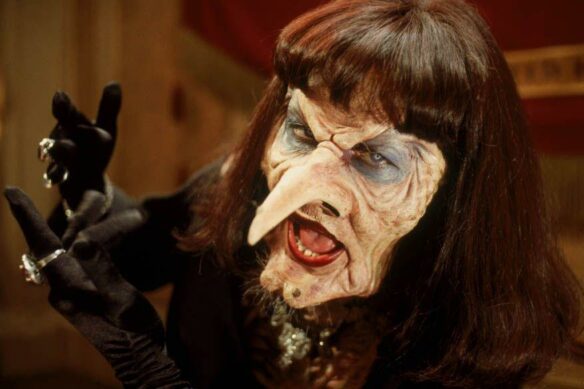
So what else did Angelica appear in? Good question. She would appear in The Witches based off of the Roald Dahl work as the Grand High Witch. Her makeup here is a work of art so here it is.
Anjelica Huston as Grand High Witch
Yes, I know the film has fallen into let us say disrepute among certain groups, but I still like it.
I’m not seeing anything else this genre but she did one interesting animated work, one of which I wish to point out which is in English A Cat in Paris, in French it sounds oh so much better as Une vie de chat which is A cat’s life. Black cat with red stripes leads a double life. During the night, which is the best part, he accompanies a car burglar named Nico (who calls him Mr. Cat), who performs heists to steal jewels. She voices the English version of Claudine.
She’s in John Wick, Chapter 3, Parabellum as The Director about which the John Wick wiki helpfully says “The Director is a crime lord and leader of the New York branch of the Ruska Roma. She is also the adoptive mother of John Wick and a mentor at the Tarkovsky Theater.”
Once upon a time, film-makers were mysterious sorcerers hunched over Steenbecks and smoke machines, conjuring cinematic magic from the recesses of their cerebellums. These days it seems they spend half their time on Reddit, fighting like gremlins to stay one step ahead of the hive mind.
This week, Spider-Man: No Way Home director Jon Watts revealed that his original plan for the grand entrance of the Tobey Maguire and Andrew Garfield versions of Spider-Man in the blockbuster Marvel epic was to have them turn up following the death of Aunt May, just as Spidey was at his lowest point. As our hero sheds tears on a grimy New York rooftop, the pair would enter through Doctor Strange portals at the perfect moment to reset the film and set Peter Parker on the path to redemption.
It was a perfectly serviceable plan to get the film moving again quickly before the entire multiplex ruined their popcorn with salty tears. But there was one tiny, weeny problem: the internet had thought of it first. “I was on Reddit, and I was looking at people who had already made fan art of, ‘This is probably what it’s going to be like when the two Spider-Men get revealed’,” Watts told Collider. “It was on a rooftop. It was sad. Two Doctor Strange portals were open and two Spider-Men are stepping out. I was like, ‘Well, we can’t do that. If that’s exactly what everyone thinks we’re going to do, we absolutely can’t do that.’” Watts reconfigured the screenplay so that Maguire and Garfield turn up in Ned’s grandmother’s flat instead, after Spider-Man’s right-hand man starts messing with Strange’s sling ring and accidentally ushers them both into the MCU.
As an example of the fandom hivemind guessing the plot of a movie from the quantum rear seat, this is both deranged and depressingly effective. But it’s also far from the first time fans have managed to manipulate the plot of a high-profile film before the trailers have even been released. The great-grandaddy of internet-powered cinema interference, long before Reddit got involved, was the 2006 action thriller Snakes on a Plane, a movie that was almost entirely reshot to meet fan expectations….
(12) WESTERCON BUSINESS MEETING VIDEO. Kayla Allen reports that the “Westercon 77 Business Meeting” video has been posted to YouTube. It runs about half an hour.
(13) ASTRONOMY PHOTO OF THE DAY. [Item by Mark Roth-Whitworth.] Just an “Oh, wow!” pic from NASA at the link: “Ou4: The Giant Squid Nebula”.
…Consistent with that scenario, the cosmic squid would represent a spectacular outflow of material driven by a triple system of hot, massive stars, cataloged as HR8119, seen near the center of the nebula. If so, this truly giant squid nebula would physically be over 50 light-years across….
Martin Landau and Rick Baker talk about the makeup and processes used in transforming the actor into Bela Lugosi for Tim Burton’s “Ed Wood” (1994) for which Baker wins his 3rd Academy Award for Best Make-Up.
[Thanks to Kathy Sullivan, Teddy Harvia, Mike Kennedy, Bruce D. Arthurs, Kayla Allen, Andrew Porter, John King Tarpinian, Chris Barkley, Cat Eldridge, SF Concatenation’s Jonathan Cowie, Mark Roth-Whitworth, and Steven French for some of these stories. Title credit belongs to File 770 contributing editor of the day Andrew (not Werdna).]
SFWA today issued a statement about “unusual rights inclusions” on contracts from MustRead, Inc., the new owner of several major sff prozines.
Recently, the Science Fiction & Fantasy Writers Association (SFWA) was contacted in regards to contracts potentially being offered to writers submitting to a variety of magazines including Analog, Asimov’s Science Fiction, and F&SF, that contained some potentially problematic clauses. These magazines represent important and historic repositories of some of the best speculative fiction written in the past and the present.
After conversing with MustRead, Inc., the publisher of those magazines, SFWA is pleased to provide some additional clarification on the issues brought to our attention. To wit, contract clauses regarding performance or merchandising rights should not be included in agreements with the above magazines. If these clauses do appear, authors should negotiate to have them stricken or removed entirely from the agreement, as they are considered either an editorial error or a holdover from an outdated contract. While SFWA cannot and does not provide legal advice, we are suggesting that writers approach these specific agreements this way. SFWA appreciates the clarification from MustRead, Inc., on these clauses.
SFWA will continue to monitor agreements in the speculative fiction short story marketplace, and continue our work as advocates and defenders for our membership and the genre writing community at large. Our Contracts Committee provides model contracts for various types of written work and will also provide private review of contracts (with or without personally identifying information redacted).
Thank you for your attention to this matter. Remember to always read any contract you are being asked to sign with caution, and when possible, get proper legal advice before signing any agreement that you do not fully understand. And remember, contracts are always negotiable. Advocate for your work, and when you need our help, we are here.
On behalf of the SFWA Board of Directors, Kate Ristau, President
Analog Science Fiction and Fact has revealed the 2024 Analytical Laboratory Finalists. The magazine has also made many of these stories available to read either in part or whole.
Below are the works that finished in the top five slots for Best Novelette, Best Short Story, Best Fact Article, and Best Poem, and the those that finished in the top three for Best Novella and Best Cover.
The winners will be announced in Analog’s July/August issue.
(1) BOOK BANNING NEWS, [Item by Bruce D. Arthurs.] Malinda Lo’s Last Night At The Telegraph Club is one of a number of books being considered for a statewide ban in South Carolina. Lo wrote the review committee an excellent letter defending her book and others like it. “Telegraph Club Considered for Possible Statewide Ban in South Carolina”.
… The parent who challenged LNATTC and other books in Beaufort County and at the state level is Elizabeth Szalai. She had a 5% success rate in Beaufort County, but she has had a 100% success rate at the state level so far.
Szalai’s complaint claims that LNATTC “contains explicit sexual activities in violation of Regulation 43-170 specifically touching of breast and masterbation [sic].” The complaint includes excerpts of scenes from LNATTC stripped of their context. Indeed, the context of the entire novel is irrelevant to Regulation 43-170.
I am not optimistic that LNATTC will survive this challenge in South Carolina, but it’s still possible….
…I’ve written to South Carolina’s Instructional Materials Review Committee to support my book and to ask them to uphold our First Amendment rights. My letter is below:
Dear members of the Instructional Materials Review Committee of the South Carolina Department of Education:
My name is Malinda Lo, and I’m the author of several critically acclaimed and bestselling young adult novels, including Last Night at the Telegraph Club, which is currently under review by your committee. I’m writing to you not only as the author of this book, but as a concerned American citizen who believes strongly in our First Amendment.
Last Night at the Telegraph Club was the winner of the 2021 National Book Award for Young People’s Literature, the Stonewall Book Award, the Asian Pacific American Award for Literature, the Kids’ Choice Awards Teen Book of the Year, and over over two dozen more honors and awards. It is a coming-of-age novel about a Chinese American girl discovering her identity as a lesbian in 1950s San Francisco. I am a Chinese American lesbian myself, and when I was a teen growing up in the 1980s and ’90s, I often felt alone and confused. I didn’t have access to books like this that would have helped me to better understand who I was. That’s why I write books about LGBTQ+ and Asian American characters. I’m writing the books I needed as a teen.
Since Telegraph Club was published, many LGBTQ+ and Asian American readers have contacted me to tell me how much this book meant to them. Seeing yourself in a book can be a transformative and empowering experience. One reader wrote to tell me, “Your books helped me love and accept myself.” A Chinese American reader wrote, “I feel so seen. Perhaps a little bit too seen, as I am on the verge of tears.” A teen from Nashville told me, “it means a lot to see people like me in literature, written by people like me.”
I’m an immigrant who came to the United States with my family from China when I was a child, and we settled in Boulder, Colorado. I grew up knowing that we came here to escape the oppression of the Chinese Communist government, which does not allow freedom of expression or the freedom to read. This is why I’ve always valued our First Amendment rights. The possibility that my book could be banned across the entire state of South Carolina alarms me because censorship goes directly against the ideals of our country.
I urge you to trust the judgement of your local teachers and librarians, who selected my book — and many others — for their school libraries based on their professional judgement and training. While not every book is for every reader, every reader deserves the freedom to choose what they wish to read, not to have those rights taken away from them by the state. I hope you will take this opportunity to support our fundamental rights and freedoms as Americans.
My major task and accomplishment last year was sorting, boxing, and shipping Greg’s papers to his alma mater, San Diego State University, where they are held in the library’s Special Collections. There are 60+ boxes of journals, notes, manuscripts, and letters, plus a lot of his original artwork. It’s truly a treasure, a deep dive into his creative process and the breadth and depth of his thinking and interests. But here’s the thing about archived papers — for students and researchers to have meaningful access, there needs to be a catalogue of what’s there, called a finding aid, and the items need to be stored using archival standards, such as acid-free boxes. So, I’ve made a donation of $5,000 to help fund those efforts, and am asking you to help match that. A total of $10,000 will go a long way to make the archive accessible.
SDSU is having their major annual fundraising effort right now, so there’s a spiffy website interface for making donations. Link will be in the comments. If you are able to donate even a little bit, that will help meet the $10,000 goal. My match money is already there, just waiting to partner with yours.
“The link in the comments should take you my fundraising page. Scroll down to Matches and Challanges to find Library: $5K Match to the Special Collections Support Fund, and you’ll see my name there. Click on Contribute and it will take you to the page to enter your info. The designation should already be filled in, Library Special Collections Fund. If it’s not, go up a bit to the drop-down menu titled, “There are 6 matches and/or challenges running!” and select “Just for Library Special Collections Fund.”
“Thank you so much for considering this. SDSU and its libraries meant a lot to Greg, as did having his archives be available and studied long into the future.”
(3) PROZINE OWNERSHIP TRANSITION PLANS. Locus Online has extensive “Details on the New Owners of Analog, Asimov’s, and F&SF”, including statements from P.L. Stevens, publisher, of new owner Must Read Books Publishing, sellers Penny Publications and Gordon Van Gelder (F&SF), as well as Analog editor Trevor Quachri and Asimov’s editor Sheila Williams.
All editorial staff from the magazines have been retained in the acquisitions….
The parent company will take over sponsorship of the Astounding Award for Best New Writer, the Black Orchid Novella Award (with The Wolfe Pack), the Dell Award for Undergraduate Excellence in Science Fiction and Fantasy Writing, Asimov’s Readers Awards, AnLab Awards, The Analog Award for Emerging Black Authors, and Ellery Queen Readers Awards, among others.
(4) WHY YES, HOW DID YOU KNOW? Times have changed. People who’d had a few drinks and would want to avoid coming home smelling like the bar might chew a few Sen-Sen before they walked through the door. Today? To make sure they come home smelling that way – well, at least like they’ve had too much Butterbeer – Orly offers this line of Harry Potter-inspired cosmetics. “Ultimate Harry Potter™ Butterbeer™ Experience” at Orly Beauty.
Infused with the iconic BUTTERBEER™ scent from the Harry Potter™ film series, this collection features all four products from the BUTTERBEER™ collection. From a whimsical Iridescent Topper to a Quick Dry Nail Spray to Nourishing Cuticle Oil and Hydrating Cuticle Froth, your nail care routine is about to become your favorite experience.
Watching Linus O’Brien’s Strange Journey: The Story of Rocky Horror, a new documentary launching out of SXSW, my most frequently thought was that — actual quality of the film notwithstanding — it’s an absolute blessing to be getting this examination of the Rocky Horror phenomenon at this particular moment in time.
Released tied to the 50th anniversary of the Rocky Horror Picture Show film, Strange Journey benefits to no small degree from the presence of O’Brien, son of The Rocky Horror Show creator Richard O’Brien — which means access to archives and memories and presumably easier facilitation of conversations with an astonishing assortment of people associated with the property at every level.
Richard O’Brien is 82; director Jim Sharman is 79; star Tim Curry is 78; Lou Adler, who brought the stage show from London to Los Angeles and then produced the movie, is 91. All are present in the documentary, as are musical director Richard Hartley, costumer Sue Blane, and stars including Susan Sarandon, Barry Bostwick, Patricia Quinn and even Peter Hinwood, who played Rocky and hasn’t acted since the ’70s. The time to get all of these people together, on camera, to discuss all things Rocky and share their stories is not infinite and, as a result, fans will find plenty to cherish in Strange Journey….
The best route to learning to love words in print could well be pictures. This, at least, is the hope of the publishing industry this spring, as it welcomes news that sales of children’s comics and graphic novels have reached an all-time peak of almost £20m in Britain.
While publishers and editors are celebrating this boom for its own sake, the popularity of these titles is also being hailed as a good omen for novels, ahead of the London Book Fair at Olympia this week. “Over the last decade we’ve seen a significant rise in sales of graphic novels for both the adult and children’s markets,” said Philip Stone, media analyst at NielsenIQ BookData, as he revealed details of the latest trends, hits and flops this weekend.
“Superhero books have been a reliably big feature, probably boosted by all the screen superhero movies. A lot of manga series are doing very well again, and this may also be linked to screen versions. What we really need now is some deep-dive research into the impact of graphic and comic fiction as a gateway for young people into reading. We certainly suspect it’s true.”…
(7) GENE WINFIELD (1927-2025). Custom car creator Gene Winfield died March 4 at the age of 97 reports Deadline.
Gene Winfield, a pioneering legend in the hot-rod world who created custom cars for numerous films and TV shows including Blade Runner, the original Star Trek series, RoboCop, Get Smart! and many others, has died. He was 97.
Winfield’s …. most famous creations include the iconic Galileo shuttlecraft and the Jupiter 8 for Star Trek [seen in the episode “Bread and Circuses”]…and the “spinners” for Blade Runner, which was nominated for the Special Effects Oscar. He also built the Catmobile for TV’s Batman and gadget cars for Get Smart! and The Man from U.N.C.L.E.
His futuristic vehicles are seen in Back to the Future II, the original RoboCop, The Last Starfighter, Woody Allen’s Sleeper and others. Winfield’s cars also are seen in the Dirty Harry sequel Magnum Force, Bewitched, Ironside, TV’s Mission: Impossible and more….
(8) MEMORY LANE.
[Written by Cat Eldridge.]
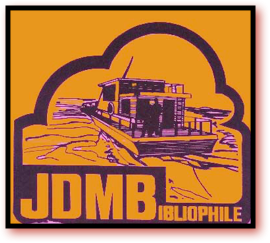
JDM Bibliophile zine
JDM Bibliophile (1965–2004). This one is for John D. Macdonald completists.
John D. MacDonald became the subject of a fan magazine in March 1965 when Len and June Moffatt of Downey, California first published the JDM Bibliophile (JDMB), devoted to his work. MacDonald starting writing for pulp magazines in 1946 during their waning days.
JDMB, a mimeographed magazine at the time, was described in its initial issue as a “non-profit amateur journal devoted to the readers of John D. MacDonald and related matters.” A goal was to obtain complete bibliographic information on all of MacDonald’s writings, and this was partly achieved with The JDM Master Checklist, published in 1969 by the Moffatts.
They had help from many people, including MacDonald himself. Though he kept good records, he, like most authors, didn’t have complete publishing data on his own work. Especially helpful to the Moffatts were William J. Clark and another couple, Walter and Jean Shine of Florida.
The Shines published an updated version of the Checklist in 1980, adding illustrations, a biographical sketch, and a listing of articles and reviews of MacDonald. JDMB offered news and reviews of MacDonald’s writings and their adaptation to various media. There were also contributions from MacDonald, including reminiscences and commentary. The Moffatts contributed a column (“& Everything”), as did the Shines (“The Shine Section”). Other JDM fans sent articles, letters, and parodies. One issue, #25 in 1979, included the Shines’ “Confidential Report, a Private Investigators’ File on Travis McGee,” describing information gleaned from the McGee canon about his past, interests, cases, and associates. MacDonald once said of Walter Shine, “He knows more about Travis than I do.”
After the Moffatts had published twenty-two issues of JDMB, it was transferred in 1979 to the University of South Florida in Tampa, with Professor Edgar Hirshberg as editor. It continued until 1999. One final issue, #65, was published as a memorial to Hirshberg who had died in June 2002. It was edited by Valerie Lawson. On February 21, 1987, about a hundred McGee fans gathered at his “address,” Slip F-18 at the Bahia Mar Marina in Fort Lauderdale, Florida, where McGee kept his houseboat The Busted Flush. The mayor of Fort Lauderdale unveiled a plaque honoring McGee.
Amazon has scattered back issues available.
So this cover for one of them done by an unknown USF student. If is not considered a close representation of The Busted Flush. For that, you should see the second image which is from The Busted Flush fan site as it “is a rendering of the boat, which MacDonald felt was very close to what he had in mind, but, as he always said about the boat and Travis McGee, he did not want to be exact about either. Let the reader fill in the gaps.”
Periodical comics made the leap from convenience store spinner racks to trade paperback collections at bookstore chains in the 1980s. And while the transition did present some initial challenges to booksellers—in those early days, it wasn’t uncommon to see superhero titles shelved next to Garfield in the “humor section”—the move proved both lucrative and permanent. Today, comics can be found wherever books are sold, with big-box retailers devoting considerable real estate to graphic novels. How do smaller specialty shops compete?
“Community is essential to the business,” says Jenn Haines, owner of The Dragon, an Eisner Spirit of Retailing Award–winning shop in Guelph, Ontario. “Generally, people who read comics have found themselves not quite fitting in.” But fans can find community, she adds, by browsing the shelves.
According to the latest ICv2 industry report, of the $1.87 billion in comics and graphic novel sales in 2023, 61% are from book channels, while 36% are via the direct market, which comprises approximately 3,000 specialty comics retailers. Indications are that specialty shops’ share rose in 2024, which was “a pretty good year in comic stores,” reports Milton Griepp, president of ICv2, which did not release full figures by press time.
According to Haines, her store’s annual sales have been generally consistent over the past five years. The Dragon’s overall 2024 sales, which includes games and toys, were up 3% over 2023, with sales of comics and graphic novels increasing 5%….
“Paradise” is a TV show on Hulu about a postapocalyptic society that lives underground in a suburb. “Silo” is a TV show on Apple TV+ about a postapocalyptic society that lives underground in an apartment tower.
Both are propelled by mysteries. Both feature curious heroes. Both have shifty leaders who lie, blackmail and murder to keep their secrets hidden and their denizens in line.
The shows have much in common, in other words.
But somehow they find opposing answers to a question that seems increasingly relevant in a warming world: If the planet goes to hell and humanity heads to a bunker, what sort of neighborhood will we build inside it? A spacious holdout that tries to approximate a comfortable standard of living, or a cramped locker that saves more lives but leaves the survivors miserable?
By imagining wildly different landscapes in response to the same end-of-the-world conceit, the shows use cinematic extremes to show how civilization and class divisions are constructed through the apportionment of space. People like to live around other people right up to the moment they feel their neighborhood has been overrun by others, at which point the hunger for togetherness becomes an impulse to exclude.
A good amount of today’s housing politics fall within these parameters, whether it’s a proposal to build apartments in a suburb or a plan to cover farms with a new city. The fact that this debate now extends to fictional bunkers has me convinced that in the aftermath of global calamity, people will be at some dystopian City Council meeting arguing about zoning….
(12) WHEN BUSINESS IS BOOMING AND THAT’S NOT GOOD. [Item by Mark Roth-Whitworth.] I don’t want to just link to an X-twit post, so… Sounds like they should *not* have launched that last one, given this. My take is that Elon was hurting, the attacks by the public on him, and on Tesla, and he said “launch”. As reported on Slashdot: “Anonymous Sources: Starship Needs a Major Rebuild After Two Consecutive Failures”.
According to information at this tweet from anonymous sources, parts of Starship will likely require a major redesign due to the spacecraft’s break-up shortly after stage separation on its last two test flights. These are the key take-aways, most of which focus on the redesign of the first version of Starship (V1) to create the V2 that flew unsuccessfully on those flights…
Astronomers say they have discovered more than 100 new moons around Saturn, possibly the result of cosmic smashups that left debris in the planet’s orbit as recently as 100 million years ago.
The gas giant planets of our solar system have many moons, which are defined as objects that orbit around planets or other bodies that are not stars. Jupiter has 95 known moons, Uranus 28, and Neptune 16. The 128 in the latest haul around Saturn bring its total to 274.
“It’s the largest batch of new moons,” said Mike Alexandersen at the Harvard-Smithsonian Center for Astrophysics, an author of a paper announcing the discovery that will be published in the days ahead in Research Notes of the American Astronomical Society.
Many of these moons are rocks only a few miles across — small compared with our moon, which is 2,159 miles across. But as long as they have trackable orbits around their parent body, the scientists who catalog objects in the solar system consider them to be moons. That is the responsibility of the International Astronomical Union, which ratified the 128 new moons of Saturn on Tuesday….
… The current naming scheme for moons on Saturn is based on characters from Norse and other mythology.
“Maybe at some point they’ll have to expand the naming scheme further,” Dr. Alexandersen said….
A saucer-like space capsule touched down in the Australian outback last month, marking the first time a commercial spacecraft has landed Down Under.
Varda Space Industries’ Winnebago-2 (W-2) space capsule reentered Earth’s atmosphere and dropped down in South Australia on Feb. 28. In doing so, W-2 also set a world first by becoming the first commercial spacecraft to return to a commercial spaceport, according to a statement released by the Australian Space Agency.The successful return of W-2 was a “landmark moment for the Australian space sector,” Australian Space Agency representatives wrote in the statement.
The company behind W-2, Varda, is an American startup based in California. W-2 originally left Earth from California on a SpaceX Falcon 9 rocket on Jan. 14 as part of the Transporter-12 rideshare mission — the Transporter carries satellites from various customers into space. W-2 then spent 45 days in orbit, carrying payloads from the U.S. Air Force and NASA before dropping down to the Koonibba Test Range, run by Australian aerospace company Southern Launch….
(15) BEAST GAMES PITCH MEETING. [Item by Mike Kennedy.] Beast Games was apparently inspired in part by how much the host (famed YouTuber Mr. Beast) enjoys Squid Games. But there’s also apparently zero to very little about the actual games played on BGs that is inspired by games on SGs. Also, no killing the contestants. Not that I’ve ever watched either show (or anything by Mr. Beast), nor would I care to.
[Thanks to Andrew Porter, John King Tarpinian, Chris Barkley, Daniel Dern, Bruce D. Arthurs, Cat Eldridge, SF Concatenation’s Jonathan Cowie, Mark Roth-Whitworth, Steven French, Kathy Sullivan, Teddy Harvia, and Mike Kennedy for some of these stories. Title credit belongs to File 770 contributing editor of the day Daniel “Good, Bester, Best!” Dern.]
(2) ASTOUNDING AWARD’S FUTURE? Following the report that Asimov’s, Analog and F&SF have been purchased by a new owner, John Scalzi speculated about the fate of the Astounding Award for Best New Writer. Although voting is administered by the Worldcon, the Astounding Award belongs to Dell Magazines, publisher of Analog prior to this sale. Will Analog’s new owners continue the sponsorship? John Scalzi volunteered a landing place if one is needed in a post at Whatever:
If the new owners of Asimov’s and Analog don’t want to take sponsorship of the Astounding Award (or the award is not otherwise folded into the responsibilities of WSFS/the individual Worldcons), we’ll take it on. The ideal plan would be for the Scalzi Family Foundation to act as a bridge sponsor while we set up an endowment that would allow the Astounding Award to be run indefinitely.
(3) EISNER HALL OF FAME INDUCTEES. Comic-Con International has announced 21 creators and industry figures who will be inducted into the Eisner Awards Hall of Fame this year.
In addition to these choices, voters in the comics industry will elect 6 persons from a group of 18 nominees proposed by the judges. Those nominees will be announced within the next week, and a ballot will be made available for online voting.
We’ve received more than 150 stories nominated by publishers, editors, and authors so far, and the range of stories, ideas, and perspectives has been so wonderful to read. As this is our first year of the anthology and our launch happened so quickly, we’ve decided to extend the submissions window out to Monday, March 17, to ensure that everyone publishing ecofiction gets a chance to submit….
…Ecofiction engages with some of the most urgent issues facing us today and also looks ahead to the possibilities of the future. Even when dealing with dark or tragic themes, ecofiction stories are expressions of our human connection to the most beautiful planet we know, and to all of earthlife….
(5) BOOK WITHIN A BOOK. [Item by SF Concatenation’s Jonathan Cowie.] BBC Radio 4 working weekday Women’s Hour had a second half (35 minutes in) largely devoted to two SF works. The first was a play, a re-imagining of the Greek tragedy Oedipus but set in a dystopic, near-future, climate drought-ridden future…
And then the Nigerian-American SF author Nnedi Okorafor who was discussing her latest book Death of the Author (out from Gollancz). This is a sweeping story about a writer of a science fiction novel that becomes a global phenomenon… at a price. The future of storytelling is here. A book-within-a-book that blends the line between writing and being written. This is at once the tale of a woman on the margins risking everything to be heard and a testament to the power of storytelling to shape the world as we know it… This interview begins 50 minutes in.
Nigerian American science fiction author Nnedi Okorafor’s new book is Death of the Author. It follows the story of Zelu, a novelist who is disabled, unemployed and from a very judgmental family. Nnedi and Nuala talk about the book within her book, success, and the influence on her writing of being an athlete in her earlier years.
James Cameron has reportedly revealed an anti-AI title card will open up Avatar 3, officially titled Avatar: Fire and Ash. The Oscar-winning director shared the news in a Q&A session in New Zealand attended by Twitter user Josh Harding.
Sharing a picture of Cameron at the event, they wrote: “Such an *incredible* talk. Also, James Cameron revealed that Avatar: Fire and Ash will begin with a title card after the 20th Century and Lightstorm logos that ‘no generative A.I. was used in the making of this movie’.”Cameron has been vocal in the past about his feelings on artificial intelligence, speaking to CTV news in 2023 about AI-written scripts. “I just don’t personally believe that a disembodied mind that’s just regurgitating what other embodied minds have said – about the life that they’ve had, about love, about lying, about fear, about mortality – and just put it all together into a word salad and then regurgitate it,” he told the publication. “I don’t believe that’s ever going to have something that’s going to move an audience. You have to be human to write that. I don’t know anyone that’s even thinking about having AI write a screenplay.”…
(7) IMAGINARY PAPERS. ASU’s Center for Science and the Imagination has published the latest issue of Imaginary Papers, its quarterly newsletter on science fiction worldbuilding, futures thinking, and imagination.
In this issue, Sarah M. Ruiz writes about climate action, allegory, and solidarity in the 2024 film Flow; Libia Brenda writes about Crononauta, the quasi-mythical, short-lived 1964 magazine founded by Alejandro Jodorowsky and René Rebetez; and Rachael Kuintzle reports on a workshop on energy futures hosted by the U.S. National Renewable Energy Laboratory in 2024.
On April 5, a beacon for California horror fans will be snuffed out when legacy Los Angeles shop Dark Delicacies closes its doors. “We’ve been open for 30 years, and I could have happily died right here,” laughs co-owner Del Howison, “but my wife Sue wanted to have a life — whatever that is.”
Dark Delicacies is more than just a Southern California storefront selling ghoulish souvenirs. It’s been a destination for film buffs, horror genre diehards and celebrities from across the macabre spectrum for decades, and Howison himself has become a cult attraction for those with a love of Southern California’s darker corners.
The longtime horror curator plans to stay busy until the end. On a recent weekday, Howison is moving about his Burbank shop, taking pictures of vintage Spanish and Italian movie posters to sell online. He occasionally breaks to gesture at the Tiki mugs, shot glasses, board games, playing cards and action figures on the shelves. “We stopped calling them dolls, as guys didn’t like saying they were collecting dolls,” Howison says of his early days in business. “Of course, back then, there was no such thing as a horror convention.”…
(9) UK PAPERS PROTEST AI LEGISLATIVE PROPOSAL. [Item by SF Concatenation’s Jonathan Cowie.] A first this side of the Pond. Irrespective of their political leanings, all the papers came together on Tuesday in a campaign to stop British government proposals (yes, we have daft politicians over here just as you do in the US) to allow artificial intelligence (AI) free access to intellectual property so that it can be trained. This is something that authors have been worried about. “UK newspapers launch campaign against AI copyright plans” in the Wandsworth Times.
Special wraps appeared on Tuesday’s editions of the Daily Express, Daily Mail, The Mirror, the Daily Star, The Sun, and The Times – as well as a number of regional titles – criticising a Government consultation around possible exemptions being added to copyright law for training AI models.
The proposals would allow tech firms to use copyrighted material from creatives and publishers without having to pay or gain a licence, or reimbursing creatives for using their work.
In response, publishers have launched the Make It Fair campaign, which saw newspapers put covers on the outside of their front page – criticising the Government’s consultation – organised by the News Media Association (NMA), and backed by the Society of Editors (SOE).
The message said: “The Government wants to change the UK’s laws to favour big tech platforms so they can use British creative content to power their AI models without our permission or payment. Let’s protect the creative industries – it’s only fair.”…
…In a statement shared with the Times, the Klara and the Sun (Faber) author said the country had reached a “fork-in-the-road” moment. “If someone wants to take a book I’ve written and turn it into a TV series, or to print a chapter of it in an anthology, the law clearly states they must first get my permission and pay me,” he said.
“To do otherwise is theft. So why is our government now pushing forward legislation to make the richest, most dominant tech companies in the world exceptions? At the dawn of the AI age, why is it just and fair – why is it sensible — to alter our time-honoured copyright laws to advantage mammoth corporations at the expense of individual writers, musicians, film-makers and artists?”
Ishiguro continued that “no one believes the proposed ‘opt-out’ system will work”, saying this is why “those lobbying on behalf of the tech giants favour it”….
(11) MICHELLE TRACHTENBERG (1985-2025). Actress Michelle Trachtenberg, known especially to fans for playing Dawn Summers in Buffy the Vampire Slayer, has died at the age of 39. According to the Guardian:
…Police sources confirmed her death to both ABC News and the New York Post. There is no cause of death yet known, with police saying on Thursday that the New York Medical Examiner is investigating but no foul play was suspected. She had recently undergone a liver transplant, according to sources….
A successful child actress, her first lead film role was in the comedy adventure Harriet the Spy (1996). Trachtenberg followed the film with a role in Inspector Gadget next to Matthew Broderick. Her role in Buffy the Vampire Slayer came in 2000 and continued til the show ended three years later.
Trachtenberg continued to have an active career after that in non-genre productions.
(12) MEMORY LANE.
[Written by Cat Eldridge.]
Award-Winning Barbara Hambly
Barbara Hambly, one of my favorite writers of horror and mysteries, has won two Lord Ruthven Awards given by the Lord Ruthven Assembly, a group of scholars specializing in vampire literature who are affiliated with the International Association for the Fantastic in the Arts.
(This piece is about her fantasies and mysteries that I’m familiar with. I know she wrote some SF, do comment upon it if so inclined.)
Those Who Hunt in The Night, the first in her excellent John Asher series, won the Locus Award for Best Horror Novel. I think the series, eight long, might be concluded, as the last came out six years ago.
I’m also very impressed of her two novelizations done for one of my favorite TV series, Beauty and the Beast and and Beauty and the Beast: Song of Orpheus as it’s hard to write material off those series that’s worth reading. I’ve read others which very quickly got really mawkish as they overly focus on the relationship, in my opinion of course, of the relationship of Catherine and Vincent to the exclusion of what could a fleshing out of that world. Not her. Wonderful novels!
I’ve not tracked down her three Sherlock Holmes short story pastiches yet.
I listened to Bride of the Rat God, which is the only supernatural fantasy in theSilver Screen historical mystery series, and the next book which was not a fantasy, Scandal in Babylon. There are two more in the series so far. They likewise are not fantasy according to her.
And yes, there’s lots about her writing career I’ve not included here so feel free to tell me what you think I should have mentioned. If anybody has read her Abigail Adams or Benjamin January mystery series, I’d be interested in knowing what you think.
Dark Horse Media has officially shut down Dark Horse Digital as of February 24, 2025, with comics no longer available for purchase on the platform. Online access to the DHD website, however, will still be available at least through this summer, and users can continue to log in and read the comics in their bookshelves.
Effective March 31, 2025, the Dark Horse Comics and Plants vs. Zombies Comics apps for iOS will also no longer be supported.
Eric Reynolds from Fantagraphics gets in touch to correct me. He says “Contrary to what you wrote, the comics were actually not printed yet. If they had been, we would have proceeded as planned. But since they weren’t, and given the uncertainty of whether Diamond will even exist come May (or be able to pay us for them), we made the difficult decision to pull the plug while we could. We may still produce the comic this year, bypassing FCBD. Things are, as you can probably understand, a bit fluid these days… The decision was made entirely based on the uncertainty of FCBD and had nothing to do with the Lost Marvels book series itself, which is otherwise proceeding as planned!”
When Netflix first started adding video games to its huge catalogue of streaming TV shows and films, it did so quietly. In 2021, after releasing an impressive experiment with the idea of interactive film in Black Mirror: Bandersnatch in 2018 and a free Stranger Things game in 2019, Netflix began expanding more fully into interactive entertainment.
The streamer’s gaming offering, for a long time, was its best-kept secret. Whoever was running it really had an eye for quality: award-winningly brilliant and relatively little-known indie games comprised the majority of its catalogue, alongside decent licensed games based on everything from The Queen’s Gambit to the reality dating show Too Hot to Handle. Subscribers could play games such as Before Your Eyes, a brief and touching story about a life cut short; Spiritfarer, about guiding lost souls to rest and Into the Breach, a superb sci-fi strategy game with robots v aliens. The company bought or invested in several game studios known for making critically acclaimed work, including London-based Ustwo games (which was behind Monument Valley). It also established a studio in California to work on blockbuster games, staffed by veteran developers.
But it seems things are changing. That blockbuster studio has been closed, as first reported by Game File, before it could ever release a game. Its latest tie-in game, Squid Game Unleashed, absolutely sucks – it’s constructed around the celebration of slapstick violence, making it a terrible fit for a satirically violent show about capitalist exploitation. Funding a bunch of indie darlings and hiring big-name talent from the likes of Blizzard and Bungie for its game studio gave the impression that Netflix really was keen on becoming a part of the gaming industry, and doing it properly. Now that is very much in question.
The company has made layoffs across its gaming divisions, including at Night Studio – makers of weird-fiction supernatural teen horror series Oxenfree. It has cancelled plans for several forthcoming games that were due to join the service, including indie hits Thirsty Suitors and Don’t Starve Together, and promising-looking hobbit game Tales of the Shire. What’s going on?
He is probably most often thought of today as a wizard, a shape-shifter or a mentor to the young King Arthur.
But a detailed re-examination of Myrddin – Merlin – by Welsh scholars suggests he can also be considered an early British environmentalist deeply worried about human interaction with the natural world…
… The researchers have been combing through manuscripts in the National Library of Wales, in Aberystwyth, and also in the 15th-century Red Book of Hergest at Jesus College, Oxford.
They also discovered more about the importance of Merlin’s sister, Gwenddydd. Callander said: “Gwenddydd is a really important figure in Welsh Merlin poetry. She supports Merlin and also appears to be a prophet in her own right.
“We found hundreds of lines of poetry in her voice in dialogue with her brother. Merlin describes her as ‘fair Gwenddydd, summit of dignity’ and ‘refuge of songs’. One of the important aspects of the project is to throw light on this lost female voice from medieval Wales.”
Callander said it was surprising that early Merlin poems had been largely neglected. “These Welsh-language texts had not been edited or translated in full, meaning much material has been missed out.”…
Akiva Goldsman is developing a new Universe at Legendary Television featuring three reimagined Irwin Allen sci-fi TV series. The Oscar-winning writer, producer and director will draw inspiration for the new TV shows from Allen’s catalog and focus on revitalizing Voyage to the Bottom of the Sea, Land of the Giants and The Time Tunnel.
… Legendary Television is focused on the three titles above and not Allen’s second TV series Lost in Space, which aired from 1965-68 on CBS and was reimagined by Legendary TV for a 2018-21 series on Netflix. 20th Century Fox produced all four of the original shows….
[Thanks to Steven French, Kathy Sullivan, Teddy Harvia, Jason Sizemore, Joey Eschrich, Mark Roth-Whitworth, Mike Kennedy, Andrew Porter, John King Tarpinian, Chris Barkley, Cat Eldridge, and SF Concatenation’s Jonathan Cowie for some of these stories. Title credit belongs to File 770 contributing editor of the day Cat Eldridge.]
Asimov’s, Analog and The Magazine of Fantasy and Science Fiction have been purchased by a new owner. Jason Sanford reported the transactions on his Patreon page.
Sanford says the new owner of the magazines is Steven Salpeter and a group of investors. More information about the buyers is in Sanford’s report.
The Asimov’s, Analog and several other Dell magazines changed their websites to identify the new ownership over the weekend. F&SF, which was owned separately by Gordon Van Gelder, has yet to make an update.
(1) ALMOST HALFWAY TO 101. The Science Fiction 101 podcast devoted its 50th episode to a look at a vintage prozine: “Analog Solutions”.
This time we have another one of our (made-up) time-honored traditions: reviewing a current science fiction magazine. We usually do this once a year, to keep on top of current SF trends – and also to compare & contrast current magazines with the SF magazines of the past.
In our last episode, we went back 50 years to review ANALOG from 1974.
This time, we’re bang up-to-date (almost) with a very recent issue of the very same magazine. Analog is the longest-continuously-running SF magazine, having been around under various titles since the 1930s!
What will we make of Analog‘s longstanding reputation for “hard SF”? How does the magazine stack up against its wholly online competitors such as Clarkesworld and Uncanny? How does it stack up against its former self?
After the hundreds (thousands?) of hours trawling through online image collections since the PDR’s inception, we’ve decided it was time to create one of our own! We are really excited to share with you the launch of our new sister-project, the Public Domain Image Archive (PDIA), a curated collection of more than 10,000 out-of-copyright historical images, free for all to explore and reuse.
While The Public Domain Review primarily takes the form of an “arts journal”, it has also quietly served as a digital art gallery, albeit one fractured across essays and collections posts. The PDIA sets out to emphasise this visual nature of the PDR, freeing these images from their textual homes and placing them front and center for easier discovery, comparison, and appreciation. Our aim is to offer a platform that will serve both as a practical resource and a place to simply wander — an ever-growing portal to discover more than 2000 years of visual culture.
A valuable image archive in its own right, offering hand-picked highlights from hundreds of galleries, libraries, archives, and museums, the PDIA also functions as a database of images featured in the PDR, offering an image-first approach to exploring the project’s content. The featured images each link to the relevant article on the PDR where one can read about the stories which surround the works….
Here’s an example of NASA art — government publications are not copyrighted, so in the public domain.
(3) IS THIS WORLDBUILDING CONVINCING? Mark Roth-Whitworth read C.J. Cherryh’s Alliance Rising, and says “I have written a meta-criticism of it — not of the story, which is as good as Cherryh is, but the political and interpersonal structure of the universe”: “Cherryh’s Alliance-Union universe”.
…I can already see problems with it – the sixty-three families, and none of them have anyone who is going to game the system, for their family’s benefit? None are going to cut back door deals with stations, to undercut other ship-families? Every one is going to be honest and trustworthy?…
(5) FIND OUT WHEN SFF EVENTS ARE HAPPENING. Stephen Beale, editor of The Steampunk Explorer site, has announced their “Expanded Calendar Listings”.
The recent re-launch of The Steampunk Explorer forced us to move some tasks to the back burner, and one of those was the calendar of events. When the site re-launched on Dec. 30, the calendar listed just 191 events taking place in 2025. But we got busy over the weekend and it now lists more than 600 happenings.
Here’s some background. We maintain a database of approximately 1,200 events that take place each year. In addition to steampunk gatherings, they include science fiction conventions, anime conventions, comic cons, Renaissance fairs, book fairs, and more.
Periodically, we go through the database and check the event websites to see if they’ve announced upcoming dates. If they have, we update the record and upload the event to the website. It’s a highly efficient process — if the event is in the same location and happens roughly the same time of the year, we can update the listing with five or six mouse clicks. (We also add new events as we learn about them.)…
If you want to see what’s happening over the next 12 months, check it out:
Friends, you read that right. A new film is coming to theaters in January that is… Hamlet staged in the Grand Theft Auto video game. Yes, Hamlet acted out by video game avatars, shot in-frame, and edited into its own film.
Before you wonder if something is rotten in the stage of filmmaking, or that the rest is violence, consider this…
Directed and written by Sam Crane and Pinny Grylls, and co-starring Crane and his friend Mark Oosterveen, the film, which is called Grand Theft Hamlet, is part digital narrative, part documentary. The film’s frame narrative features Crane and Oosterveen, two out-of-work actors sheltering-in-place during the COVID pandemic in January 2021, who discover that their video game pastime seems capable of not only bringing them together (and giving them a project) during isolation, but also allowing them to engage with a foundational text and their beloved craft.
The actors speak Shakespeare’s lines over the staging, in the modern, hyper-brutal world of GTA‘s Los Santos; underscoring the ways that Shakespeare’s words contain a kind of timelessness or malleability. According to critics, what ends up happening is not an attempt to make this as straight a Shakespeare production as possible, but to play with the text and the meaning of Hamlet in ways that only this new setting can unlock….
I, like most folk I suspect, first discovered the somewhat eccentric charms of his writing in the Eyre Affair, the first of his novels with Tuesday Next from the Special Operation Network, Literary Detective (SO-27), who could literally enter the great and not so great works of English literature.
Bidder and Stoughton published it twenty-five years ago. I’d like to say the Eyre Affair was a much-desired literary property but he says there were seventy-six publishers that he sent his manuscript to. I’m surprised there were that many publishers in the U.K. that he thought could have been interested.
There would be six in the series in all — this novel followed by Lost in a Good Book, The Well of Lost Plots, Something Rotten, First Among Sequels, One of our Thursdays Is Missing and The Woman Who Died a Lot. I won’t say that they were consistently great as they weren’t and the humor sometimes wore a lot more than a bit thin, but overall I like the series considerably.
I re-listened to the Eyre Affair recently and even the Suck Fairy admitted that it had held well over a quarter of a century, particularly the idea of dodos as pets as she wants one. Or two. Shudder.
Next up, and I wasn’t eggspecting to like it, yes, I know it’s a bad pun there, is The Big Over Easy which is set in the same universe as the Thursday Next novels though I don’t remember any overlapping characters twenty years after reading them. It reworks his first written novel, which absolutely failed to find any publisher whatsoever.
Its original title was Who Killed Humpty Dumpty? Errr, wasn’t there a novel involving a rabbit by almost that name? Kinda of drops a large anvil. It had a sequel of sorts in The Fourth Bear. Both are quite more than bearably good. Yes more bad puns.
I have not read his dystopian Shades of Grey serieswhich is about a future Britain where everyone there is judged by how they perceive colors. Suspect someone with color blindness like myself wouldn’t be welcome there. A friend who did read it liked it a lot.
His Dragonslayer series, also known as The Chronicles of Kazam, are a YA affair and a great deal of fun indeed.
Thanks to some distinctly Scottish weather over the holidays, my family and I ended up celebrating Hogmanay at home rather than at the party we’d planned to attend. My smallest son’s wee pal and his parents came over for dinner, and when the smaller members of our group started to spiral out of control around 9pm, we threw them a little midnight countdown party in Animal Crossing.
The last time I played Animal Crossing was in the depths of lockdown. Tending my island paradise helped me cope while largely imprisoned in a 2.5 bedroom basement flat with a baby, a toddler and a teenager. (I was far from the only one – the National Videogame Museum compiled an archive of people’s Animal Crossing experiences during the Covid-19 pandemic, and it’s evident that it was a lifeline for many.) Our guests had brought their family Switch, and we set up the kids with their little avatars so they could join the animals’ New Year party.
They spent about 10 minutes gleefully whacking each other with bug nets before gathering with the other inhabitants in the square with a giant countdown clock in the background, the island’s racoon magnate Tom Nook offering party poppers and shiny top-hats. I was visited by a sudden, arresting memory of New Year’s Eve 2021, which I spent on my sofa, alone but also not alone, because I was with my friends in Animal Crossing, watching the same countdown clock tick down. My youngest had just started walking, and was unsteady on his short, chunky legs. Turning away from the screen, I saw him joking with his big brother, thrilled at being up so late. It felt surreal.
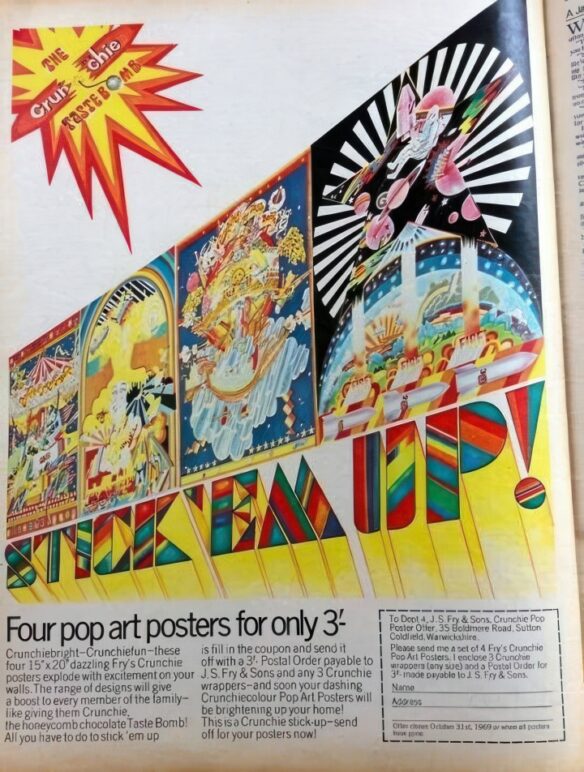
(10) EYE-POPPING. DJ Food recalls the “Psychedelic Crunchie Bomb poster offer” of 1969. The original ad is reproduced below. See good images of the four posters at the link.
A rare set of four “Crunchie Bomb” posters commissioned in 1969 by Frys Chocolate, measuring 20×15 inches. Two designed by graphic artist and Professor of Illustration at the RCA, Dan Fern, two by renowned designer Chris McEwan. They were available in exchange for 3 Crunchie wrappers – see the last photo of the original advert.
While cutting a trailer for their co-directorial effort “It Doesn’t Get Any Better Than This,” Nick Toti and Rachel Kempf had a little fun at the end of the clip.
“We were like, ‘Oh, it kind of needs something,’” he says. “So we put the scroll at the end. It just says, ‘The producers of this film regret to inform you that it will not be released online. See it in theaters.’”
In fact, the three-person creative team behind the found footage horror movie “It Doesn’t Get Any Better Than This” made an unusual pact before they even shot a frame: They would never make the work available for streaming, digital or physical purchase, only allowing it to play theatrically. Yet what might have seemed like a limitation ended up creating word-of-mouth interest in the microbudget production, which led to sold-out shows across the country without any promotional dollars….
(12) THE LAST CHATGPT ARGUMENT OF KINGS. [Item by Mike Kennedy.] Is it a killer robot? No. But it was a step toward that and a step too far for OpenAI to be comfortable letting this engineer use ChatGPT as a front-end to command their sentry gun/mount. Besides, they seem to be having way too much fun riding the mounted weapon like it was a potentially deadly mechanical bull at a country-western bar.
(Pro Hint: Next time just grab a ruler. It’s cheaper and you can finish your measuring project much faster.)
OpenAI says it has cut off API access to an engineer whose video of a motorized sentry gun controlled by ChatGPT-powered commands has set off a viral firestorm of concerns about AI-powered weapons.
An engineer going by the handle sts_3d started posting videos of a motorized, auto-rotating swivel chair project in August. By November, that same assembly appeared to seamlessly morph into the basis for a sentry gun that could quickly rotate to arbitrary angles and activate a servo to fire precisely aimed projectiles (though only blanks and simulated lasers are shown being fired in his videos).
Earlier this week, though, sts_3d started getting wider attention for a new video showing the sentry gun’s integration with OpenAI’s real-time API. In the video, the gun uses that ChatGPT integration to aim and fire based on spoken commands from sts_3d and even responds in a chirpy voice afterward.
“If you need any other assistance, please let me know,” the ChatGPT-powered gun says after firing a volley at one point. “Good job, you saved us,” sts_3d responds, deadpan.
“I’m glad I could help!” ChatGPT intones happily.
In response to a comment request from Futurism, OpenAI said it had “proactively identified this violation of our policies and notified the developer to cease this activity ahead of receiving your inquiry. …”
(13) BLUE ORIGIN WILL LAUNCH NEW GLENN ON MONDAY. “The Very Long Wait for Jeff Bezos’ Big Rocket Is Coming to an End” – in the New York Times (behind a paywall). (Note: The date has changed since the article was published. The rocket now is set to make its inaugural launch attempt as soon as Monday at 1 am. Eastern. Weather conditions at sea, where the company hopes to recover part of the rocket after launch, prompted the 24-hour delay.)
The foundational building block for Jeff Bezos’ space dreams is finally ready to launch.
A New Glenn rocket — built by Blue Origin, the rocket company that Mr. Bezos started nearly a quarter century ago — is sitting on a launchpad at Cape Canaveral Space Force Station in Florida. It is as tall as a 32-story building, and its voluminous nose cone can carry larger satellites and other payloads than other rockets in operation today.
In the predawn darkness on Sunday, it may head to space for the first time.
“This has been very long awaited,” said Todd Harrison, a senior fellow at the American Enterprise Institute, a conservative-leaning think tank in Washington.
New Glenn could inject competition into a rocket business where one company — Elon Musk’s SpaceX — is winning big. While companies and governments have welcomed SpaceX’s innovations that have greatly cut the cost of sending stuff to space, they are wary of relying on one company that is subject to the whims of the world’s richest person.
“SpaceX is clearly dominating” the market for launching larger and heavier payloads, Mr. Harrison said. “There needs to be a viable competitor to keep that market healthy. And it looks like Blue Origin is probably the best positioned to be that competitor to SpaceX.”
New Glenn is larger than SpaceX’s current workhorse rocket, the Falcon 9, but not as big as Starship, the fully reusable rocket system that SpaceX is currently developing….
[Thanks to Kathy Sullivan, Teddy Harvia, Mike Kennedy, Andrew Porter, John King Tarpinian, Chris Barkley, Cat Eldridge, SF Concatenation’s Jonathan Cowie, and Steven French for some of these stories. Title credit belongs to File 770 contributing editor of the day Cat Eldridge.]