Pixel Scroll 7/16/26 Going Over Niagara Files In A Pixel

(1) NEW SINO-AUSTRALIAN SFF MAGAZINE. [Item by Ersatz Culture.] Crux Dragon is a new magazine that describes itself as “a Sino-Australian science fiction and fantasy literary magazine featuring original fiction, essays, and literary scholarship from writers in China and Australia.”

The blurb goes on to say:

This inaugural issue explores themes including artificial intelligence, cyberpunk, mythology, history, post-apocalyptic futures, and the human experience. It brings together science fiction, fantasy, non-fiction, and academic writing from authors, translators, researchers, students, and independent creators.

Created to promote cross-cultural literary exchange, Crux Dragon introduces readers to diverse voices and perspectives through speculative fiction and creative collaboration.

Whether you enjoy science fiction, fantasy, or discovering new voices in world literature, Crux Dragon: Singularity offers a unique collection of stories from China and Australia.

Contributors to the first issue include Hugo finalists RiverFlow, Arthur Liu and Ren Qing.

The magazine is available in both English and Traditional Chinese.  The Chinese language announcement on Xiaohongshu/RedNote only mentions availability through Amazon (either as a paid download, or via Kindle Unlimited) and currently only an ebook edition is available (EnglishTraditional Chinese), but the copyright page says that a paperback edition (97817644410625) should also be available.  The Chinese edition is also readable in-browser here.

(2) TOP 25. [Item by Bill.]  “The 25 most influential works of American culture” in the Washington Post. (Behind a paywall.)

Are we a young country or an old one? By the standards of ancient Egypt, or China, we have been on the map for the smallest blip of time. But what an astonishing interval that has been. Since the founders put their names to the Declaration of Independence, there have been revolutions in science, technology, medicine, art and literature. We have seen the camera transform memory and politics, we have doubled our average lifespan, and we have been to the moon….

The 25 most influential works of American culture (one each decade):

Includes several genre and related items –

  • ‘The Legend of Sleepy Hollow’ and ‘Rip Van Winkle’ by Washington Irving
  • Mickey Mouse
  • ‘Earthrise’ photo by William Anders
  • ‘Doom’ video game
  • ‘The Matrix’

Obviously much to dispute – how did Michael Jackson’s Thriller album beat Star Wars?

(3) KING NOVELLAS BANNED. “Utah bans Stephen King novella collection from public schools” reports the Guardian.

A collection of Stephen King novellas that inspired classic films including Stand by Me and The Shawshank Redemption has been banned from Utah public schools.

Published in 1982, the collection, titled Different Seasons, contains four novellas: Rita Hayworth and Shawshank Redemption: Hope Springs Eternal, Apt Pupil: Summer of Corruption, The Body: Fall from Innocence, and The Breathing Method: A Winter’s Tale.

But earlier this month, the Davis, Jordan, Tooele and Washington school districts decided to remove the collection from their libraries, triggering a statewide ban by the Utah state board of education on 6 July. The book had previously been available to students in grades seven through 12, according to the board.

A book is removed from all public schools in the state if at least three school districts – or at least two school districts and five charter schools – determine that a book contains “objective sensitive material” defined under Utah code, according to Utah law….

(4) TROTTING ALONG. “Was the Trojan Horse Real? What Historians Actually Think” according to Mental Floss.

…To this day a lot of people think that the city of Troy didn’t really exist, and that the Trojan War never actually happened. The ancient city is placed in the same category as Atlantis: possibly inspired by real-world events, but ultimately a work of fantasy.

However, most historians agree that the city of Troy really did exist. What’s more, it’s believed the city was located in modern-day Turkey, at an excavation site first discovered by German archeologist Heinrich Schliemann in 1873.

While evidence of the Trojan War is difficult to come by, the city’s ruins are full of battle scars. Throughout time, archeologists have discovered skeletons, stashes of sling bullets, and fortifications that appear to have been damaged, repaired, and damaged again….

…Writing for History Today, Julia Kindt, a historian and author of The Trojan Horse and Other Stories: Ten Ancient Creatures That Make Us Human, wonders if the Trojan Horse was really a poetic metaphor for a ship. “After all,” she writes, “Homer calls ships ‘horses of the deep’ and the Greek playwright Euripides compares the horse with ‘the dark hull of a ship.’”

At the same time, she recognizes that the ancient sources—Homer included—all describe the Trojan Horse as a unique, custom-made object. Among other things, they note it was designed by the master carpenter Epeius, built using wood from Mount Ida, and mounted on wheels….

(5) LITERARY TRAIL OF PRATCHETT’S DEMENTIA. “Scientists spot hidden dementia warning signs buried in Terry Pratchett’s novels”.

…Turning Discworld into a neurological case study

To understand what was happening inside Pratchett’s mind, researchers first had to turn his fiction into something that could be measured. A team working in Jan used digital tools to examine the language of his fantasy series, treating each Discworld novel as a snapshot of how he was thinking and writing at the time. They focused on structural features such as vocabulary range, sentence patterns and the balance between different parts of speech, on the premise that these elements often shift when the brain starts to struggle with complex tasks.

In their brain study, the group built a detailed profile of Pratchett’s style across his career, then compared earlier and later works to see where the curves began to bend. The Methods section explains that the team analysed 33 Discworld novels by Terry Pratchett, explicitly contrasting linguistic features before and after a potential turning point in his health. By anchoring their approach in quantitative metrics rather than literary impression, they aimed to separate normal artistic evolution from signs that might be linked to dementia.

The adjective “narrowing” that gave the game away

One of the clearest signals the researchers found was a steady contraction in the variety of descriptive words Pratchett used. Across Pratchett’s later novels, there was a clear and statistically significant decline in the diversity of adjectives he used, even as his plots and characters remained as intricate as ever. I find that detail striking, because adjectives are where his comic inventiveness usually ran wild, and a shrinking palette there suggests a specific kind of cognitive strain rather than a general loss of talent.

The team behind the linguistic work argued that this pattern was unlikely to be a simple stylistic choice, because it emerged gradually and consistently over multiple books. In their account of the project, they note that this adjective narrowing was the most robust signal when they compared different measures of language change, and they link it to how dementia can influence how people use language. Their analysis, shared in a Jan commentary that explains how Across Pratchett the later works, this decline stood out, suggests that tracking such subtle shifts could help identify problems long before everyday conversation sounds obviously impaired….

(6) SNOOZE ALARUM. James Davis Nicoll highlights “Five SFF Works Based Around Sleep or Sleeplessness” for Reactor readers.

…Science fiction and fantasy authors have long been aware of sleep’s potential where plots are concerned—not simply as a means of transporting people from one era to another, as useful as that is. Sleep can figure in so many ways, as these books demonstrate….

On his list is –

Harriet the Invincible by Ursula Vernon (2015)

Princess Harriet receives delightful news on her tenth birthday. The wicked fairy Nightshade had cursed Harriet. When Harriet turns twelve, she will prick her finger and fall into a deep, magical sleep. So it is written. So shall it be.

Harriet reasons that she can only suffer her doom if she is still alive at twelve. Therefore, the curse will protect her until then… and therefore, Harriet is functionally indestructible. There is no reason why Harriet cannot spend the next two years vanquishing evil. When her curse does arrive? Well, by that time Harriet will be an experienced adventurer. Who knows what could happen?

There is a lot of ground between “must be alive, and retain sufficient cognitive ability that sleep and wake can be distinguished” and “invincible.” Horribly injured people can sleep. Badly brain-damaged people can sleep. Luckily for Harriet, this novel appeared under the author’s Ursula Vernon byline and not her T. Kingfisher horror-oriented persona, or Harriet’s fate might have been much darker.

(7) OCTOTHORPE. Episode 164 of the Octothorpe podcast, “WSFS and ESFS and All Sorts of SFSes”, discusses Eurocons, including MetropolCon, with roving reporter Alison Scott. Then John Coxon and Liz Batty dive into the WSFS business meeting agenda because it’s the SUMMER OF FUN! Uncorrected transcript here.

John and Liz are behind two large stacks of paper with text reading "WSFS Agenda… D… E… E… F… F7… more F7… secret squirrel" whilst Alison sits in the stands of Lord’s. Words above say “Octothorpe 164” and “It’s the summer of fun!”.

(8) TODAY’S BIRTHDAY.

[Written by Paul Weimer.]

July 16, 1928Robert Sheckley. (Died 2005.)

By Paul Weimer: I came to Robert Sheckley’s work through an oblique angle. Somehow, through all of the reading I did in the late 70’s and early 80’s, I missed or didn’t recognize, his short story work (although it’s dollars to donuts I came across a story or three in the many anthologies I read during that period. (And a check in the writing of this shows a couple of Sheckley stories in 100 Great Science Fiction Short Short Stories).  But I didn’t recognize his work and his genius and his skill until 1992. 

It wasn’t until the movie Freejack came around that I started looking for Sheckley’s work specifically, since the movie proudly announced in its credits that it was based on “Immortality, Inc. by Robert Sheckley”.  Yes, this is the movie where Emilio Estevez is a car driver transported to the future, with Mick Jagger (!) of all people as the major antagonist.

The name sounded familiar even so, and as was my practice at the time (Total Recall leading me to Philip K. Dick in similar fashion), I decided that I needed to investigate his work, starting with Immortality, Inc. The novel was very different than the movie by a long show, but I was immediately hooked on his writing. 

I found his work sharp, twisty, clever, devilishly entertaining, and especially for his short stories, with a sting in the tail. It was no wonder to me that his work has been so adapted so frequently, and with such great effect. And while science fiction is generally not explicitly in the prediction business, “The Prize of Peril” pretty accurately and sharply predicts and shows the consequences of television devoted and focused on Reality Television for clicks. “The Perfect Woman” shows the consequences of wanting the perfect mate, straight from the factory, and the consequences of a lack of quality control.  

My favorite Sheckley story might surprise, but it is “Death Freaks” from the “Heroes in Hell” shared world verse. With the ability of throwing anyone who is anyone into their shared world version of Hell, the editors got a story from Sheckley involving the Marquis de Sade, Baudelaire, Lizzie Borden, Jesse James, and an 8th Century BC Greek Hoplite. Sheckley, perhaps out of all of the authors in the series, best “understood the assignment” and let his imagination run wild.  It’s a story that’s a lot of fun and full of the unexpected, entertaining all along the way. That’s what Sheckley could, and did do, with his fiction.

Robert Sheckley

(9) COMICS SECTION.

(10) FAREWELL YANCY STREET. “Marvel Comics to Leave New York and Move Staffers to L.A.”The Hollywood Reporter has the story.

After calling the Big Apple home for almost 90 years, Marvel Comics is moving out of New York City. And heading to Hollywood.

The relocation was revealed to staff at a town hall Thursday at Marvel’s New York office in Midtown, where employees were informed that its publishing division will be pulling up stakes and transferring operations to Burbank, California, the current headquarters of Marvel Studios and corporate parent, The Walt Disney Company.

The development is accompanied by a changing of the guard at the top. Stephen Wacker, a respected veteran comics editor who also earned an Emmy nomination for his work in the company’s forays in animation, has been named Marvel’s new editor-in-chief, replacing outgoing chief C.B. Cebulski, who had steered the division since 2017. Cebulski will still remain part of the family, however, as he will be moving to Japan to spearhead the company’s push into manga, among others things, as editor, Asia originals.

Both changes are meant to reinvigorate the comic book side of the company, which has been overshadowed in recent years by the success of Marvel’s movies, and by a creative slump that saw it lose its position as comics market share leader for the first time this century. Marvel chief Kevin Feige’s installing of the new leadership and the relocation of its comics side to Disney’s Burbank base represents a long-term investment in what he believes underpins the source of Marvel’s storytelling….

(11) UNEXPECTEDLY PREPARED. “What if disabled astronauts are just better suited to space?” asks Phys.org.

The UK Space Agency and space startup Vast just signed an agreement to send Paralympic sprinter and below-knee amputee John McFall into orbit as early as 2027. Most coverage framed it as a victory for inclusion. As a space health researcher, I think something far more interesting happened.

For 70 years, spaceflight has assumed a rigid archetype: a healthy white man with a military background. The assumption was that physical uniformity minimized risk. As we prepare for Mars, the evidence increasingly suggests the opposite.

Star Trek understood this decades ago: Exploration rewards difference. The further you travel into uncertainty, the more kinds of human experience you need. It debuted in 1966 with a Black female communications officer, a Japanese helmsman, a Russian navigator, a biracial Vulcan and a captain who made mistakes and felt his humanity down to the last drop.

What strikes me now as a scientist is not how idealistic that vision was, but how practical. Despite decades of spaceflight, we still cannot reliably predict how one person’s health will change in space. Consider Mars 500, a 520-day simulated isolation mission between 2007 and 2011, during which six male crew members under identical conditions differed dramatically in psychological resilience. Two participants remained stable; three developed severe sleep disturbances; and one suffered persistent depression.

Additionally, around 17% of astronauts experience significant physical deterioration in spaceflight despite following identical exercise regimens. Disability does not necessarily introduce uncertainty into spaceflight; uncertainty is already the norm….

… Researchers are finally investigating this issue by asking whether amputees, who carry less mass and respond differently to microgravity, offer advantages in space. People with lower-limb mobility impairments or vascular differences may be naturally adapted to the headward fluid shifts of weightlessness that cause brain swelling and vision changes in around 70% of astronauts.

When a cooling leak filled Italian astronaut Luca Parmitano’s helmet with water during a 2013 spacewalk, it left him nearly blind and deaf to mission control. He survived by navigating back to the airlock using touch alone. On Mars, where dust storms reduce vision to near-zero, blind people would have an advantage because they depend on other senses….

(12) WORLDCON MASQUERADE HISTORY. Video of the Noreascon Three Masquerade (1989) is available on YouTube.

All 52 Costumes – Pauses and Delays cut out! All the Awards! Close-ups, Freeze Frames, and Credits!

[Thanks to SF Concatenation’s Jonathan Cowie, Chris Barkley, Mark Roth-Whitworth, Ersatz Culture, Thomas the Red, Bill, Paul Weimer, Dennis Howard, Kathy Sullivan, Steven French, Mike Kennedy, Andrew Porter, John King Tarpinian, and Cat Eldridge for some of these stories. Title credit belongs to File 770 contributing editor of the day OGH.]

2026 Silver Falchion Award Finalists

Finalists for the 2026 Silver Falchion award given by the Killer Nashville Writers Conference in Franklin, Tennessee were announced on July 9. The Silver Falchion award categories cover the spectrum of popular literature.

The conference takes place August 20-23. The awards dinner is on August 22.

Here are the finalists in Silver Falchion categories that include works of genre interest.

BEST SCI-FI / FANTASY

  • TOUCH OF THE ELEGRIAN by Cheryl Arko
  • BROKEN ALLIANCE by David E Graham
  • WIZARD OF MOST WICKED WAYS by Charlie N. Holmberg
  • THE MOORWITCH by Jessica Khoury
  • THE VIOLENCE OF SOUND by Jeff Wheeler

BEST SUPERNATURAL

  • HAUNTED BY A BROKEN OATH by Dee Armstrong
  • A WALKING SHADOW by Teel James Glenn
  • SNAKE-EATER by T. Kingfisher
  • A LOVE THIS GRIM by Elora Morgan
  • DEAD WEIGHT by Richard Rybicki
  • TOO CURSED TO KISS by J. Morgyn White

Amazing Stories Celebrated in First Fandom Annual 2026

Vol. 1, No. 1 – April 1926.  Artwork by Frank R. Paul

100 Years of Amazing Stories

First Fandom Annual 2026

(Edited by John L. Coker III and Jon D. Swartz, Ph.D.)

Featuring photo essays about the editors and illustrators of Amazing Stories with dozens of cover reproductions in full color, and insights on writing for, editing, and publishing Amazing Stories over the course of ten decades.

56 pages, limited edition (30 copies). Laser printed on 28# quality paper. Many color interior illustrations. Gloss covers, 8½ x 11, saddle-stitched.

Contributors: Mike Ashley, James Bacon, John L. Coker III, Steve Davidson, Lloyd & Yvonne Penney, Robert Silverberg, and Jon D. Swartz.

This will soon be out-of-print, so order your copy today by sending a check or money order for $35. (payable to John L. Coker III) to 4813 Lighthouse Road, Orlando, FL – 32808.

Pixel Scroll 7/15/26 The Pixel With The Schnitzel Is The Scroll That Is Droll

(1) ALLOY ALLIES. The Guardian declares: “Bite my shiny metal ass! TV’s all-time top robots”.

Surprising no one, ranked right at the bottom is –

20. Twiki (Buck Rogers in the 25th Century, 1979-1981)

Swashbuckling sci-fi hero Buck Rogers began life as a 1929 newspaper comic strip. By the time he got an NBC adaptation half a century later, starring square-jawed Gil Gerard, he was accompanied by cute robo-assistant Twiki. Played by Felix “Cousin Itt from the Addams Family” Silla and voiced by Looney Tunes favourite Mel Blanc, Twiki served drinks, said “Biddi-biddi-biddi!” and carried a Frisbee-sized sentient computer called Dr Theopolis around this neck. Because this is what the 25th century will look like, apparently.

(2) LOOTING THE GENRE. “Silicon Valley has a science fiction problem” says Ali Rıza Taşkale at Aeon. “Tech titans claim the genre inspired them. But all they’ve done is graft their politics onto stories of a better future.”

… What makes the Foundation books so resonant is their emotional generosity toward ordinary people and ordinary institutions. Seldon’s ‘psychohistory’ works not because one man is brilliant but because it models the behaviour of millions of people making small, often anonymous choices in favour of knowledge and community. The heroes of the later novels are not visionaries but librarians, diplomats and civic administrators. Asimov’s vision of the far future is a defence of the mundane infrastructure of civilisation: the archive, the committee, the negotiated agreement.

Musk’s reading discards all of this. By 2024, he was explicit: ‘Becoming multiplanetary is critical to ensuring the long-term survival of humanity and all life as we know it.’ The framing recasts SpaceX’s ventures as civilisational imperative and immunises them from scrutiny – placing Musk in the role of Seldon, the lone visionary who sees what others cannot, so that questions about labour practices, environmental costs or whether Mars colonisation serves any public good become mere friction obstructing humanity’s survival. But the premises are contested on both scientific and moral grounds. On the science, the astrophysicists Arwen E Nicholson and Raphaëlle D Haywood argue in their Aeon Essay ‘There Is No Planet B’ (2023) that the proposed best-case scenario for terraforming Mars still leaves an atmosphere of concentrated CO₂ that humans cannot breathe, and that replicating the billions of years of co-evolution between Earth’s biosphere and its life, on any timescale relevant to human survival, is simply impossible.

As for Musk’s invocation of the Sun’s eventual expansion as long-term justification for his plans, Nicholson and Haywood are blunt: that is a problem for a billion years hence, and treating it as urgent while the climate crisis unfolds within the next 50 is simply absurd. On the ethics, Andrew Russell and Lee Vinsel argue in their Aeon Essay ‘Whitey on Mars’ (2017) that Musk’s invocation of ‘humanity’ conceals a striking sleight of hand: his target population of 1 million Mars colonists would represent just 0.014 per cent of Earth’s current inhabitants. The ‘spillover’ justification – that space investment trickles down to benefit everyone – is trickle-down science: if the goal is to solve real problems, a research agenda aimed directly at those problems would be more effective than hoping Mars money overflows onto the needy. As the poet Gil Scott-Heron put it in 1970, some people have rats biting their sisters while ‘Whitey’s on the Moon’. The question Russell and Vinsel pose has not dated: shouldn’t we be ashamed for spending so much time and effort to put Whitey on Mars? Musk wants to be Hari Seldon, but without the Foundation that Seldon knew he needed to build.

Similarly, Jeff Bezos funds space-habitat projects inspired by Gerard K O’Neill’s book The High Frontier (1976). O’Neill’s vision was one of the most ambitious and humanistic in 20th-century speculative thought: massive rotating space colonies that would relieve Earth’s environmental pressures by moving industry off-planet, with settlement governed democratically and benefits distributed widely. O’Neill imagined these colonies as humanity’s next great collective project – a genuine expansion of the democratic frontier into space. Bezos’s reading, like all readings, is selective: he takes the engineering vision and the scale of ambition, and leaves behind the democratic governance and broadly shared benefit that gave O’Neill’s project its moral foundation…

…The vision is one of infinite growth, infinite resources. But like Musk’s Mars ambitions, Bezos’s space colonies reframe Earth’s environmental crises not as problems requiring collective action but as resource constraints to be solved by expansion. The sci-fi vision becomes an escape hatch from reality, funded by private wealth and governed by private interests. O’Neill imagined these colonies as humanity’s democratic future; Bezos offers them as Amazon’s next frontier….

…Peter Thiel – co-founder of PayPal and Palantir, among others – has spoken of science fiction as political blueprint. He references Robert Heinlein’s novel The Moon Is a Harsh Mistress (1966): a lunar colony that rebels and establishes a libertarian society with minimal government. In a New York Times podcast with Ross Douthat in 2025, Thiel discussed his transhumanist views. When asked whether the human race as we currently know it should endure, he hesitated before answering ‘yes’.

But Heinlein’s novel deserves more than Thiel’s reading of it. The Moon Is a Harsh Mistress is not a libertarian pamphlet – it is a genuinely complex political novel about what revolution actually costs. Heinlein’s lunar colonists are not entrepreneurs: they are prisoners, deportees and their descendants, people with nothing to lose who have built a fragile community out of shared deprivation. The novel’s most memorable character is Mike, an artificial intelligence who becomes politically conscious through friendship with the human rebels – motivated not by efficiency or profit but by curiosity and the desire to belong. The revolution Heinlein imagines is messy, compromised and pyrrhic; the book ends not in triumph but in exhausted ambivalence about what has been won and lost. Heinlein was genuinely fascinated by the tension between individual freedom and the social bonds that make freedom possible and worth having. Thiel reads none of this.

Heinlein’s Moon is a penal colony – the libertarian society was built on transported prisoners’ labour. Silicon Valley’s selective reading is precise: take the anti-government aesthetics, and discard the economic foundation of coercion and exploitation. Heinlein’s Moon is a frontier utopia where rugged individualists thrive without bureaucratic interference. Silicon Valley absorbed this wholesale. The seasteading movement – building sovereign, floating city-states beyond governmental reach – channels the novel’s fantasy directly. Thiel launched it with a $500,000 investment, and at a 2009 conference declared that seasteading was not even a question of possibility or desirability – it was an absolute necessity….

… The central question isn’t whether science fiction will shape reality – that process is already underway. The question is: whose version will prevail?…

(3) WHY NOT SAY WHAT HAPPENED? Episode 34 of Scott Edelman’s podcast Why Not Say What Happened is “My Most Memorable Captain Marvel Hate Mail”. (And here’s where multiple hosts can be found,)

While shredding nearly 10,000 pages of my accumulated papers, I made several discoveries worth sharing, including memorable hate mail I received while writing Captain Marvel, multiple reasons I’m unqualified to write my own autobiography, a job application at Comico, why I refused to meet editors until after I’d already sold them stories, my unsuccessful score on a DC Comics proofreading test, four rejected Tales from the Darkside pitches which didn’t end up published in Elvira’s House of Mystery, and more.

You can hear me borne back ceaselessly into the past via the link.

(4) NO MUPPETS IN THIS. John Coulthart describes “The Cube by Jim Henson”, a 1969 show for NBC’s Experiment in Television.

…The scenario is the kind of thing you’d be more likely to find in an animated film: an unnamed man (Richard Schaal) inside a room-sized cubic space which he’s unable to leave. Furniture and other objects appear then vanish; doors open in the walls from time to time, other people enter and leave but the man himself is always told his exit through the doors his visitors use is forbidden.…

(5) CARRIE ON THE INSTALLMENT PLAN. “’Carrie’ TV series first look reveals Mike Flanagan’s modern twist” at Entertainment Weekly.

…By contrast, Carrie (premiering this fall on Prime Video) was something Amazon brought to Flanagan to launch their partnership. And with a new take that excited even King — an executive producer on the series — the showrunner assembled the “Flana-fam,” the nickname for his club of frequent collaborators, to bring the horror author’s it girl back to screens.

“The themes that Steve was talking about half a century ago of kindness versus cruelty, of empathy and bullying, and violence at school have become even more relevant today than he could have contemplated because of our relationship to technology and the degree to which violence encroaches on our high schoolers, especially in the United States,” Flanagan says. “So that meant we had an opportunity to tell a story about a modern teenage experience that could use the seeds of these characters King created 50 years ago, but express them completely differently.”

With a present-day setting, Summer H. Howell is our new Carrie White. She’s spent her life hidden away at home with her mother, Margaret (Flana-fam regular Samantha Sloyan). Not even the state knew the two existed until the sudden death of Carrie’s father, Ralph, forces a spotlight onto their household and prompts the teenager to enter public school for the very first time.

Flanagan’s fresh vision for these iconic characters couldn’t be more different than previous depictions. He describes Spacek’s performance as “a clenched fist who’s absolutely shaking out there in the world.” Meanwhile, the character that Howell plays is “wide open,” “eager,” “curious,” and “earnest,” he explains. “[She’s] walking into the forest of her teenagehood without any sense of danger and with an innate trust in people and in goodness.”…

(6) KILLER ROBOTS. The New York Times tells how “A Robot Army Remakes Ground Warfare in Ukraine”. (Behind a paywall.)

While flying drones have grabbed the world’s attention and rewritten the rules of combat, a quieter revolution is crawling along beneath them on the battlefield in Ukraine.

Battalions of ground robots — tracked and wheeled machines that deliver supplies, haul ammunition, evacuate the wounded, lay mines and, increasingly, hold land — now conduct thousands of missions every month. That has made them an indispensable tool for Ukrainian infantrymen who spend monthslong rotations in buried bunkers hiding from flying drones.

At the cutting edge, unmanned ground vehicles are doing what once seemed a generation away: assaulting and capturing enemy trenches. In April, President Volodymyr Zelensky said Ukrainian forces had captured a Russian-held position using only land and aerial drones, without putting a single soldier on its own side in direct danger.

Ukraine is outrunning the world’s most advanced militaries, including Russia’s, in its development of ground robots. Leading the charge are not the software whizzes behind aerial drones, but welders and grease monkeys whose MacGyvered creations help with the grunt work of infantrymen.

“Drones developed faster because they were in the hands of highly creative I.T. people,” said Oleksiy Honcharuk, a former prime minister and board chairman of Uforce, a company that makes land drones. “Ground robotic systems were mostly in frontline infantry units where the work is heavier and more practical — more about figuring out how to bolt things together so they work.”

A desperate underdog, Ukraine has turned to ever more technical tricks to stay in the fight. Cheap 3-D-printed quadcopter drones now matter more than rifles at the front. Naval drones have driven Russia’s Black Sea fleet into port. Ukrainian drone interceptors proved so effective that some were sent to the Middle East to help down Iranian attackers…

(7) SAM NEILL (1947-2026). “’Jurassic Park’ star Sam Neill dies aged 78: Jeff Goldblum, Laura Dern and Steven Spielberg pay tribute to ‘dream leading man’” at Yahoo!

…Neill’s most enduring role will likely be that of gruff paleontologist Dr Alan Grant in Steven Spielberg’s Jurassic Park franchise.

Appearing alongside Laura Dern, Jeff Goldblum and Richard Attenborough in the initial 1993 blockbuster, Neill’s character is asked to travel to an island near Costa Rica where herds of cloned dinosaurs roam.

Billed as “an adventure 65 million years in the making,” the 1993 hit — based on Michael Crichton’s 1990 novel — was a box-office smash and pop-culture phenomenon, blending pioneering computer-generated imagery with life-size animatronics, scooping three Oscars in 1994 and spawning a series of sequels of varying success and critical acclaim.

Neill did not reprise his role in 1997’s The Lost World: Jurassic Park II, but returned for the third movie in 2001 and Jurassic World: Dominion in 2022….

Speaking in 2022, the actor said he “never liked living” in Los Angeles and had “zero interest” in show business, adding, “My true home is my farm in New Zealand. That’s where I am at my utmost peace, where I produce wine.”

“I’m not afraid to die,” Neill told the Guardian in 2023, “but it would annoy me. Because I’d really like another decade or two, you know?…

(8) MEMORY LANE.

[Written by Cat Eldridge.]

1974 Ursula Le Guin’s The Dispossessed: An Ambiguous Utopia 

Fifty-two years ago, Ursula K. Le Guin’s The Dispossessed: An Ambiguous Utopia was published. (Not on this day.) 

Though it is often considered the fifth book of the Hainish Cycle, Le Guin in multiple interviews and her writings has stated that there is no particular cycle or order for what she called the Ekumen novels. 

And yes, I can say having read it more than once and those readings being decades apart that the full title does really make sense. Later printings would just call it The Dispossessed. No idea why the change and if Le Guin said why. 

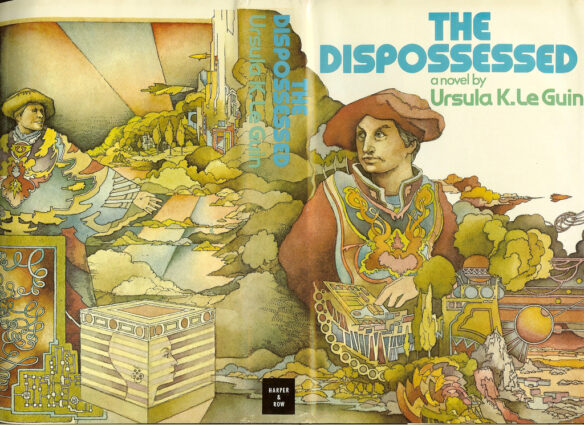
It was by published by Harper & Row that year with a stunning wraparound cover by Fred Winkowski. I found only two first editions to be had online, the first $1200, the other substantially more, but that was signed. 

Le Guin in the forward to Ursula K. Le Guin: The Hainish Novels & Stories, Volume One which includes The Dispossessed says “The Dispossessed started as a very bad short story, which I didn’t try to finish but couldn’t quite let go. There was a book in it, and I knew it, but the book had to wait for me to learn what I was writing about and how to write about it. I needed to understand my own passionate opposition to the war that we were, endlessly it seemed, waging in Vietnam, and endlessly protesting at home. If I had known then that my country would continue making aggressive wars for the rest of my life, I might have had less energy for protesting that one. But, knowing only that I didn’t want to study war no more, I studied peace. I started by reading a whole mess of utopias and learning something about pacifism and Gandhi and nonviolent resistance. This led me to the nonviolent anarchist writers such as Peter Kropotkin and Paul Goodman. With them I felt a great, immediate affinity. They made sense to me in the way Lao Tzu did. They enabled me to think about war, peace, politics, how we govern one another and ourselves, the value of failure, and the strength of what is weak. So, when I realized that nobody had yet written an anarchist utopia, I finally began to see what my book might be.” 

So let’s now go on to note that I discovered that the novel has a story set before it, “The Day Before the Revolution” and the character in that story, revolutionary Laia Asieo Odo, is a major presence in The Dispossessed

But that’s not really why I’m bringing the story to your attention. The story is included in the Library of America’s Ursula K. Le Guin: The Hainish Novels & Stories which has a short essay on what she was feeling after writing the novel which you can read here “Story of the Week: The Day Before the Revolution”. And the story is here “The Day Before the Revolution”.

Now where was I? Ahh it’s 1974, the novel has come out. Among us, it was widely acclaimed, and the Ursula K. Le Guin Foundation definitely was appreciative of this as her website lists them this way:

Winner of the 1974 Nebula Award for Best Novel
Winner of the 1975 Hugo Award for Best Novel
Winner of the 1975 Locus Award for Best Novel
Winner of the 1975 Jupiter Award for Best Novel

And yes, each link takes you to the proper Award site. Stellar webmasters whoever they are. Now interestingly, the Foundation doesn’t include the Prometheus Hall of Fame Award. I wonder why.  It was also nominated for a John W. Campbell Memorial Award but didn’t win. 

As near as I can tell, it has never been out of print in the last fifty years with multiple hardcover, trade and paperback editions. ISFDB lists far too many editions to really make sense of its printing history, so I can’t say definitively. 

What I didn’t see is it ever got the small press, lavish edition treatment, but then I’m having a hard time remembering if any of her works did. Come on Filers, help me out here.  

In 2019, The Folio Society published a hardcover edition with illustrations by David Lupton and an introduction by Brian Attebery.  

Harper Perennial published a trade paper edition of the book with a new foreword by Karen Joy Fowler. 

(9) COMICS SECTION.

(10) KELLY THOMPSON Q&A. “Breaking the Mold: PW Talks with Kelly Thompson” at Publishers Weekly.

While she doesn’t do conventions, Kelly Thompson remains a perennial nominee at the Eisner Awards that are given out at San Diego Comic-Con every year. She’s nominated once again for Best Writer for Absolute Wonder Woman, one of the standouts of the megasuccessful Absolute line that helped DC dominate this year’s nominations….

Wonder Woman has had her ups and downs over the years. It sometimes has felt like comics creators don’t always know what to do with her, or which aspects of her character to focus on. One of the most fun things about Absolute Wonder Woman has been you leaning into her as a fantasy character. How did that approach, and the Absolute vibe overall, unlock new facets of her character?

DC really put their full force behind it and [Absolute Batman writer] Scott Snyder has been the greatest champion and leader, which has led to them bringing in creators who really had an idea for what they wanted to do. I can’t speak to everyone’s experience, but nobody got in my way. DC was like, “that’s the coolest thing we’ve ever seen. Let’s do that.” And once you feel like you’re being given that rope, you can also just really push the envelope and do some interesting stuff.

Diana in particular is often handcuffed. It’s much less true these days, but for a very long time, she was one of the only headlining female superhero characters that had name recognition and therefore always had a book. When you’re one of the only women, that means you have to represent all women and that’s hard to do. It can end up pigeonholing the character and feeling like you can’t do certain things with her, which becomes very limiting. It’s a limitation that you rarely see on a character like Batman who can do anything and be anything. So the new modern age of comics has helped Wonder Woman. The fantasy and magic you mentioned is just an incredibly rich vein of material to tap. It also fits very well with Diana, even her main version has a lot of that, but it’s also really useful in defining her among the Trinity. It pushes her into a more fantasy place and it lets Superman exist in a more sci-fi place, which really helps stake out territory and is great for everyone….

(11) THAT’S REALLY SUPER, SUPERGIRL. [Item by N.] YouTuber Princess Weekes was not a fan of the recent Supergirl film. As an alternative to all those “it’s bad because it’s woke” takes, she dissects it in her newest video: “Why Supergirl Didn’t Work”.

[Thanks to Cat Eldridge, SF Concatenation’s Jonathan Cowie, Chris Barkley, N., Christopher Hennessy, Jeffrey Smith, Mark Roth-Whitworth, Kathy Sullivan, Steven French, Mike Kennedy, Andrew Porter, and John King Tarpinian for some of these stories. Title credit belongs to File 770 contributing editor of the day Daniel Dern.]

Classics of Science Fiction at the 2026 Worldcon

By John Hertz: This year’s World Science Fiction Convention “LAcon V” (the 84th Worldcon, gosh) will be August 27-31 at the Anaheim, California, Convention Center, and nearby hotels.

We’ll discuss three SF Classics, one discussion each. Come to as many as you like. You’ll be welcome to join in.

No response from the con committee about scheduling these, I suppose because the concom is so busy scrambling they can hardly breathe. We’ll hold our discussions anyway.

Look for details at the con. I’ll try to get times and places posted here, and in such other media as can be managed.

I’m still with “A classic is a work that survives its own time. After the currents which might have sustained it have changed, it remains, and is seen to be worthwhile for itself.” If you have a better definition, bring it.

Each of our three is famous in a different way. Each may be more interesting now than when first published. Have you read them? Have you re-read them?

Robert A. Heinlein, Sixth Column (1949)

Of course there is talk of the science that grounds the story, but mostly we are occupied with application. The viewpoint character, no superman, comes onto the scene and finds he must manage it. Ingenuity beats bureaucracy. Is this a racist book – or an anti-racist book, considering Frank Mitsui in Chapter 12?

Andre Norton, Galactic Derelict (1959)

We begin with an Apache, who is made central. Struggling with the alien technology we came to study, we are captured by it. The author, telling us what is thought, details what is perceived. We have, perhaps, another instance of George 0. Smith’s “Lost Art”, and indeed Theodore Sturgeon’s great pun Science fiction is knowledge fiction.

A.E. Van Vogt, Slan (1951)

Of a local appearance by the author, Lee Gold said “I was wearing golden pipe-cleaners in my hair, and I thought he might like to see me.” Here is a tale of intrigue, of an undaunted protagonist working alone, of antagonists outwitted in crisis. So much is carried by thought and speech that we might miss the poetry.

Pixel Scroll 7/14/26 Specialization Is For Pixels

(1) COMICS CENSORSHIP IN IRELAND. James Bacon will be giving a talk at the National Library of Ireland in Dublin on Thursday August 6 at 6:00 p.m. Details and Free tickets are available here: “Banned Comics at the NLI: A history of censorship of comics in Ireland”.

Join comic fan and scholar James Bacon as he reveals the history of banned comics through National Library collections.

Comics were banned in Ireland. The worldwide “Moral Panic” about comics in the 1950’s was different in Ireland, with an active censorship and distrust of foreign publications, the outrage ignited quickly. Comic scholar and historian James Bacon shares his investigations using comics and material from the National Library. 

Please be aware that this talk may include themes of a sensitive nature. Recommended for ages 16+.

(2) TÄHTIFANTASIA AWARD. The Helsinki Science Fiction Society has announced the winner of the 2026 Tähtifantasia Award, given for the best fantasy book published in Finnish during the previous year.

  • J. S. Meresmaa: Noidanlanka (Myllylahti)

(3) AS YOU LIKE IT. Russell Samora studies “Comparisons as Predictable as the Sunrise” at Pudding. The article is all done with graphics, so I’m only presenting a couple of unrelated screencaps to whet your appetite.

(4) STOKERCON LOGO. Artist Dan Sauer’s logo for next year’s StokerCon was unveiled today. Maxwell Gold asked Sauer:

How does it feel to design and work on the StokerCon logo celebrating 40 years of the Horror Writers Association? As a follow-up, while I know you’ve been very involved in the writing community for some time, what does celebrating forty years of horror mean to you?”

I’ve loved horror (and more broadly, the Weird) ever since I can remember—probably starting with seeing Vincent Price in The Pit and the Pendulum when I was perhaps too young. I’ve also felt like an outsider for most of my life. I’m not sure if the two are connected, but it’s always been hard for me to fit in with non-creative types with more mainstream tastes, and I never felt completely at home until I got involved with the horror/weird fiction community. So the Horror Writers Association—an organization started by some of my favorite authors, and dedicated to fostering community among creative, horror-loving misfits and weirdos of all kinds—seems like a pretty valuable thing to me. I feel honored that I was chosen to work on the logos for the past two StokerCons, plus the special 40th Anniversary logo for 2027. …

(5) T. REX GOES UNDER THE HAMMER. “T rex fossil ‘Gus’ sells for $50.1m at New York auction, setting new record” reports Yahoo!

vast, fossilized Tyrannosaurus rex nicknamed Gus sold at Sotheby’s in New York on Tuesday for $50.1m with fees (£37.4m) to a phone bidder – making it the most valuable dinosaur fossil sold at auction.

It also sold well above a pre-sale estimate of $20m to $30m (£15m to £22.4m).

The skeleton, judged to be one of the largest and most complete ever unearthed, was excavated on a ranch in Harding county, South Dakota, by the commercial fossil outfit Theropoda Expeditions….

(6) LONG DAY’S JOURNEY INTO NIGHT. “After Nearly 50 Years In The Depths Of Space, Voyager 1 Still Sends Messages That Take 23 Hours To Reach Earth” – and Jalopnik is listening…

It traverses the ocean of stars that lies beyond our solar system, both the oldest spacecraft still in operation and the farthest object ever made by human hands. Launched before the parents of some of the team who still work on it were born, it continues to gather lessons about our cosmic home long after it was expected to die. Systems failing, nuclear battery draining, it presses forward on its long march through the long dark, the very edge of humanity’s grasp. It holds what may very well be our world’s first communication with another. But for now, the only species it talks to is our own, still trapped on our pale blue dot.

NASA’s Voyager 1 probe lifted off from planet Earth in 1977 and never returned. A twin with the Voyager 2 probe that also left that year, its mission was straightforward: fly past Jupiter and Saturn and collect data using a range of scientific instruments. These included an ultraviolet spectrometer, a magnetometer, and an imaging science subsystem, among many others. In 1979, it discovered a new ring and two new moons around Jupiter; in 1980, it discovered a new ring and five new moons around Saturn. And then the mission was accomplished, human knowledge was advanced, and the probe’s job was done. There was nothing left for it to do.

But this is NASA. Finding ways to use what it has in space for purposes never intended is its specialty. Voyager 1 still had a future as the greatest explorer in history….

…However, in its age and mileage, it is also growing ever weaker. It is powered by three radioisotope thermoelectric generators (RTGs), essentially small plutonium pellets that generate heat within a container; the heat differential with the outside causes electricity to flow. At launch, this system produced 470 watts in total. But the decay of the plutonium reduces this output year over year, forcing JPL to shut down one precious scientific instrument after another just to keep the others powered up.

Today, Voyager 1 produces just 230 watts, just enough to power its magnetometer and plasma wave subsystem. But JPL has a bold plan to extend its life even further as it travels ever farther, trying to keep Voyager working past its 50th birthday next year.

… There’s more at stake than just the power drain of the scientific instruments. Its thruster lines are both clogged and in danger of freezing; without thrusters, Voyager 1 can’t turn its antenna around to face Earth, and we would lose contact with it forever. Certain systems on the spacecraft are kept powered just to heat those lines, but by doing so, that puts even more strain on the dying RTGs.

Always seeking solutions, JPL believes that it may have one. Dubbed the “Big Bang,” the Southern California space center will attempt to switch off the devices currently heating the lines and switch on several others, all at once. If it works, the thrusters will stay warm at a savings of 10 watts. That will ensure that the probe and its twin Voyager 2 have enough power to last until the 2030s, which must have seemed like an impossible date back in 1977. And it will enable the spacecrafts to keep sending messages home, even if they take an entire day to get there….

(7) ANDREW NISBET III (1949-2026). Oregon fan Andrew Nibet III died July 4 at the age of 77. The family obituary is here.

…Andrew graduated from Reed College in 1973 as one of a limited few Viet Nam veterans in the student body and where he was known as a storyteller extraordinaire, a board gamer and led the Empire (game) Association for well over 50 years. He also enjoyed role-playing games with essentially the same core group of friends for decades and was one of their valued game masters right up until his passing….

…Andrew also volunteered to help on the organizing committees of local and regional science fiction conventions such as Con, OryCon, and Westercon and served on the board of Oregon Science Fiction Conventions, Inc. (OSFCI). He and his wife, Cecilia Anne Eng, were together since December 1973 (marrying in August 1977) and were inseparable for most of their life together. Andrew supported her music and her non-profit association, Friends of Filk, helping to raise money to bring filk musicians to sf conventions in the Pacific Northwest and occasionally to the Worldcons….

He is survived by his wife, a sister and a brother, as well as nephews, nieces, and grandnieces and grandnephews.

(8) MEMORY LANE.

[Written by Cat Eldridge.]

July 14, 1999Muppets from Space

Muppets from Space, which premiered in the States on this day twenty-sseven years ago, was the first film released after the death of Jim Henson. As such, it came with great hope and quite a few individuals expected it to, well, fail as it didn’t have the magic of Jim Henson in it. 

It was written by written by Jerry Juhl, Joseph Mazzarino, and Ken Kaufman. Juhl wrote every Muppets film that had been done as well as the chief writer on The Muppets, Mazzarino was the chief writer on Head Writer and Director on Sesame Street. So serious writing creds here. Well excepting Kaufman who had none

The plot is an SF one with Gonzo being told by a pair of cosmic knowledge fish (and wouldn’t that make a great basis for a SF novel) that he is an alien from outer space. Yes, I’m serious as he really is as we will see an entire ship full of gonzo beings. Now having said that very weird tidbit, I’m not going to say another word about the story. 

One of the co-writers, Mazzarino. has repeatedly said that he left the film before shooting started, due to changes made to his draft of the screenplay. He said that his draft included parodies of AlienContact and Men in Black but most of that got removed on the request of the studio. 

Reception was decidedly mixed. Roger Ebert of the Chicago Sun-Tribune said, “Muppets from Space is just not very good.” However, Robin Rauzi of the Los Angeles Times exclaimed “The magic is back.” Frank Oz, who was not there for the filming for reasons that remain in dispute to this day, kvetched to everyone that it was “not the movie that we wanted it to be.”   

Indeed, it lost money, just a bit, as it made just about two million less than the twenty-four million that it cost to make.   

(9) COMICS SECTION.

(10) STUDENT ACADEMY AWARD FINALISTS. The complete list finalists in all four categories is at the link: 2026 Student Academy Awards Finalists.

Animation Magazine analyzes the Animation category in its article “Gobelins, Filmakademie Shorts Dominate Student Academy Awards Animation Finalists”.

The finalists for the 2026 Student Academy Awards have been revealed, with seven graduate films created by both groups and individuals vying for a medal in the Animation category. This year, all the animation finalists hail from European film schools, dominated by Gobelins (France) with three contenders and Filmakademie Baden-Württemberg (Germany) with two, competing alongside films from ESMA and Rubika (France).

The Student Academy Awards is an international student film awards program. Each year, college and university film students from all over the world submit films for consideration in the following categories: Animation, Documentary, Live Action Narrative and Alternative/Experimental. Past Student Academy Award winners, including Pete Docter and Robert Zemeckis, have gone on to receive 70 Oscar nominations and have won or shared 15 awards.

Animation

  • Jonathan Lally, Elio Molinaro & Nicolas Acevedo Ferrate, COWS, École Supérieure de Métiers Artistiques (France)
  • Martha Rivière, Théo Bergougnoux & Romane Casha, Fellow, Rubika (France)
  • Noran Fikri Alezabi, Xinyue Ma & Yulin Yue, Gauze, Gobelins (France)
  • William Burger, Odelia Laine & Mathilde Vergereau, Le Jardin Rossini, Gobelins (France)
  • Matthias Strasser, The Panic Inside, Film Academy Baden-Württemberg (Germany)
  • David Sick, Send Nudes, Film Academy Baden-Württemberg (Germany)
  • Yehor Bondarenko, Alp Kurdoglu & Ange Yajima, Tears of the Mountain, Gobelins (France)

(11) NONE LIKE IT HOT. “Scientists Finally Solved the Mystery of Earth’s ‘Great Dying.’ It’s Bad News for Our Future” says Gizmodo.

Roughly 252 million years ago, nearly all life on Earth vanished. In a blink of geologic time, the Permian-Triassic mass extinction—also known as the Great Dying—wiped 96% of marine species and 70% of terrestrial species off the planet. The question that has plagued researchers for decades is, why?

Well, hang on a minute. Let me be more precise. Scientists do know what triggered the Great Dying: The geological record shows that a surge of volcanic activity (likely from the Siberian Traps) filled the atmosphere with greenhouse gases, ushering in a much warmer climate that most species simply couldn’t tolerate. However, the specific kill mechanisms at play have long perplexed experts.

In a study published July 6 in the journal Proceedings of the National Academy of Sciences, a team of scientists believes they have finally pinned down why so many sea animals died as a result of this extreme global warming. The findings not only solve a longstanding scientific mystery, but present a warning about Earth’s future….

… Sperling and several co-authors of the new research previously published a 2018 modeling study suggesting that warmer waters and declining dissolved oxygen levels were primarily responsible for marine die-off during the Permian-Triassic extinction. The rationale is simple: As global temperatures rapidly increased, so did ocean temperatures, and warm water holds less oxygen than cold water.

If these changes were the culprit, the handful of species that survived the mass extinction must have been particularly resilient to them. To test their hypothesis, the researchers measured how different groups of sea animals respond to warmer, oxygen-poor waters, comparing living representatives of those that dominated prior to the mass extinction with those that thrive today.

The results showed that groups that succumbed to the Great Dying had metabolisms that were far less tolerant of warm, oxygen-poor waters than those that survived.

“Our findings show that, across different organism groups, extinctions happened at much higher rates for those more vulnerable to increases in water temperature and decreases in oxygen availability,” lead author Jose Andres Marquez, who completed the research as a PhD student in Sperling’s lab, said in a statement….

(12) SPACE SUGAR. [Item by SF Concatenation’s Jonathan Cowie.] A good number of fans have a sweet tooth. I know this from when I used to regularly go to Eastercons back before they became wall-to-wall panel fests (no offence but I am old-fashioned in liking a solid diversity of programme formats and sadly Eastercons these days just don’t cut it). But the 1993 Eastercon, Helicon, was rather extra special being both an Eastercon and a Eurocon and held on the Island of Jersey: it was quite a blast with some mainland continental European fans driving to France and getting the ferry. Anyway, the hotel sported a quality chocolate shop and we bought the entire stock after a couple of days of the four-day convention. (If I recall, when we went there next we were asked to place orders in advance…)

All of which brings us up to today and in the journal Nature Astronomy there is a pre-print of a paper reporting the detection of a four-carbon sugar in interstellar space!

“Sugars are essential biomolecules, serving as metabolic fuels, nucleic acid backbone components and structural or energy-storage polymers. A central question in origin-of-life research is how monosaccharides formed on the primitive Earth, as laboratory experiments under prebiotic conditions yield insufficient concentrations. The detection of ribose, glucose and other monosaccharides in asteroids and meteorites suggests an exogenous origin, possibly in the interstellar medium (ISM) before meteoritic parent-body formation. However, no sugar has been observed in the ISM so far. Here we report the discovery of erythrulose, a chiral four-carbon ketose, in the ISM.”

The pre-print is Jiménez-Serra, I. et al (2026) “Detection of a four-carbon sugar in interstellar space”, Nature Astronomy pre-print.

[Thanks to John King Tarpinian, Cat Eldridge, SF Concatenation’s Jonathan Cowie, Thomas the Red, Chris Barkley, Mark Roth-Whitworth, Kathy Sullivan, Steven French, Mike Kennedy, and Andrew Porter for some of these stories. Title credit belongs to File 770 contributing editor of the day Brian Z.]

2026 Tähtifantasia Award

The Helsinki Science Fiction Society has announced the winner of the 2026 Tähtifantasia Award, given for the best fantasy book published in Finnish during the previous year.

  • J. S. MeresmaaNoidanlanka (Myllylahti)

The English version of the award citation says:

…The language and world of Meresmaa’s novel enchant with their joyful originality and richness. The plot easily takes the reader along. The story contains excitement, love, and humor. The reader can enjoy interesting ideas and authentic characters. The narrative gives space to the characters’ thoughts and feelings. The reader empathizes with the experiences of growing and uncertain young people. There is the mysterious atmosphere of old forests, details drawn from folklore, everyday life in villages, and the exploration of a steampunk-inspired city. The story touches on timeless themes of world domination and human exploitation.

Witch’s Thread is part of the tradition of speculative fiction, in which the world itself is a great adventure. It approaches reality through curiosity and gentleness. Meresmaa devotes equal care to the description of people, technical devices and natural phenomena. The author’s narrative and world-building are completely original. They are based on a knowledge of the tradition of fantasy literature and northern folk poetry, which gives the text a deep resonance and naturalness. Meresmaa plays with new words and uses interesting, fresh expressions with the sensitivity of a poet.

Meresmaa draws attention to how things look and feel. Nooa can listen to the song of the river, its playful lilt or its serious droning. The description of details creates a strong atmosphere in the novel and shows the importance of focused observation. The master storyteller shows how life, with all its everyday activities, is a journey of exploration.

The Witch’s Thread is an intelligent novel for all ages. It centers on the human experience and the relationship with nature. It celebrates creativity, language, and care….

The award jury is composed of critics Jukka Halme and Aleksi Kuutio, Osmo Määttä of Risingshadow.net and Niina Tolonen, a book blogger. Aleksi is the chair and is also on the Board of The Finnish Critics’ Association.

[Based on a press release.]

Review of Tales from Rugosa Coven by Sarah Avery

Review by Jennifer Stevenson: It’s been a long, long time since my witchy days, but these three novellas bring it all back like riding a bicycle. At least, the parts where the gang are clowning, cooking, squabbling, doing friend stuff, and having personal drama.

Tales from Rugosa Coven by Sarah Avery is an antidote to the angsty romantasy universe of blood feuds between immortal haters. These are witches you can relate to, with problems they can solve, kinda. Nobody you know dies.

Bonus: None of them is in menopause. (I never thought I’d say that in a review.)

In fact, these feel like real witches with a strong coven of some years’ standing. They get business done. They cook and argue and do their totally non-magickkkal laundry. And they’re kind to each other. You could say that kindness is their thing.

Tales from Rugosa Coven does not do so many annoying things. Nobody’s fifteen (or fifty) and clueless. Avery skips the whole “origins story” thing, which all too often by the third volume tends to swamp the interesting parts in Marvel-sized Shiny Army Versus Ugly Army apocalypses, with one small boy or menopausal witch attaining godhood by the end and shoving all the other characters aside. The human factor is never overshadowed by special effects. No gods or monsters talk shop over tea and so doing erase the heroism of our protagonists.

Oh, and nobody’s cat talks.

The Rugosa Coven witches have real-coven stuff. They come together from different traditions under the Big Top umbrella that is modern occult group practice. This makes for very diverse problems, from having to argue a case in front of Anubis to rescuing stranded mermen. They suffer the usual coven wrangling about how to call the quarters. These witches solve their problems with the strength of their differences tempered by patience, decency, friendship, and good will.

What a nice idea.

Their problems, also, feel like ordinary people stuff. What do you do when your parents die and you find out they were hoarders? Ordinary. And then you find all their friends are hoarders? Less ordinary. And the dead parents send nagging post-it notes promising revelations to come? Wait, what’s going on?

Whatever their differences, Rugosa Coven comes together every time to do what real witches do. Most of the time that is to figure things out, or maybe just to witness.

Active witnessing is hard, hard work. We all know what it’s like to do this, when someone we love turns weird.

This collection of three novellas originally appeared from Dark Quest in 2013 and won the Mythopoeic Award in 2015.  It has been revised by the author and is being republished by Candlemark & Gleam under the leadership of SFF legend Melissa Scott.

Charming, engrossing, authentic, highly recommended.

(Candlemark & Gleam, coming August 2026)


JENNIFER STEVENSON‘S BIOGRAPHY. Every now and then I write something witchy. My first effort was Trash Sex Magic, shortlisted two years running for the Nebula and the Locus Award about trailer trash sex magicians and a tree who used to be a man and is now a god. When the tree is cut down and killed by real estate developers, sex miracles begin to spray all over the landscape. Our heroine has four days to find someone to take his place. You can still get it in ebook from Small Beer Press.

When The Fan Decades Melt Away

By SF Concatenation’s Jonathan Cowie: I suspect that I am not alone among Filers of a certain age who have a number of fan reunions each year.  Last week I had my third of the year so far when a small number of first generation PSIFAns gathered in a town several rail stations north of St Albans (more of which shortly).  PSIFA (the Polytechnic ScIence Fiction Association) was Hatfield Polytechnic’s (now Hertfordshire University’s) SF group founded back in 1978 (which is uncomfortably close to being half a century) ago.

PSIFA logo, sweat-shirt iteration
The Elephant House Student’s Union building – an exact miniature of London Regent’s Park Zoo’s elephant house – that provided the venue for the Shoestringcons.

PSIFA was known for its meetings of talks, films (that rivalled the college’s Film Appreciation Society), a Campus Radio (the first student radio station in the UK) SF show called Radio Free Entropy (the first fan radio show?), field trips to Novacon and Eastercon as well as London’s specialist SF bookshops, and a series of Shoestringcon SF conventions.

As it happened, at this week’s reunion gathering was the Chairman of Shoestringcon 1: Polycon.  Go back to 1979 and the end-of-term euphoria and a bunch of PSIFAns were hanging out with the StAlbans SF group Staffen (StAlbans fen) in a pub not far from StAlbans rail station.  Back then, much of the chat was about the then forthcoming Worldcon to be held in Brighton and some foolish wag suggested that PSIFA should run a mini-convention. It was decided to call it Shoestringcon as we knew that there would be comparisons with that year’s Worldcon and we wanted to signal that it was being run on a tight budget. The Staffen fans were enthusiastic in having some mugs run a convention in the next town.  So, who to be the con’s Chair?  Well, as it happened one PSIFAn was temporarily, absent in the toilets making a watery offering to Bacchus and so he was duly volunteered.

That individual was also present at the recent 2026 reunion and at some stage, once again, he went to make an offering to Bacchus.  This time he wasn’t volunteered to be a con Chair but did return somewhat excited as the pub’s gents’ toilet had a picture of a flying Victorian and a stargate…

And lo, nearly half a century ago, the convention came to pass with GoHs Ken Bulmer and Mat Irvine.  PSIFA is still going today but has (we hope temporarily) lapsed – seduced by the dark side – from being broad church SF group to a table top gaming society.

Having said all that, at these fan reunions, the years and decades simply melt away, it is as if we all last meet a week ago.

Pixel Scroll 7/13/26 The Discworld Turned Upside Down

(1) WAYWARD WORMHOLE WRAPUP. [Item by Cat Rambo.] Thank you to The Wayward Wormhole Barbados attendees. Once in a while, elements come together in a way that creates an epochal shift in our writing careers, and for The Wayward Wormhole, this shift will forever be linked to Barbados. Between the group of students, the insightful instructors, and the friendly, sandy-beached, crystal blue waters, flying fish, sting rays, and large sea turtles of Oistins, Barbados, we all experienced a camaraderie greater than the sum of its parts.

Our sincere thank you to Karen Lord for inviting us to her beautiful island. The Wayward Wormhole would like to thank everyone in attendance.

Cat Rambo
Karen Lord
Premee Mohamed
S.J. Elliott (Sean)
Sarah Day
Rosemary Claire Smith
Em Dupre
Kathy Brown
Marilyn Mauer
Christian Ivey
Janet K Smith

Writing fantasy, science fiction, or horror and want to move from promising rejections to actual acceptances? The Rambo Academy for Wayward Writers offers live and on-demand classes as well as a virtual campus featuring daily co-working, craft book and story discussion groups, writing to prompts, motivation sessions, and other Zoom-based social events as well as a lively Discord server for chatting with other writers and exchanging story critiques.

Access is a human right for all, regardless of disability status.  To facilitate open communication, I am happy to: limit e-mail to specific times of day; use subject line keywords; use (or not use) bold, italics, or other styles for legibility; use specific quoting patterns (above, below, point by point); reformat for screen readers, or anything else you may find helpful. 

(2) HOW’S YOUR HUGO BALLOT COMING ALONG? Camestros Felapton hasn’t quite decided which novel will get his vote – and explains why it’s hard to choose in “Hugo 2026 Best Novel Rankings”.

… I recommended The Incandescent to a friend, whom I was confident would like it, but I quickly found I had to sort of work against describing the premise. It’s about a teacher at a magical school…but not like what you might imagine that to be like, but well, yes, it is like that, but not all etc. With The Everlasting, I was doing something similar, but with my own preconceptions of the book.

Of these three top picks, I think Death of the Author stands out as the most distinctive, but while I enjoyed it, I think, as a reading experience, I preferred The Incandescent. At this point, though, I’m quibbling with myself over fine distinctions….

(3) DARK POETRY NEWS. “Horror Writers Association Partners with Raw Dog Screaming Press for the HWA Poetry Showcase Series”.

The Horror Writers Association (HWA) is pleased to announce a new publishing partnership with award winning independent publisher Raw Dog Screaming Press (RDSP), which will publish and distribute “HWA Poetry Showcase Volume XIII.” As part of the agreement, Raw Dog Screaming Press will also publish future editions of the acclaimed “HWA Poetry Showcase” series.

For more than a decade, the HWA Poetry Showcase has provided an important platform for emerging and established poets working in horror, dark fantasy, and speculative poetry. Each annual volume celebrates the creativity and diversity of the horror poetry community while introducing readers to compelling new voices alongside accomplished authors….

… The volume is scheduled for release in October 2026 in celebration of Dark Poetry Month, an annual observance dedicated to recognizing the enduring power and artistry of horror poetry….

(4) UP FROM THE RANKS. ScreenRant calls these the “10 Best Dystopian Sci-Fi Movies of the 21st Century, Ranked”.

The dystopian sci-fi movie is made to force viewers to take a look at society and see how things could spiral into a terrifying future. While these movies have been around since the silent era, the 21st century has turned the dystopian story into one of the most enduring sci-fi subgenres in movies and books today. These films hold a broken mirror up to the world and ask viewers what could happen if one thing goes wrong…

Here’s one of their picks:

Looper (2012)

Looper is a sci-fi movie about a future where crime syndicates send back targets to be killed in the past by assassins called loopers. This is a future where time travel exists, but is outlawed, so only the criminals use it. When a looper is waiting for his latest target, he pauses when he realizes he is looking at an older version of himself. The older version (Bruce Willis) escapes and decides to kill the future crime lord to prevent the atrocities he would one day cause.

While a lot of the action takes place in the movie’s present day of 2044, it does show the future dystopian world of 2074, where dystopia is shown as visible social decay, vagrancy, crime, and inequality. Directed by Rian Johnson, the movie is a critical success, with a 93% Rotten Tomatoes score. It was a nice change in dystopian thrillers, as it cared more about changing the future than dwelling on what went wrong.

(5) GOOGLE SUIT. “Publishers, Authors File Class Action Lawsuit Against Google” reports Publishers Weekly.

Publishers and authors have teamed up to file a new lawsuit against Google, contending that the tech giant has engaged in widespread copyright infringement in developing its Gemini AI models.

Publisher Hachette Book Group, Cengage Learning, and Elsevier, as well as author Scott Turow, are the named plaintiffs in the lawsuit, and the claims are being brought on behalf of themselves and a proposed class of authors and publishers. The suit follows an attempt by HBG and Cengage to join the Google Generative AI Copyright Litigation lawsuit first brought by a group of illustrators and writers in 2023, and which Google has been challenging the right for the publishers to participate.

With the new lawsuit, Cengage and HBG have withdrawn their motion to take part in the 2023 suit, observing that Google could assert that a three-year statute of limitations pertains to the class member claims. In light of that possibility, Hachette and Cengage “determined that they must take action to protect claims that appear to be outside the putative class in this action,” according to the motion to withdraw from the original suit.

Among the highlights in the new lawsuit, filed in the U.S. District Court for the Southern District of New York, are that Google executives knew publishers would consider some of its plans to copy books as illegal, and despite facing huge potential monetary damages (a Google document notes the company “faced $10Bs-$100Bs” in potential fines) but went ahead and made copies anyway….

(6) 2D OR NOT 2D, THAT IS THE QUESTION. “’Coyote vs. Acme’ Director Dave Green Discusses the Making of the Long-Awaited Movie” in Animation Magazine.

Coyote vs. Acme’s somewhat rocky road to the silver screen is nearing the finish line this month. The big kid in all of us is thrilled that Looney Tunes’ self-proclaimed genius, Wile E. Coyote, will soon be presenting his case against Acme Corp. in the new live-action/animation hybrid feature directed by Dave Green….

… “When I first started pitching this film and talking about it, I was really interested in extremes and how far we could push [the] tone,” Green tells Animation Magazine. “We wanted to obviously keep the cartoon joy and ebullience of the Looney Tunes but also counterbalance it with courtroom thrillers and courtroom dramas that would act as a kind of grounding agent.”…

… The director points out that Wile E. is defined by the fact that every single morning he not only wants and expects to not only chase the Road Runner but also thinks he’s going to capture the bird and make Road Runner stew that night. “That goal and singular focus makes him the most optimistic character I can think of, and not only in the Looney Tunes world,” explains Green. “The movie for us, thematically, became about the spirit of the chase and about Wile E.’s want and his passion really being chasing. Once we started talking about that, it cracked open a larger nugget that ended up applying to all of the characters. Like what does Kevin Avery, played by Will Forte, want and can his want be cracked open, and what is he chasing?”

For Green, Coyote vs. Acme’s animation development starts and ends with a 2D process. “Because Wile E. Coyote doesn’t exist, producer Chris DeFaria said early on in the process that he’s the one actor that’s not going to show up and be able to have a conversation with you,” he recalls. “He recommended this story process where we draw out the entire movie in animatic and previs form and draw every single character. I’d have meetings with my story artists where they’d draw Wile E., and we’d have conversations about what he’d want and think and feel in each scene.”

Green adds, “He’s a nonverbal character so he really expresses himself through expressions and body language. From there, we shot the film with a puppeteer who showed up on set, Dave Barclay, who’d worked in the [Jim] Henson universe for years and years and worked on Roger Rabbit. He was there to show the actors what Wile E. would be doing in the scene in physical space. He was there for eyeline and interaction with the actors. Then in post, we did the whole process again with a sketch-vis process with 2D artists drawing on our live footage and informing posing, body language and expression. From there, we brought it to our 3D team at DNEG, who had a brilliant team of animators. They brought those poses and those expressions to life, of course honoring all of the expressions and posing we’d seen in the original legacy cartoons.”…

(7) TODAY’S BIRTHDAY.

[Written by Paul Weimer.]

July 13, 1942Harrison Ford, 84.

By Paul Weimer: The man who was Deckard, Han Solo and Indiana Jones?

Where to begin?  Well, with Han Solo, since I first saw him in Return of the Jedi. I knew from osmosis and commercials that he was frozen in carbonite in ESB (the cloud city playset could “Turn him into carbonite”). So, having him frozen/petrified was not a surprise, but the kiss was. I had the wrong idea that Harrison Ford’s Han Solo and Leia had been a real thing for a lot longer than they were in the movies.

But such charisma, the rogue turned hero. I think that because I saw ROTJ first, I wasn’t a “Forget Luke, Solo is the best” sort of person despite Ford’s skills and charisma, because he is out of it for so long in the movie. 

But then the next year I saw Temple of Doom… having not seen Raiders of the Lost Ark as yet. And yes I was pretty young to see a rather violent movie (it is the movie that created the PG-13 rating). So my first exposure to Ford’s Dr. Jones is him at his most mercenary. His alignment is far more closer to Neutral than Good. It would confuse me later, when I finally saw Raiders that he was much more heroic. But again, such screen charisma! 

And then there was Deckard. I didn’t see Blade Runner until a couple of years later, thank you again, WPIX. It was a chopped version and not as good as later versions, but even though I am not a connoisseur of Noir movies, I grokked Deckard as Ford portrayed him, immediately. But that movie is full of other delights than Ford’s “one more job” performance and perhaps deserves an entry of its own. 

Of course, I would see the remainder of the Star Wars movies, and the Indiana Jones movies in due course, seeing Last Crusade in the theater, to boot. Connery and Ford play off of each other wonderfully. It may be the best of the original three Indiana Jones movies in my heart. And it brings home and completes the character arc that starts in Temple of Doom (which is, in internal chronology, the first movie) and I appreciated that. Ford’s Indiana Jones goes from a mercenary archeologist not that much better than the as yet unmet Belloq all the way to a Grail Knight. 

The faults in Indiana Jones and the Crystal Skull are not Ford’s to shoulder. He does more than fine in the movie, it’s other elements of the movie that annoy me to no end.

Seeing Ford’s Han Solo die in The Force Awakens didn’t shock me, once I figured this was a quasi remake of A New Hope, I figured someone had to be the Obi-Wan here, and Solo was the best choice for that role. But it still moved me all the same, since one of the best actors of his generation, in one of the best roles he has ever done, came to an end. 

I have not yet seen Captain America: Brave New World, I have mostly fallen off of the Marvel wagon these days. I have not yet seen Dial of Destiny, I’ve been warned off of it, but perhaps I will see it, sometime.

Harrison Ford

(8) COMICS SECTION.

(9) ‘UNHOLY HISTORIES’. [Item by Steven French.] “Humanists UK is a charity dedicated to promoting humanist values and the latest episode of their podcast ‘Unholy Histories’ is all about humanist thought and science fiction (and yes, Star Trek is in the mix of course!)” “Imagining better futures – hum…–Unholy Histories: The Humanist Heritage Podcast from Humanists UK” on Apple Podcasts.

In her 1818 novel Frankenstein, Mary Shelley asked what it meant to make a person – and what we owed to the beings we create. Two centuries later, the questions she opened are still being asked, in the time machines and starships and feminist utopias of the science fiction tradition. 

Humanism has long found a home in speculative fiction: a genre where the supernatural is set aside, where the world’s contingency is laid bare, and where, as this week’s guests put it, we can test-drive our values without looking to the heavens for answers. 

From H.G. Wells and Olaf Stapledon to Naomi Mitchison, Octavia Butler, Samuel Delany and the writers reimagining the genre today, this episode asks how imagining the impossible helps us change the present – and boldly go towards a better future.

Guests:

S.I. Martin, British historian, author and educator specialising in Black British history and literature, and a patron of Humanists UK. simartin.org.uk

Katie McGregor Stone, literary critic and researcher of science fiction and utopian literature, currently writing a book on Frankenstein. katiemcgregorstone.co.uk’

(10) IN BENNU’S PANTRY. “Scientists examining samples returned from asteroid Bennu found ribose and glucose inside — and with phosphate and every RNA nucleobase already detected in the same asteroid material, every chemical component needed to build RNA was present in the early solar system, long before life existed on Earth.” at Space Daily.

The Bennu sample is becoming less like a single asteroid story and more like a chemistry inventory from the early solar system. The latest result is simple to state, but easy to overread: scientists found ribose and glucose in material returned from Bennu, and ribose is the sugar used in RNA….

…This is one set of sample analyses, not proof that RNA formed on Bennu, and not evidence that life existed there. It is more specific than that. It shows that the raw molecular pieces used by life on Earth could be made and preserved in small bodies before Earth had life at all….

(11) BITS AND PIECES. “Space junk debris cloud discovered in high-traffic orbit ‘is a potential minefield’ for the costliest satellites” reports Space.com.

Tiny pieces of space junk only 2 inches (5 centimeters) in size are cluttering a valuable orbital region where some of the costliest satellites reside, a new study has found.

Researchers from the University of Warwick in the U.K. found that the geostationary orbit — a region of space at the altitude of 22,000 miles (36,000 kilometers) — is full of dangerous, previously unseen bits of space junk that could destroy satellites.

The geostationary orbit is quite unique. Satellites at this altitude circle Earth in sync with the planet’s rotation, appearing permanently suspended above a fixed spot on the equator. A single satellite in the geostationary ring has a constant view of a vast portion of the globe. This feature has been taken advantage of for decades for things like TV broadcasting, internet delivery, Earth observation and weather monitoring. But, as it appears, those satellites might not be safe up there at all.

“The debris in geosynchronous orbit is a potential minefield,” Stuart Eves, the study’s co-author and space consultant at SJE Space, said in a statement. “No one in their right mind would enter a terrestrial minefield without a mine detector. Similarly, no one in their right mind should launch a satellite to GEO without an adequate debris survey.”

The researchers uncovered the previously invisible debris by re-examining a dataset from an earlier space debris survey conducted by astronomers using the 8.3-foot (2.54-meter) Isaac Newton Telescope in La Palma, Canary Islands. They ran the data through new image processing algorithms to distinguish smaller and much fainter fragments than was previously possible in the distant geostationary orbit….

(12) TODAY’S TITLE EXPLAINED. [Item by Daniel Dern.] “The Discworld Turned Upside Down” comes via the song (title) “The World Turned Upside Down” [1, 2].

[1] I did the title purely by and for the wordplay. No political notions, commentary, opinions et c. re Discworld or anything here are implied nor should be inferred (nor, for credentials, infurred).

[2] According to Wikipedia, there’s (at least) I’m thinking of the song with this title (also known as “The Diggers”) written by Leon Rosselson (who, among other things, I see, wrote for the British TV show “That Was The Week That Was” (as opposed to the American TV show of the same name, which Tom Lehrer wrote some songs for).  (popularized later by Billy Bragg). I’m pretty sure I heard Rosselson do it live (decades ago!) at some coffeehouse (probably Passim or The Iron Horse); ditto, possibly first, from Frankie Armstrong (loci cit.), although I’m not finding that in web search, and my LPs and CDs are still in a bunch of muddles.

Here’s Rosselson doing performing his song on one of his albums, and a live version by Rosselson, with a fair bit of explanation first, and another version accompanied by Roy Bailey.

And here’s Billy Bragg’s version, and versions by John McCutcheon, Dick Gaughan, Amanda Palmer, and, aha! a live performance (so-so sound, alas) by Jim Woodland, Janet Russell, Reem Kelani, Frankie Armstrong, Leon Rosselson.

The original “The World Turned Upside Down,” says Wiki P, “is an English ballad. It was first published on a broadside in the middle of the 1640s as a protest against the policies of Parliament relating to the celebration of Christmas.”

Other songs with or including this title, which may or may not overlap in thoughts and phrases, include (same title by) Chumbawamba, and in Hamilton (the musical, in case you’re in doubt what I’m referring to here), “Yorktown (The World Turned Upside Down)

[Thanks to Andrew Porter, John King Tarpinian, Cat Eldridge, Cat Rambo, Paul Weimer,  SF Concatenation’s Jonathan Cowie, Chris Barkley, Mark Roth-Whitworth, Kathy Sullivan, Steven French, and Mike Kennedy for some of these stories. Title credit belongs to File 770 contributing editor of the day Daniel Dern.]