





Introduce
Home
Partners
Funding
Protocol
Robot Financing
Agentic Payments
Data Flywheel
Constitutional Robotics
Blog
Resource
Whitepaper
Community
The Infrastructure For The Robot Economy
We are in an exciting time as the intersection between robotics, AI, and crypto provide the necessary tools to become a category-defining leader.
FOUR PILLARS
Pillars Powering Fabric Adoption
Robot Financing illustration
Robot Financing
Unlocking demand-driven capital for robot manufacturers through real-world revenue streams.
Agentic Payments illustration
Agentic Payments
Building the machine-native payment and identity layer that enables robots to transact autonomously at global scale.
Data Flywheel illustration
Data Flywheel
Turning real-world robot activity into a demand-driven data engine that continuously improves robotics intelligence.
Constitutional Robotics illustration
Constitutional Robotics
Establishing an open governance framework to ensure robots act safely, ethically, and in alignment with society.
PILLARS 01
Robot Financing
Fabric finances the robot economy and connects global capital with the largest robotics buildout of our generation while delivering real yield.
Robot manufacturers are constrained by liquidity, not by demand. Fabric introduces a revenue-based financing protocol designed for robot OEMs. Instead of borrowing through traditional loans, OEMs can access upfront capital by selling a portion of the future revenue tied to confirmed customer orders.
This means the birth of robots will be driven by demand, not limited by capital.
Robot Financing
Robot Financing
Financing operations are managed and operated by Fabric Protocol, and users just need to provide liquidity. This model is anchored in contracted customer demand rather than speculative future performance, making it fundamentally different from traditional crypto yield.
PILLARS 02
Agentic Payments
As robots become economically active, robots will need to pay and be paid for goods and services autonomously. From purchasing software and compute to paying for energy, maintenance, and services, robots will participate directly in the economy.
However, today’s financial systems are not built for machines.
Robots cannot open bank accounts, hold credit cards, or transact globally without human intermediaries. Existing rails assume human identity, manual authorization, and high-friction payments, none of which scale to billions of autonomous agents.
This creates three core problems:
[01]
PAYMENTS ARE NOT MACHINE-NATIVE
Existing systems rely on human authorization and intermediaries.
[02]
ACCESS IS RESTRICTED
Robots face geographic and banking constraints (no bank accounts or credit cards).
[03]
TRANSACTIONS ARE INEFFICIENT
Transactions are inefficient as fees and latency make real-time machine payments impractical.
Fabric Agentic Payments Solution – A Financial Layer for Robots
Fabric is building the payment and identity layer for robots.
Programmable Wallets

Every robot is equipped with a native, programmable wallet, enabling autonomous transactions without the need for traditional bank accounts or human intermediaries.

Programmable Wallets
Programmatic Execution

Robots can hold wallets without bank accounts, execute payments programmatically, and transact globally in real time.

Programmatic Execution
High-Frequency Micropayments

Fabric, in collaboration with Circle, enables high-frequency, low-cost micropayments, allowing robots to pay per task, per API call, or per second of work in real time.

High-Frequency Micropayments
How It Works
Step
Phase
Key Highlights
01
Unique Identity
Assigns a unique onchain identity to each robot.
02
Initial Funding
Users provide initial funding to the robot's wallet.
03
Real-time Income
Robots receive income in real time by providing labor/services.
04
Autonomous Spending
Robots autonomously pay for compute, software, energy, and maintenance costs.
05
Programmatic Execution
Payments are triggered automatically based on predefined rules and real-time conditions.
06
Onchain Verification
All transactions are recorded onchain, ensuring transparency and auditability.
The robot economy requires a financial system built for machines. By embedding payments directly into robots, Fabric transforms them from tools into autonomous economic actors. As more robots transact through Fabric, it becomes the default financial layer for machine-to-machine commerce.
PILLARS 03
Data Flywheel
Whoever controls high-quality real-world data will win robotics.
Robotics is fundamentally a data problem. The companies that win will not just build better hardware or better models. They will control the highest-quality real-world data and use it to continuously improve performance, reliability, and economics.
Fabric Data Solution:
Real-Time Feedback Application:
Meaningful robotics data requires large hardware deployments, diverse real-world environments, and continuous real-time feedback from machines operating in the field. As robots proliferate society, companies will need to fine-tune their models. Fabric is building an application that addresses this pain-point. By allowing users to send real-time evaluations, robots will become more useful as edge-cases are solved.
More
Demand-driven Marketplace
Fabric’s data marketplace is driven by demand, not passive supply. Instead of collecting data first and searching for buyers later, Fabric begins with specific data needs from companies building robots and AI systems.Qualified data buyers including robotics companies, AI developers, and research organizations submit detailed requests for the data they need. These requests can include specific environments, tasks, edge cases, performance scenarios, or behavioral outcomes required to improve their models.
More
FABRIC STANDARDIZES
These Requests Into Structured Data Bounties That Define:
01
The type of data required (e.g. navigation, manipulation, human interaction)
02
The conditions under which the data must be collected (environment, hardware, constraints)
03
Quality thresholds and validation requirements
04
The compensation offered for successful fulfillment

These data bounties are then distributed across Fabric’s network of robot operators, OEMs, and deployed fleets.

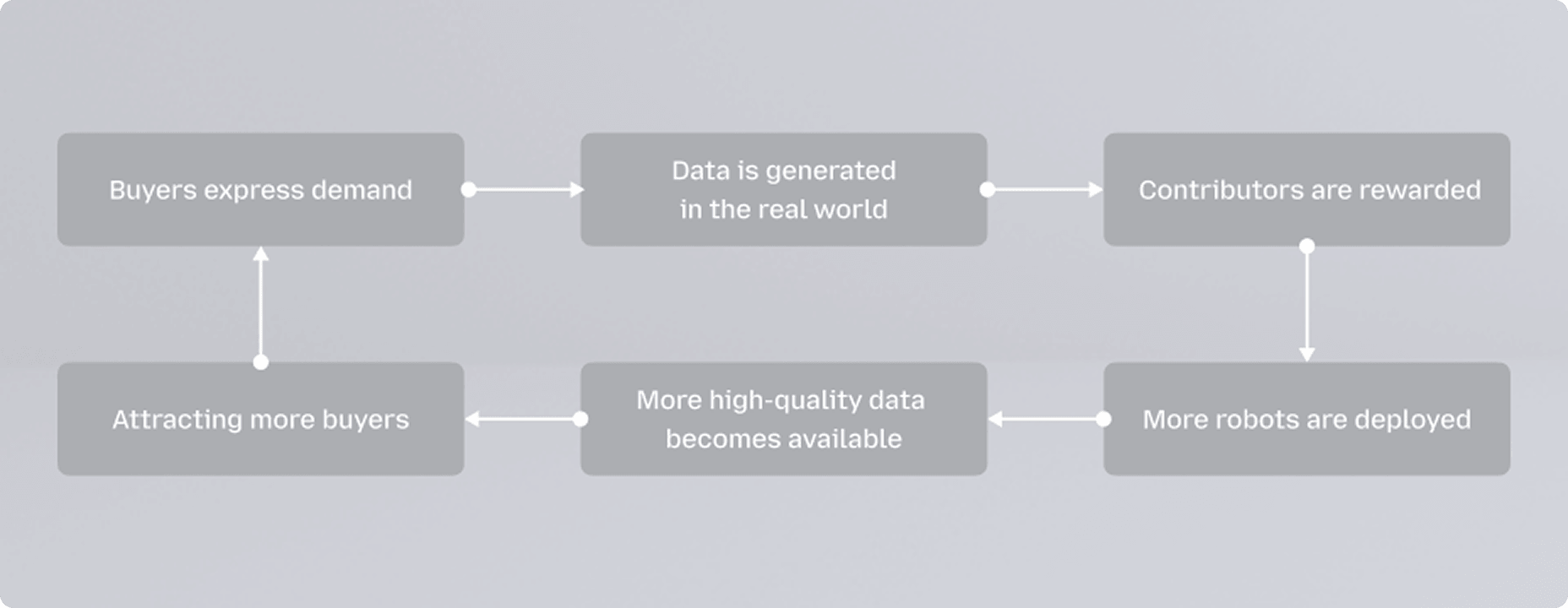
Over time, this creates a closed-loop system:
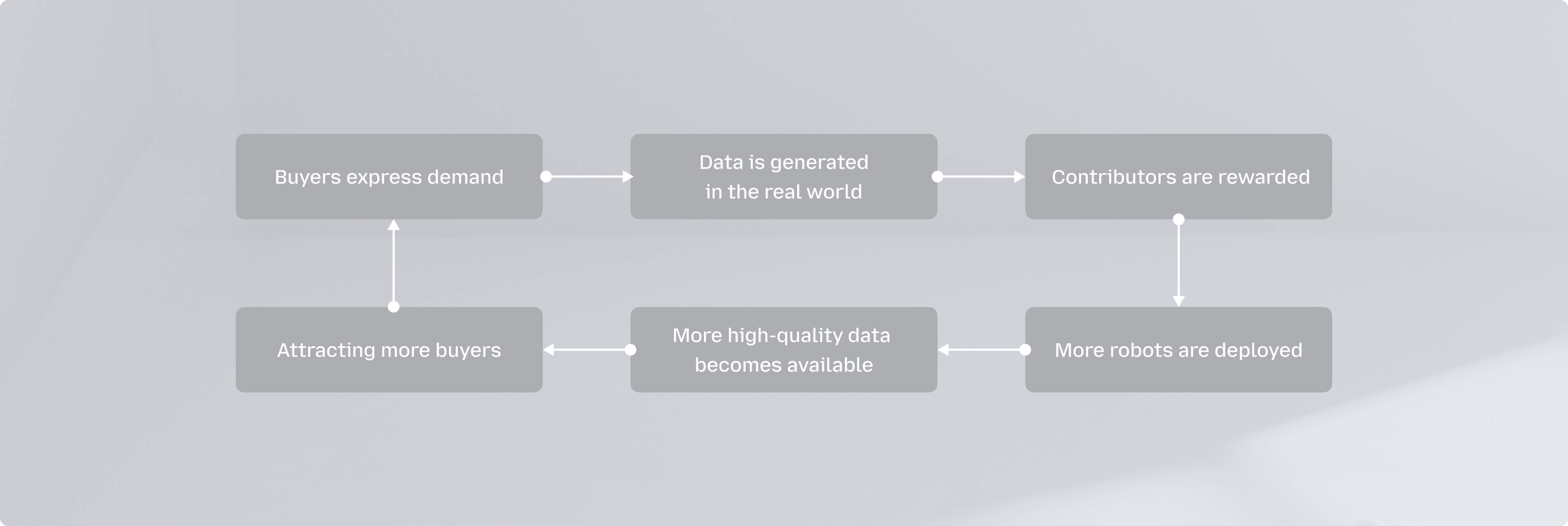
Fabric StandardizesFabric Standardizes
By aligning data production directly with demand, Fabric ensures that the network continuously generates the most valuable data for advancing robotics and AI, while economically rewarding the participants who make it possible.
PILLARS 04
Constitutional Robotics
Robots will be physical AI agents in the real world making decisions, interacting with humans, and participating in the economy at scale. As robots become more autonomous and more integrated into daily life, the question is no longer just what they can do physically, but what they should do.
Today, there is no shared framework that defines how robots should behave, who sets those rules, or how those rules evolve over time.
This Creates Three Major Problems:
[ 01 ]
Robotic behavior is undefined
as there is no consistent standard for how robots should act in real-world environments, especially in edge cases involving safety, ethics, and human interaction.
[ 02 ]
Control is centralized
since a small number of corporations may define how robots behave, optimizing for business outcomes rather than societal well-being.
[ 03 ]
Stakeholders lack a voice
as the people most impacted by robots—workers, consumers, and communities—have little to no input in how these systems are governed.
Fabric Constitutional Robotics Protocol – An Onchain Framework For Robot Behavior:
Fabric is building a constitutional layer for robotics: a set of guiding principles, rules, and governance mechanisms that define how robots should operate in the world.
This protocol is designed to ensure that robots act in ways that are safe, aligned with human values, and beneficial to society as a whole. Rather than being controlled by any single company, this framework is open, evolving, and shaped by a broad set of stakeholders.
HOW IT WORKS
Ecosystem Formation
[01]
Ecosystem Formation
Create a stakeholder ecosystem: through partnerships, conferences, and international discussions.
Onchain Constitution
[02]
Onchain Constitution
Fabric embeds constitutional principles onchain, powering identity, payments, and coordination systems for robots.
More
CONCLUSION
Robotics will reshape labor, economies, and daily life. The systems we put in place today will determine whether that future is broadly beneficial or narrowly optimized for a few.
Fabric’s goal is to ensure that the robot economy is built on foundations that are open, accountable, and aligned with humanity, not just corporate incentives.
By combining financial infrastructure, data coordination, and constitutional governance, Fabric is accelerating the adoption of robots and shaping how they behave in the world.
A Non-Profit Advancing Open Robotics & AGI.
Focused on ecosystem development and real-world deployment.
Overview
Home
Partners
Funding
Protocol
Blog
Privacy Policy
Terms of Use
Community
Whitepaper
© 2026 Fabric Foundation. All rights reserved