type
(redirected from type 2 muscle fiber)Also found in: Dictionary, Thesaurus, Medical, Financial.
type
type
any abstract or conceptual class or category which may or may not be seen as capable of straightforward empirical reference. Compare IDEAL TYPE. See also TYPOLOGY, TYPIFICATION.type
[′tīp]type
ii. In relation to the certification of aircraft, aircraft engines, or propellers, it means those aircraft, aircraft engines, or propellers that are similar in design.
type
(theory, programming)Types supported by most programming languages include integers (usually limited to some range so they will fit in one word of storage), Booleans, floating point numbers, and characters. Strings are also common, and are represented as lists of characters in some languages.
If s and t are types, then so is s -> t, the type of functions from s to t; that is, give them a term of type s, functions of type s -> t will return a term of type t.
Some types are primitive - built-in to the language, with no visible internal structure - e.g. Boolean; others are composite - constructed from one or more other types (of either kind) - e.g. lists, arrays, structures, unions. Object-oriented programming extends this with classes which encapsulate both the structure of a type and the operations that can be performed on it.
Some languages provide strong typing, others allow implicit type conversion and/or explicit type conversion.
Type
a rectangular piece of metal, plastic, or wood with a raised image of a letter or character on one side. The raised or recessed image serves to reproduce letters and characters by printing, in which the face is covered with ink and an impression is made on paper. Metal type is the most common; it is cast from printing alloy. The parts of a piece of type (see Figure 1) are the body (a), beard (b), and face (c); the dimensions of the type are defined by the point size (d), width (e), and height to paper (f). The last dimension is constant for all kinds of type.
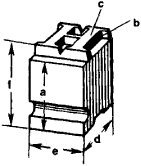
Type
an element with which a particular taxon is always associated. The type of a species or an intraspecific taxon is usually a single specimen of a plant or animal or, less commonly, several specimens viewed together on one herbarium sheet or in one laboratory preparation. Sometimes a drawing serves as a type. The type of the plant species Companula aldanensis is a specimen collected by the Russian botanist V. S. Korzhevin on Aug. 6, 1928, on the bank of the Aldan River in Siberia; the specimen is preserved in Leningrad at the herbarium of the V. L. Komarov Botanical Institute of the Academy of Sciences of the USSR.
The term “type” is also used as a designation for a lower taxonomic category that is selected as a standard of reference for a higher category. The type of a genus or of a taxon between a genus or species (for example, a subgenus or section) is a particular species. For example, the species Campanula latifolia is the type of the genus Campanula. The type of family or of a taxon between a family and a genus (for example, a tribe or subfamily) is a particular genus. For example, the type genus of the family Campanulaceae is Campanula, a genus established by C. Linnaeus. Taxa higher than a family do not have types.
M. E. KIRPICHNIKOV