projection
(redirected from projective)Also found in: Dictionary, Thesaurus, Medical, Financial, Wikipedia.
projection
Projection



Projection
(dreams)Although many aspects of the personality theory formulated by Sigmund Freud have been rejected by contemporary analysts, Freud was nevertheless responsible for a significant number of insights into human nature that have been generally accepted. Among these insights are the Freudian “defense mechanisms,” one of which is projection. In projection, a certain urge we are repressing is projected onto another person or group of people. A familiar example is the sexually repressed person who perceives other groups of people (e.g., racial minorities) as being obsessed by sex, whereas in actuality it is the repressed individual who is obsessed by sex. A roughly similar process takes place in dreams.
According to Freud, dreams provide an avenue for the expression of normally repressed desires while simultaneously disguising and censoring our real urges. In this view, the purpose of dreams is to allow us to satisfy in fantasies the instinctual urges that society judges to be unacceptable, such as the urge to go to bed with every attractive member of the opposite sex. If, however, we were to dream about actually having intercourse, the emotions evoked by the dream would wake us up. So that our sleep is not continually disturbed by such dreams, the mind modifies and disguises the content of our dreams so that strong emotions are not evoked. For example, if a man is attracted to someone who is unavailable for sexual relations, he might dream about taking a train ride through a tunnel while seated next to the woman.
projection
[prə′jek·shən]projection
projection
projection
(theory)In reduction systems, a function which returns some component of its argument. E.g. head, tail, \ (x,y) . x. In a graph reduction system the function can just return a pointer to part of its argument and does not need to build any new graph.
Projection
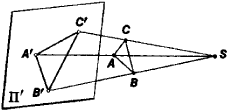
a term in geometry used to refer to the following operation. Suppose an arbitrary point S in space (see Figure 1) is selected as the center of projection and a plane Π′ not passing through S is selected as the plane of projection, or image plane. In order to project the point A, the so-called preimage, on Π′ through the center of projection S, the line SA is extended to its intersection with Π′ at the point A′. The image point A′ is called the projection of A. The projection of a figure F is the set of the projections of all the figure’s points. A line not passing through the center of projection is projected into a line.
In the described type of projection, which is called a central projection, an important role is played by the choice of the center of projection S. A number of difficulties arise when points of a given plane Π are projected on the plane Π′ as in Figure 2. Π contains points that have no image in Π′. Such is the case for the point B when the projection line SB is parallel to Π′. To eliminate this difficulty, which is due to the properties of Euclidean space, elements at infinity, also called ideal elements, are
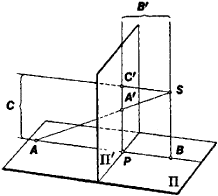
added to the space. In other words, the parallel lines BS and PA′ are assumed to intersect at a point at infinity B′. This point may then be considered as the image of the point B in Π′. Similarly, the point at infinity C is the preimage of the point C (see Figure 2). Thus, one-to-one correspondence defined by means of central projection can be established between the points of Π and the points of IT by introducing elements at infinity. Such a correspondence is called a perspective collineation.
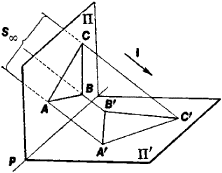
The type of projection in which the center of projection is the point at infinity S∞ (Figure 3) is of great practical importance. In this case, all the projection lines are parallel, and the projection is called a parallel projection. The one-to-one correspondence between the points of Π and the points of Π′ established by a parallel projection is called a perspective affinity.
The special type of parallel projection in which the plane Π is perpendicular to the direction of projection is widely used in drawing. Such a projection is called orthogonal.
Central and parallel—in particular, orthogonal—projections are widely used in descriptive geometry, and such different types of images as perspective images and axonometric images are obtained. Special types of projections on a plane, a sphere, or other surfaces are used in, for example, geography, astronomy, crystallography, and topography. Thus, cartographic projections include such types as gnomonic and stereographic projections.
Orthogonal projection of directed line segments is discussed in VECTOR CALCULUS.
N. F. CHETVERUKHIN
Projection
in psychology, the perception of one’s own mental processes as those of an external object, resulting from the unconscious transfer of internal impulses and feelings to that object. Projection plays an important role in the formation of the psyche in early childhood, when a child cannot clearly differentiate between himself and the external world. It is also the basis of archaic and anthropomorphic ideas about the world that characterize the early stages of development of human consciousness.
The onset of a number of mental diseases (paranoia, phobia, mania) is associated with pathological forms of projection. In these cases, perception of the external world is severely distorted, while the illusion of control over one’s own behavior is preserved. The mechanism of projection is used diagnostically in projective tests, such as the Rorschach test, to detect hidden motivations and stimuli.