Depression
Also found in: Dictionary, Thesaurus, Medical, Legal, Financial, Acronyms, Idioms, Wikipedia.
depression
Depression
depression
- (PSYCHOLOGY) a mood state characterized by despondency and pessimism, which may be short-lived but in its persistent forms may have its source in NEUROSIS or PSYCHOSIS. A further distinction is between reactive (to external stress) and endogenous forms.
- (ECONOMICS), see TRADE CYCLE.
Depression
Unrealistic Expectations
Our culture bombards us with the message that the Christmas season is the happiest time of year, a time for festive parties, loving family get-togethers, lavish gift giving, and constant good cheer. These high emotional, social, and material expectations set us up to be disappointed. Many people find it difficult to fulfill the cultural ideal of non-stop Christmas conviviality. This ideal may easily defeat people with difficult family situations, those who lost a loved one during a previous holiday season, the socially isolated, and those estranged or far away from their families. This failure to meet cultural expectations, along with the belief that "everyone else is having a good time," can result in depression.
High material expectations for the holiday may pose similar problems, especially for those on limited budgets (see also Commercialism). So great are the pressures to buy that some people bring financial hardship on themselves by spending more then they can really afford on holiday preparations and gifts. The resulting stress may open the door to depression.
Even those who can afford to participate fully in the gift giving, decorating, cooking, eating, drinking, and partygoing may sink into holiday season sadness, however. Stress and exhaustion brought on by an endless whirl of activities as well as overindulgence in food and drink also contribute to feelings of depression. Women may be particularly prone to this syndrome, as our culture assigns them the primary responsibility for shopping, cooking, decorating, and creating "special" family celebrations.
Advice
Therapists advise those with a tendency to suffer from this form of Christmas season sadness to discard their unrealistic expectations of the holidays. Often these spring from childhood nostalgia and romantic images promoted in the media rather than from a realistic assessment of one's own wishes, needs, limitations, and personal circumstances. In spite of our dreams of instant holiday happiness, these limitations and circumstances seldom vanish underneath the tinsel and colored lights of the Christmas season. Moreover, the stress of holiday preparations, travel, and family visits may aggravate whatever tensions exist in any of these areas. To avoid resentments bred by overwork, psychologists suggest that those saddled with organizing and hosting holiday celebrations delegate responsibilities to others.
Psychologists point out that family tensions that simmer below the surface during the rest of the year very often boil over when the family gathers together for the holidays. Although many people feel that family fights "ruin" holiday get-togethers, it may be more realistic to assume that if family members quarrel during the rest of the year, they will quarrel on Christmas.
Psychologists also recommend giving oneself, others, and the occasion permission to be less than perfect. They remind us that although the dynamic of family get-togethers often encourages everyone to assume old family roles, we may choose otherwise. Although we may make these choices for ourselves, psychologists counsel us to avoid using Christmas celebrations as a forum for changing family relationships. They point out, for example, that challenging Auntie May about her drinking is likely to lead to a confrontation, and that attempting to squeeze a year's worth of "quality time" with family members into a single holiday is doomed to failure.
Those who have experienced the loss of a loved one in the past year need to accept their current mental, emotional, and physical limits and openly acknowledge that this year's celebrations will be different. Counselors also recommend that those who grieve take time to evaluate which social obligations, family traditions, and religious observances will comfort and strengthen them, and which could overwhelm them. They also suggest that mourners seek the company of comforting people and make occasions to talk about their loved one. It may be best to plan provisionally and be prepared to alter arrangements as necessary to suit one's needs.
Christmas Suicides
It is widely believed that the rate of suicides increases during the holiday period. Although many Americans admit to feeling sad during the holiday season, studies reveal that the suicide rate does not increase around Christmas time.
Winter Weather
The winter weather itself plunges some people into depression. S.A.D., seasonal affective disorder, causes its sufferers to become depressed during the dark days of winter that coincide with the holiday season in the Northern Hemisphere. Christmas, New Year's Day, Hanukkah, Thanksgiving, and Kwanzaa all cluster around the time of the winter solstice. At this time of year, the days are short, the sunlight weak, the skies often overcast, and the nights long. People suffering from S.A.D. react strongly to the lack of light, falling into states of lethargy and depression that last for months. Other symptoms may include increased appetite, an excessive desire for sleep, irritability, anxiety, decreasing self-esteem, and difficulty concentrating.
Experts estimate that about six percent of all Americans exhibit symptoms of full-blown S.A.D. About fourteen percent suffer from a milder version of these symptoms known informally as the "winter blues." Some psychologists claim that among S.A.D. patients, women outnumber men by a four-to-one ratio. Others point out, however, that these figures may be somewhat skewed since men have more difficulty than do women in admitting to mood-related problems.
In the Northern Hemisphere the incidence of S.A.D. increases as one travels northward because the northern latitudes enjoy fewer winter daylight hours. Researchers have discovered that about 28 percent of the population of Fairbanks, Alaska, suffers to some degree from S.A.D. The city of Tromsø, Norway, lies 200 miles south of the Arctic Circle. There the sun sets in November and inhabitants endure midwinter darkness until day breaks again in late January. The people of Tromsø refer to this period as the mørketiden, or "murky time." Each year the mørketiden ushers in an increase in the incidence of physical and mental illness, domestic violence, alcoholism and other forms of drug abuse, arrests, suicides, and poor school performance. Like the inhabitants of many other towns in northern Norway, the people of Tromsø observe a joyous yearly festival, "Sun Day," on the day the sun returns.
If you suspect you may be suffering from S.A.D., seek professional diagnosis and treatment. Many people affected by S.A.D. have found relief in light therapy treatments, medication, changes in diet, or other lifestyle alterations.
Further Reading
Marano, Hara Estroff. "Surviving Holiday Hell." Psychology Today 31, 6 (November-December 1998): 32-36. Peters, Celeste A. Don't Be SAD. Calgary, Canada: Script Publishing, 1994. Robinson, Jo, and Jean Coppock Staeheli. Unplug the Christmas Machine. New York: William Morrow and Company, 1982. Rosenthal, Norman E. Winter Blues. New York: Guilford Press, 1993. Smith, Harold Ivan. A Decembered Grief: Living with Loss While Others AreCelebrating. Kansas City, Mo.: Beacon Hill Press of Kansas City, 1999. Whybrow, Peter, and Robert Bahr. The Hibernation Response. New York: Arbor House, William Morrow, 1988.
Depression
(religion, spiritualism, and occult)In traditional astrology, depression is an alternate term for fall.
depression
[di′presh·ən]depression
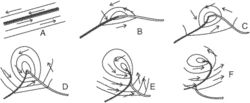

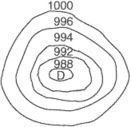
ii. A region of relatively low barometric pressure. The term depression is usually applied to a certain stage in the development of a tropical cyclone, but it also applies to migratory lows and troughs and to upper air lows and troughs that are only weakly developed.
iii. The amount the gun-sight datum is depressed to allow for the effects of gravity on a weapon during its travel to the target. It is expressed in degrees or milliradians.
iv. A negative altitude.
Depression
(of the snow line), the amount of lowering of the snow line during climatic cooling caused by a drop in summer or mean annual temperatures and by an increase in solid precipitation. During ice ages, depression was accompanied by an increase in glaciation of mountain areas and by continental glaciation. Maximum depression of the snow line in the high latitudes may reach the level of the world ocean. The depression of the snow line is determined primarily by the elevation of relict cirques situated lower than the present snow line.
Depression
(1) In geomorphology, any lowering of the earth’s surface; in the narrow sense it is a trough or basin lying below sea level. Depressions may be dry (for example, the Turfan depression) or filled with water (the Caspian Sea).
(2) Tectonic depression, an area of downwarping of the earth’s crust that is completely or partially filled with precipitation (for example, the Tadzhik depression in Middle Asia).
Depression
in medicine, a pathological state of melancholy, dejection, and inescapable despair, characteristic of a number of mental illnesses.
Depression often arises as a reaction to a difficult life situation, in many mental illnesses (manic-depressive psychosis, schizophrenia), in neuroses, with the prolonged use of certain medications (for example, chlorpromazine), and in physical illnesses. Depression must be distinguished from the natural (physiological) reaction of a person to unpleasant experiences, life failures, and psychic traumas. Depression is manifested by ideational, emotional, and motor inhibition (sometimes by inhibition of only one or two of the above areas of psychological activity). In serious cases it is manifested by delusions of persecution (the patient thinks he is being accused or blamed for poor work or unethical behavior) or by self-condemnation and self-deprecation (the patient accuses himself of dishonesty, poor work, and misdeameanors, regards himself as guilty for the destruction of his family, the collective, or the whole world) and by hypochondria (he feels that terrible changes have occurred in his internal organs, as a result of which he will forever ail and suffer). Treatment of patients with severe depression is conducted in psychiatric hospitals, since the patients are often persistently suicidal and self-destructive, and therefore require daily surveillance, which can be accomplished only in special medical institutions. Depression is treated with psychotropic (antidepressive) drugs, electroconvulsive therapy, and psychotherapy.
B. S. BAMDAS