The Volcanoes portal

A volcano is a vent or fissure in the crust of a planetary-mass object that allows hot lava, volcanic ash, and gases to escape from a magma chamber below the surface. On Earth, volcanoes are most often found where tectonic plates are diverging or converging, and because most of Earth's plate boundaries are underwater, most volcanoes are found underwater. For example, a mid-ocean ridge, such as the Mid-Atlantic Ridge, has volcanoes caused by divergent tectonic plates whereas the Pacific Ring of Fire has volcanoes caused by convergent tectonic plates. Volcanoes resulting from divergent tectonic activity are usually non-explosive whereas those resulting from convergent tectonic activity cause violent eruptions. Volcanoes can also form where there is stretching and thinning of the crust's plates, such as in the East African Rift, the Wells Gray-Clearwater volcanic field, and the Rio Grande rift in North America. Volcanism away from plate boundaries most likely arises from upwelling diapirs from the core–mantle boundary called mantle plumes, 3,000 kilometres (1,900 mi) deep within Earth. This results in hotspot volcanism or intraplate volcanism, in which the plume may cause thinning of the crust and result in a volcanic island chain due to the continuous movement of the tectonic plate, of which the Hawaiian hotspot is an example. Volcanoes are usually not created at transform tectonic boundaries where two tectonic plates slide past one another.
Volcanoes, based on their frequency of eruption or volcanism, are referred to as either active, dormant, or extinct. Active volcanoes have a history of volcanism and are likely to erupt again, while extinct ones are not capable of eruption at all as they have no magma source. "Dormant" volcanoes have not erupted in a long time – generally accepted as since the start of the Holocene, about 12,000 years ago – but may erupt again. However, dormant volcanoes are technically considered to be seismically "active". These categories are not entirely uniform; they may overlap for certain examples. Large eruptions can affect atmospheric temperature as ash and droplets of sulfuric acid obscure the Sun and cool Earth's troposphere. Historically, large volcanic eruptions have been followed by volcanic winters which have caused catastrophic famines.
Other planets besides Earth have volcanoes. For example, volcanoes are very numerous on Venus. Mars has significant volcanoes. In 2009, a paper was published suggesting a new definition for the word 'volcano' that includes processes such as cryovolcanism. It suggested that a volcano be defined as 'an opening on a planet or moon's surface from which magma, as defined for that body, and/or magmatic gas is erupted.' (Full article...)
Selected article -

Ubinas is an active stratovolcano in the Moquegua Region of southern Peru, approximately 60 kilometres (37 mi) east of the city of Arequipa. Part of the Central Volcanic Zone of the Andes, it rises 5,672 metres (18,609 ft) above sea level. The volcano's summit is cut by a 1.4-kilometre-wide (0.87 mi) and 150-metre-deep (490 ft) caldera, which itself contains a smaller crater. Below the summit, Ubinas has the shape of an upwards-steepening cone with a prominent notch on the southern side. The gently sloping lower part of the volcano is also known as Ubinas I and the steeper upper part as Ubinas II; they represent different stages in the volcano's geological history.
The most active volcano in Peru, Ubinas has a history of small to moderate explosive eruptions as well as a few larger eruptions, such as in 1667, along with persistent degassing and ash emissions. Activity at the volcano began in the Pleistocene epoch, and led to the growth of the current mountain in two phases. Among the recent eruptions was the 2006–2007 event, which produced eruption columns and led to ash fall in the region, resulting in health issues and evacuations. During the most recent activity, from 2013 to 2017, a lava flow formed inside the crater, and further ash falls led to renewed evacuations of surrounding towns. Ubinas is monitored by the Peruvian geological service INGEMMET, which has published a volcano hazard map for Ubinas and regular volcanic activity reports. (Full article...)
Did you know

- ... that the Galápagos hotspot (pictured), located in the east Pacific Ocean, is responsible for the creation of the Galápagos Islands?
- ... that although the summit of submarine volcano Lōʻihi is 969 metres (3,180 ft) below sea level, it is still twice as tall, measured from the base of its southern flank, as Mount St. Helens ever was?
- ... that a sub-marine eruption near the Hunga Tonga-Hunga Haʻapai volcano in Tonga began spewing steam, smoke, pumice, and ash thousands of feet into the sky on March 16, 2009?
- ... that Cross Seamount, a landform arising from the ocean floor southwest of Hawaii, is used by the NOAA to study tuna migratory patterns?
- ... that Detroit Seamount, a submarine volcano in the North Pacific, is as big as the island of Hawaii?
- ... that Koko Guyot, a submarine volcano in the Hawaiian volcanic chain, was named for the 58th emperor of Japan, Emperor Kōkō?
- ... that the discovery of a population of Aleutian cackling geese on Buldir Volcano in the Aleutian Islands prevented their extinction?
- ... that the 1929 eruption of the Gareloi Volcano created a fissure running down the mountain's southern summit?
General images

 Some features of volcanism found in Earth's crust (from Volcanism)
 Sarychev Peak: the sulphur dioxide cloud generated by the eruption on June 12, 2009 (in Dobson units). (from Timeline of volcanism on Earth)
 Diagrammatic representation of a plume on Enceladus (from Volcanism)
 VEI and ejecta volume correlation (from Timeline of volcanism on Earth)
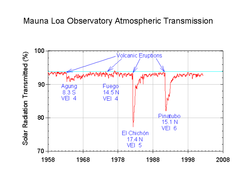 MLO transmission ratio - Solar radiation reduction due to volcanic eruptions (from Timeline of volcanism on Earth)
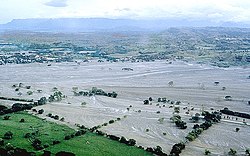 Lahar flows from the 1985 eruption of Nevado del Ruiz, which totally destroyed Armero in Colombia (from Volcanic eruption)
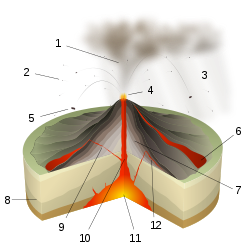 Diagram of a Strombolian eruption. (key: 1. Ash plume 2. Lapilli 3. Volcanic ash rain 4. Lava fountain 5. Volcanic bomb 6. Lava flow 7. Layers of lava and ash 8. Stratum 9. Dike 10. Magma conduit 11. Magma chamber 12. Sill) Click for larger version. (from Volcanic eruption)
 Cross section diagram of Earth showing some settings for volcanism on the planet (from Volcanism)
 Phreatic explosion captured at the Main Crater of Taal Volcano in January 2020, from an installed IP camera of the Philippine Institute of Volcanology and Seismology (PHIVOLCS) monitoring the volcano. (from Decade Volcanoes)
 Mount Lamington following the devastating 1951 eruption (from Volcanic eruption)

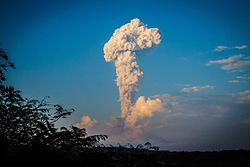 Colima Volcano eruption column, December 2016 (from Decade Volcanoes)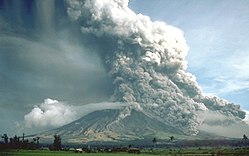
 Lava-flooded craters and large expanses of smooth volcanic plains on Mercury (from List of extraterrestrial volcanoes)
 An example of the lava arcs formed during Strombolian activity. This image is of Stromboli itself. (from Volcanic eruption)
 Diagram of a Hawaiian eruption. (key: 1. Ash plume 2. Lava fountain 3. Crater 4. Lava lake 5. Fumaroles 6. Lava flow 7. Layers of lava and ash 8. Stratum 9. Sill 10. Magma conduit 11. Magma chamber 12. Dike) Click for larger version. (from Volcanic eruption)
 Diagram of Peléan eruption. (key: 1. Ash plume 2. Volcanic ash rain 3. Lava dome 4. Volcanic bomb 5. Pyroclastic flow 6. Layers of lava and ash 7. Stratum 8. Magma conduit 9. Magma chamber 10. Dike) Click for larger version. (from Volcanic eruption)
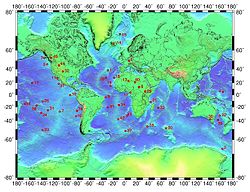 Distribution of selected hotspots. The numbers in the figure are related to the listed hotspots on Hotspot (geology). (from Timeline of volcanism on Earth)
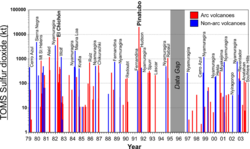 Sulfur dioxide emissions by volcanoes. Mount Pinatubo: 20 million tons of sulfur dioxide. (from Timeline of volcanism on Earth)
 Eruption of mud at Dashgil mud volcano in Gobustan, Azerbaijan (from Volcanism)
 The final eruptions in the creation of Banks Peninsula in New Zealand occurred about 9 million years ago. (from Timeline of volcanism on Earth)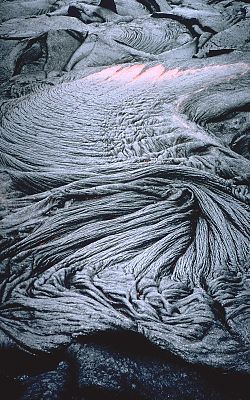
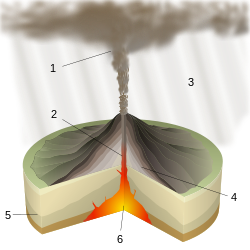 Diagram of a Plinian eruption. (key: 1. Ash plume 2. Magma conduit 3. Volcanic ash rain 4. Layers of lava and ash 5. Stratum 6. Magma chamber) Click for larger version. (from Volcanic eruption)
 21 April 1990 eruptive column from Redoubt Volcano, as viewed to the west from the Kenai Peninsula (from Volcanic eruption)
 Diagram of a Surtseyan eruption. (key: 1. Water vapor cloud 2. Compressed ash 3. Crater 4. Water 5. Layers of lava and ash 6. Stratum 7. Magma conduit 8. Magma chamber 9. Dike) Click for larger version. (from Volcanic eruption)
 Diagram of a Vulcanian eruption. (key: 1. Ash plume 2. Lapilli 3. Lava fountain 4. Volcanic ash rain 5. Volcanic bomb 6. Lava flow 7. Layers of lava and ash 8. Stratum 9. Sill 10. Magma conduit 11. Magma chamber 12. Dike) Click for larger version. (from Volcanic eruption)
 A major eruption of Gran Canaria took place around 14 million years ago. (from Timeline of volcanism on Earth)
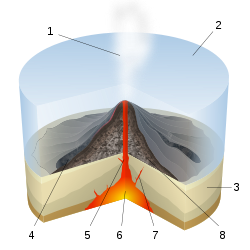 Diagram of a Submarine eruption. (key: 1. Water vapor cloud 2. Water 3. Stratum 4. Lava flow 5. Magma conduit 6. Magma chamber 7. Dike 8. Pillow lava) Click to enlarge. (from Volcanic eruption)
 The high initial temperatures of silicate lavas mean that they emit visible light before cooling. (from Volcanism)
 Some of the eruptive structures formed during volcanic activity (counterclockwise): a Plinian eruption column, Hawaiian pahoehoe flows, and a lava arc from a Strombolian eruption (from Volcanic eruption)
 Diagram of a phreatic eruption. (key: 1. Water vapor cloud 2. Magma conduit 3. Layers of lava and ash 4. Stratum 5. Water table 6. Explosion 7. Magma chamber) (from Volcanic eruption)
 TOMS sulfur dioxide from the June 15, 1991 eruption of Mount Pinatubo. (from Timeline of volcanism on Earth)
 Location of Mount Pinatubo, showing area over which ash from the 1991 eruption fell. (from Timeline of volcanism on Earth)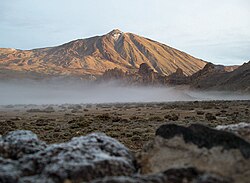
 2016 eruption of Mount Sinabung (from Volcanic eruption)
 Olympus Mons (Latin, "Mount Olympus"), located on the planet Mars, is the tallest known mountain in the Solar System. (from Volcanism)
 A diagram of a Subglacial eruption. (key: 1. Water vapor cloud 2. Crater lake 3. Ice 4. Layers of lava and ash 5. Stratum 6. Pillow lava 7. Magma conduit 8. Magma chamber 9. Dike) Click for larger version. (from Volcanic eruption)
 A gentle, or effusive, volcanic eruption, in which liquid material (lava) gently flows from a vent, in this case in south-eastern Hawai’i island (from Volcanism)
 Satellite measurements of ash and aerosol emissions from Mount Pinatubo. (from Timeline of volcanism on Earth)
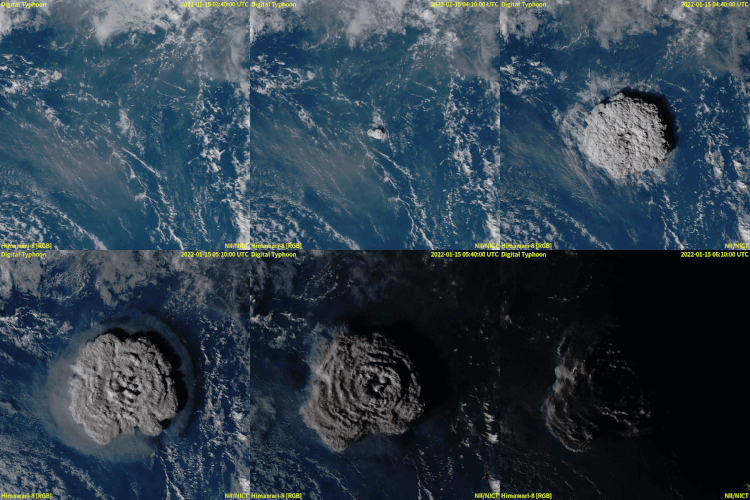 Satellite animation of the initial ash plume and shockwave of the 2022 Hunga Tonga–Hunga Ha’apai eruption and tsunami. The massive explosive eruption was hundreds of times more powerful than the atomic bomb dropped on Hiroshima. (from Volcanism)


.JPG)


.jpg)


.jpg)


Selected biography -
.jpg)
David Alexander Johnston (December 18, 1949 – May 18, 1980) was an American United States Geological Survey (USGS) volcanologist who was killed by the 1980 eruption of Mount St. Helens in the U.S. state of Washington. A principal scientist on the USGS monitoring team, Johnston was killed in the eruption while manning an observation post six miles (10 km) away on the morning of May 18, 1980. He was the first to report the eruption, transmitting "Vancouver! Vancouver! This is it!" before he was swept away by a lateral blast; despite a thorough search, Johnston's body was never found, but state highway workers discovered remnants of his USGS trailer in 1993.
Johnston's career took him across the United States, where he studied the Augustine Volcano in Alaska, the San Juan volcanic field in Colorado, and long-extinct volcanoes in Michigan. Johnston was a meticulous and talented scientist, known for his analyses of volcanic gases and their relationship to eruptions. This, along with his enthusiasm and positive attitude, made him liked and respected by many co-workers. After his death, other scientists lauded his character, both verbally and in dedications and letters. Johnston felt scientists must do what is necessary, including taking risks, to help protect the public from natural disasters. His work, and that of fellow USGS scientists, convinced authorities to close Mount St. Helens to the public before the 1980 eruption. They maintained the closure despite heavy pressure to re-open the area. His story became intertwined with the popular image of volcanic eruptions and their threat to society, and a part of volcanology's history. To date, Johnston is one of two American volcanologists known to have died in a volcanic eruption; the other is his student Harry Glicken.
Following his death, Johnston was commemorated in several ways, including a memorial fund established in his name at the University of Washington to fund graduate-level research. Two volcano observatories were established and named after him: one in Vancouver, Washington, and another on the ridge where he died. Johnston's life and death are featured in several documentaries, films, docudramas and books. A biography of his life, A Hero on Mount St. Helens: The Life and Legacy of David A. Johnston, was published in 2019. (Full article...)
Selected picture
 |
Puʻu ʻŌʻō is a cinder/spatter cone in the eastern rift zone of the Kīlauea volcano of the Hawaiian Islands. Puʻu ʻŌʻō has been erupting continuously since January 3, 1983, making it the longest-lived rift-zone eruption of the last two centuries. From 1983 through 1998, lava from Puʻu ʻŌʻō covered more than 97 km² (37 square miles).
Selected quote
"Is this volcano active?"
— Tourist on Mount Etna, after being reprimanded for camping out at the base of a dangerous volcanic vent, 2000.
Related portals


WikiProjects

Volcanoes topics


Subcategories

Featured work and other approved content

Featured articles: 1980 eruption of Mount St. Helens • 2007–2008 Nazko earthquakes • Amchitka • Armero tragedy • Craters of the Moon National Monument and Preserve • Cerro Azul (Chile volcano) • David A. Johnston • Enceladus (moon) • Geology of the Lassen volcanic area • Io (moon) • Kamaʻehuakanaloa Seamount • Mauna Kea • Mauna Loa • Metacomet Ridge • Mono-Inyo Craters • Mount Cayley volcanic field • Mount St. Helens • Mount Tambora • Nevado del Ruiz • Surtsey • The Volcano (British Columbia) • Triton (moon) • Upper and Lower Table Rock • Volcanism on Io • Volcano (South Park) • Yellowstone National Park
Featured lists: List of volcanoes in Indonesia • List of volcanoes in the Hawaiian – Emperor seamount chain • List of largest volcanic eruptions
Featured pictures: There are currently 43 volcano-related Featured pictures. A full gallery can be seen here.

Good articles: Abyssal plain • Amak Volcano • Anahim hotspot • Axial Seamount • Ben Nevis • Bowie Seamount • Crater Lake • Davidson Seamount • Ferdinandea • Gareloi Volcano • Geyser • Glacier Peak • Hawaii hotspot • Hualālai • Kohala (mountain) • Lake Toba • Minoan eruption • Mount Adams (Washington) • Mount Bailey • Mount Baker • Mount Cleveland (Alaska) • Mount Edziza volcanic complex • Mount Garibaldi • Mount Hood • Mount Kenya • Mount Rainier • Mount Redoubt • Mount Tehama • Mount Thielsen • Mount Vesuvius • Peter I Island • Roxy Ann Peak • Rùm • Sakurajima • Sangay • Silverthrone Caldera • Staffa • Types of volcanic eruptions • Volcanic ash • Weh Island • Wells Gray-Clearwater volcanic field • Yamsay Mountain
Valued pictures: A gallery of volcano-related valued pictures can be seen here.
What you can do

- Add the {{WikiProject Volcanoes}} message box to talk pages of articles within the scope of this project, including appropriate assessments, if needed.
- Add appropriate volcano type categories to articles, and verify the accuracy of any existing categories. See the section "Categorization" below.
- Add {{infobox mountain}} to articles if needed and missing, and add volcano-related fields to existing infoboxes if these are missing.
- Expand volcano articles which are stubs, especially by adding photos and (most importantly) proper references.
- Help improve articles related to Hawaiian and Canadian volcanism by joining the Hawaiian and Canadian workgroups.
- Improve some of the project's most visible articles.
Associated Wikimedia
The following Wikimedia Foundation sister projects provide more on this subject:
-
 Commons
Free media repository -
 Wikidata
Free knowledge base -
 Wikiquote
Collection of quotations -
 Wikisource
Free-content library -
 Wikiversity
Free learning tools -
 Wiktionary
Dictionary and thesaurus