The Nuclear Technology Portal
Introduction

- Nuclear technology is technology that involves the nuclear reactions of atomic nuclei. Among the notable nuclear technologies are nuclear reactors, nuclear medicine and nuclear weapons. It is also used, among other things, in smoke detectors and gun sights. (Full article...)
- Nuclear power is the use of nuclear reactions to produce electricity. Nuclear power can be obtained from nuclear fission, nuclear decay and nuclear fusion reactions. Presently, the vast majority of electricity from nuclear power is produced by nuclear fission of uranium and plutonium in nuclear power plants. Nuclear decay processes are used in niche applications such as radioisotope thermoelectric generators in some space probes such as Voyager 2. Reactors producing controlled fusion power have been operated since 1958 but have yet to generate net power and are not expected to be commercially available in the near future. (Full article...)
- A nuclear weapon is an explosive device that derives its destructive force from nuclear reactions, either nuclear fission (fission or atomic bomb) or a combination of fission and nuclear fusion reactions (thermonuclear weapon), producing a nuclear explosion. Both bomb types release large quantities of energy from relatively small amounts of matter. Nuclear warfare is widely considered a global catastrophic risk. Nine sovereign states are believed to possess nuclear weapons as of 2026[update]: the United States, Russia, the United Kingdom, France, China, India, Pakistan, North Korea and Israel. (Full article...)
General images -
 A schematic nuclear fission chain reaction. 1. A uranium-235 atom absorbs a neutron and fissions into two new atoms (fission fragments), releasing three new neutrons and some binding energy. 2. One of those neutrons is absorbed by an atom of uranium-238 and does not continue the reaction. Another neutron is simply lost and does not collide with anything, also not continuing the reaction. However, the one neutron does collide with an atom of uranium-235, which then fissions and releases two neutrons and some binding energy. 3. Both of those neutrons collide with uranium-235 atoms, each of which fissions and releases between one and three neutrons, which can then continue the reaction. (from Nuclear fission)
 Survey respondents in the European Union and US considered investment in nuclear energy to be a higher priority than those in China, though all three favored renewable energy much more strongly than nuclear overall. (from Nuclear power)
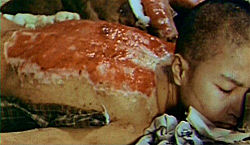 A photograph of Sumiteru Taniguchi's back injuries taken in January 1946 by a US Marine photographer (from Nuclear weapon)
 The "curve of binding energy": A graph of binding energy per nucleon of common isotopes. (from Nuclear fission)
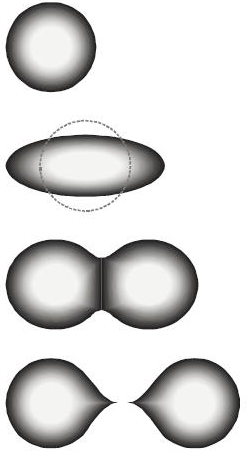 The stages of binary fission in a liquid drop model. Energy input deforms the nucleus into a fat "cigar" shape, then a "peanut" shape, followed by binary fission as the two lobes exceed the short-range nuclear force attraction distance, and are then pushed apart and away by their electrical charge. In the liquid drop model, the two fission fragments are predicted to be the same size. The nuclear shell model allows for them to differ in size, as usually experimentally observed. (from Nuclear fission)
 The Calder Hall nuclear power station in the United Kingdom, the world's first commercial nuclear power station (from Nuclear power)
 More than 2,000 nuclear explosions have been conducted in more than a dozen different sites around the world. Red Russia/Soviet Union, blue France, light blue United States, violet Britain, yellow China, orange India, brown Pakistan, green North Korea and light green (territories exposed to nuclear bombs). The black dot indicates the location of the Vela incident. (from Nuclear weapon)
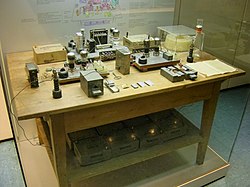 The nuclear fission display at the Deutsches Museum in Munich. The table and instruments are originals, but would not have been together in the same room. (from Nuclear fission)
 The launching ceremony of USS Nautilus January 1954. In 1958 it would become the first vessel to reach the North Pole. (from Nuclear power)
 Death rates per unit of electricity production for different energy sources (from Nuclear power)
 Mushroom cloud from the explosion of Castle Bravo, the largest nuclear weapon detonated by the US, in 1954 (from Nuclear weapon)
 The mushroom cloud of the atomic bomb dropped on Nagasaki, Japan, on 9 August 1945 rose over 12 kilometres (7.5 mi) above the bomb's hypocenter, which killed an estimated 39,000 people. (from Nuclear fission)
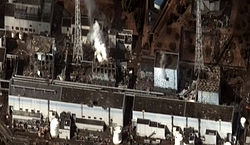 Three of the reactors at Fukushima I overheated, causing the coolant water to dissociate and led to the hydrogen explosions. This along with fuel meltdowns released large amounts of radioactive material into the air. (from Nuclear reactor)
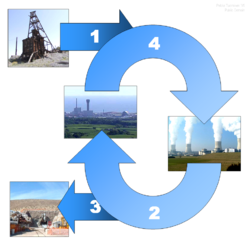 The nuclear fuel cycle begins when uranium is mined, enriched, and manufactured into nuclear fuel (1), which is delivered to a nuclear power plant. After use, the spent fuel is delivered to a reprocessing plant (2) or to a final repository (3). In nuclear reprocessing, 95% of spent fuel can potentially be recycled to be returned to use in a power plant (4). (from Nuclear power)
 In thermal nuclear reactors (LWRs in specific), the coolant acts as a moderator that must slow the neutrons before they can be efficiently absorbed by the fuel. (from Nuclear reactor)
 Scaled-down model of TOPAZ nuclear reactor (from Nuclear reactor)
 Anti-nuclear protest near nuclear waste disposal centre at Gorleben in northern Germany (from Nuclear power)
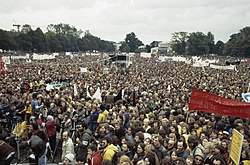 Protest in Bonn against the nuclear arms race between the US/NATO and the Warsaw Pact, 1981 (from Nuclear weapon)
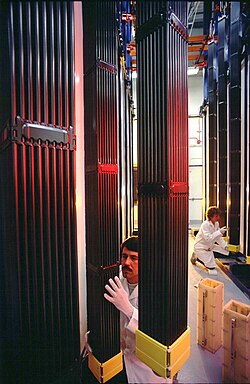 Nuclear fuel assemblies being inspected before entering a pressurized water reactor in the United States (from Nuclear power)
 Following the 2011 Fukushima Daiichi nuclear disaster, the world's worst nuclear accident since 1986, 50,000 households were displaced after radiation leaked into the air, soil and sea. Radiation checks led to bans of some shipments of vegetables and fish. (from Nuclear power)
 The multi-mission radioisotope thermoelectric generator (MMRTG), used in several space missions such as the Curiosity Mars rover (from Nuclear power)
 Soviet OTR-21 Tochka missile. Capable of firing a 100-kiloton nuclear warhead a distance of 185 km (from Nuclear weapon)
 This view of downtown Las Vegas shows a mushroom cloud in the background. Scenes such as this were typical during the 1950s. From 1951 to 1962 the government conducted 100 atmospheric tests at the nearby Nevada Test Site. (from Nuclear weapon)
 The first nuclear weapons were gravity bombs, such as the "Fat Man" weapon dropped on Nagasaki, Japan. They were large and could only be delivered by heavy bomber aircraft (from Nuclear weapon)
 NC State's PULSTAR Reactor is a 1 MW pool-type research reactor with 4% enriched, pin-type fuel consisting of UO2 pellets in zircaloy cladding (from Nuclear reactor)
 A Minuteman III ICBM test launch from Vandenberg Space Force Base, United States. MIRVed land-based ICBMs are considered destabilizing because they tend to put a premium on striking first. (from Nuclear weapon)
 Anti-nuclear weapons protest march in Oxford, 1980 (from Nuclear weapon)
 Ballistic missile submarines have been of great strategic importance for the United States, Russia, and other nuclear powers since they entered service in the Cold War, as they can hide from reconnaissance satellites and fire their nuclear weapons with virtual impunity. (from Nuclear weapon)
 UN vote on adoption of the Treaty on the Prohibition of Nuclear Weapons on July 7, 2017YesNoDid not vote(from Nuclear weapon)
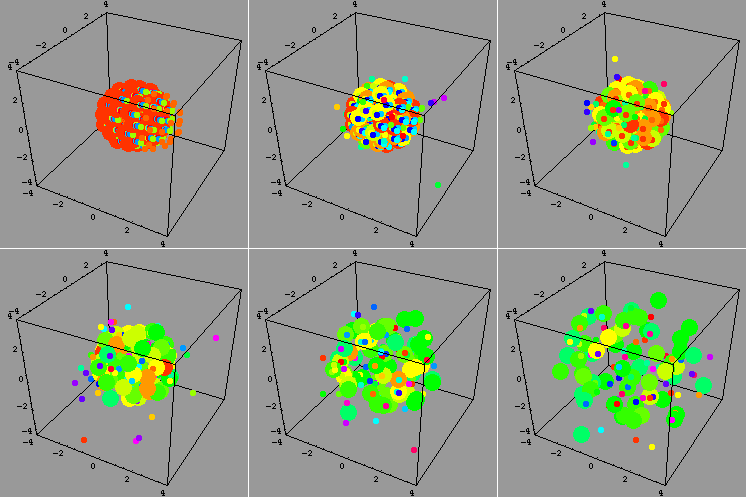 Animation of a Coulomb explosion in the case of a cluster of positively charged nuclei, akin to a cluster of fission fragments. Hue level of color is proportional to (larger) nuclei charge. Electrons (smaller) on this time-scale are seen only stroboscopically and the hue level is their kinetic energy. (from Nuclear fission)
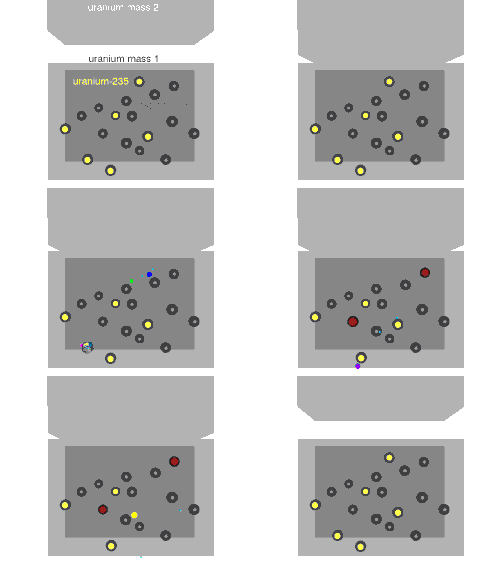 A visual representation of an induced nuclear fission event where a slow-moving neutron is absorbed by the nucleus of a uranium-235 atom, which fissions into two fast-moving lighter elements (fission products) and additional neutrons. Most of the energy released is in the form of the kinetic velocities of the fission products and the neutrons. (from Nuclear fission)
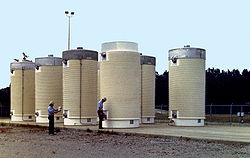 Dry cask storage vessels storing spent nuclear fuel assemblies (from Nuclear power)
 The number of nuclear warheads by country in 2024, based on an estimation by the Federation of American Scientists (from Nuclear weapon)
 Olkiluoto 3 under construction in 2009. It was the first EPR, a modernized PWR design, to start construction. (from Nuclear power)
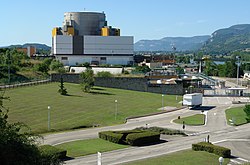 The Superphénix, closed in 1998, was one of the few FBRs (from Nuclear reactor)
 Activity of spent UOx fuel in comparison to the activity of natural uranium ore over time (from Nuclear power)
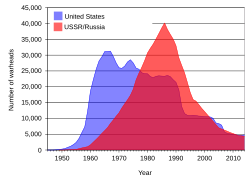 The USSR and United States nuclear weapon stockpiles throughout the Cold War until 2015, with a precipitous drop in total numbers following the end of the Cold War in 1991. (from Nuclear weapon)
 Overhead view of the core of the RA-3 Research and Production Reactor (CNEA, Argentina) (from Nuclear reactor)
 A comparison of levelized cost of energy (LCOE) over time for nuclear power and other sources. While wind turbines and solar panels can be mass-produced and thus enjoy learning curve effects, nuclear are almost always one-of-a-kind projects due to the limited number of reactors being built. The source of this chart, Our World in Data notes that the costs presented here is the global average, and these costs were driven up by 2 projects in the United States. The organization recognises that the median cost of the most exported and produced nuclear energy facility in the 2010s the South Korean APR1400, remained "constant", including in export. (from Nuclear power)
 The first light bulbs ever lit by electricity generated by nuclear power at EBR-1 at Argonne National Laboratory-West (now the Idaho National Laboratory), December 20, 1951. (from Nuclear power)
 Edward Teller, often referred to as the "father of the hydrogen bomb" (from Nuclear weapon)
 The basics of the Teller–Ulam design for a hydrogen bomb: a fission bomb uses radiation to compress and heat a separate section of fusion fuel. (from Nuclear weapon)
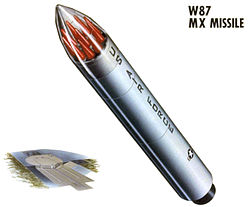 The now decommissioned United States' Peacekeeper missile was an ICBM developed to replace the Minuteman missile in the late 1980s. Each missile, like the heavier lift Russian SS-18 Satan, could contain up to ten nuclear warheads (shown in red), each of which could be aimed at a different target. A factor in the development of MIRVs was to make complete missile defense difficult for an enemy country. (from Nuclear weapon)
 An example of an induced nuclear fission event. A neutron is absorbed by the nucleus of a uranium-235 atom, which in turn splits into fast-moving lighter elements (fission products) and free neutrons. Though both reactors and nuclear weapons rely on nuclear chain reactions, the rate of reactions in a reactor is much slower than in a bomb. (from Nuclear reactor)
- Induced fission reaction. A neutron is absorbed by a uranium-235 nucleus, turning it briefly into an excited uranium-236 nucleus, with the excitation energy provided by the kinetic energy of the neutron plus the forces that bind the neutron. The uranium-236, in turn, splits into fast-moving lighter elements (fission products) and releases several free neutrons, one or more "prompt gamma rays" (not shown) and a (proportionally) large amount of kinetic energy. (from Nuclear fission)


.jpg)


.jpg)


.jpg)

.jpg)


-LLNL.jpg)


.jpg)
Selected article -
The United Kingdom became the third country (after the United States and the Soviet Union) to develop and, in 1952, test nuclear weapons. The UK is one of nine nuclear-armed states, and one of five recognized by the Treaty on the Non-Proliferation of Nuclear Weapons. As of 2025[update], the UK possesses a stockpile of approximately 225 warheads, with 120 deployed on its only delivery system, the Trident programme's submarine-launched ballistic missiles. Additionally, United States B61 nuclear bombs have potentially been stored at RAF Lakenheath since 2025. In 2025, the UK announced plans to procure 12 F-35A aircraft capable of delivering B61s.
Trident consists of four Vanguard-class submarines, based at HMNB Clyde in Scotland. Each is armed with up to sixteen Trident II missiles, each carrying warheads in up to eight multiple independently targetable re-entry vehicles. Since 1969, the Royal Navy has operated the continuous at-sea deterrent: at least one nuclear-armed ballistic missile submarine always on patrol. Under the Polaris Sales Agreement, the US supplied the UK with Polaris missiles and nuclear submarine technology, in exchange for the general commitment of these missiles to NATO. In 1982, an amendment allowed the purchase of Trident II missiles, and since 1998, Trident has been the only British nuclear weapons system. The UK is the only nuclear-armed country to use exclusively sea-launched nuclear weapons.
UK nuclear command and control launch authority rests with the Prime Minister, or if unreachable a designated deputy, while it is possible the Chief of the Defence Staff holds a veto. In the event of a decapitation strike, handwritten letters of last resort from the Prime Minister are used to instruct submarine crews. UK nuclear weapons have no permissive action links or corresponding launch codes, thus submarine crews may independently launch a nuclear attack.
The UK initiated the world's first nuclear weapons programme, Tube Alloys, in 1941 during the Second World War. At the 1943 Quebec Conference, it was merged with the American Manhattan Project, but collaboration ended in 1946. The UK began an independent programme, High Explosive Research, testing its first nuclear weapon in 1952. In total the UK conducted 45 nuclear tests, 12 in Australia, 9 in the Pacific, and 24 at the Nevada Test Site, with its last in 1991. The UK and France are the only two nuclear-armed countries that have ratified the Comprehensive Nuclear-Test-Ban Treaty.
The British hydrogen bomb programme's success with its Operation Grapple Pacific nuclear testing led to the 1958 US–UK Mutual Defence Agreement. This nuclear Special Relationship has involved the exchange of classified scientific data, warhead designs, and fissile materials. UK warheads are designed and manufactured by the Atomic Weapons Establishment. During the Cold War, the Royal Air Force operated the V bomber fleet for strategic weapons, followed by aircraft in tactical nuclear roles using WE.177 bombs. The RAF also planned to operate the cancelled Blue Streak intermediate-range ballistic missile (IRBM). The RAF also briefly operated Thor IRBMs under US custody, while both the RAF and the British Army of the Rhine operated US-custody tactical bombs, missiles, depth charges and artillery. US Air Force nuclear weapons were stationed in the UK between 1954 and 2008, and from 2025. (Full article...)
Selected picture -

The black plaque on top reads:
Trinity Site
Where The World's First Nuclear Device Was Exploded On July 16, 1945
Erected 1965 White Sands Missile Range J. Frederick Thorlin Major General U.S. Army Commanding
The gold plaque below it declares the site a National Historic Landmark, and reads:
Trinity Site has been designated a National Historical Landmark
This Site Possesses National Significance In Commemorating The History of the United States of America
1975 National Park Service United States Department of the Interior
Did you know?
- ... that Jeya Wilson invited New Zealand prime minister David Lange to debate the moral indefensibility of nuclear weapons at the Oxford Union?
- ... that nucleariid amoebae are among the closest relatives of fungi?
- ... that the 1991 Andover tornado narrowly avoided hitting two warplanes equipped with nuclear warheads?
- ... that the Manhattan Project feed materials program used uranium ore from a mine in Canada near the Arctic Circle?
- ... that sabotage in World War II involved delaying the Nazi nuclear program, derailing trains, freeing Jews, and ... explosive rats?
- ... that scientists at the University of Chicago achieved a self-sustaining nuclear chain reaction under the stands of a football stadium?
Related WikiProjects

Things you can do
 | Parts of this portal (those related to section) need to be updated. Please help update this portal to reflect recent events or newly available information. Relevant discussion may be found on the talk page. (September 2021) |
|
|
Here are some Open Tasks :
|

Selected biography -

Fermi's first major contribution involved the field of statistical mechanics. After Wolfgang Pauli formulated his exclusion principle in 1925, Fermi followed with a paper in which he applied the principle to an ideal gas, employing a statistical formulation now known as Fermi–Dirac statistics. Today, particles that obey the exclusion principle are called "fermions". Pauli later postulated the existence of an uncharged invisible particle emitted along with an electron during beta decay, to satisfy the law of conservation of energy. Fermi took up this idea, developing a model that incorporated the postulated particle, which he named the "neutrino". His theory, later referred to as Fermi's interaction and now called weak interaction, described one of the four fundamental interactions in nature. Through experiments inducing radioactivity with the recently discovered neutron, Fermi discovered that slow neutrons were more easily captured by atomic nuclei than fast ones, and he developed the Fermi age equation to describe this. After bombarding thorium and uranium with slow neutrons, he concluded that he had created new elements. Although he was awarded the Nobel Prize for this discovery, the new elements were later revealed to be nuclear fission products.
Fermi left Italy in 1938 to escape new Italian racial laws that affected his Jewish wife, Laura Capon. He immigrated to the United States, where he worked on the Manhattan Project during World War II. Fermi led the team at the University of Chicago that designed and built Chicago Pile-1, which went critical on 2 December 1942, demonstrating the first human-created, self-sustaining nuclear chain reaction. He was on hand when the X-10 Graphite Reactor at Oak Ridge, Tennessee, went critical in 1943, and when the B Reactor at the Hanford Site did so the next year. At Los Alamos, he headed F Division, part of which worked on Edward Teller's thermonuclear "Super" bomb. He was present at the Trinity test on 16 July 1945, the first test of a full nuclear bomb explosion, where he used his Fermi method to estimate the bomb's yield.
After the war, he helped establish the Institute for Nuclear Studies in Chicago, and served on the General Advisory Committee, chaired by J. Robert Oppenheimer, which advised the Atomic Energy Commission on nuclear matters. After the detonation of the first Soviet fission bomb in August 1949, he strongly opposed the development of a hydrogen bomb on both moral and technical grounds. He was among the scientists who testified on Oppenheimer's behalf at the 1954 hearing that resulted in the denial of Oppenheimer's security clearance.
Fermi did important work in particle physics, especially related to pions and muons, and he speculated that cosmic rays arose when the material was accelerated by magnetic fields in interstellar space. Many awards, concepts, and institutions are named after Fermi, including the Fermi 1 (breeder reactor), the Enrico Fermi Nuclear Generating Station, the Enrico Fermi Award, the Enrico Fermi Institute, the Fermi National Accelerator Laboratory (Fermilab), the Fermi Gamma-ray Space Telescope, the Fermi paradox, and the synthetic element fermium, making him one of 16 scientists who have elements named after them. (Full article...)
Nuclear technology news
- 12 July 2026 – Russo-Ukrainian war
- Rosatom head Alexey Likhachev says a Ukrainian drone attack on Enerhodar, the Russian-controlled town hosting the Zaporizhzhia Nuclear Power Plant, has killed four people and injures four others. (Reuters)
- 26 June 2026 – Middle Eastern crisis
- International Atomic Energy Agency (IAEA) secretary-general Rafael Grossi says that the interim ceasefire peace deal between Iran and the United States would allow the IAEA access to Iran's nuclear inspectors. (Reuters)
- 26 June 2026 – 2026 European heatwaves
- Swiss energy utility Axpo suspends operations at the Beznau Nuclear Power Plant in Döttingen, Aargau, Switzerland, after the temperature of the Aare river, which the plant uses for cooling, reached 25 °C (77 °F). (AFP via The Straits Times)
Related portals


Related topics
| |||||||||||||||||||||||||||||||||||||||||||||||||||||||
| |||||||||||||||||||||||||||||||||||||||||||||||||||||||


Fusion power, processes and devices | |||||||||||||||||||||||||||||||||||||||||||||||||||||
|---|---|---|---|---|---|---|---|---|---|---|---|---|---|---|---|---|---|---|---|---|---|---|---|---|---|---|---|---|---|---|---|---|---|---|---|---|---|---|---|---|---|---|---|---|---|---|---|---|---|---|---|---|---|
| Core topics |
| ||||||||||||||||||||||||||||||||||||||||||||||||||||
| Processes, methods |
| ||||||||||||||||||||||||||||||||||||||||||||||||||||
| Devices, experiments |
| ||||||||||||||||||||||||||||||||||||||||||||||||||||


Types of nuclear fusion reactor | |
|---|---|
by confinement | |
| Magnetic | |
| Inertial | |
| Other | |


Types of nuclear fission reactor | |||||||||||||||
|---|---|---|---|---|---|---|---|---|---|---|---|---|---|---|---|
| Light water | |||||||||||||||
| Heavy water by coolant |
| ||||||||||||||
| |||||||||||||||
None (fast-neutron) |
| ||||||||||||||
| Others | |||||||||||||||

Subcategories

Associated Wikimedia
The following Wikimedia Foundation sister projects provide more on this subject:
-
 Commons
Free media repository -
 Wikidata
Free knowledge base -
 Wikiquote
Collection of quotations -
 Wikisource
Free-content library -
 Wikiversity
Free learning tools -
 Wiktionary
Dictionary and thesaurus