The Drink Portal
A portal dedicated to all beverages
Introduction

A drink or beverage is a liquid intended for human consumption. In addition to their basic function of satisfying thirst, drinks play important roles in human culture. Common types of drinks include plain drinking water, milk, juice, smoothies and soft drinks. Traditionally warm beverages encompass coffee, tea, and hot chocolate. Caffeinated drinks that contain the stimulant caffeine, have been consumed for centuries.
In addition, alcoholic drinks such as wine, beer, and liquor, which contain the psychoactive substance ethanol, have been part of human culture for more than 8,000 years. Non-alcoholic drinks typically refer to beverages that are traditionally alcoholic—such as beer, wine, or cocktails—but are produced with a very low alcohol by volume content. This category includes beverages that have undergone processes to remove or significantly reduce alcohol, such as non-alcoholic beers and de-alcoholized wines. (Full article...)
Selected article -

In cooler regions, such as the Mosel in Germany, Riesling wines often display apple and tree fruit notes with pronounced acidity that is sometimes balanced by residual sugar. As a late-ripening variety, Riesling can develop citrus and peach notes in warmer areas such as the Palatinate, Alsace, and parts of[which?] Austria. In Australia, Riesling is often noted for a characteristic lime note that tends to emerge in examples from the Clare Valley and Eden Valley in South Australia.
Riesling's naturally high acidity and pronounced fruit flavors give wines made from the grape exceptional aging potential, with well-made examples from favorable vintages often developing smokey, honey notes, and aged German Rieslings, in particular, taking on a "petrol" character, as a result of the development of the compound TDN.
In 2015, Riesling was the most grown variety in Germany with 23.0% and 23,596 hectares (58,310 acres), and in the French region of Alsace with 21.9% and 3,350 hectares (8,300 acres). In Germany, the variety is particularly widely planted in the Palatinate, Rheinhessen, Mosel, Rheingau, Nahe, and Baden.
There are also significant plantings of Riesling in Austria, Slovenia, Serbia, Czech Republic, Slovakia, Luxembourg, northern Italy, Australia, New Zealand, Canada, South Africa, China, Crimea, and the United States (Washington, California, Michigan, and New York). (Full article...)
Did you know? -
- ... that the chairman of the board of a Texas TV station was found to have died from drinking cyanide-laced cola?
- ... that some insects drink the tears of their predators?
- ... that The Drunkard's Progress suggests that a single social drink leads to poverty, crime, and suicide?
- ... that trembleuse cups and saucers enabled people with unsteady hands to drink hot beverages?
- ... that instead of drinking liquor with prospective clients, Arthur Harrison Motley sent them notes written in red pencil crayon, 10,000 times a year?
- ... that a Thompson Seattle rooftop bar distributes drinks from copper containers shaped like flamingos?
General images -


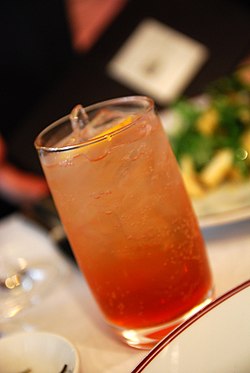 Lemon, lime and bitters is commonly consumed in Australia and New Zealand. (from List of national drinks)
 Ice milk and lemon tea (from List of drinks)
 Per capita, people in Turkey drink more tea than in any other nation. (from List of national drinks)
 Caipirinha is the national drink of Brazil and is made from cachaça, lime, and sugar. (from List of national drinks)
 A reservoir glass filled with a naturally colored verte absinthe, next to an absinthe spoon (from List of alcoholic drinks)
 Palm wine is collected, fermented and stored in calabashes in Bandundu Province, Democratic Republic of the Congo. (from List of alcoholic drinks)
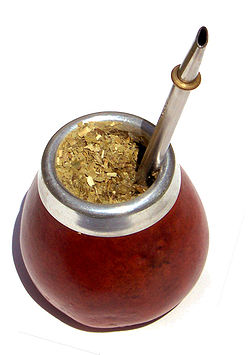 Mate, a traditional beverage in southern South America, especially in Argentina, Paraguay, Uruguay, and the south of Brazil. (from List of national drinks)
 Bottles of Zhuyeqing (Chu Yeh Ching) baijiu produced in Shanxi, China. (from List of national drinks)
 Mai Tai is a cocktail made of rum, Curaçao liqueur, orgeat syrup, and lime juice. It is one of the characteristic cocktails in Tiki culture. (from List of national drinks)
 Various distilled drinks (from List of drinks)
 A glass of grappa, a grape-based pomace brandy of Italian origin. Grappa is a protected name in the European Union. (from List of national drinks)
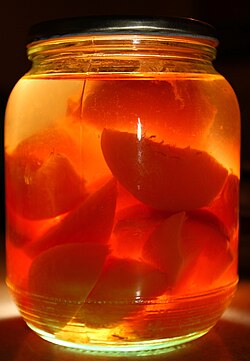 Peach kompot, traditional to several countries in Eastern and Southeastern Europe. (from List of national drinks)
 A classical Chinese tea set and three gaiwan. (from List of national drinks)
 Cider (from List of drinks)
 Founders Old Curmudgeon old ale (from List of alcoholic drinks)
 Palm wine is an alcoholic beverage created from the sap of various species of palm trees such as the palmyra, date palms, and coconut palms. It is known by various names in different regions and is common in various parts of Africa, the Caribbean, South America, South Asia, Southeast Asia, and Micronesia. (from List of national drinks)
 Akpeteshie is a liquor produced by distilling palm wine or sugar cane, primarily in the region of Western Africa. (from List of national drinks)
 Clear vodka served with pickled cucumber – the usual way of consuming vodka in Slavic countries of the so-called "vodka belt". (from List of national drinks)
 Red wine is popular in many European countries, notably France and Italy. (from List of national drinks)
 Mixed drinks: a non-alcoholic Shirley Temple (left) and alcoholic Cosmopolitan (right) (from List of drinks)
 Bottled beer (from List of drinks)
 Many in both Peru and Chile consider pisco sour their national drink. (from List of national drinks)
 2004 data of alcohol consumption per capita (age 15 or older), per year, by country, in liters of pure alcohol (from List of drinks)
 A hard cider produced in Michigan, U.S. (from List of alcoholic drinks)
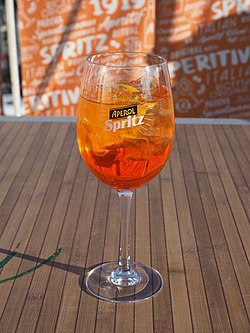 The spritz is an Italian wine-based cocktail, commonly served as an apéritif across Italy. It consists of Prosecco, digestive bitters, and soda water. The original spritz veneziano uses Select as bitters and was created in Venice in 1920. (from List of national drinks)
 A glass mug of mugicha, a type of roasted barley tea (from List of drinks)
 Coffee accessories in small shops in Baščaršija, Bosnia and Herzegovina. (from List of national drinks)
 The espresso comes from the Italian esprimere, which means "to express," and refers to the process by which hot water is forced under pressure through ground coffee. (from List of national drinks)
 Libyan tea with peanuts (from List of national drinks)
 A typical informal faikava in Tonga with the touʻa serving the men. (from List of national drinks)
 Australian iced coffee served with ice-cream and coffee beans (from List of national drinks)
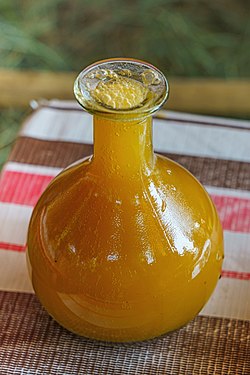 A berele glass containing tej, a honey wine brewed and consumed in Ethiopia. (from List of national drinks)
 Singapore Sling, a gin-based sling cocktail from the city-state Singapore. (from List of national drinks)
 A fully supplied bar with various types of drinks (from List of alcoholic drinks)
 Various views of a bottle of mezcal. The "worm", which is actually the larval form of the moth Hypopta agavis that lives on the agave plant, can be seen in the middle image, at the bottom of the bottle. (from List of alcoholic drinks)
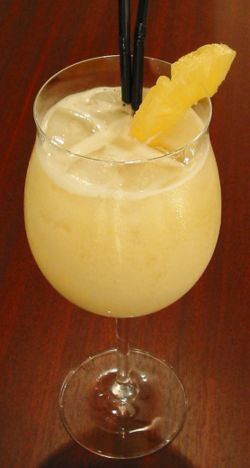 Piña colada, a cocktail made with rum, cream of coconut, and pineapple juice, usually served either blended or shaken with ice. It may be garnished with either a pineapple wedge, maraschino cherry, or both. The drink originated in Puerto Rico. (from List of national drinks)
 Various bottles and containers of Russian vodka (from List of alcoholic drinks)
 A display of spirits in a supermarket (from List of drinks)
 Desi daru from India (from List of alcoholic drinks)
 Kaapi, Indian filter coffee. (from List of national drinks)
 Thai iced tea is a popular drink in Thailand and in many parts of the world. (from List of national drinks)


.jpg)


.jpg)


.jpg)


.JPG)


.jpg)


Selected image -

Selected biography -

Harold Clifford "Harry" Hatch (1884–1946) was a millionaire industrialist from Prince Edward County, Ontario, specializing in the business of wine and spirits.
Hatch started out with a small liquor store in Whitby, Ontario, and prospered to the point where he was able to purchase the controlling interest of Gooderham & Worts Ltd. in 1923. Four years later, Hatch acquired Hiram Walker & Sons Ltd. based in Walkerville, Ontario, and in 1927 merged the two companies under the parent company of Hiram Walker-Gooderham & Worts Limited. The company was one of a number of Canadian distillers who prospered by shipping their products into the United States during the Prohibition era from 1920 to 1933. (Full article...)
Selected quote -
| “ | The bar is in full swing, and floating rounds of cocktails permeate the garden outside, until the air is alive with chatter and laughter, and casual innuendo and introductions forgotten on the spot, and enthusiastic meetings between women who never knew each other’s names. | ” |
| — F. Scott Fitzgerald The Great Gatsby (1925) |
Selected ingredient -
High-fructose corn syrup (HFCS), also known as glucose–fructose syrup, and isoglucose, is a sweetener made from corn starch. As in the production of conventional corn syrup, the starch is broken down into glucose by enzymes. To make HFCS, the corn syrup is further processed with the enzyme D-xylose isomerase to convert some of its glucose into fructose. HFCS was first marketed in the early 1970s by the Clinton Corn Processing Company, together with the Japanese Agency of Industrial Science and Technology, where the enzyme was discovered in 1965.
As a sweetener, HFCS is often compared to granulated sugar, but manufacturing advantages of HFCS over sugar include that it is cheaper. "HFCS 42" and "HFCS 55" refer to dry weight fructose compositions of 42% and 55% respectively, the rest being glucose. HFCS 42 is mainly used for processed foods and breakfast cereals, whereas HFCS 55 is used mostly for production of soft drinks.
The United States Food and Drug Administration (FDA) states that it is not aware of evidence showing that HFCS is less safe than traditional sweeteners such as sucrose and honey. Uses and exports of HFCS from American producers have grown steadily during the early 21st century.Topics
| General topics: | Bartending • Bottling • Drinking • Drinking water • Bottled water • Mineral water • Coffee • Energy drink • Juice • Tea • Milk • Plant milk • Pasteurization • Refrigeration • Steeping • Water purification |
| Alcoholic beverages: | Beer • Brandy • Brewing • Caffeinated alcoholic drinks • Cider • Cocktails • Distillation • Fermentation • Hard soda • Liquor • Liqueur • Malt drink • Mead • Proof • Rice Wine • Schnapps • Vodka • Whiskey • Wine |
| Soft Drinks: | Carbonation • Cola • Orange soft drink • Frozen carbonated drink • Root beer • Soda water • Lithia water • |
| Miscellaneous: | Drink industry • Lemonade • Limeade • Orange drink • Slush (beverage) |
List articles


Subcategories

Related portals


WikiProjects
.svg)

WikiProject Food & Drink is an association of Wikipedians with an interest in culinary-related subjects. They have come together to co-ordinate the development of food and drink articles here on Wikipedia as well as the many subjects related to food such as foodservice, catering and restaurants. If you wish to learn more about these subjects as well as get involved, please visit the project.
 WikiProject Beer – covers Wikipedia's coverage of beer and breweries and microbreweries
 WikiProject Wine – aims to compile thorough and accurate information on different vineyards, wineries and varieties of wines, including but not limited to their qualities, origins, and uses.
| Child projects: | Task forces: (All inactive) |
| Related projects: | |
Things you can do
 |
Here are some tasks awaiting attention:
|
Associated Wikimedia
The following Wikimedia Foundation sister projects provide more on this subject:
-
 Commons
Free media repository -
 Wikidata
Free knowledge base -
 Wikiquote
Collection of quotations -
 Wikisource
Free-content library -
 Wikiversity
Free learning tools -
 Wiktionary
Dictionary and thesaurus


More portals