The Classical Music Portal


Classical music is a tradition of art music in the Western world, considered to be distinct from Western folk music or popular music. It is sometimes distinguished as Western classical music, as the term "classical music" can also be applied to non-Western art musics. Classical music is often characterized by formality and complexity in its musical form and harmonic organization, particularly with the use of polyphony. Since at least the ninth century, it has been primarily a written tradition, spawning a sophisticated notational system, as well as accompanying literature in analytical, critical, historiographical, musicological and philosophical practices. (Full article...)
Selected articles –

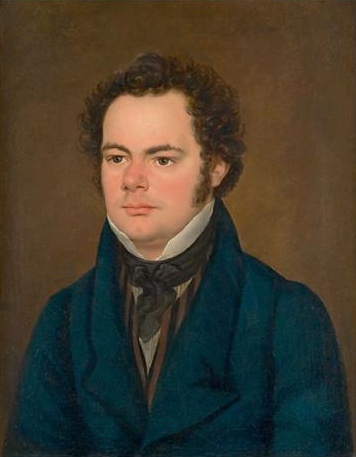
Schubert in 1827 (oil on canvas, by Anton Depauly)
Franz Schubert's final chamber work, the String Quintet in C major (D. 956, Op. posth. 163) is sometimes called the "Cello Quintet" because it is scored for a standard string quartet with a second cello rather than a second viola, which is more usual.
The piece was composed in 1828 and completed just two months before the composer's death. The first public performance of the piece did not occur until 1850, and publication occurred three years later in 1853. Schubert's only full-fledged string quintet, it has been called "sublime" and "extraordinary", been said to possess "bottomless pathos", and is generally regarded as Schubert's finest chamber work as well as one of the greatest compositions in all chamber music. (Full article...)
The Magic Flute (German: Die Zauberflöte, pronounced [diː ˈtsaʊbɐˌfløːtə] ⓘ), K. 620, is an opera in two acts by Wolfgang Amadeus Mozart to a German libretto by Emanuel Schikaneder. It is a Singspiel, a popular form that included both singing and spoken dialogue. The work premiered on 30 September 1791 at Schikaneder's theatre, the Freihaus-Theater auf der Wieden in Vienna, just two months before Mozart's death. It was Mozart's last opera. It was an outstanding success from its first performances, and remains a staple of the opera repertory.
In the opera, the Queen of the Night persuades Prince Tamino to rescue her daughter Pamina from captivity under the high priest Sarastro; instead, he learns the high ideals of Sarastro's community and seeks to join it. Separately, then together, Tamino and Pamina undergo severe trials of initiation, which end in triumph, with the Queen and her cohorts vanquished. The earthy Papageno, who accompanies Tamino on his quest, fails the trials completely but is rewarded anyway with the hand of his ideal female companion Papagena. (Full article...)
Carmen (French: [kaʁmɛn] ⓘ) is an opera in four acts by the French composer Georges Bizet. The libretto was written by Henri Meilhac and Ludovic Halévy, based on the novella of the same title by Prosper Mérimée. The opera was first performed by the Opéra-Comique in Paris on 3 March 1875, where its breaking of conventions shocked and scandalised its first audiences. Bizet died suddenly after the 33rd performance, unaware that the work would achieve international acclaim within the following ten years. Carmen has since become one of the most popular and frequently performed operas in the classical canon; the "Habanera" and "Seguidilla" from act 1 and the "Toreador Song" from act 2 are among the best known of all operatic arias.
The opera is written in the genre of opéra comique with musical numbers separated by dialogue. It is set in southern Spain and tells the story of the downfall of Don José, a naïve soldier who is seduced by the wiles of the fiery gypsy Carmen. José abandons his childhood sweetheart and deserts from his military duties, yet loses Carmen's love to the glamorous torero Escamillo, after which José kills her in a jealous rage. The depictions of proletarian life, immorality, and lawlessness, and the murder of the main character on stage, broke new ground in French opera and were highly controversial. (Full article...)
Rachmaninoff, pictured here at age 10, produced most of the pieces not included in his opus before he was 14.
The composer Sergei Rachmaninoff produced a number of solo piano pieces that were either lost, unpublished, or not assigned an opus number. While often disregarded in the concert repertoire, they are nevertheless part of his oeuvre. Sixteen of these pieces are extant; all others are lost. Ten of these pieces were composed before he completed his Piano Concerto No. 1, his first opus, and the rest interspersed throughout his later life. In these casual works, he draws upon the influence of other composers, including Frédéric Chopin and Pyotr Tchaikovsky.
The more substantial works, the Three Nocturnes and Four Pieces, are sets of well-thought out pieces that are his first attempts at cohesive structure among multiple pieces. Oriental Sketch and Prelude in D minor, two pieces he composed very late in his life, are short works that exemplify his style as a mature composer. Whether completed as a child or adult, these pieces cover a wide spectrum of forms while maintaining his characteristic Russian style. (Full article...)
Madama Butterfly (Italian pronunciation: [maˈdaːma ˈbatterflai]; Madame Butterfly) is an opera in three acts (originally two) by Giacomo Puccini, with an Italian libretto by Luigi Illica and Giuseppe Giacosa. The Schickling catalog number is SC 74.
It is based on the short story "Madame Butterfly" (1898) by John Luther Long, which, in turn, was based on stories told to Long by his sister Jennie Correll, and on the semi-autobiographical 1887 French novel Madame Chrysanthème by Pierre Loti. Long's version was dramatized by David Belasco as the one-act play Madame Butterfly: A Tragedy of Japan, which, after premiering in New York in 1900, moved to London, where Puccini saw it in the summer of that year. (Full article...)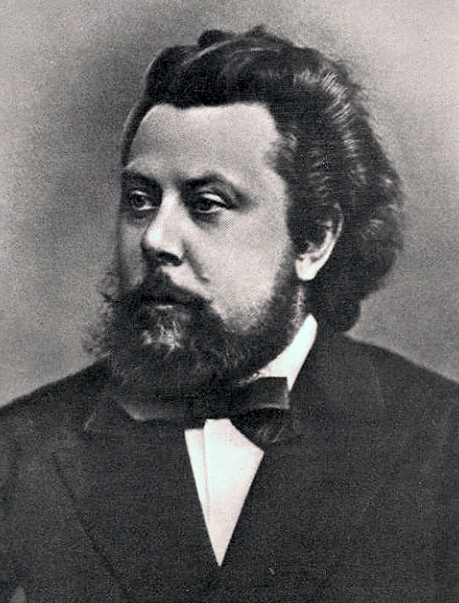 Mussorgsky, c. 1870
Modest Petrovich Mussorgsky (/mʊˈsɔːrɡski, -ˈzɔːrɡ-/; Russian: Модест Петрович Мусоргский, romanized: Modest Petrovich Musorgsky; IPA: [mɐˈdɛst pʲɪˈtrovʲɪtɕ ˈmusərkskʲɪj] ⓘ; 21 March [O.S. 9 March] 1839 – 28 March [O.S. 16 March] 1881) was a Russian composer, one of the group known as "The Five." He was an innovator of Russian music in the Romantic period and strove to achieve a uniquely Russian musical identity, often in deliberate defiance of the established conventions of Western music.
Many of Mussorgsky's works were inspired by Russian history, Russian folklore, and other national themes. Such works include the opera Boris Godunov, the orchestral tone poem Night on Bald Mountain and the piano suite Pictures at an Exhibition. (Full article...)
The Symphony No. 8 in E-flat major by Gustav Mahler is one of the largest-scale choral works in the classical concert repertoire. As it requires huge instrumental and vocal forces it is frequently called the "Symphony of a Thousand", although the work is normally presented with far fewer than a thousand performers and Mahler greatly disapproved of the name. The work was composed in a single inspired burst at his Maiernigg villa in southern Austria in the summer of 1906. The last of Mahler's works that was premiered in his lifetime, the symphony was a critical and popular success when he conducted the Munich Philharmonic in its first performance, in Munich, on 12 September 1910.
The fusion of song and symphony had been a characteristic of Mahler's early works. In his "middle" compositional period after 1901, a change of style led him to produce three purely instrumental symphonies. The Eighth, marking the end of the middle period, returns to a combination of orchestra and voice in a symphonic context. The structure of the work is unconventional: instead of the normal framework of several movements, the piece is in two parts. Part I is based on the Latin text of Veni creator spiritus ("Come, Creator Spirit"), a ninth-century Christian hymn for Pentecost, and Part II is a setting of the words from the closing scene of Goethe's Faust. The two parts are unified by a common idea, that of redemption through the power of love, a unity conveyed through shared musical themes. (Full article...)
Igor Fyodorovich Stravinsky (17 June [O.S. 5 June] 1882 – 6 April 1971) was a Russian composer and conductor with French (from 1934) and American citizenship (from 1945). He is widely considered one of the most important and influential composers of the 20th century and a pivotal figure in modernist music.
Born into a musical family in Saint Petersburg, Stravinsky grew up taking piano and music theory lessons. While studying law at the University of Saint Petersburg, he met Nikolai Rimsky-Korsakov and studied music under him until the latter's death in 1908. Soon after, Stravinsky met impresario Sergei Diaghilev, who commissioned him to write three ballets for the Ballets Russes's Paris seasons: The Firebird (1910), Petrushka (1911), and The Rite of Spring (1913), the last of which caused a near-riot at the premiere due to its avant-garde nature and later changed the way composers understood rhythmic structure. (Full article...)
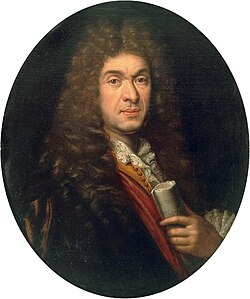
Jean-Baptiste Lully (born Giovanni Battista Lulli; 28 or 29 November [O.S. 18 or 19 November] 1632 – 22 March 1687) was an Italian-French composer, dancer and instrumentalist, who is considered a master of the French Baroque music style. Best known for his operas, he spent most of his life working in the court of Louis XIV and became a French subject in 1661. He was a close friend of the playwright Molière, with whom he collaborated on numerous comédie-ballets, including L'Amour médecin, George Dandin ou le Mari confondu, Monsieur de Pourceaugnac, Psyché and his best known work, Le Bourgeois gentilhomme. (Full article...)
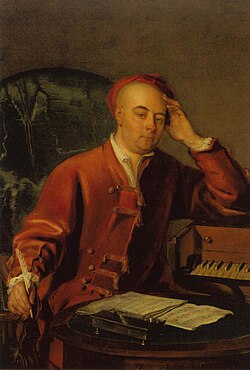
Jean-Philippe Rameau, by Jacques Aved, 1728
Jean-Philippe Rameau (/rɑːˈmoʊ/; French: [ʒɑ̃filip ʁamo]; 25 September 1683 – 12 September 1764) was a French composer and music theorist of the late Baroque era. Regarded as one of the most important French composers and music theorists of the 18th century, he replaced Jean-Baptiste Lully as the dominant composer of French opera and is also considered the leading French composer of his time for the harpsichord, alongside François Couperin.
Little is known about Rameau's early years. It was not until the 1720s that he won fame as a major theorist of music with his Treatise on Harmony (1722) and also in the following years as a composer of masterpieces for the harpsichord, which circulated throughout Europe. He was almost 50 before he embarked on the operatic career on which his reputation chiefly rests today. His debut, Hippolyte et Aricie (1733), caused a great stir and was fiercely attacked by the supporters of Lully's style of music for its revolutionary use of harmony. (Full article...)
Beginning of BWV 565 in Johannes Ringk's manuscript, which is, as far as known, the only extant 18th-century copy of the work
The Toccata and Fugue in D minor, BWV 565, is a composition for organ from the Baroque period which was long attributed to Johann Sebastian Bach, but whose authorship has been questioned by a minority of scholars since 1981. It is one of the most widely recognisable works in the organ repertoire. It was written between 1704 and the 1750s. The piece opens with a toccata section followed by a fugue that ends in a coda, and is typical of the north German organ school of the Baroque era.
Little was known about its early existence until the piece was discovered in an undated manuscript produced by Johannes Ringk. It was first published in 1833 during the early Bach Revival period through the efforts of composer Felix Mendelssohn, who also performed the piece in 1840. In the 20th century, its popularity rose above that of other organ compositions by Bach, as exemplified by its inclusion in Walt Disney's 1940 animated film Fantasia using Leopold Stokowski's orchestral transcription from 1927. (Full article...)
Antonio Vivaldi (engraving by François Morellon de La Cave, from Michel-Charles Le Cène's edition of Vivaldi's Op. 8, 1725)
The Four Seasons (Italian: Le quattro stagioni) is a group of four violin concerti by Italian composer Antonio Vivaldi, each of which gives musical expression to a season of the year. These were composed around 1718–1723, when Vivaldi was the court chapel master in Mantua. They were published in 1725 in Amsterdam in what was at the time the Dutch Republic, together with eight additional concerti, as Il cimento dell'armonia e dell'inventione (The Contest Between Harmony and Invention).
The Four Seasons is the best known of Vivaldi's works. The inspiration for the concertos is not the countryside around Mantua, as initially supposed, where Vivaldi was living at the time, since according to Karl Heller they could have been written as early as 1716–1717, while Vivaldi was engaged with the court of Mantua only in 1718. (Full article...)


_-_001.jpg)


General images –
 The opening bars of the Commendatore's aria in Mozart's opera Don Giovanni. The orchestra starts with a dissonant diminished seventh chord (G# dim7 with a B in the bass) moving to a dominant seventh chord (A7 with a C# in the bass) before resolving to the tonic chord (D minor) at the singer's entrance. (from Classical period (music))
 Richard Wagner in Paris, 1861
 Gerard van Honthorst, The Concert (1623), National Gallery of Art, Washington D.C. (from Renaissance music)
 Gustav Mahler, photographed in 1907 by Moritz Nähr at the end of his period as director of the Vienna Hofoper (from Romantic music)

 Wolfgang Amadeus Mozart, posthumous painting by Barbara Krafft in 1819 (from Classical period (music))
 Portion of Du Fay's setting of Ave maris stella, in fauxbourdon. The top line is a paraphrase of the chant; the middle line, designated "fauxbourdon", (not written) follows the top line but exactly a perfect fourth below. The bottom line is often, but not always, a sixth below the top line; it is embellished, and reaches cadences on the octave.Play (from Renaissance music)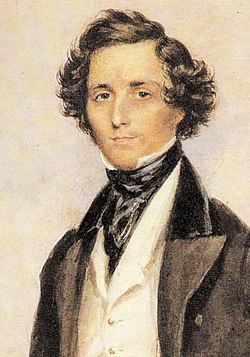
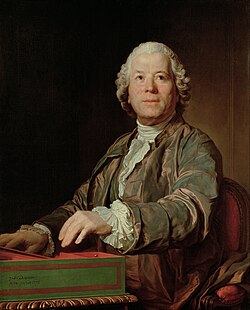 Gluck, detail of Portrait of Christoph Willibald Gluck by Joseph Duplessis, dated 1775 (Kunsthistorisches Museum, Vienna) (from Classical period (music))
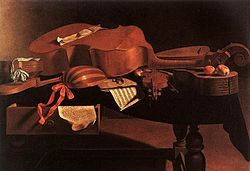 Painting by Evaristo Baschenis of Baroque instruments, including a cittern, viola da gamba, violin, and two lutes (from Baroque music)
 Selection of Renaissance instruments (from Renaissance music)
 An example of a guitar from the classical period (from Classical period (music))
 Bernhard Crusell, a Swedish-Finnish composer and clarinetist, in 1826 (from Classical period (music))
 Hummel in 1814 (from Classical period (music))
 A modern string quartet. In the 2000s, string quartets from the Classical era are the core of the chamber music literature. From left to right: violin 1, violin 2, cello, viola. (from Classical period (music))
 Claudio Monteverdi in 1640 (from Baroque music)
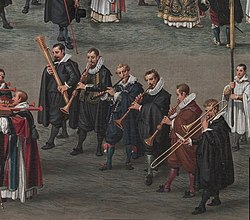 Musicians from 'Procession in honour of Our Lady of Sablon in Brussels.' Early 17th-century Flemish alta cappella. From left to right: bass dulcian, alto shawm, treble cornett, soprano shawm, alto shawm, tenor sackbut. (from Renaissance music)
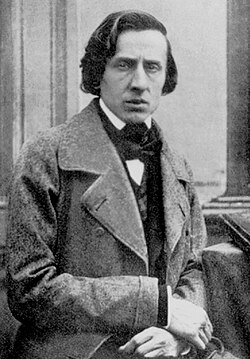 Daguerreotype of Chopin, c. 1849 (from Romantic music)
 Portrait of Beethoven, 1820 (from Classical period (music))
 Portrait of the Mozart Family, dated 1780–81 (from Classical period (music))
 View of Vienna in 1758, by Bernardo Bellotto (from Classical period (music))
 Franz Liszt in 1858, by Franz Hanfstaengl (from Romantic music)
 Wolfgang Amadeus Mozart, a representative composer of the Classical period, seated at a keyboard (from Classical period (music))
 1875 oil painting of Franz Schubert by Wilhelm August Rieder, after his own 1825 watercolor portrait (from Classical period (music))
 Wanderer above the Sea of Fog, by Caspar David Friedrich, is an example of Romantic painting. (from Romantic music)
 Fortepiano by Paul McNulty after Walter & Sohn, c. 1805 (from Classical period (music))
 A large instrumental ensemble's performance in the lavish Teatro Argentina, as depicted by Panini (1747) (from Baroque music)
 Bizet photographed by Étienne Carjat (1875) (from Romantic music)
 Josef Danhauser's 1840 painting Liszt at the Piano featuring Franz Liszt at the piano surrounded by (from left to right) Alexandre Dumas, Hector Berlioz, George Sand, Niccolò Paganini, Gioachino Rossini and Marie d'Agoult, with a bust of Ludwig van Beethoven on the piano (from Romantic music)
 Balakirev (top), Cui (upper left), Mussorgsky (upper right), Rimsky-Korsakov (lower left), and Borodin (lower right). (from Romantic music)
 Haydn portrait by Thomas Hardy, 1792 (from Classical period (music))


_Google_Art_Project.jpg)


_058.jpg)


.jpg)
Quotes –
| “ | Music is enough for a life — but a life is too short for music. | ” |
| — Richard Strauss | ||
Related portals


WikiProjects



 Selected composers –


- Anthony Edward Payne (2 August 1936 – 30 April 2021) was an English composer, music critic and musicologist. He is best known for his acclaimed completion of Edward Elgar's third symphony, which gained wide acceptance into Elgar's oeuvre. Payne is particularly noted for his chamber music, much of which was written for his wife, the soprano Jane Manning, and the couple's new music ensemble Jane's Minstrels. Initially an unrelenting proponent of modernist music, by the 1980s his compositions had embraced aspects of the late English romanticism, described by his colleague Susan Bradshaw as "modernized nostalgia".
Born in London, Payne first seriously studied music at Durham University. His professional career began around 1969 with his first major work, the staunchly modernist Phoenix Mass for choir and brass band. He continued to write choral and vocal works, almost exclusively to British poets. From his 1981 chamber work A Day in the Life of a Mayfly on, he synthesised modernism with the English romanticism of Elgar, Delius and Vaughan Williams. Two orchestral commissions for The Proms, The Spirit's Harvest (1985) and Time's Arrow (1990) were well received. After his successful completion of Elgar's unfinished third symphony, Payne became unsure of his musical identity. He found difficulty in subsequent composition until a series of orchestral works for the Proms, Visions and Journeys (2002), The Period of Cosmographie (2010) and Of Land, Sea and Sky (2016). (Full article...)
Pandit Ravi Shankar (Bengali pronunciation: [ˈrobi ˈʃɔŋkor]; born Robindro Shaunkor Chowdhury, sometimes spelled as Ravindra Shankar Chowdhury; 7 April 1920 – 11 December 2012) was an Indian sitarist and composer. A sitar virtuoso, he became the world's best-known exponent of Indian classical music in the second half of the 20th century, and influenced many musicians in India and throughout the world. Shankar was awarded India's highest civilian honour, the Bharat Ratna, in 1999. He is also the father of American singer Norah Jones and British-American musician and sitar player Anoushka Shankar.
Shankar was born to a Bengali family in India, and spent his youth as a dancer touring India and Europe with the dance group of his brother Uday Shankar. At age 18, he gave up dancing to pursue a career in music, studying the sitar for seven years under court musician Allauddin Khan. After finishing his studies in 1944, Shankar worked as a composer, creating the music for the Apu Trilogy by Satyajit Ray, and was music director of All India Radio, New Delhi, from 1949 to 1956. (Full article...)
Mykola Dmytrovych Leontovych (Ukrainian: Микола Дмитрович Леонтович, pronounced [mɪˈkɔlɐ ˈdmɪtrowɪtʃ leonˈtɔwɪtʃ] ⓘ; 13 December [O.S. 1 December] 1877 – 23 January 1921) was a Ukrainian composer, conductor, ethnomusicologist, and teacher. His music was inspired by the Ukrainian composer Mykola Lysenko and the Ukrainian National Music School. Leontovych specialised in a cappella choral music, ranging from original compositions to church music to elaborate arrangements of folk music.
Leontovych was born and raised in Monastyrok in the Podolia province of the Russian Empire (now in Vinnytsia Oblast, west of Ukraine). He was educated as a priest in the Kamianets-Podilskyi Theological Seminary. With the independence of the Ukrainian State in the 1917 revolution, he moved to Kyiv, where he worked at the Kyiv Conservatory and the Mykola Lysenko Institute of Music and Drama. He composed "Shchedryk" in 1914 (premiered in 1916), now known to the English-speaking world as "Carol of the Bells". He was murdered by a Soviet agent in 1921 and is known as a martyr in the Eastern Orthodox Ukrainian Church, where he is also remembered for his liturgy, the first composed in the vernacular, specifically in the modern Ukrainian language. (Full article...)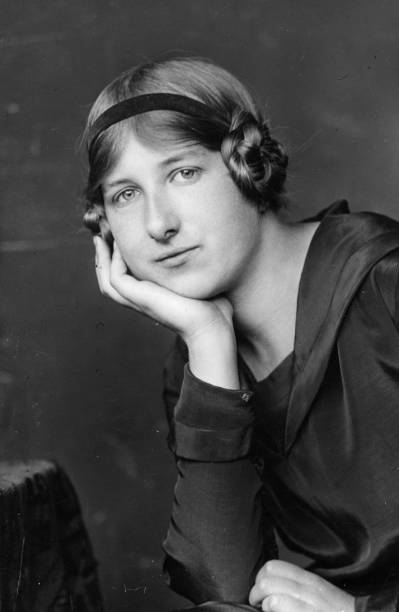
Imogen Clare Holst CBE (née von Holst; 12 April 1907 – 9 March 1984) was a British composer, arranger, conductor, teacher, musicologist and festival administrator. The only child of the composer Gustav Holst, she is particularly known for her educational work at Dartington Hall in the 1940s, and for her 20 years as joint artistic director of the Aldeburgh Festival. In addition to composing music, she wrote composer biographies, much educational material and several books on the life and works of her father.
From a young age Holst showed precocious talent in composing and performance. After attending Eothen School and St Paul's Girls' School, she entered the Royal College of Music, where she developed her skills as a conductor and won several prizes for composing. Unable to follow her initial ambitions to be a pianist or a dancer for health reasons, Holst spent most of the 1930s teaching, and as a full-time organiser for the English Folk Dance and Song Society. These duties reduced her compositional activities, although she made many arrangements of folksongs. After serving as an organiser for the Council for the Encouragement of Music and the Arts at the start of the Second World War, in 1942 she began working at Dartington. In her nine years there she established Dartington as a major centre of music education and activity. (Full article...)
A l’arme A l’arme by Grimace, verso 55 from the Chantilly Codex
Grimace (fl. mid-to-late 14th century; French: [ɡʁi.mas]; also Grymace, Grimache or Magister Grimache) was a French composer in the ars nova style of late medieval music. Virtually nothing is known about Grimace's life other than speculative information based on the circumstances and content of his five surviving compositions of formes fixes; three ballades, a virelai and rondeau. His best known and most often performed work in modern-times is the virelai and proto-battaglia: A l’arme A l’arme.
He is thought to have been a younger contemporary of Guillaume de Machaut and based in southern France. Three of his works were included in the Chantilly Codex, which is an important source of ars subtilior music. However, along with P. des Molins, Jehan Vaillant and F. Andrieu, Grimace was one of the post-Machaut generation whose music shows few distinctly ars subtilior features, leading scholars to recognize Grimace's work as closer to the ars nova style of Machaut. (Full article...)- Philibert Rabezoza (1923 – 29 September 2001), better known by the name Rakoto Frah, was a flautist and composer of traditional music of the central highlands of Madagascar. Born in 1923 near the capital city of Antananarivo to a poor rural family, Rakoto Frah surmounted the challenges posed by his underprivileged origins to become the most acclaimed 20th century performer of the sodina flute, one of the oldest traditional instruments on the island. Through frequent international concerts and music festival performances, he promoted the music of the highlands of Madagascar and became one of the most famous Malagasy artists, both within Madagascar and on the world music scene.
After gaining regional recognition for his sodina skills as a youth, Rakoto Frah rose to national fame in 1958 when he was selected by Malagasy President Philibert Tsiranana to perform on the sodina for the visiting French president Charles de Gaulle. This event launched his career as a professional musician. He first played at traditional ceremonies around the country, then expanded his performances from 1967 to include participation in international music competitions and festivals. His popularity declined in the 1970s but underwent a revival that began in the mid-1980s and continued until his death in 2001. During this period Rakoto Frah recorded ten albums, toured extensively in Madagascar and overseas, was featured in two French documentaries, and collaborated with a variety of international and Malagasy artists. Over the course of his career he recorded over 800 original compositions. Rakoto Frah and his sodina were depicted on the 200 ariary Malagasy banknote in honor of his key role in revitalizing and internationally popularizing the sodina. Despite the artist's worldwide acclaim, he lived simply and died having earned little from his lifetime of musicianship. His death was widely mourned and marked by a state funeral, and in 2011 a famadihana (the Malagasy highland "turning of the bones" funerary tradition) was organized to celebrate the artist's life. (Full article...)
Frédéric François Chopin (born Fryderyk Franciszek Chopin; 1 March 1810 – 17 October 1849) was a Polish composer and virtuoso pianist of the early Romantic period who wrote primarily for solo piano. He has maintained worldwide renown as a leading composer of his era whose "poetic genius was based on a professional technique that was without equal in his generation".
Chopin was born in Żelazowa Wola and grew up in Warsaw, which in 1815 became part of Congress Poland. A child prodigy, he completed his musical education and composed his early works in Warsaw before leaving Poland at age 20, less than a month before the outbreak of the November 1830 Uprising; at 21, he settled in Paris. Thereafter he gave only 30 public performances, preferring the more intimate atmosphere of the salon. He supported himself by selling his compositions and giving piano lessons, for which he was in high demand. Chopin formed a friendship with Franz Liszt and was admired by many musical contemporaries, including Robert Schumann. After a failed engagement to Maria Wodzińska from 1836 to 1837, he maintained an often troubled relationship with the French writer Aurore Dupin (known by her pen name George Sand). A brief and unhappy visit to Mallorca with Sand in 1838–39 proved one of his most productive periods of composition. In his final years he was supported financially by his admirer Jane Stirling. In poor health most of his life, Chopin died in Paris in 1849 at age 39. (Full article...)
Bizet photographed by Étienne Carjat (1875)
Georges Bizet (né Alexandre César Léopold Bizet; 25 October 1838 – 3 June 1875) was a French composer of the Romantic era. Best known for his operas in a career cut short by his early death, Bizet achieved few successes before his final work, Carmen, which has become one of the most popular and frequently performed works in the entire opera repertoire.
During a brilliant student career at the Conservatoire de Paris, Bizet won many prizes, including the prestigious Prix de Rome in 1857. He was recognised as an outstanding pianist, though he chose not to capitalise on this skill and rarely performed in public. Returning to Paris after almost three years in Italy, he found that the main Parisian opera theatres preferred the established classical repertoire to the works of newcomers. His keyboard and orchestral compositions were likewise largely ignored; as a result, his career stalled, and he earned his living mainly by arranging and transcribing the music of others. Restless for success, he began many theatrical projects during the 1860s, most of which were abandoned. Neither of his two operas that reached the stage in this time—Les pêcheurs de perles and La jolie fille de Perth—were immediately successful. (Full article...)
Andrieu's Armes, amours/O flour des flours, recto 52 in the Chantilly Codex
F. Andrieu (fl. late 14th century; possibly François or Franciscus Andrieu) was a French composer in the ars nova style of late medieval music. Nothing is known for certain about him except that he wrote Armes, amours/O flour des flours (Weapons, loves/O flower of flowers), a double ballade déploration, for the death of Guillaume de Machaut in 1377. The work has been widely praised and analyzed; it is notable for being one of two extant medieval double ballades for four voices, the only known contemporary musical setting of Eustache Deschamps and the earliest representative of the longstanding medieval and Renaissance lamentation tradition between composers.
Andrieu may be the same person as Magister Franciscus, although the scholarly consensus on this identification is unclear. With P. des Molins, Jehan Vaillant and Grimace, Andrieu was one of the "post-Machaut" generation whose pieces retain enough ars nova qualities to be differentiated from composers of ars subtilior. (Full article...)
Delius, photographed in 1907
Frederick Theodore Albert Delius (born Fritz Theodor Albert Delius; /ˈdiːliəs/; 29 January 1862 – 10 June 1934) was an English composer. Born in Bradford in the north of England to a prosperous mercantile family, he resisted attempts to recruit him to commerce. He was sent to Florida in the United States in 1884 to manage an orange plantation. He soon neglected his managerial duties, and in 1886 returned to Europe.
Having been influenced by African-American music during his short stay in Florida, he began composing. After a brief period of formal musical study in Germany beginning in 1886, he embarked on a full-time career as a composer in Paris and then in nearby Grez-sur-Loing, where he and his wife Jelka lived for the rest of their lives, except during the First World War. (Full article...)- Tōru Takemitsu (武満 徹; pronounced [takeꜜmitsɯ̥ toːɾɯ]; 8 October 1930 – 20 February 1996) was a Japanese composer of contemporary classical music and writer on music. Largely self-taught, Takemitsu was admired for his subtle manipulation of instrumental and orchestral timbre. He is known for combining elements of oriental and occidental philosophy and for fusing sound with silence and tradition with innovation.
Takemitsu composed several hundred independent works of music, scored more than ninety films and published twenty books. He was also a founding member of the Jikken Kōbō (実験工房, experimental workshop) in Japan, a group of avant-garde artists who distanced themselves from academia and whose collaborative work is often regarded among the most influential of the 20th century. (Full article...) - Jane Marian Joseph (31 May 1894 – 9 March 1929) was an English composer, arranger, and music teacher. She was a pupil and later associate of the composer Gustav Holst, and was instrumental in the organisation and management of various of the music festivals which Holst sponsored. Many of her works were composed for performance at these festivals and similar occasions. Her early death at age 34, which prevented the full realisation of her talents, was considered by her contemporaries as a considerable loss to English music.
Holst first observed Joseph's potential when he was teaching her composition at St Paul's Girls' School. She began to act as his amanuensis in 1914, when he was composing The Planets, her special responsibility being the preparation of the score for the "Neptune" movement. She continued to assist Holst with transcriptions, arrangements and translations, and was his librettist for the choral ballet The Golden Goose. (Full article...)
Jack Wall is an American video game music composer. He has worked on video game music for over 20 games including the Myst franchise, Splinter Cell, Jade Empire, Mass Effect, and Call of Duty. Wall earned a degree in civil engineering from Drexel University in Philadelphia, Pennsylvania, and, after a brief stint working in civil engineering, transitioned into music production. He worked with musicians such as John Cale, David Byrne, and Patti Smith, and, after performing increasingly complex production and sound engineering tasks, moved into music composition in 1995.
Wall's first video game composition was the soundtrack to Vigilance. Primarily composing in an orchestral style, by 2001 he composed the soundtrack to Myst III: Exile, which was the title he says put him on the map as a video game composer. In 2002, Wall became one of around 20 co-founders of the Game Audio Network Guild (G.A.N.G.) as well as senior director. In 2005, Wall, along with G.A.N.G. founder and fellow composer Tommy Tallarico, produced the Video Games Live concert series, having served as the conductor for the international concert tour. His soundtracks for Myst III: Exile, Myst IV: Revelation, Rise of the Kasai, Jade Empire, Mass Effect, and Mass Effect 2 were nominated for and won multiple awards. (Full article...)- Julius Allan Greenway Harrison (26 March 1885 – 5 April 1963) was an English composer and conductor who was particularly known for his interpretation of operatic works. Born in Lower Mitton, Stourport in Worcestershire, by the age of 16 he was already an established musician. His career included a directorship of opera at the Royal Academy of Music where he was a professor of composition, a position as répétiteur at the Royal Opera House, Covent Garden, conductor for the British National Opera Company, military service as an officer in the Royal Flying Corps, and founder member and vice-president of the Elgar Society. (Full article...)

First page of The Pilgrim: Grand Overture by Douglass
John Thomas Douglass (1847–1886) was an American composer, virtuoso violinist, conductor and teacher. He is best known for composing Virginia's Ball (1868), which is generally regarded as the first opera written by an African-American composer. The work is now lost, and his only extant composition is The Pilgrim: Grand Overture (1878) for piano. His biography from James Monroe Trotter's Music and Some Highly Musical People (1878)—in which The Pilgrim survives—reports that he wrote many now lost pieces for piano, orchestra and particularly guitar, which he was known to play.
A highly regarded violinist, Douglass's violin playing received high praise during his lifetime. In addition to his solo career, he traveled with various groups throughout the 1870s, including the Hyers Sisters. He settled in New York by the 1880s and conducted both a music studio and string ensemble. Later in life he led a teaching studio, and among his students was David Mannes who became the concertmaster of the New York Symphony Orchestra. Nearly 30 years after Douglass's death at age 38–39, Mannes founded the Colored Music Settlement School in the memory of his teacher. (Full article...)


.jpg)


Did you know (auto-generated) –

- ... that WFMT classical music radio host Don Tait owned such a large collection of recordings that he had to buy a house and have its floor reinforced to accommodate the weight?
- ... that opera singer Charles Holland spent much of his career in Europe as opportunities in classical music for African Americans were limited?
Selected image
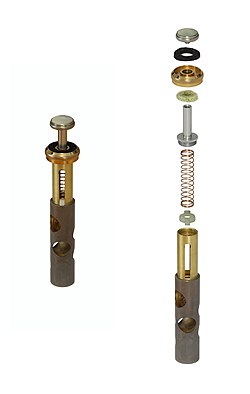 Photo: Guillaume PiolleThe anatomy of a Périnet piston valve, this one taken from a B♭ trumpet. When depressed, the valve diverts the air stream through additional tubing, thus lengthening the instrument and lowering the harmonic series on which the instrument is vibrating (i.e., it lowers the pitch). Trumpets generally use three valves, with some variations, such as a piccolo trumpet, having four. When used singly or in combination, the valves make the instrument fully chromatic, or capable of playing all twelve pitches of classical music. Trumpets may also use rotary valves instead.
 Sheet music for the Polonaise in A-flat major, Op. 53, a solo piano piece written by Frédéric Chopin in 1842. This work is one of Chopin's most admired compositions and has long been a favorite of the classical piano repertoire. The piece, which is very difficult, requires exceptional pianistic skills and great virtuosity to be interpreted. A typical performance of the polonaise lasts seven minutes.
 Photograph: David IliffThe Royal Albert Hall is a concert hall, seating a maximum of 5,272, on the northern edge of South Kensington, London. Constructed beginning in 1867, the hall was inaugurated on 29 March 1871. Since 1941 it has held The Proms, an eight-week summer season of daily orchestral classical music concerts and other events.
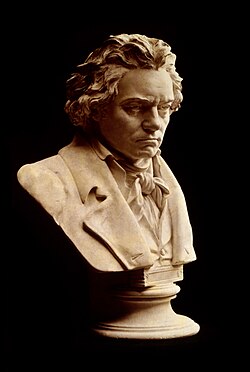 Photo: W. J. Mayer; Restoration: Lise BroerA bust of the German composer and pianist Ludwig van Beethoven (1770–1827), made from his death mask. He was a crucial figure in the transitional period between the Classical and Romantic eras in Western classical music, and remains one of the most acclaimed and influential composers of all time. Born in Bonn, of the Electorate of Cologne and a part of the Holy Roman Empire of the German Nation in present-day Germany, he moved to Vienna in his early twenties and settled there, studying with Joseph Haydn and quickly gaining a reputation as a virtuoso pianist. His hearing began to deteriorate in the late 1790s, yet he continued to compose, conduct, and perform, even after becoming completely deaf.
 Photograph credit: Eugène Pirou; restored by Adam CuerdenJules Massenet (12 May 1842 – 13 August 1912) was a French composer of the Romantic era, best known for his operas. Between 1867 and his death, he wrote more than forty stage works in a wide variety of styles, from opéra comique to grand depictions of classical myths, romantic comedies and lyric dramas, as well as oratorios, cantatas and ballets. Massenet had a good sense of the theatre and of what would succeed with the Parisian public. Despite some miscalculations, he produced a series of successes that made him the leading opera composer in France in the late 19th and early 20th centuries. By the time of his death, he was regarded as old-fashioned; his works, however, began to be favourably reassessed during the mid-20th century, and many have since been staged and recorded. This photograph of Massenet was taken by French photographer Eugène Pirou in 1875.
 Ballet is a formalized form of dance with its origins in the French court, further developed in France and Russia as a concert dance form.
 Painting: Thomas GainsboroughJohann Christian Bach (5 September 1735 – 1 January 1782) was a composer of the Classical era, the eighteenth child of Johann Sebastian Bach, and the youngest of his eleven sons. Bach was taught by his father and then, after the latter's death, by his half-brother C. P. E. Bach. Bach moved to Italy in 1754, and then to London in 1762, where he became known as the "London Bach". Bach's compositions include eleven operas, as well as chamber music, orchestral music and compositions for keyboard music. In 1764 Bach met Wolfgang Amadeus Mozart, who was eight at the time, and spent five months teaching him composition. He had considerable influence on Mozart, and was later described by scholars as his "only, true teacher".
This portrait of Bach was painted in 1776 by Thomas Gainsborough, as part of a collection started by Bach's former teacher Padre Martini. It now hangs in the National Portrait Gallery, London.
A picture of the first theatre drawn shortly before it burned down in 1808.
The Royal Opera House is an opera house and major performing arts venue in the London district of Covent Garden. The large building, often referred to as simply "Covent Garden", is the home of The Royal Opera, The Royal Ballet and the Orchestra of the Royal Opera House. The Teatro alla Scala (or La Scala, as it is known), in Milan, Italy, is one of the world's most famous opera houses. The theatre was inaugurated on 3 August 1778, under the name Nuovo Regio Ducal Teatro alla Scala with Salieri's Europa riconosciuta.
 Photograph credit: William P. Gottlieb; restored by Adam CuerdenBilly Strayhorn (November 29, 1915 – May 31, 1967) was an American jazz composer, pianist, lyricist, and arranger, best remembered for his long-time collaboration with bandleader and composer Duke Ellington that lasted nearly three decades. Though classical music was Strayhorn's first love, his ambition to become a classical composer went unrealized because of the harsh reality of a black man trying to make his way in the world of classical music, which at that time was almost completely white. He was introduced to the music of pianists like Art Tatum and Teddy Wilson at age 19, and the artistic influence of these musicians guided him into the realm of jazz, where he remained for the rest of his life. This photograph of Strayhorn was taken by William P. Gottlieb in the 1940s.
 Stradivarius is one of the violins, violas, cellos and other string instruments built by members of the Italian Stradivari family, particularly Antonio Stradivari.


.jpg)

Topics
|
|
Things you can do
 |
Here are some tasks awaiting attention:
|
Categories

Associated Wikimedia
The following Wikimedia Foundation sister projects provide more on this subject:
-
 Commons
Free media repository -
 Wikidata
Free knowledge base -
 Wikiquote
Collection of quotations -
 Wikisource
Free-content library -
 Wikiversity
Free learning tools -
 Wiktionary
Dictionary and thesaurus