
Pioneer 11 (also known as Pioneer G) is a NASA robotic space probe launched on April 5, 1973, to study the asteroid belt, the environment around Jupiter and Saturn, the solar wind, and cosmic rays.[2] It was the first probe to encounter Saturn, the second to fly through the asteroid belt, and the second to fly by Jupiter. Later, Pioneer 11 became the second of five artificial objects to achieve an escape velocity allowing it to leave the Solar System. Due to power constraints and the vast distance to the probe, the last routine contact with the spacecraft was on September 30, 1995, and the last good engineering data was received on November 24, 1995.[3]
 An artist's impression of a Pioneer spacecraft on its way to interstellar space. | |
| Mission type | Planetary / Heliosphere exploration |
|---|---|
| Operator | NASA / Ames |
| COSPAR ID | 1973-019A |
| SATCAT no. | 6421 |
| Website | science.nasa.gov |
| Mission duration | 22 years, 7 months and 19 days |
| Spacecraft properties | |
| Spacecraft | Pioneer G |
| Manufacturer | TRW |
| Launch mass | 258.5 kg (570 lb)[1] |
| Power | 155 watts (at launch) |
| Start of mission | |
| Launch date | April 6, 1973, 02:11:00 UTC[1] |
| Rocket | Atlas SLV-3D Centaur-D1A Star-37E |
| Launch site | Cape Canaveral LC-36B |
| End of mission | |
| Disposal | Decommissioned |
| Last contact | November 24, 1995 |
| Flyby of Jupiter | |
| Closest approach | December 3, 1974 |
| Distance | 43,000 km (27,000 mi) |
| Flyby of Saturn | |
| Closest approach | September 1, 1979 |
| Distance | 21,000 km (13,000 mi) |

| |

Mission background
editHistory
editApproved in February 1969, Pioneer 11 and its twin spacecraft, Pioneer 10, were the first probes designed to explore the outer Solar System. Early mission objectives, developed from proposals made throughout the 1960s, were to:
- Explore the interplanetary medium beyond the orbit of Mars.
- Investigate the asteroid belt and assess its potential hazard to missions to the outer planets.
- Explore Jupiter and its environment.
After a Saturn encounter was added to the mission plan, additional objectives included:
- Map Saturn's magnetic field and determine its strength, direction, and structure.
- Measure the distribution of electrons and protons of different energies along the spacecraft's trajectory through the Saturnian system.
- Study the interaction between Saturn's magnetosphere and the solar wind.
- Measure the temperatures of Saturn's atmosphere and of Titan, Saturn's largest moon.
- Investigate the structure of Saturn's upper atmosphere, including its ionosphere.
- Map the thermal structure of Saturn's atmosphere using infrared observations and radio occultation measurements.
- Obtain two-color spin-scan images of the Saturnian system and polarimetric measurements of Saturn.
- Study Saturn's rings and atmosphere using S-band radio occultation.
- Improve estimates of the masses of Saturn and its larger moons by measuring their gravitational effects on the spacecraft's trajectory.
- Characterize the environment of Saturn's ring plane in preparation for the planned Voyager program, helping determine whether it could be crossed safely without serious damage to a spacecraft.[2]
Pioneer 11 was built by TRW Inc. and managed by NASA Ames Research Center as part of the Pioneer program.[3] A backup spacecraft, Pioneer H, is on display in the "Milestones of Flight" exhibit at the National Air and Space Museum.[4] Many aspects of the mission informed the planning and design of the Voyager program.[5]
 Pioneer 10 and Pioneer 11 spacecraft diagram
 Reconstructed full-scale mock-up Pioneer 10 / 11 spacecraft at the National Air and Space Museum
 Side view of the spacecraft
 Pioneer 11 during the installation of its protective shroud


.jpg)
.jpg)
Spacecraft design
editThe Pioneer 11 spacecraft bus is a hexagonal structure 36 centimeters (14 in) deep with six panels, each 76-centimeter-long (30 in) long. It houses the propellant system used for attitude control and eight of the spacecraft's 12 scientific instruments. At launch, the spacecraft had a mass of 259 kg (571 lb).[6]
The spacecraft's orientation was controlled by six 4.5 N hydrazine monopropellant thrusters arranged in three pairs.[7] One pair maintained the spacecraft's spin rate of 4.8 rpm, another provided trajectory correction maneuvers, and the third controlled attitude adjustments. Attitude information was provided by conical scanning maneuvers that tracked Earth, a star tracker that used Canopus as a reference, and two Sun sensors.[8]
Power and communications
edit
Pioneer 11 uses four SNAP-19 radioisotope thermoelectric generators (RTGs). They are positioned on two three-rod trusses, each 3 m (9 ft 10 in) in length and 120 degrees apart. This was expected to be a safe distance from the sensitive scientific experiments carried on board. Combined, the RTGs provided 155 watts at launch, and decayed to 140 W in transit to Jupiter. The spacecraft requires 100 W to power all systems.[9] Multilayer capsules of plutonium-238, shielded by graphite heat shields, served as the fuel source for the RTGs.[10]
The space probe includes a redundant system transceivers, one attached to the high-gain antenna, the other to an omni-antenna and medium-gain antenna.[11] Each transceiver is 8 watts and transmits data across the S-band using 2110 MHz for the uplink from Earth and 2292 MHz for the downlink to Earth with the Deep Space Network tracking the signal. Prior to transmitting data, the probe uses a convolutional encoder to allow correction of errors in the received data on Earth.[12]
Much of the computation for the mission was performed on Earth and transmitted to the probe, where it is able to retain in memory, up to five commands of the 222 possible entries by ground controllers. The spacecraft includes two command decoders and a command distribution unit, a very limited form of a processor, to direct operations on the spacecraft. This system requires that mission operators prepare commands long in advance of transmitting them to the probe. A data storage unit is included to record up to 6,144 bytes of information gathered by the instruments. The digital telemetry unit is then used to prepare the collected data in one of the thirteen possible formats before transmitting it back to Earth.[13]
Scientific instruments
editPioneer 11 has one additional instrument more than Pioneer 10, a flux-gate magnetometer.[14]
| Helium Vector Magnetometer (HVM) | |
|---|---|
 |
Measures the fine structure of the interplanetary magnetic field, mapped the Jovian magnetic field, and provides magnetic field measurements to evaluate solar wind interaction with Jupiter.[15]
|
| Quadrispherical Plasma Analyzer | |
 |
Peer through a hole in the large dish-shaped antenna to detect particles of the solar wind originating from the Sun.[16]
|
| Charged Particle Instrument (CPI) | |
 |
Detects cosmic rays in the Solar System.[18]
|
| Cosmic Ray Telescope (CRT) | |
 |
Collects data on the composition of the cosmic ray particles and their energy ranges.[19]
|
| Geiger Tube Telescope (GTT) | |
 |
Surveys the intensities, energy spectra, and angular distributions of electrons and protons along the spacecraft's path through the radiation belts of Jupiter and Saturn.[20]
|
| Trapped Radiation Detector (TRD) | |
 |
Includes an unfocused Cerenkov counter that detects the light emitted in a particular direction as particles passed through it recording electrons of energy, 0.5 to 12 MeV, an electron scatter detector for electrons of energy, 100 to 400 keV, and a minimum ionizing detector consisting of a solid-state diode that measured minimum ionizing particles (<3 MeV) and protons in the range of 50 to 350 MeV.[21]
|
| Meteoroid Detectors | |
 |
Twelve panels of pressurized cell detectors mounted on the back of the main dish antenna record penetrating impacts of small meteoroids.[22]
|
| Asteroid/Meteoroid Detector (AMD) | |
 |
Meteoroid-asteroid detector looks into space with four non-imaging telescopes to track particles ranging from close by bits of dust to distant large asteroids.[23]
|
| Ultraviolet Photometer | |
 |
Ultraviolet light (200 to 800 Å) is sensed to determine the quantities of hydrogen and helium in space and on Jupiter and Saturn.[24]
|
| Imaging Photopolarimeter (IPP) | |
 |
The imaging experiment relies upon the spin of the spacecraft to sweep a small telescope across the planet in narrow strips only 0.03 degrees wide, looking at the planet in red (5800 to 7000 Å) and blue (3900 to 4900 Å) light. These strips are then processed to build up a visual image of the planet.[25]
|
| Infrared Radiometer | |
 |
Provides information on cloud temperature and the output of heat from Jupiter and Saturn.[26]
|
| Triaxial Fluxgate Magnetometer | |
 |
Measures the magnetic fields of both Jupiter and Saturn. This instrument is not carried on Pioneer 10.[27]
|
Mission profile
editLaunch and trajectory
edit_launch.jpg)

Pioneer 11 · Earth · Jupiter · Saturn
Pioneer 11 was launched on April 6, 1973, at 02:11:00 UTC from Cape Canaveral Launch Complex 36A in Florida aboard an Atlas-Centaur launch vehicle with a Star-37E upper stage.[1][28] Its twin spacecraft, Pioneer 10, had been launched on March 3, 1972.[28]
Pioneer 11 was initially launched on a direct trajectory to Jupiter without any gravity assists.[29] In May 1974, mission controllers adjusted its trajectory to pass Jupiter on a north-to-south path, enabling a flyby of Saturn in 1979. The maneuver used 17 lb (7.7 kg) of propellant, lasted 42 minutes and 36 seconds, and increased the spacecraft's speed by 230 km/h (140 mph).[30] Pioneer 11 also performed two mid-course correction maneuvers, on April 11, 1973, and November 7, 1974.[1]
Encounter with Jupiter
edit
Pioneer 11 · Jupiter · Io · Europa · Ganymede · Callisto
Pioneer 11 encountered Jupiter in November and December 1974. At closest approach on December 2, it passed 42,828 km (26,612 mi) above the planet's cloud tops.[1] The spacecraft returned detailed images of the Great Red Spot, transmitted the first close-up views of Jupiter's polar regions, and refined estimates of the mass of the moon Callisto.[3] Jupiter's gravity was also used for a gravity-assist maneuver that redirected the spacecraft toward Saturn and increased its velocity.[31] On April 16, 1975, after the Jupiter encounter, the micrometeoroid detector was switched off.[1]
 Pioneer 11 Jupiter encounter
 Approach on Jupiter
 The Great Red Spot imaged by Pioneer 11
 The Great Red Spot prior to closest approach
 Cloud bands along the edge of Jupiter
 Beginning polar gravity assist
 Jupiter polar region from 1,079,000 km
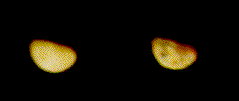 Io imaged from 756,000 km


 Media related to Pioneer 11 Jupiter encounter at Wikimedia Commons
Encounter with Saturn
editThis section needs more citations. (October 2024) |

Pioneer 11 · Saturn · Epimetheus · Janus · Mimas · Enceladus
Pioneer 11 flew past Saturn on September 1, 1979, passing about 21,000 km (13,000 mi) above the planet's cloud tops. During the encounter, it returned 440 images and collected data on Saturn, its rings, and its moons.[29]
By then, Voyager 1 and Voyager 2 had already flown past Jupiter and were en route to Saturn. Mission planners directed Pioneer 11 to cross Saturn's ring plane along the same path later planned for Voyager 2 on its way to Uranus and Neptune.[29] If hazardous ring particles were present, Pioneer 11 would detect them first, allowing Voyager 2's trajectory to be changed if necessary, although doing so would have prevented its later encounters with the ice giants.[31]
During the flyby, Pioneer 11 passed within about 4,000 km (2,500 mi) of one of Saturn's small moons. The object was initially identified as Epimetheus, which had been discovered only the previous day from images returned by Pioneer 11 and had also been suspected from earlier Earth-based observations. After the Voyager missions, astronomers determined that two similarly sized moons, Epimetheus and Janus, share nearly the same orbit, leaving some uncertainty over which moon Pioneer 11 actually passed. The spacecraft encountered Janus on September 1, 1979, at 14:52 UTC, passing within 2,500 km (1,600 mi), and later flew past Mimas at 16:20 UTC the same day at a distance of 103,000 km (64,000 mi).[citation needed]
In addition to observing Epimetheus, Pioneer 11 detected another previously unknown small moon and a previously unknown ring, mapped Saturn's magnetosphere and magnetic field,[3] and found Titan's surface temperature to be about −193 °C (−315 °F), indicating that the moon was too cold to support life as it was understood at the time.[29] Passing beneath the ring plane, the spacecraft returned images of Saturn's rings from a unique viewing angle. Rings that appear bright when viewed from Earth appeared dark in Pioneer 11's images, while the dark gaps visible from Earth appeared bright.[3]
 Pioneer 11 image of Saturn taken on 1979/08/26
 Pioneer 11 image of Saturn taken on 1979/09/01
 Pioneer 11 image of Saturn taken on 1979/09/01
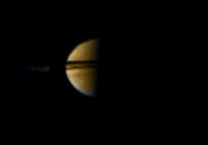 Outgoing Pioneer 11 image of Saturn taken on 1979/09/03
 Pioneer 11 image of Saturn's moon Titan


 Media related to Pioneer 11 Saturn encounter at Wikimedia Commons
Interstellar mission
edit
On February 25, 1990, Pioneer 11 became the fourth human-made object to pass beyond the orbit of the planets.[32]
By 1995, Pioneer 11 could no longer power any of its detectors, so the decision was made to shut it down.[33] On September 29, 1995, NASA's Ames Research Center, responsible for managing the project, issued a press release that began, "After nearly 22 years of exploration out to the farthest reaches of the Solar System, one of the most durable and productive space missions in history will come to a close." It indicated NASA would use its Deep Space Network antennas to listen "once or twice a month" for the spacecraft's signal, until "some time in late 1996" when "its transmitter will fall silent altogether." NASA Administrator Daniel Goldin characterized Pioneer 11 as "the little spacecraft that could, a venerable explorer that has taught us a great deal about the Solar System and, in the end, about our own innate drive to learn. Pioneer 11 is what NASA is all about – exploration beyond the frontier."[34] Besides announcing the end of operations, the dispatch provided a historical list of Pioneer 11 mission achievements.
NASA terminated routine contact with the spacecraft on September 30, 1995, but continued to make contact for about two hours every two to four weeks.[33] Scientists received a few minutes of good engineering data on November 24, 1995, but then lost final contact once Earth moved out of view of the spacecraft's antenna.[1][35]
Timeline
edit

Plot 1 is viewed from the north ecliptic pole, to scale.
Plots 2 to 4 are third-angle projections at 20% scale.
In the SVG file, hover over a trajectory or orbit to highlight it and its associated launches and flybys.
| Timeline of travel | ||||||||||||||||||||||||||||||||||||||||||||||||||||||||||||||||||||||||||||||||||||||||||||||
|---|---|---|---|---|---|---|---|---|---|---|---|---|---|---|---|---|---|---|---|---|---|---|---|---|---|---|---|---|---|---|---|---|---|---|---|---|---|---|---|---|---|---|---|---|---|---|---|---|---|---|---|---|---|---|---|---|---|---|---|---|---|---|---|---|---|---|---|---|---|---|---|---|---|---|---|---|---|---|---|---|---|---|---|---|---|---|---|---|---|---|---|---|---|---|
| ||||||||||||||||||||||||||||||||||||||||||||||||||||||||||||||||||||||||||||||||||||||||||||||
Current status
editDue to power constraints and the vast distance to the probe, the last routine contact with the spacecraft was on September 30, 1995, and the last good engineering data was received on November 24, 1995.[3][1]
As of June 24, 2024, Pioneer 11 is estimated to be 113.121 AU (16.9227×10⁹ km; 10.5153×10⁹ mi) from the Earth and 114.089 AU (17.0675 billion km; 10.6052 billion mi) from the Sun. It was traveling at 11.155 km/s (40,160 km/h; 24,950 mph) relative to the Sun and traveling outward at about 2.35 AU per year.[38][39] The spacecraft is heading in the direction of the constellation Scutum near the current position (June 2024) RA 18h 54m dec -8° 46' (J2000.0), close to Messier 26. In 928,000 years, it will pass within 0.25 parsecs (0.82 light-years) of the K dwarf TYC 992-192-1[40] and will pass near the star Lambda Aquilae in about four million years.[41]
Pioneer 11 has been overtaken by the two Voyager probes launched in 1977. Voyager 1 has become the most distant object built by humans and will remain so for the foreseeable future, as no probe launched since Voyager has the speed to overtake it.[42]
Pioneer anomaly
editAnalysis of the radio tracking data from the Pioneer 10 and 11 spacecraft at distances between 20 and 70 AU from the Sun had consistently indicated the presence of a small but anomalous Doppler frequency drift. The drift can be interpreted as due to a constant acceleration of (8.74 ± 1.33) × 10−10 m/s2 directed towards the Sun. Although it was suspected that there was a systematic origin to the effect, none was found. As a result, there has been sustained interest in the nature of this so-called "Pioneer anomaly".[43] Extended analysis of mission data by Slava Turyshev and colleagues determined the source of the anomaly to be asymmetric thermal radiation and the resulting thermal recoil force acting on the face of the Pioneers away from the Sun.[44][45]
Pioneer plaque
edit
Pioneer 10 and 11 both carry a gold-anodized aluminum plaque in the event that either spacecraft is ever found by intelligent lifeforms from other planetary systems. The plaques feature the nude figures of a human male and female along with several symbols that are designed to provide information about the origin of the spacecraft.[46]
Commemoration
editIn 1991, Pioneer 11 was honored on one of 10 United States Postage Service stamps commemorating uncrewed spacecraft exploring each of the then nine planets and the Moon. Pioneer 11 was the spacecraft featured with Jupiter. Pluto was listed as "Not yet explored".[47]
Gallery
edit Pioneer 11 and Saturn rings on September 1, 1979 (artist concept)
 Pioneer 11's flyby of Saturn (artist concept)


See also
edit

References
edit- 1 2 3 4 5 6 7 8 9 "Pioneer 11 - NASA Science". science.nasa.gov. NASA. December 21, 2017. Retrieved December 1, 2022.
- 1 2 Fimmel, Swindell & Burgess 1974, p. 19.
- 1 2 3 4 5 6 "The Pioneer Missions". nasa.gov. NASA / Ames. March 27, 2007. Archived from the original on October 19, 2021. Retrieved March 3, 2015.
- ↑ "Milestones of Flight". Smithsonian National Air and Space Museum. Archived from the original on April 15, 2012. Retrieved February 8, 2011.
- ↑ Burrows 1990, pp. 266–268.
- ↑ Fimmel, Swindell & Burgess 1974, p. 42.
- ↑ M. Wade. "Pioneer 10-11". Encyclopedia Astronautica. Retrieved February 8, 2011.
- ↑ Fimmel, Swindell & Burgess 1974, pp. 42–43.
- ↑ Fimmel, Swindell & Burgess 1974, pp. 44–45.
- ↑ Skrabek, E. A.; McGrew, J. W. (January 12–16, 1987). "Pioneer 10 and 11 RTG performance update". Transactions of the Fourth Symposium on Space Nuclear Power Systems. Albuquerque, New Mexico. pp. 201–204. Bibcode:1987snps.symp..201S.
- ↑ John D. Anderson; Philip A. Laing; et al. (April 2002). "Study of the anomalous acceleration of Pioneer 10 and 11". Physical Review D. 65 (8) 082004. arXiv:gr-qc/0104064. Bibcode:2002PhRvD..65h2004A. doi:10.1103/PhysRevD.65.082004. S2CID 92994412.
- ↑ Fimmel, Swindell & Burgess 1974, p. 43.
- ↑ Fimmel, Swindell & Burgess 1974, p. 38.
- ↑ "Pioneer 10 & 11". Views of the Solar System. Retrieved December 20, 2018.
- ↑ E. J. Smith. "Pioneer 11: Magnetic Fields". nssdc.gsfc.nasa.gov. NASA. Retrieved February 19, 2011.
- ↑ A. Barnes. "Pioneer 11: Quadrispherical Plasma Analyzer". nssdc.gsfc.nasa.gov. NASA. Retrieved February 19, 2011.
- 1 2 3 4 5 6 7 8 9 10 Simpson 2001, p. 146.
- ↑ J. A. Simpson. "Pioneer 11: Charged Particle Instrument (CPI)". nssdc.gsfc.nasa.gov. NASA. Retrieved February 19, 2011.
- ↑ F. B. MacDonald. "Pioneer 11: Cosmic-Ray Spectra". nssdc.gsfc.nasa.gov. NASA. Retrieved February 19, 2011.
- ↑ J. A. Van Allen. "Pioneer 11: Geiger Tube Telescope (GTT)". nssdc.gsfc.nasa.gov. NASA. Retrieved February 19, 2011.
- ↑ R. W. Fillius. "Pioneer 11: Jovian Trapped Radiation". nssdc.gsfc.nasa.gov. NASA. Retrieved February 19, 2011.
- ↑ W. H. Kinard. "Pioneer 11: Meteoroid Detectors". nssdc.gsfc.nasa.gov. NASA. Retrieved February 19, 2011.
- ↑ R. K. Soberman. "Pioneer 11: Asteroid/Meteoroid Astronomy". nssdc.gsfc.nasa.gov. NASA. Retrieved February 19, 2011.
- ↑ D. L. Judge. "Pioneer 11: Ultraviolet Photometry". nssdc.gsfc.nasa.gov. NASA. Retrieved February 19, 2011.
- ↑ T. Gehrels. "Pioneer 11: Imaging Photopolarimeter (IPP)". nssdc.gsfc.nasa.gov. NASA. Retrieved February 19, 2011.
- ↑ A. P. Ingersoll. "Pioneer 11: Infrared Radiometers". nssdc.gsfc.nasa.gov. NASA. Retrieved February 19, 2011.
- ↑ M. H. Acuña. "Pioneer 11: Jovian Magnetic Field". nssdc.gsfc.nasa.gov. NASA. Retrieved September 24, 2013.
- 1 2 "NASA Glenn: Pioneer Launch History". NASA. March 7, 2003. Archived from the original on July 13, 2017. Retrieved June 13, 2011.
- 1 2 3 4 J. Uri (September 3, 2019). "40 Years Ago: Pioneer 11 First to Explore Saturn". nasa.gov. NASA. Retrieved July 25, 2024.
- ↑ "Pioneer 11 Successfully Retargeted for Saturn". New Scientist. Vol. 62. May 9, 1974. p. 294. Retrieved December 5, 2017.
- 1 2 Schalkwyk, James (April 5, 2013). "NASA Celebrates Four Decades of Plucky Pioneer 11". NASA. Archived from the original on April 8, 2013. Retrieved July 21, 2026.
- ↑ "Pioneer 11 Is Reported to Leave Solar System". The New York Times. February 25, 1990. p. 24. Retrieved December 3, 2017.
- 1 2 "Farewell to a Pioneer". Science News. Vol. 148, no. 16. Society for Science. October 14, 1995. p. 250. JSTOR 4018121.
- ↑ D. Savage; Ann Hutchison (September 28, 1995). "Pioneer 11 to End Operations after Epic Career" (TXT). nssdc.gsfc.nasa.gov. NASA / Ames. Retrieved August 7, 2011.
- ↑ E. Howell (September 26, 2012). "Pioneer 11: Up Close with Jupiter & Saturn". Space.com. Retrieved December 10, 2017.
- ↑ Fimmel, Swindell & Burgess 1974, pp. 61–94.
- ↑ D. Muller. "Pioneer 11 Full Mission Timeline". Spaceflight Realtime Simulations and Information. Archived from the original on March 4, 2016. Retrieved January 9, 2011.
- ↑ "Spacecraft escaping the Solar System". Heavens Above. Retrieved August 24, 2022.
- ↑ "Pioneer 11 - Live Position". www.theskylive.com. Retrieved July 19, 2015.
- ↑ C. A. L. Bailer-Jones; D. Farnocchia (April 3, 2019). "Future Stellar Flybys of the Voyager and Pioneer spacecraft". Research Notes of the AAS. 3 (4): 59. arXiv:1912.03503. Bibcode:2019RNAAS...3...59B. doi:10.3847/2515-5172/ab158e. S2CID 134524048.
- ↑ "Hardware, Leaving the Solar System: Where are they now?". DK Eyewitness - Encyclopedia of Space and the Universe. 2001. ISBN 978-0-789-40881-5.
- ↑ "Voyager - Mission Status". voyager.jpl.nasa.gov. NASA / JPL. Retrieved December 15, 2021.
- ↑ R. R. Britt (October 18, 2004). "The Problem with Gravity: New Mission Would Probe Strange Puzzle". Space.com. Retrieved June 7, 2011.
- ↑ "Pioneer Anomaly Solved!". The Planetary Society. Archived from the original on April 22, 2012. Retrieved April 20, 2012.
- ↑ S. G. Turyshev; V. T. Toth; G. Kinsella; et al. (June 12, 2012). "Support for the Thermal Origin of the Pioneer Anomaly". Physical Review Letters. 108 (24) 241101. arXiv:1204.2507. Bibcode:2012PhRvL.108x1101T. doi:10.1103/PhysRevLett.108.241101. PMID 23004253.
- ↑ C. Sagan; L. S. Sagan; F. Drake (February 25, 1972). "A Message from Earth". Science. 175 (4024): 881–884. Bibcode:1972Sci...175..881S. doi:10.1126/science.175.4024.881. PMID 17781060.
- ↑ S. Kronish (October 27, 1991). "Space Launches are Featured". The Index Journal. South Carolina, USA. p. 21. Retrieved December 5, 2017 – via Newspapers.com.
- "Pioneer 11". Weebau Space Encyclopedia. November 9, 2010. Retrieved January 12, 2012.
Bibliography
edit- Burrows, W. E. (1990). Exploring Space: Voyages in the Solar System and Beyond (first ed.). New York: Random House. ISBN 978-0-394-56983-3.
- Fimmel, R. O.; Swindell, W.; Burgess, E. (1974). Pioneer Odyssey: Encounter with a Giant. Washington, D.C.: NASA / Ames. ISBN 978-1-493-71200-7. OCLC 3211441. NASA-SP-349/396.
- Fimmel, R. O.; van Allen, J. A.; Burgess, E. (1980). "Pioneer: First to Jupiter, Saturn, and Beyond" (PDF). NASA Special Publication. 446. Washington, D.C.: NASA / Ames. ASIN B000IRXYN0. Bibcode:1980NASSP.446.....F. NASA-SP-446.
- Simpson, J. A. (2001). "The Cosmic Radiation". In Johan A. M. Bleeker; Johannes Geiss; Martin C. E. Huber (eds.). The Century of Space Science. Vol. 1. Springer. p. 146. ISBN 978-0-7923-7196-0.
External links
edit