
This article needs additional citations for verification. (August 2015) |
The natural horn is a musical instrument descending from the hunting horn, and is the predecessor to the modern-day French horn. Differentiated by its lack of valves, natural horn relies on a variety of crooks and hand stopping techniques to play the instruments full range. Throughout the seventeenth and eighteenth centuries, the natural horn evolved separate from the trumpet by widening of the bell and lengthening of the tubes.[1] Natural horn consists of a mouthpiece, a pitched crook, foundational tubing, and flared bell. This instrument was used extensively until the emergence of the valved horn in the early 19th century.
 "Cor Solo", Raoux, Paris, 1797 | |
| Classification | Brass instrument |
|---|---|
| Hornbostel–Sachs classification | 423.1 |
| Playing range | |
| Bb2 to Eb5 | |
| Related instruments | |
| Hunting horn | |

Hand-stopping Technique
editThe natural horn has several gaps in its harmonic range. To play chromatically, in addition to crooking the instrument into the right key, users require two additional techniques: bending and hand-stopping. Bending a note is achieved by modifying the embouchure to raise or lower the pitch fractionally, and compensates for the slightly out-of-pitch "wolf tones" which all brass instruments have. Hand-stopping is a technique whereby the player can modify the pitch of a note by up to a semitone (or sometimes slightly more) by inserting a cupped hand into the bell. Both techniques change the timbre as well as the pitch.
It is commonly thought that hand technique emerged during the first half of the eighteenth century at the Dresden court with the horn player Anton Hampel. Domnich (1807) cited Hampel as the inventor of this technique and recounted the "invention" in which Hampel, trying to emulate oboist colleagues who used cotton plugs to "mute" their instruments, tried the same with his horn and was "surprised to find that the pitch of his instrument rose by a semitone. In a flash of inspiration he realised that by alternately inserting and withdrawing the cotton plug he could cover without a break every diatonic and chromatic scale."[2]
Pitch changes are made through a few techniques:
- Modulating the lip tension as done with modern brass instruments. This allows for notes in the harmonic series to be played.
- Changing the length of the instrument by switching the crooks. This is a rather slow process. Before the advent of the modern valved horn, many ideas were attempted to speed up the process of changing the key of the instrument. Crooks were in common use by 1740.[3]
- Changing the position of the hand in the bell; this is called hand-stopping. The effect is a pitch that lowers the harmonic, but dampens the sound.
The Inventionshorn and Tuning slide
edit
In 1753 Anton Hampel alongside Johann Werner, developed invented the Inventionshorn, built with a fixed mouthpiece so that the horn remained at the same distance no matter how many crooks were added. This aspect of the Inventionshorn influenced the modern day double sided horn the F and Bb harmonic series. [4]

Johann Gottfried Haltemhof, in the 1770s designed the tuning slide system lengthening the tenons into slides to make it possible to tune the horn and we still have that system on modern day horns. [4]
Crooks
edit[5] The Crooks are also where we get transpositions on the modern day horn.
| Key of Crooks | Ranges of harmonics | Crook Length | Tranposes | |
|---|---|---|---|---|
| Bb Alto | Bb2-D5 | 2nd-10th | 16in | Major 2nd lower |
| A | A2-C#5 | 2nd-10th | 22.5in | minor 3rd lower |
| Ab | Ab2-C5 | 2nd-10th | 29.5in | Major 3rd lower |
| G | G2-D5 | 2nd-12th | 36.75in | Perfect 4th lower |
| F | F2-F5 | 2nd-16th | 52.5in | Perfect fifth lower |
| E | E2-E5 | 2nd-16th | 61in | minor 6th lower |
| Eb | Eb2-Eb5 | 2nd-16th | 70.25in | Major 6th lower |
| D | D2-D5 | 2nd-16th | 80in | minor 7th lower |
| C basso | G2-C5 | 3rd-16th | 101in | Octave lower |
| Bb basso | F2-Bb4 | 3rd-16th | 125in | Major 9th lower |
Repertoire
editThe repertoire for horn includes many pieces that were originally written with the natural horn in mind. Until the development of the modern horn in the early to mid-19th century, Western music employed the natural horn and its natural brass brethren. Substantial contributors to the horn repertoire include Handel, Haydn, Mozart, Beethoven, Telemann, Weber, Brahms and many others.
The chromatic abilities of recently developed brass instruments, however, opened new possibilities for composers of the Romantic era, and fit with the artistic currents of the time. By the end of the 19th century and the beginning of the 20th century, almost all music was written for the modern valved horn.
However, the natural horn still found its way into the works of some composers. Brahms did not care for the valved horn and wrote for natural horn.[6] Benjamin Britten's Serenade for Tenor, Horn and Strings, though written for the modern horn, makes notable use of the F harmonic series and has been performed using the natural horn to produce a "sorrowful tone" as a consequence of its "fragile intonation".[7]
György Ligeti's Hamburg Concerto makes a great use of the natural horn and of natural sounds on the modern horn in the solo part and requires four natural horns in the orchestra.
 A natural horn in heraldry, crest of Gerardus Rubens.
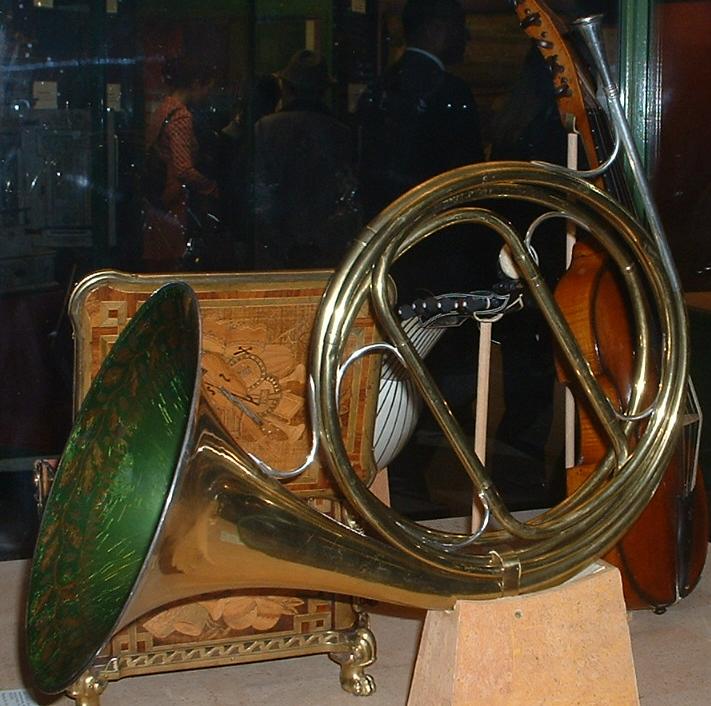 Natural horn in the Victoria and Albert Museum, London

.JPG)
Comparative Performance Demands
editBeyond note bending and hand stopping, physical difference brought on via the nature of the natural horn, there are nuanced differences in repitoire preparation in comparison to the modern horn. Notably differences in air stream and resistance alter the difficulty of passages, altering the audibly differences in the horns. Mozarts Fourth Horn Concerto is a standard repitoire piece that is suited for both instruments, despite evident differences in excecution. [8]
Allegro Moderato relies heavily on hand movements in the natural horn, shifts in hand stopping between full, three-quarters and open playing whereas the modern horn circumvents these challenges via valves. Phrasing, intended musicality and transposition are comparatively more manageable despite having the same expectations. The simplified focus does not favour only the modern horn, as the second movement, Romanza (Andante), instead benefits the natural horn. The complex tubing of the modern horn increases air resistance and fatigue, whereas the natural horn benefits from the smaller lengths of indiviual crooks, meaning phrasing and sustain demands can be met with lesser physical straing of the natural horn. Rondo (Allegro Vivace) returns to the virtuosic focus of the opening movement, with the demands of leaps, tempo and articulation remaining challenging regardless of the chosen instrument; The third movement requires precision regardless of memorizing valve or hand movements.[8]
See also
editReferences
edit- ↑ Hiebert, Thomas (October 1997). "The horn in the Baroque and Classical periods". The Cambridge Companion to Brass Instruments. pp. 103–114. doi:10.1017/ccol9780521563437.010. ISBN 9780521565226. Retrieved 2019-03-28.
- ↑ Humphries, John. The Early Horn (Cambridge University Press, 2000)
- ↑ Meucci, Renato; Rocchetti, Gabriele (2001). "Horn | Grove Music". www.oxfordmusiconline.com. doi:10.1093/gmo/9781561592630.article.13353. ISBN 978-1-56159-263-0. Retrieved 2019-03-28.
- 1 2 Tuckwell, Barry (1983). Horn. 866 Third avenue, New York. N.Y.. 10022: Schirmer Books. pp. 29–30. ISBN 0-02-871530-6.
{{cite book}}: CS1 maint: date and year (link) CS1 maint: location (link) - ↑ Phiergo, Johnny (1997). "The Horn Call Annual". The Horn Call (9): 10. ISSN 0046-7928 – via The University of Oklahoma Fine arts Library.
- ↑ Moore, K. C. "The persistence of the natural horn in the romantic period". Retrieved 2008-07-20.
- ↑ Mullins, Chris. "BRITTEN: Serenade for Tenor, Horn and Strings etc". Opera Today. Retrieved 27 April 2024.
The Berlin Philharmonic, needless to say, performs with exquisite precision, and Radek Baborak's horn in the Serenade has a beauty others have foregone for a more sorrowful tone produced by the fragile intonation of a natural horn.
- 1 2 Garrison, Brandon (2023-12-01). "A SURVEY OF THE COMPARATIVE PERFORMANCE DEMANDS OF PERFORMING MOZART'S FOURTH HORN CONCERTO ON THE NATURAL HORN AND MODERN HORN". Doctoral Projects.
External links
edit- The Cyber Horn Museum
- Ericson, John. "The Natural Horn".
- Seraphinoff, Richard. Natural Horns—see the Articles menu