
A khanate (/ˈxɑːneɪt, -ət/ KHAHN-ayt, -ət) or khaganate was a polity ruled by a khan, khagan, khatun, or khanum.[1][2] Khanates were typically nomadic Mongolic and Turkic societies located on the Eurasian Steppe,[3][4][5] and politically equivalent in status to kinship-based chiefdoms and feudal monarchies. Khanates and khaganates were organised tribally, where leaders gained power on the support and loyalty of their warrior subjects,[3] gaining tribute from subordinates as realm funding.[6] In comparison to a khanate, a khaganate, the realm of a khagan, was a large nomadic state maintaining subjugation over numerous smaller khanates.[7] The title of khagan, translating as "Khan of the Khans", roughly corresponds in status to that of an emperor.[4]
Mongol khanates
edit
- Mongol Empire (1206–1368) was the largest steppe nomadic Khaganate as well as second largest empire and the largest contiguous empire[8] in history. After Genghis Khan established appanages for his family in the Mongol Empire during his rule (1206–1227), his sons, daughters, and grandsons inherited separate sections of the empire. The Mongolian khanates that emerged from those appanages are listed below.
- Chagatai Khanate (1226–1347), established by Chagatai Khan, the second son of Genghis Khan. At its height in the late 13th century, the khanate extended from the Amu Darya south of the Aral Sea to the Altai Mountains in the border of modern-day Mongolia and China, roughly corresponding to the defunct Qara Khitai Empire. Initially the rulers of the Chagatai Khanate recognized the supremacy of the Great Khan, but by the reign of Kublai Khan, Ghiyas-ud-din Baraq no longer obeyed the emperor's orders. By 1347 the khanate had split into the Moghulistan and West Chagatai Khanate.[9]
- Ilkhanate (1256–1335), established by the grandson of Genghis Khan, Hulagu Khan. Its core territory lies in what is now part of the countries of Iran, Azerbaijan, and Turkey. At its greatest extent, the Ilkhanate also included parts of modern Iraq, Syria, Armenia, Georgia, Afghanistan, Turkmenistan, Pakistan, part of modern Dagestan, and part of modern Tajikistan. Later Ilkhanate rulers, beginning with Ghazan in 1295, converted to Islam. In the 1330s, the Ilkhanate was ravaged by the Black Death. Its last khan Abu Sa'id died in 1335, after which the khanate disintegrated. The Ilkhanid rulers, although of non-Iranian origin, tried to advertise their authority by tying themselves to the Iranian past, and they recruited historians in order to present the Mongols as heirs to the Sasanians (224–651 AD) of pre-Islamic Iran.

Turco-Mongol residual states and domains in the 15th century - Golden Horde
- Yuan dynasty
- Northern Yuan dynasty
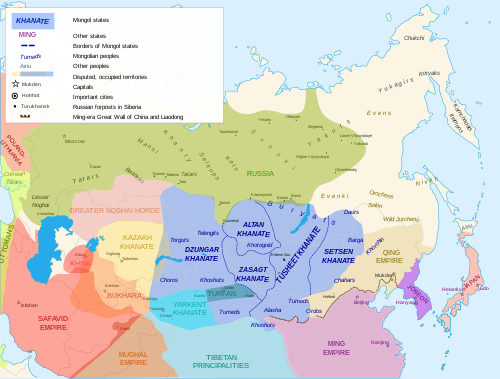
Central Asia in 1636. The Dzungar Khanate was the last great nomadic empire in Central Asia
- Northern Yuan dynasty
- Oirat Khanate
- Dzungar Khanate (1634–1758), formed by the Dzungars, a confederation of several Oirat tribes. It covered Xinjiang region of China, Kyrgyzstan, eastern Kazakhstan and western Mongolia. 1717–1720, also styled Protector of Tibet; annexed by the Qing dynasty.
- Kalmyk Khanate (1630–1771), established by the Torghut branch of the Mongol Oirats, settled along the lower Volga River (in modern Russia and Kazakhstan).
- Khoshut Khanate (1642–1717), established by the Khoshut branch of the Mongol Oirats.
- Bogd Khanate (1911–1924), under the rule of the Bogd Khan, the last Mongol khagan.
- Keraite Khanate
- Khamag Mongol Khanate
- Kumul Khanate (1696–1930), a vassal state to Qing dynasty and Republic of China.
- Merkit Khanate
- Naiman Khanate
- Tatar Khanate


Turkic khanates
editEarly and Late Medieval Turkic khaganates and khanates
edit.png)


- First Turkic Khaganate
- Second Turkic Khaganate
- Uyghur Khaganate
- Yenisei Kyrgyz Khaganate
- Khazar Khaganate – Turkic nomads who later converted to Rabbinic Judaism
- Turgesh Khaganate
_eng.png)

- Old Great Bulgaria
- Volga Bulgaria
- First Bulgarian Empire, which started as a Turkic state, also known as Danube Bulgaria (in contrast to Volga Bulgaria, as both were established by members of the same Bulgar Turkic Dulo clan), but later became fully Slavicized and a Tsardom.
- Golden Horde
- Khanate of Kazan
- Crimean Khanate
Central Asian Turkic khanates
edit- Kara-Khanid Khanate
- Kimek Khanate
- Keraite Khanate
- Naiman Khanate
- Tatar Khanate
- Merkit Khanate
- Nogai Khanate
- Astrakhan Khanate
- Besh Tau El
- Khanate of Bukhara
- Khanate of Khiva
- Kyrgyz Khaganate
- Kara-Kyrgyz Khanate
- Karluk Khanate
- Khanate of Kashgaria – Kashgaria was founded in 1514 as part of Chagatai Khanate; in the 17th century it was divided into several minor khanates without importance, with real power going to the so-called Khwaja, Arabic Islamic religious leaders. It became the Yarkent Khanate which was annexed by the Dzungar Khanate in the Dzungar conquest of Altishahr in 1680.
- Kazakh Khanate
- Senior zhuz
- Middle zhuz
- Junior zhuz
- Bukey Horde, Bokei or Buqei; also known as the Inner or Interior Horde – This state founded in 1801 by Sultan Bukey under Russian suzerainty, and restyled as the khanate of the Inner Horde in 1812. 5,000–7,500 families of Kazakhs from the Younger Kazakh Zhuz tribe settled between the Volga and Yaik (Ural) rivers. In 1845 the post of khan was abolished, and Russia took over the region.
- Kokand Khanate
- Kumul Khanate – a vassal state to Qing dynasty and Republic of China, abolished in 1930
- Kunduz Khanate
- Maimana Khanate
- Oghuz Yabgu State
- Qasim Khanate (hence modern Kasimov) – named after its founder, a vassal of Moscow and Russia
- Khanate of Sibir – source of the name Siberia, as the first significant conquest during Russia's great eastern expansion across the Urals
- The Khanate of Tuva near Outer Mongolia
- Uzbek Khanate
- Yarkent Khanate
- Turpan Khanate
Khanates of Azerbaijan
editKhanates of the Caucasus
editOther khanates
edit
- Avar Khaganate
- Khanate of Kalat – Brahui/Baloch Khanate
- Later Jin dynasty – Later evolved into the Qing dynasty
- Nishapur Khanate
- Rouran Khaganate
- Xiongnu, mentioned in Chinese sources, were possibly of Proto-Turkic, Turkic, Mongolic or else Iranic origin (disputed) and are proposed as the possible ancestors of the Huns (whose language remains unclassified).
- Xueyantuo, mentioned in Chinese sources, were a Tiele tribe, related to the earlier Dingling people, who emerged after the disintegration of the Xiongnu confederacy (they were at one point vassals of the Göktürks, later aligning with the Tang dynasty against the Eastern Göktürks).
See also
edit- Rus Khaganate (not an actual Khanate but so named retroactively)
- Afsharid dynasty
- Beg Khan
- Orda (organization)
- Safavid dynasty
- Timurid dynasty
References
edit- ↑ "Definition of KHANATE". merriam-webster.com. Retrieved 21 April 2023.
- ↑ "khagan in Old Turkish – English-Old Turkish Dictionary | Glosbe". glosbe.com. Retrieved 21 April 2023.
- 1 2 "khanate". Oxford Reference. Retrieved 21 April 2023.
- 1 2 "What Is a Khan?". ThoughtCo. Retrieved 21 April 2023.
- ↑ "The Mongol Khans". education.nationalgeographic.org. Retrieved 21 April 2023.
- ↑ Cartwright, Mark (16 September 2019). "Genghis Khan". World History Encyclopedia. Retrieved 21 April 2023.
- ↑ Królikowska-Jedlińska, Natalia. Law and Division of Power in the Crimean Khanate (1532–1774).
- ↑ Morgan. The Mongols. p. 5.
- ↑ The Yenching Journal of Social Studies, Volumes 4-5. 1948. p. 68.
External links
edit Media related to Khanates at Wikimedia Commons

.svg)