
Cesar Enrique Aguinaldo Virata KGCR (born December 12, 1930)[1] is a Filipino former statesman and businessman who was the fourth Prime Minister of the Philippines from 1981 to 1986. Serving concurrently as Secretary of Finance from 1970 to 1986, Virata was the chief economic technocrat during the administration of President Ferdinand Marcos.[2] He is currently serving as the corporate vice chairman of the Rizal Commercial Banking Corporation.[3] He is the eponym of the Cesar E.A. Virata School of Business (VSB),[4] the business school of the University of the Philippines Diliman, a naming designation that has sparked public controversy due to his high-level association with the Marcos martial law regime.[5]
Cesar Virata | |
|---|---|
.jpg) Virata in 2019 | |
| 4th Prime Minister of the Philippines | |
| In office July 28, 1981[a] – February 25, 1986 | |
| President | Ferdinand Marcos |
| Deputy | Jose Roño |
| Preceded by | Ferdinand Marcos |
| Succeeded by | Salvador Laurel |
| Deputy Prime Minister of the Philippines | |
| In office June 12, 1978 – June 30, 1981 | |
| President | Ferdinand Marcos |
| Prime Minister | Ferdinand Marcos |
| Preceded by | Position established |
| Succeeded by | Jose Roño |
| 3rd Director-General of the National Economic and Development Authority and Minister of Economic Planning | |
| In office 1983–1984 | |
| President | Ferdinand Marcos |
| Preceded by | Placido Mapa Jr. |
| Succeeded by | Vicente Valdepeñas Jr. |
| Secretary/Minister of Finance | |
| In office February 9, 1970 – March 3, 1986 | |
| President | Ferdinand Marcos |
| Preceded by | Eduardo Romualdez |
| Succeeded by | Jaime Ongpin |
| Member of the Regular Batasang Pambansa | |
| In office June 30, 1984 – March 25, 1986 | |
| Constituency | Cavite |
| Member of the Interim Batasang Pambansa | |
| In office June 12, 1978 – June 5, 1984 | |
| Constituency | Region IV-A |
| Personal details | |
| Born | Cesar Enrique Aguinaldo Virata December 12, 1930 |
| Party | Independent (1986–present) KBL (1978–1986) |
| Spouse | Phylita Joy Gamboa |
| Children | 3 |
| Alma mater | University of the Philippines Diliman (BS) University of Pennsylvania (MBA) |
Awards | Grand Cordon, Order of the Rising Sun |
Early life and education
editCesar Enrique Aguinaldo Virata was born on December 12, 1930, in Kawit, Cavite to a family of middle-class landowners.[6][7] His father was a mathematics professor at the original campus of the University of the Philippines (UP) in Manila, later becoming an acting president for the university.[7]
Virata studied at the University of the Philippines Diliman, obtaining a Bachelor of Science degree in Mechanical Engineering with honors (cum laude) in 1952. After completing his engineering degree, he taught at the UP College of Business Administration.[7] His status as a UP faculty member linked him to a network of fellowships, enabling him to study at the Wharton School of the University of Pennsylvania in 1953 with support from the Mutual Security Administration (a forerunner to the United States Agency for International Development).[7] He graduated with a Master of Business Administration degree with a concentration in Industrial Management, studying various aspects of business administration, American labor, and the automobile and steel industries.[6] When he returned to the Philippines, he was recruited to the accounting and consulting firm SyCip Gorres Velayo & Co., working full-time until returning to teaching at UP in December 1965, eventually becoming a professor as well as dean at the UP College of Business Administration.[8]
Government service
editThis section needs more citations. (December 2025) |
Finance minister
edit.jpg)
He served as Finance Minister from 1970 to 1986 under President Ferdinand Marcos.
During his tenure as Finance Minister, he oversaw the national budget and restructured debt. He also established more hydroelectric plants in hopes of making the Philippines less reliant on foreign energy.[9]
Prime Minister of the Philippines
edit
Virata served as Prime Minister of the Philippines[10] from 1981 to 1986 under the Interim Batasang Pambansa and the Regular Batasang Pambansa, concurrently with his position as Finance Minister.
He also headed the National Economic and Development Authority (NEDA), the country's highest economic planning body, while also serving as the prime minister. Virata was the third to occupy the position and was succeeded by economist Vicente Valdepeñas, Jr.
After the 1986 EDSA Revolution
editHe was replaced as prime minister in the aftermath of the 1986 People Power Revolution by Salvador Laurel. Laurel succeeded Virata as prime minister on February 25, 1986, through the appointment of Corazon Aquino, but the position was abolished a month later by Proclamation No. 3 (the 'Freedom Constitution'). The office was confirmed as superseded by the 1987 Constitution, which again fused the offices of the head of state and the head of government in the President.
Academe
editPrior to assuming leadership positions in the government service during the Marcos administration, Virata taught at the business school of the University of the Philippines Diliman. He served as dean of the College of Business Administration, which was named after him on April 12, 2013, by the University of the Philippines Board of Regents (BOR) as the Cesar E.A. Virata School of Business. This decision was driven by a commitment from businessman and UP alumnus Magdaleno Albarracin, who pledged to donate ₱40 million to the university, conditioned upon the board's approval to rename the college after Virata.[11]
The renaming sparked protests from several sectors within the UP community, including faculty, U.P. Kilos Na and UP School of Business Student Council.[12] The objectors argued against honoring Virata, with many citing his role as a top-ranking official and enabler of the Marcos dictatorship,[13][11] a regime marked by widespread human rights abuses and economic plunder. Critics also questioned the ethics of allowing a private financial donation to influence the naming of a public academic institution.[14] Because of this intense backlash, the BOR decided to restudy its decision during its board meeting held on July 29, 2013. The matter was discussed at length in a series of meetings which resulted in the BOR re-affirming its decision to rename the college after Virata.[15]
Personal life
edit
Virata is married to Phylita Joy Gamboa, a Philippine stage actress and theater director.[16][17] Together, they have three children: Steven Cesar, a businessman; Gillian Joyce, an educator; and Michael Dean, a physician specializing in infectious disease.[18] Virata is a grandnephew of the first president of the Philippines, Emilio Aguinaldo, and half-nephew to Leonides Sarao Virata, who also served under the Marcos regime as Secretary of Trade and Industry and chairman of the Development Bank of the Philippines. Outside of his professional life, Virata is known to be an accomplished tennis player. Virata is a member of the Philippine Independent Church.[19]
Biographies
editVirata's life and his impact on Philippine economic history have been the subject of various books. The most of extensive biography to cover Virata as its main subject is Gerardo Sicat's biography, Cesar Virata: Life and Times Through Four Decades of Philippine Economic History (2014).[20] Sicat was a top economist during the Marcos dictatorship and a close associate of Virata.[21] He is also one of the main subjects of Teresa S. Encarnacion Tadem's Ateneo Press book Philippine Politics and the Marcos Technocrats: The Emergence and Evolution of a Power Elite (2019).[22]
Honors
edit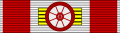 Grand Cordon of the Order of the Rising Sun (2016)[23]
- Most Distinguished Brother, Pan Xenia International Professional Foreign Trade Fraternity

See also
edit- Prime Minister of the Philippines
- National Economic and Development Authority (Prime Minister was also the head of the NEDA)
- Gerardo P. Sicat, 2014. Cesar Virata Life and Times Through Four Decades of Philippine Economic History, Diliman, Quezon City: The University of Philippines Press, ISBN 978-971-542-742-5.
Notes
edit- ↑ Acting prime minister from June 30, 1981 to July 28, 1981
References
edit- ↑ "The Philippines Who's who". Who's Who Publishers. May 28, 1981 – via Google Books.
- ↑ Tadem, Teresa S. Encarnacion (2016). "The Rise and Fall of Virata's Network: Technocracy and the Politics of Economic Decision Making in the Philippines". Southeast Asian Studies. 5 (1): 35–71. doi:10.20495/seas.5.1_35. hdl:2433/210524. ISSN 2186-7275.
- ↑ Tupas, Emmanuel. "Año, Bongbong, Virata test positive". PhilStar.com. Retrieved April 3, 2020.
- ↑ "UP Virata School of Business". www.vsb.upd.edu.ph. Retrieved May 24, 2026.
- ↑ Andrade, Jeannette I. (June 13, 2013). "New UP college name questioned". INQUIRER.net. Retrieved May 24, 2026.
- 1 2 "César Virata". Third World Quarterly. 6 (2): 272. 1984.
- 1 2 3 4 Tadem, Teresa S. Encarnacion (2016). "The Rise and Fall of Virata's Network: Technocracy and the Politics of Economic Decision Making in the Philippines". Southeast Asian Studies. 5 (1): 38. doi:10.20495/seas.5.1_35. hdl:2433/210524.
- ↑ Tadem, Teresa S. Encarnacion (2016). "The Rise and Fall of Virata's Network: Technocracy and the Politics of Economic Decision Making in the Philippines". Southeast Asian Studies. 5 (1): 39. doi:10.20495/seas.5.1_35. hdl:2433/210524.
- ↑ Kelner, Braden (July 1, 2007). "Progressive Leader For The Philippines: Cesar Virata, WG '53". Wharton Magazine. Retrieved May 26, 2026.
- ↑ "Aquino Abolishes Assembly, Declares Interim Government". Milwaukee Journal. AP. March 25, 1986. p. 3. Retrieved September 30, 2010.
- 1 2 Mateo, Janvic. "UP gets 1st half of P40-M donation to rename college after Marcos PM". Philstar.com. Retrieved May 24, 2026.
- ↑ Tupaz, Voltaire (February 10, 2014). "UP students oppose naming college after Marcos PM". RAPPLER. Retrieved May 24, 2026.
- ↑ "Ang mga Isyu at Interes sa Pagpangalan sa UP College of Business Administration na Cesar E. A. Virata School of Business". Kasarinlan: Philippine Journal of Third World Studies. 27–28 (1–2): 20. 2013.
- ↑ "Ang mga Isyu at Interes sa Pagpangalan sa UP College of Business Administration na Cesar E. A. Virata School of Business". Kasarinlan: Philippine Journal of Third World Studies: 51. January 1, 2013.
- ↑ Hidalgo, Cristina Pantoja (2016). The UP Cesar E.A. Virata School of Business: A Century of Business Education in the Philippines (First ed.). Diliman, Quezon City: UP Business Research Foundation, Inc. pp. 81–82. ISBN 978-621-95585-0-1.
- ↑ "Long lives: Stories & secrets". Philstar Life. Retrieved May 25, 2026.
- ↑ "Joy Virata". REPERTORY PHILIPPINES. Retrieved May 25, 2026.
- ↑ Jose, F. Sionil. "The man who holds a candle: Cesar Virata in the Marcos regime". Philstar.com. Retrieved May 25, 2026.
- ↑ Wilson Lee Flores (May 22, 2016). "Is a socialist 'ghost' to be feared?". The Philippine Star. Retrieved December 14, 2019.
- ↑ Sicat, Gerardo P. (2014). Cesar Virata : life and times through four decades of Philippine economic history. Diliman, Quezon City. ISBN 978-971-542-741-8. OCLC 885027140.
{{cite book}}: CS1 maint: location missing publisher (link) - ↑ Tadem, Teresa S. Encarnacion (2014). "Philippine Technocracy and the Politics of Economic Decision-Making: A Comparison of the Martial Law and Post-Martial Law Periods The Politics of Technocracy in Southeast Asia". Southeast Asian Studies. 3 (2): 353. doi:10.20495/seas.3.2_345. ISSN 2186-7275.
- ↑ Tadem, Teresa S. Encarnacion (2019). Philippine politics and the Marcos technocrats : the emergence and evolution of a power elite. Quezon City, Philippines. ISBN 978-971-550-913-8. OCLC 1120784698.
{{cite book}}: CS1 maint: location missing publisher (link) - ↑ Kristine Angeli Sabillo (November 25, 2016). "Marcos admin PM Virata receives award from Japanese gov't". Philippine Daily Inquirer. Retrieved November 25, 2016.
External links
edit Media related to Cesar Virata at Wikimedia Commons
