
| Name | Proto-Germanic | Old English | Old Norse | |
|---|---|---|---|---|
| *Berkanan | Beorc/Berc | Bjarkan, Birkal | ||
| "birch" | "birch"/"poplar"? | "birch (lumber)", "birch buds" | ||
| Shape | Elder Futhark | Futhorc | Younger Futhark | |
 | |  | ||
| Unicode | ᛒ U+16D2 | ᛒ U+16D2 | ᛓ U+16D3 | |
| Transliteration | b, ƀ | b, p | ||
| Transcription | b | |||
| IPA | [b], [β] | [b], [p] | ||
| Position in rune-row | 18 | 13 | ||
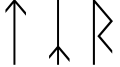
ᛒ is a rune that is transliterated as b or ƀ (β)[1] in the Germanic Elder Futhark and the Anglo-Saxon Futhorc writing systems respectively, and as b or p in the Norse Younger Futhark.
The letter shape is likely directly based on Old Italic 𐌁, whence comes also the Latin letter B.
Proto-Germanic tradition
editThe reconstructed Proto-Germanic rune name is *berkanan, meaning "birch". While the reconstructed name may have varried historically, the sense of "birch" is uniform across all Runic traditions, including potential derivatives like Irish Ogham, which also uses "birch" for B (Old Irish: Beith).
Gothic tradition
editThe Goths used the Elder Futhark for some time before switching to the Gothic alphabet in the 4th century. Like the runic system, they gave corresponding names for all the letters, which for the most part are direct analogs to the rune names, meaning that they most likely ported over the old rune names to their new alphabet. This gives the potentially oldest recorded form of the rune name in the corresponding Gothic letter 𐌱 b, recorded in the late 8th century as bercna by Alcuin of York, which can be reconstructed as the earlier proper form *𐌱𐌰𐌹𐍂𐌺𐌰𐌽 (*baírkan).[2]
Anglo-Saxon / Old English tradition
edit_(berc).jpg)
The Anglo-Saxon and Old English name is recorded as beorc or berc ("birch" or "poplar"). It is found as early as the 8th century, as featured in the Old English rune poem.
The Old English rune poem goes:
- ᛒ Beorc bẏþ bleda leas, bereþ efne sƿa ðeah
- tanas butan tudder, biþ on telgum ƿlitig,
- heah on helme hrẏsted fægere,
- geloden leafum, lẏfte getenge.
- Birch has no fruit, yet it bears nevertheless
- shoots without fruits, is beautiful with branches
- high in its crown, splendidly adorned
- and laden with leaves, pressing up loftily[3]
Norse tradition
editIn West Norse tradition (Norway, Iceland) the rune is called bjarkan, meaning birch, albeit archaically, as the common form for birch is bjǫrk. The form probably existed in East Norse as well (Denmark, Sweden), as the Old Danish Norse form biercan is found in Codex Leidensis (10th c.).[4]
Danish tradition
edit
In Denmark, little is preserved of Danish runic tradition, in comparison to Iceland, Norway, and Sweden. No indigenous rune poem is known. As aforementioned, the rune name "bjarkan" is recorded in Danish Old Norse as biercan, as found in Codex Leidensis (10th c.).[4]
Another Danish name is recorded in Abecedarium Nordmannicum (10th c.), which became largely unreadable in the 19th century due to a failed preservation attempt. A handwritten copy exists from 1826, by Wilhelm Grimm, which has the name written as brica or brita depeding on the assumed identity of the fourth character. If "brica" is correct, then a reasonable cenario could be that it is a corruption or mispelling of the name birka. If "brita" is correct, then various theories are possible. For example, Brita is a Nordic shortform for the name Birgitta, which stems from the same root as the Irish pagan goddess Brigid, who is believed to have had the "birch" as her holy tree.[5] Likewise, "Börk", a Nordic dialect form for birch, is recorded as a variation of the given name Brita in Västerbotten and Norrbotten in Sweden.[6]
Icelandic tradition
editIn Iceland, the rune is called bjarkan per Norwegian tradition. The Old Icelandic rune poem is partially incomplete, as the original record, AM 687d 4°, is damaged and impossible to make out at parts, such as the bjarkan poem.[7] Many different forms are recorded.[8] A recorded form by Jón Ólafsson of Grunnavík (1732), attributed to either Magnus Olafsson (c. 1573-1636) or a Sveinn a Barði, with Latin translation,[7] reads as:
- ᛒ Bjarkan er litit lim
- ok laufgat tre
- vaxandi vidr[7]
- Birch is a small twigged
- and leafy tree
- growing wood
Norwegian tradition
editIn Norway, the rune is called bjarkan. The Old Norwegian rune poem goes:
- ᛒ Bjarkan er laufgrønstr líma;
- Loki bar flærða tíma.
- Birch has the greenest leaves of any plant-limb;
- Loki bore fortune in his deceit.
Swedish tradition
editIn Sweden, the rune is called birkal (also recorded as bÿrkal, birka),[9] with secondary forms like birk, biørk/björk (lit. 'birch'), and birke (lit. 'birch lumber, birch grove') in Dalecarlian (1599).[10] The suffix -al in Birkal is assumed to mean "fruit of the tree" (also found as Old Norse: -yla, Gothic: -𐌹𐌻𐍉 -ílo, and various West Germanic forms, for example Old High German: eihh-ila, "acorn"; Middle High German: büech-el, "beech nut", etc; cf. Swedish: ek-ållon, "acorn"),[11] which is supported by the its primary Swedish rune kenning, björkbrumar frodast ("birch buds most flourishing").[10] Dalecarlian birke, meaning "birch forrest",[12] also has analog rune kennings: björkahultet grönast[9] ("the birch grove greenest"), björkeskog grönast ("birch forest greenest").[13]
There are multiple recorded Swedish rune poems, all of which are short rune kennings. Some shows features of the High to Late Middle Ages and regional variation, with others showing archaic features of unknown older descent, with some select being analog to the Norwegian and Icelandic poems.
The earliest recorded poem was done rather unknowingly by Johannes Bureus in 1599, simply listing them as "signific" in Latin.[10] An incomplete alternative collection was recorded in a letter by Nicolaus Granius in 1600,[9] and a supplemented third version, more similar to the Bureus collection, was published by Georg Stiernhielm in 1685.[13] Various random forms are also recorded by Olaus Verelius in 1675, found scattered alongside equivelant short forms of the Icelandic poems.[14]
Bureus kenning (1599) goes:
ᛒᛁᚬᚱᚴᛅ_ᛒᚱᚢᛘᚱ ᚠᚱᚭᚦᛆᛋᛏ
(Biörkä-brumr frothast)[10]
"Birch buds most flourishing"
The Granius kenning (1600) goes:
Biörkahúltet grönast[9]
"The birch grove greenest"
The Verelius kenning (1675) is anachronistic in spelling, but goes:
Biarks brumur frodast
Biark lunda fegurd[14]
"Birch's buds most flourishing"
"Birch be, in a way, beautiful"
The Stiernhielm kenning (1685) goes:
Biörkbrumar frodast;
Biörkeskog grönast,
i.e. bäst til Wärke[13]
"Birch buds most flourishing;
Birch forest greenest,
i.e. best (material) for working"
Norse p-rune (Plástr)
edit| Name | Old Norse | |
|---|---|---|
| stunginn ᛒ | Plástr | |
| "stung ᛒ" | "Bandage" | |
| Unicode | ᛔ U+16D4 | ᛕ U+16D5 |
| Transliteration | p | |
| Transcription | p | |
| IPA | [p] | |
| Position in rune-row | *13 | |
The Norse ᛒ rune primarily stood for /b/, but also represented /p/. In the Early Medieval period, various improvements were made to the Norse runic system in order to make it easier to write with, leading to some proper p-runes. Such generally lacked its own name, but have at times been referred to as Plástr ("bandage").
ᛔ Stung Bjarkan/Birkal
editA stung version of Bjarkan/Birkal ᛔ appeared in the 12th century (Old West Norse: stunginn Bjarkan; Old Swedish: stungen Birkal), meant to indicate that the rune made a /p/ sound.
ᛕ Open Bjarkan/Birkal
editThe stung version of the Bjarkan/Birkal ᛔ was complex to carve, leading to a simplified modifikation ᛕ where the loops were opened, leading to the "open Bjarkan/Birkal".[15]
ᛒ Turned Bjarkan/Birkal
editIn Norse Medieval writing, the ᛒ was sometimes mirrored ᛒ to represent /p/ instead of /b/.[10] Such runes are recorded in Early Modern Swedish as being called "turned runes" (vändrunor).[10] A potential name could be *Birkal-vänd ("ᛒ turned") based on other recorded rune names.[16]
See also
editReferences
edit- ↑ "ramm sbst. 4". saob.se (in Swedish). Swedish Academy. Retrieved 2026-05-18.
urnord. haraƀanaR
- ↑ Kirchhoff, Adolf (1854). Das gothische Runenalphabet (in German). Berlin: Wilhelm Hertz. p. 37. OCLC 1042908167. OL 14002786M. Retrieved 2025-01-03.
- ↑ Frederick George Jones, JR.JONES, JR. (1967). The Old English rune poem, an edition. University of Florida. Retrieved 2026-05-02.
{{cite book}}: CS1 maint: multiple names: authors list (link) - 1 2 cod. leidensis lat. 4:o, 83
- ↑ Hutton, Ronald (1996). The Stations of the Sun: A History of the Ritual Year in Britain. Oxford University Press. ISBN 9780198205708. OCLC 832535162.
- ↑ börk – via Project Runeberg.
- 1 2 3 R. I. Page (1999). The Icelandic rune poem. Viking Society for Northern Research, University College London. ISBN 0 903521 43 1.
- ↑ Bjarkan rune poem – via Project Runeberg.
- 1 2 3 4 c:File:Brief van Nicolaus Andreas Granius aan Bonaventura Vulcanius (1538-1614), VUL 106 1.pdf
- 1 2 3 4 5 6 Bureus: Runakänslånäs lärä_spån (1599)
- ↑ "birkal sbst". saob.se. Svenska Akademiens ordbok (SAOB). Retrieved 2026-04-30.
- ↑ "björke sbst. 1". saob.se. Swedish Academy. Retrieved 2026-05-18.
- 1 2 3 Georg Stiernhielm (1685). Anticluverius. p. 156.
- 1 2 Verelius, Olauf (Olof) (1675). "4". Kort underwijsning om then gambla swea-götha runa-ristning [Brief report on the old Swedish-Geatish rune carving] (in Swedish and Latin). p. 31.
- ↑ Katrín Axelsdóttir. "All the King's Runes" (PDF). University of Iceland.
- ↑ Thomas Karlsson (2009). Götisk kabbala och runisk alkemi: Johannes Bureus och den götiska esoterismen (PDF) (in Swedish). Stockholm University. p. 232. ISBN 978-91-628-8030-9. Retrieved 2026-05-02.
kaghvänd
 | This article about runes or other related topic is a stub. You can help Wikipedia by adding missing information. |