The Feminism Portal

.JPG)
Feminism is a range of socio-political movements and ideologies that aim to define and establish the political, economic, personal, and social equality of the sexes. Feminism holds the position that modern societies are patriarchal—they prioritize the male point of view—and that women are treated unjustly in these societies. Efforts to change this include fighting against gender stereotypes and improving educational, professional, and interpersonal opportunities and outcomes for women. A person who advocates for feminism is known as a feminist.
Originating in late 18th-century Europe, feminist movements have campaigned and continue to campaign for women's rights, including the right to vote, run for public office, work, earn equal pay, own property, receive education, enter into contracts, have equal rights within marriage, and maternity leave. Feminists have also worked to ensure access to contraception, legal abortions, and social integration; and to protect women and girls from sexual assault, sexual harassment, and domestic violence. Changes in female dress standards and acceptable physical activities for women have also been part of feminist movements.
Many scholars consider feminist campaigns to be a main force behind major historical societal changes for women's rights, particularly in the West, where they are near-universally credited with achieving women's suffrage, gender-neutral language, reproductive rights for women (including access to contraceptives and abortion), and the right to enter into contracts and own property. Although feminist advocacy is, and has been, mainly focused on women's rights, some argue for the inclusion of men's liberation within its aims, because they believe that men are also harmed by traditional gender roles. Feminist theory, which emerged from feminist movements, aims to understand the nature of gender inequality by examining women's social roles and lived experiences. Feminist theorists have developed theories in a variety of disciplines in order to respond to issues concerning gender.
Numerous feminist movements and ideologies have developed over the years, representing different viewpoints and political aims. Traditionally, since the 19th century, first-wave liberal feminism, which sought political and legal equality through reforms within a liberal democratic framework, was contrasted with labour-based proletarian women's movements that over time developed into socialist and Marxist feminism based on class struggle theory. Since the 1960s, both of these traditions are also contrasted with the radical feminism that arose from the radical wing of second-wave feminism and that calls for a radical reordering of society to eliminate patriarchy. Liberal, socialist, and radical feminism are sometimes referred to as the "Big Three" schools of feminist thought. Modern feminist activism, scholarship, and policy tend to define contemporary feminism as a movement grounded in human rights, solidarity, and intersectionality; for example UN Women emphasized in 2024 that "the feminist goals of intersectional justice and gender equality can only be achieved if all women and all LGBTIQ+ people are included as part of a broad, intersectional feminist movement rooted in the universality and indivisibility of human rights," while a group of 28 Nordic feminist studies departments, academic journals and feminist organizations in 2025 defined feminism as "a universal human rights movement built on solidarity, intersectionality, and compassion."
Since the late 20th century, many newer forms of feminism have emerged. Some forms, such as white feminism and gender-critical feminism, have been criticized as taking into account only white, middle class, college-educated, heterosexual, or cisgender perspectives. These criticisms have led to the creation of ethnically specific or multicultural forms of feminism, such as black feminism and intersectional feminism. (Full article...)
Featured article

Featured picture

The "Maid of Orleans", Joan of Arc is a national heroine of France and a saint of the Roman Catholic Church. She helped inspire Charles VII's troops to retake most of his dynasty's former territories, which had been under English and Burgundian dominance during the Hundred Years' War. She later was convicted of heresy (overturned posthumously) and burnt at the stake at the age of nineteen. Pope Benedict XV canonized her on 16 May 1920 and she is now one of the most popular saints of the Catholic Church.
Shown here is a statue of Joan of Arc inside Notre-Dame de Paris, a Gothic cathedral in Paris, where she was beatified in 1909.
In this month

- May 1892 – Publication of "The Yellow Wallpaper" by Charlotte Perkins Gilman (pictured), a prominent American writer, and utopian feminist who argued for women's economic independence in Women and Economics
- 16 May 1929 – Birth of Adrienne Rich, award-winning lesbian American poet and feminist
- 20 May 1806 – Birth of John Stuart Mill, British philosopher whose essay The Subjection of Women argued for the equality of women
- 21 May 1970 – First Women's studies program established in the United States at San Diego State College after a year of intense consciousness raising, rallies, petitions, and unofficial classes
- 24 May 1990 – Judi Bari Day, honoring the American ecofeminist and labor leader who worked to protect the redwood forests of Northern California
Selected quote

Related portals


.svg)

Featured biography

Did you know (auto-generated) -

- ... that the subculture of Aristasia combined Guénonian Traditionalism with lesbian separatism?
- ... that Margareth Rago seeks to establish a methodology for what she calls "feminist science"?
- ... that Mary Kahil, an Egyptian Christian mystic, cofounded one of the earliest women's movements in the Arab world?
- ... that the retelling of stories can focus on female characters to reflect the feminist perspective?
- ... that after dying in her daughter's arms in an asylum in 1897, Maria Trubnikova was remembered as the "heart and soul" of feminist activism in Russia?
More "Did you know"
- ...that Soviet sniper Roza Shanina's (pictured) declaration "I shall return after the battle" would be paraphrased in a book title?
- ...that feminist American magazine Ms. has not carried advertisements since 1989?
- ...that the feminist group Women on Waves, which built a gynecology unit on a ship, performs abortions in international waters?
General images -
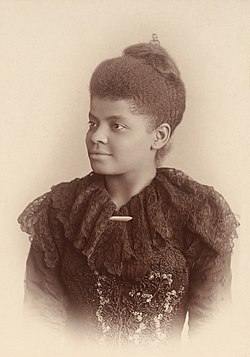 Ida B. Wells (from History of feminism)
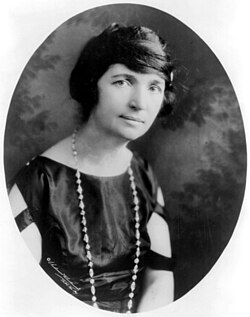 Margaret Sanger (from History of feminism)
 Germaine Greer in June 1972 (from History of feminism)
 Author and scholar Helen Kendrick Johnson opposed women's suffrage. (from History of feminism)
 First edition print of A Vindication of the Rights of Woman (from History of feminism)
 bell hooks (from History of feminism)
 Female members of the Australian Builders Labourers Federation march on International Women's Day 1975 in Sydney (from International Women's Day)
 A veil-burning ceremony in Andijan on International Women's Day in 1927 (from International Women's Day)
 The White Feather: A Sketch of English Recruiting" (Arnold Bennett, 1914) (from History of feminism)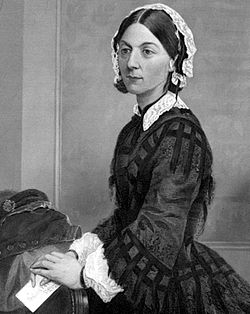
 An Antimonumenta, installed in Mexico City on International Women's Day 2019, as photographed the day after. The circle part says "In Mexico 9 women are murdered daily" and the cross part says "Not one more!" On the opposite side, the Antimonumenta reads "We demand a national gender alert", and in the central part "No + Femicides" (from International Women's Day)
 John Neal (from History of feminism)
 Simone de Beauvoir (from History of feminism)
 Lucy Stone (from History of feminism)
 Marie Stopes (from History of feminism)
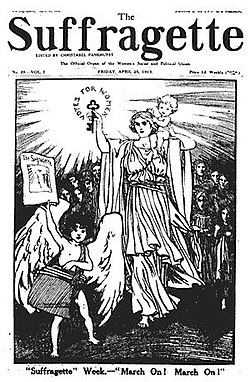 Cover of WSPU's The Suffragette, April 25, 1913 (after Delacroix's Liberty Leading the People, 1830) (from History of feminism)

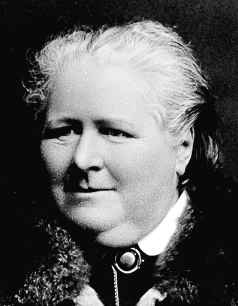 Frances Cobbe (from History of feminism)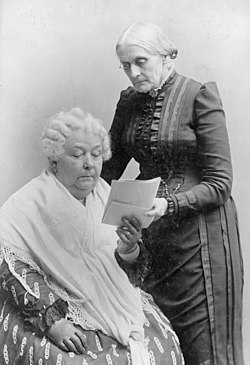
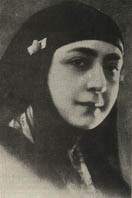 Huda Shaarawi, founder of the Egyptian Feminist Union (from History of feminism)
 Women's Liberation march in Washington, D.C., 1970 (from History of feminism)
 Emily Davison (from History of feminism)
 8M 2020 in Spain (from International Women's Day)
 Giorgia Meloni, (third from right) the first female prime minister of Italy at a 2024 Women's Day event in Rome (from International Women's Day)
 Women on the street celebrating International Women's Day in Cameroon (from International Women's Day)
 Camilla Collett (from History of feminism)
 Betty Friedan 1960 (from History of feminism)
 The Nineteenth Amendment (from History of feminism)
 María Elena Oddone holding a banner, on International Women's Day in 1984 in Argentina. The banner says "No to motherhood, yes to pleasure" (from International Women's Day)

 Board of directors of "Jam'iat e nesvan e vatan-khah", a women's rights association in Tehran (1923–1933) (from History of feminism)
 The vandalized Concepción Feminist Mural in Spain, which was vandalized on International Women's Day 2021. (from International Women's Day)
 Yellow mimosa is the symbol of International Women's Day in Italy as well as in Russia, Ukraine and many other ex-Soviet Union republics (from International Women's Day)
 8M 2018 in Pamplona (from International Women's Day)
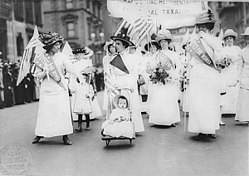 Suffrage parade in New York, May 6, 1912 (from History of feminism)
 Gloria Steinem at news conference, Women's Action Alliance, January 12, 1972 (from History of feminism)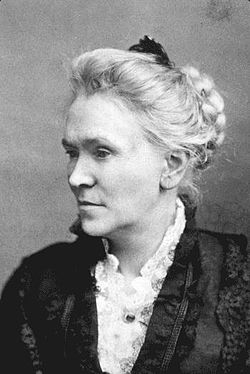
 Catharine MacKinnon (from History of feminism)
 Wealthy Chinese women with bound feet (Beijing, 1900). Foot binding was a symbol of women's oppression during the reform movements in the 19th and 20th centuries. (from History of feminism)


.jpg)


.jpg)
.jpg)


WikiProjects

Topics


Categories

Featured content

 | This is a list of recognized content, updated weekly by JL-Bot (talk · contribs) (typically on Saturdays). There is no need to edit the list yourself. If an article is missing from the list, make sure it is tagged (e.g. {{WikiProject Feminism}}) or categorized correctly and wait for the next update. See WP:RECOG for configuration options. |
Featured articles
 Vidya Balan
- Beyoncé
- Louise Bryant
- Josephine Butler
- Luisa Capetillo
- Cher
- Control (Janet Jackson album)
- Marjory Stoneman Douglas
- Female genital mutilation
- Anna Filosofova
- Margaret Fuller
- Emma Goldman
- Inter-Allied Women's Conference
- Janet Jackson
- Kahaani
- Madonna
- Kitty Marion
- Lise Meitner
- Olive Morris
- Mothers of the Disappeared
- Mud March (suffragists)
- Jessie Murray
- Margaret Murray
- Florence Nagle
- Emmeline Pankhurst
- Katy Perry
- Adelaide Anne Procter
- Ruby Loftus Screwing a Breech-ring
- Margaret Sanger
- Susan B. Anthony dollar
- Taylor Swift
- Maria Trubnikova
- Harriet Tubman
- Veiqia
- A Vindication of the Rights of Men
- A Vindication of the Rights of Woman
- Emma Watson
- We Can Do It!
- Wife selling (English custom)
- Mary Wollstonecraft
- École Polytechnique massacre
Featured lists
Good articles
 Nineteenth Amendment to the United States Constitution
- Ángela Acuña Braun
- Chimamanda Ngozi Adichie
- Susan B. Anthony II
- Applesauce (novel)
- Elena Arizmendi Mejía
- Trinidad Arroyo
- Aurora (Sleeping Beauty)
- Ay mamá
- Rachel Barrett
- Gerlin Bean
- Belle (Disney character)
- Birth control
- Jex Blackmore
- BoJack Horseman season 5
- Jeni Bojilova-Pateva
- Virginia Bolten
- Boneghazi
- Tawana Brawley rape hoax
- Build a Bitch
- Can't Hold Us Down
- Claudia Cardinale
- Elvia Carrillo Puerto
- A Catholic Statement on Pluralism and Abortion
- Rita Cetina Gutiérrez
- Cherry Wine (Hozier song)
- Child prostitution
- Lara Croft
- Cutting the Mustard
- Lucinda Lee Dalton
- Damned Whores and God's Police
- Emily Davies
- Voltairine de Cleyre
- Maymie de Mena
- 2012 Delhi gang rape and murder
- Details Cannot Body Wants
- The Dirty Picture
- Elisabeth Dmitrieff
- Double burden
- Rosa Dubovsky
- Anne Dallas Dudley
- Mary Beth Edelson
- Lilian Faithfull
- Feminism in Russia
- Feminist Improvising Group
- María Teresa Ferrari
- Princess Fiona
- First Feminist Congress of Yucatán
- Jane Fonda
- Alaíde Foppa
- Forced sterilization in Peru
- Marge Frantz
- Edith Garrud
- Kirsten Gillibrand
- Glorieta de las mujeres que luchan
- Laura de Force Gordon
- Government Hooker
- Juana Belén Gutiérrez de Mendoza
- Güzel İstanbul
- H.W. v. France
- Margarethe Hardegger
- Hilda Heine
- Nora Helmer
- Aileen Hernandez
- Hitachi Magic Wand
- Hole (band)
- Howl's Moving Castle (film)
- Clair Huxtable
- I'll Make a Man Out of You
- Incel
- Independent Women's Forum
- 2014 Isla Vista attacks
- Jane Collective
- Jasmine (Aladdin)
- Jenny of the Prairie
- Doris Sands Johnson
- India Juliana
- Kim Possible
- Gina Krog
- Lady Like
- Lady Like (song)
- Argelia Laya
- Astrid Lindgren
- Love, Loss, and What I Wore
- Paulina Luisi
- Malouma
- Marie of Romania
- Bertha Mason (suffragist)
- Maria Mies
- Kate Millett
- Moana (character)
- Mother's Little Helper
- Mr. Lady Records
- Mulan (Disney character)
- Nala (The Lion King)
- Louise Nevelson
- No One Killed Jessica
- Opal Plumstead
- Paper or Plastic (song)
- Patricia Paputsakis
- Irene Parlby
- Roy Earl Parrish
- Part of Your World
- Planned Parenthood
- Kim Possible (character)
- Pussy Riot
- Ann Radcliffe
- Funmilayo Ransome-Kuti
- A Rape on Campus
- Rasan (organization)
- Marcela Revollo
- Tessie Reynolds
- Deolinda Rodrigues
- Nina Salaman
- Zainab Salbi
- Linda Sarsour
- Cher Scarlett
- Rosika Schwimmer
- Seneca Falls Convention
- Shadowland (song)
- Chava Shapiro
- Manal al-Sharif
- Mary Stuart Smith
- Valerie Solanas
- Sole Front for Women's Rights
- Miriam Soljak
- Hope Solo
- Elizabeth Cady Stanton
- Shelby Starner
- Gloria Steinem
- Jessie Stephen
- Doris Stevens
- Cecilia Suárez
- Tailhook scandal
- Thung Sin Nio
- Nino Tkeshelashvili
- A Toast to Men
- Lana Turner
- Mary Two-Axe Earley
- Ugly (Fantasia song)
- WAP (song)
- Jean Walton
- Abby Wambach
- When a man argues against two beautiful ladies like this, they are going to have the last word
- The Woman's Bible
- Optional Protocol to the Convention on the Elimination of All Forms of Discrimination Against Women
- Women in early modern Scotland
- Women in classical Athens
- Women of the Young Lords
- Women's International Democratic Federation
- Women's March on Portland
- Women's club movement in the United States
- Women's suffrage in Wales
- Xue Susu
- Year 24 Group
- Zhang Xichen
Featured pictures
 Alice Manfield - Guide Alice, Mt Buffalo, c1900-30, SLV
 Alice Park - Records of the National Woman's Party
 Alice Paul (1915) by Harris & Ewing
 Angela Davis in a half-length portrait by Bernard Gotfryd - crop
 Anne Dallas Dudley LOC
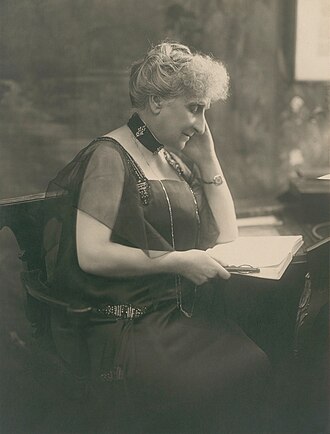 Avril de Sainte-Croix - Restored, cropped
 Bertha Lutz 1925
 Cabinet Card of Sojourner Truth - Collection of the National Museum of African American History and Culture
 Convicts Lunatics and Women! Have No Vote for Parliament, ca. 1907-1918
 Dr. Caroline Spencer 275029v
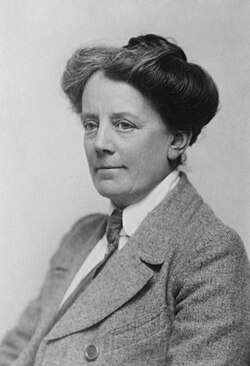 Ethel Smyth
 Frances Benjamin Johnston, Self-Portrait (as "New Woman"), 1896
 Fredrikke Mørck
 George Charles Beresford - Virginia Woolf in 1902 - Restoration
 Henrietta Rodman from the George Grantham Bain Collection
 Henry Mayer, The Awakening, 1915 Cornell CUL PJM 1176 01 - Restoration
 Hester Jeffrey
 Hubertine Auclert 1910
 Iris Calderhead
 Joy Young Rogers outside the White House
 Lucretia Mott, signed photo, by F. Gutekunst
 Mabel Vernon, c. 1917, by Edmonston, Washington, D.C.
 Marguerite Durand 1910 - Restoration
 Marie Stopes in her laboratory, 1904 - Restoration
 Mary Garrity - Ida B. Wells-Barnett - Google Art Project - restoration crop
 Millicent Fawcett
 Mrs. Crystal Eastman Benedict by Edmonston, Washington, D.C.
 Mrs. Lillian Ascough, chairman of the Connecticut branch of the Woman's Party
 Mrs. Pauline Adams 147002v
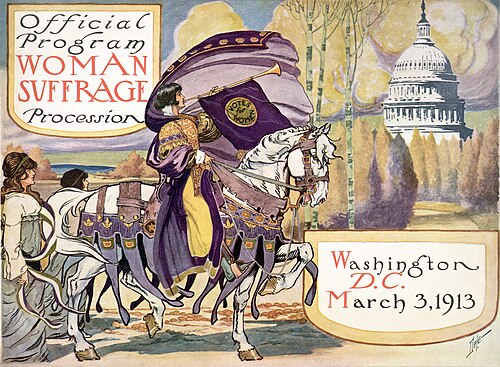 Official Program Woman Suffrage Procession - March 3, 1913
 Portrett av Gina Krog (6276081582) - Restoration
 Poster by Anna Soós Korànyi for the Seventh Conference of the International Woman Suffrage Alliance
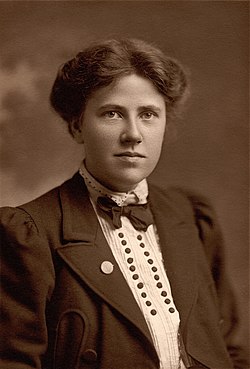 Ray Strachey restored
 Sojourner Truth, 1870 (cropped, restored)
 Victoria Claflin Woodhull by Mathew Brady - Oval Portrait
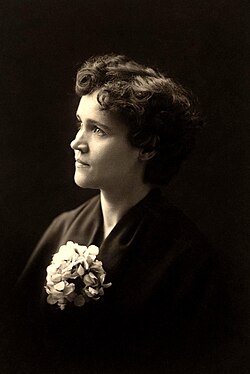 Voltairine de Cleyre (Age 35)
 We Can Do It! NARA 535413 - Restoration 2


_by_Harris_&_Ewing.jpg)


,_1896.jpg)


_-_Restoration.jpg)


.jpg)

.jpg)

Featured portals

Featured topics

Good topics

Things you can do

- Add {{Portal|Feminism}} to the See also section of Feminism-related articles.
- Tag the talk pages of Feminism-related articles with {{WikiProject Feminism}}
- Join Wikipedia:WikiProject Feminism
- Cleanup: A cleanup listing for this project is available, updated by CleanupWorklistBot.
- Notability: Articles with notability concerns, listed at WikiProject Notability
- Rate the Unassessed Gender Studies articles in the Gender Studies WikiProject.
- Requested articles: Requested articles on Feminism, Requested articles on Feminist figures
- Stubs: Gender studies stubs, Feminism stubs, Women's rights activist stubs
Wikimedia
The following Wikimedia Foundation sister projects provide more on this subject:
-
 Commons
Free media repository -
 Wikidata
Free knowledge base -
 Wikiquote
Collection of quotations -
 Wikisource
Free-content library -
 Wikiversity
Free learning tools -
 Wiktionary
Dictionary and thesaurus