swan_tower: (Default)
[personal profile] swan_tower
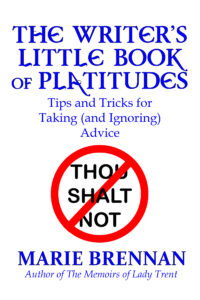
Following on last month's re-release of The Writer's Little Book of Naming, The Writer's Little Book of Platitudes is back out in the world!

A white background with the text "The Writer's Little Book of Platitudes: Tips and Tricks for Taking (and Ignoring) Advice," by Marie Brennan, author of the Memoirs of Lady Trent. In the center is a red circle with a diagonal line through it (the symbol for "no") with the words "thou shalt not" inside.

“Show, don’t tell.” “Murder your darlings.” “Write every day.”

Certain pieces of advice are widespread in the writing community — but what do they really mean? And are they nuggets of universal wisdom, or do they only apply to some writers in some circumstances? Award-winning author Marie Brennan tackles these old saws, dissecting each one to see what purpose it might serve . . . and when you should toss it aside.


And starting next month, there will be a brand-new Writer's Little Book -- stay tuned for news on that . . .

(originally posted at Swan Tower: https://www.swantower.com/2026/07/07/the-writers-little-book-of-platitudes-returns/)
neotoma: Neotoma albigula, the white-throated woodrat! [default icon] (Default)
[personal profile] neotoma
Two chicken empanadas, a mango tart, a jar of pickled mushrooms, a dill plant, red and pink raspberries, sour cherries, sweet cherries, blueberries, a loaf of struan bread, chocolate chip cookies, dark chocolate walnut cookies, nectarines, yellow peaches, lemon-ricotta waffles, peach cakette, and a box of mixed yellow and purple plums

(no subject)

Jul. 4th, 2026 09:49 pm
arethinn: Angry golden-eyed wild elf with blood dripping from her mouth (angry (rahnee))
[personal profile] arethinn
I don't have a news article about this to link to or anything but I heard that there were Colombian folk dancers at some event in $LOCAL_BIGGISH_CITY yesterday/today?, and some guy in attendance yelling crap about "speak English, this is America" who was shouted down by the collective fuck-you's of the crowd. (Good.) This would be unacceptable anywhere in the US, but, my dude. The land you are standing on was called Alta California and considered part of Mexico less than two hundred years ago (Spanish colonization of the native peoples is outside the scope of this post 😅). Exactly what the fuck language did you think the name of the city was even in?

3 Faces (d. Jafar Panahi, 2018)

Jul. 4th, 2026 05:32 pm
caramarie: Emily from Revenge drinking her morning coffee. (emily drinks coffee)
[personal profile] caramarie
A young woman Marziyeh sends a video to Behnaz Jafari, an established older actress, saying that she’s been trying to get in touch with her in the hopes that the actress can convince her parents to let her attend drama school, but having failed to do so the video ends with Marziyeh’s apparent suicide.

Read more... )

New Worlds: How's the Weather?

Jul. 3rd, 2026 08:01 am
swan_tower: (Default)
[personal profile] swan_tower
Weather tends to show up in novels merely as a background detail -- all too often as an example of the pathetic fallacy, where e.g. it's raining because the protagonist is sad. Every so often, it rises to the level of plot device: there's a snowstorm so characters can get snowed in somewhere. Speculative fiction honestly has a dearth of weather worked into the general description of a scene, despite the fact that any time the story moves outside, there must be some kind of weather in play.

But if that were all, I wouldn't be devoting an essay to this subject. After all, this Patreon is about worldbuilding, which means not just the physical but the cultural side of a setting. (Given my inclinations, the cultural side more than anything else). So how is weather itself a part of society?

Depending on where you live, you already know some of the answers to that. Weather shapes our houses, our clothing, and our food, in ways discussed in previous essays. It also gives a rhythm to our lives: if you live in a region where afternoon thunderstorms are expected in the summer, or the monsoon blows through at certain times of year, that affects what activities people undertake at what times. But there are other, more directly weather-focused elements, too.

Let's start with a question we tend to take for granted nowadays: can you see the weather coming?

Weather forecasting as a formal science got started in the nineteenth century, and it began with us more rigorously measuring what the weather even was. You can't do much in the way of prediction unless you have a mass of data about highs, lows, wind speed and direction, pressure changes, precipitation, and so on. And you need that data to be spread over a large area, because of course weather is never purely a local phenomenon! This included giving scientific instruments to ship captains, since the ocean is a key driver of weather . . . and also the safety of those captains can depend on knowing what the weather is about to do.

Fast communication is key, too. If you hear that an area upwind of you is getting a cold snap or a storm front, odds are good that's headed your way shortly. What really sets forecasting going, though, is computers -- which can crunch huge amounts of data vastly quicker than humans can -- and weather balloons and satellites to measure conditions from above. Thanks to those things, especially improved computer modeling, the precision of our forecasts has improved astonishingly: these days, the prediction for four days from now is as accurate as the prediction for tomorrow was thirty years ago.

Of course, people have been trying to predict the weather for a lot longer than we've had computers, or even thermometers. This has largely been short-term and based on observations of immediate phenomena: for example, "red sky at night, sailor's delight; red sky in the morning, sailor's warning" is accurate for regions where weather tends to move from west to east, as the tint of the sky signals the location of a high-pressure (good weather) system and whether it's headed toward you or moving away. Or, where I grew up -- at the tail end of Tornado Alley -- we all learned that a certain greenish cast to the sky meant the weather was ripe for forming twisters.

The thing about that green sky is, it does mean a likelihood of severe weather . . . but not necessarily tornadoes. And that's the flaw of this kind of weather lore, that it can be inconsistent, or outright incorrect. That whole North American tradition of Groundhog Day, where the presence or absence of shadows seen by a groundhog predicts how much longer the winter will last? It has absolutely no statistical underpinning. Some analyses even give it a negative correlation, showing that Punxsutawney Phil's predictions are less accurate than random chance! Maybe we need to update our proverb.

But humans are not content merely to know what the weather is likely to do an hour or a day from now. We would really, really love to control it, to suit our own purposes.

And for millennia, people have been promising the ability to do exactly that. This is honestly one of the underpinnings of certain elements of religion: you pray or make offerings to a deity of the sky or agriculture in the hopes of getting the rain or sun necessary for a good crop, or a deity of the sky or sea to get the wind you need for your ocean voyage. Humans can't control the weather, but gods can, so you ask them nicely for their help. Colloquially, we often call society-wide weather rituals "rain dances," and dancing is indeed a common element, though not a universal one.

Rainmakers, however, peddle claims of a more direct skill. They assert that they, on their own, can end a drought -- or, less commonly, end a deluge that's causing flooding or drowning the crops. Historically, they attributed their power to magic; in the nineteenth and twentieth centuries, they instead dressed their assertions up in scientific trappings. Charles Hatfield, one famous American rainmaker, used a secret mix of chemicals in evaporating tanks to "attract" rain to an area. His apparent success rate (likely due to him being a good weather predictor, rather than weather-worker) was high enough that he was able to charge the City of San Diego ten thousand dollars -- in early 1900s money! -- to fill their empty reservoir.

Which promptly backfired on him, as the region experienced torrential rains that broke a dam, killed about twenty people, and caused an estimated $3.5 million in damage. Rainmakers who promised results they failed to deliver could and did get sued for fraud, but rainmakers who "succeeded" too well could also wind up in trouble.

This idea has not gone away. If anything, it's trying to accelerate into the realm of actual, reliable science. We've been conducting experiments in cloud seeding for decades, aiming to encourage rain or snow through scattering material in the atmosphere. Its efficacy is debatable, and people have understandable concerns about the environmental impact of the material used. Other, newer concepts involve things like reflecting some of the sun's energy back out into space, to slow the effects of global warming.

Science fiction can take these ideas to an extreme. Especially in closed environments like biomes, stories may depict weather as scheduled down to the minute, so characters know to expect a quarter-inch of rain between 3:17 and 4:01 p.m. That's plausible when the "rain" is actually coming out of ceiling pipes; when it's the product of natural planetary forces, it's much more of a stretch. At that point, you're more in the realm of fantasy, where a sorcerer can summon a storm on demand . . . which would probably have a lot more society-wide effects, especially in military contexts, than most novels take the time to imagine.

With the rise of climate fiction as a subgenre, though, we might expect to see a lot more weather control showing up in our stories. And so, with an eye toward that, next week we'll take a look at climate change!

Patreon banner saying "This post is brought to you by my imaginative backers at Patreon. To join their ranks, click here!"

(originally posted at Swan Tower: https://www.swantower.com/2026/07/03/new-worlds-hows-the-weather/)

Small film updates

Jul. 3rd, 2026 05:26 pm
caramarie: A magpie perched against a backdrop of the stars. (Default)
[personal profile] caramarie

Velvet Goldmine (d. Todd Haynes, 1998)

I don’t know how many times I’ve seen this film. It’s been a while since I did a rewatch, and I spent half the film with a stupid grin on my face so I guess it still works for me! This time I felt like Arthur in the 80s, remembering a time when you were young and music meant everything and the world was full of possibilities. And now everything is grey and grim and grinding you down. I guess that’s what getting older does to you.

/bleak

I appreciate more than ever the disregard for a traditional film structure here.

The Blue Angel (d. Josef von Sternberg, 1930)

Early German talkie. A schoolteacher who disapproves of his students sneaking around to watch cabaret singers at night tries to catch them at it, and falls for their idol himself. The film went downhill for me at the point Read more... )

I guess I shouldn’t expect so much from the 30s.
swan_tower: The Long Room library at Trinity College, Dublin (Long Room)
[personal profile] swan_tower
Over the years I've picked up a few books by Zilpha Keatley Snyder that I remembered loving as a kid -- specifically, The Egypt Game and The Velvet Room. But the one I kept wondering about was Below the Root and its sequels (And All Between and Until the Celebration), which form the Green Sky trilogy, and recently I found I could get them all in ebook from my library. So I did a binge!

And (like I did for the Seven Citadels quartet), I want to talk about whether they held up. In this case, though, the answer is "no, sort of, but not really, except for the bits that do."

Be warned that Here Be Spoilers. Partly because I can't talk about what does and doesn't work here without getting into them, but also because honestly, you'll see most of the twists coming three miles off. So it doesn't feel like there's much to spoil.

***

Read more... )

So, yeah. Mixed bag. The worldbuilding is frequently interesting, the prose is frequently dire, the plot is lackadaisical at best, and there are some very legitimately thorny complications buried in a morass of summary narration. The Snyder estate will probably not authorize me to redo the entire thing from the ground up. I doubt I'll feel the need to re-read them ever again, but it was -- despite how often I was skim-reading -- worth revisiting, for the memories and for what I'm pretty sure was entirely new to me.

(originally posted at Swan Tower: https://www.swantower.com/2026/06/29/zilpha-keatley-snyders-green-sky-trilogy/)

Prometheus + Alien: Covenant

Jun. 28th, 2026 12:48 pm
caramarie: David from Prometheus with the cube of human accomplishments. (david and the cube of human accomplishme)
[personal profile] caramarie
I did a rewatch! Read more... )

Anyway, I had a good time. Maybe I will finally get around to making that one vid I’ve had on my list for ages!

New Worlds: Gold Rushes

Jun. 26th, 2026 08:11 am
swan_tower: (Default)
[personal profile] swan_tower
I live in California -- specifically in the San Francisco Bay Area, a place whose history is indelibly shaped by the gold rush of 1848. And, having proposed in last week's essay a speculative path to industrialization involving the discovery of some kind of unobtanium, I find myself led naturally to the notion of a rush: a sudden influx of hopeful miners to the location of a newly discovered mineral deposit, seeking to make their fortunes in one fell swoop.

We hear about these mostly as gold rushes, but they can actually happen for other resources, too; there have been silver rushes and diamond rushes. So what elements are necessary to cause a rush?

First and most obviously, the object of the rush must be highly valuable. Nobody's going to travel for months, often through rugged wilderness (because all the sites closer to home have already been claimed), to go after an ordinary resource like iron or coal. Or rather, they will, but not in the kind of sudden mass migration that leads us to call such an event a rush. If people don't grow starry-eyed at the thought of getting their hands on some of that thing, it's not fancy enough for this scenario. Think especially in terms of value versus volume: something that wows people when you hold it in the palm of your hand will have much more power to attract prospectors than something that requires an entire cartload to impress.

Second, it has to be (theoretically) easy to obtain. This is both a legal and a technological angle, with the legal part being the question of who owns the land where the resource is found. I suspect it's no accident that, of the nine countries Wikipedia lists as having major gold rushes in the 19th century, eight of them were areas colonized by Europeans, with Greece as the sole outlier. In places like Australia, Venezuela, and the United States, a frontier mentality prevailed which facilitated the idea that any random guy could move in and start panning for gold. Try the same trick in England of the same era, and the landowner will have words and possibly bullets for you -- not to mention the unlikelihood of finding major gold deposits not already under exploitation.

At least, easily accessible ones. This is the technological side of the equation: if extracting the resource requires sophisticated training and/or expensive equipment, then that's going to limit active parties to the well funded, well organized operations. These days a lot of our mineral extraction involves digging up ore, sometimes from deep underground, and subjecting it to complex chemical and physical processes. It's a far cry from some guy with a pan on the bank of a stream believing he might strike it rich.

And finally, people have to hear about it. This seems like an easy requirement to meet, but again, notice that "gold rush" is a phrase we associate with the nineteenth century. There are a handful from earlier -- all of them in the context of Spanish and Portuguese colonization of the Americas -- but the mass communication of newspapers and especially the electric telegraph made it vastly easier to spread the news widely, creating a large pool of hopeful prospectors willing to pack up their lives and go in search of fortune.

(You might think, by the way, that the accessibility of the location might matter. One look at the Klondike Gold Rush, however, puts paid to that notion. People were willing to risk freezing off their body parts, dying of starvation, being eaten by bears, or falling off a mountain to get to where there was gold. It certainly does help if it's easier to get to, especially if there are ships or trains, but it's not a requirement.)

That mass media thing, of course, cuts both ways. Whoever first discovers the resource probably doesn't want anybody to know about it! Marshall and Sutter at Sutter's Mill in 1848 wanted to keep their gold to themselves. Alas, despite oaths of secrecy, the guy they sent to secure mineral rights for their land blabbed the tale repeatedly along the way and failed in his mission to boot. Sutter not only didn't get to keep the gold to himself, but lost all his workers to prospecting, his crops and cattle to squatters, and his entire dream of a profitable agricultural rancho there.

Of course, not everybody who rushes to a source of gold, silver, diamonds, or any other valuable material makes their fortune. In fact, the vast majority of them don't. Advantage goes to those who get there first, as they stake out and deplete the best claims -- which of course contributes to the feverish sense of urgency, people making snap decisions rather than thinking it through. Between the cost of getting there, the cost of equipment (which may not be specialized but is still an expense for the kind of poor man hoping to strike it rich), and the cost of supporting yourself and any allies or employees in the wilderness, most people start out in the hole. In the California Gold Rush, it's estimated that a few lucky souls truly acquired a fortune, about half made a modest profit, and the rest lost their shirts.

Which is why the actual smart move -- albeit the much less glamorous one -- is to be the guy selling picks and shovels. It was less than two months after the discovery at Sutter's Mill that Samuel Brannan bought every piece of prospecting equipment he could find and opened a store in the then-tiny town of San Francisco, so he could sell those things to the people he knew would come -- knew in part because he was also one of the first people to publicize the discovery! (The story goes that he couldn't put it in his newspaper because all his staff had run off, so instead he walked through the streets with a vial of gold, shouting about it to everyone who could hear.) Selling pans at seventy-five times the price he paid for them, he made out like a bandit and became enormously wealthy.

Selling picks and shovels is also a lot safer. Any time riches or the dream of them are at stake, you're going to get people fighting over them, and a gold rush is no different. Claim-jumping is the act of starting to work on a site someone else has claimed as their own -- usually not while they're conducting active operations, but if they haven't gotten to it yet or have decided it's not as promising as another location, neither of which mean they're ready to let you have it instead. Even when people respect those boundaries, any dispute is liable to escalate to fighting . . . and, of course, any pre-existing tensions are likely to be exacerbated by the tense conditions. Black, Latino, and Chinese miners -- along with smaller numbers from other marginalized groups -- faced particularly intense threats and bloodshed; it's no accident that they were less likely to reap a profit than their white counterparts. Meanwhile, Native Americans were massacred by miners who wanted them out of the way.

This kind of thing is also environmentally disastrous, because the men (and much smaller number of women) chasing a vision of gold don't care very much about anything else. Deforestation, soil runoff, and active pollution from toxic chemicals wreak havoc on the land and anybody relying on it for their survival. In just a few short years, this can transform not only the immediate landscape of the claims but anything downstream of them, and not for the better.

And all of these things could happen in a speculative world! Any planetary colonization scenario is ripe for it, so long as interstellar travel is available to the masses. Even something non-mineral, like the hunting of fantastical beasts could potentially look like a gold rush, if someone finds a critical use for their horns or hides or other body parts. As long as it's local to a certain area, valuable, relatively easy to get, and advertised widely, the fever will take hold, and people will come.

Patreon banner saying "This post is brought to you by my imaginative backers at Patreon. To join their ranks, click here!"

(originally posted at Swan Tower: https://is.gd/W6WbjY)

Profile

elfquest: (Default)
ElfQuest Fans on Dreamwidth

May 2021

S M T W T F S
      1
2345678
9101112131415
16171819202122
2324 2526272829
3031     

Disclaimer

Elfquest art copyright Warp Graphics, Inc. Elfquest, its logos, characters, situations, all related indicia, and their distinctive likenesses are trademarks of Warp Graphics, Inc. All rights reserved.

Style Credit

Expand Cut Tags

No cut tags
Page generated Jul. 8th, 2026 01:17 am
Powered by Dreamwidth Studios