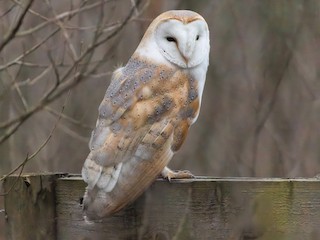
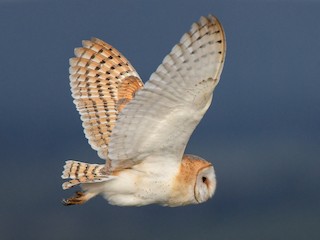
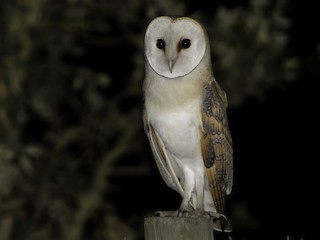
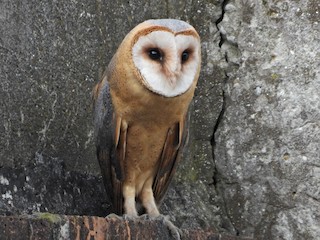
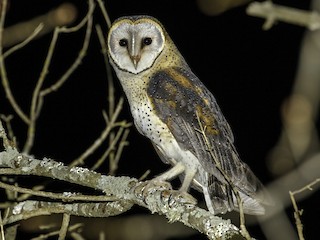
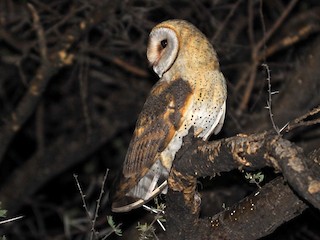
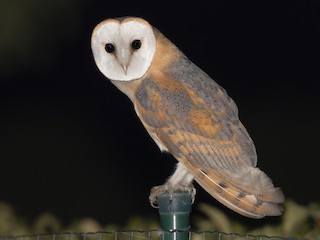
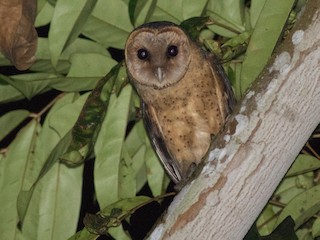
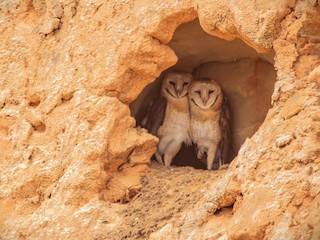

Western Barn Owl Tyto alba Scientific name definitions
- Names (53)
- Subspecies (9)
Revision Notes
Sign in to see your badges
Species names in eBird-supported languages
| Language | Common name |
|---|---|
| Afrikaans | Nonnetjie-uil (Westelike Nonnetjie-uil) |
| Asturian | Curuxa común |
| Azerbaijani | Adi alabayquş |
| Basque | Hontz zuri eurasiarra |
| Bulgarian | Забулена сова |
| Catalan | òliba comuna occidental |
| Chinese (SIM) | 西仓鸮 |
| Croatian | kukuvija |
| Czech | sova pálená |
| Danish | Slørugle |
| Dutch | Kerkuil |
| English | Western Barn Owl |
| English (AVI) | Western Barn Owl |
| English (India) | European Barn Owl |
| English (United States) | Western Barn Owl |
| Estonian | loorkakk |
| Finnish | tornipöllö |
| French | Effraie des clochers |
| Galician | Curuxa común |
| Georgian | ბუხრინწა |
| German | Schleiereule |
| Greek | Τυτώ |
| Gujarati | રેવીદેવી |
| Hebrew | תנשמת לבנה |
| Hungarian | Gyöngybagoly |
| Icelandic | Turnugla |
| Italian | Barbagianni |
| Japanese | ニシメンフクロウ |
| Kazakh | Қамба жапалағы |
| Latvian | Plīvurpūce |
| Lithuanian | Liepsnotoji pelėda |
| Norwegian | tårnugle |
| Persian | جغد انباری |
| Polish | płomykówka |
| Portuguese (Portugal) | Coruja-das-torres |
| Punjabi (India) | ਸੁਨਹਿਰੀ ਉੱਲੂ |
| Romanian | Strigă |
| Russian | Сипуха |
| Serbian | Kukuvija |
| Slovak | plamienka driemavá |
| Slovenian | Pegasta sova |
| Spanish | Lechuza Común Occidental |
| Spanish (Cuba) | Lechuza Euroasiática |
| Spanish (Ecuador) | Lechuza Campanaria Occidental |
| Spanish (Mexico) | Lechuza Europea |
| Spanish (Spain) | Lechuza común occidental |
| Spanish (Uruguay) | Lechuza de Campanario Occidental |
| Swedish | tornuggla |
| Telugu | ఇంట్ల కౌశికము |
| Turkish | Peçeli Baykuş |
| Ukrainian | Сипуха західна |
| Welsh | tylluan wen |
| Zulu | umzwelele |
Revision Notes
Peter Pyle revised the Plumages, Molts, and Structure section. Guy M. Kirwan revised the Systematics section. John Lusby reviewed the account and revised the Conservation and Management and Priorities for Future Research sections. Brooke K. Keeney and Maria G. Smith standardized the content with Clements taxonomy. Arnau Bonan Barfull curated the media. Nicholas D. Sly generated the distribution map.
Tyto alba (Scopoli, 1769)
Definitions
- TYTO
- alba
The Key to Scientific Names
Legend Overview
Content Partner

Full content is available exclusively to Birds of the World subscribers. Sign in Learn more
Introduction
Subspecies
Western Barn Owl (Eurasian) Tyto alba [alba Group]
Tyto alba alba Scientific name definitions
Systematics History
Strix alba Scopoli, 1769, Annus 1, Historico-Naturalis, p. 21.—“Ex Foro Juli” [= Friuli, northern Italy].
The whereabouts of any type material associated with Scopoli’s name is unknown, but some specimens from his personal collection survive in the Museo di Storia Naturale all Università di Pavia (33).
Synonyms:
Strix splendens C. L. Brehm, 1855, Der vollständige Vögelsang: Eine gründliche Anleitung alle europaischen Vögel, p. 40.—northeast Africa. The lectotype, a male collected near Cairo, Egypt, in November 1848 by Wilhelm Friedrich Hemprich (1796–1825) and Christian Gottfried Ehrenberg (1795–1876), is held in the American Museum of Natural History, New York (AMNH 629158) (34); designation by Hartert (35), who stated that the specimen was received in exchange from the Museum für Naturkunde, Berlin, which possessed several specimens of this species collected by Hemprich and Ehrenberg.
Strix margaritata C. L. Brehm, 1855, Der vollständige Vögelsang: Eine gründliche Anleitung alle europaischen Vögel, p. 40.—no locality. The lectotype, a male collected (presumably in Egypt) and received from Prince Paul of Württemberg (1785–1852), according to Brehm, is held in the American Museum of Natural History, New York (AMNH 629167) (34); designation by Hartert (35). In a subsequent publication, in 1858, Brehm made it clear where the material upon which his name was based came from.
Strix Kirchhoffi A. E. Brehm, 1857, Allgemeine deutsche naturhistorische Zeitung 3:440.—Spain. The holotype, a male collected in November 1856 by Alfred Edmund Brehm (1829–1884), which Hartert (35) noted was the only Spanish specimen from Brehm in the Rothschild Collection, is held in the American Museum of Natural History, New York (AMNH 629121) (34).
Strix paradoxa C. L. Brehm, 1858, Naumannia 8:217.—Algeria. The holotype, an adult male collected on the Bône Plain on 13 July 1855 by Dr Leopold Buvry (1822‒1870), is held in the American Museum of Natural History, New York (AMNH 629147) (35, 34).
Strix hostilis O. Kleinschmidt, 1915, Falco 11:18.—England. Described on the basis of two syntypes: a male collected at Hurst, Sussex, in August 1894, and a female taken at Bramber, Sussex, on 10 September 1897, both received via the dealer Brazenor in Brighton, and held at the Leibniz Institute for the Analysis of Biodiversity Change, Museum Koenig, Bonn (ZFMK Coll. Kl. 6952 and ZFMK Coll. Kl. 6953) (36, 37).
Tyto alba kleinschmidti von Jordans, 1924, Journal für Ornithologie 72:409.—Alcúdia, Mallorca. The holotype, a male collected on 9 May 1921 by Adolf Petrus Margareta Maria Joseph Hubertus von Jordans (1892‒1974), is held at the Leibniz Institute for the Analysis of Biodiversity Change, Museum Koenig, Bonn (ZFMK A.III.13.a6.γ), along with the following paratypes: ZFMK A.III.13.a6.α, male taken on 7 April 1913; ZFMK A.III.13.a6.β, female, 9 May 1913; ZFMK A.III.13.a6.γ, male9 May 1921; ZFMK A.III.13.a6.δ, female, 22 May 1921; ZFMK A.III.13.a6.ε, male, 24 May 1921; ZFMK A.III.13.a6.ζ, male, 9 May 1921 (36, 37).
Distribution
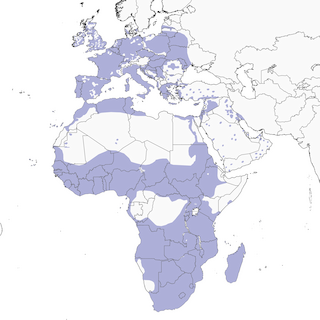
Western and southern Europe (including Balearic Islands and Sicily) to northern Turkey; also western Canary Islands (Tenerife, Gran Canaria, El Hierro), and North Africa from Morocco to Egypt (except Sinai), south to northern Mauritania, southern Algeria, Niger (Aïr Massif), and northeast Sudan.
Field Identification
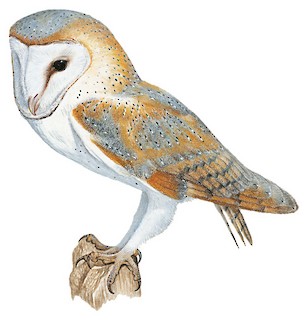
Vaurie (38) noted that the nominate subspecies is paler than those in Macaronesia, with the upperparts more golden ochraceous brown (less mottled paler gray) and the underparts much whiter. In nominate alba the color of the underparts varies individually in both sexes from silvery white to buff, with or without small round brown spots; most males are white with only a few fine spots, whilst females are normally white but more frequently tinged with buff than males, are usually more abundantly spotted, and those spots are typically larger (38). He also reported that alba averages larger than the Macaronesian subspecies (38).
Tyto alba alba (Scopoli, 1769)
Definitions
- TYTO
- alba
The Key to Scientific Names
Legend Overview
Tyto alba guttata Scientific name definitions
Systematics History
Strix guttata C. L. Brehm, 1831, Handbuch der Naturgeschichte aller Vögel Deutschlands, p. 106.—the northeast, perhaps Riga; in winter in Germany.
Name first introduced by Brehm three years earlier, in 1828, but as a nomen nudum initially. The whereabouts of the relevant specimen upon which Brehm’s description was based are unknown; it has not been identified in the American Museum of Natural History, New York (34) or the Leibniz Institute for the Analysis of Biodiversity Change, Museum Koenig, Bonn (36, 37).
Synonyms:
Strix adspersa C. L. Brehm, 1855, Der vollständige Vögelsang: Eine gründliche Anleitung alle europaischen Vögel, p. 40.—no locality. The holotype, said to be a male, collected around Eisenberg in Altenburg, Thüringen, on 5 April 1816, is held in the American Museum of Natural History, New York (AMNH 629224) (35, 34). In a subsequent publication, in 1858, Brehm made it clear where the material upon which his name was based came from.
Strix Flammea rhenana O. Kleinschmidt, 1906, Berajah, Zoographia infinita 2, Strix Flammea, p. 20.—Darmstadt, Germany. Named by Kleinschmidt because Brehm’s type of guttata was thought to refer to a migrant not a resident individual. No type was mentioned in the original description, but a type series was designated in Kleinschmidt’s own collection catalogue. Rheinwald and van den Elzen (36) reported that the holotype is a female collected at Kornsand, on the River Rhine near Darmstadt on 3 November 1899 by Otto Kleinschmidt (1870–1954), held at the Leibniz Institute for the Analysis of Biodiversity Change, Museum Koenig, Bonn (ZFMK Kl. 6920); they also reported the availability of ten paratypes (four males, six females) in the same collection, taken by Kleinschmidt at Kornsand in October 1892, March, October, and November 1899, September and October 1901, and April 1903 (ZFMK Kl. 6921‒6930). Another paratype, a specimen collected in September 1889, at the same locality, also by Kleinschmidt, is held in the Museum für Tierkunde, Staatliche Naturhistorische Sammlungen Dresden (SMTD C51053) (39). In contrast, van den Elzen (37) considered the same specimens in Bonn to be the lectotype and paralectotypes, respectively, presumably (although this is not made explicit) considering the type attribution of Rheinwald and van den Elzen (36) to represent a lectotypification, which seems debatable.
Distribution
Central Europe east to Latvia, Lithuania, and Ukraine, and southeast to Albania, Macedonia, Romania, and northeast Greece.
Field Identification
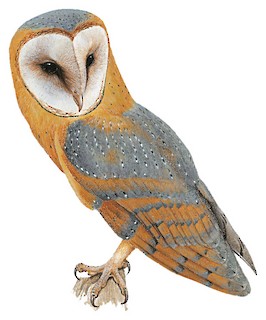
Generally gray, sometimes buff-washed, above, buff (male) to rufous-buff (female) and usually is more coarsely and more abundantly spotted below (38).
Tyto alba guttata (Brehm, 1831)
Definitions
- TYTO
- alba
- guttata
The Key to Scientific Names
Legend Overview
Tyto alba ernesti Scientific name definitions
Systematics History
Strix ernesti O. Kleinschmidt, 1901, Ornithologische Monatsberichte 9:168.—Loceri, Sardinia.
The holotype, a male collected on 17 April 1901 by Otto Kleinschmidt (1870–1954), is held at the Leibniz Institute for the Analysis of Biodiversity Change, Museum Koenig, Bonn (ZFMK Coll. Kl. 6945) (36, 37).
Distribution
Field Identification
The subspecies ernesti is characterized as being paler above and purer white-breasted than nominate alba; a few females are tinged buff below, and may show a few very small spots below (38). The primaries and tail are very much paler and only faintly barred brown, with the tail being virtually pure white in many individuals (38). Averages slightly larger than nominate alba and guttata (38).
Tyto alba ernesti (Kleinschmidt, 1901)
Definitions
- TYTO
- alba
- ernesti
The Key to Scientific Names
Legend Overview
Tyto alba erlangeri Scientific name definitions
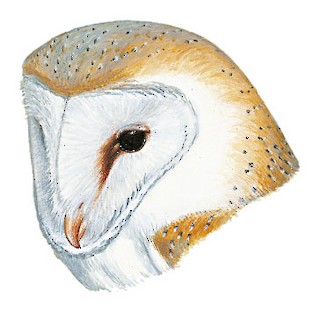
Systematics History
Tyto alba erlangeri W. L. Sclater, 1921, Bulletin of the British Ornithologists’ CIub 42:24.—Lahej, near Aden, Yemen.
The holotype, an adult female collected on 24 August 1899 by W. Dodson (d. 1900) during the British Museum Percival-Dodson Expedition, is held in the Natural History Museum, Tring (NHMUK 1900.8.5.44) (40).
Synonym:
Tyto alba microsticta Koelz, 1950, American Museum Novitates 1452:3.—Jahrum, Fars, Iran. The holotype, a male collected on 25 March 1940 by Walter Norman Koelz (1895–1989), is held in the American Museum of Natural History, New York (AMNH 803060) (34).
Distribution
Crete and smaller southern Greek islands, Cyprus, and patchily from Syria east to southwest Iran and south to northeast Egypt (Sinai) and southern Arabian Peninsula.
Field Identification
Like T. a. ernesti, subspecies erlangeri is also white-breasted, but has the upperparts more golden, less gray, with the ochraceous plumage tracts paler and more extensive, and the gray-mottled areas reduced and having smaller and narrower white and brown spots (38). The underparts are only weakly spotted or entirely unmarked, but is nevertheless on average slightly more spotted than ernesti; its primaries and tail are darker, and more darkly and broadly barred brown (38). T. a. erlangeri further differs from ernesti, as well as from nominate alba, by having the tarsus less heavily feathered (38).
Tyto alba erlangeri Sclater, 1921
Definitions
- TYTO
- alba
- erlangeri / erlangerii
The Key to Scientific Names
Legend Overview
Western Barn Owl (Madeiran) Tyto alba schmitzi Scientific name definitions
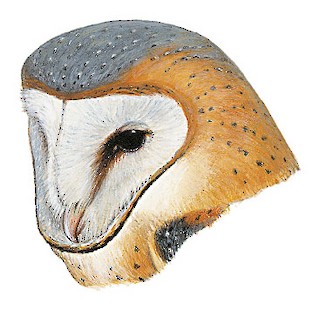
Systematics History
Strix flammea schmitzi E. Hartert, 1900, Novitates Zoologicae 7:534.—Funchal, Madeira.
The holotype, a male collected on 16 April 1898 by Padre Ernst Johann Schmitz (1845‒1922), is held in the American Museum of Natural History, New York (AMNH 629195) (34).
Distribution
Field Identification
A buff-breasted subspecies, similar to gracilirostris in general coloration, but on average paler below, with the spots on the upperparts and underparts averaging somewhat coarser (38).
Tyto alba schmitzi (Hartert, 1900)
Definitions
- TYTO
- alba
- schmitzi
The Key to Scientific Names
Legend Overview
Western Barn Owl (Canary Is.) Tyto alba gracilirostris Scientific name definitions
Systematics History
Strix flammea gracilirostris E. Hartert, 1905, Bulletin of the British Ornithologists’ Club 16:31.—Fuerteventura, Canary Islands.
The holotype, a male collected on 28 May 1904 by Capt. Johann Polatzek (1838 or 1839‒1927), is held in the American Museum of Natural History, New York (AMNH 629207) (34).
Distribution
Eastern Canary Islands (Fuerteventura, Lanzarote, Lobos, Montaña Clara, Alegranza).
Field Identification
A buff-breasted subspecies; overall paler than detorta, with a slenderer bill and overall smaller size than other Palearctic subspecies (38).
Tyto alba gracilirostris (Hartert, 1905)
Definitions
- TYTO
- alba
- gracilirostris
The Key to Scientific Names
Legend Overview
Western Barn Owl (African) Tyto alba poensis Scientific name definitions
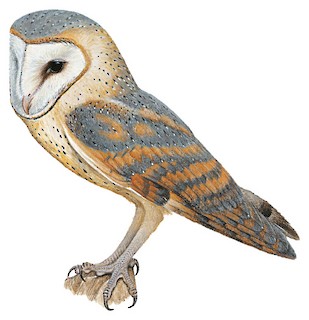
Systematics History
Strix poensis Fraser, 1843, Proceedings of the Zoological Society of London 1842:189.—Fernando Po [= Bioko].
The holotype, collected at the settlement of Clarence around 1841 or 1842 apparently by Louis Fraser (1819–ca. 1883), might be expected to be held in one of the University Museum of Zoology, Cambridge, UK (UMZC), World Museum, Liverpool (WML) or the Natural History Museum, Tring (NHMUK), but it was not identified during surveys of these institutions’ respective type material (40, 41, 42, 43). However, Moore and Jobling (44) reported that specimens collected by Fraser also exist in museums in Germany and the USA, without being more specific as to which.
Synonyms:
Strix maculata C. L. Brehm, 1855, Der vollständige Vögelsang: Eine gründliche Anleitung alle europaischen Vögel, p. 40.—northeast Africa. The holotype, a female collected at Khartoum, Sudan, on 16 May 1851 by Alfred Edmund Brehm (1829–1884), is held at the American Museum of Natural History, New York (AMNH 629262) (34).
Strix affinis Blyth, 1862, Ibis 4:388.—Cape of Good Hope; Cape Town, Cape Province, South Africa, fixed as type locality by Grant and Mackworth-Praed (45:157). Blyth’s holotype was sent to the Indian Museum, Kolkata, from the Government Museum, Cape Town, via E. L. Layard, but Grant and Mackworth-Praed (45) reported that their enquiries had revealed the specimen was no longer extant by the late 1930s. Considered to be grayer above than nominate, with more and coarser spotting below.
Tyto alba hypermetra Grote, 1928, Ornithologische Monatsberichte 36:79.—central Madagascar. The holotype, a female collected by Johann Maria Hildebrandt (1847‒1881) in December 1880, is held at the Museum für Naturkunde, Berlin (ZMB 18527).
Distribution
Africa south from southern edge of Sahara, including Zanzibar and Pemba, and Madagascar and Comoro Islands.
Field Identification
Compared to other subspecies, poensis is darker above, more golden-buff and streaked and speckled black and white, primaries barred and tail buffier.
Tyto alba poensis (Fraser, 1843)
Definitions
- TYTO
- alba
- poense / poensis
The Key to Scientific Names
Legend Overview
Western Barn Owl (Cape Verde) Tyto alba detorta Scientific name definitions
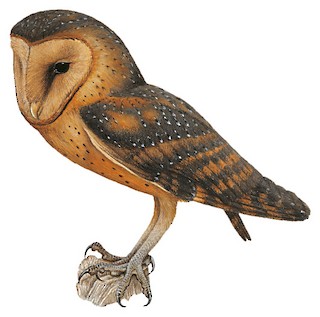
Systematics History
Tyto alba detorta E. Hartert, 1913, Bulletin of the British Ornithologists’ Club 31:38.—Cape Verde Islands.
The holotype, a male collected on Santiago in the Cape Verde Islands on 4 December 1897 by Lieutenant Boyd Alexander (1873–1910), is held in the American Museum of Natural History, New York (AMNH 629305) (34).
Distribution
Cape Verde Islands.
Field Identification
A buff-breasted subspecies, darker than in schmitzi and gracilirostris. Vaurie (38) considered this subspecies to be darker than all others in the Palearctic, with large and prominent spots above and broad dark bars on the primaries and tail.
Tyto alba detorta Hartert, 1913
Definitions
- TYTO
- alba
- detorta
The Key to Scientific Names
Legend Overview
Western Barn Owl (Sao Tome) Tyto alba thomensis Scientific name definitions
Systematics History
Strix thomensis Hartlaub, 1852, Revue et Magasin de Zoologie pure et appliquée (2)4:3.—São Tomé.
The holotype, an adult male collected by Carl Weiss (dates unknown), a German medical surgeon who collected on São Tomé between 1847 and 1849 (46), is held at at the Leibniz Institute for the Analysis of Biodiversity Change, Museum der Natur Hamburg (ZMH 216) (47).
Sometimes suggested to represent a species apart from the other taxa comprising Western Barn Owl, most recently by Mikkola (28), Uva et al. (31), and Alves (48).
Distribution
São Tomé Island; reports from Príncipe Island are erroneous (49).
Field Identification
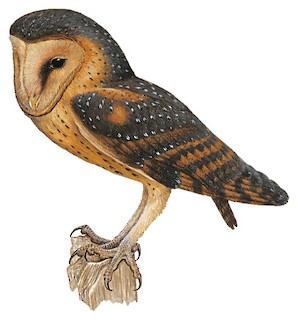
Subspecies thomensis is smaller, much darker, dark gray above with conspicuous small black and white spots, and golden-brown below.
Tyto alba thomensis (Hartlaub, 1852)
Definitions
- TYTO
- alba
- thome / thomensis
The Key to Scientific Names
Legend Overview
- Year-round
- Migration
- Breeding
- Non-Breeding
Map last updated 07 October 2024.