Skip to content
Create account or Sign in
The Stripe Docs logo
/
Ask AI
Create accountSign in
Get started
Payments
Revenue
Platforms and marketplaces
Money management
Developer resources
APIs & SDKsHelp
Overview
Versioning
Changelog
Upgrade your API version
Upgrade your SDK version
Essentials
SDKs
API
Testing
Stripe CLI
Sample projects
Tools
Stripe Dashboard
Workbench
Developers Dashboard
Stripe for Visual Studio Code
Terraform
Stripe Discord server
Features
Workflows
Batch jobs
Event destinations
Stripe health alertsStripe SignalsFile uploads
AI solutions
Agent toolkit
Model Context ProtocolBuild agentic AI SaaS Billing workflows
Security and privacy
Security
Activity logsStripebot web crawler
Privacy
Extend Stripe
Overview
Build Stripe apps
Use apps from Stripe
Build extensions
Custom objects
Partners
Partner ecosystem
Partner certification
United States
English (United States)
  1. Home/
  2. Developer resources

Extend and customize Stripe

Use apps and custom logic to extend Stripe products.

Make Stripe work the way your business does

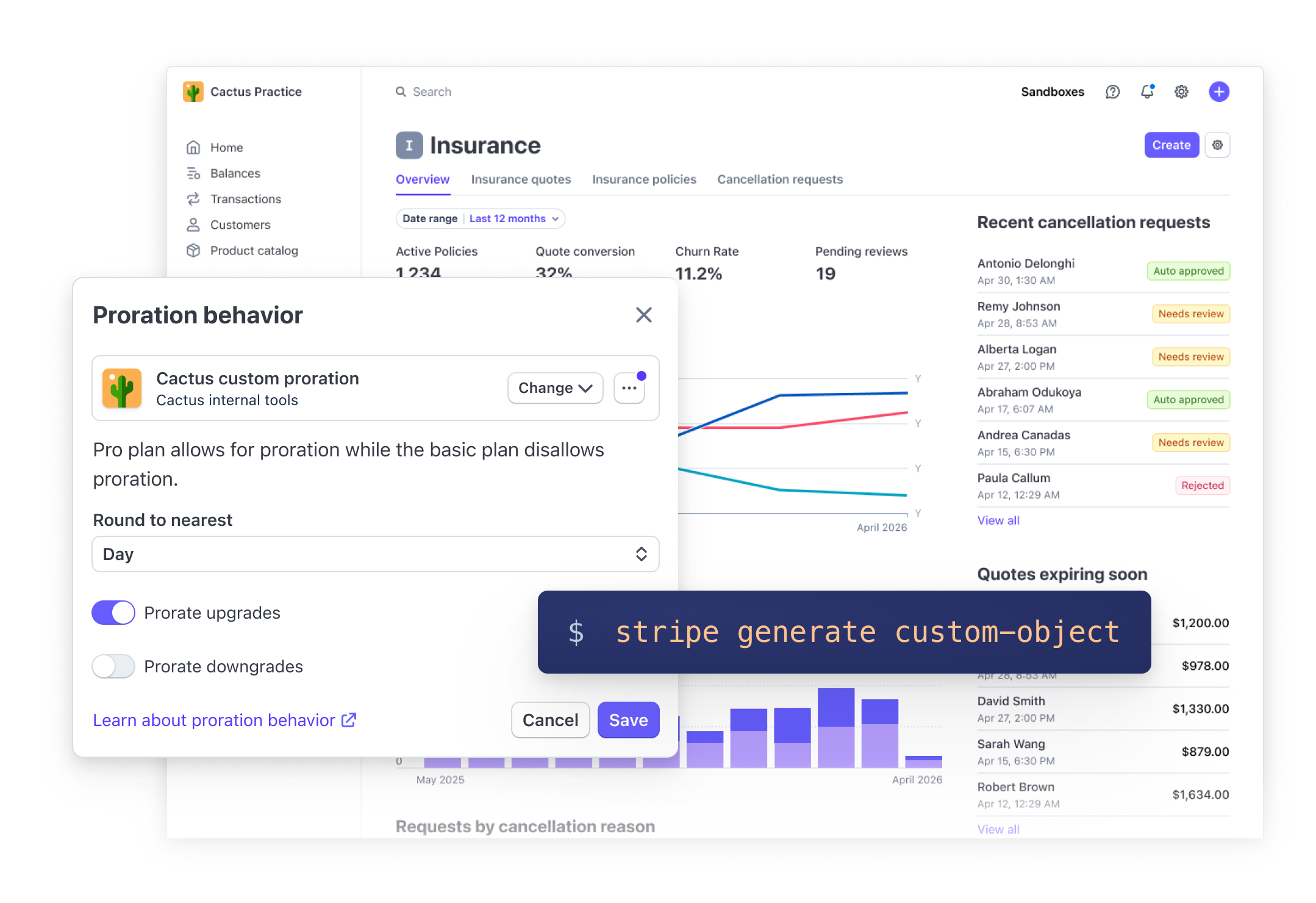
Extensibility makes Stripe work the way your business does, accounting for its unique rules, workflows, and data. With extensibility, you can replace default product behavior with your own logic, connect Stripe to the rest of your systems, and customize product behavior on top of the platform. You package and distribute your customizations as Stripe Apps.

Get started
Sign up for early access to extend Stripe

Enter your email to request access.

What you can extend

Billing

Override how Stripe calculates prorations, applies customer balances, and routes billing items. Replace default billing behavior with your business logic.

Private preview
Workflows

Create custom actions that connect Stripe events to any external system. Trigger emails in your marketing platform, update records in your CRM, or call any API when something happens in Stripe.

Private preview
Dashboard

Build React components that render in Stripe Dashboard pages. Display data from your own systems, add new functionality, and give your team the context they need without switching tools.

Your data model

Define structured business objects, such as policies, contracts, or fulfillment records, and store them alongside your Stripe resources. Attach methods that encode your domain rules and expose them through the API and Dashboard.

Private preview

For the full list of available extension points, see available extension points. For the full list of places where you can plug in custom UI, see available viewports.

How you can extend

Scripts

Write TypeScript that runs on the Stripe managed runtime. No infrastructure to manage, and you deploy through the Stripe CLI. Use scripts for billing customizations and workflow actions that call external APIs.

Private preview
Remote functions

Host HTTP endpoints on your own infrastructure. Stripe calls them when an extension point is reached. Use any language, connect to your own systems, and manage your own auth and deployment.

Private preview
UI extensions

Write React components that appear inside the Stripe Dashboard. Display custom UI, pull in data from external services, and extend Dashboard pages for your team or customers.

Custom objects

Define data models with JSON Schema, create records through the API or Dashboard, and attach methods that encode business logic. Runs on Stripe’s infrastructure.

Private preview

To understand how these building blocks fit together, see how extensions work.

Was this page helpful?
YesNo
  • Need help? Contact Support.
  • Chat with Stripe developers on Discord.
  • Check out our changelog.
  • Questions? Contact Sales.
  • LLM? Read llms.txt.
  • Powered by Markdoc